
Life, 1911-11-16 · page 12 of 44
Life — November 16, 1911 — page 12: what you’re looking at
What you’re looking at
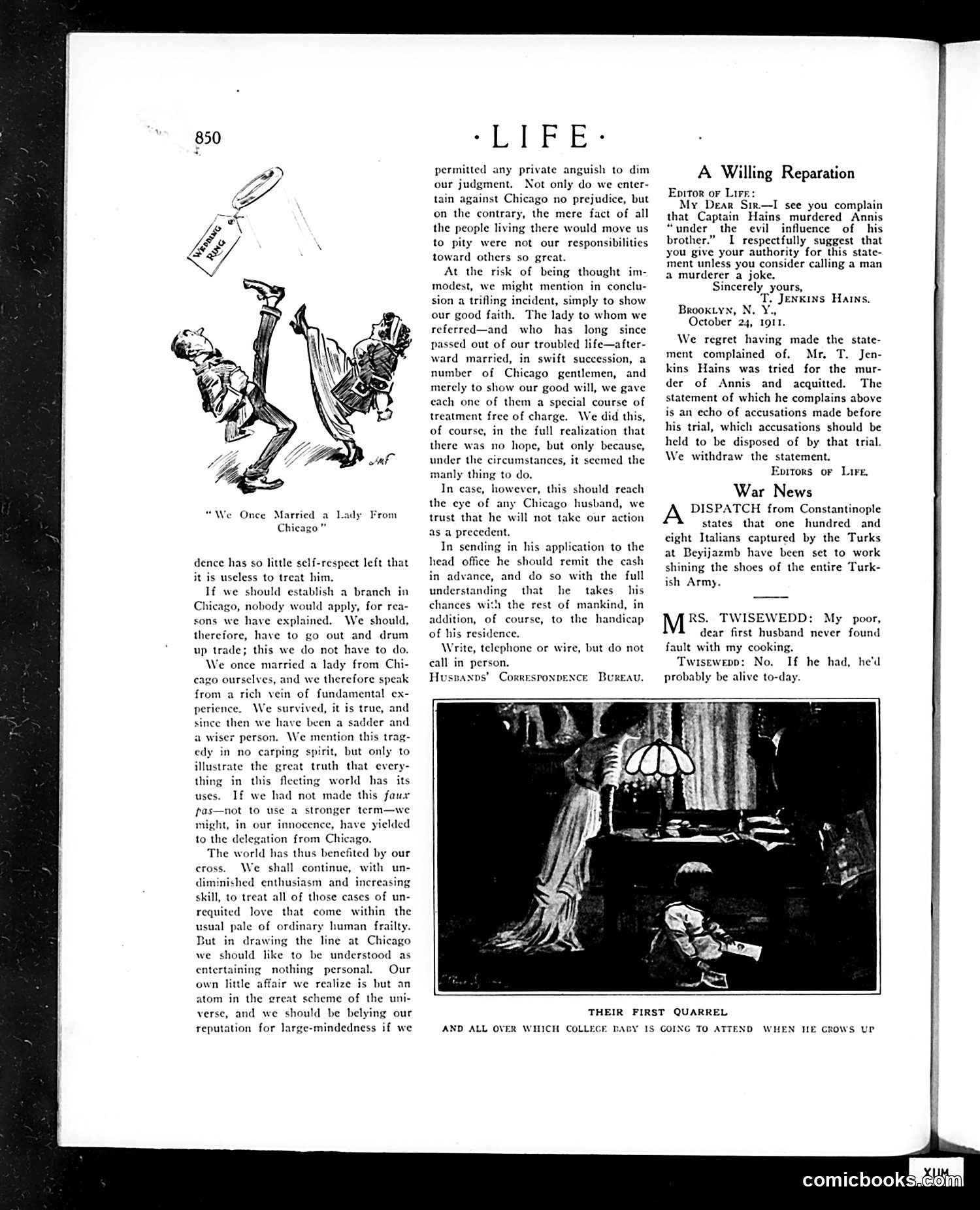
The cartoon titled "We Once Married a Lady From Chicago" depicts a man being violently attacked or thrown by what appears to be a woman wielding a large club or bat. The accompanying text discusses a marital dispute involving Captain Hains, who was accused of murdering a man under the "evil influence" of his brother. The piece includes a retraction/apology acknowledging they made false statements about Hains during his trial. The satire appears to mock marital conflict—specifically using the Hains case as reference point. It suggests that marrying a Chicago woman leads to literal violence, playing on contemporary anxieties about women's aggression and marital discord. The cartoon trivializes serious legal proceedings through comedic exaggeration of domestic conflict.
📄 Transcribed text from this page (OCR, searchable)
Machine-transcribed from the original scan — historical spelling and the odd misread are preserved.
so little self-respect left that it is useless to treat him. If we should establish a branch in Chicago, nobody would apply, for rea- sons we have explained. We should, therefore, have to go out and drum up trade; this we do not have to do. We once married a lady from Chi- cago ourselves, and we therefore speak from ich vein of fundamental ex- perience. We survived, it is true, and since then we have been a sadder and a wiser person. We mention this trag- edy in no carping spirit, but only to illustrate the great truth that every- thing in this fleeting world has its uses. If we had not made this faux fas—not to use a stronger term—we might, in our innocence, have yielded to the delegation from Chicago. The world has thus benefited by our cross. We shall continue, with un- diminished enthusiasm and increasing skill, to treat all of those cases of un- requited love that come within the usual pale of ordinary human frail But in drawing the line at Chi we should like to be understood as entertaining nothing personal. Our own little affair we realize is but an atom in the great scheme of the uni- verse, and we should be belyi reputation for la dence ha ‘LIF E* permitted any private anguish to dim our judgment. Not only do we enter- tain against Chicago no prejudice, but on the contrary, the mere fact of all the people living there would move us to pity were not our responsibilities toward others so great. At the risk of being thought im- modest, we might mention in conclu- sion a trifling incident, simply to show our good faith. The lady to whom we referred—and who has long since passed out of our troubled life—after- ward married, in swift succession, a number of Chicago gentlemen, and merely to show our good will, we gave cach one of them a special course of treatment free of charge. We did this, of course, in the full realization that there was no hope, but only because, under the circumstances, it seemed the manly thing to do. In case, however, this should reach the eye of any Chicago husband, we trust that he will not take our action as a precedent. In sending in his application to the head office he should remit the cash in advance, and do so with the full understanding that he takes his chances with the rest of mankind, in addition, of course, to the handicap of his residence. Write, telephone or wire, but do not call in person. Huspay Corresron: Bureau. ps’ ENCE A Willing Reparation Epitor or Lire: My Dear Sin—I see you complain that Captain Hains murdered Annis “under the evil influence of his brother.” I respectfully suggest that you give your authority for this state- ment unless you consider calling a man a murderer a joke. . ins Hans. Brooktyx, N. Y., October 24, 1911. We regret having made the state- ment complained of. Mr. T. Jen- kins Hains was tried for the mur- der of Annis and acquitted. The statement of which he complains above is an echo of accusations made before his trial, which accusations should be held to be disposed of by that trial. We withdraw the s DISPATCH from Constantinople states that one hundred and eight Italians captured by the Turks at Beyijazmb have been set to work shining the shoes of the entire Turk- ish Army. M* TWISEWEDD: My poor, dear first husband never found fault with my cooking. Twisewepp: No. If he had, he'd probably be alive to-day. THEIR FI AND ALL OVER WHICH COLLEGE RST QUARREL 1S GOING TO ATTEND WHEN HE GROWS UP comicbookMee 5