
Life, 1911-11-16 · page 21 of 44
Life — November 16, 1911 — page 21: what you’re looking at
What you’re looking at
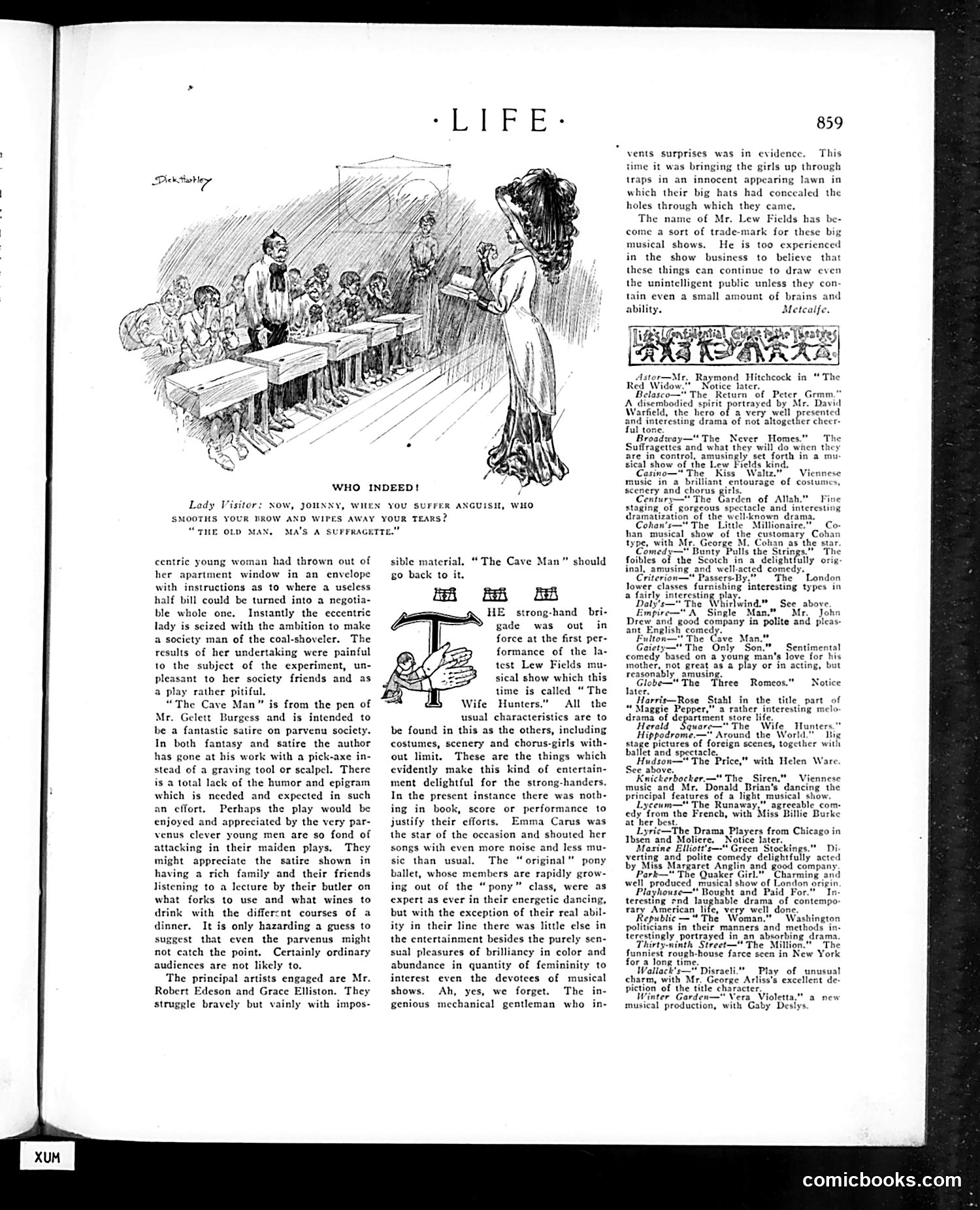
This single-panel cartoon satirizes Victorian gender roles and parenting. A society lady visitor asks a young boy ("Johnny"), "When you suffer anguish, who smooths your brow and wipes away your tears?" The boy replies, "The old man" — meaning the working-class male servant or janitor, not his mother. The joke targets sentimental assumptions about motherhood and feminine nurturing. It suggests that in upper-class households, even children recognize that practical male workers provide actual comfort, while society ladies perform only superficial maternal duties. The accompanying text indicates this relates to a play called "The Cave Man" about satirizing nouveau-riche society through exaggerated social pretense. The humor relies on class commentary: the contradiction between idealized motherhood and the reality of privilege where servants do the actual caretaking.
📄 Transcribed text from this page (OCR, searchable)
Machine-transcribed from the original scan — historical spelling and the odd misread are preserved.
WHO INDEED! Lady Visitor: Now, JONNY, WHEN You SUFFER ANGUISH, WHO SMOOTHS YOUR DROW AND WIPES AWAY YOUR TEARS? “THE OLD MAN. centric young woman had thrown out of her apartment window in an envelope with instructions as to where a useless half bill could be turned into a negotia- ble whole one, Instantly the eccentric lady is seized with the ambition to make a society man of the coal-shoveler. The results of her undertaking were painful to the subject of the experiment, un- pleasant to her society friends and as a play rather pitiful “The Cave Man” is from the pen of Mr. Gelett Burgess and is intended to be a fantastic satire on parvenu society. In both fantasy and satire the author has gone at his work with a pick-axe in- stead of a graving tool or scalpel. There is a total lack of the humor and epigram which is needed and expected in such an effort. Perhaps the play would be enjoyed and appreciated by the very par- venus clever young men are so fond of attacking in their maiden plays, They might appreciate the satire shown in having a rich family and their friends listening to a lecture by their butler on what forks to use and what wincs to drink with the differcnt courses of a dinner. It is only hazarding a guess to suggest that even the parvenus might not catch the point. Certainly ordinary audiences are not likely to. ‘The principal artists engaged are Mr. Robert Edeson and Grace Elliston. They struggle bravely but vainly with impos- MA'S A SUPFRAGETTE.” sible material. “The Cave Man” should g0 back to it, ai ai A HE strong-hand_ bri- gade was out in force at the first per- formance of the la- test Lew Fields mu- sical show which this time is called “ The Wife Hunters.’ All the usual characteristics are to be found in this as the others, including costumes, scenery and chorus-girls with- out limit. These are the things which evidently make this kind of entertain- ment delightful for the strong-handers. In the present instance there was noth- ing in book, score or performance to justify their efforts. Emma Carus was the star of the occasion and shouted her songs with even more noise and less mu- sic than usual, The “original” pony ballet, whose members are rapidly grow- ing out of the “pony” class, were as expert as ever in their energetic dancing, but with the exception of their real abil- ity in their line there was little else in the entertainment besides the purely sen- sual pleasures of brilliancy in color and abundance in quantity of femininity to interest even the devotees of musical shows. Ah, yes, we forget. The in- genious mechanical gentleman who in- 859 vents surprises was in evidence. This time it was bringing the girls up through traps in an innocent appearing lawn in which their big hats had concealed the holes through which they came, The name of Mr. Lew Fields has be- come a sort of trade-mark for these big musical shows. He is too experienced in the show business to believe that these things can continue to draw even the unintelligent public unless they con tain even a small amount of brains and ability. Metcalfe. ORE Raymond Hitchcock in “ The Notice later. The Return of Peter Gr A disembodied spirit portrayed by Mr. Warfield, the hero of a very well presented and interesting drama of not altogether cheer- ful tone. Broadway—" The Never Homes.” Suffragettes and what they will do when t are in control, amusingly set forth in a mu sical show of the Lew Fields ki Casino—" The Kiss Waltz, sie in a brilliant entourage of costumes, scenery and chorus girls. Century—" The Garden of All Fine staging, of gorgeous spectacle and interesting dramatization of the well-known drama. Cohan's—" The Little Millionaire.” Co- han musical show of the customary Cohan type, with Mr. George M. Cohan as the star amedy—" Bunty Pulls the Strings." ‘The foibles of the Scotch in a delightfully orig inal, amusing and well-acted comedy, Criterion—" Passers-By,” ‘The London lower classes furnishing interesting types in a fairly interesting play. Daly's—" The Whirlwind.” | See above. Empire—" A” Single Man.” Mr. John Drew. and good company in polite and pleas- ant English comedy. Fulton—" The Cave Ma Geiety—" The Only Soi Sentimental comedy based on a young man's love for his mother, not great as a play or in acting, but reasonably amusing. Globe—" The Three later. . Harris—Rose Stahl in the title part “ Maggie Pepper,” a rather interesting mel drama of department store lif Herald Square—" The Wife ters Hippodrome.—" Around the Wo: Lig stage pictures of foreign scenes, together with ballet and spectacle. Hudson—" The Price,” with Helen Ware. See above, . Knickerbocker.—" The Siren." Viennese music and Mr, Donald Brian’s dancing the principal features of a light, musical show, Lyceum—" The Runaway," agreeable com edy from the French, with Miss Billie Burke at her best. Lyric—The Drama Players from Chicago in Ibsen and Moliere. Notice later. Maxine Elliott's—- Green Stockings. verting and polite comedy delightfully acted by Miss Margaret Anglin and good company Park—" The Quaker Girl.” Charming and well produced musical show of London origin Playhouse—" Bought and Paid For." In- teresting snd laughable drama of contempo- rary American life, very well done. Republic —“ The Woman.” Washington politicians in their manners and methods i terestingly portrayed in an absorbing drama Thirty-ninth Street-—“The Million.” ‘The funniest rough-house farce seen in New York for a long time. Wallack's—" Disraeli.” Play of unusual charm, with Mr. George Arliss's excellent de- piction of the title character. Winter Garden—" Vera_ Violeta,” a new musical production, with Gaby Desiys. Romeos.” Notice comicbooks.com