
Life, 1911-11-16 · page 14 of 44
Life — November 16, 1911 — page 14: what you’re looking at
What you’re looking at
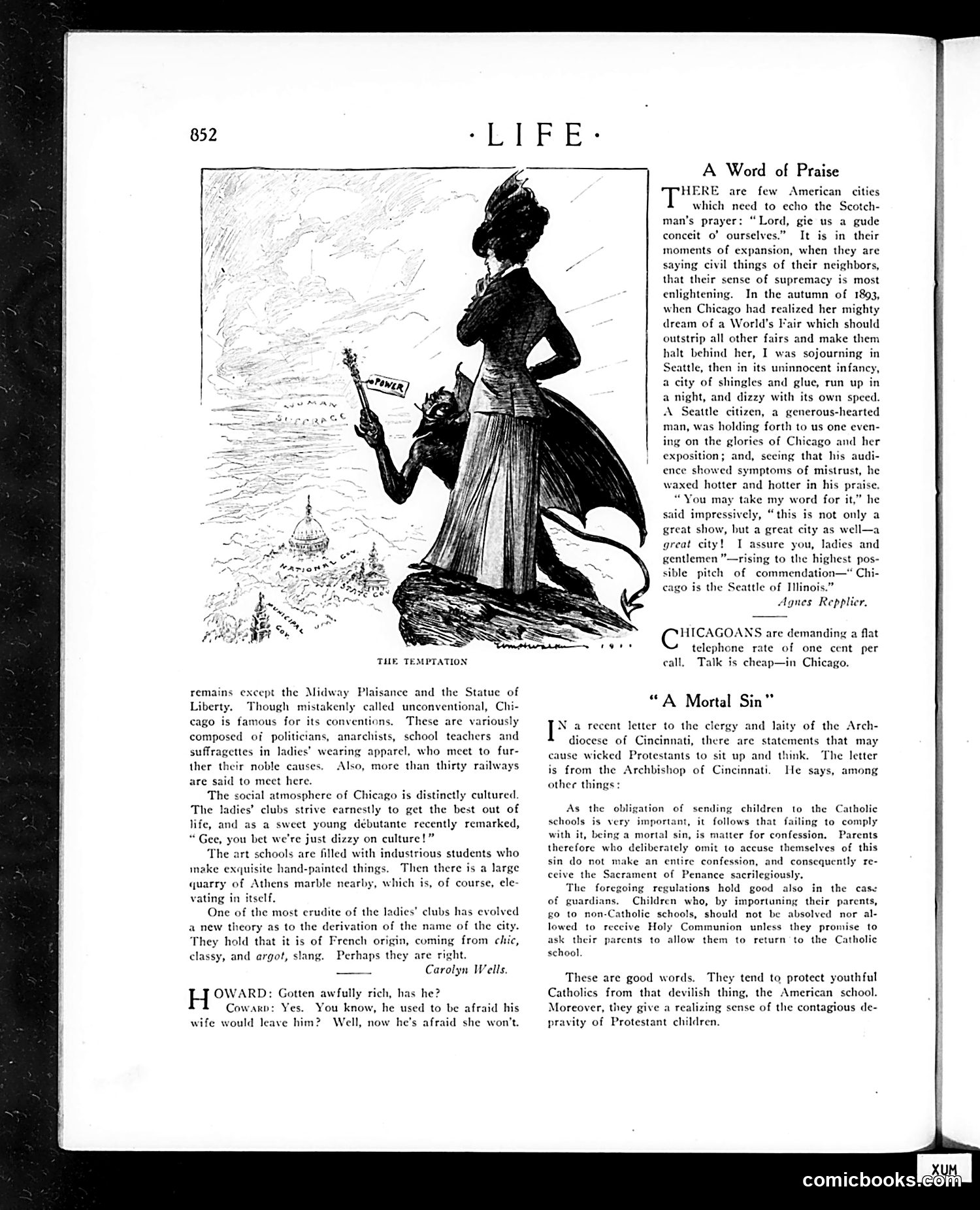
This editorial cartoon satirizes Chicago's boastfulness following its successful 1893 World's Columbian Exposition. The image depicts a wealthy, well-dressed woman (representing Chicago or American cities generally) being tempted by a small figure holding what appears to be a banner labeled "PARIS." The accompanying text critiques American cities' tendency toward self-aggrandizement and competitive superiority claims over neighbors. The "temptation" suggests Chicago is being lured away from its civic achievements by European glamour or rivalry. The cartoon reflects late-19th-century regional American competition, particularly tensions between industrial cities like Chicago and established Eastern centers. It satirizes Midwestern civic pride while questioning whether cities should be so preoccupied with outshining rivals rather than genuine civic development.
📄 Transcribed text from this page (OCR, searchable)
Machine-transcribed from the original scan — historical spelling and the odd misread are preserved.
THE TEMPTATION remains except the Midway Plaisance and the Statue of Liberty. hough mistakenly called unconventional, Chi- cago is famous for its conventions. These are variously composed of politicians, anarchists, school teachers and suffragettes in ladies’ wearing apparel, who meet to fur- ther their noble cau Also, more than thirty railways are said to meet here. The social atmosphere of Chicago is distinctly cultured. The ladies’ clubs strive earnestly to get the best out of life, and as a sweet young débutante recently remarked, “Gee, you bet we're just dizzy on culture!” The art schools are filled with industrious students who inake exquisite hand-painted things. Then there is a large quarry of Athens marble nearby, which is, of course, ele- vating in itself. One of the most erudite of the ladies’ clubs has evolved a new theory as to the derivation of the name of the city. They hold that it is of French origin, coming from chic, classy, and argot, slang. Perhaps they are right. . Carolyn Wells. OWARD: Gotten awfully rich, has he? Cowakrp: Yes. You know, he used to be afraid his wife would leave him? Well, now he’s afraid she won't. A Word of Praise HERE are few American cities which need to echo the Scotch- man’s prayer: “Lord, gie us a gude conceit o’ ourselves.” It is in their moments of expansion, when they are saying civil things of their neighbors, that their sense of supremacy is most enlightening. In the autumn of 1893, when Chicago had realized her mighty dream of a World's Fair which should outstrip all other fairs and make them halt behind her, I was sojourning in Seattle, then in its uninnocent infancy, a city of shingles and glue, run up in a night, and dizzy with its own speed. A Seattle citizen, a generous-hearted man, was holding forth to us one even- ing on the glories of Chicago and her exposition; and, seeing that his audi- ence showed symptoms of mistrust, he waxed hotter and hotter in his praise. “You may take my word for it,” he said impressively, “this is not only a great show, but a great city as well—a great city! T assure you, ladies and gentlemen ”—rising to the highest pos- sible pitch of commendation—“ Chi- cago is the Seattle of Illinois.” Agnes Repplier. HICAGOANS are demanding a flat telephone rate of one cent per call, Talk is cheap—in Chicago. “A Mortal Sin” [* a recent letter to the clergy and laity of the Arch- diocese of Cincinnati, there are statements that may cause wicked Protestants to sit up and think. The letter is from the Archbishop of Cincin He says, among other things: As the obligation of sending children to the Catholic schools is very important, it follows that failing to comply with it, being a mortal sin, is matter for confession, Parents therefore who deliberately omit to accuse themselves of this sin do not make an entire confession, and consequently re- ve the Sacrament of Penance sacrilegiously. The foregoing regulations hold good also in the case of guardians, Children who, by importuning their parents, go to non-Catholic schools, should not be absolved nor al- lowed to receive Holy Communion unless they promise to ask their parents to allow them to return to the Catholic school These are good words. They tend to protect youthful Catholics from that devilish thing, the American school. Moreover, they give a realizing sense of the contagious de- pravity of Protestant children. comicbooks Meee