
Life, 1911-11-16 · page 16 of 44
Life — November 16, 1911 — page 16: what you’re looking at
What you’re looking at
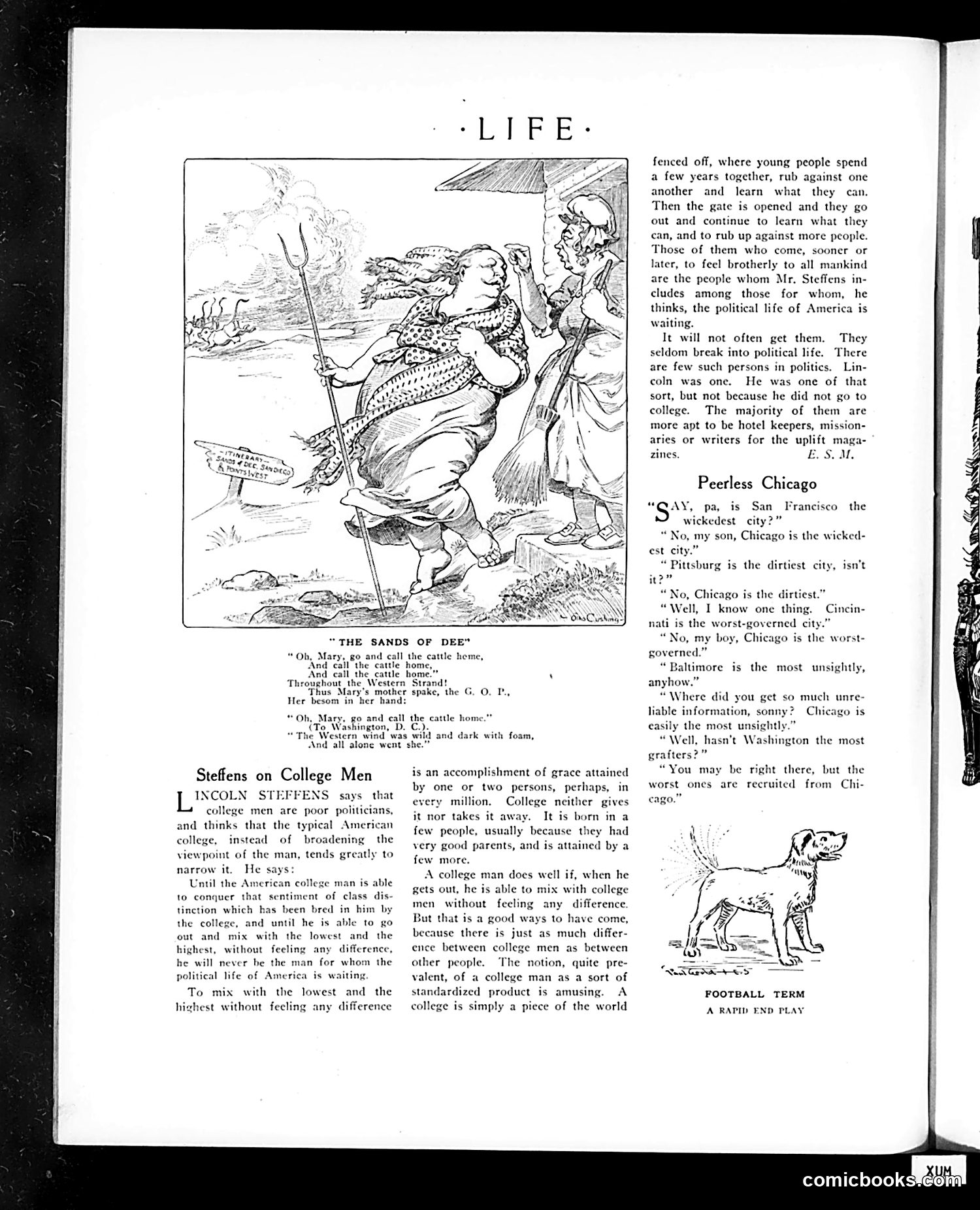
The main cartoon parodies a famous Victorian poem ("The Sands of Dee") to mock Republican Party (G.O.P.) leadership calling back their wayward members to Washington. Mary represents the Republican rank-and-file who have strayed; her "mother" (the G.O.P. leadership) desperately summons them home like cattle. The dark, drowning imagery suggests political peril. The accompanying article by Lincoln Steffens critiques college-educated men as ineffective in American politics, arguing they're disconnected from common people and class-conscious—too narrow to truly lead. The "Peerless Chicago" section is humorous dialogue where a father repeatedly corrects his son that Chicago (not various other cities) holds every negative distinction: wickedest, dirtiest, worst-governed, most unsightly. It satirizes Chicago's notorious corruption and poor governance during the Progressive Era.
📄 Transcribed text from this page (OCR, searchable)
Machine-transcribed from the original scan — historical spelling and the odd misread are preserved.
“THE SANDS OF DEE” “Ob, Mary, go and call the cattle heme, And call the cattle home, And call the cattle home. Throughout the Western Strand! Thus Mary's mother spake, the G. O. P., Her besom in her hand: Ob, Mary, go and call the cattle home.” (To Washington, D. The Western wind ‘was wild and dark with foam, <And all alone went she. Steffens on College Men INCOLN STEFFENS that college men are poor politicians, and thinks that the typical American college, instead of broadening the viewpoint of the man, tends greatly to narrow it. He says: Until the Aw able to conquer that sentiment of class tinction which kas been bred in him by the college, and until he is able to go out and mix with the lowest and the highest, without feeling any difference, ill never be the man for whom the life of America is waiting says To mix with the lowest and the highest without feeling any difference is an accomplishment of grace attained by one or two persons, perhaps, in every million. College neither gives it nor takes it away. It is born in a few people, usually because they had very good parents, and is attained by a few more, A college man does well if, when he gets out, he is able to mix with college men without feeling any difference. But that is a good ys to have come, because there is just as much differ- ence between college men as between other people. The notion, quite pre- valent, of a college man as a sort of standardized product is amusing. A college is simply a piece of the world fenced off, where young people spend a few years together, rub against one another and learn what they can. Then the gate is opened and they go out and continue to learn what they can, and to rub up against more people. Those of them who come, sooner or later, to feel brotherly to all mankind are the people whom Mr. Steffens in- cludes among those for whom, he thinks, the political life of America is waiting. It will not often get them. They seldom break into political life. There are few such persons in politics. Lin- coln was one. ‘as one of that sort, but not because he did not go to college. The majority of them are more apt to be hotel keepers, mission- aries or writers for the uplift maga- zines. E. S. M. Peerless Chicago AY, pa, is San Francisco the wickedest city?” No, my son, Chicago is the wicked- est city. “Pittsburg is the dirtiest city, i it?” “No, Chicago is the dirtiest. “Well, I know one thing. Cincin- nati is the worst-governed city.” Chicago is the worst- Yo, my b governed.” “Baltimore is the most unsightly, anyhow.” “Where did you get so much unre- liable information, sonr Chicago is easily the most unsightly. “Well, hasn't Washington the most grafters?” “You may be right there, but the worst ones are recruited from Chi- FOOTBALL TERM A RAPID END PLAY comicbookMeerd