
A complete issue · 46 pages · 1911
Life — September 14, 1911
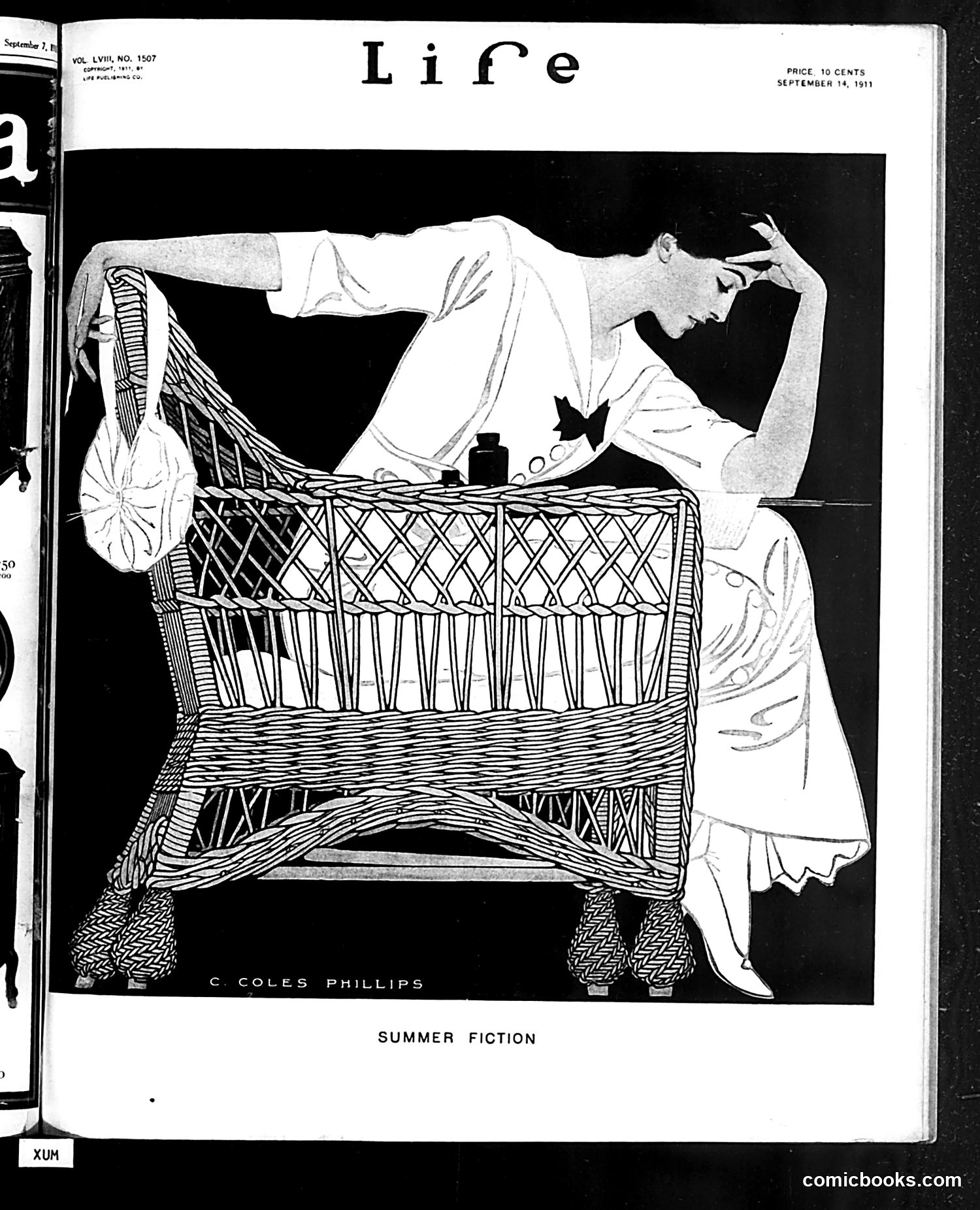
This cover illustration by C. Coles Phillips depicts a woman reclining beside a baby carriage, labeled "Summer Fiction." The satire is straightforward: during summer, popular literature and entertainment become lightweight and trivial—represented by the woman's leisure, relaxation, and inattention (she's reading or daydreaming rather than attending to the baby). The carriage itself, rendered in detailed technical cross-hatching, contrasts with the woman's languid pose, emphasizing the gap between serious domestic responsibility and frivolous summer reading. The joke mocks both the quality of seasonal literature publishers marketed and the assumption that readers—particularly women—wanted escapist entertainment during warm months rather than substantive content.
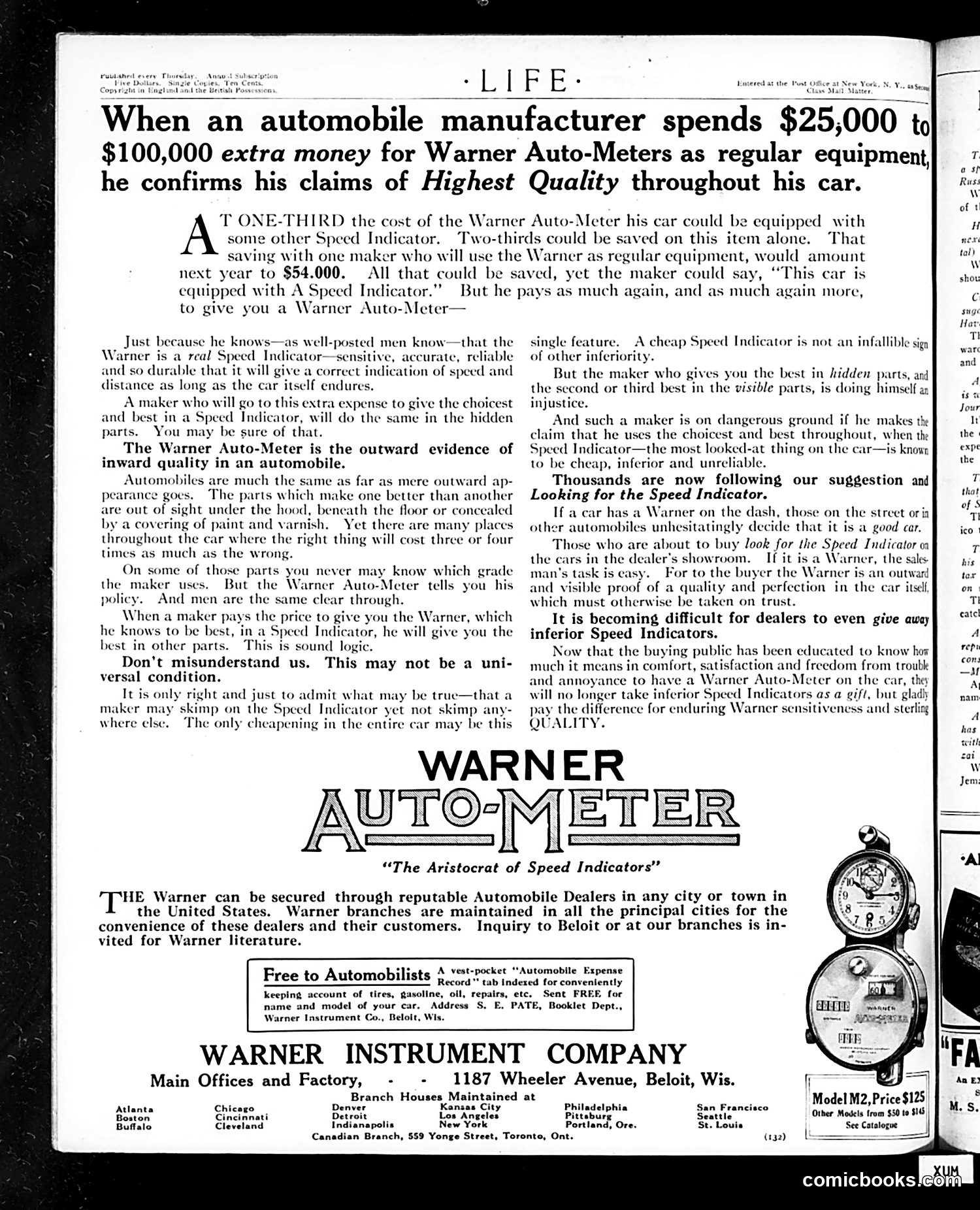
This is primarily a **Warner Auto-Meter advertisement**, not a political cartoon. The page promotes speedometers as markers of automobile quality and manufacturer integrity. The ad's argument: manufacturers who spend extra money on Warner speedometers demonstrate commitment to quality. The text criticizes cheap speed indicators as unreliable, contrasting them with Warner's superior engineering. It appeals to consumer desire for "hidden quality"—excellence in unseen parts reflecting overall craftsmanship. The ad suggests dealers increasingly stock Warner meters because educated buyers now demand them, making inferior alternatives harder to sell. The speedometer becomes visual proof of quality to consumers and dealers alike. The humor is implicit: a mere gauge becomes emblematic of automotive trustworthiness—a sales pitch elevating a functional instrument into a status symbol of manufacturer integrity.
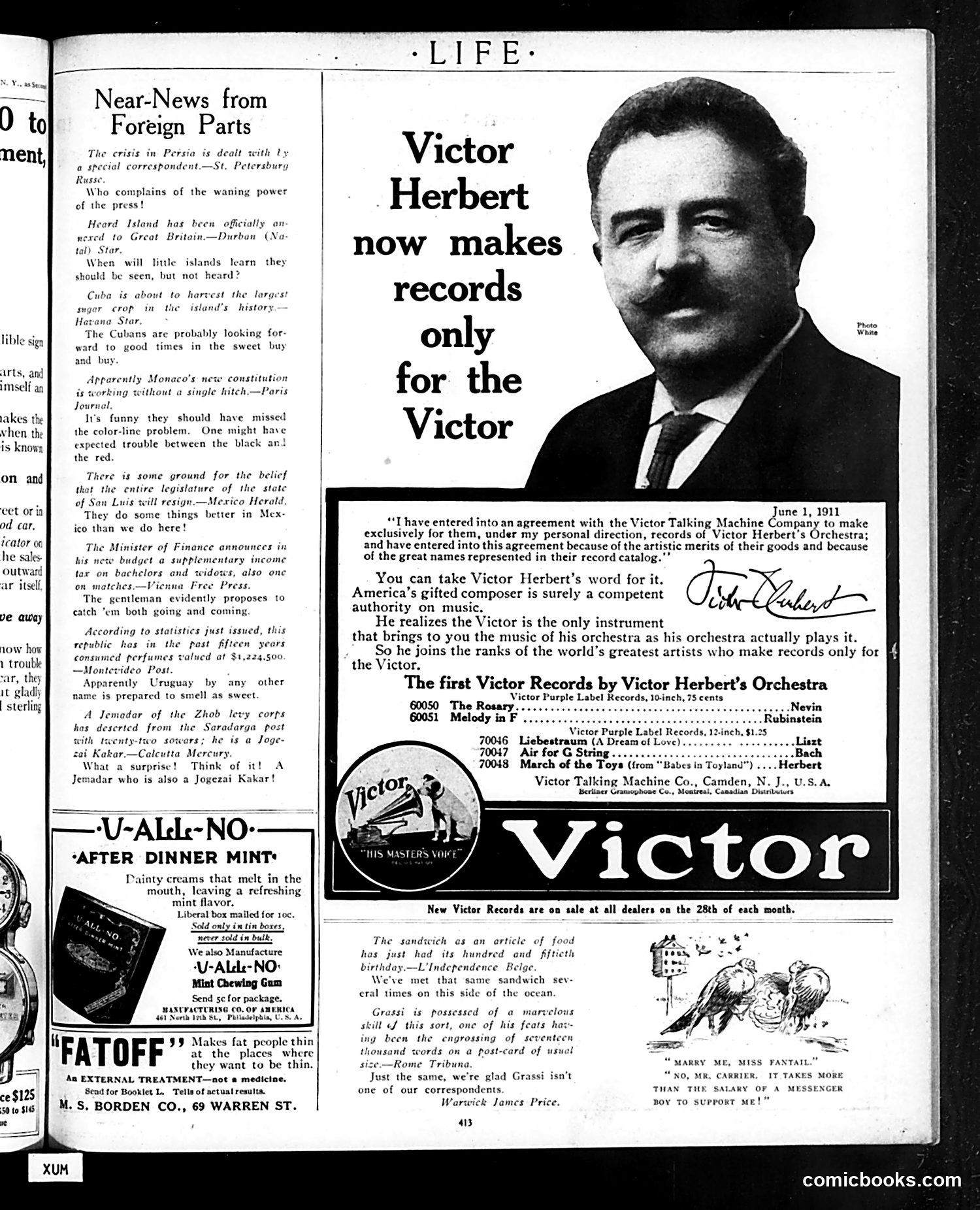
This page is primarily a **Victor Talking Machine advertisement**, not satire. It features composer **Victor Herbert** endorsing the Victor brand phonograph. The announcement (dated June 1, 1911) states Herbert has agreed to record exclusively for Victor, making records "only for the Victor" due to the instrument's superior quality. The text emphasizes Herbert's prestige as "America's gifted composer" and claims Victor is "the only instrument that brings to you the music of his orchestra as his orchestra actually plays it." The ad lists Herbert's first Victor recordings, including classical and popular pieces. This represents early 20th-century celebrity endorsement marketing, leveraging a famous composer's reputation to establish the Victor brand's legitimacy and sound quality.
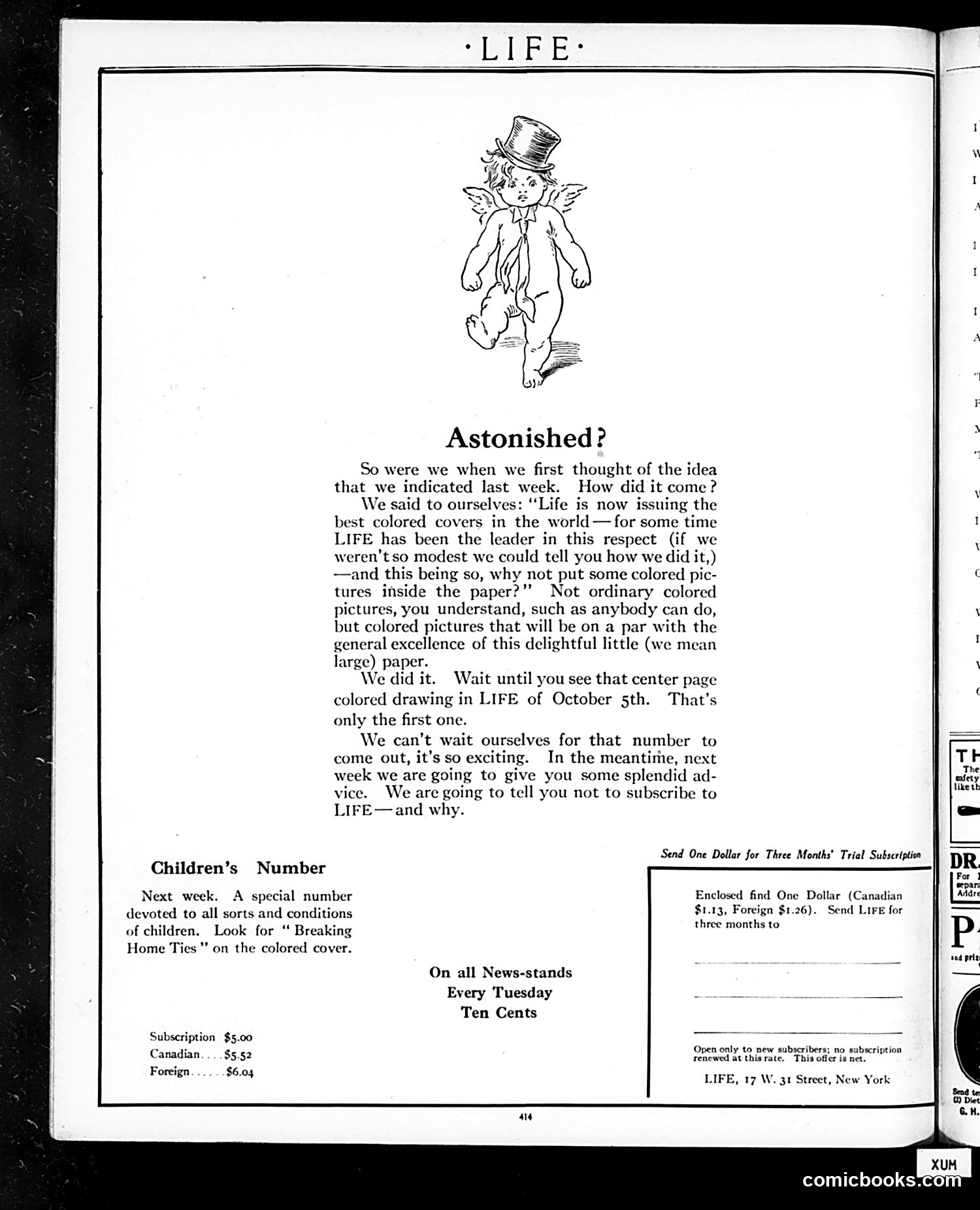
This page is primarily **promotional content**, not political satire. The central illustration shows a cherub or cupid figure wearing a top hat, walking cheerfully. The text announces that *Life* magazine will begin publishing **colored cover illustrations**—a significant innovation for the publication. The editors boast that *Life* has been the leader in color printing quality and are now adding full-color interior drawings, with the first appearing in the October 5th issue. The "astonished" cherub appears designed to convey excitement about this new feature. The page also advertises an upcoming **Children's Number** special issue and promotes subscription rates ($5.00 domestic, $5.52 Canadian, $6.04 foreign). This is essentially a trade announcement celebrating *Life*'s modernization and inviting new subscriptions.
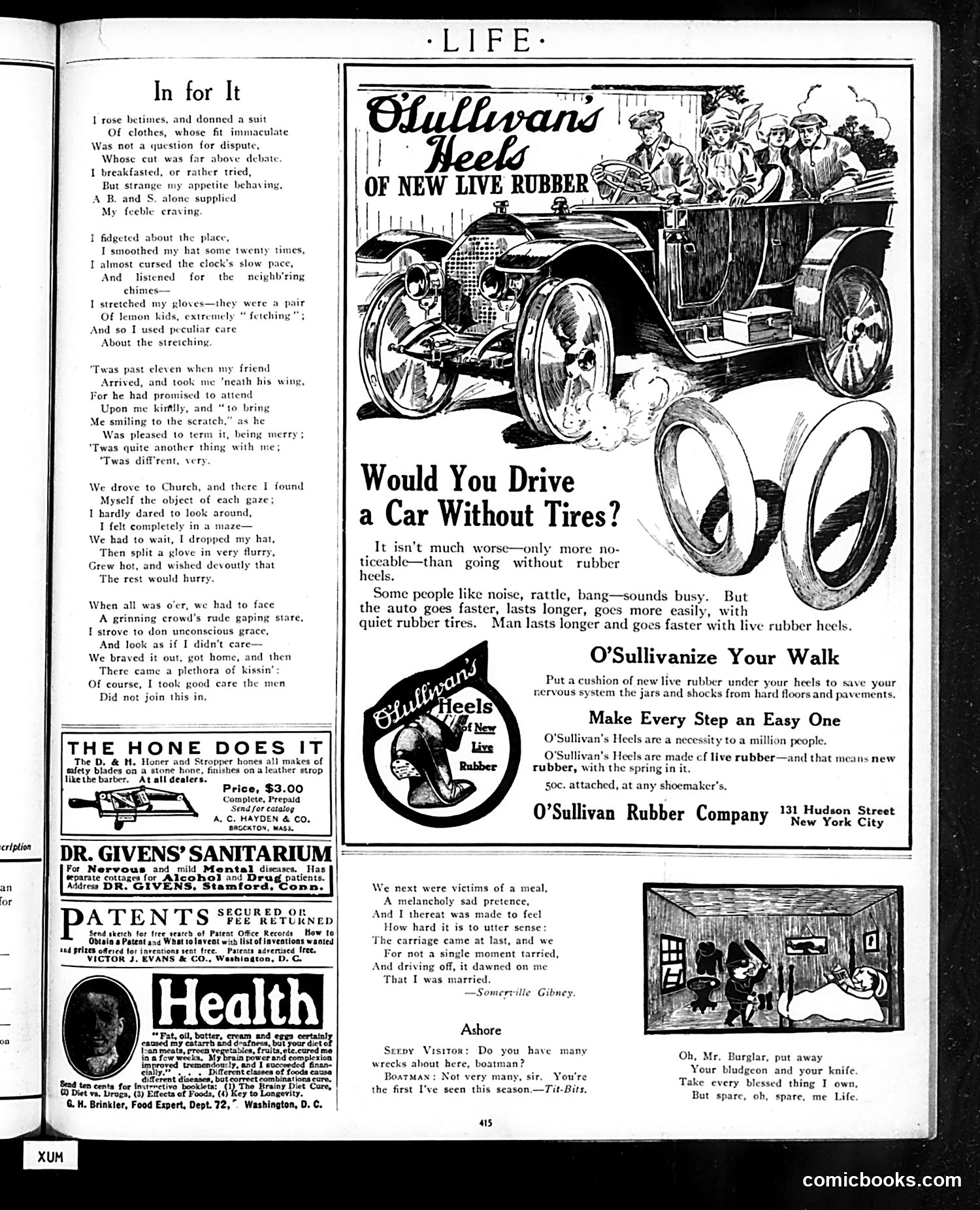
This page is primarily **advertising**, not political satire. The dominant content is O'Sullivan Rubber Company's advertisement for "O'Sullivan Heels"—rubber shoe heels claiming to reduce noise and extend shoe life. The ad uses a humorous comparison: "Would You Drive a Car Without Tires?" suggesting rubber heels are similarly essential. The illustrated scenario shows a noisy, chaotic scene with people and vehicles, implying that shoes without rubber heels would be equally impractical and disruptive. The smaller text advertisements below (Dr. Givens' Sanitarium, Patents, Health) are typical period medical/patent promotions. The left page contains poetry titled "In for It" and "The Hone Does It," unrelated to the advertising. This reflects early 20th-century consumer marketing rather than political commentary.
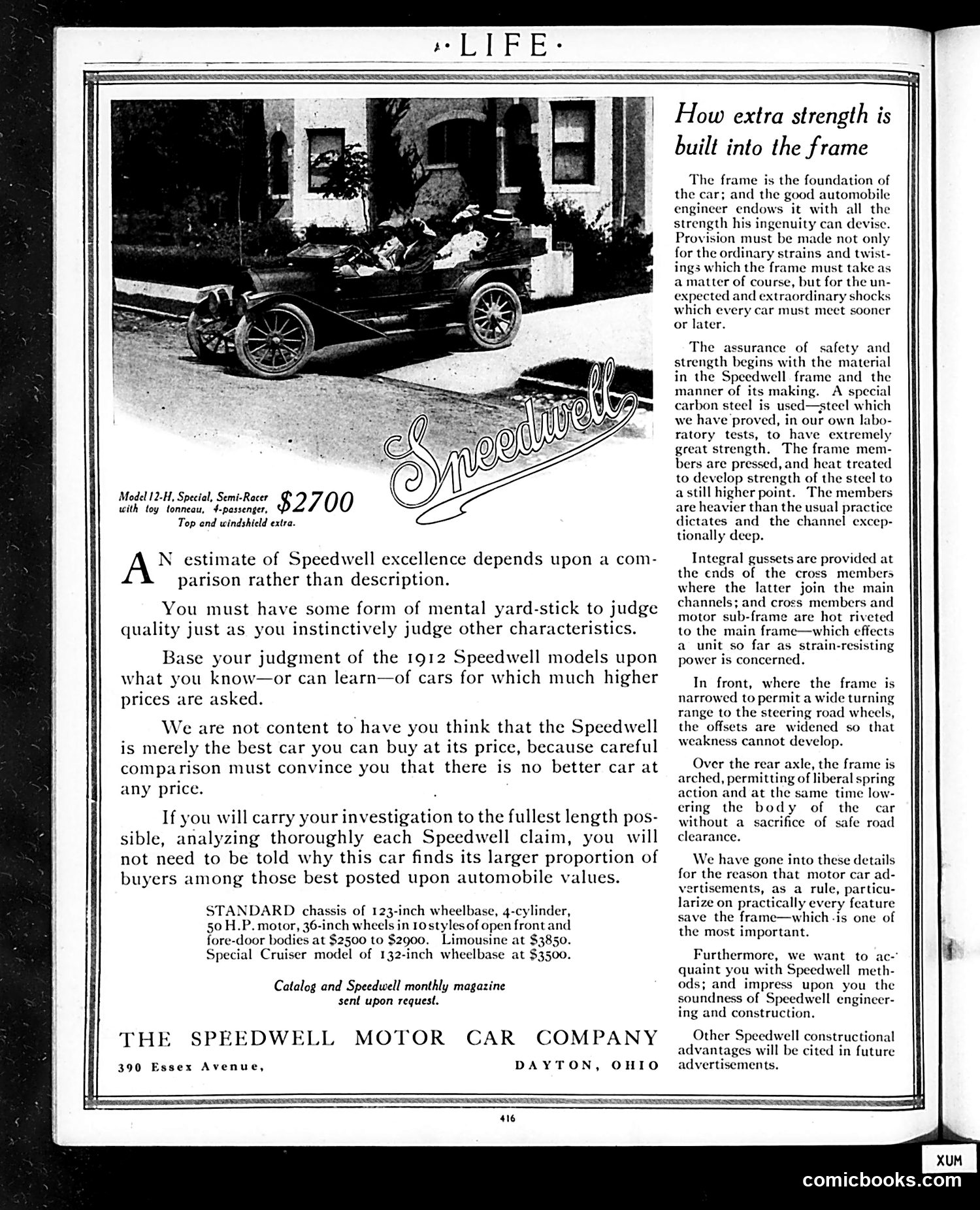
This page is **primarily a Speedwell automobile advertisement**, not satire or political commentary. The ad occupies the majority of the space in *Life* magazine. The image shows a 1912 Speedwell automobile parked in front of a house. The advertisement emphasizes the car's frame construction and structural integrity, arguing that buyers should judge automobile quality by comparing features across models and price points, not merely accepting the manufacturer's claims. The text details technical specifications (123-inch wheelbase, 4-cylinder, 50 H.P. motor) and pricing ($2,700 for the Model 12-H Special Semi-Racer). **There is no cartoon or satire present.** This is straightforward automotive marketing from the early automotive era, when manufacturers needed to educate consumers about mechanical quality differences.
This is **not a cartoon or satirical piece** — it's a straightforward automobile advertisement for the Speedwell Motor Car Company of Dayton, Ohio, published in Life magazine. The page features a photograph of a 1912 Speedwell Model 12-H automobile (priced at $2,700) and lengthy promotional text about frame construction and engineering quality. The advertisement emphasizes the car's superior frame strength, safety features, and construction methods as selling points. The copy appeals to potential buyers to compare Speedwell favorably against competitors by examining technical specifications and build quality — a standard sales pitch for early automobile advertising, not satire or political commentary.
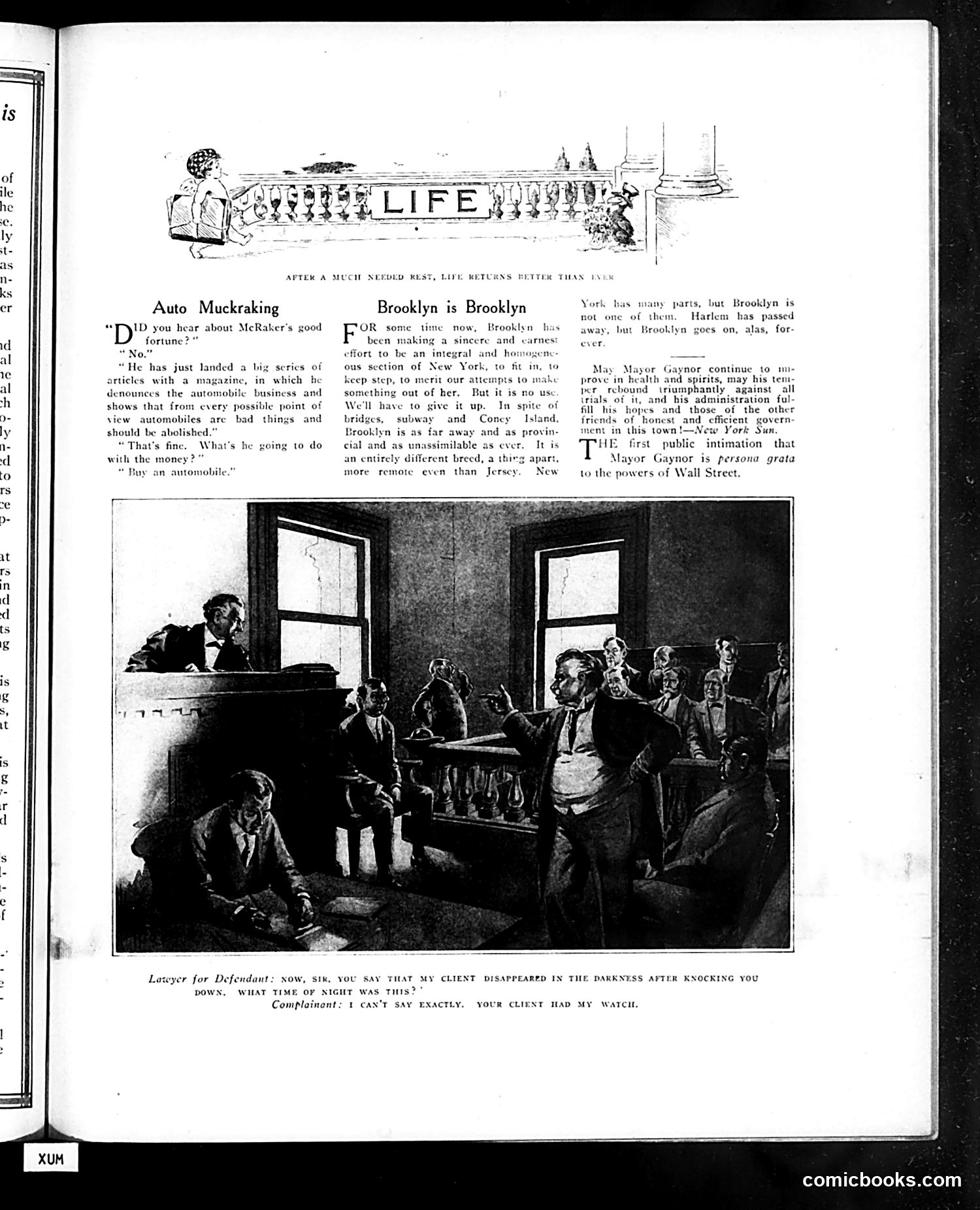
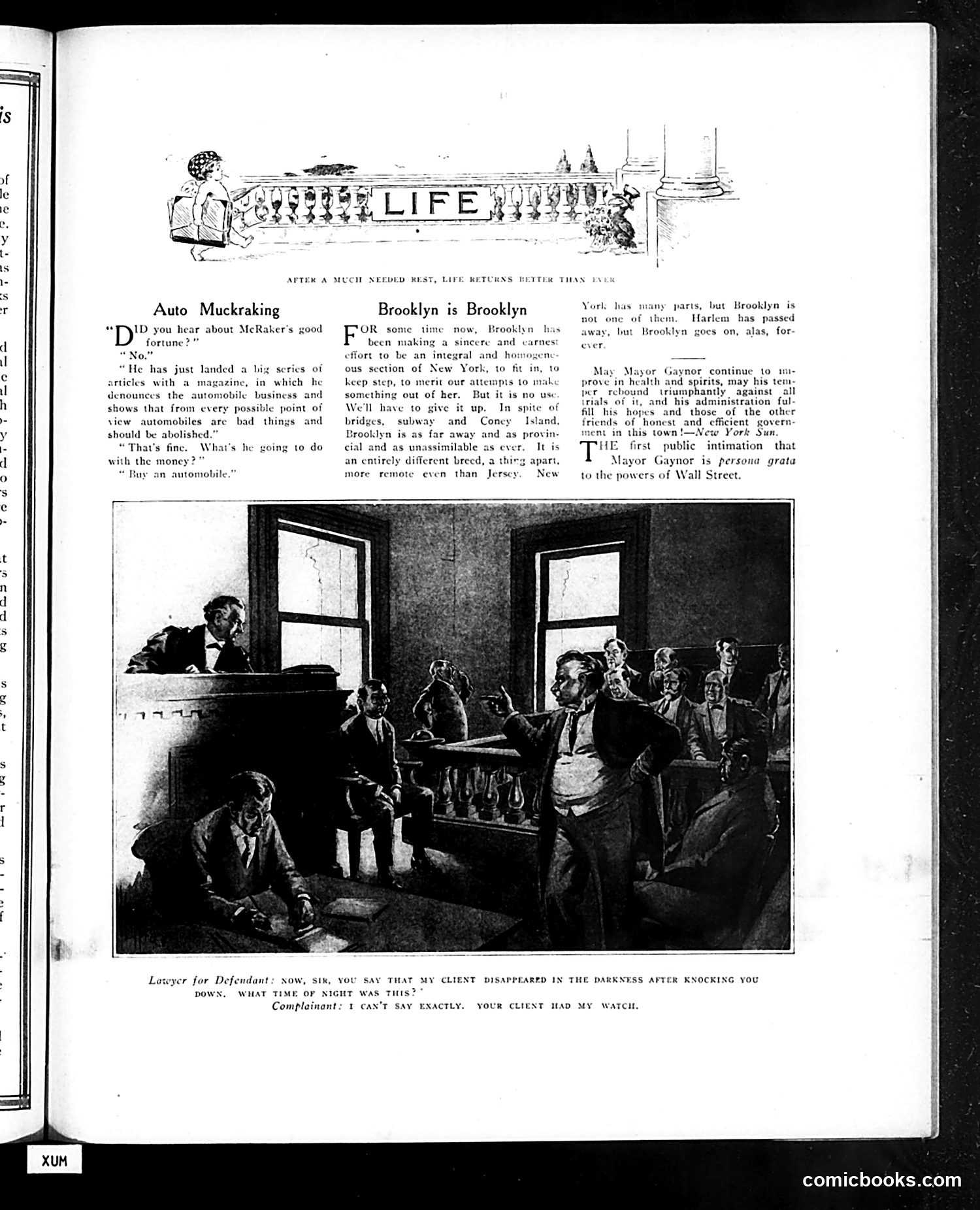
This page contains two pieces about Brooklyn and automobiles from *Life* magazine. The top article "Auto Muckraking" satirizes a magazine article criticizing the automobile industry as dishonest. The author defends automobiles while mocking Brooklyn as an "integral and homogenous section of New York" that should adopt cars rather than relying on bridges, subways, and Coney Island transit. The bottom illustration depicts a courtroom scene titled "Lawyer for Defendant." A lawyer questions a complainant about a client who "disappeared in the darkness after knocking you down." The complainant admits he cannot say exactly what time this occurred because his client had taken his watch—a satirical jab at the vagueness of accident testimony and insurance claims in early automobile litigation. Both pieces mock early 20th-century anxieties about automobiles and legal liability.
This page discusses Governor Woodrow Wilson as a potential Democratic presidential candidate. The text defends Wilson against critics who claim he's "mentally insincere" or a "demagogue," arguing instead that he's a serious reformer with genuine executive ability. The accompanying cartoon (upper left) appears to be a small satirical illustration, though details are difficult to discern clearly in this reproduction. The main article emphasizes Wilson's accomplishments as governor, his intellectual capabilities, and his alignment with progressive politics. It suggests that while Wilson may be unconventional, he represents genuine reform rather than radicalism—positioning him as an acceptable choice for voters concerned about progressive change without revolutionary upheaval.
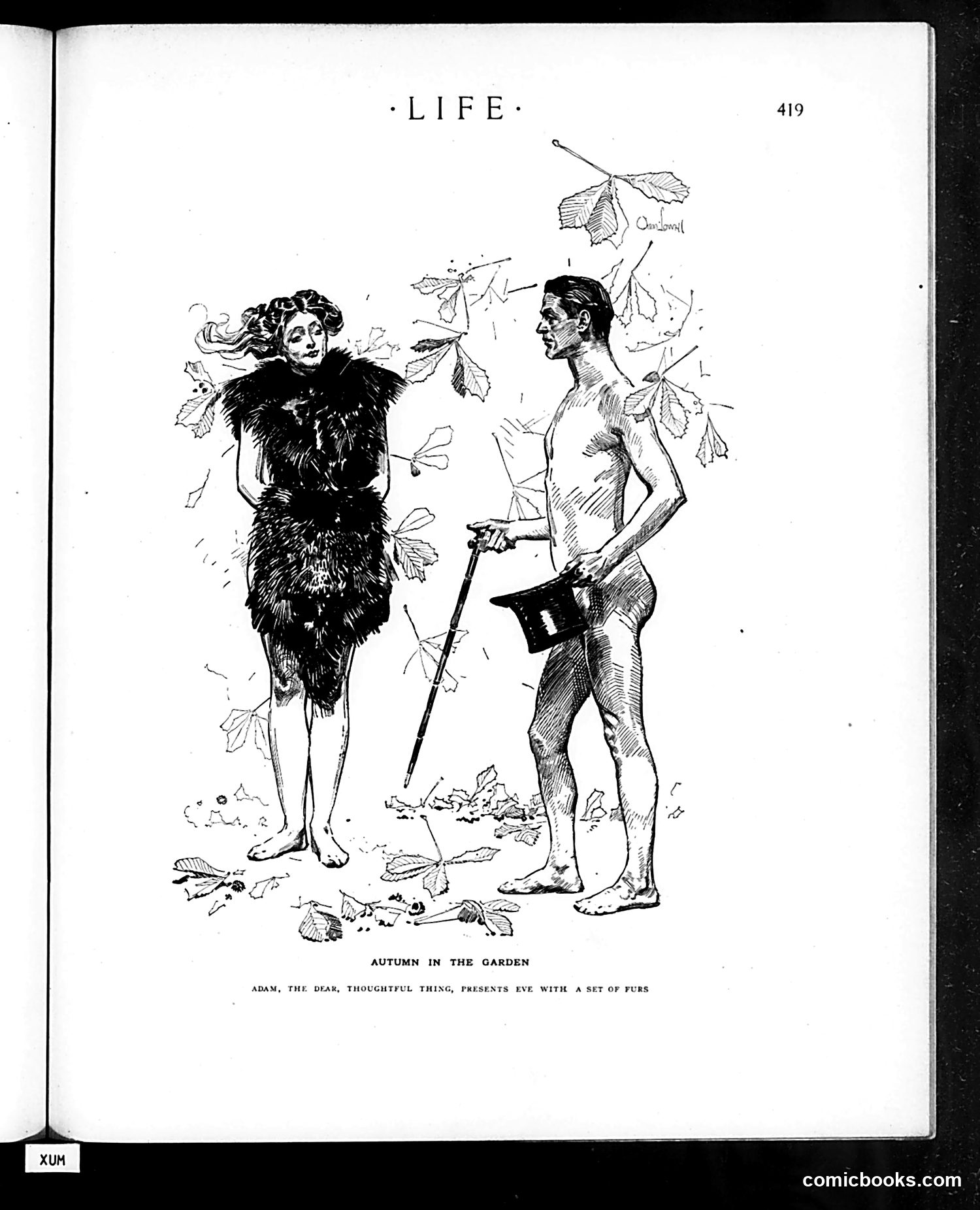
This satirical cartoon depicts Adam presenting Eve with a fur coat as an autumn gift. The caption reads: "Adam, the dear, thoughtful thing, presents Eve with a set of furs." The joke is a sardonic commentary on gender relations and consumerism. It suggests that men demonstrate affection through expensive material gifts (furs being a luxury item), while the falling autumn leaves frame the scene. The biblical Adam and Eve reference adds irony—positioning the archetypal male as a thoughtful gift-giver, though the satire likely critiques either masculine materialism as a substitute for genuine thoughtfulness, or society's expectation that women value expensive possessions. The naturalistic setting contrasts with the artificial gesture of luxury consumption.
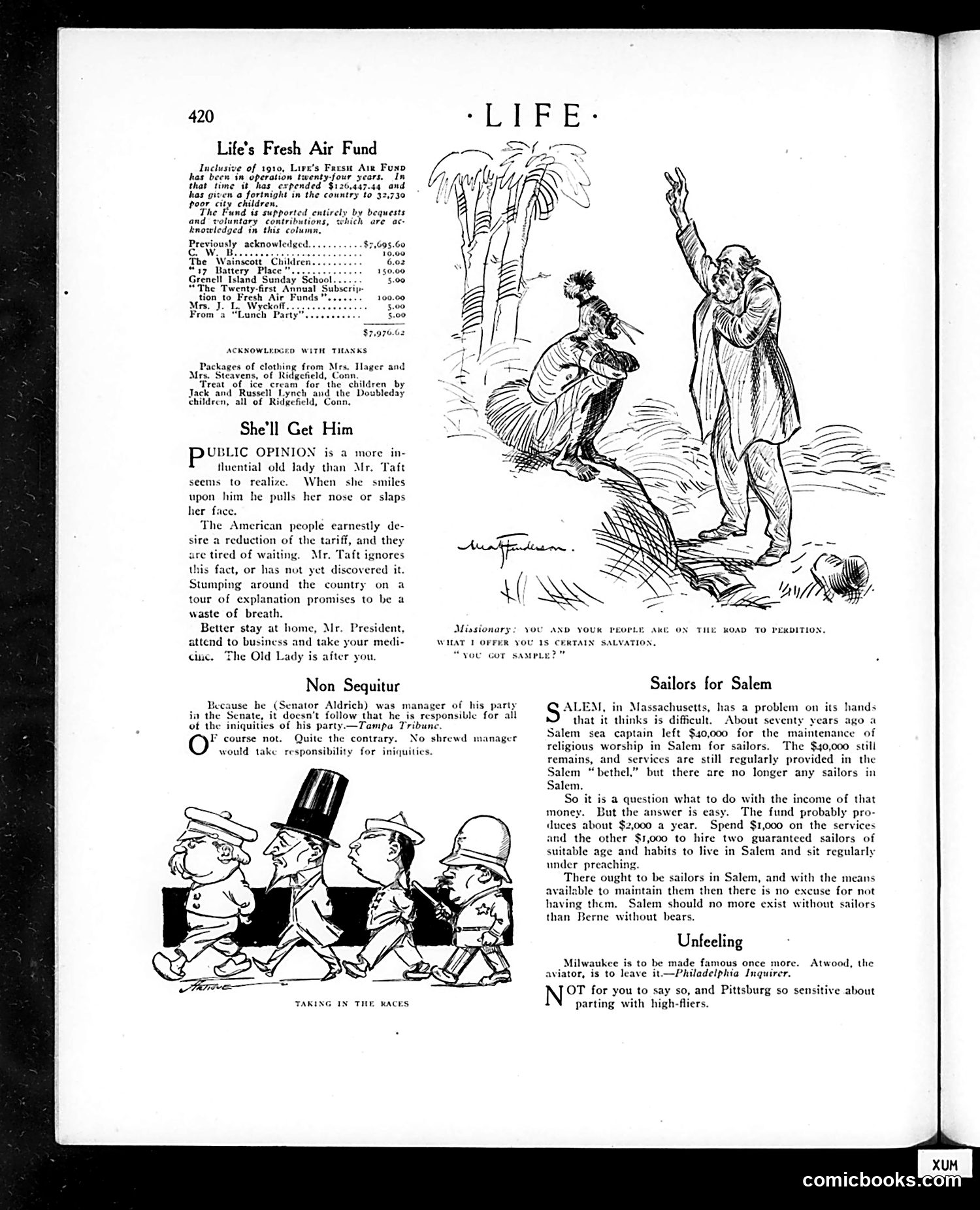
This page contains three distinct political commentaries: **"She'll Get Him"** critiques President Taft's tariff policies. The text argues that American public opinion (personified as an old lady) will ultimately prove more influential than Taft's arguments, suggesting his tariff defense tour is futile. **"Non Sequitur"** satirizes Senator Aldrich's management style, mocking the illogic of holding him responsible for Senate issues while claiming he bears no responsibility for injuries—depicted in the accompanying cartoon showing four men in top hats labeled "TAKING IN THE BACKS." **"Sailors for Salem"** addresses Salem, Massachusetts' difficulty maintaining religious sailors due to insufficient funds, proposing the income be used to hire guaranteed sailors instead. All three pieces use humor to critique political leaders' reasoning or governance approaches circa the Taft era (1909-1913).
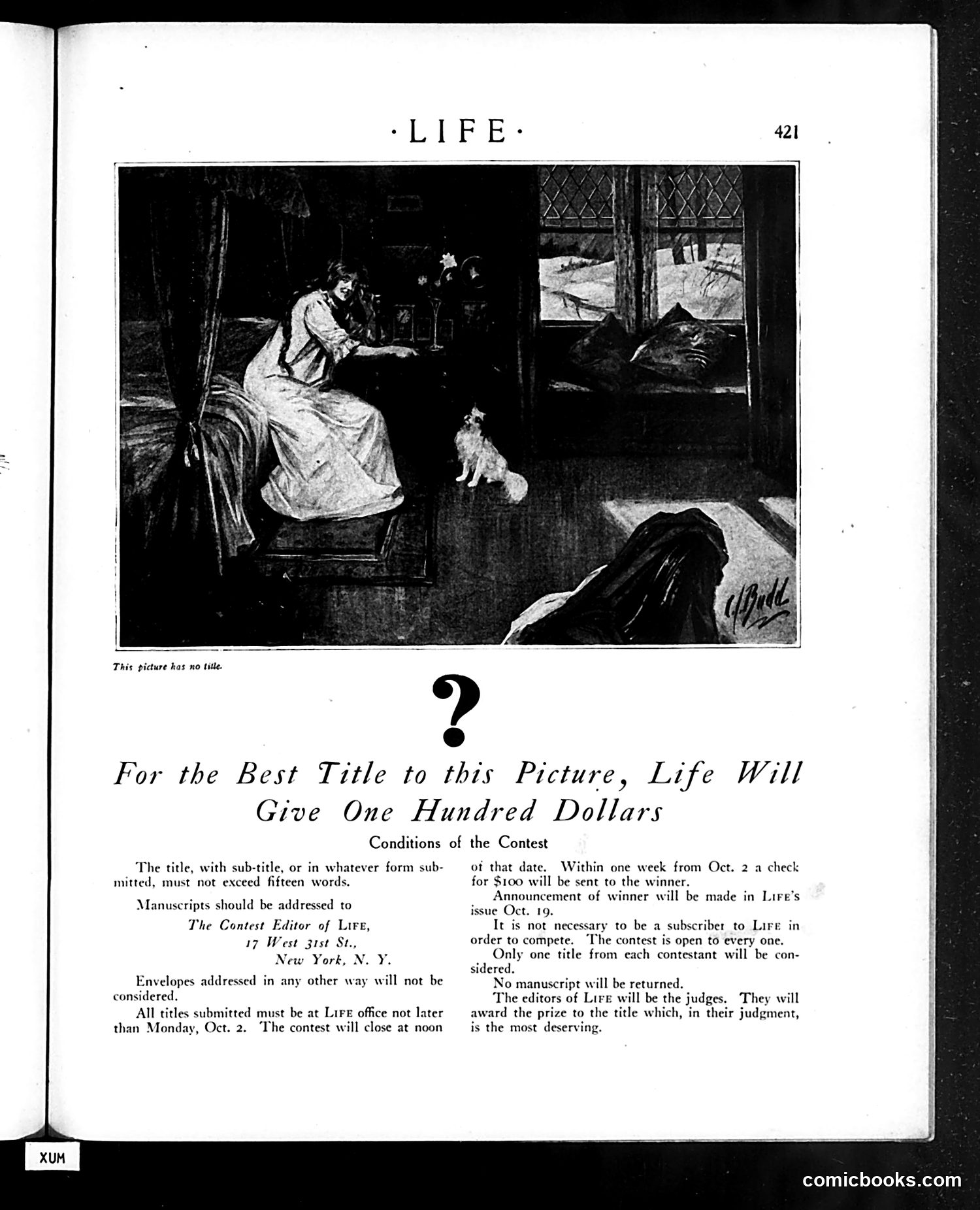
This is a **contest announcement page**, not a political cartoon. Life magazine is soliciting reader submissions for the best title to accompany an untitled illustration—offering $100 as the prize (substantial for the era). The image shows an interior domestic scene: a woman sits sewing or working at a table while a small dog sits nearby; a man's figure lies in the foreground (partially visible). Snow is visible through windows, suggesting winter. The scene appears domestic but ambiguous—the page notes "This picture has no title," inviting interpretation. The contest rules specify entries must arrive by October 2, with winners announced October 19. Notably, contestants need not be Life subscribers. The judges are Life's editors themselves. Without the original date visible, the specific social or satirical meaning remains unclear.
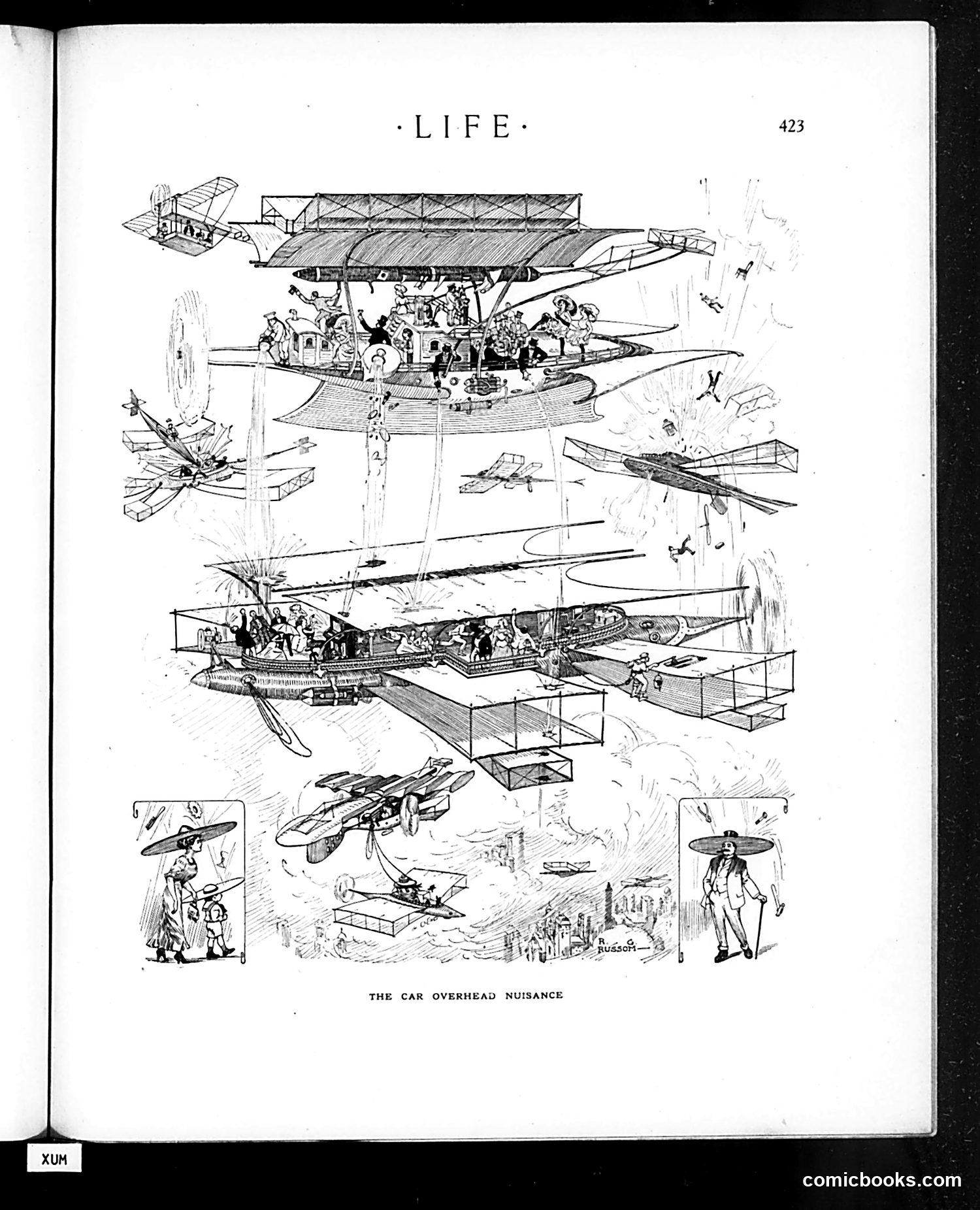
This satirical cartoon depicts futuristic flying vehicles as an urban problem. The central illustration shows multiple aircraft hovering above a city street, creating chaos below—pedestrians scatter, buildings are damaged, and traffic is disrupted. The smaller vignettes at bottom show ordinary citizens bewildered or distressed by this "overhead nuisance." The satire mocks contemporary anxieties about aviation technology's rapid development and integration into daily life. Rather than celebrating flying cars as progress, *Life* presents them as an invasive, dangerous inconvenience that would plague urban residents. The humor derives from treating fantastical future technology as a mundane urban pest—like noise pollution or congestion, but literally overhead. This reflects early-20th-century ambivalence about technological advancement.
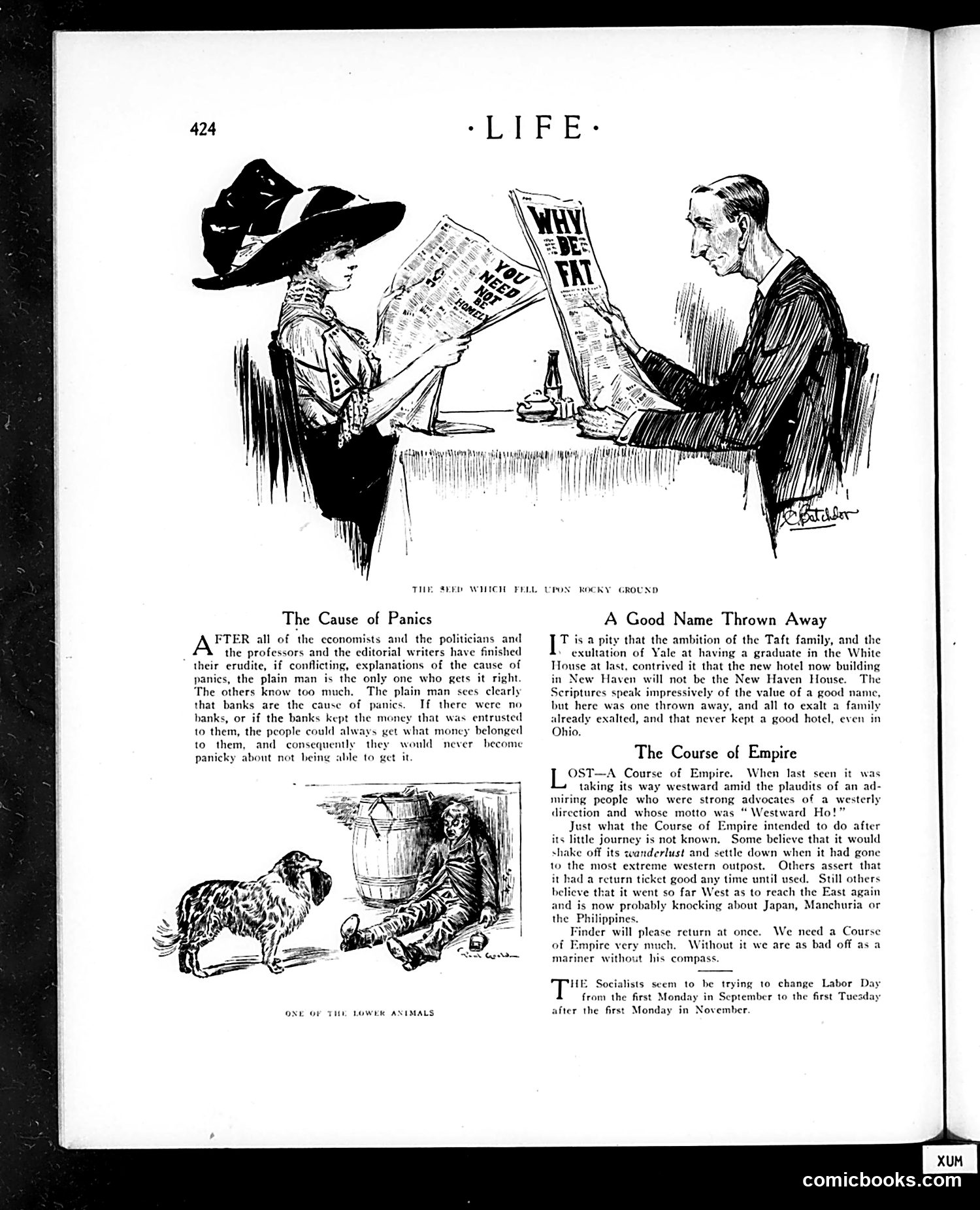
**"The Cause of Panics"** mocks economists and intellectuals for overcomplicating financial crises. The satirist argues ordinary people understand the real problem simply: banks cause panics by failing to safeguard deposited money. The piece critiques abstract theorizing versus common sense during what appears to be an economic panic period. **"A Good Name Thrown Away"** expresses disappointment that a new hotel in New Haven won't be called the "New Haven House." Instead, it will apparently bear the Taft family name (likely connected to President William Howard Taft). The author laments this vanity, noting the Tafts—despite their prominence and Yale connections—never actually managed a successful hotel, even in Ohio. **"The Course of Empire"** playfully satirizes westward expansion ideology, joking that America's westward "course" has gone so far it may circle back to Asia. The piece humorously suggests this imperial ambition has become lost and needs "returning" like a lost object. All three pieces employ satirical humor to critique banks, political nepotism, and expansionist thinking.
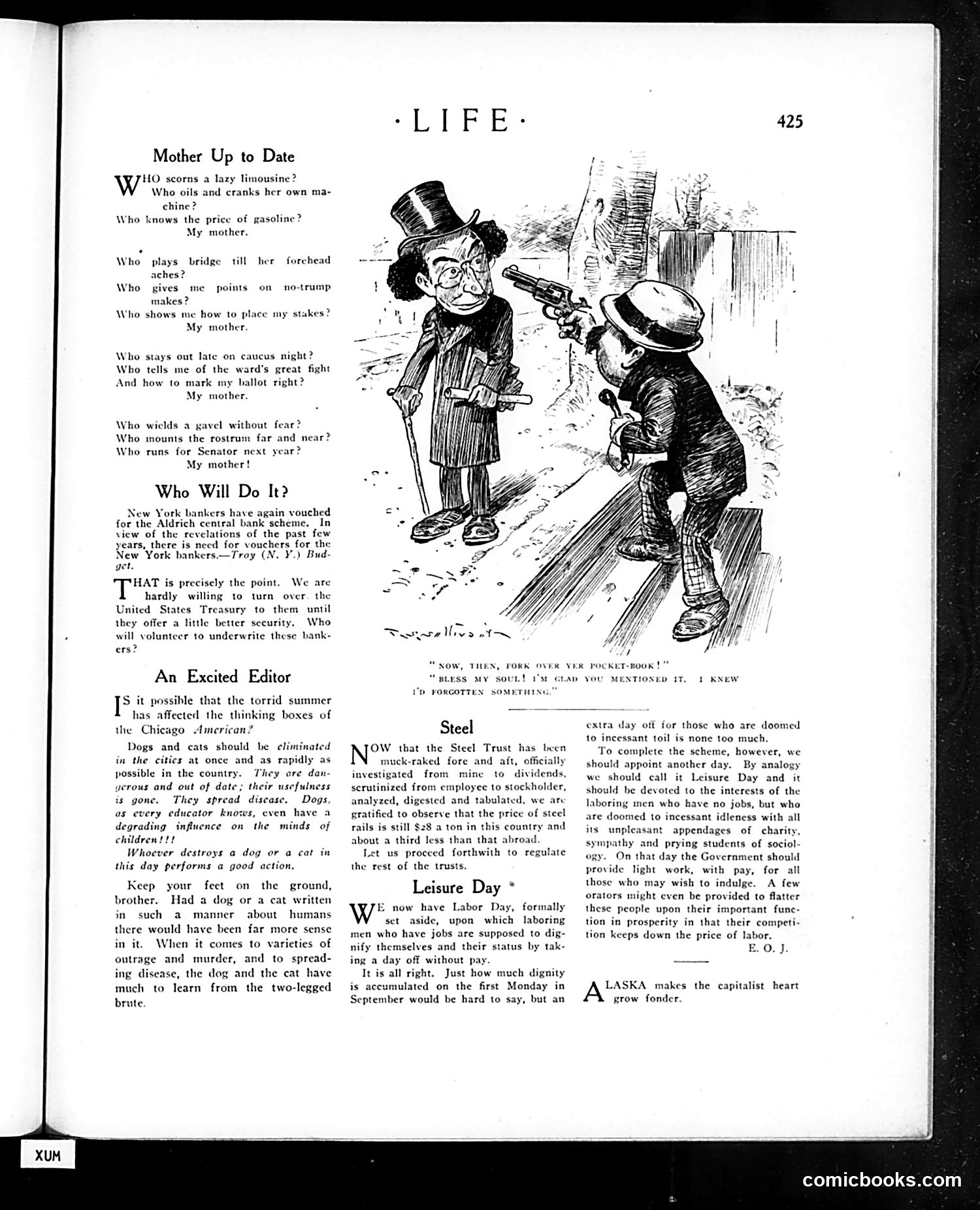
This satirical page critiques early 20th-century social and political issues: **"Mother Up to Date"** mocks women's expanding public roles—driving cars, playing bridge, attending political caucuses, and running for Senate. The poem sarcastically celebrates mothers abandoning traditional domestic duties for modern civic participation, reflecting anxiety about women's suffrage and political involvement. **"Who Will Do It?"** satirizes the Aldrich banking scheme (a 1908 proposed central bank). It jokes that New York bankers vouching for their own bank scheme is circular logic—asking criminals to vouch for themselves. The wit: who will guarantee the bankers' trustworthiness? **"An Excited Editor"** mocks a Chicago newspaper's extremism, citing its proposal to eliminate all urban dogs and cats as "degrading influences" on children. The response argues humans cause far more disease and mayhem than animals—a rebuke of the paper's absurd logic. **"Steel" and "Leisure Day"** critique trusts and labor conditions, sarcastically suggesting "Leisure Day" (unpaid time off) for unemployed workers receiving only charity and pity.
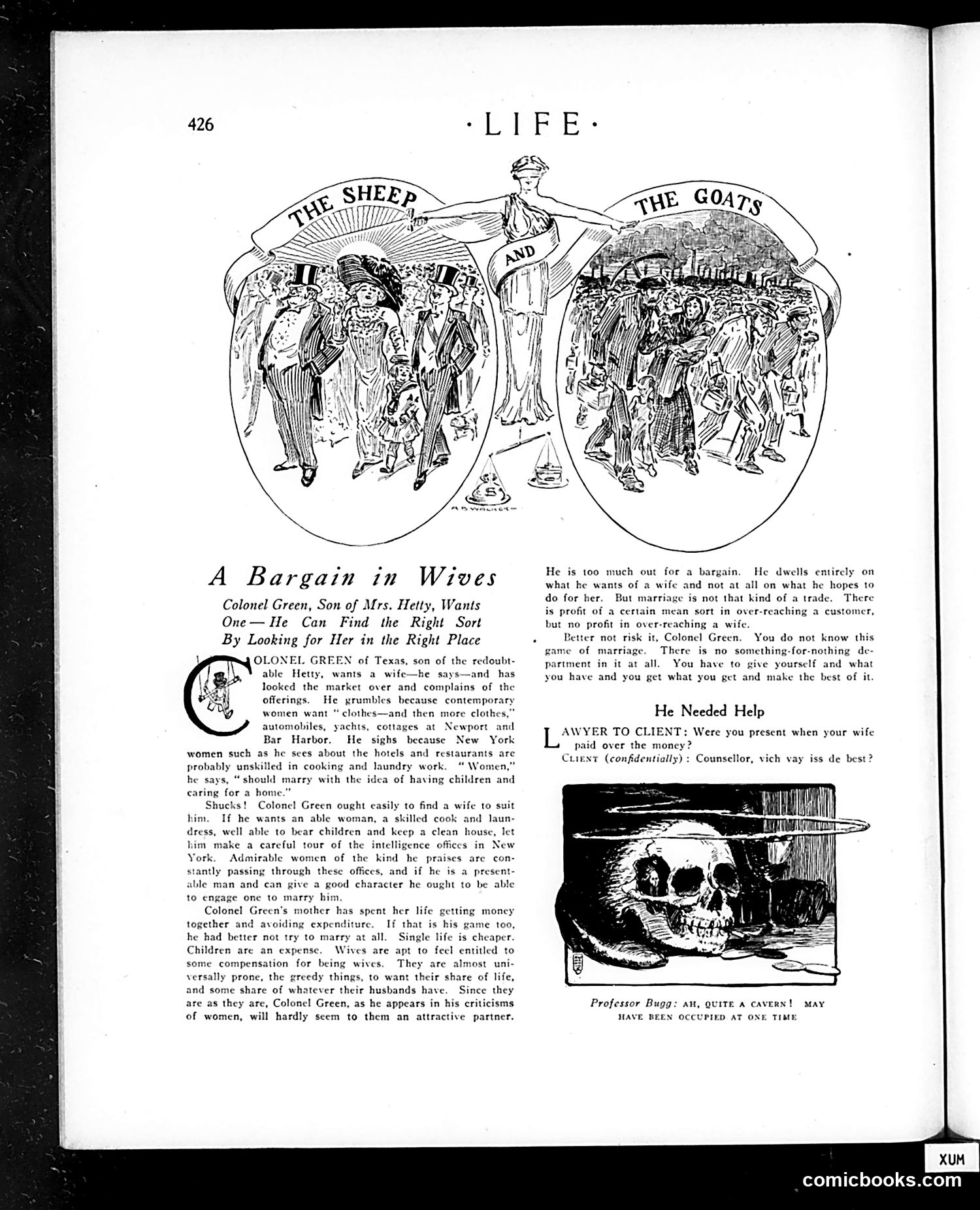
This article satirizes **Colonel Green of Texas**, a wealthy man (son of the famously rich Hetty Green) who is shopping for a wife like he'd buy merchandise. He complains that modern women demand luxuries—clothes, cars, yachts, Newport cottages—and aren't skilled homemakers. **The satire's point**: Life magazine mocks Green's transactional view of marriage. The editors argue marriage isn't a business deal where one "over-reaches" the other. They note that wives legitimately expect to share in their husbands' wealth and lifestyle, and that childbearing and housework deserve compensation. The implicit criticism: Green wants a servant, not a partner. The accompanying cartoons (labeled "The Sheep" and "The Goats") appear to illustrate social types, while the lower cartoon labeled "Professor Bugg" jokes about caverns—likely a separate, unrelated comic. The article defends women's economic expectations in marriage against wealthy men's self-serving complaints.
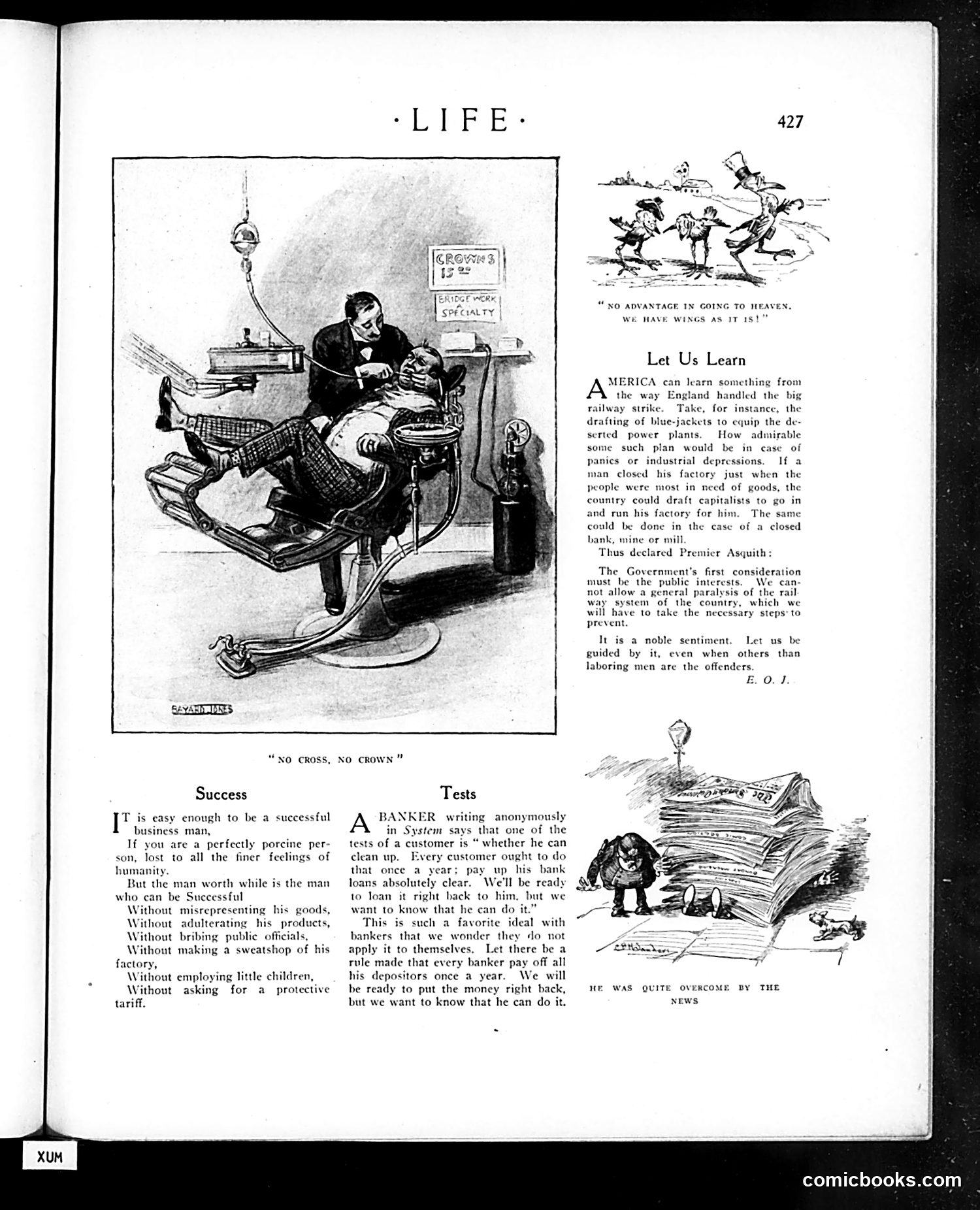
This page contains three editorial commentaries mocking American business and banking practices: **"No Cross, No Crown"** (left cartoon): Depicts a dentist-like figure operating on a prone businessman, satirizing that success requires moral compromise—corruption, child labor, adulteration, bribery, and protectionist tariffs. **"Success"** (text below): Lists the hypocritical prerequisites for business success, ironically praising the rare businessman who succeeds *without* these unethical practices. **"Tests"**: Mocks banker hypocrisy. Banks demand customers prove they can pay off loans annually, yet bankers themselves never demonstrate they can repay depositors. The author sarcastically suggests applying bankers' own "test" to themselves. **"Let Us Learn"**: References England's railway strike response (drafting military to operate power plants). The author proposes America should similarly draft capitalists to run factories during depressions—turning their own logic against wealthy industrialists. The page's overall message: American business elites practice double standards, demanding accountability from ordinary citizens while exempting themselves from similar scrutiny.
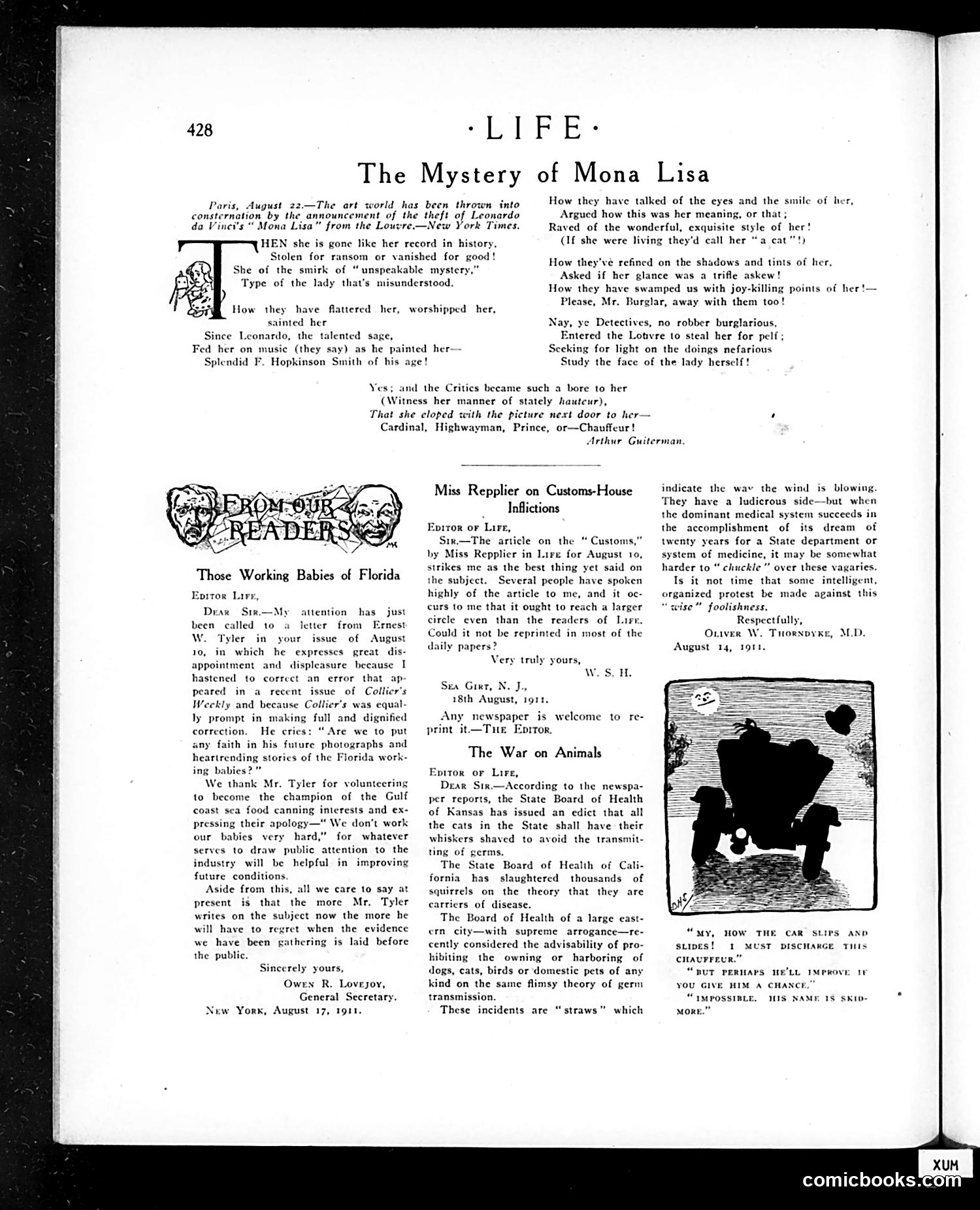
This page satirizes the 1911 theft of the Mona Lisa from the Louvre. The poem by Arthur Guiterman mocks both the painting's mystique and the obsessive critical commentary surrounding it. **The satire:** The poem suggests the famous portrait is so tired of being endlessly analyzed by critics—debating her smile, eyes, and meaning—that she literally *ran away* with the painting itself, possibly eloping with "a Cardinal, Highwayman, Prince, or—Chauffeur!" **The joke:** Rather than a criminal theft, Guiterman proposes the painting escaped of its own volition from the burden of art-world over-interpretation. He mocks both the painting's romanticized reputation ("the smirk of unspeakable mystery") and the pretentious criticism it attracts, suggesting the so-called masterpiece is actually quite ordinary—"if she were living they'd call her 'a cat.'" The cartoon below illustrates the escape theme, showing figures involved in the painting's disappearance.
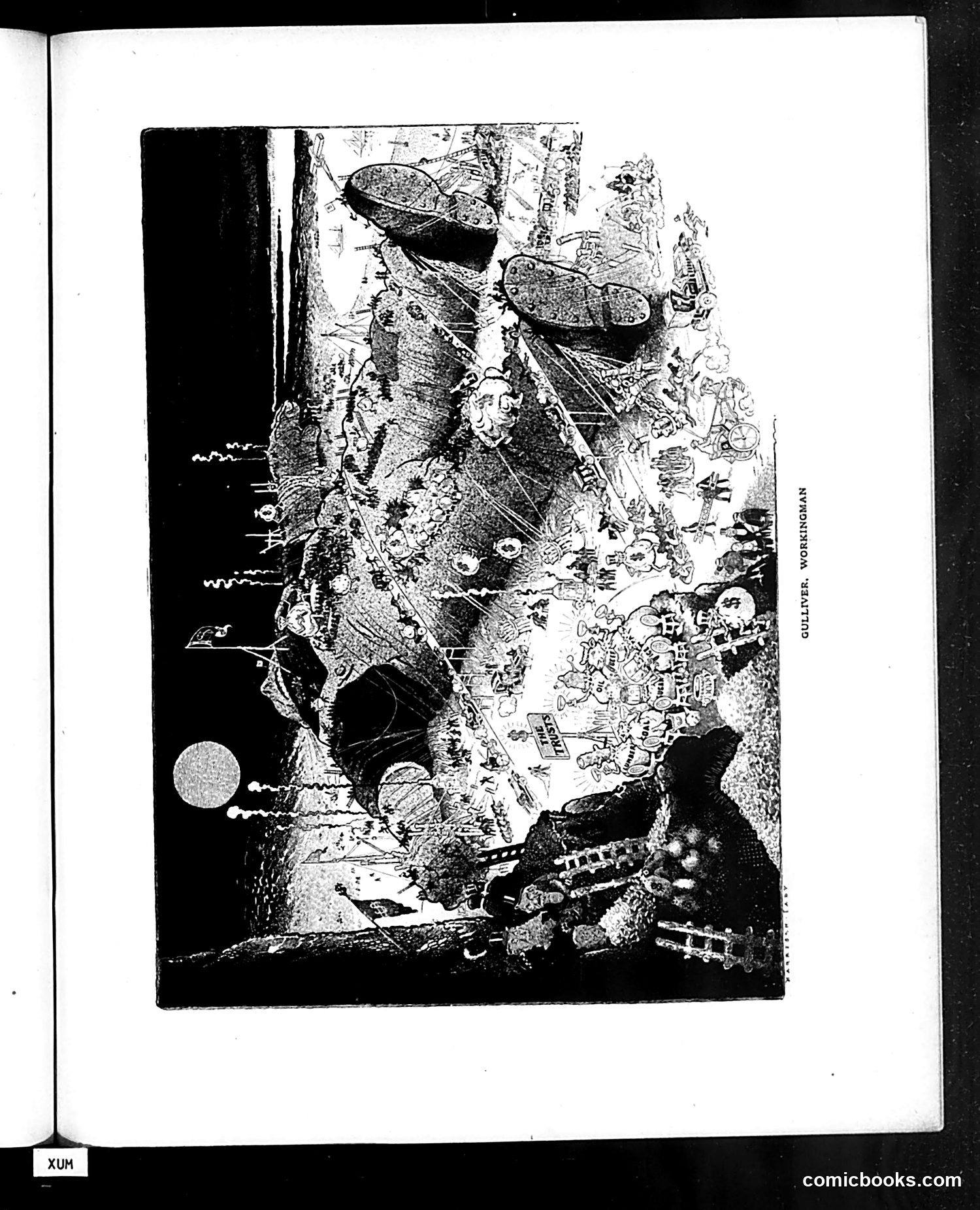
This appears to be an illustration from Jonathan Swift's *Gulliver's Travels*, titled "Gulliver in Lilliput" based on the caption visible on the right margin. The image shows a giant figure (Gulliver) tied down by tiny people (Lilliputians) on his body and surrounding area. The detailed etching depicts the famous scene where the shipwrecked traveler wakes to find himself immobilized by the miniature inhabitants of the fictional island. This is a classical literary illustration rather than political satire. The Wisconsin reference in the caption likely indicates the publication source or artist attribution rather than political commentary.
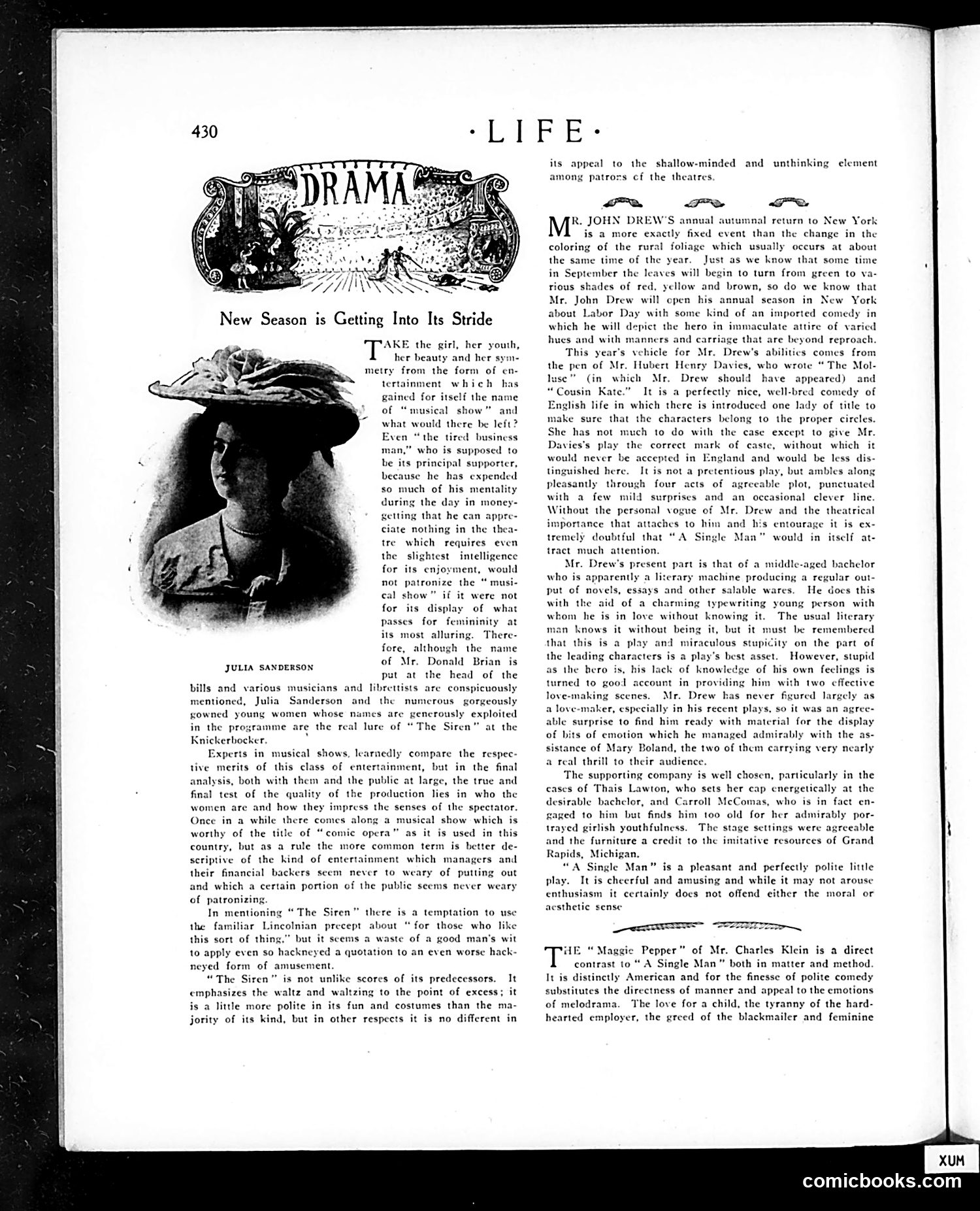
This page critiques early 20th-century American musical theater through reviews of two Broadway productions: "The Siren" (starring Julia Sanderson and Donald Brian) and an unnamed John Drew vehicle. **The Satire:** The author argues that musical shows succeed entirely through **displaying attractive women**, not artistic merit. He dismisses the genre as mindless entertainment for "the tired business man" seeking visual spectacle rather than intelligence. "The Siren" exemplifies this—despite featuring respected performers, it's merely a waltz-heavy show exploiting female beauty and elaborate costumes. **The Point:** Life magazine's satire targets the superficiality of commercial theater that prioritizes glamour over substance. The author suggests audiences and producers willingly participate in this cycle of lowbrow entertainment, treating women performers as decorative rather than talented artists. **Context:** This reflects period anxieties about mass entertainment dumbing down cultural standards while acknowledging its commercial inevitability.
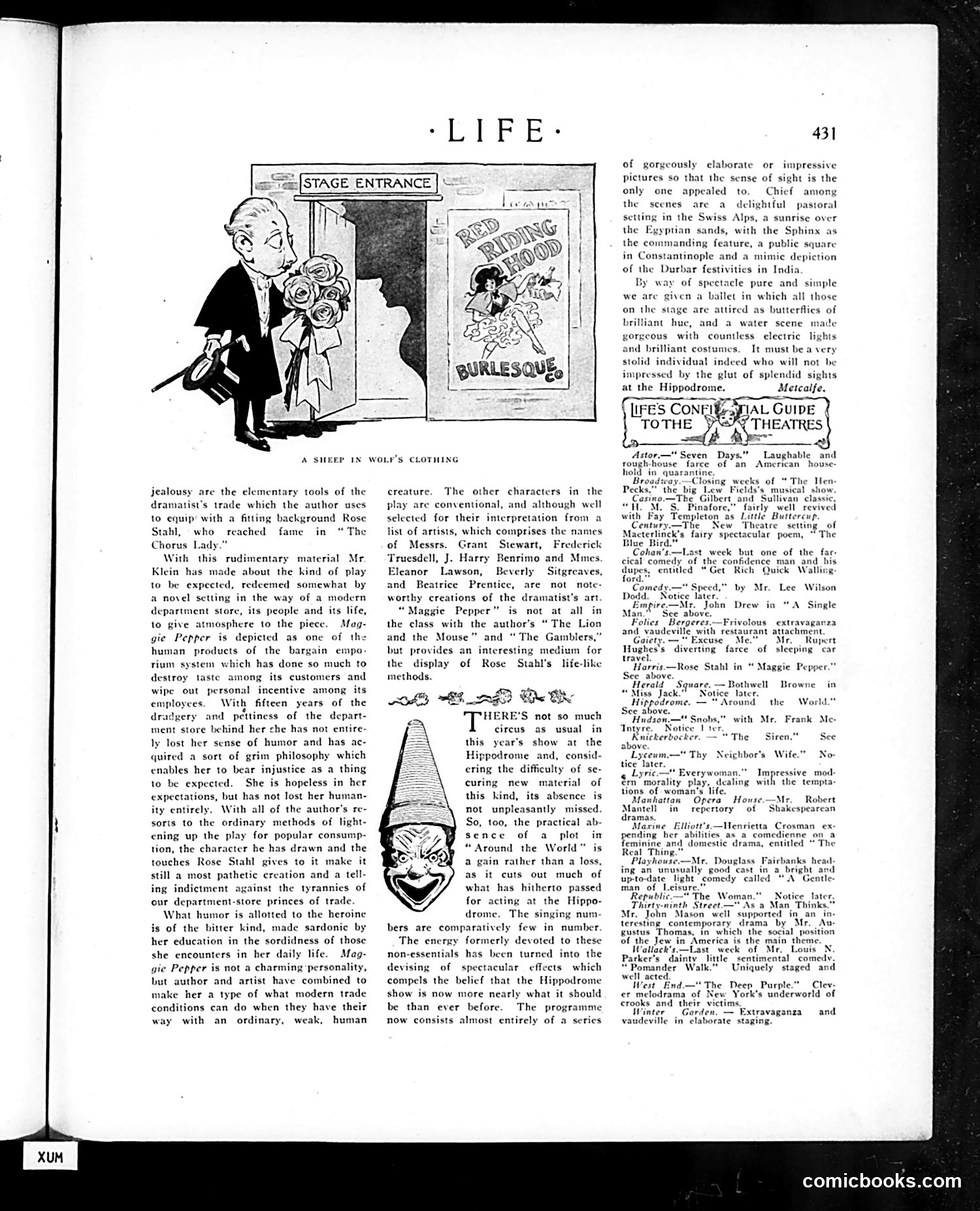
This cartoon illustrates a theatrical review of a play titled "Maggie Pepper," starring Rose Stahl. The visual pun in the title suggests deception or disguise—the well-dressed gentleman entering through the "Stage Entrance" carrying roses appears refined on the surface, but the accompanying text reveals the play itself concerns a department store worker depicted as a product of commercial exploitation. The satire targets both the theatrical production and modern consumer capitalism. The review criticizes the play as formulaic melodrama, noting its characters are "conventional" and the work inferior to the author's previous successes. More broadly, it indicts "department-store princes of trade" for their tyranny over ordinary workers like the titular character—depicting commercial systems as inherently dehumanizing. The cartoon's sophistication lies in its visual-textual irony: respectable theatrical presentation masks darker social commentary about labor and commerce.
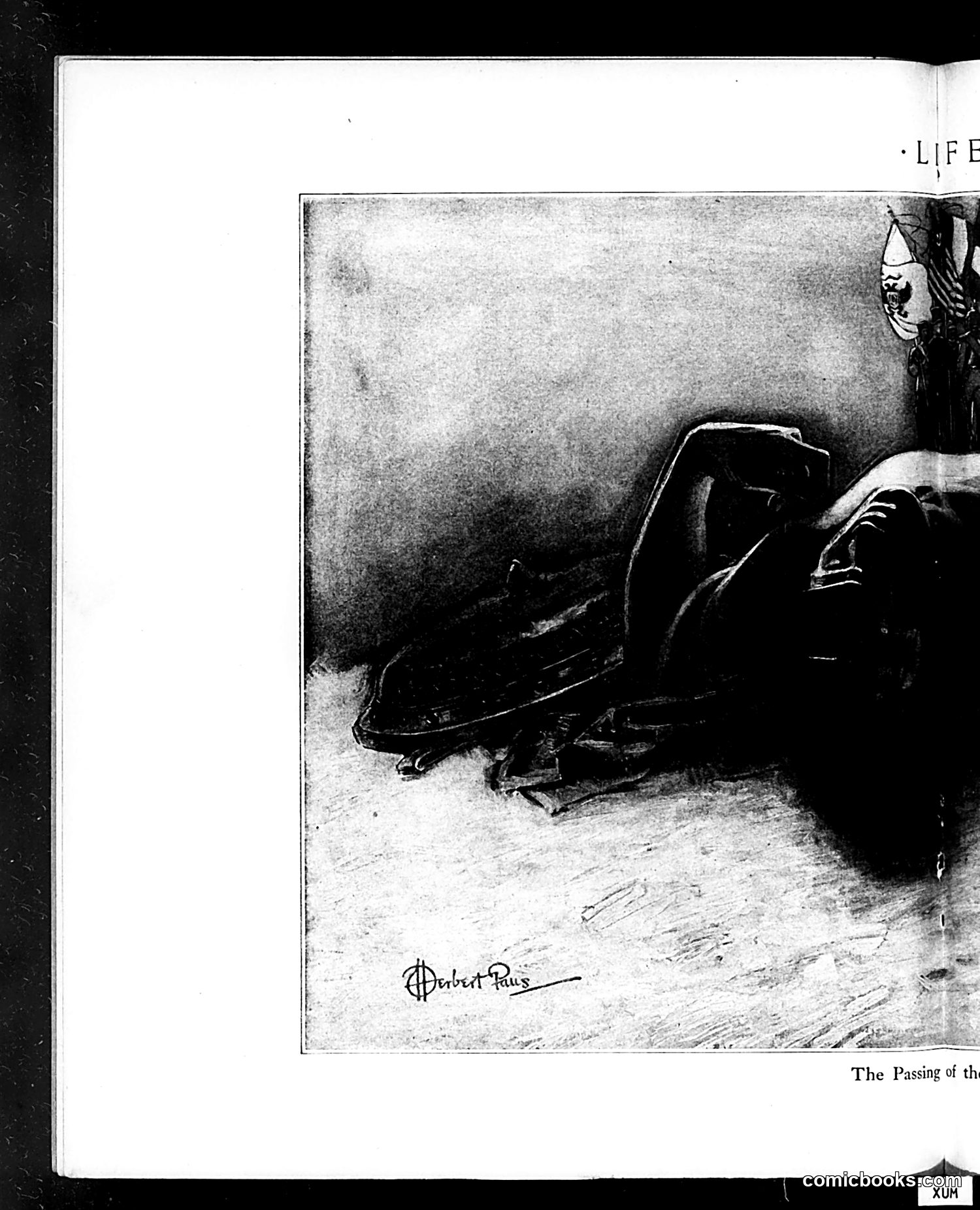
This appears to be a satirical illustration by Albert Polis (signature visible) from *Life* magazine. The image shows a figure reclining or collapsed on the ground in what appears to be distress or defeat, with what looks like a vehicle or mechanical object nearby. The caption begins "The Passing of th[e]..." (text cut off). Without the complete caption or publication date, I cannot definitively identify the specific political figure or event being satirized. However, the composition suggests commentary on someone's downfall or political demise—a common theme in *Life*'s satirical work. The dramatic, dark artistic style emphasizes the subject's misfortune. To accurately explain the satire's specific target and meaning, the full caption and publication context would be necessary.
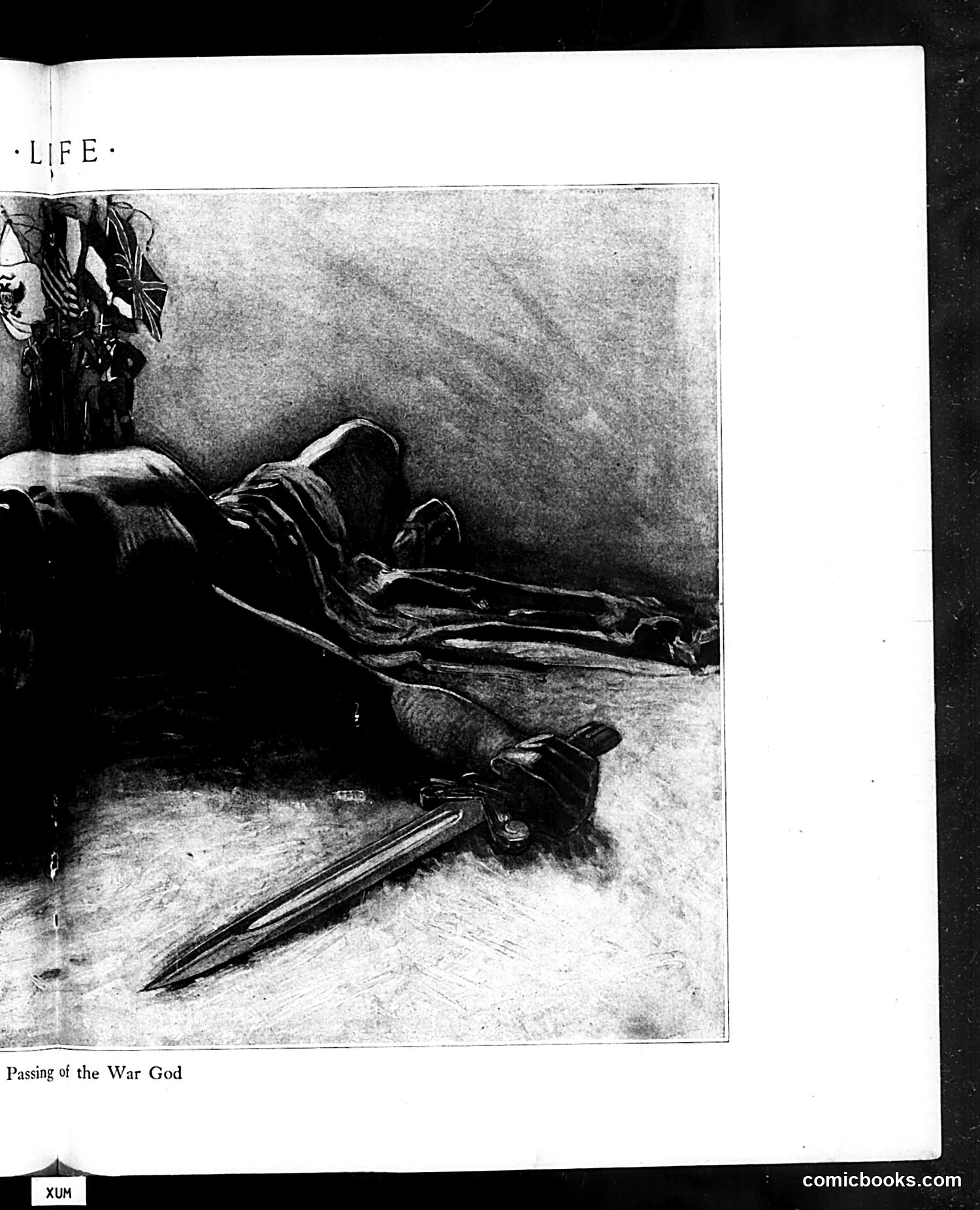
This Life magazine illustration depicts a fallen soldier lying dead on the ground, with a sword nearby. The title "Passing of the War God" employs ironic religious language—referring to the soldier as a "war god" who has now "passed" (died). The satire critiques the glorification of warfare and militarism. By sarcastically calling a dead soldier a "god," the cartoonist mocks the romanticization of war and military heroism prevalent in nationalist rhetoric. The stark, realistic depiction emphasizes the brutal reality of death in combat, contrasting with jingoistic celebrations of warfare. Without additional context about the publication date, the specific conflict referenced remains unclear, though the style suggests early-to-mid 20th century.
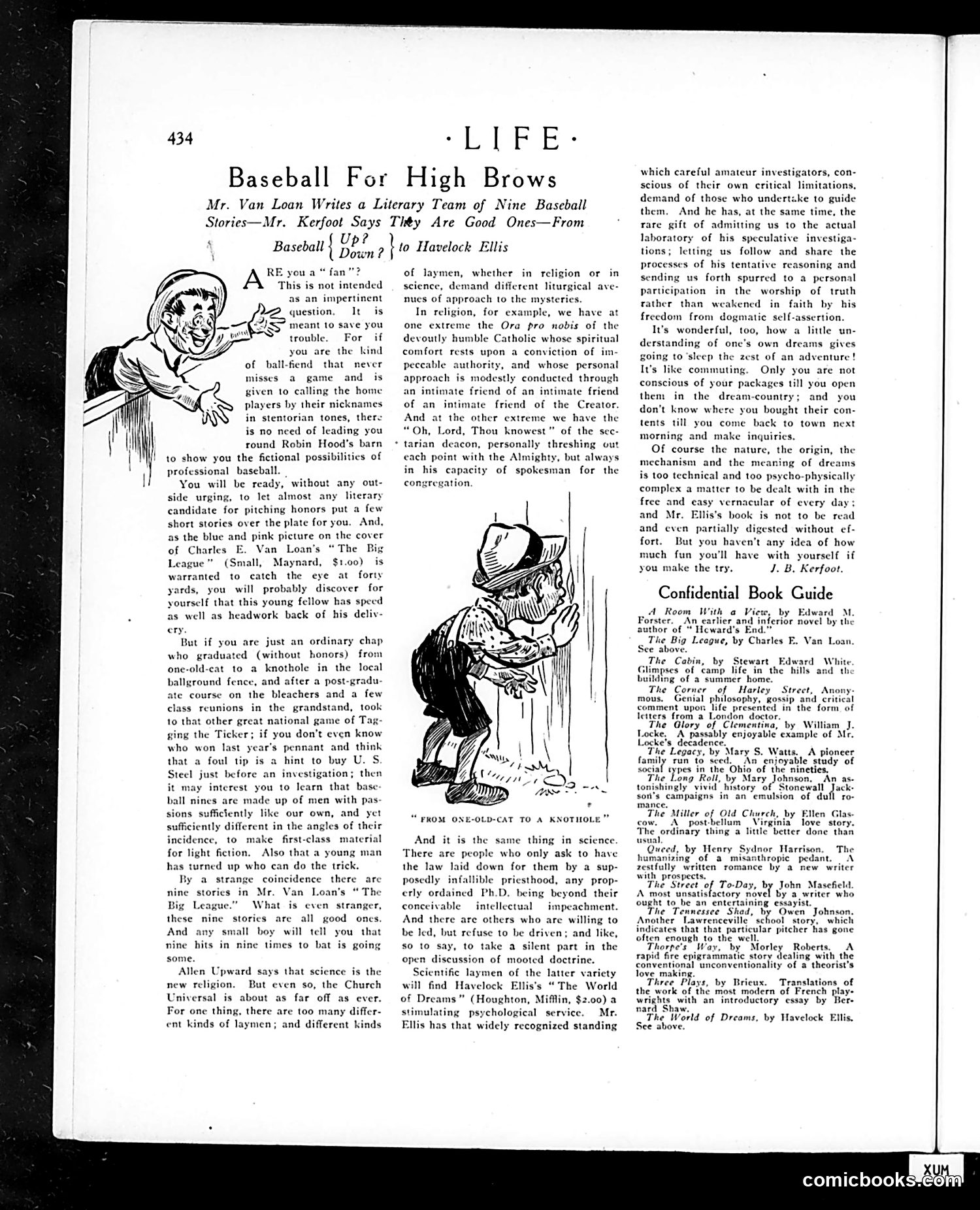
This article mocks the pretension of treating baseball—America's working-class sport—with literary seriousness. The opening cartoon depicts a stereotypical "fan" (caricatured with exaggerated features), labeled "FROM ONE-OLD-CAT TO A KNOTHOLE," tracing an everyman's journey from sandlot games to bleacher-sitting. The satire targets intellectuals ("high brows") who might dismiss baseball as unworthy of serious fiction, while simultaneously noting that Charles E. Van Loan has written nine surprisingly good short stories about professional baseball. The piece argues baseball has legitimate human drama—the players possess "passions sufficiently like our own"—making it worthy material for quality literature. The broader point: even lowbrow subjects merit serious artistic treatment when handled well. The tone is gently mocking toward both baseball snobs and literary elitists.
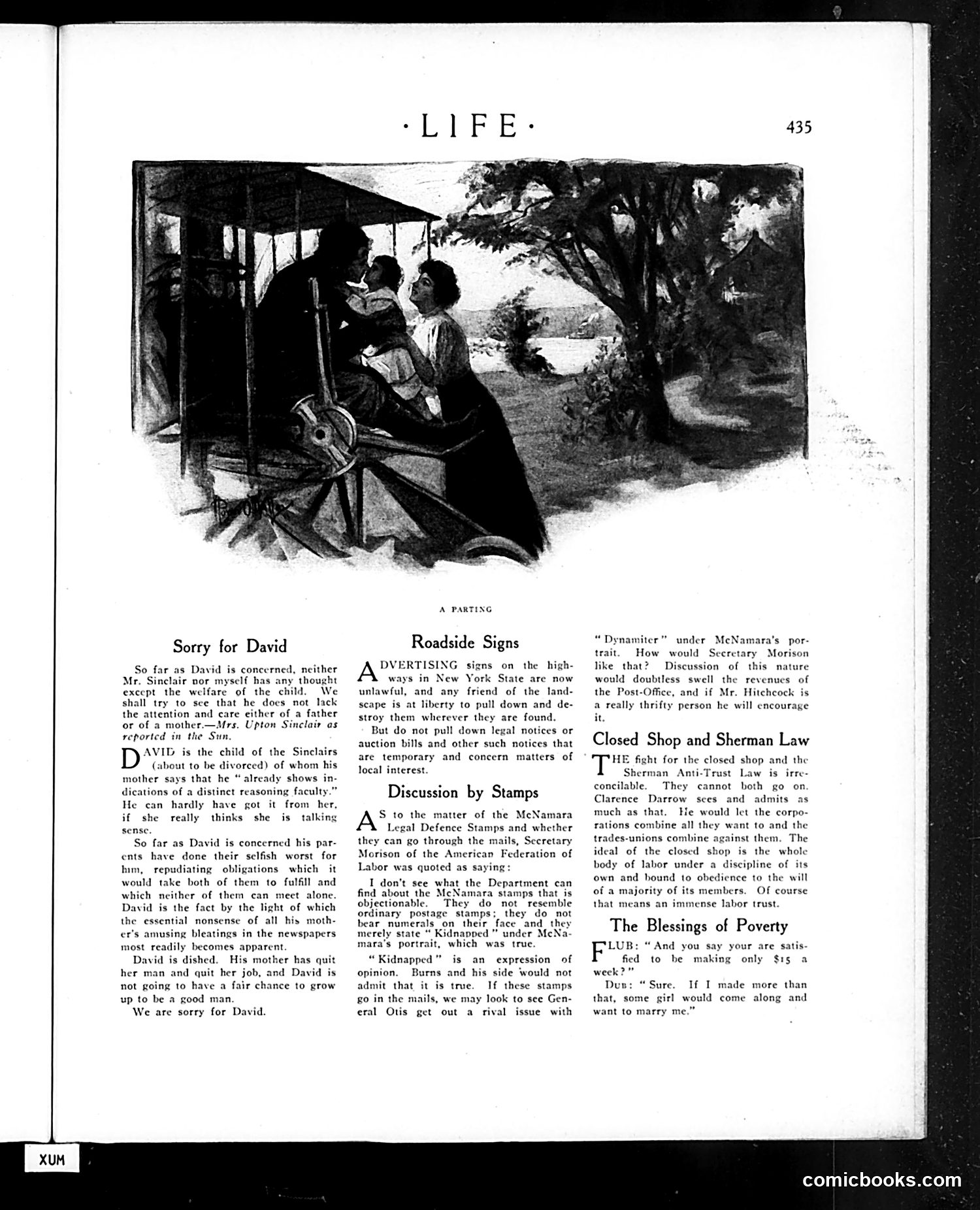
This page contains three distinct satirical pieces typical of early 20th-century Life magazine: **"Sorry for David"** mocks Upton Sinclair's divorce and custody arrangements. The piece attacks both parents for abandoning parental responsibilities, sarcastically noting that David's mother claims he shows "reasoning faculty" while she herself talks nonsense. The satire suggests the child will suffer from parental selfishness. **"Roadside Signs"** and related pieces discuss contemporary labor and political disputes, including the McNamara case (likely referring to the 1911 Los Angeles Times bombing). References to "Kidnapped" stamps and General Otis suggest debate over labor defense fundraising and anti-union sentiment. **"The Blessings of Poverty"** offers a brief comic dialogue where a poor man earning $15/week claims contentment, joking that earning more would attract gold-diggers seeking marriage. The tone throughout is mordant social criticism targeting both progressive reformers and contemporary labor disputes, characteristic of Life's satirical approach to American politics and society.
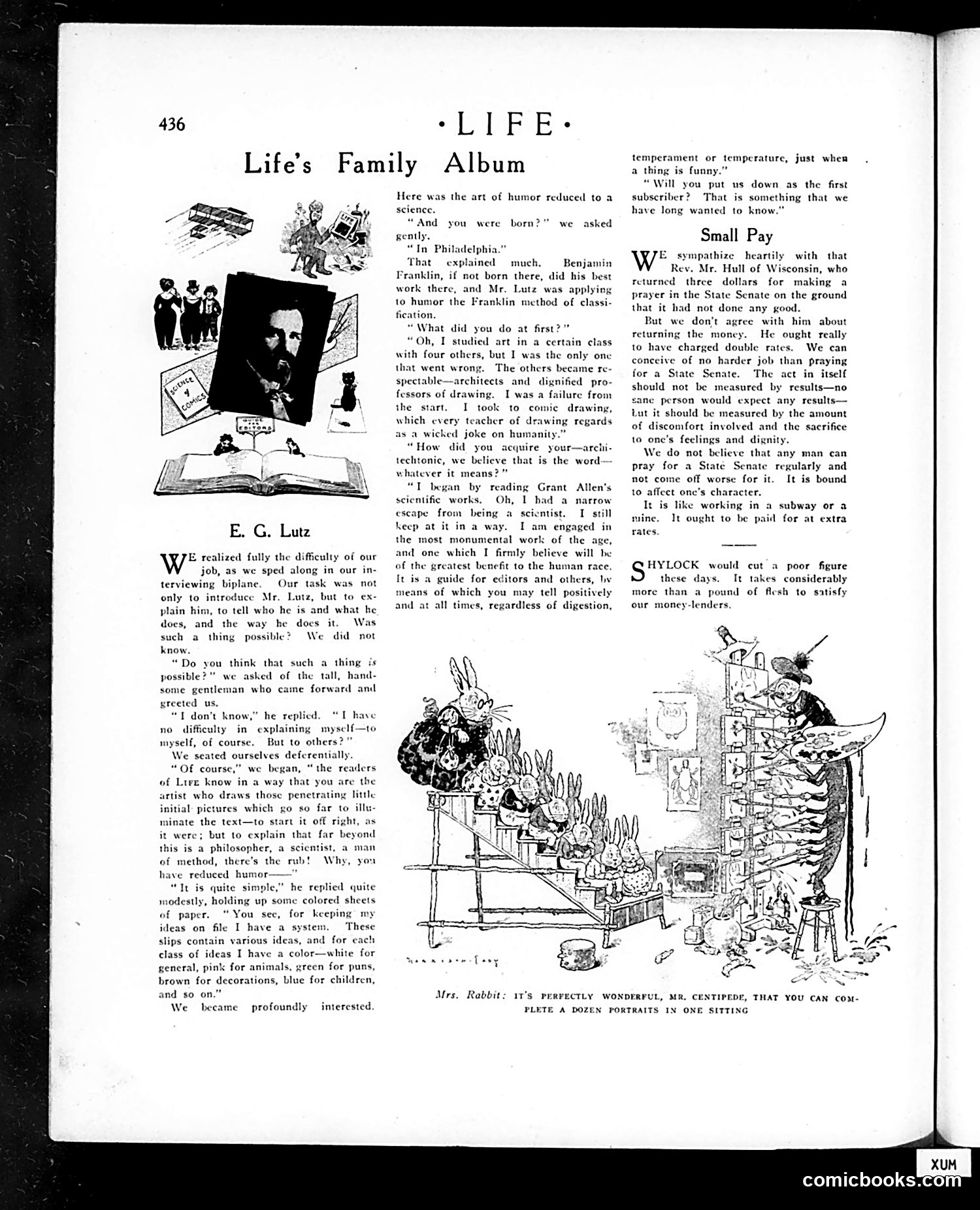
This page profiles E.G. Lutz, a cartoonist and illustrator for *Life* magazine. The interview reveals Lutz's systematic approach to humor: he organizes cartoon ideas by color-coded categories (white for general, pink for animals, green for puns, brown for decorations, blue for children). The satire compares this scientific method to Benjamin Franklin's classificatory approach, suggesting Lutz has reduced humor to a rational system. The "Small Pay" section satirizes a Wisconsin reverend who returned three dollars for praying in the State Senate, arguing the prayer was ineffective. *Life* humorously counters that such unpleasant work deserves *higher* payment, not refunds—comparing it to working in unpleasant conditions like subways or mines. The final cartoon panel appears unrelated, likely advertising.
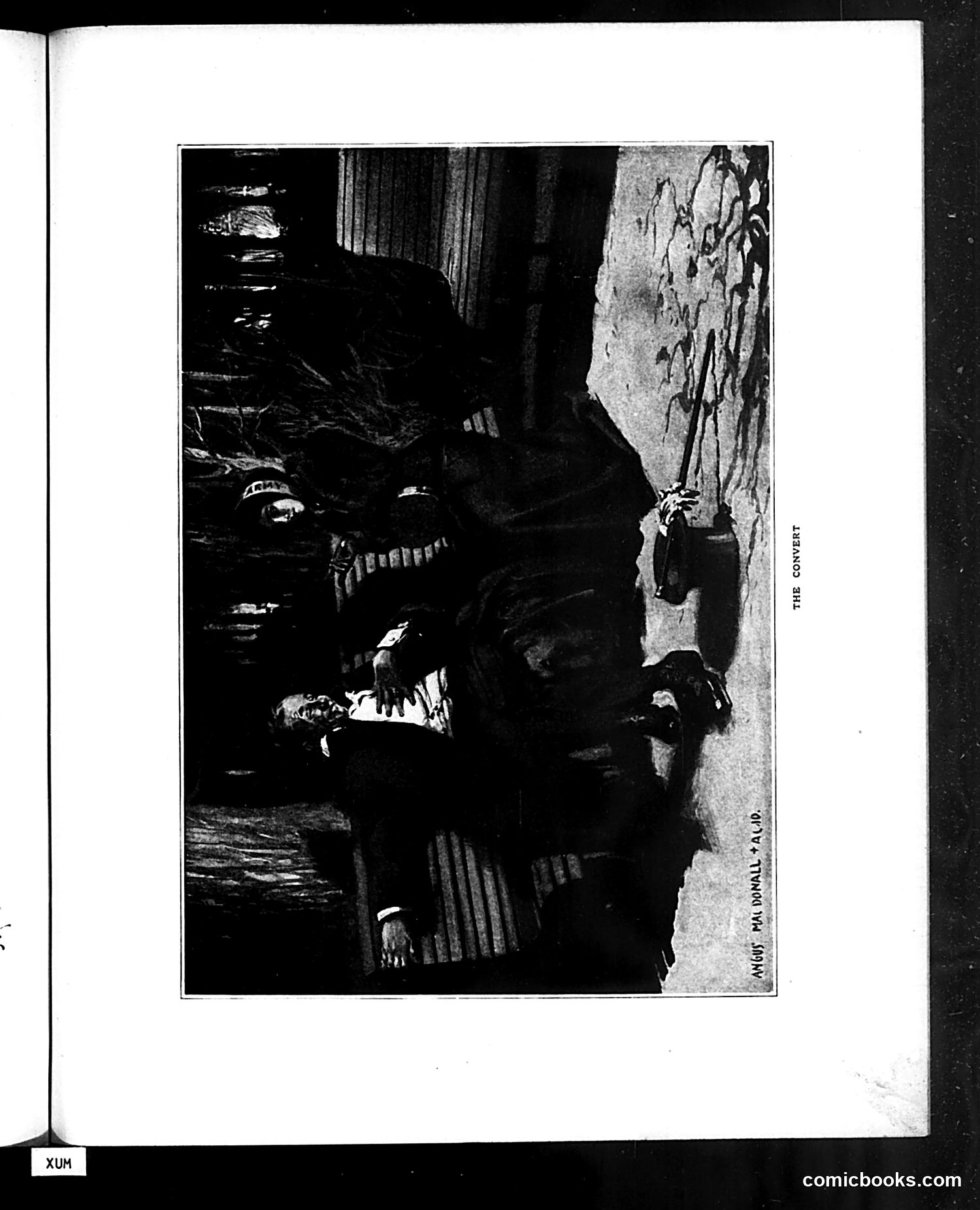
The OCR text is too corrupted to read intelligently. The image itself is a black-and-white photograph that appears rotated or inverted, making it difficult to identify specific figures or details with confidence. I can see what appears to be people in period clothing in an interior setting, but cannot reliably determine who they are, what historical event is depicted, or what satirical point is being made. To properly explain this content for modern readers, I would need either a legible caption, clearer image orientation, or readable OCR text identifying the subject matter and context.
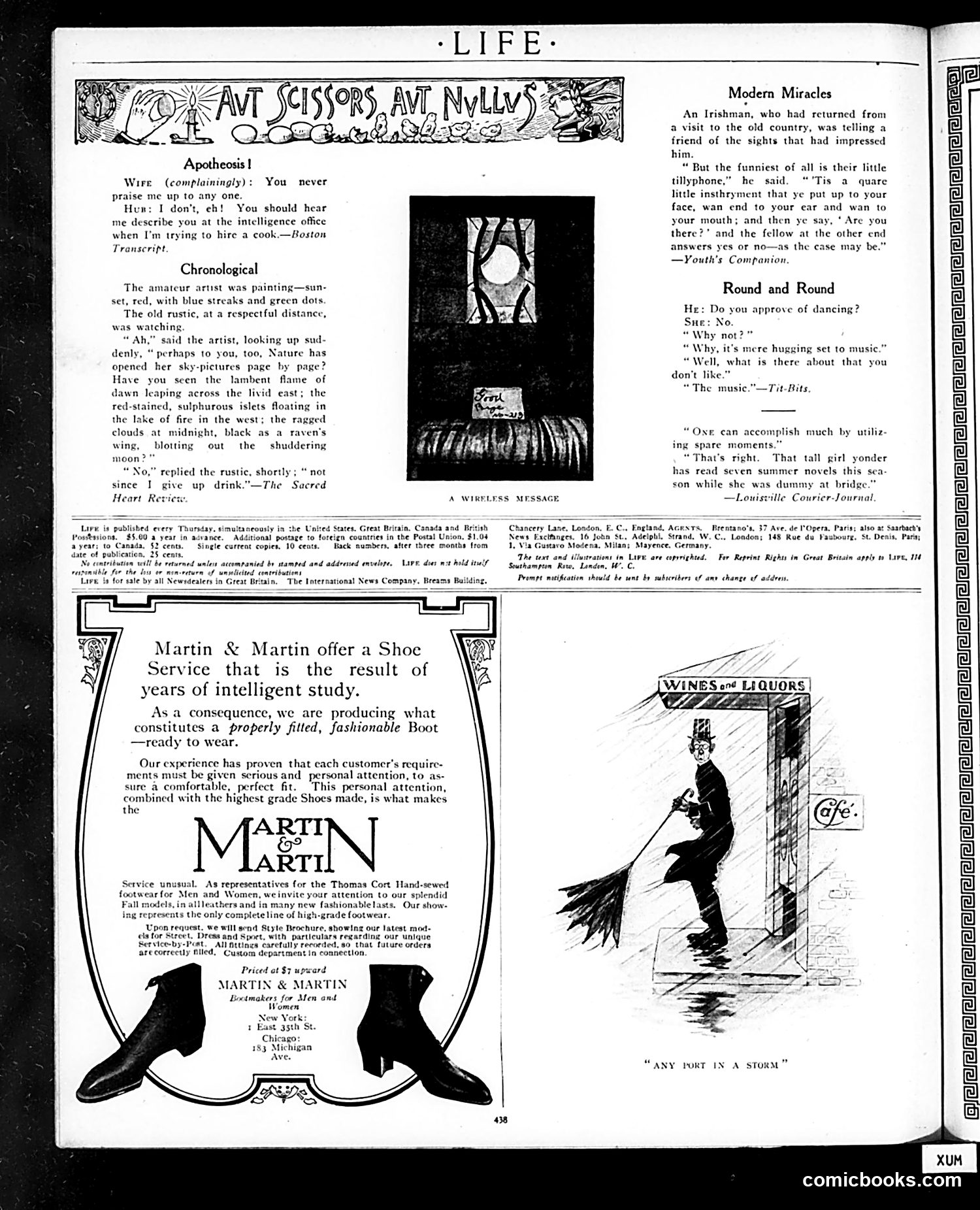
This page from *Life* magazine contains several short humorous anecdotes and advertisements typical of early 20th-century American satirical publishing. The jokes mock domestic servants ("Wire" complaining about her employer praising her), artistic pretension (a painter waxing poetic about nature to a rustic who simply stopped drinking), technological novelty (an Irishman amazed by the telephone), and relationship dynamics (a woman disapproving of dancing as "mere hugging set to music"). The cartoon "Any Port in a Storm" depicts a figure taking shelter outside a "Wines and Liquors" establishment—a visual pun playing on the expression "any port in a storm" while suggesting alcohol as refuge. The advertisements for Martin & Martin shoes and publishing information occupy substantial space, reflecting *Life*'s reliance on advertising revenue. The humor relies on class distinctions, gender roles, and gentle mockery of both rural unsophistication and urban affectation—typical of the era's middlebrow satirical sensibility.
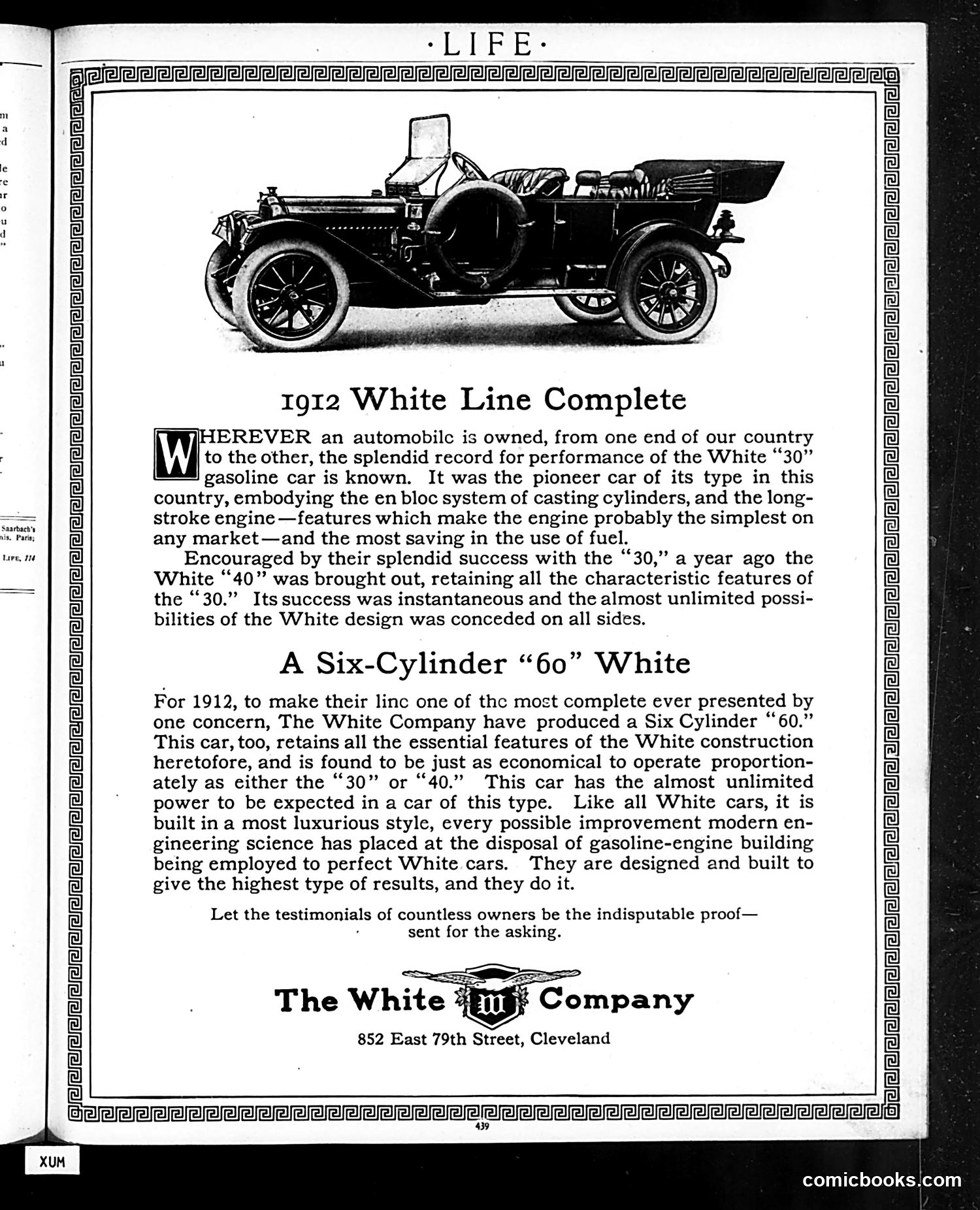
This is **not satire or a political cartoon**—it's a straightforward automobile advertisement from *Life* magazine's 1912 issue. The page promotes the White Company's new "60" model automobile, a six-cylinder gasoline car. The advertisement emphasizes the car's technical innovations: its "en bloc" cylinder casting system and long-stroke engine, which the company claims make it fuel-efficient and mechanically simple—advantages over competing vehicles. The text describes a product line progression: the earlier "30" model, the newer "40," and now the luxurious "60" with greater power. The company appeals to potential buyers by referencing owner testimonials and the car's reputation across the country. This reflects the early automotive era when gasoline-powered cars were still relatively new and competing manufacturers promoted technical specifications as primary selling points.
This page from *Life* magazine presents satirical humor pieces mocking various contemporary figures and attitudes. The cartoons use racial stereotypes common to early 20th-century American humor—specifically depicting African Americans in dialect-heavy stories meant to ridicule both Black characters and the white authority figures they encounter. "A Qualification" mocks a minister's sanctimonious preaching about neighborliness to a Black man named Rastus, who delivers a self-deprecating punchline. "Imperfect Harmony" ridicules composer Richard Strauss's discordant music through Senator Depew's anecdote. "Patience Gave Out at Last" satirizes Appalachian feuding culture through an old woman's matter-of-fact description of escalating violence. The page is primarily advertising, promoting shaving cream and facial soap alongside these humor pieces—typical *Life* magazine format mixing satirical content with consumer goods.
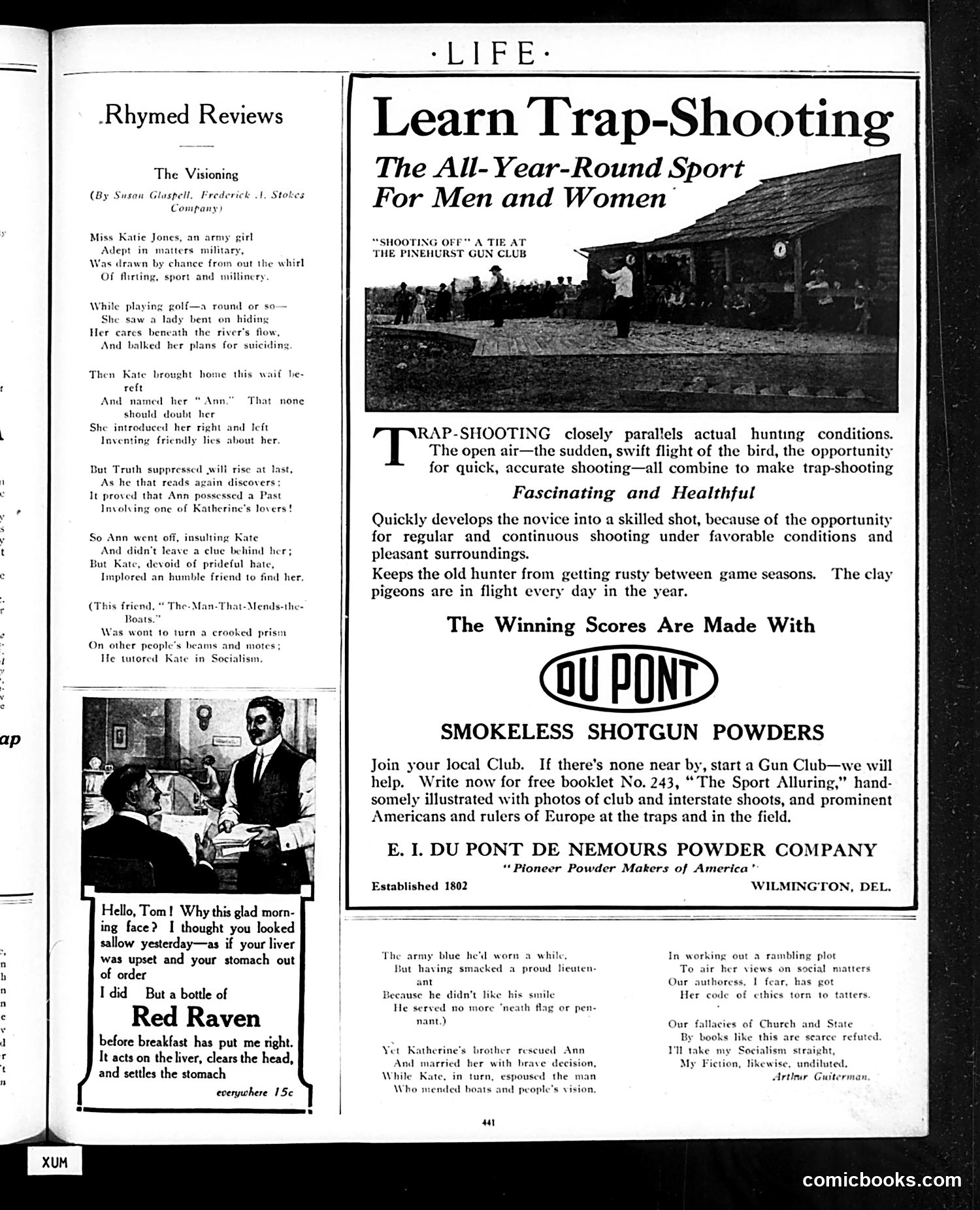
This page contains **book and product reviews**, not political satire. **Left side:** "Rhymed Reviews" critiques Susan Glaspell's novel *The Visioning*—a story about Katie Jones, an army girl who befriends a mysterious woman named Ann. The review reveals Ann has a compromising past involving Katherine's lover. The plot resolves with Katherine's brother marrying Ann, while Katherine marries "the man who mended boats." The final commentary by Arthur Guiterman dismisses the novel's social messaging, preferring "Socialism straight" and "Fiction...undiluted"—suggesting the reviewer found its moralizing heavy-handed. **Right side:** A **Du Pont Smokeless Shotgun Powders advertisement** promoting trap-shooting as healthful recreation for "men and women," paralleling actual hunting. It encourages joining gun clubs nationwide. **Bottom left:** A **Red Raven tonic advertisement** (a digestive remedy sold "everywhere" for 15¢) using a comedic dialogue about liver troubles and stomach upset. The page is primarily commercial and literary, not satirical.
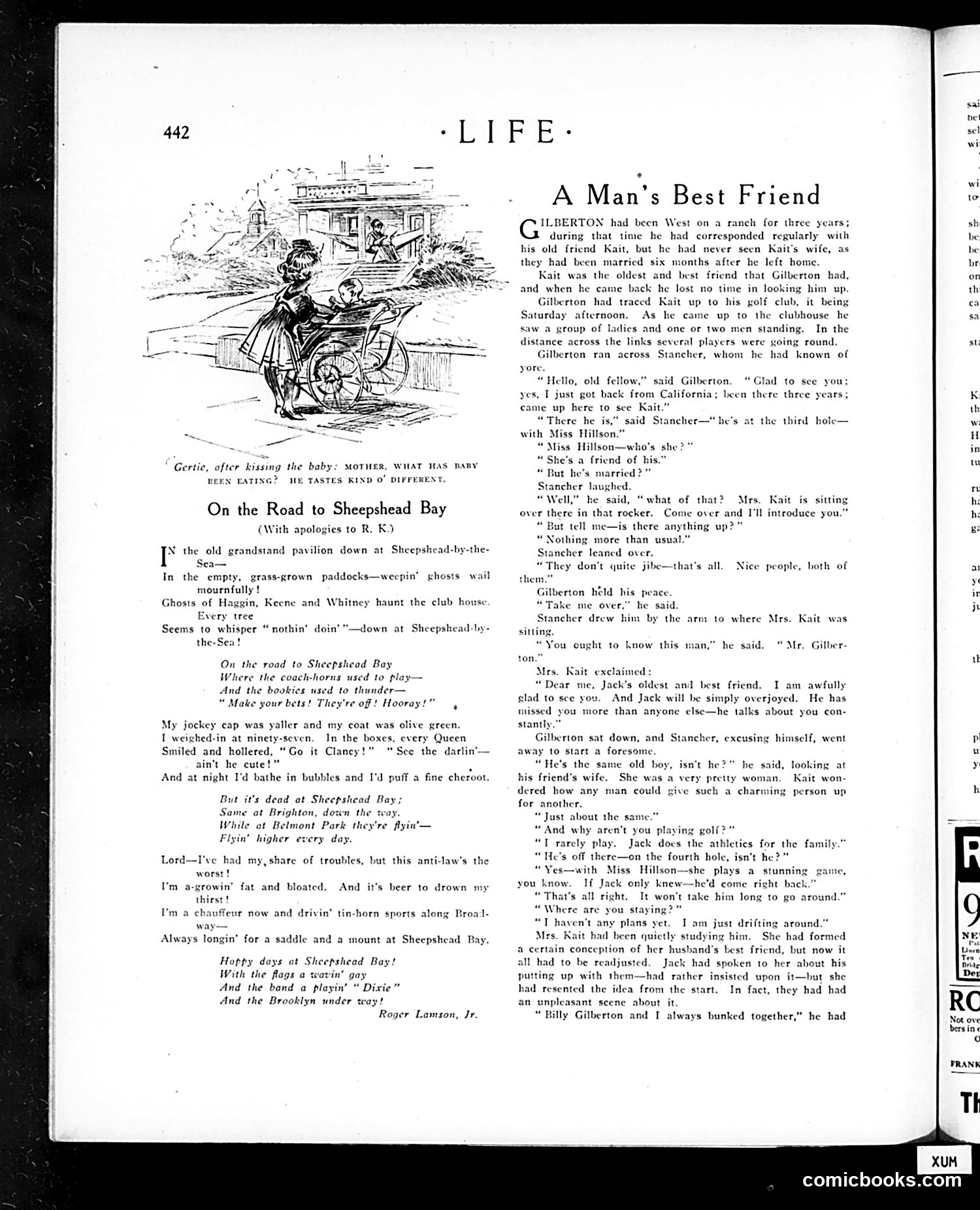
This page contains a short story about a reunion with troubling undertones. Gilberton returns from three years out West to visit his oldest friend Kait at a golf club. However, he discovers Kait is playing golf with "Miss Hillson" while Kait's wife sits alone watching—a clear social impropriety suggesting infidelity or at least inappropriate attention. The story's irony lies in Mrs. Kait's effusive greeting, praising her husband's devotion to Gilberton. Yet Gilberton observes Kait with an attractive woman while his wife remains excluded. Mrs. Kait has "formed a certain conception" of the friend but finds reality doesn't match expectations—likely recognizing that Gilberton, despite being the "best friend," hasn't prevented or addressed Kait's apparent wandering. The title's bitter humor suggests that true friendship means either enabling or ignoring a friend's questionable behavior.
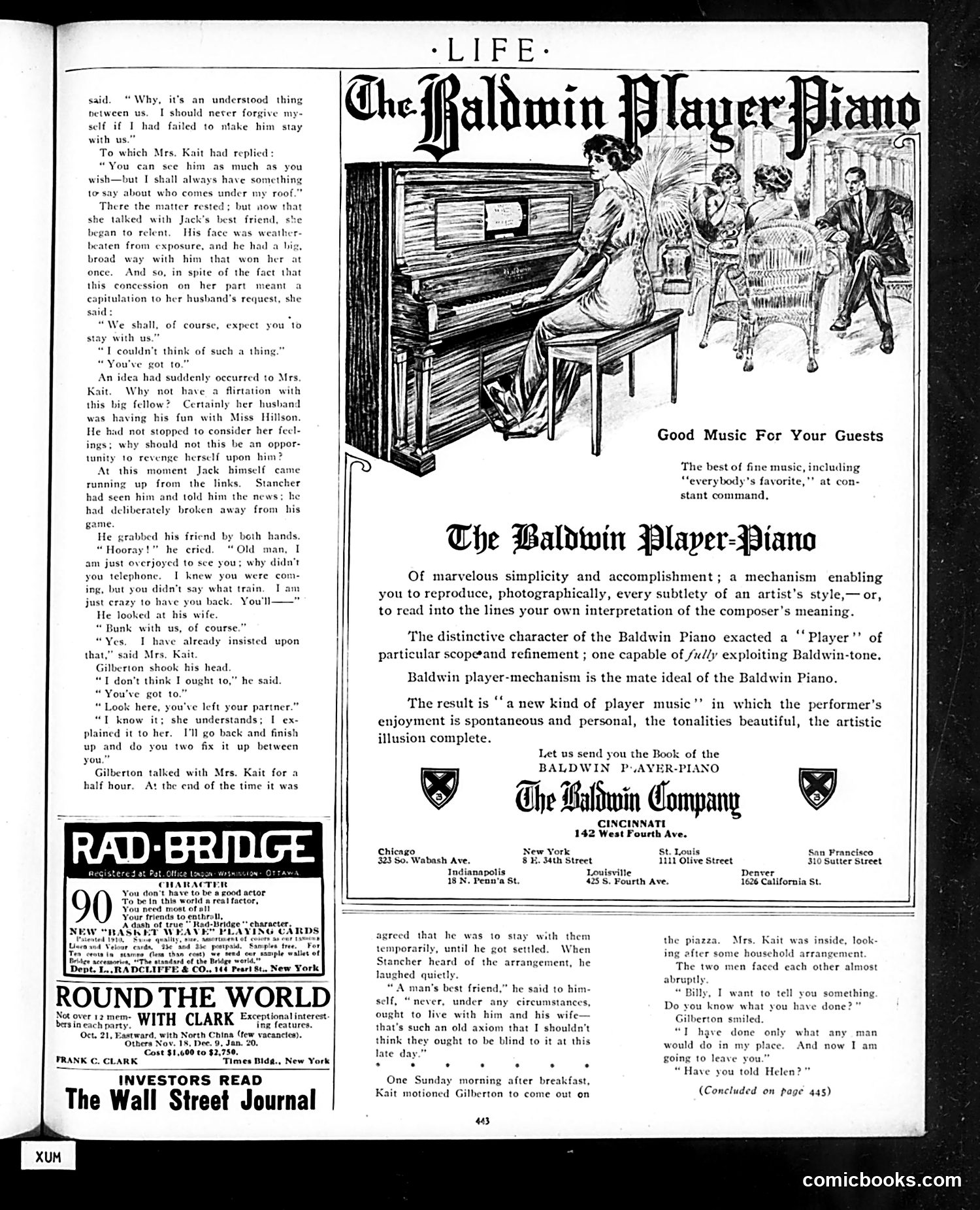
This page combines serialized fiction with period advertising. The main narrative depicts a domestic drama: Mrs. Kait, initially refusing to host her husband's friend Gilberton, gradually relents after speaking with him. The subplot suggests she contemplates flirting with Gilberton as revenge against her husband's own flirtation with "Miss Hillson"—a common theme in early 20th-century magazine fiction exploring marital tensions and social propriety. The advertisements (RAD-BRIDGE playing cards, BALDWIN PLAYER-PIANO, Wall Street Journal) represent typical Life content: products marketed to affluent readers. The player-piano ad emphasizes how mechanical reproduction allows anyone to perform "good music for your guests"—reflecting contemporary anxieties about authenticity versus convenience in the Jazz Age. The narrative itself satirizes upper-middle-class social conventions, particularly how easily principles crumble when face-to-face with charm. The story's morality remains ambiguous—whether sympathetic or critical toward Mrs. Kait's motivations is unclear from this excerpt alone.
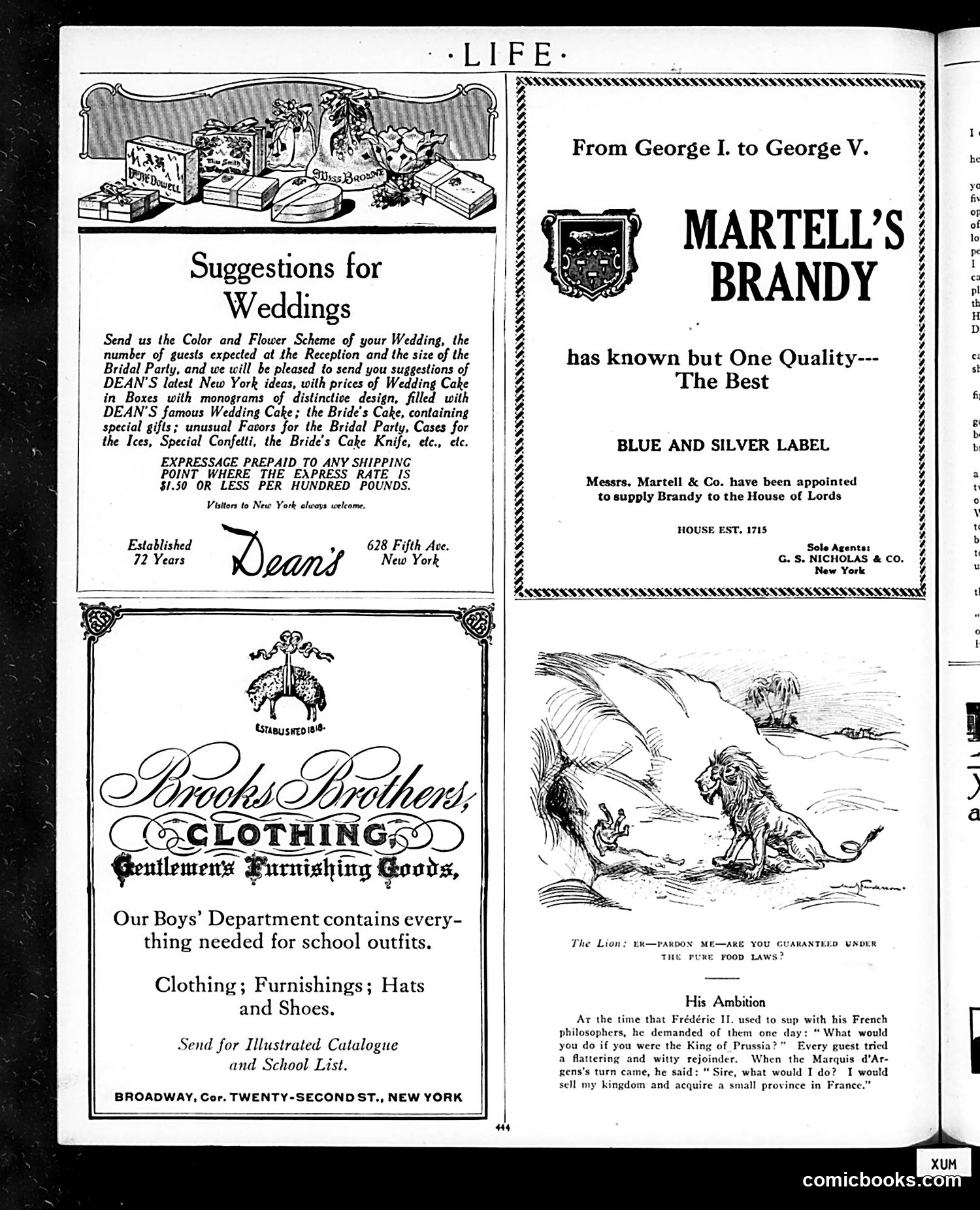
This page is primarily **advertisements** for luxury goods interspersed with one cartoon. The main content includes wedding cake services (Dean's), clothing (Brooks Brothers), and brandy (Martell's). The cartoon depicts **a lion questioning a man about pure food law compliance**—a topical reference to early 20th-century American food safety regulation (likely the 1906 Pure Food and Drug Act). The joke implies the man cannot guarantee safety, making him less trustworthy than a wild animal. Below is an anecdote titled "His Ambition," recounting a story about **King Frederick II of Prussia** and the French philosopher Marquis d'Argens. When asked what he'd do as King of Prussia, d'Argens quipped he'd sell the kingdom to acquire a French province instead—a witty commentary on French cultural superiority and Prussian inferiority, which would have amused Life's educated readership. The page reflects turn-of-the-century American attitudes: consumer confidence, European sophistication, and mild mockery of German pretension.
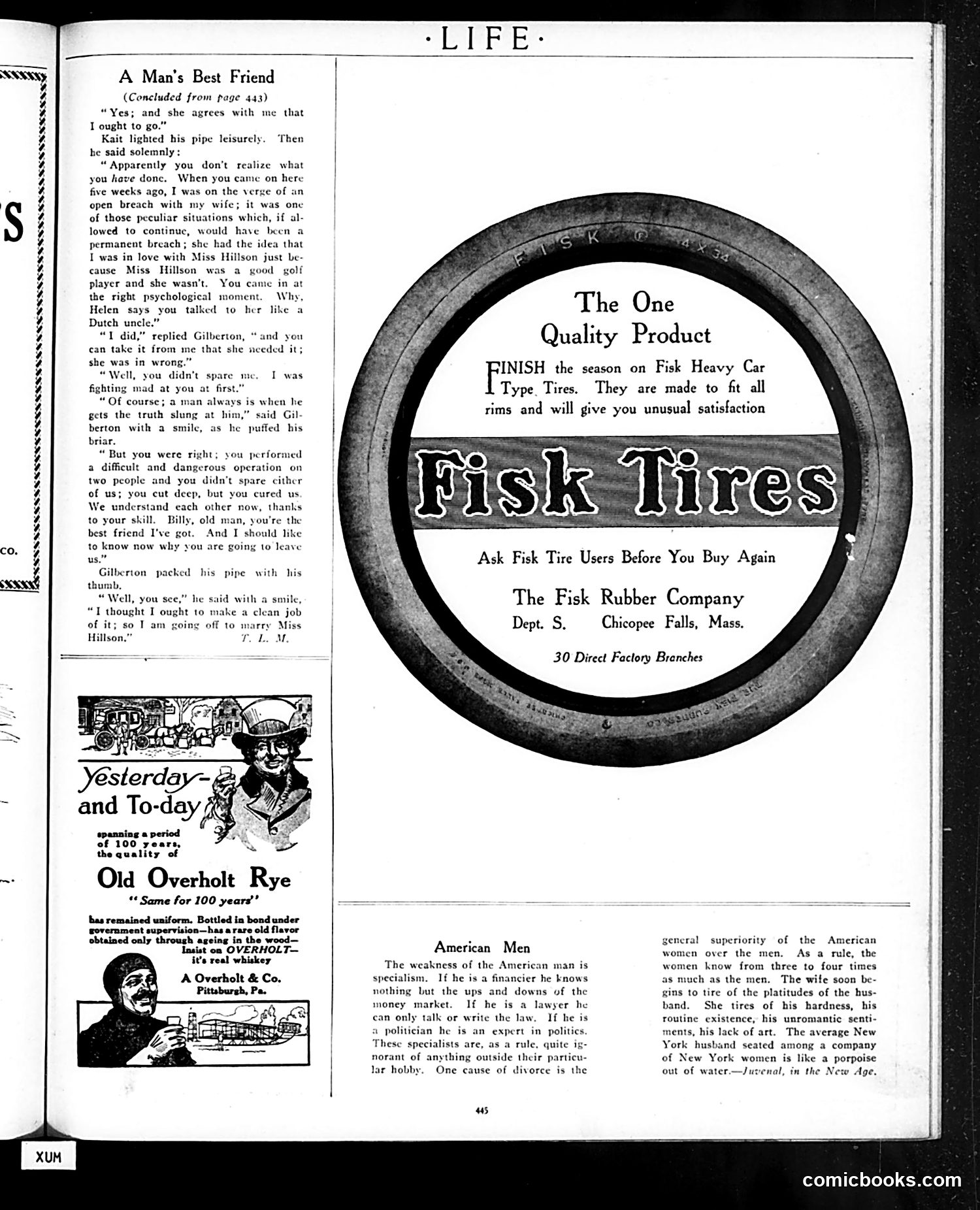
This page contains two distinct elements: **Left side:** A serialized short story conclusion titled "A Man's Best Friend." The narrative depicts a man (Gilberton) who has served as a mediator in marital conflicts for his friends Kait and Helen. The story resolves with Gilberton announcing he's leaving to marry Miss Hillson, suggesting his intervention work is complete. The humor lies in the irony: he's solved everyone else's romantic problems but now reveals his own solution. **Right side:** Mostly advertising—a large Fisk Tires advertisement and smaller ad for Old Overholt Rye whiskey. **Bottom section:** An essay titled "American Men" criticizing American males for excessive specialization in their professions (finance, law, politics) while remaining ignorant of broader knowledge. The piece argues this intellectual narrowness causes divorce, as American women are intellectually superior—knowing "three to four times as much." It's social commentary lamenting men's lack of cultural sophistication and romantic sensibility.
This is primarily an **advertisement** for Ainslee's magazine (October issue), not a political cartoon. The page uses satirical commentary to promote Ainslee's by contrasting itself with competitors. The text mocks the **tariff system on imported woolens**—a real contemporary economic issue. Life's editors humorously calculate that Americans pay duty on wool that shrinks away after washing, equivalent to enough fabric to stretch from New York to San Francisco. They sarcastically ask "Who IS getting it?"—implying corrupt politicians or manufacturers benefit from tariffs while consumers lose value. The satire's point: Life engages in hard-hitting "muck-raking" journalism (investigative exposés), while Ainslee's is "merely entertaining." This positions Life as serious social commentary versus Ainslee's as lightweight fiction. The ad lists Ainslee's October contents: a Western novel, novelettes, and short stories to establish its literary credibility against Life's implicit criticism.
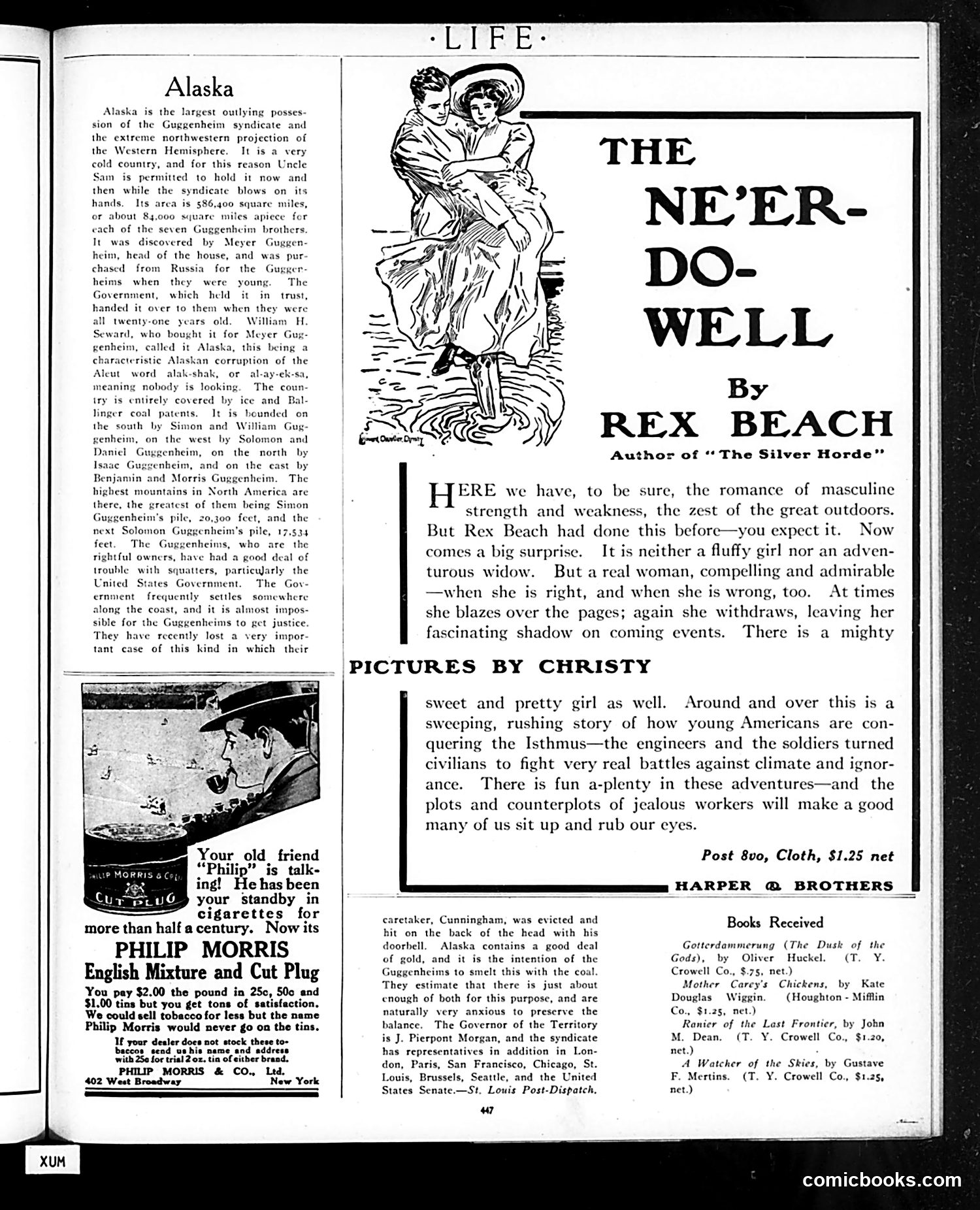
This page promotes Rex Beach's novel *The Ne'er-Do-Well*, published by Harper & Brothers. The main satirical content is the "Alaska" section—a tongue-in-cheek description mocking the Guggenheim family's dominance over Alaska's resources. The satire presents Alaska as essentially a Guggenheim private possession rather than U.S. territory, with the seven Guggenheim brothers "owning" sections divided by area. It jokes that the U.S. Government merely holds it "in trust" and that the Guggenheims face legal troubles with squatters and have "recently lost a very important case." This reflects Progressive Era concerns about wealthy industrialists controlling vast natural resources and the government's inability to regulate them effectively. The Guggenheims were real mining magnates heavily invested in Alaska. The accompanying cigarette advertisement for Philip Morris is unrelated editorial content.
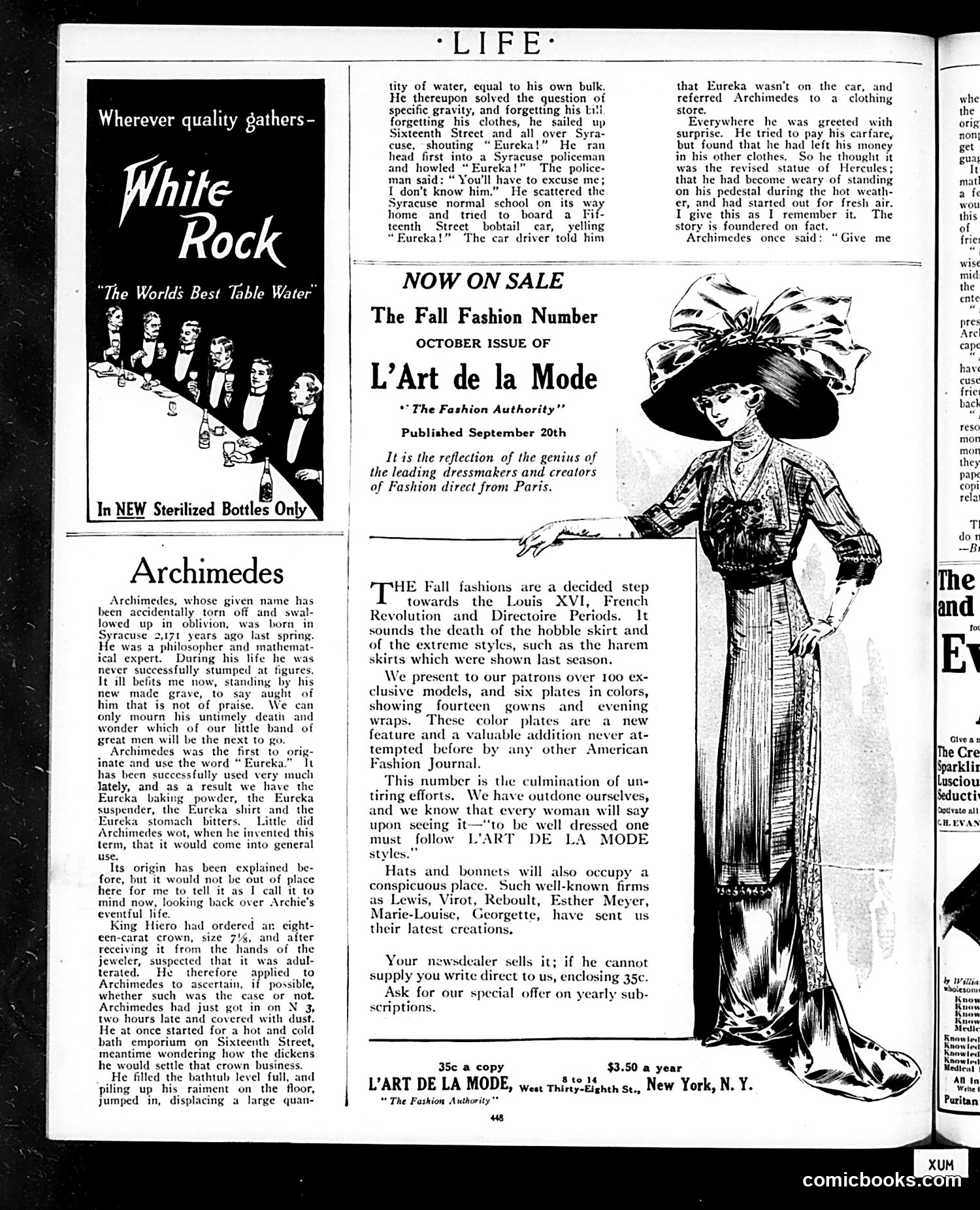
This page contains a humorous retelling of the famous Archimedes bathtub story. The satire mocks how the word "Eureka" (meaning "I have found it") has been commercialized in modern times—applied to everything from baking powder to suspenders to stomach bitters. The joke: Ancient Archimedes discovered the principle of water displacement while bathing, then ran naked through Syracuse shouting "Eureka!" The satirist uses this dignified historical moment to lampoon contemporary advertising culture. While Archimedes solved an important mathematical problem, modern businesses merely slap "Eureka" on ordinary consumer products, trivializing his genuine intellectual achievement. The piece implies criticism of American commercial excess and marketing practices that exploit any catchy word or historical reference for profit, regardless of relevance.
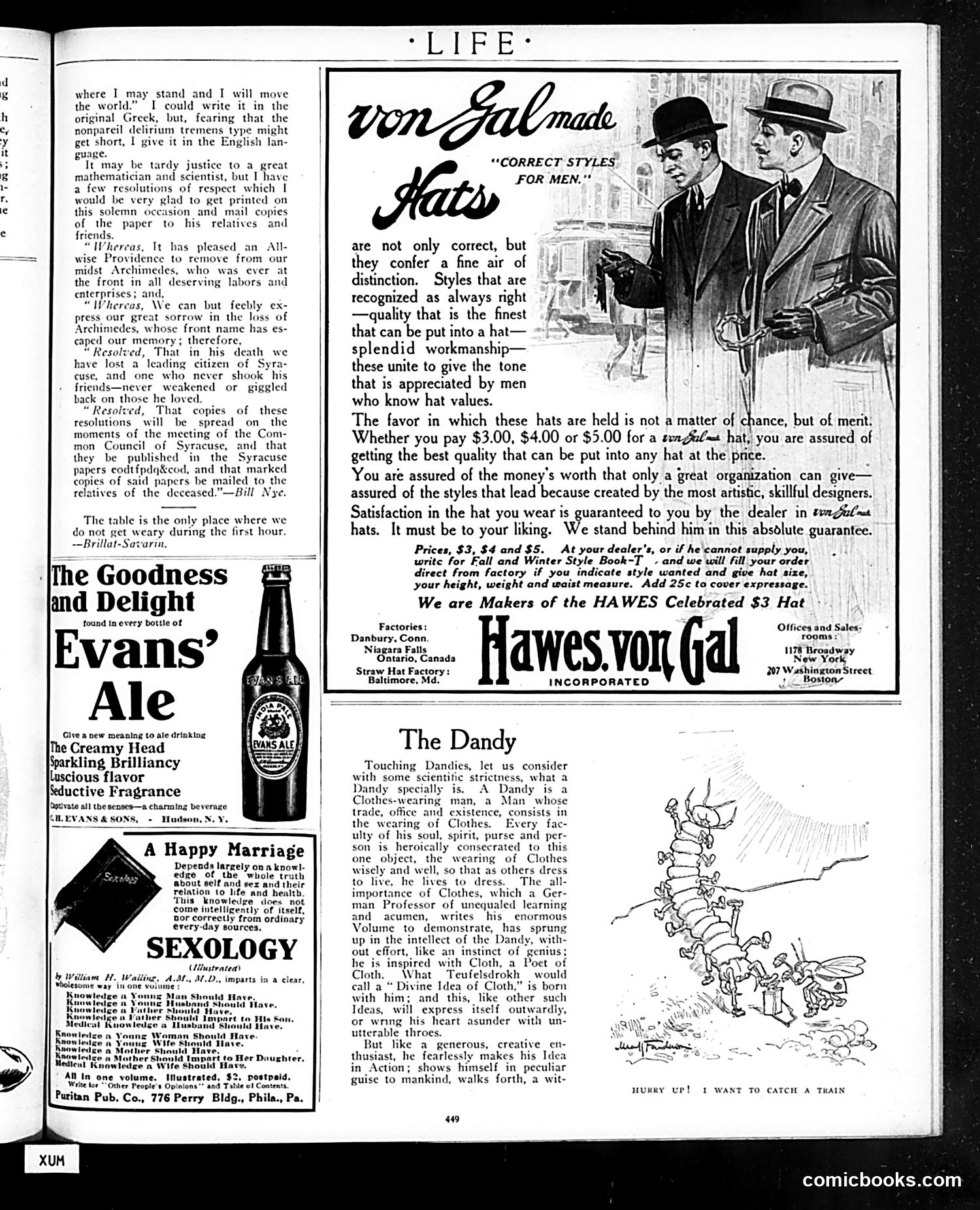
This page contains mostly **advertisements** rather than political satire. The main content includes: **Von Gal Hats advertisement** (center): A pitch for men's hats at $3-5, featuring two well-dressed men. The ad emphasizes "correct styles" and quality craftsmanship—standard early 20th-century menswear marketing with no satirical content. **"The Dandy" article** (bottom right): A humorous essay about the "Dandy"—a man obsessed with clothing and fashion. The text references a German professor who wrote extensively about clothes' importance, treating fashion as a serious intellectual subject. The satire mocks this over-intellectualization of mere clothing choices. **Side advertisements**: Evans' Ale, a "Sexology" book (promising marital advice), and other period products. The page reflects early 1900s consumer culture and social attitudes about masculinity, fashion, and self-presentation. "The Dandy" satire gently ridicules men who take their appearance too seriously.
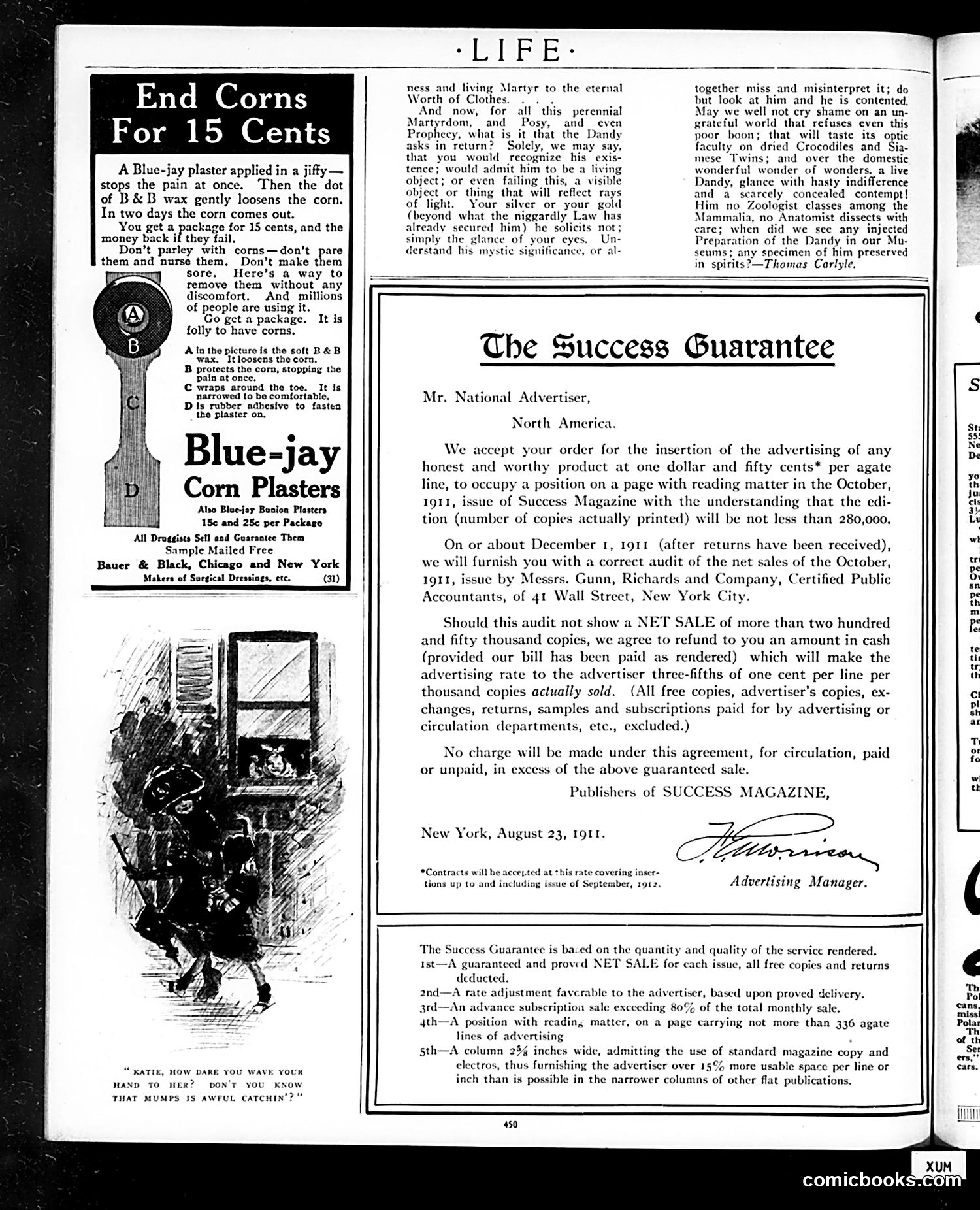
This page mixes advertisements with editorial content and one cartoon. The cartoon (bottom left) shows a child being scolded for waving at someone with mumps—a commentary on contagious disease awareness and social etiquette around illness in the early 1900s. The main content is **advertising**: Blue-jay corn plasters (15 cents) with product diagrams, and a "Success Guarantee" contract from Success Magazine offering advertisers audited circulation numbers. The Success Guarantee promises refunds if October 1911 circulation falls below 250,000 copies—an early form of **accountability advertising** aimed at building trust with national advertisers. The page also includes a lengthy excerpt (unclear source, possibly Carlyle) mocking "Dandies"—fashionable men concerned with appearance—suggesting they deserve society's indifference.
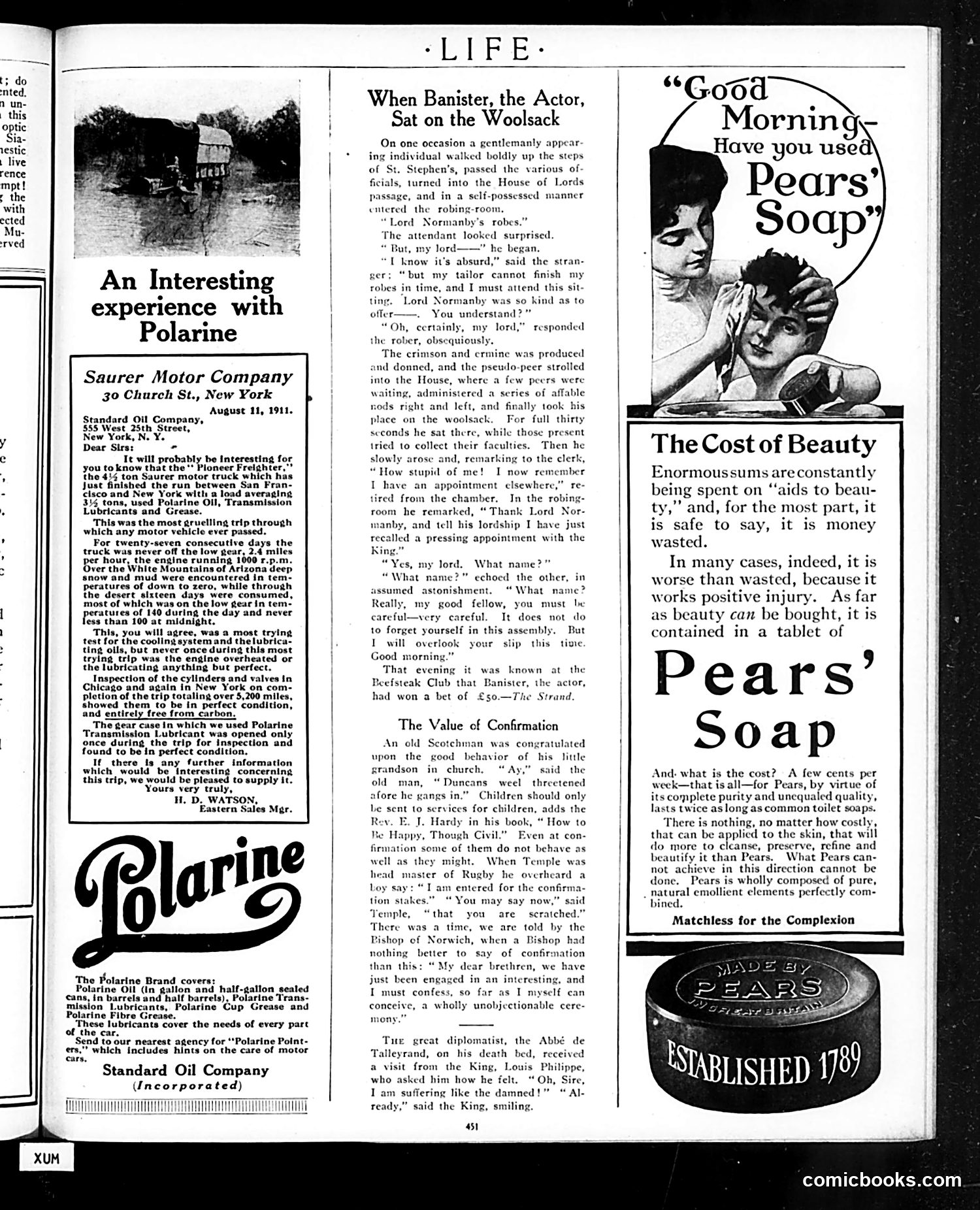
This satirical anecdote describes actor Banister's successful prank: he infiltrates the House of Lords by borrowing Lord Normanby's ceremonial robes under the pretense that his tailor hasn't finished his own. Sitting on the woolsack (the seat of the Lord Chancellor), he goes undetected for thirty seconds before excusing himself with a fabricated appointment "with the King." The humor targets the British aristocracy's superficiality and class pretensions—that a peer can be impersonated based solely on costume and confident demeanor, with no one questioning his identity. The prank exposes how institutional prestige relies on external trappings rather than actual verification. Banister wins a £50 bet, suggesting this was deliberately staged. The piece mocks both the gullibility of Parliament's guardians and the performative nature of aristocratic authority itself.
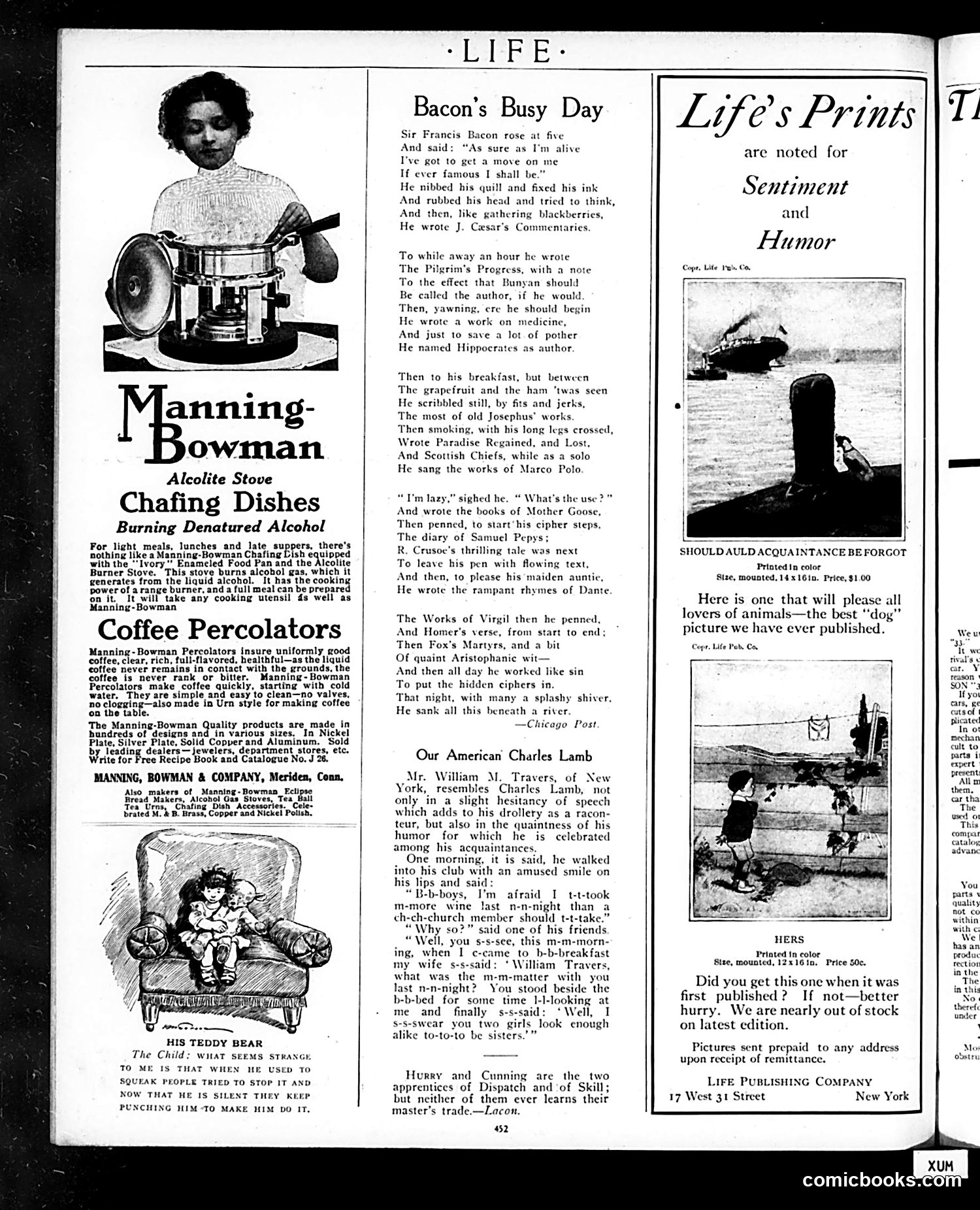
This page primarily contains **advertisements and humorous literary content** rather than political cartoons. **The main humor pieces:** 1. **"Bacon's Busy Day"** — A satirical poem suggesting Sir Francis Bacon wrote virtually all major English literature (Caesar's Commentaries, Paradise Lost, Mother Goose, etc.) as casual daily tasks, then destroyed it all. The joke mocks both Bacon's famous philosophy and literary attribution debates of the era. 2. **"Our American Charles Lamb"** — A brief anecdote about William M. Travers, a New York socialite who resembles the English essayist Charles Lamb. The humor involves his stammering speech and a joke about drinking too much wine at church-member standards—typical genteel humor of the period. 3. **"His Teddy Bear"** — A short cartoon caption about a child noting that adults tried stopping his bear's squeak but now punch it to make noise—mild social observation humor. The bulk of the page consists of **Manning-Bowman kitchen equipment advertisements** (chafing dishes, coffee percolators) and **Life's Prints animal photography** with sentimental captions.
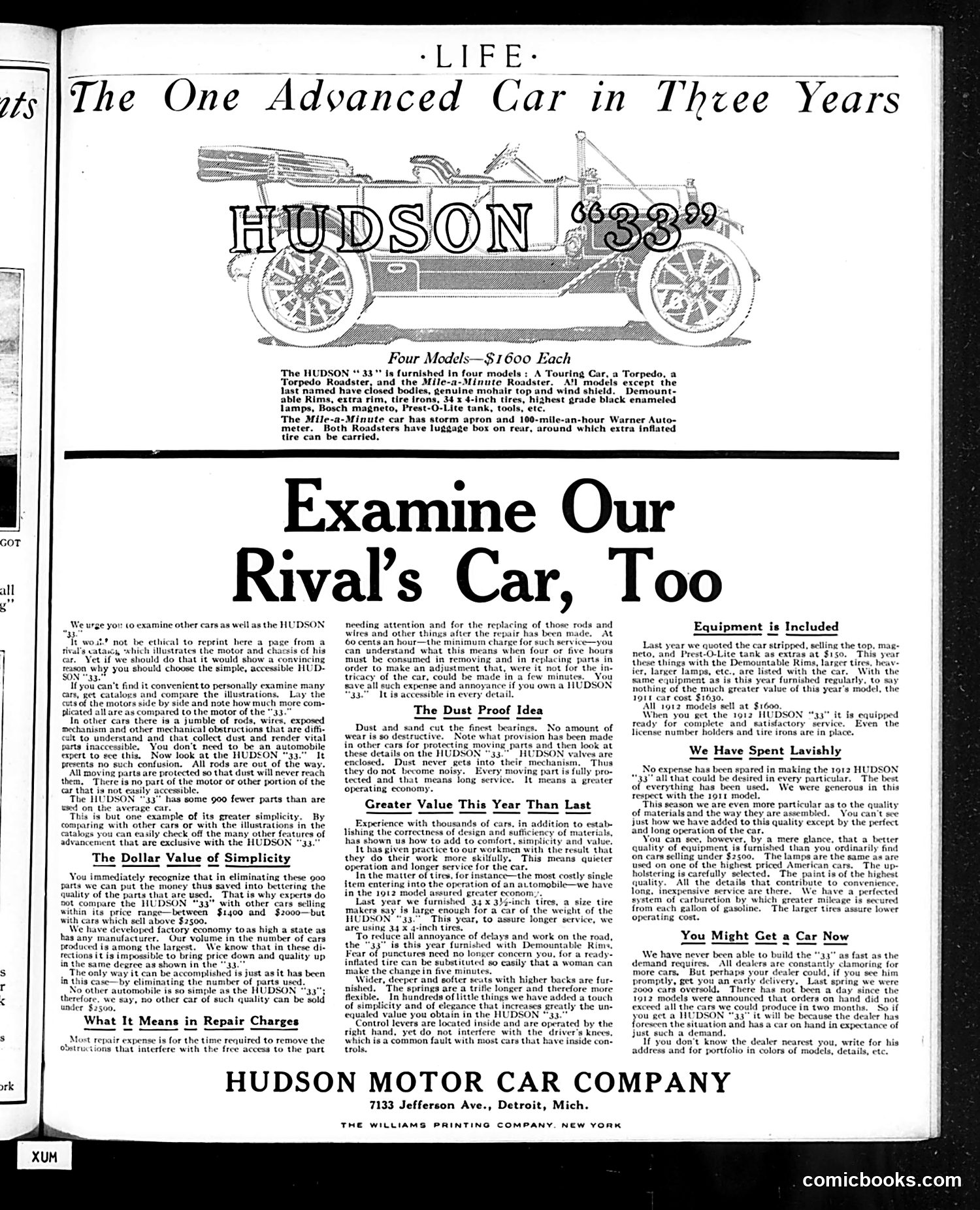
This page is primarily **advertising, not satire or cartooning**. It's a 1912 Hudson "33" automobile advertisement from *Life* magazine. The headline "Examine Our Rival's Car, Too" is a competitive sales pitch, not satire. Hudson challenges readers to compare their vehicle's design against competitors, emphasizing the Hudson's **accessibility and simplicity** versus rival cars with complicated, dust-prone mechanisms. Key sales arguments include: - **Four models at $1,600 each** - **Simple, accessible design** with exposed rods and parts easy to service (not hidden like competitors) - **Dust-proof engineering** protecting moving parts - **Superior value and equipment** included as standard The page uses technical comparisons to argue the Hudson's engineering superiority, appealing to buyers concerned about maintenance costs and reliability—practical concerns for early automotive purchasers when cars required frequent service.
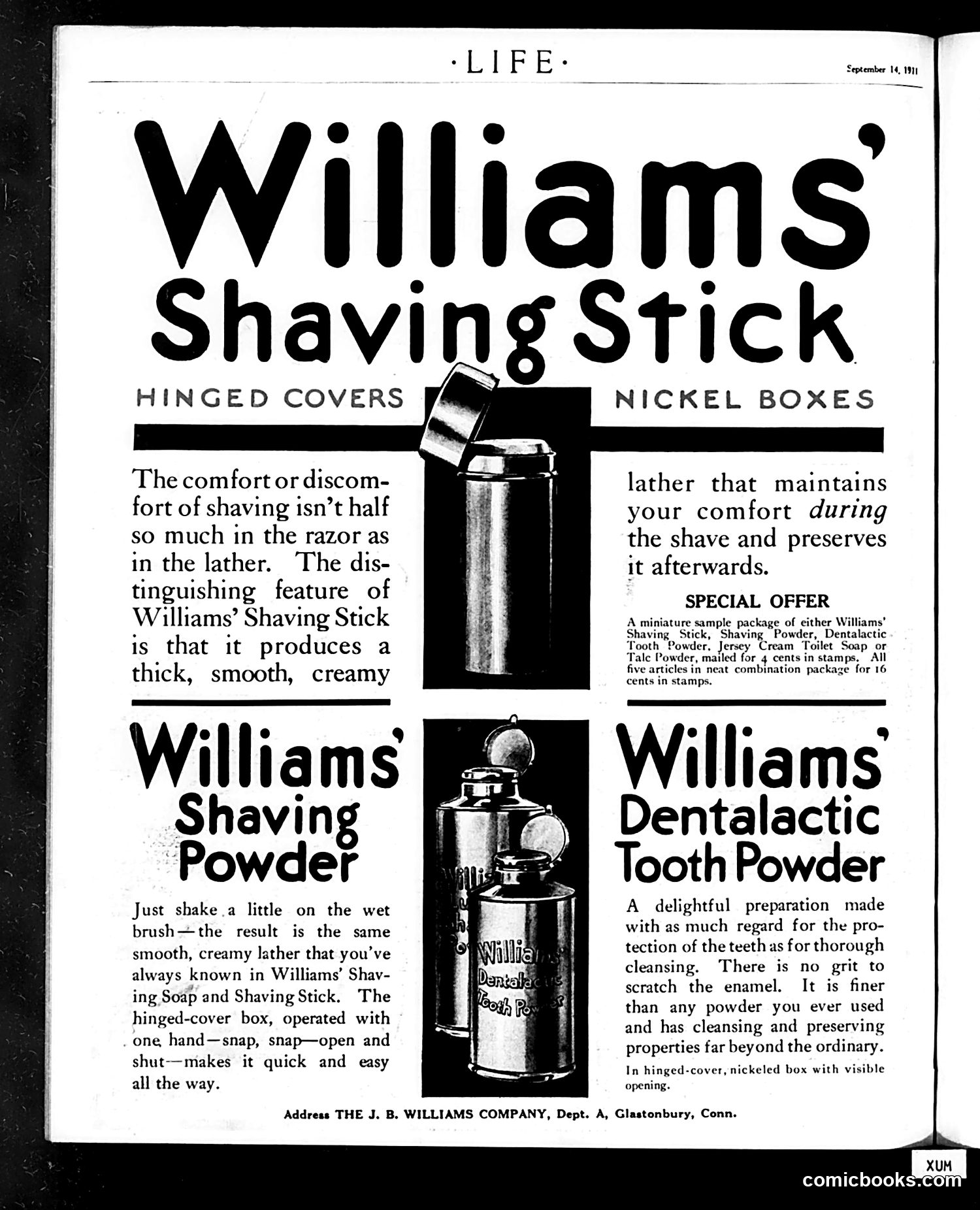
This is **not a political cartoon or satire**—it's a straightforward product advertisement from Life magazine, September 14, 1911. The page promotes three grooming products by the J.B. Williams Company: shaving stick, shaving powder, and dentalactic tooth powder. Each product is shown in its nickel-plated hinged box and described with period marketing language emphasizing comfort, quality, and convenience. The "joke" or appeal is purely commercial: the advertisements highlight practical features (one-handed operation, smooth lather, non-gritty formula) and offer a special deal—sample packages of all five Williams products for 16 cents in stamps. This reflects early 20th-century advertising norms in Life magazine, which mixed satirical content with commercial pages. There are no political references, caricatures, or hidden meanings—just vintage men's grooming marketing aimed at readers of a humor publication.