
Life, 1911-09-14 · page 26 of 46
Life — September 14, 1911 — page 26: what you’re looking at
What you’re looking at
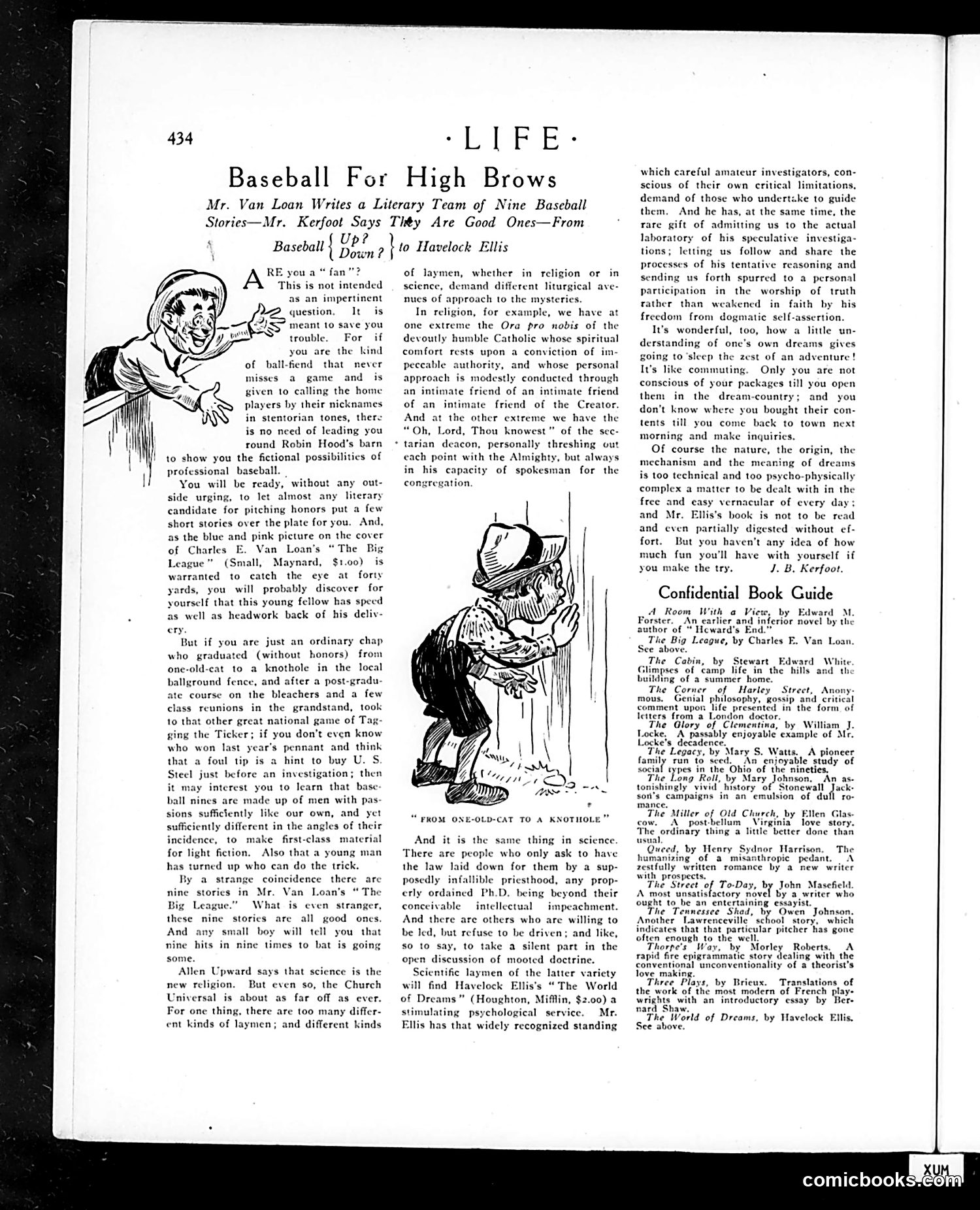
This article mocks the pretension of treating baseball—America's working-class sport—with literary seriousness. The opening cartoon depicts a stereotypical "fan" (caricatured with exaggerated features), labeled "FROM ONE-OLD-CAT TO A KNOTHOLE," tracing an everyman's journey from sandlot games to bleacher-sitting. The satire targets intellectuals ("high brows") who might dismiss baseball as unworthy of serious fiction, while simultaneously noting that Charles E. Van Loan has written nine surprisingly good short stories about professional baseball. The piece argues baseball has legitimate human drama—the players possess "passions sufficiently like our own"—making it worthy material for quality literature. The broader point: even lowbrow subjects merit serious artistic treatment when handled well. The tone is gently mocking toward both baseball snobs and literary elitists.
📄 Transcribed text from this page (OCR, searchable)
Machine-transcribed from the original scan — historical spelling and the odd misread are preserved.
Baseball For “LIFE- High Brows Mr. Van Loan Writes a Literary Team of Nine Baseball Stories—Mr. Kerfoot Says Thty Are Good Ones—From Down? RE you a “ fan"? This is not intended as an impertinent question, It is meant to save you trouble. For if you are the kind f ball-fiend that never game and is Basebait { Up? misses a given to calling the home players by their nicknames in stentorian tones, there is no nced of leading you round Robin Hood's barn to show you the fictional possibilities of professional baseball. You will be ready, without any out- side urging, to let almost any literary candidate for pitching honors put a few short stories over the plate for you. And, as the blue and pink picture on the cover of Charles E. Van Loan's “The Big League” (Small, Maynard, $1.00) is warranted to catch the eye at forty yards, you will probably discover for yourself that this young fellow has speed as well as headwork back of his deli cry But if you are just an ordinary chap who graduated (without honors) from one-old-eat to a knothole in the local ballground fence, and after a post-gradu- ate course on the bleachers and a few class reunions in the grandstand, took to that other great national game of Tag- ging the Ticker; if you don’t even know who won last year’s pennant and think that a foul tip is a hint to buy U. S. Steel just before an investigation; then it may interest you to learn that base ball nines are made up of men with pas- sions sufficiently like our own, and yet sufficiently different in the angles of their incidence, to make first-class material for light fiction. Also that a young man has turned up who can do the trick. coincidence there arc nine stories in Mr. Van Loan’s “ The Big League.” What is even stran these nine stories are all good ones. And any small boy will tell you that nine hits in nine times to bat is going some. Allen Upward says that science is the But even so, the Church Universal is about as far off as ever. For one thing, there are too many differ- ent kinds of laymen; and different kinds Ry a. strange new religion. + to Havelock Ellis of laymen, whether in religion or in science, demand different liturgical ave- nues of approach to the mysteries. In religion, for example, we have one extreme the Ora pro nobis of the devoutly humble Catholic whose spiritual comfort rests upon a conviction of im- peccable authority, and whose personal approach is modestly conducted through an intimate friend of an intimate friend of an intimate friend of the Creator. And at the other extreme we have the “Oh, Lord, Thou knowest” of the sec- tarian deacon, personally threshing out cach point with the Almighty, but always in his capacity of spokesman for the congregation st | “PROM ONE-OLD-CAT TO A KNOTHOLE" And it is the same thing in science There are people who only ask to have the law laid down for them by a sup- posedly infallible priesthood, any prop- erly ordained Ph.D. being beyond their conceivable intellectual impeachment. And there are others who are willing to be led, but refuse to be driven; and like, so to say, to take a silent part in the open discussion of mooted doctrine. Scientific laymen of the latter variety will find Havelock Ellis’s “The World of Dreams” (Houghton, Mifflin, $2.00) a stimulating psychological service. Mr. Ellis has that widely recognized standing which careful amateur investigators, con- scious of their own critical limitations, demand of those who undertake to guide them. And he has, at the same time, the rare gift of admitting us to the actual laboratory of his speculative investiga- tions; letting us follow and share the processes of his tentative reasoning and sending us forth spurred to a personal participation in the worship of truth rather than weakened in faith by his freedom from dogmatic self-assertion. It’s wonderful, too, how a little un- derstanding of one’s own dreams gives going to'sleep t zest of an adventure! It’s like commuting. Only you are not conscious of your packages till you open them in the dream-country; and you don't know where you bought their con- tents till you come back to town next morning and make inquiries. Of course the nature, the origin, the mechanism and the meaning of dreams is too technical and too psycho-physically complex a matter to be dealt with in the free and easy vernacular of every day; and Mr. Ellis's book is not to be read and even partially digested without ef- fort. But you haven't any idea of how much fun you'll have with yourself if you make the try. J. B. Kerfoot. Confidential Book Guide A Room With a View, by Edward M. Forster. An earlier and inferior novel by the author of “ Heward’s End.” League, by Charles E. Van Loan The Cabin, by Stewart Edward White impses of camp life in the hills and the building of a summer home. The Corner of Harley Strect, Anony- mous. Genial philosophy, gossip and criti comment upon life presented in the form of letters from a London doctor. The Glory of Clementina, by William J. Locke, A passably enjoyable example of Mr. Locke's decadence. The Legacy, by Mary S, Watts. A pioneer ly run to seed. An enjoyable study of types in the Ohio of the nineties, Tie Long Roll, by Mary Johnson. “An as. tonishingly vivid’ history of Stonewall Jack- son's campaigns in an emulsion of dufl ro- mance. The Miller of Old Church, by Ellen Glas cow. Av postbellum Virginia’ love story. The’ ordinary thing a litle better done than Queed, by Henry Sydnor Harrison. The humanizing of a misanthropic pedant. zestfully written romance by a new writer with prospects, The Street of To-Day, by John Masefield. A most unsatisfactory novel by a writer who ought to be an entertaining essayist. The Tennessee Shad, by Owen Johnson. Another Lawrenceville" school story, which dicates that that particular pitcher has gone often enough to the well. Thorpe's Way, by Morley Roberts, A rapid fire epigrammatic story dealing with the conventional unconventionality of a theorist’s love making. Three Plays, by Brieux. Translations of the work of the most modern of French play- wrights with an introductory essay by Ber- nard Shaw. The World of Dreams, by Havelock Ellis, Sce above. comicbookMen ql