
Life, 1911-09-14 · page 23 of 46
Life — September 14, 1911 — page 23: what you’re looking at
What you’re looking at
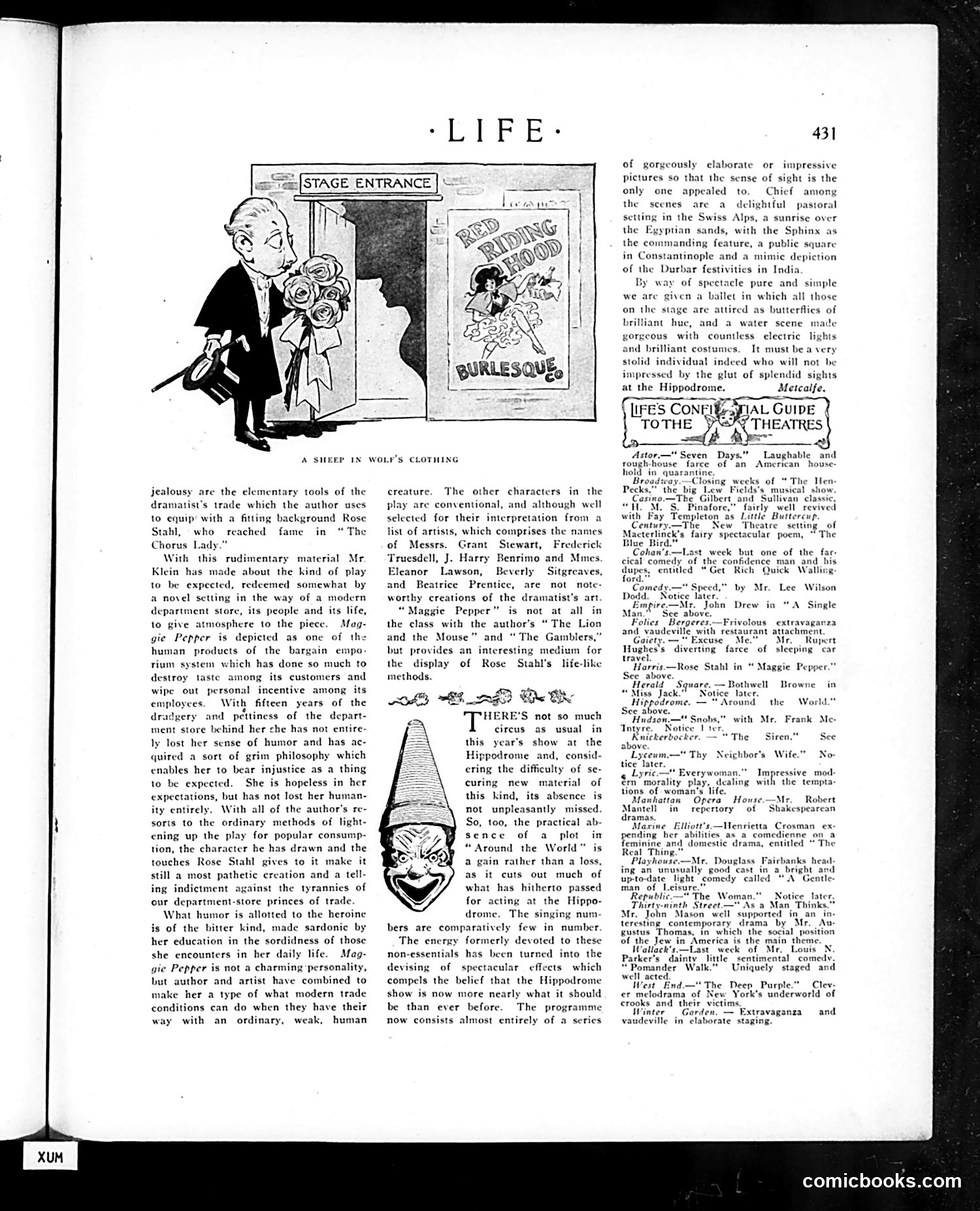
This cartoon illustrates a theatrical review of a play titled "Maggie Pepper," starring Rose Stahl. The visual pun in the title suggests deception or disguise—the well-dressed gentleman entering through the "Stage Entrance" carrying roses appears refined on the surface, but the accompanying text reveals the play itself concerns a department store worker depicted as a product of commercial exploitation. The satire targets both the theatrical production and modern consumer capitalism. The review criticizes the play as formulaic melodrama, noting its characters are "conventional" and the work inferior to the author's previous successes. More broadly, it indicts "department-store princes of trade" for their tyranny over ordinary workers like the titular character—depicting commercial systems as inherently dehumanizing. The cartoon's sophistication lies in its visual-textual irony: respectable theatrical presentation masks darker social commentary about labor and commerce.
📄 Transcribed text from this page (OCR, searchable)
Machine-transcribed from the original scan — historical spelling and the odd misread are preserved.
A SMEEP IN WOLP’S CLOTHING jealousy are the elementary tools of the dramatist’s trade which the author uses to equip: with a fitting background Rose Stahl, who reached fame in “The Chorus Lady With this rudimentary material Mr Klein has made about the kind of play to be expected, redeemed somewhat by a novel setting in the way of a modern department store, its people and its life, to give atmosphere to the piece. Mag- gie Pepper is depicted as one of the human products of the bar, cmpo rium system which has done so much to aste among its customers and personal incentive among its employees. With fifteen years of the dradgery and pettiness of the depart- ment store behind her che has not entire- ly lost her sense of humor and has ac- quired a sort of grim philosophy which enables her to bear injustice as a thing to be expected. She is hopeless in her expectations, but has not lost her human- ity entirely. With all of the author's r soris to the ordinary methods of light- ening up the play for popular consump- tion, the character he has drawn and the touches Rose Stahl gives to it make it still a most pathetic creation and a tell- ing indictment against the tyrannies of our department-store princes of trade: What humor is allotted to the heroine is of the bitter kind, made sardonic by her education in the sordidness of those she encounters in her daily life. Mag- gie Pepper is not a charming personality, but author and artist have combined to make her a type of what modern trade conditions can do when they have their way with an ordinary, weak, human ipe out The other characters in the play are conventional, and although well selected for their interpretation from a list of artists, which comprises the names of Messrs. Grant Stewart, Frederick Truesdell, J. Harry Benrimo and Mmes Lawson, Beverly Sitgreaves, Beatrice Prentice, are not worthy creations of the dramatist’s art “Maggie Pepper” is not at all in the class with the author's “The Lion and the Mouse” and “The Gamblers,” but provides an interesting medium for the display of Rose Stahl’s life-like methods. oh BSED Te BY HERE'S not so much circus as usual in this year’s show at the Hippodrome and, consid- ering the difficulty of se- curing new material of this kind, its absence is not unpleasantly missed. So, too, the practical ab- sence of a plot in “Around the World” is a gain rather than a loss, as it cuts out much of what has hitherto passed for acting at the Hippo- drome. The sing! bers are comparatively few in number. The energy formerly devoted to these non-essentials has been turned into the devising of spectacular effects which compels the belief that the Hippodrome show is now more nearly what it should be than ever before. The programme now consists almost entirely of a series creature. note- 431 of gorgeously elaborate or impressive pictures so that the sense of sight is the only one appealed to. Chief the scenes are a delightful setting in the Swiss Alps, a sunrise over among pastoral the Egyptian sands, with the Sphinx as the commanding feature, a public square in Constantinople and a mimic depiction of the Durbar festivities in India By way of spectacle pure and simple we are given a ballet in which all those on the stage are attired as butterflies of brilliant hue, and a water scene made countless electric lights and brilliant costumes. gorgeous with It must be a very stolid individual indeed who will not be impressed by the glut of splendid sights Metcalfe. (IFES CoNFIg; arial Guipe 2 THEATRES at the Hippodrome. ‘I TOTHE Y Asto rough:h of an hold in Laughable American ecks of “The Hen- ids's musical show. —The Gilbert and Sullivan classic, . M. S. Pinafore,” fairly well revived with Fay Templeton as Little Buttercup. Century. New Theatre setting s fairy spectacular poem, ™ The Cohan’s'—Last week but one of the far- cical comedy of the confidence man and his dupes, entitled “Get Rich Quick Walling Comedy.—" Speed,” by Mr. Dada. , Notice later. - Sick npire—Mr. John Drew in “A Single Mans?’ See above. Folies Bergeres.—Frivolous extravaganza and vaudeville with restaurant attachment Gaiety. Excuse. Me.” Mr, Rupert Hughes's diverting farce of sleeping car travel Harris—Rose Stahl in “ Maggie Pepper.” See above. Herald | Square. “Miss Jack." Nos Hippodrome. — * See abovi Lee Wilson Bothwell ce later. Around’ the Browne in World. Snobs,” - “The with Mr. Frank Me- Intyre, Knickerbock above. Lyceum.—" Thy tice later. Lyric.—"* Everywoman, fm" morality play, dealing w tions of woman's life. Manhatton Opera Honse.—Mr. Robert Mantell in repertory of Shakespearean Marine Siren." See Neighbor's Wife.” No- Impressive mod- the tempta- jiott's.—Henrietta Crosman ex pending her abilities as a comedienne on a feminine and domestic drama, entitled “ The Real Thing.” Playhouse.—Mr. Douglass Fairbanks hi ing an unusually good cast ic ent a uptodate light comedy calle Gentle man of Leisure.” Republic.—* The Woman.” Notice later. Thirty-ninth Street—" As a Man Thinks.”* Mr. John Mason well supported in an in- teresting contemporary drama by Mr. Au- gustus Thomas, in which the social position of the Jew in America is the main theme. Waltack’s.—Last_ weck of Mr. Louis N. Parker's dainty little sentimental comedy, “Pomander Walk.” Uniquely staged a: well acted. West End— The Deen Purple.” Clev- er melodrama of New York's underworld of crooks and their victims Winter rden. — Extravaganza and vaudeville in elaborate staging. comicbooks.com