
Life, 1911-09-14 · page 22 of 46
Life — September 14, 1911 — page 22: what you’re looking at
What you’re looking at
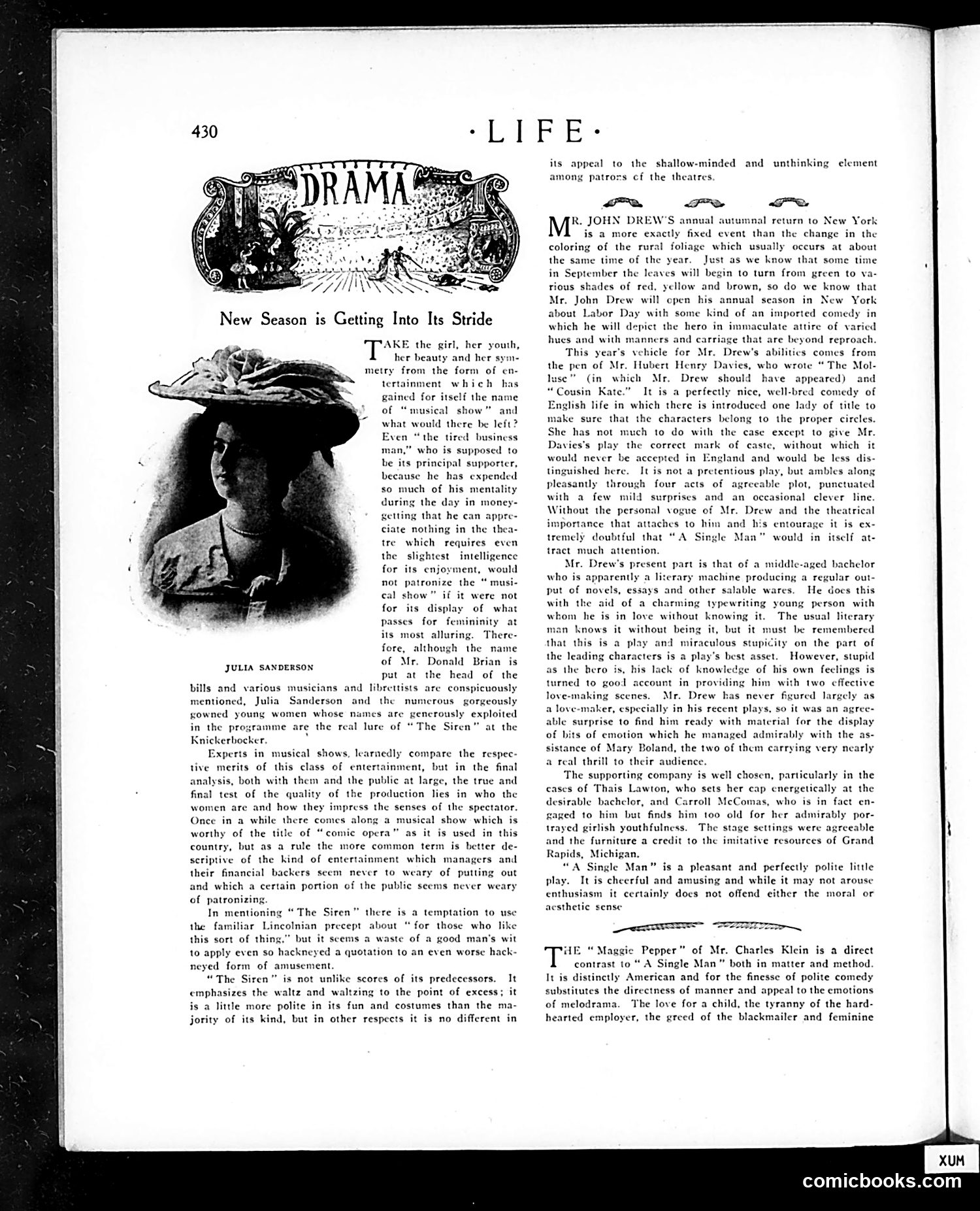
This page critiques early 20th-century American musical theater through reviews of two Broadway productions: "The Siren" (starring Julia Sanderson and Donald Brian) and an unnamed John Drew vehicle. **The Satire:** The author argues that musical shows succeed entirely through **displaying attractive women**, not artistic merit. He dismisses the genre as mindless entertainment for "the tired business man" seeking visual spectacle rather than intelligence. "The Siren" exemplifies this—despite featuring respected performers, it's merely a waltz-heavy show exploiting female beauty and elaborate costumes. **The Point:** Life magazine's satire targets the superficiality of commercial theater that prioritizes glamour over substance. The author suggests audiences and producers willingly participate in this cycle of lowbrow entertainment, treating women performers as decorative rather than talented artists. **Context:** This reflects period anxieties about mass entertainment dumbing down cultural standards while acknowledging its commercial inevitability.
📄 Transcribed text from this page (OCR, searchable)
Machine-transcribed from the original scan — historical spelling and the odd misread are preserved.
“LIP eE= New Season is Getting Into Its Stride AKE the girl, her youth, her beauty and her sym- metry from the form of en- tertainment which gained for itself the name of “musical show” and what would there be left? Even “the tired business man,” who is supposed to be its principal supporter, because he has expended so much of his mentality during the day in money- getting that he can appre- ciate nothing in the the: tre which requires even the slightest intelligence for its enjoyment, would not patronize the “ musi- cal show" if it were not for its display of w passes for femininity at its most alluring. Ther fore, although the name of Mr. Donald Brian is put at the head of the bills and various musicians and librettists are conspicuously mentioned, Julia Sanderson and the numerous gorgeously gowned young women whose names are generously exploited in the programme are the real lure of “The Siren” at the Knickerbocker . Experts in musical shows, learnedly compare the respec: tive merits of this class of entertainment, but in the final analysis, both with them and the public at large, the true and final test of the quality of the production lies in who the women are and how they impress the senses of the spectator. Once in a while there comes along a musical show which is worthy of the title of “comic opera” as it is used in this country, but as a rule the more common term is better de- scriptive of the kind of entertainment which managers and their financial backers scem never to weary of putting out and which a certain portion of the public seems never weary of patronizing In mentioning “The Siren" there is a temptation to use the familiar Lincolnian precept about “for those who like this sort of thing.” but it seems a waste of a good man's wit to apply even so hackneyed a quotation to an even worse hack- neyed form of amusement “The Siren” is not unlike scores of its predecessors. It emphasizes the waltz and waltzing to the point of excess; it is a little more polite in its fun and costumes than the ma- jority of its kind, but in other respects it is no different JULIA SANDERSO} its appeal to the shallow-minded and unthinking clement among patrors cf the theatres, ya Fu Fu R. JOHN DREW'S annual autumnal return to New York is a more exactly fixed event than the change in the coloring of the rural foliage which usually occurs at about the same time of the year. Just as we know that some time in September the leaves will begin to turn from green to va- rious shades of red, yellow and brown, so do we know that Mr. John Drew will open his annual season in New York about Labor Day with some kind of an which he will depict the hero in immaculate attire of varied hucs and with manners and carriage that are beyond reproach This year’s vehicle for Mr, Drew's abilities comes from the pen of Mr. Hubert Henry Davies, who wrote “The Mol- luse” (in which Mr. Drew should have appeared) and “Cousin Ki It is a perfectly nice, well-bred comedy of English life in which there is introduced one lady of title to make sure that the characters belong to the proper circles. She has not much to do with the case except to give Mr. Davies's play the correct mark of caste, without which it would never be accepted in England and would be less dis- tinguished here. It is not a pretentious play, but ambles along pleasantly four acts of agreeable plot, punctuated with a few mild surprises and an occasional clever line. Without the personal vogue of Mr. Drew and the theatrical importance that attaches to him and his entourage it is ex- tremely doubtful that “A Single M. would in itself at- tract much attention. Mr. Drew's present part i ported comedy in that of a middle-aged bachelor who is apparently a liserary machine producing a regular out- put of novels, essays and other salable wares. He docs this with the aid of a charming typewriting young person with whom he is in love without knowing it. The usual literary man knows it without being it, but it must be remembered that this is a play and miraculous stupicity on the part of the leading characters is a play's best asset. However, stupid as the hero is, his lack of knowledge of his own feclings is turned to good account in providing him with two effective love-making scenes. Mr. Drew has never figured largely as a love-maker, especially in his recent plays, so it was an agree- le surprise to find him ready with material for the display of bits of emotion which he managed admirably with the as- sistance of Mary Boland, the two of them carrying very nearly 2 real thrill to their audience. The supporting company is well chosen, particularly in the cases of Thais Lawton, who sets her cap energetically at the desirable bachelor, and Carroll McComas, who is in fact en- ed to him but finds him too old for her admirably por- trayed girlish youthfulness. The stage settings were agreeable and the furniture a credit to the imitative resources of Grand Rapids, Michigan, “A Single Man” is a pleasant and perfectly polite little play. It is cheerful and amusing and while it may not arouse enthusiasm it certainly docs not offend either the moral or aesthetic sense Ti E “Maggie Pepper” of Mr. Charles Klein is a direct contrast to “ A Single Man” both in matter and method. It is distinctly American and for the finesse of polite comedy substitutes the directness of manner and appeal to the emotions of melodrama. The love for a child, the tyranny of the hard- hearted employer, the greed of the blackmailer and feminine comicbooks.com