
A complete issue · 40 pages · 1911
Life — August 10, 1911
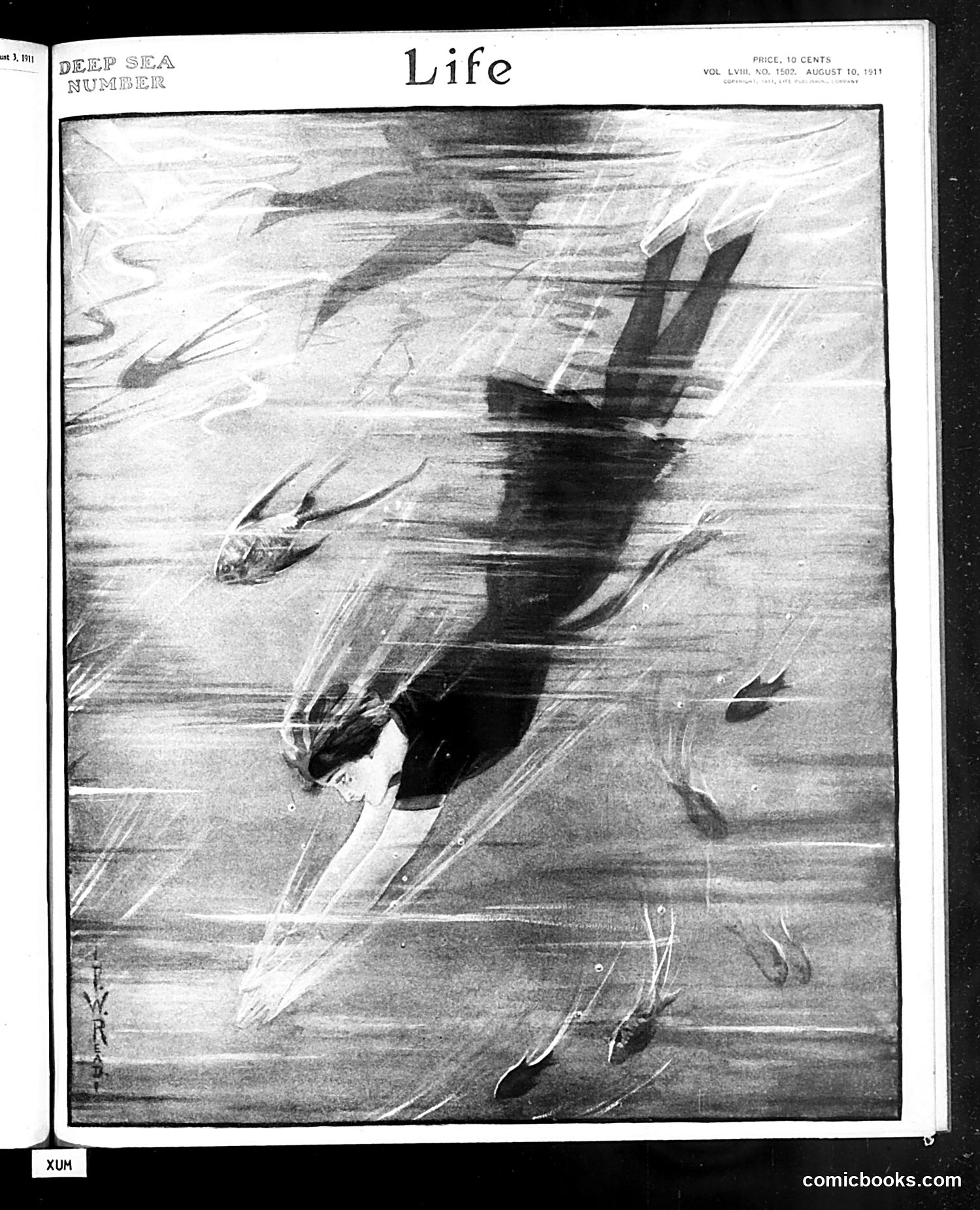
This appears to be the cover of *Life* magazine from August 10, 1911 (labeled "Deep Sea Number"). The image shows multiple human figures swimming or diving underwater, depicted in an artistic, somewhat surreal style with flowing movement and dynamic composition. Without additional text context visible on this page, I cannot definitively identify specific political figures or determine what satirical point is being made. The "Deep Sea Number" designation suggests thematic content about ocean/undersea exploration, which was a topic of popular interest in the early 1910s. The artistic rendering emphasizes movement and perhaps weightlessness. To explain the cartoon's specific meaning—what figures represent, what events it references, or what satirical commentary it intended—I would need accompanying caption text or article content that is not clearly legible in this image.
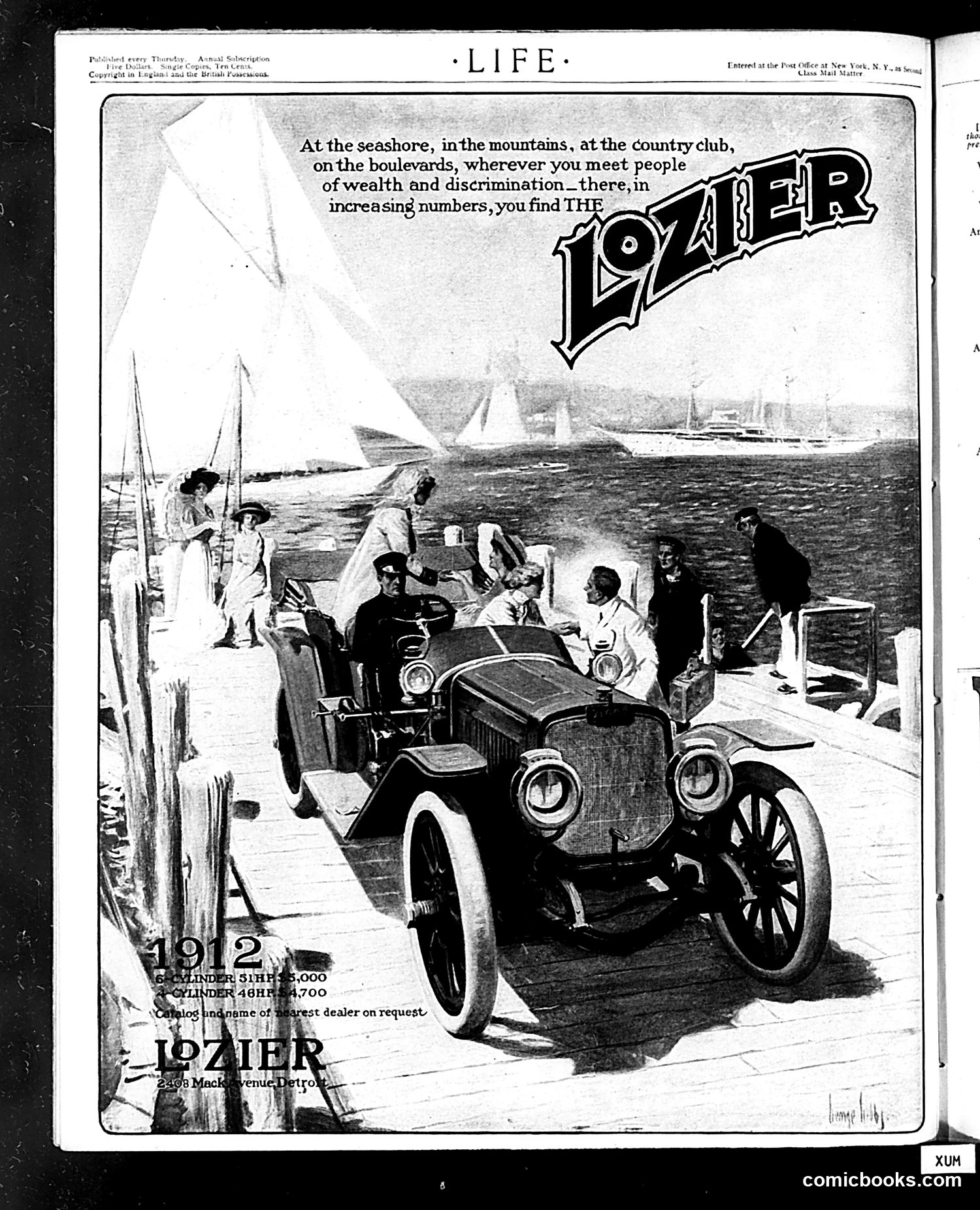
This is primarily a **1912 Loiter automobile advertisement**, not a political cartoon. The ad appears in *Life* magazine and showcases the vehicle at an upscale seaside setting with wealthy people in period dress. The advertisement's text promises that "at the seashore, in the mountains, at the country club, on the boulevards, wherever you meet people of wealth and discrimination—there, in increasing numbers, you find THE LOITER." The image depicts the car prominently displayed among well-dressed figures, sailing vessels, and steamships in the background—visual markers of leisure and affluence. This is aspirational marketing targeting the wealthy class, associating the Loiter automobile with exclusivity and social status among America's elite.
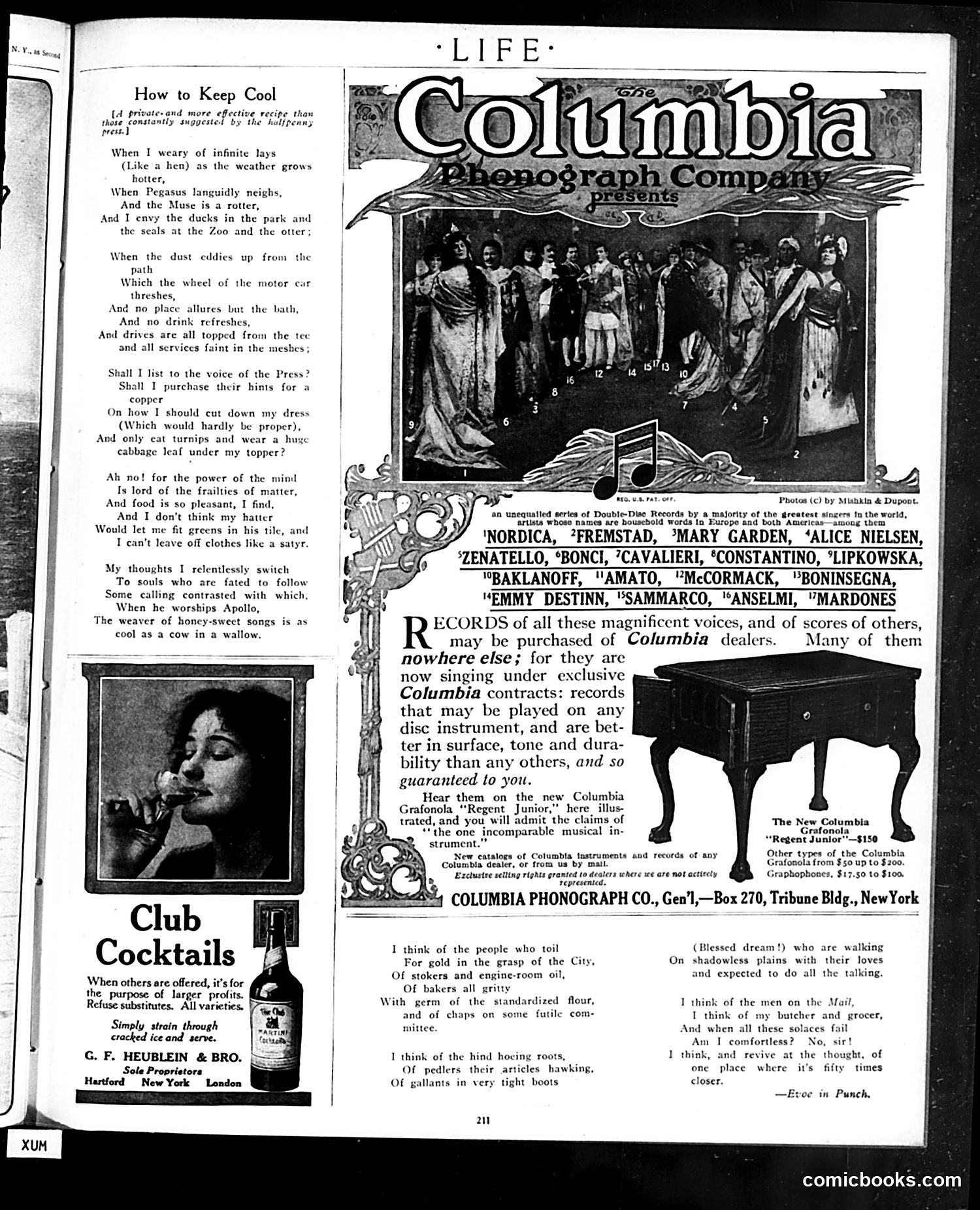
This page is primarily **advertising and entertainment content**, not political satire. The left column features a poem titled "How to Keep Cool," offering humorous observations about summer heat and urban life—a lighthearted piece typical of Life magazine's satiric style. The dominant right side advertises **Columbia Phonograph Company records** featuring famous opera singers of the era (Caruso, Galli-Curci, and others listed). The accompanying image shows what appears to be an operatic scene with numbered figures. Below is a **Club Cocktails advertisement** for G.F. Heublein & Bro.'s beverages, using period marketing language. The page footer includes poetry about city life and working people, maintaining the magazine's satirical tone about modern urban existence. This represents typical early-20th-century Life magazine content: commercial advertising interspersed with light social commentary and humor.
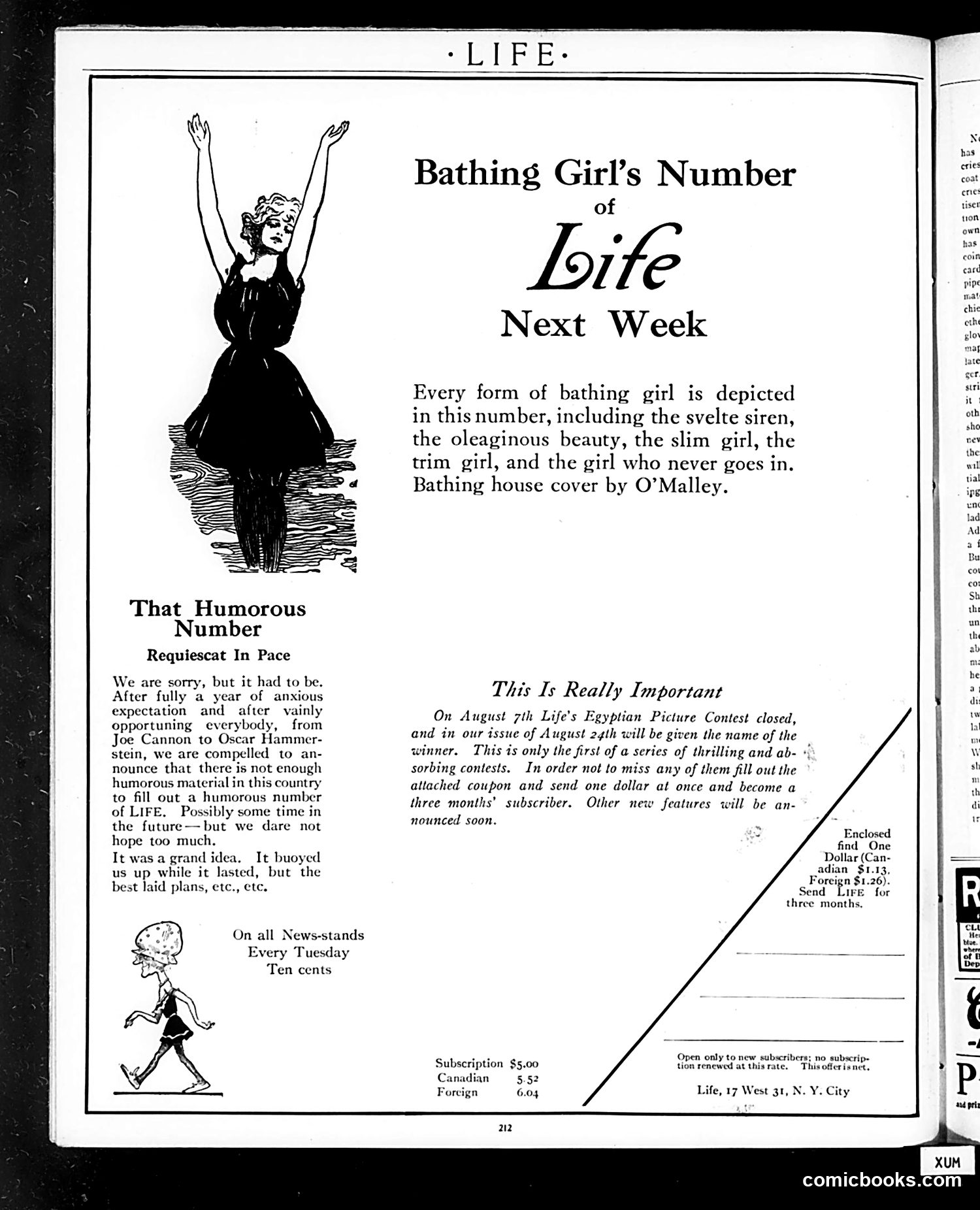
This page is primarily **advertising** for Life magazine's upcoming issue, not political satire. The main advertisement announces that next week's issue will feature a "Bathing Girl's Number," depicting various types of bathing girls—from "svelte siren" to those who "never goes in." The illustration shows a woman in a bathing costume with arms raised. Below that is an obituary-style notice for a previous "humorous number" about bathing girls that apparently didn't meet expectations. The editors apologize for discontinuing it despite initial enthusiasm. The bottom section promotes Life's Egyptian Picture Contest and subscription rates. The small cartoon showing a running figure is merely decorative. This is essentially a house advertisement promoting upcoming content and subscription offers to readers.
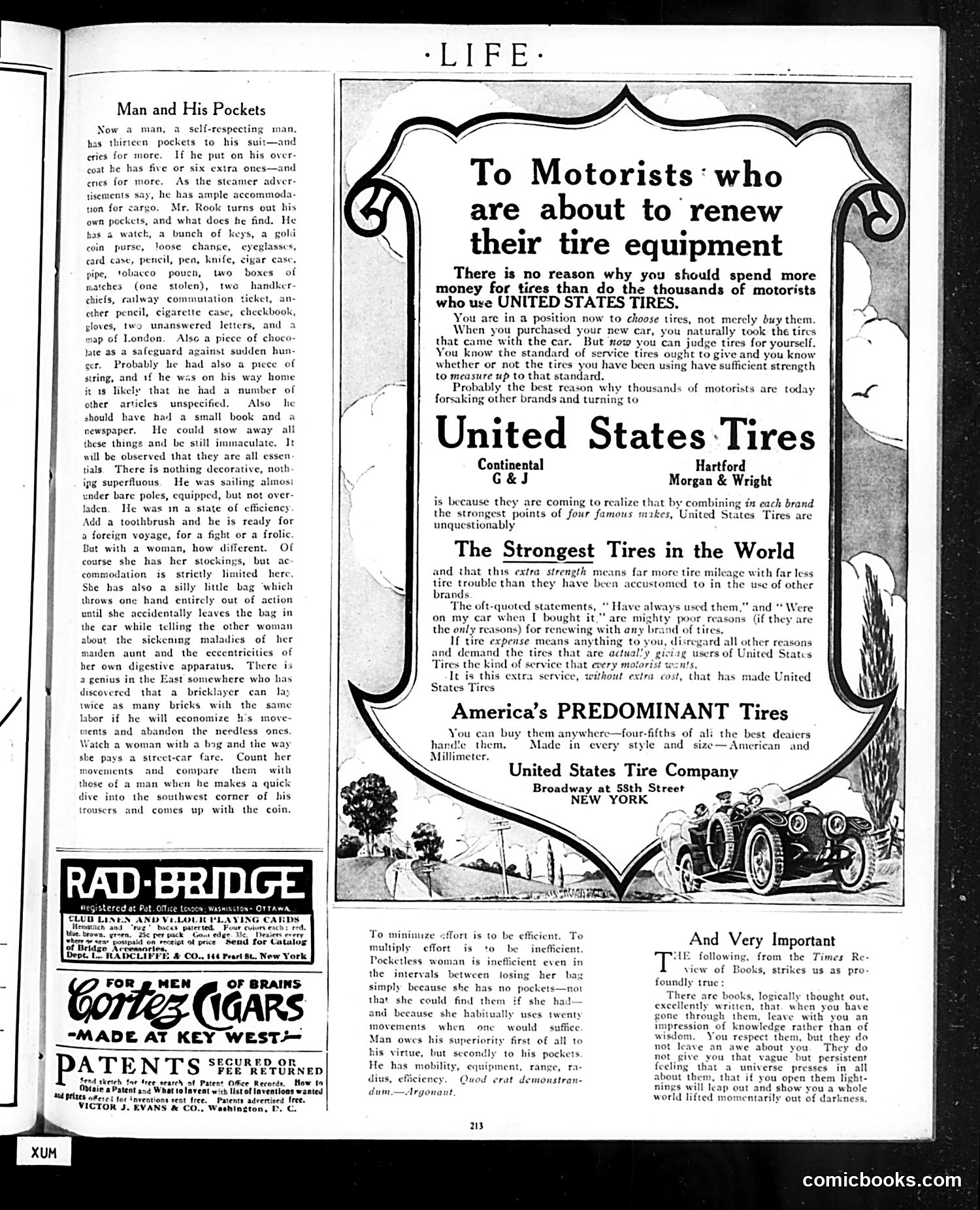
This page is primarily **advertising**, not satire or political commentary. The dominant content is a full-page ad for United States Tires, emphasizing their strength and reliability for motorists renewing tire equipment. The left column contains a humorous essay titled "Man and His Pockets," satirizing how men accumulate excessive items in their suit pockets—watches, keys, coins, cigars, and other objects—creating an inefficient burden. The piece gently mocks male disorganization and the contrast with women's more streamlined approach. Additional small ads appear for Radcliffe playing cards, Cortez cigars, and a patents attorney service. The page reflects early 20th-century consumer culture and gender stereotypes about personal organization.
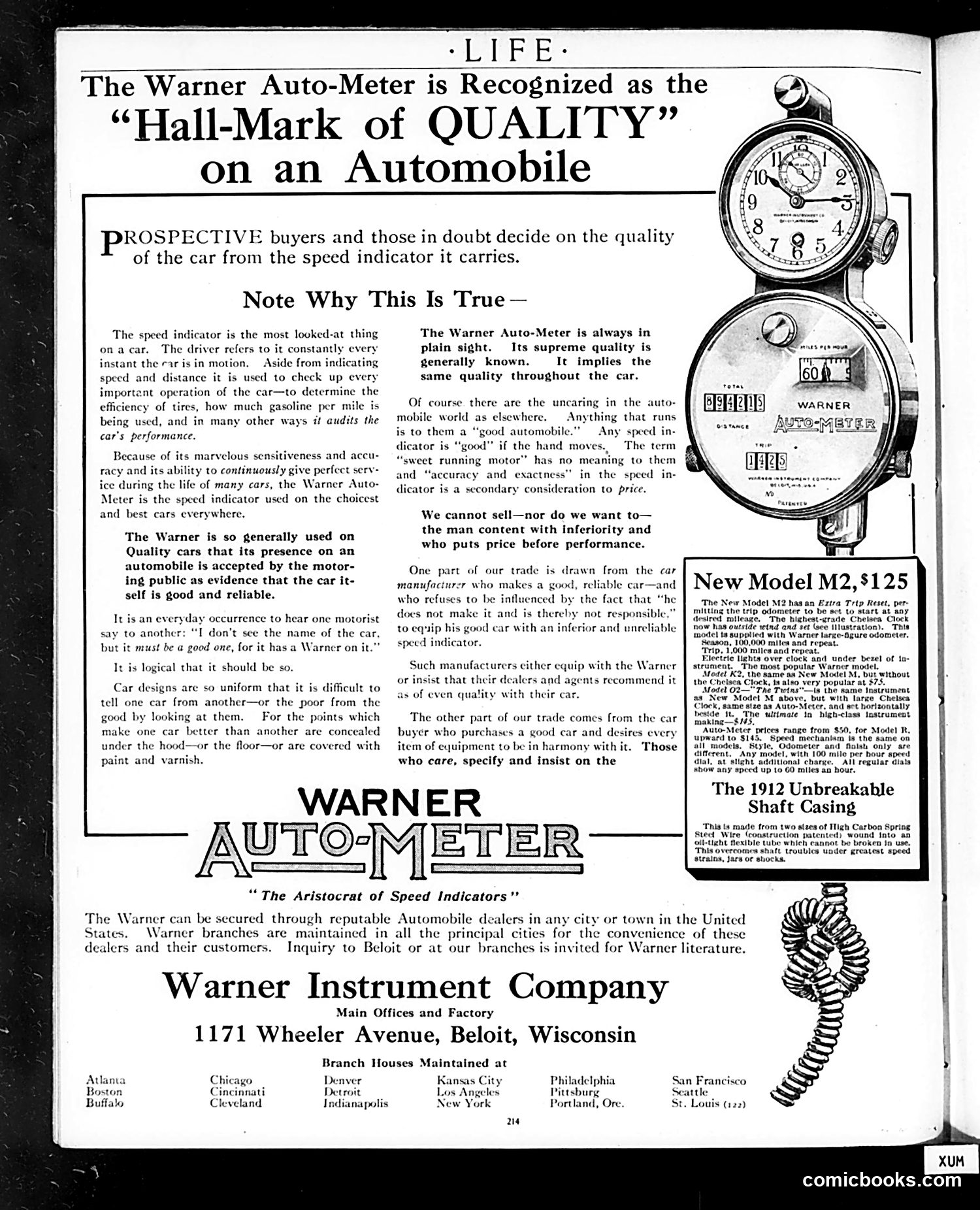
This page is primarily **advertising, not satire or political commentary**. It's a full-page ad for the Warner Auto-Meter, a speedometer marketed as a quality indicator for automobiles. The ad argues that a car's speedometer reflects manufacturer reliability—a "hall-mark of quality." It targets buyers uncertain about vehicle quality, claiming the Warner Auto-Meter's presence indicates good engineering throughout the car. The ad emphasizes the device's accuracy and sensitivity as proof of superior craftsmanship. The page includes images of the actual meter and promotes the New Model M2 ($125). The bottom lists the Warner Instrument Company's headquarters in Beloit, Wisconsin, and branch locations across major American cities. There is no political cartoon or satire present—this is straightforward early-1910s automotive advertising.
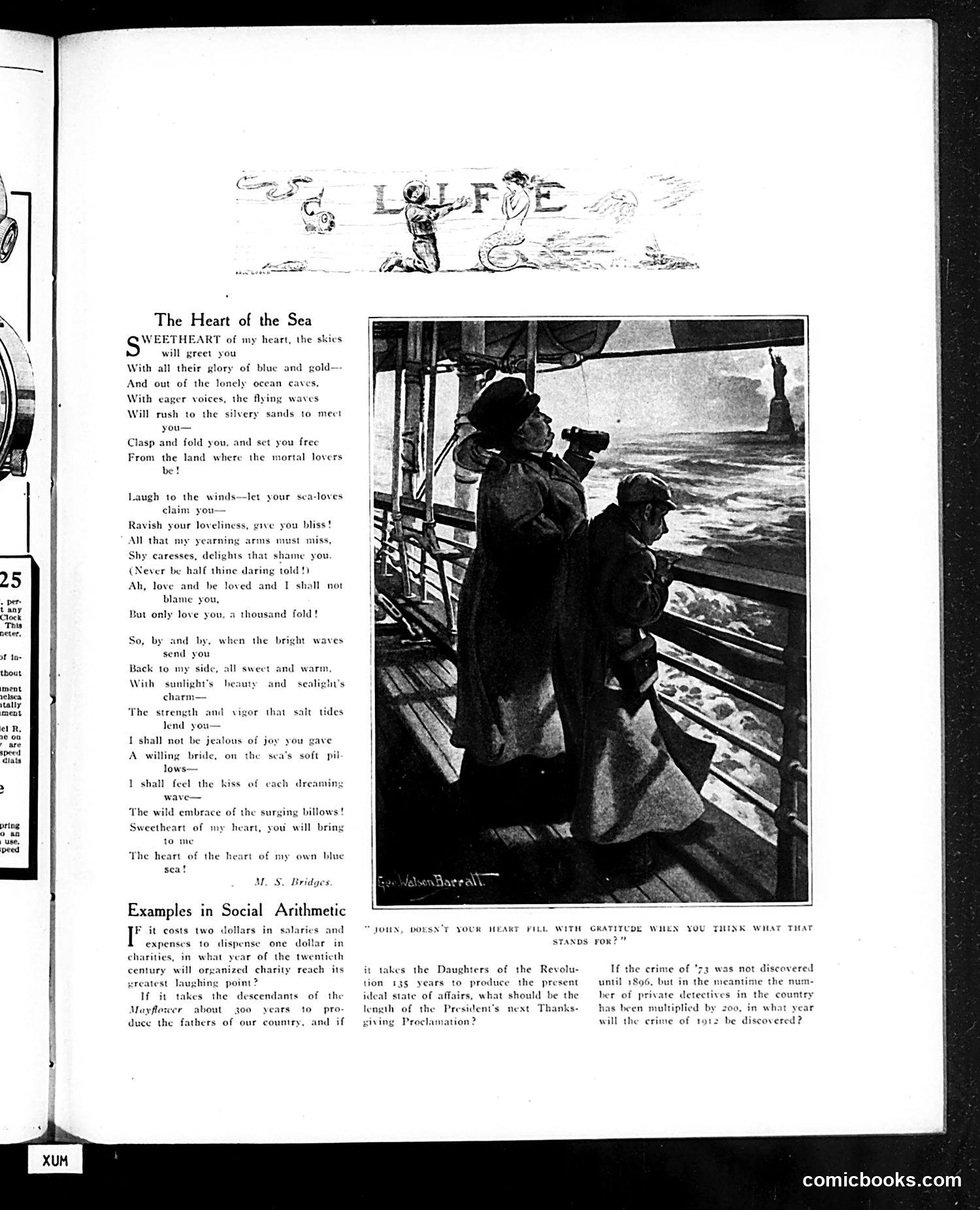
This page contains a romantic poem titled "The Heart of the Sea" by M. S. Bridges, accompanied by a photograph showing a woman at a ship's railing looking out at the ocean. Below the poem is a section titled "Examples in Social Arithmetic" that presents satirical mathematical problems. These mock-serious calculations appear to critique charitable giving and historical timescales—one references the "Mayflower" taking 300 years to produce outcomes, and another questions how long the Daughters of the Revolution might take to achieve their stated ideals. The satire seems to mock both excessive optimism about social progress and the self-importance of heritage organizations like the DAR.
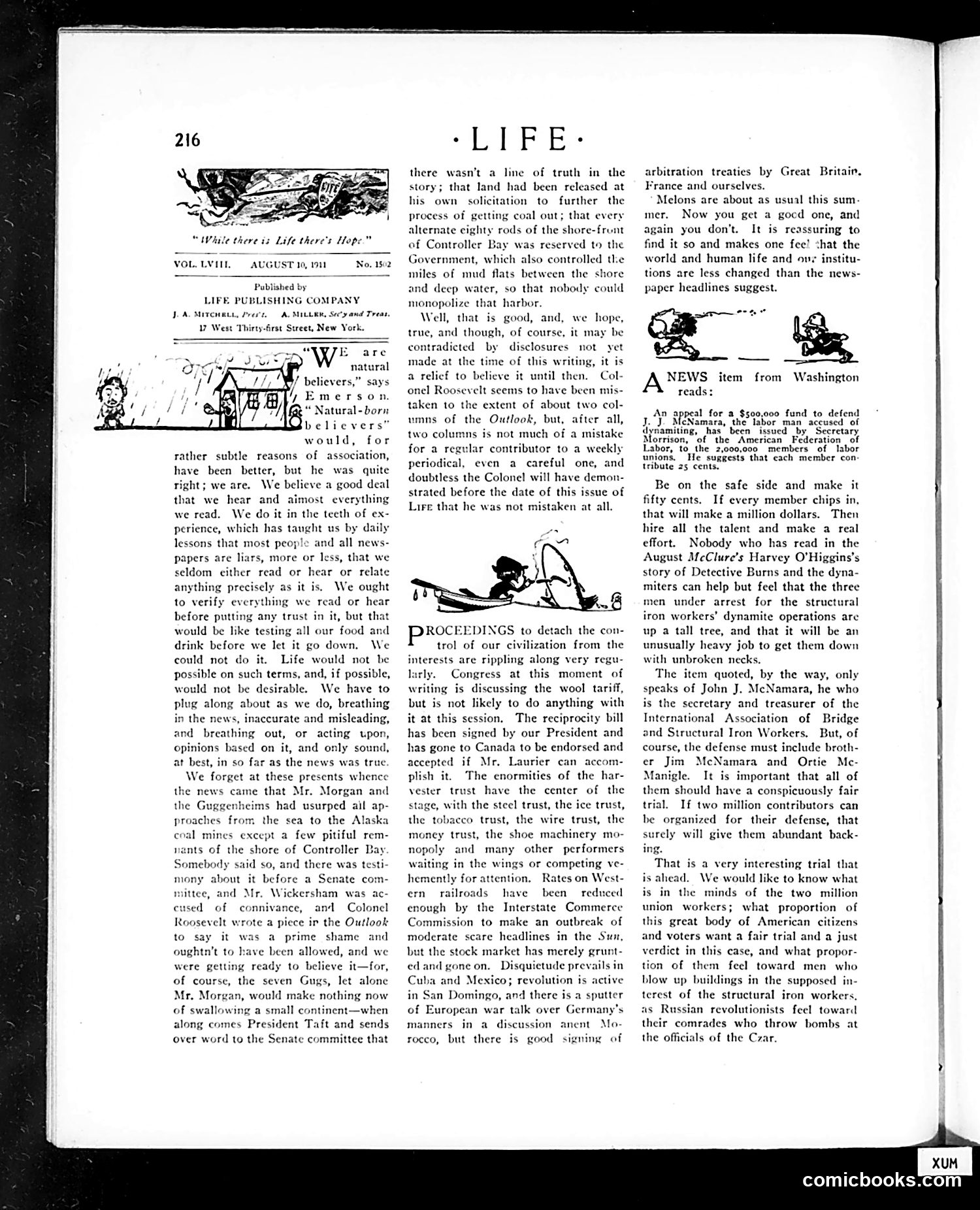
This page contains editorial commentary on contemporary political and labor issues rather than satirical cartoons. The main text discusses Colonel Roosevelt's alleged misstatements regarding coal output at Controller Bay, Alaska—a controversy over whether Roosevelt had been truthful about available resources there. The page also reports on labor activism, specifically mentioning a $250,000 defense fund for three structural iron workers arrested during dynamite operations. It references John J. McNamara and others in the labor movement, discussing concerns about fair trial treatment and the relationship between American unions and Russian revolutionary sympathies. The small illustrations appear to be decorative rather than editorial cartoons conveying specific political satire.
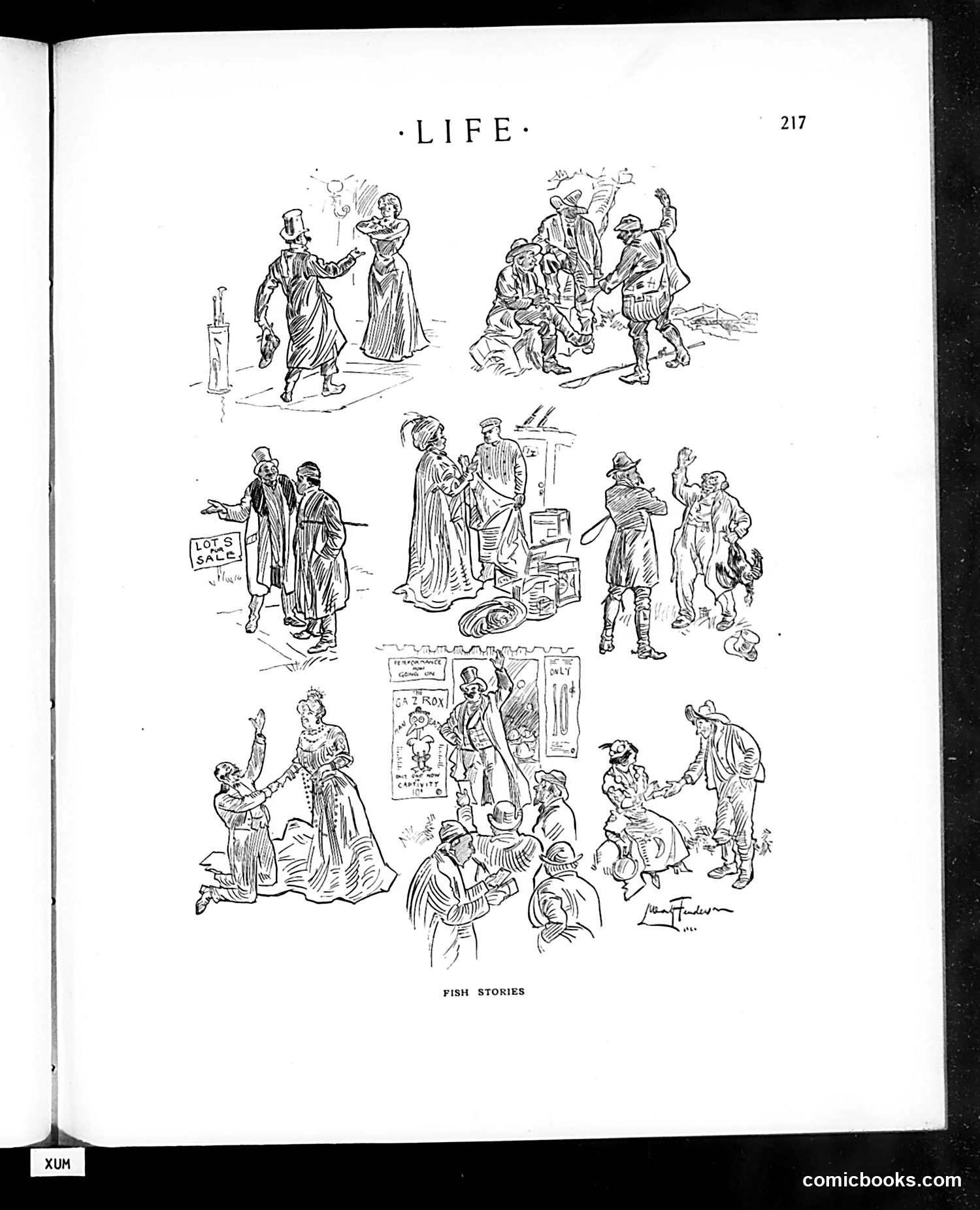
This page titled "Fish Stories" presents eight satirical vignettes showing various people telling exaggerated tales, likely about fishing or hunting exploits. The humor relies on a universal social observation: people embellishing their adventures when recounting them to others. The sketches depict recognizable scenarios—men gesturing dramatically while narrating to audiences, women listening with varying degrees of credulity, and children engaged in the storytelling. One panel includes a sign reading "LOTS SOLD," suggesting commercial pitch-men spinning yarns to potential buyers. The satire mocks human nature's tendency toward boastfulness and the gap between actual experience and retelling. This was a timeless subject for Life magazine's humor, requiring no specific historical context to resonate with readers—the "fish story" (exaggerated tale) remains culturally recognizable today.
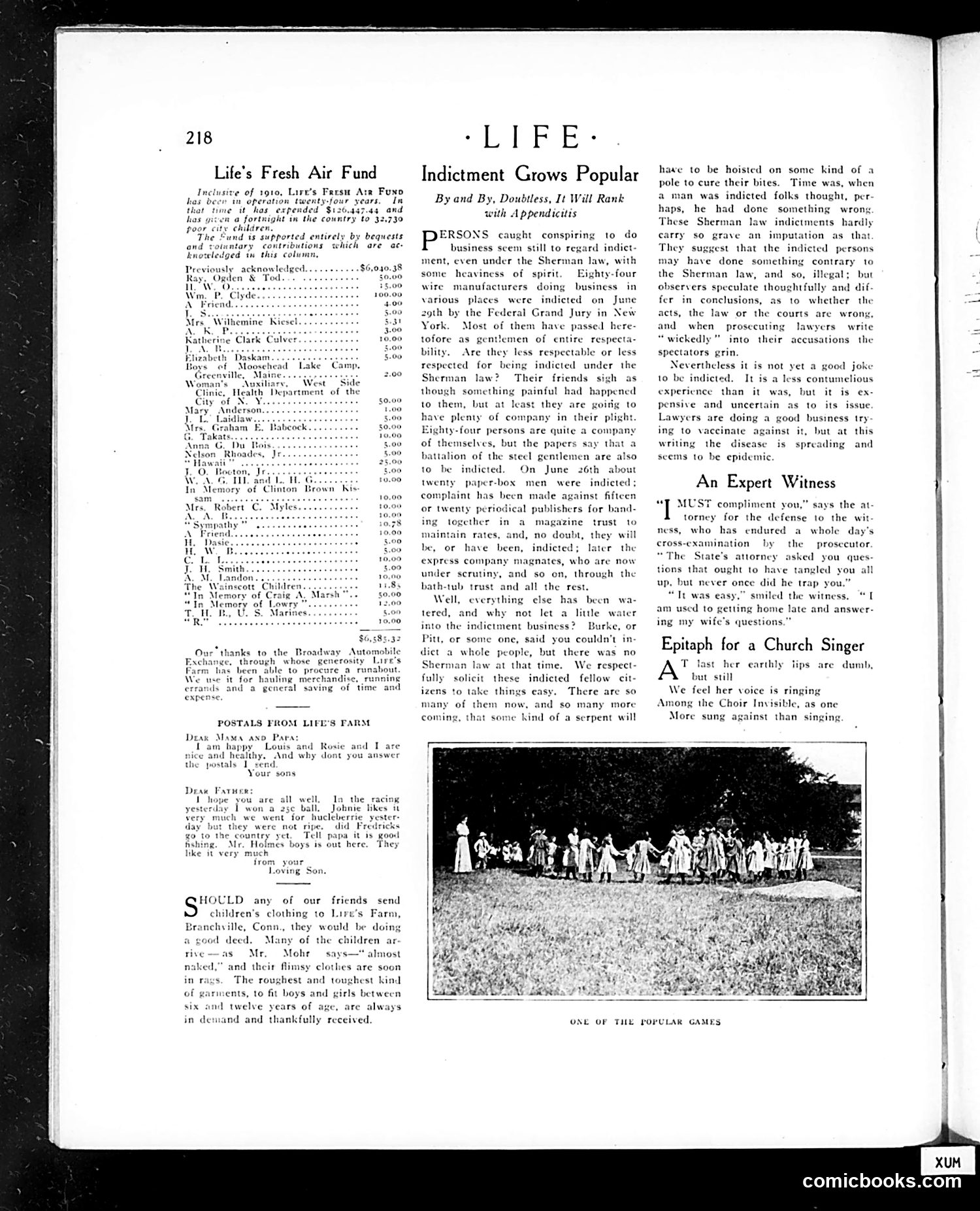
This page contains several distinct sections rather than a unified cartoon: 1. **"Life's Fresh Air Fund"** - A charitable appeal listing donors who've contributed to send poor children to the countryside for health benefits. 2. **"Indictment Grows Popular"** - An article discussing widespread business indictments under Sherman Antitrust Law, with eighty-four wire manufacturers and paper manufacturers facing charges. The piece humorously notes these businessmen claim innocence despite mounting evidence. 3. **"An Expert Witness"** - A brief anecdote about courtroom cross-examination humor. 4. **"Epitaph for a Church Singer"** - A short poem. 5. **Photograph** - Shows children in a circle outdoors, captioned "ONE OF THE POPULAR GAMES," likely illustrating the Fresh Air Fund's charitable work. The page lacks satirical cartoons; it's primarily text-based content reflecting Progressive Era concerns about corporate monopolies and child welfare.
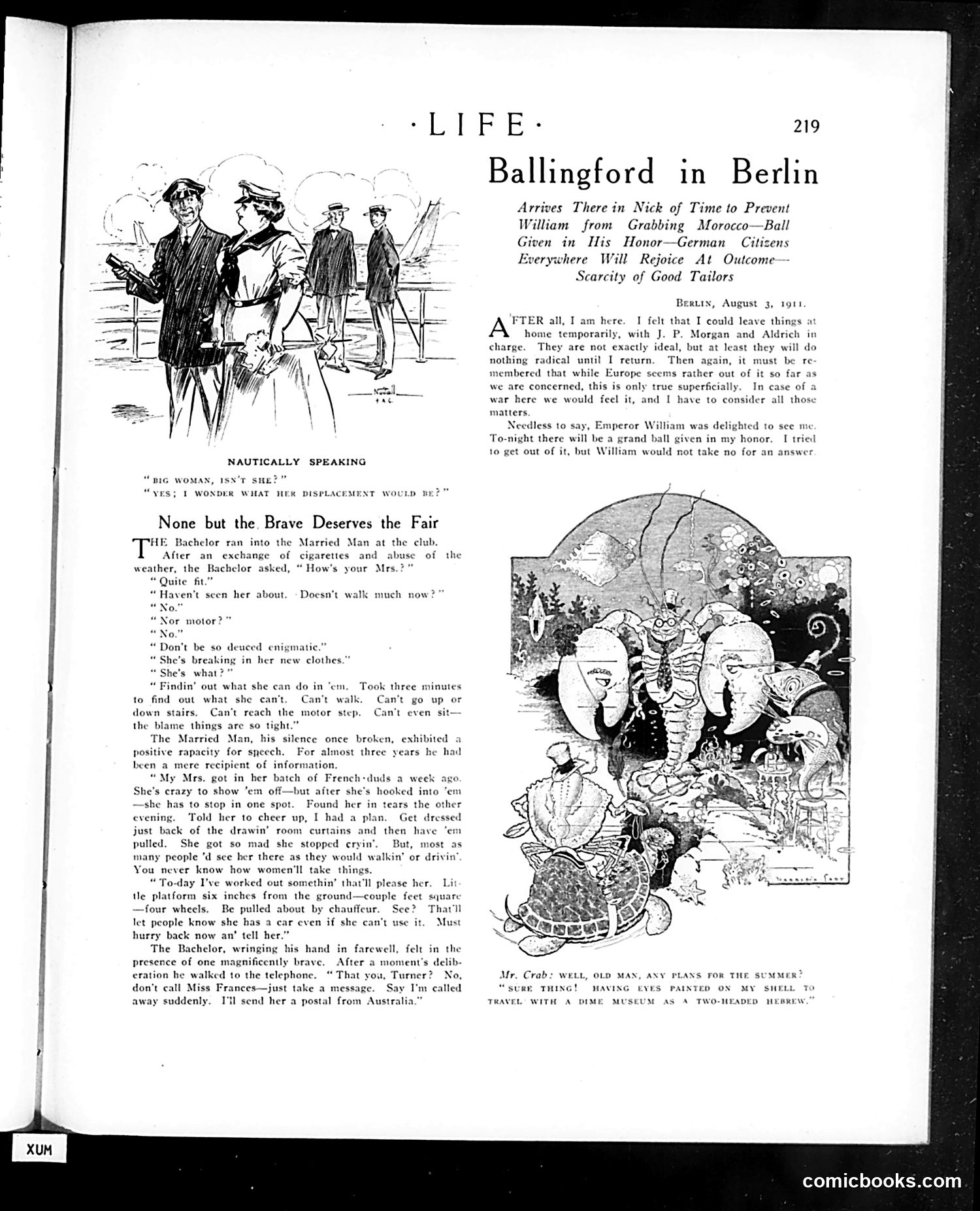
This page depicts an American diplomat or official ("Ballingford") navigating Berlin social obligations in pre-WWI Germany. The narrative describes his arrival and upcoming formal ball in his honor, hosted by Emperor William (Kaiser Wilhelm II). The upper cartoon shows figures in formal dress, illustrating "nautical" conversation about "a big woman" and her "displacement." The lower section, "None but the Brave Deserves the Fair," depicts a bachelor and married man discussing the bachelor's wife—she's injured and immobilized after a carriage accident. The joke centers on the married man's lengthy, unsympathetic anecdote about her condition, contrasting with his callous indifference to her suffering. The satirical point appears to target male obliviousness or callousness toward women's hardship.
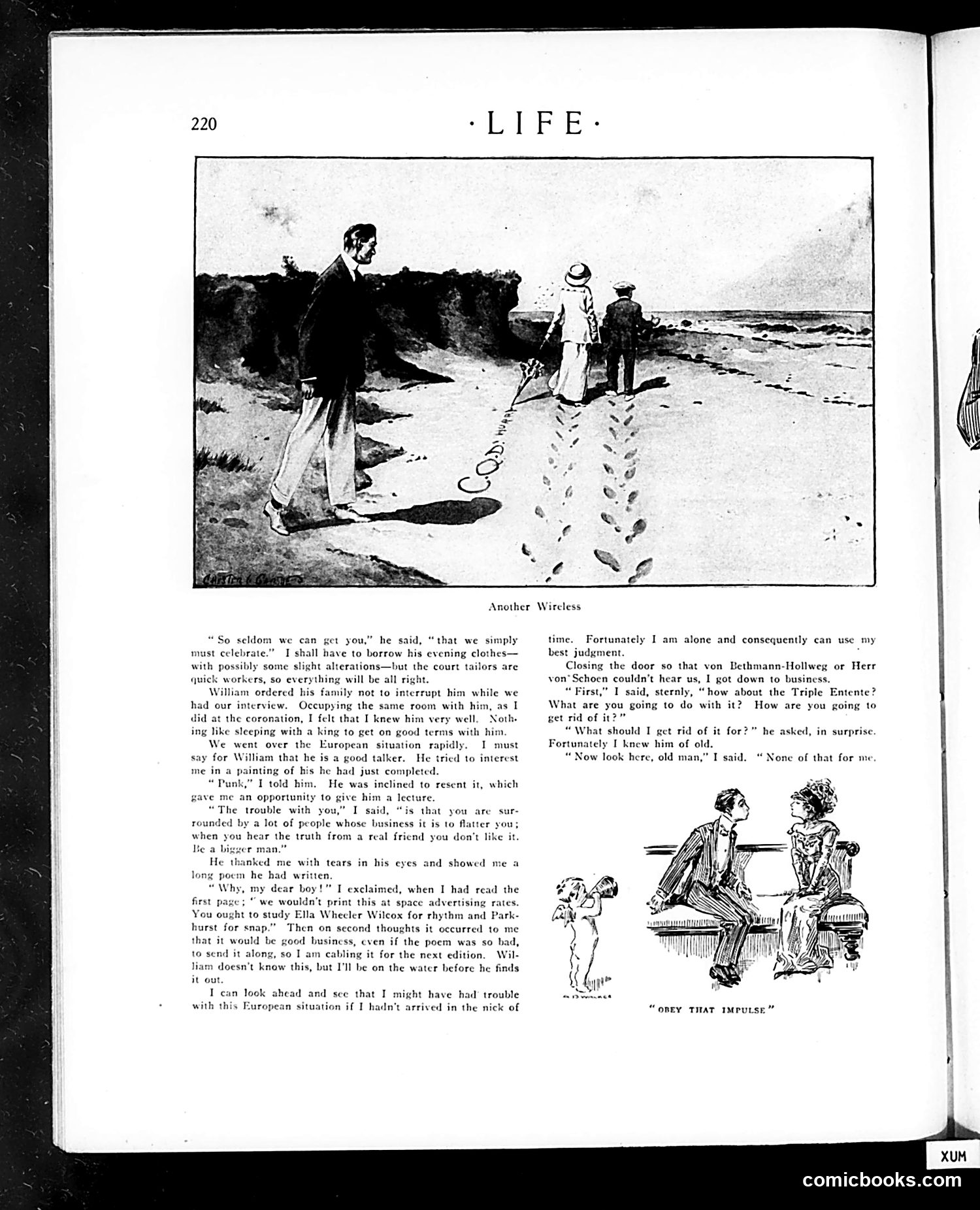
This page satirizes wireless telegraph technology and European social pretension. The top illustration shows fashionably dressed figures on a beach with footprints forming morse code patterns, titled "Another Wireless." The accompanying text describes a conflict between the narrator and someone named William over a European romantic situation. The story mockingly presents a man ("von Bethmann-Hollweg or Herr von Schoen") receiving a wireless message about a romantic entanglement—"the Triple Entente"—creating a pun on diplomatic alliances. The lower illustration titled "OBEY THAT IMPULSE" depicts figures in conversation, suggesting impulsive romantic or social behavior. The satire combines contemporary wireless technology with European diplomatic tensions and romantic comedy, targeting both modern gadgetry and Old World pretensions that American readers would find amusing.
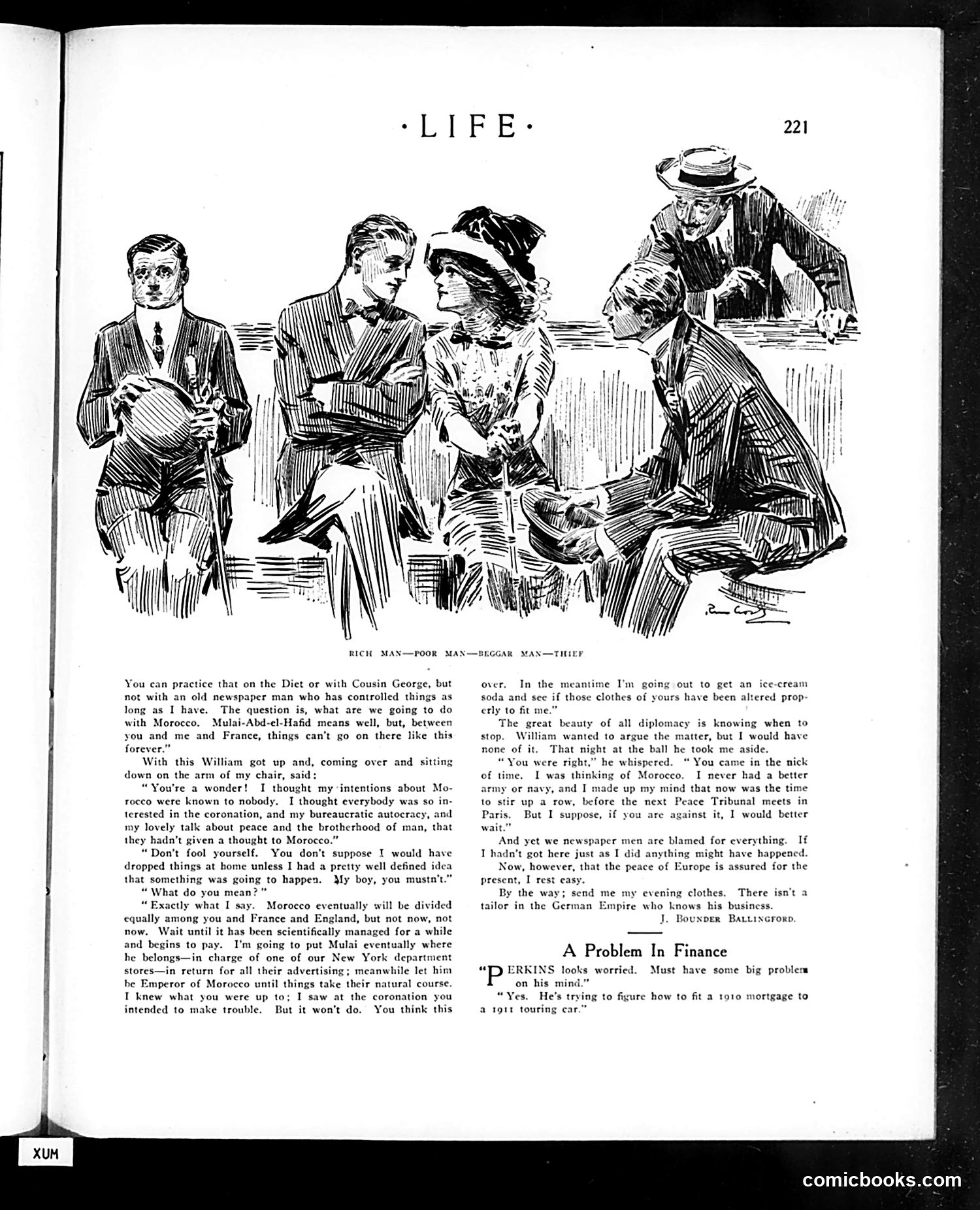
This page from *Life* magazine contains a satirical cartoon labeled "RICH MAN—POOR MAN—BEGGAR MAN—THIEF" depicting four men in conversation. The accompanying text discusses Morocco's political status and colonial interests, mentioning "William" arguing about whether Morocco should be divided between France and England. The cartoon appears to satirize the geopolitical maneuvering over Morocco's future—treating the colonial powers as characters in the nursery rhyme. The "rich man" likely represents wealthy colonial interests, while the progression suggests how colonial ambitions operate across different social classes and moral standings. A secondary article, "A Problem in Finance," discusses mortgage and automobile financing concerns. The satire critiques European imperial competition over North African territories during the early 1900s colonial period.
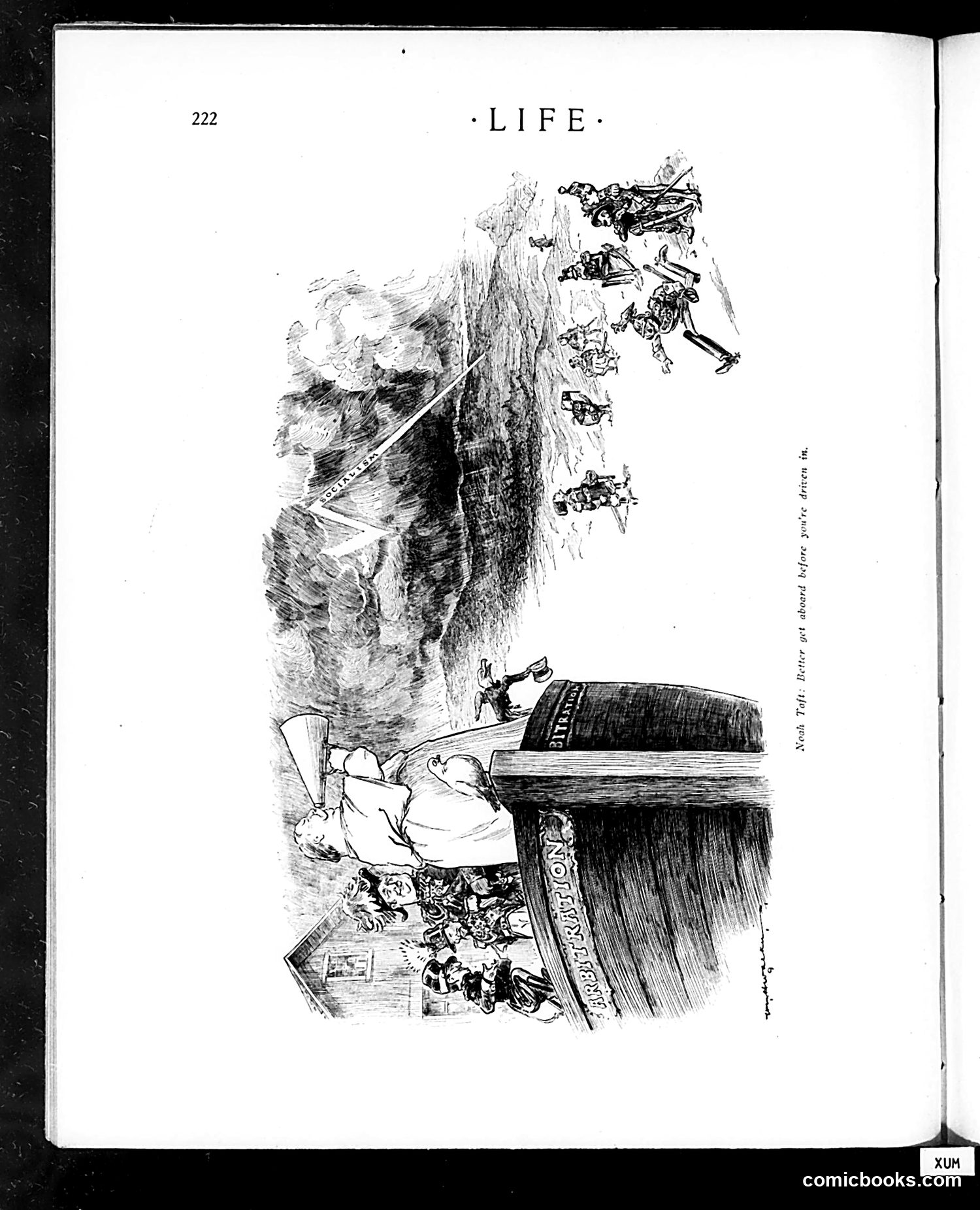
This page contains a single satirical illustration titled "Man Tired, Blurry of about thirty percent in." The cartoon depicts a rotund, well-dressed man in profile, appearing exhausted or overwhelmed. He's positioned at what seems to be a desk or podium labeled "CORPORATION" (partially visible). Above and around him swirl numerous small figures appearing chaotic or troublesome. The satire appears to target **corporate leadership or management** overwhelmed by workplace chaos—possibly depicting labor disputes, multiple business problems, or administrative headaches. The man's tired demeanor and the swirling confusion suggest critiques of incompetent or overextended business management. Without additional context about the magazine's publication date or specific contemporary events, the precise political or social target remains unclear, though the general message concerns corporate mismanagement.
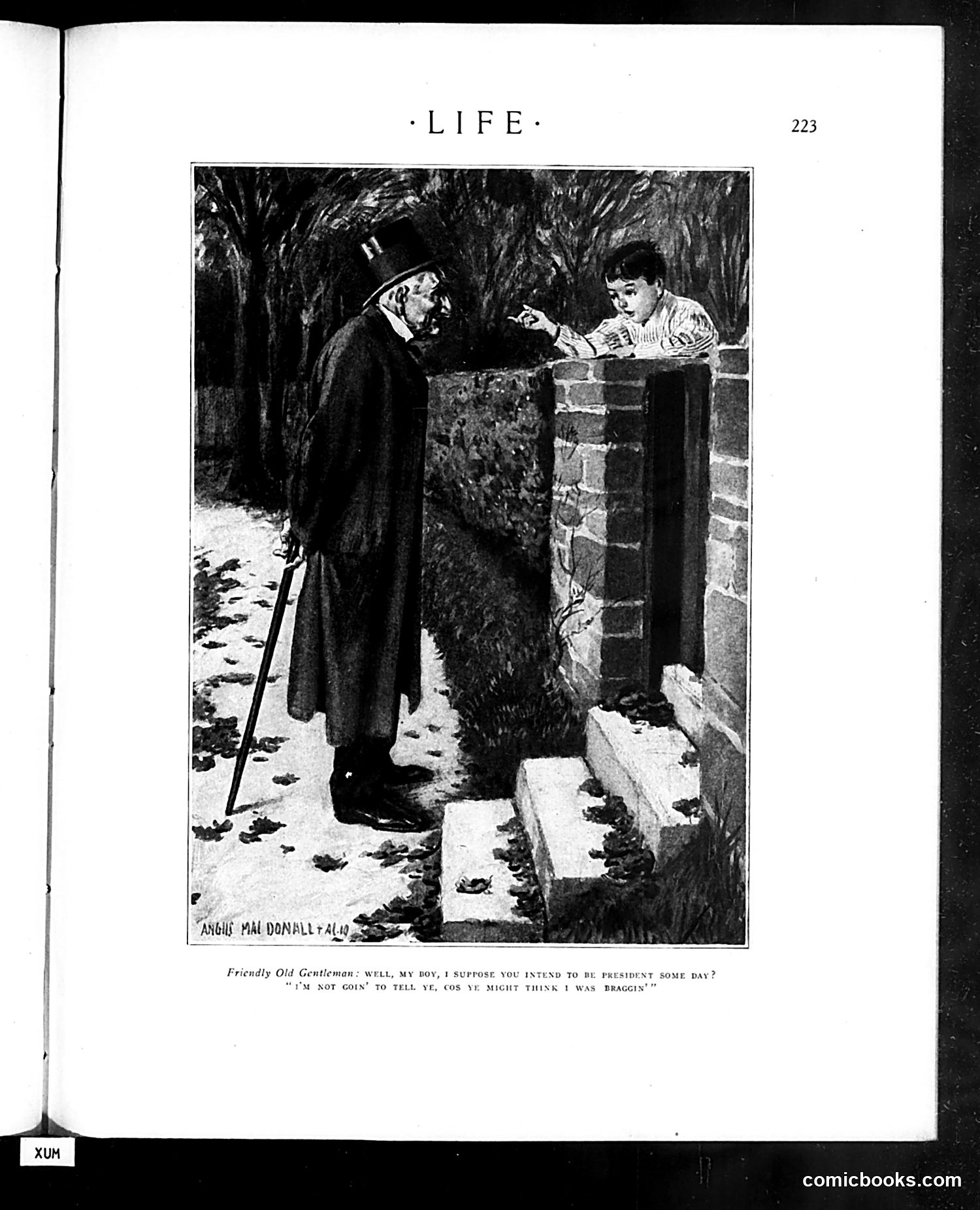
This cartoon satirizes American aspirational culture and class consciousness. An elderly gentleman in formal dress encounters a young boy in a working-class setting (note the brick wall, snow, and rustic surroundings). The gentleman asks if the boy intends to become president—a stock question reflecting the American ideal that anyone can rise to high office. The boy's response—refusing to state his ambitions lest he appear boastful—mocks this meritocratic mythology. His self-consciousness about "braggin'" suggests that presidential aspirations are so common among Americans (even poor boys) that admitting them seems presumptuous. The cartoon ironically critiques both the pervasive dream of social mobility and the cultural anxiety surrounding it.
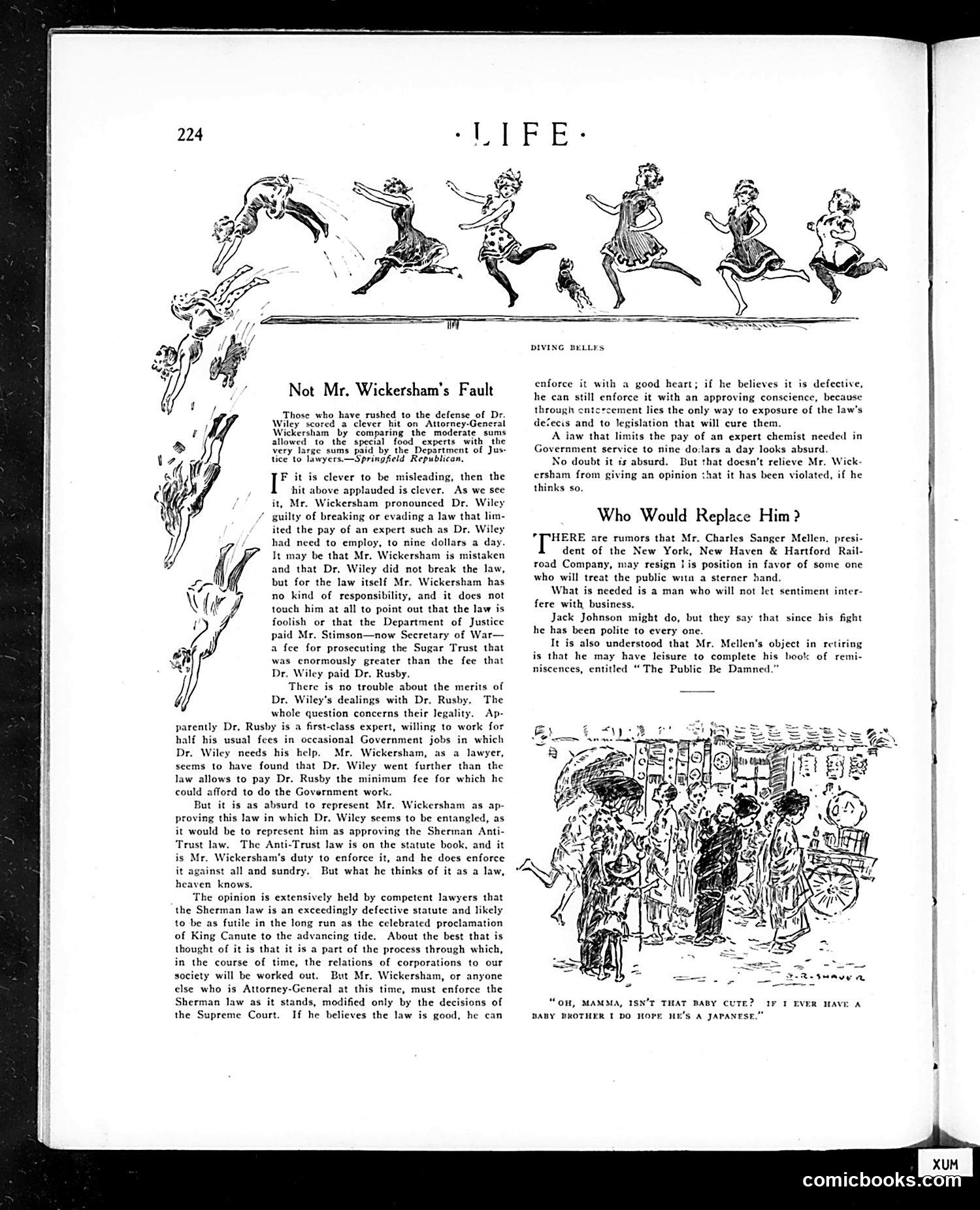
This page addresses two separate political-satirical topics: **"Not Mr. Wickersham's Fault"** defends Attorney-General Wickersham against criticism regarding Dr. Wiley, a food safety expert. Wiley allegedly violated a law limiting expert pay to $9/day by employing Dr. Rusby. Critics compared this to the Justice Department paying lawyers far more for similar work. Life argues the criticism is unfair: Wickersham merely enforced existing law, not created it. The piece defends a public official's duty to enforce laws deemed foolish, noting that exposing bad laws through enforcement enables legislative reform. **"Who Would Replace Him?"** sarcastically mocks Charles Sanger Mellen, president of the New York, New Haven & Hartford Railroad, who rumored to resign. Life jokes that his replacement should "not let sentiment interfere with business"—suggesting Mellen was too considerate to passengers. The cruel humor references Mellen's book titled "The Public Be Damned," implying railroad executives prioritize profits over public welfare. The "Diving Belles" cartoon illustration appears decorative rather than thematically connected.
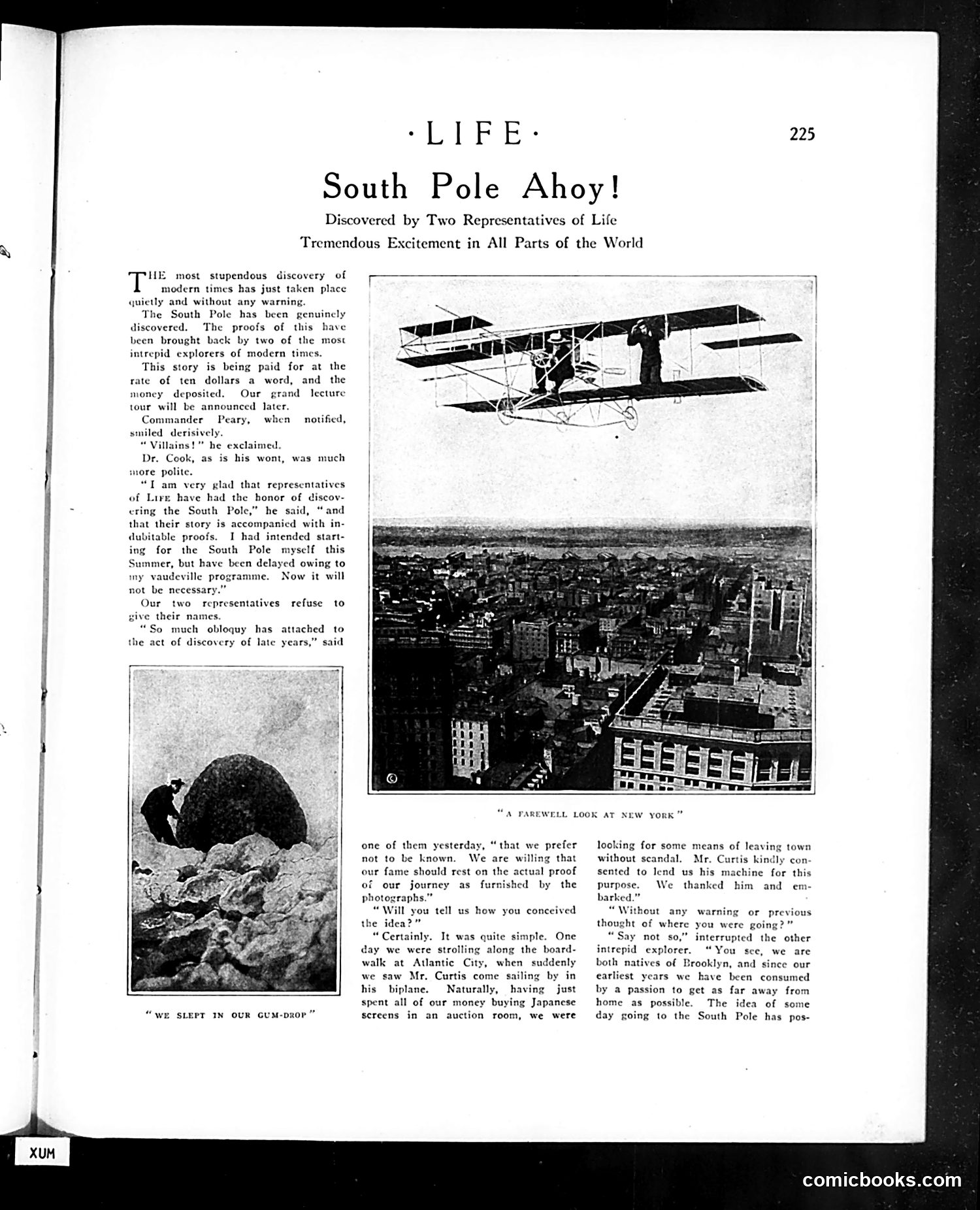
This is a *Life* magazine satire mocking the contemporary obsession with polar exploration and sensationalized newspaper coverage. The article parodies the famous rivalry between explorers Peary and Cook, who both claimed to have discovered the North Pole around 1909, generating enormous public interest and controversy. *Life's* joke: two of their own reporters claim to have "discovered" the South Pole, getting paid "$10 a word" for their story—satirizing how newspapers profited from exploration narratives. The explorers anonymously cite absurd reasons for their trip: they were broke after buying Japanese screens at auction, borrowed Curtis's biplane on impulse, and as Brooklynites simply wanted to escape home. The cartoon mocks both the explorer-celebrity phenomenon and journalism's sensationalism. References to Peary's and Cook's "derision" and "politeness" needle their real-world feud. The joke assumes readers recognize how exploration stories dominated headlines and generated lecture tours and commercial opportunities.
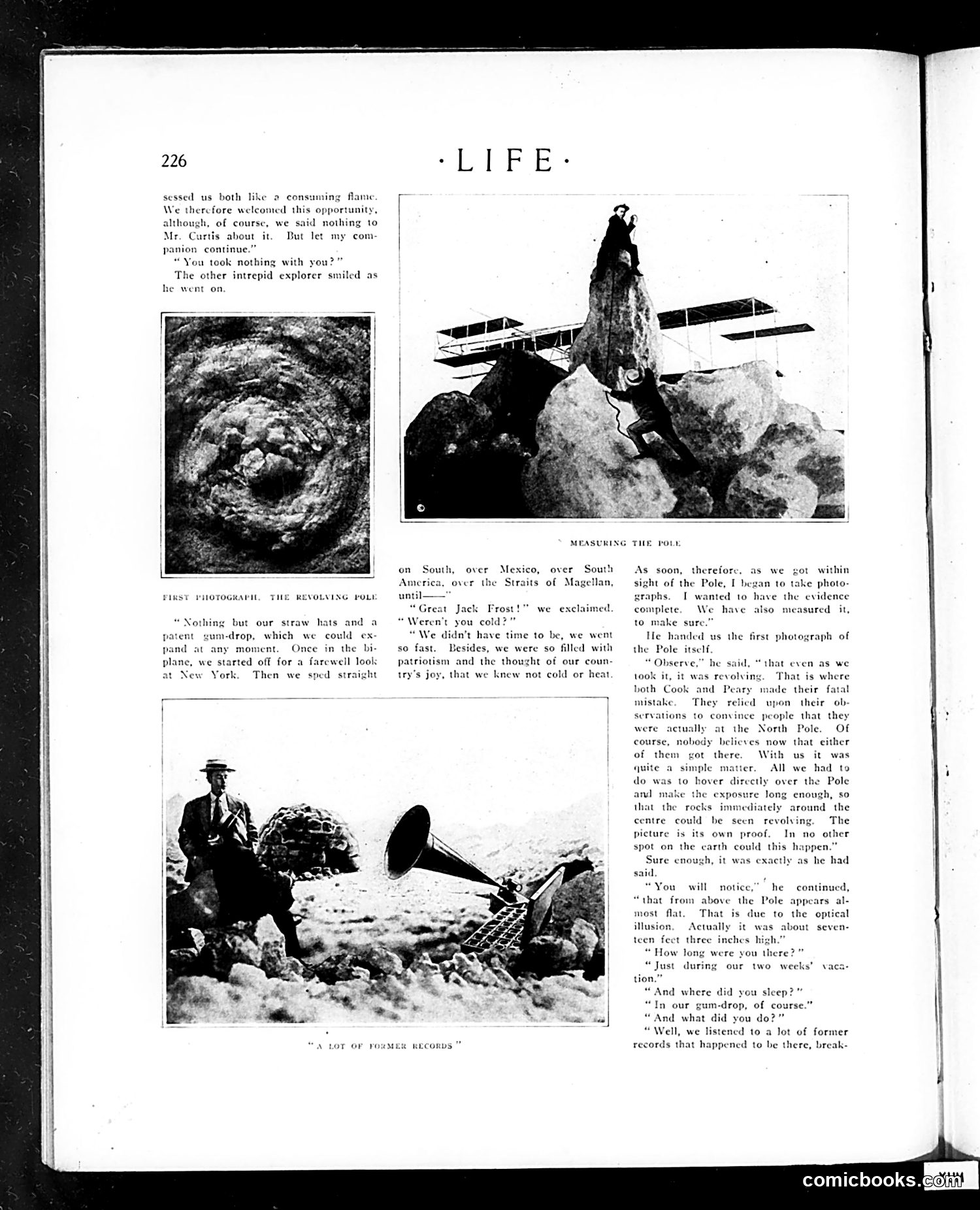
This page satirizes **polar exploration claims**, specifically referencing the **Cook-Peary North Pole controversy** (early 1900s). Two explorers famously disputed who reached the Pole first, with questions about the authenticity of their claims. The satirist mocks this by depicting an explorer's absurd account: traveling with only a "straw hat" and "patent gum-drop," sleeping in a gum-drop, and claiming the Pole itself is "revolving"—making it impossible to verify its location. The revolving Pole is the joke's centerpiece: a physical impossibility used to ridicule how explorers relied on photographs and observations to prove their claims when independent verification was impossible. The photographs shown ("First Photograph: The Revolving Pole" and "Measuring the Pole") are presented as "proof," but the satirist suggests such evidence is worthless if the Pole itself moves. The piece mocks both the explorers' competitive patriotism and public gullibility—audiences wanted to believe these heroic claims despite logical inconsistencies.
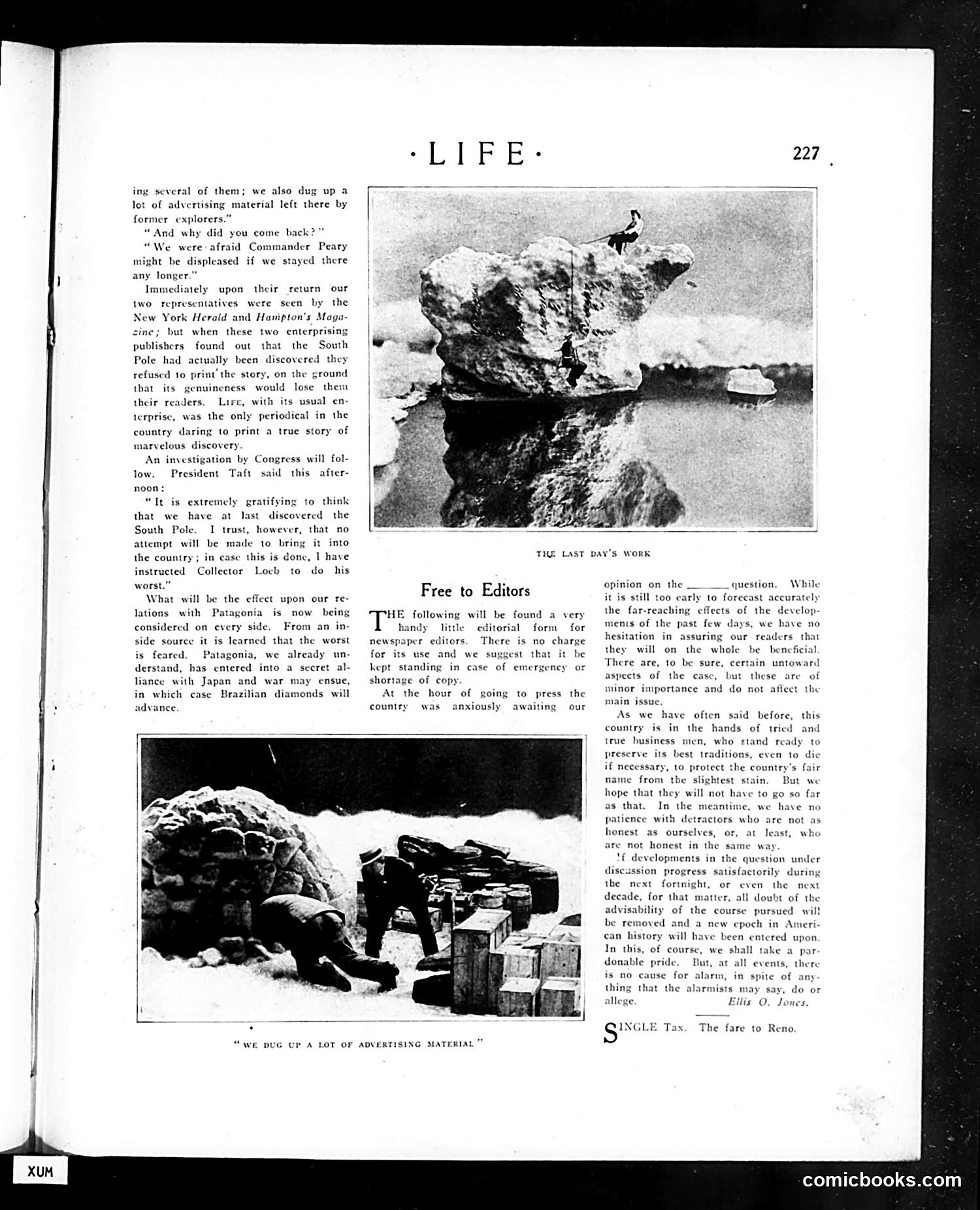
This page satirizes the competing claims over the discovery of the South Pole (likely referencing Peary's 1909 expedition). The text mocks how major newspapers (the Herald and Hampton's Magazine) refused to publish the South Pole discovery story because it would undermine their readers' trust—only Life claims to have printed "a true story of marvelous discovery." The satire escalates absurdly: President Taft allegedly instructs Collector Loeb to prevent the Pole from being brought into the country, and there's a mock-serious concern that Patagonia might declare war over the discovery. The lower section, titled "Free to Editors," is a joke offering a fill-in-the-blank editorial template for newspapers lacking original content—a jab at lazy journalism and formulaic editorial writing. It's a sophisticated satire on both media competition and journalistic integrity.
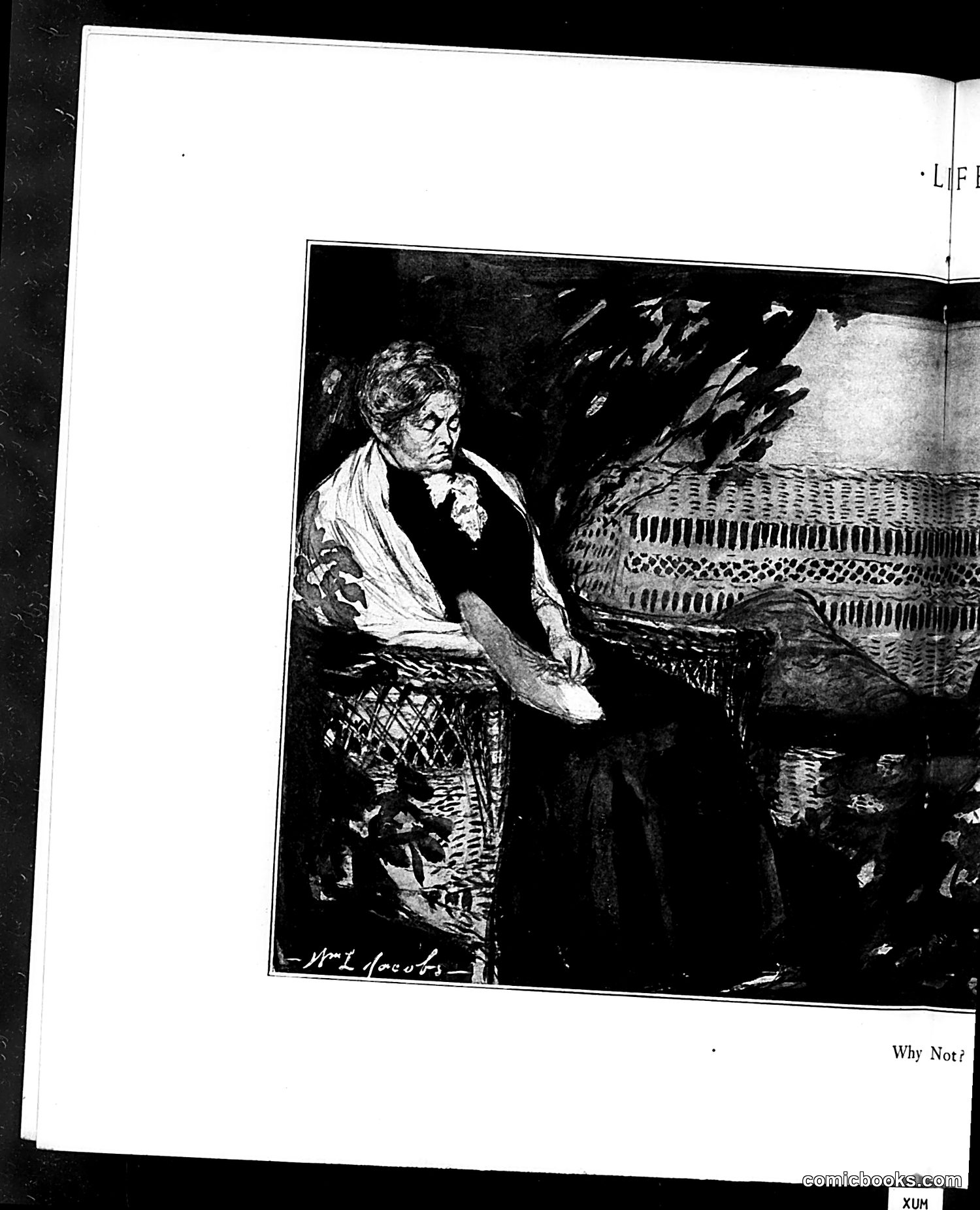
This page appears to be from Life magazine and features a dark etching or sketch signed by what looks like "Goya" (visible in lower left). The image shows an older person in period clothing (white shawl, dark garment) sitting and working with their hands, surrounded by woven baskets or similar crafted items. The figure appears focused on detailed handwork. The caption simply reads "Why Not?" which is deliberately vague and open-ended. Without additional context from the surrounding magazine pages, the specific satirical point is unclear. It could be commenting on labor, craft work, poverty, or elderly people's continued productivity—but the exact target of satire cannot be determined from this image alone. The Goya signature (if accurate) suggests it may invoke themes of social commentary typical of that artist's work.
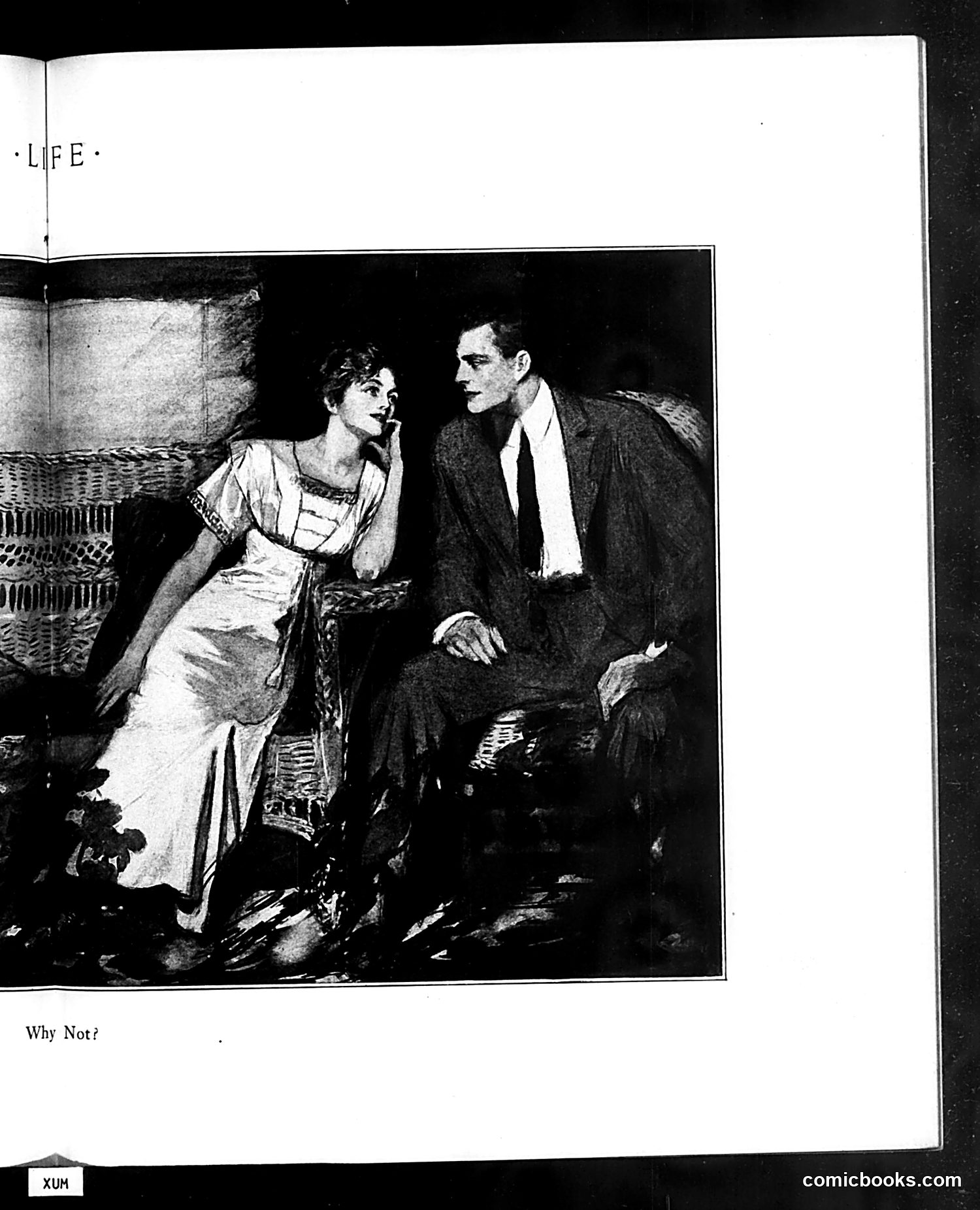
This page shows a black and white illustration of a woman in a light dress and a man in a dark suit sitting together on a couch, appearing to be in intimate conversation. The woman gazes at the man while he looks away. The caption "Why Not?" suggests a rhetorical question about romantic or social propriety. Without additional context about the publication date, specific figures, or accompanying article text, the precise satirical target remains unclear. However, the piece likely comments on contemporary courtship customs, social expectations regarding romance, or perhaps questions conventional relationship norms—a common theme in Life's satirical content about American social life. The formal styling suggests early-to-mid 20th century social satire.
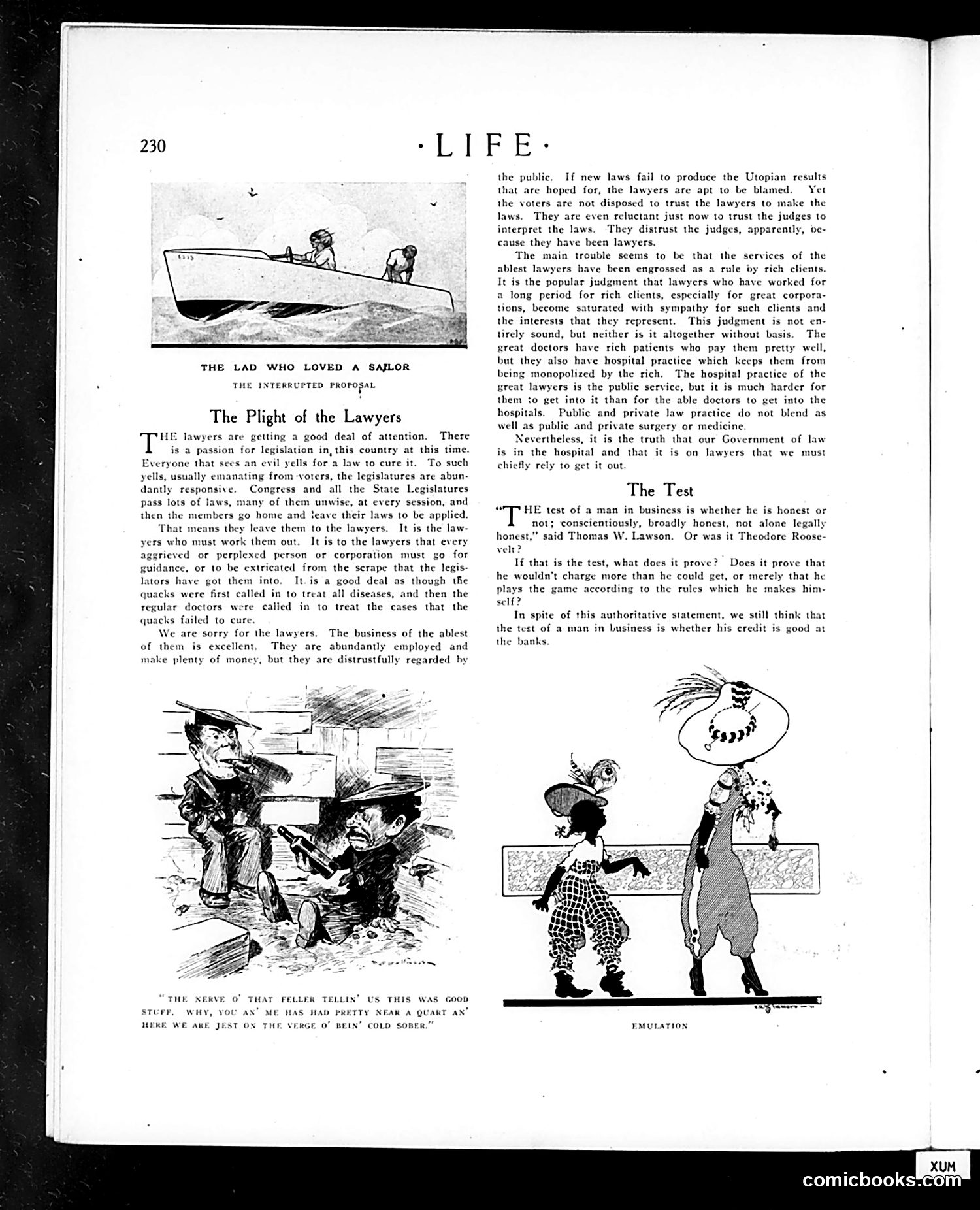
This page critiques the legal profession's entanglement with wealthy interests. The main article argues that while legislators pass numerous laws, **lawyers must implement them**, often blamed when laws fail. The central complaint: top lawyers become monopolized by rich corporate clients, losing sympathy for public service—unlike doctors who maintain hospital practice alongside private work. The cartoon at bottom-left depicts working-class men discussing drinking, illustrating common people's skepticism of authorities and institutions. A secondary piece, "The Test," satirizes business ethics by quoting Thomas Lawson and Theodore Roosevelt on honesty, then deflating their rhetoric: the *real* test of a businessman isn't moral integrity but simply whether banks extend him credit—a cynical observation that financial reputation, not conscience, determines success. Together, the page expresses progressive-era skepticism toward both legal elites serving the wealthy and corporate morality generally.
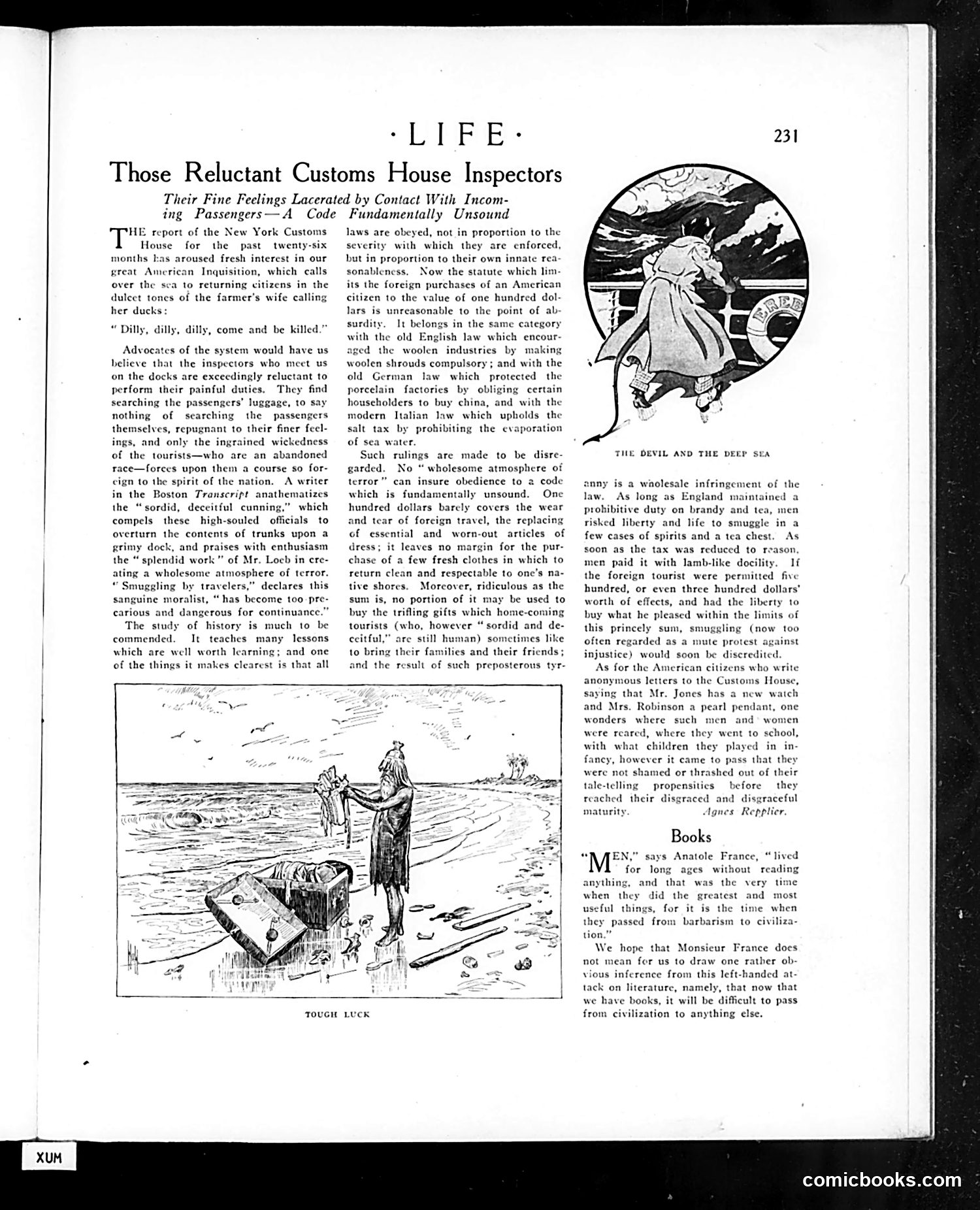
This satirical piece critiques the U.S. Customs House inspection system at ports of entry. The article argues that customs inspectors are portrayed as "reluctant" enforcers of an unjust law, when the real problem is the law itself—not the inspectors' supposed moral discomfort. The core argument: A $100 limit on returning Americans' foreign purchases is unreasonably low and inherently unenforceable. The author compares it to historically absurd laws (English wool shroud requirements, German china-buying mandates, Italian salt taxes) that people naturally circumvented. The article contends that reasonable laws achieve compliance without terror tactics; unreasonable ones breed systematic smuggling and moral corruption. The cartoons illustrate the tension: travelers arriving with contraband face inspection at customs. The satire targets both the flawed policy and self-righteous citizens who denounce smuggling while supporting an unjust statute.
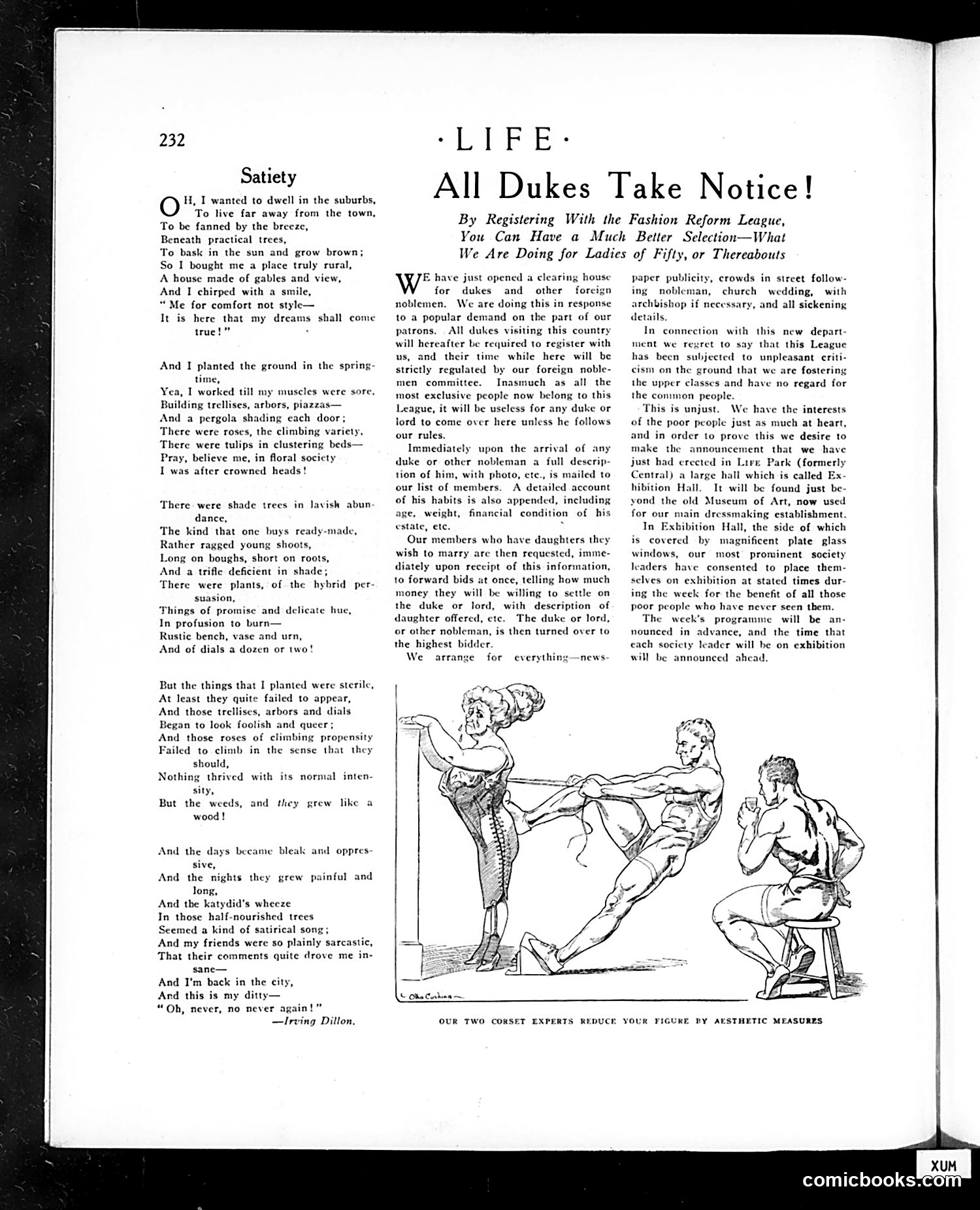
This page contains two satirical pieces from Life magazine: **Left: "Satiety"** — A humorous poem by Irving Dillon mocking the suburban dream. A city dweller buys a rural estate, plants elaborate gardens, and builds decorative structures (pergolas, trellises, sundials), expecting pastoral bliss. Instead, nothing thrives except weeds; plants fail, hired trees are spindly, and visiting friends mock his pretensions. Defeated, he retreats to the city, swearing never to try country living again. The satire targets the era's romanticization of suburban life and the gap between aspirations and reality. **Right: "All Dukes Take Notice!"** — A satirical advertisement for a "Fashion Reform League" that cynically positions itself as a matchmaking service auctioning foreign dukes to wealthy American families. The piece mocks both social climbing (American heiresses seeking titled husbands) and the commodification of aristocracy. The added claim that they also serve "poor people" through a public exhibition hall is transparent hypocrisy, satirizing how the wealthy mask class exploitation with false benevolence.
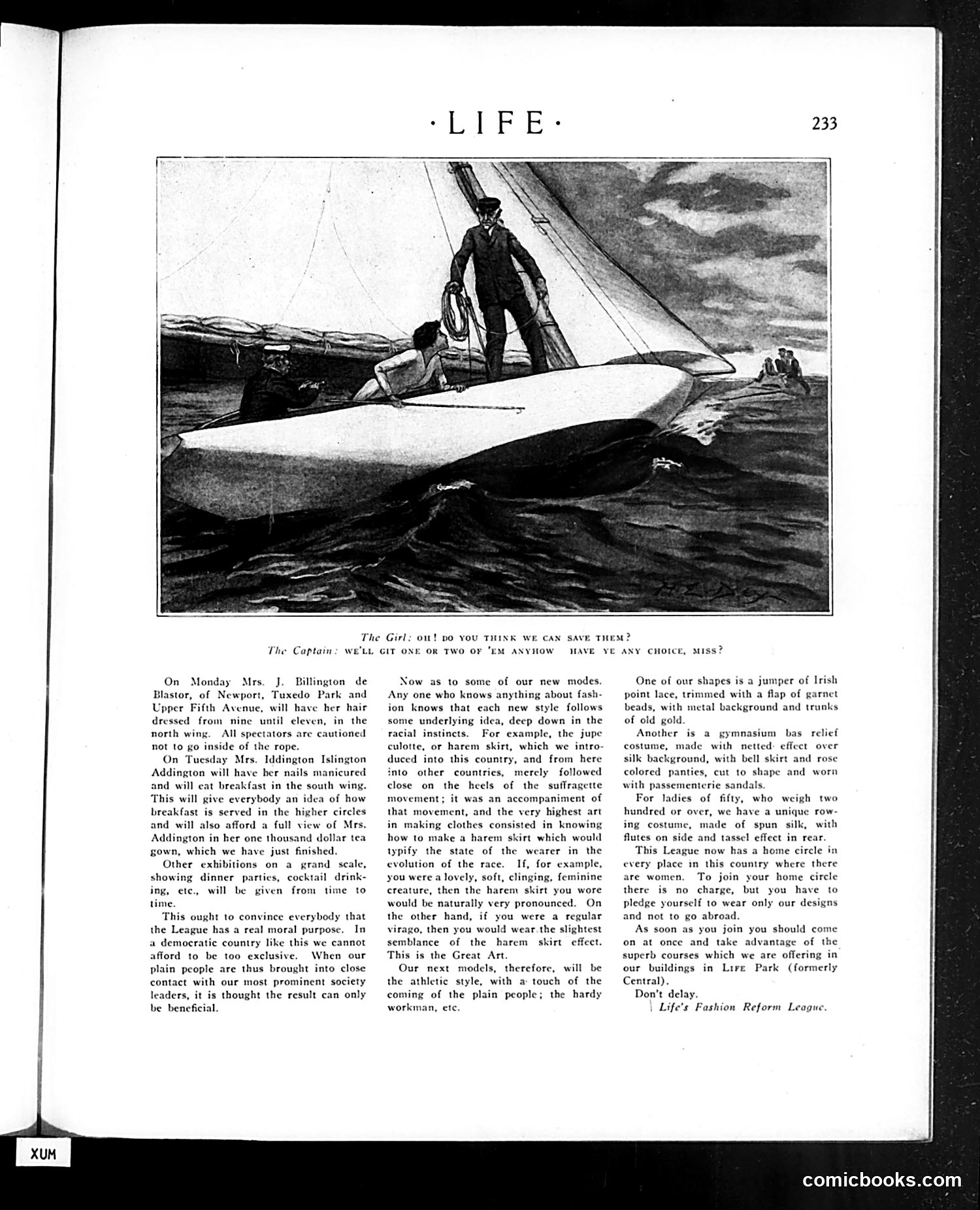
This page satirizes wealthy elites and a fashion reform movement through mock announcements. The illustration shows a rescue scene at sea, with the caption presenting a dark joke about saving drowning victims—establishing the irreverent tone. The text mocks exclusive society by announcing that prominent Newport socialites (Mrs. Billington de Blastor, Mrs. Addington) will perform mundane activities—having hair dressed, eating breakfast—as public "exhibitions" to demonstrate the League's democratic purpose. The satire suggests these wealthy women view even basic grooming as spectacles. The second section parodies fashion ideology, claiming styles reflect "racial instincts" and women's social evolution. The harem skirt supposedly expresses the wearer's femininity or "virago" nature. New designs absurdly target specific body types (jumpers, gymnasium costumes, rowing outfits for women over 200 pounds). The satire targets both snobbish society pretending at democracy and the pseudo-scientific fashion justifications used to market clothing, suggesting both are fundamentally ridiculous.
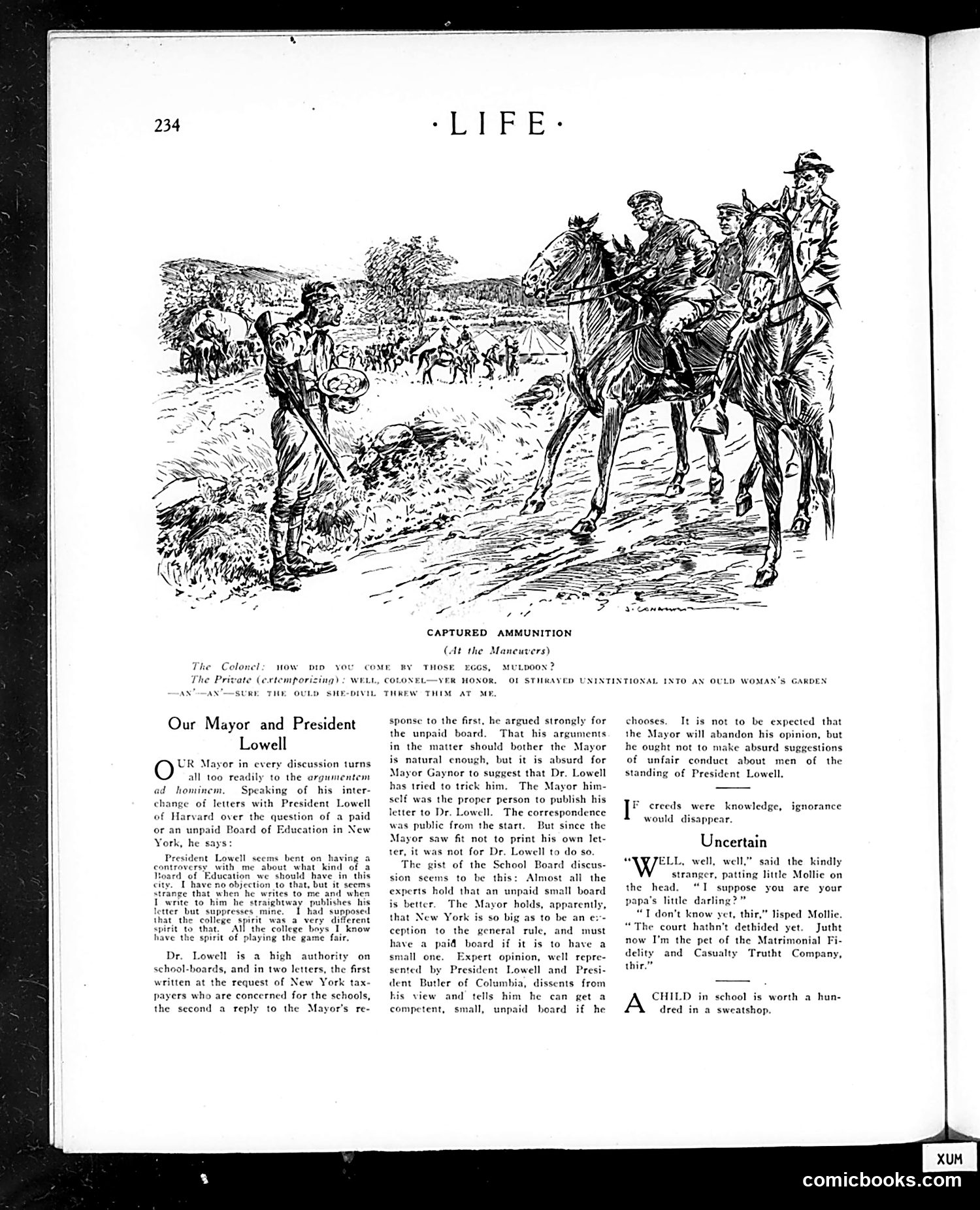
This page contains editorial commentary on a dispute between New York's Mayor and Harvard President Lowell over whether the city's Board of Education should be paid or unpaid. **The Main Article ("Our Mayor and President Lowell"):** The author criticizes the Mayor for using *ad hominem* arguments—attacking Lowell personally rather than engaging his substantive points. The Mayor accused Lowell of trying to trick him by publishing their correspondence; the author finds this absurd, noting Lowell had every right to publish his own letter. **The Two Cartoons:** The top illustration titled "Captured Ammunition" depicts soldiers joking about eggs, apparently from military maneuvers. The bottom cartoon, "Uncertain," shows a child telling a stranger she's currently "the pet of the Matrimonial Fidelity and Casualty Trustt Company"—satirizing how custody disputes treat children as property, while the final aphorism advocates for child labor reform. The page illustrates *Life*'s role as a satirical publication addressing urban politics and social issues.
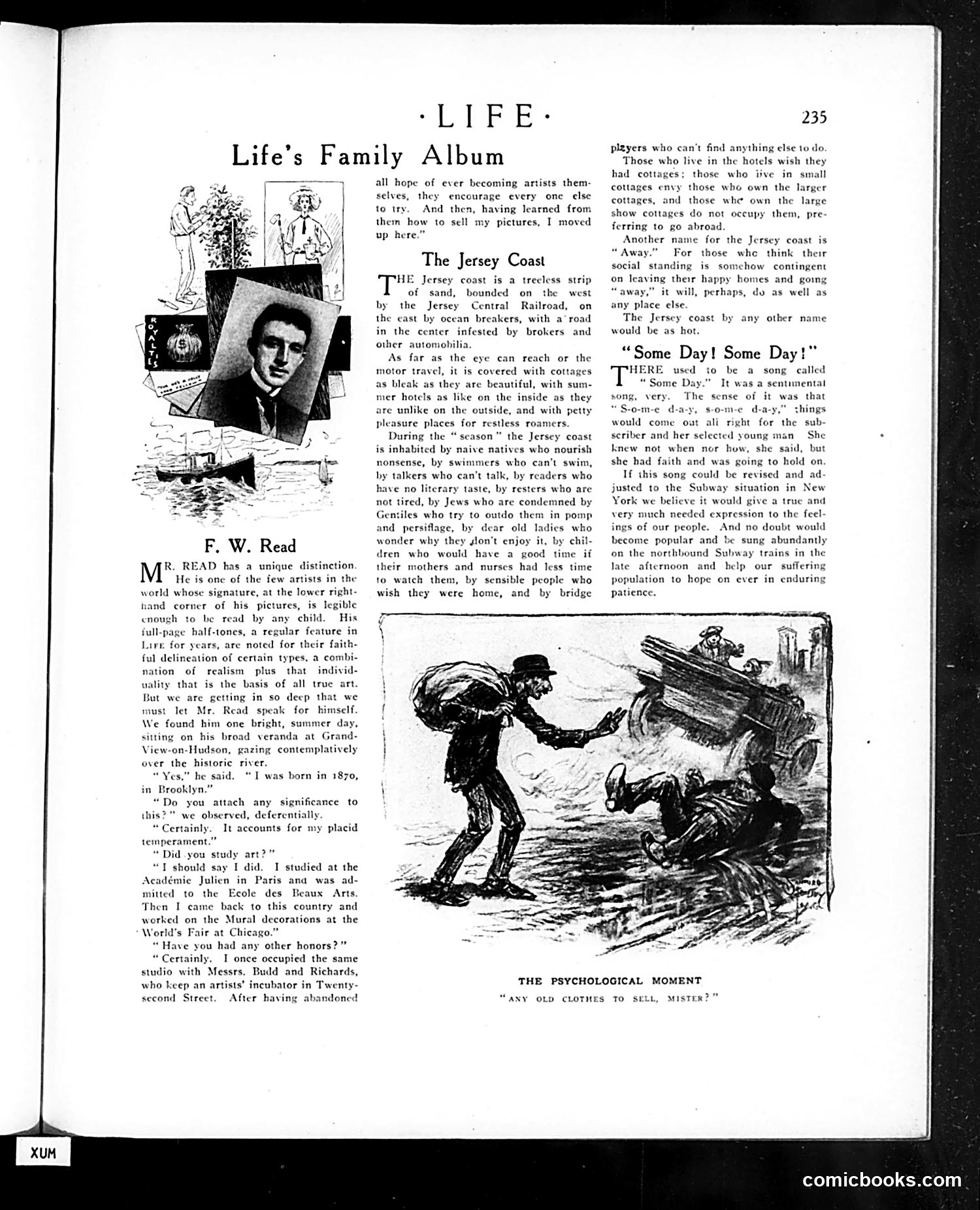
This page from *Life* magazine features F.W. Read, a prominent illustrator whose work regularly appeared in the publication. The text celebrates Read as an artist of particular skill—notably, his signature is legible enough for any child to read, a humorous distinction. The interview is satirical: Read claims to have studied at prestigious Paris academies and worked on the World's Fair murals, yet admits he ultimately learned "how to sell my pictures" from fellow artists at a studio in Manhattan. The page also includes two satirical essays: one mocking the Jersey Shore as crowded with pretentious vacationers and the socially anxious (people preferring hotels to cottages, or cottages to larger cottages), and another lamenting the NYC Subway experience, suggesting commuters need a sentimental song to endure their suffering. The cartoon "The Psychological Moment" shows a beggar attempting to sell worn clothes, capturing the absurdity of street commerce during the era.
This page contains reader letters to Life magazine addressing three topics: **"Unjust to Florida?"** - A Florida correspondent (Ernest W. Tyler) defends his state against child labor allegations. He denies Life's reporting that children worked in shrimp canneries, claiming no such canneries exist in Florida. He criticizes Owen Lovejoy of the National Child Labor Committee for making false claims, suggesting Lovejoy's "heartrending stories" about working babies shouldn't be trusted. Tyler argues Florida's climate is actually beneficial for children. **"Too Many Crowns"** - A correspondent critiques American illustrated magazines for incorrectly depicting British peers wearing royal crowns instead of coronets (which lack arches). He also corrects that Lord Charles Beresford, referenced in Life's pages, isn't actually a peer but uses "lord" by courtesy through his father's marquis title. **"Bishops"** - W.V. Mack corrects errors about bishops' nationalities and religious affiliations. These are typical reader-feedback letters to a satirical magazine, showing how Life functioned as a forum for public debate and correction.
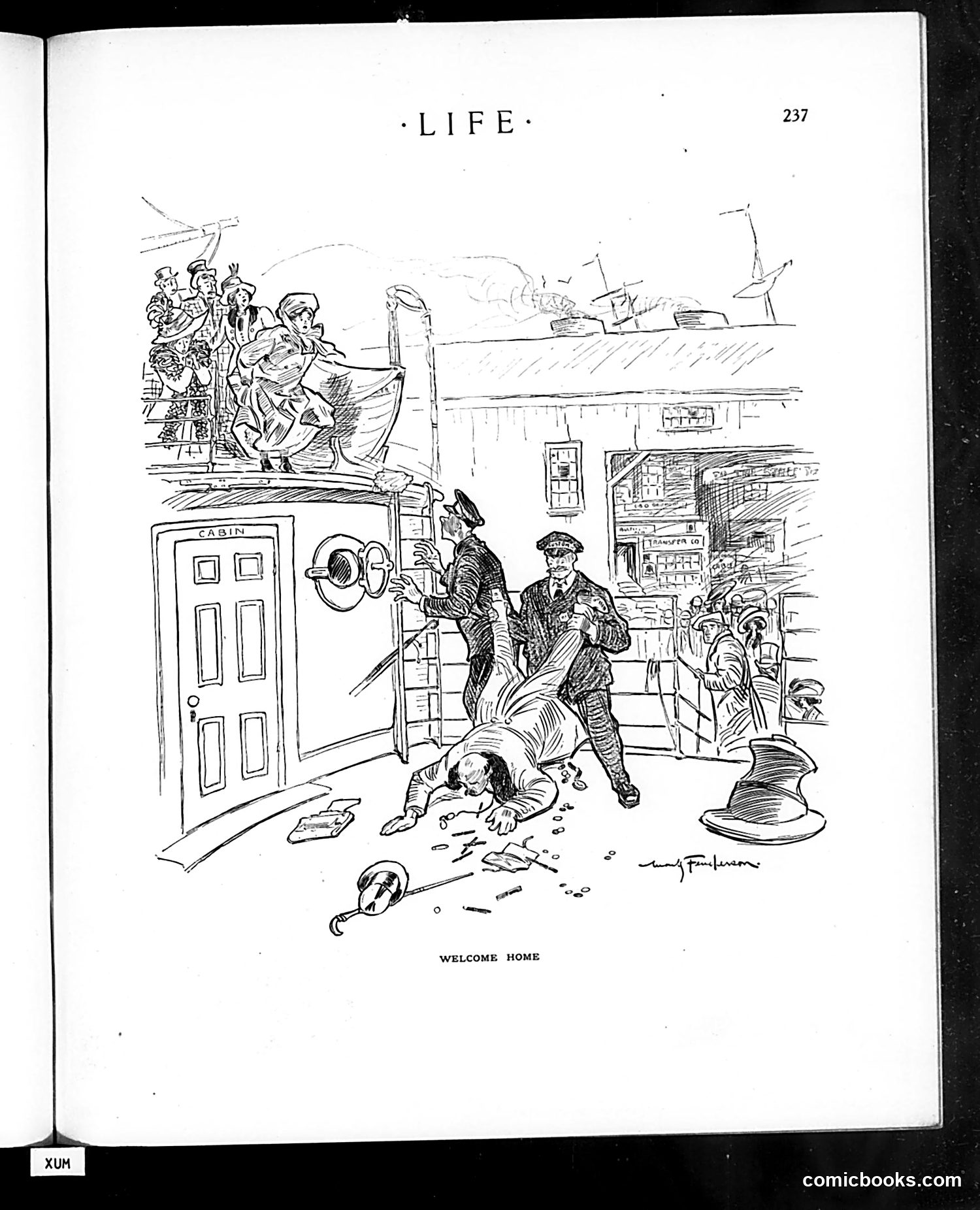
This Life magazine cartoon depicts a sailor's homecoming, likely from World War I or the interwar period. A uniformed sailor arrives at a modest house to find chaos: a child crawls on the floor surrounded by scattered items, while adults (presumably family members) gesture animatedly in the background. A cabin door is visible, and various household objects are strewn about. The satire appears to target the disruption caused by a serviceman's return to domestic life—suggesting that home has descended into disorder during his absence. The exaggerated chaos and the sailor's apparent bewilderment humorously comment on the gap between soldiers' expectations of a peaceful homecoming and the reality of a household that has carried on without them, perhaps implying wives or families have grown independent or the home has simply fallen into disarray.
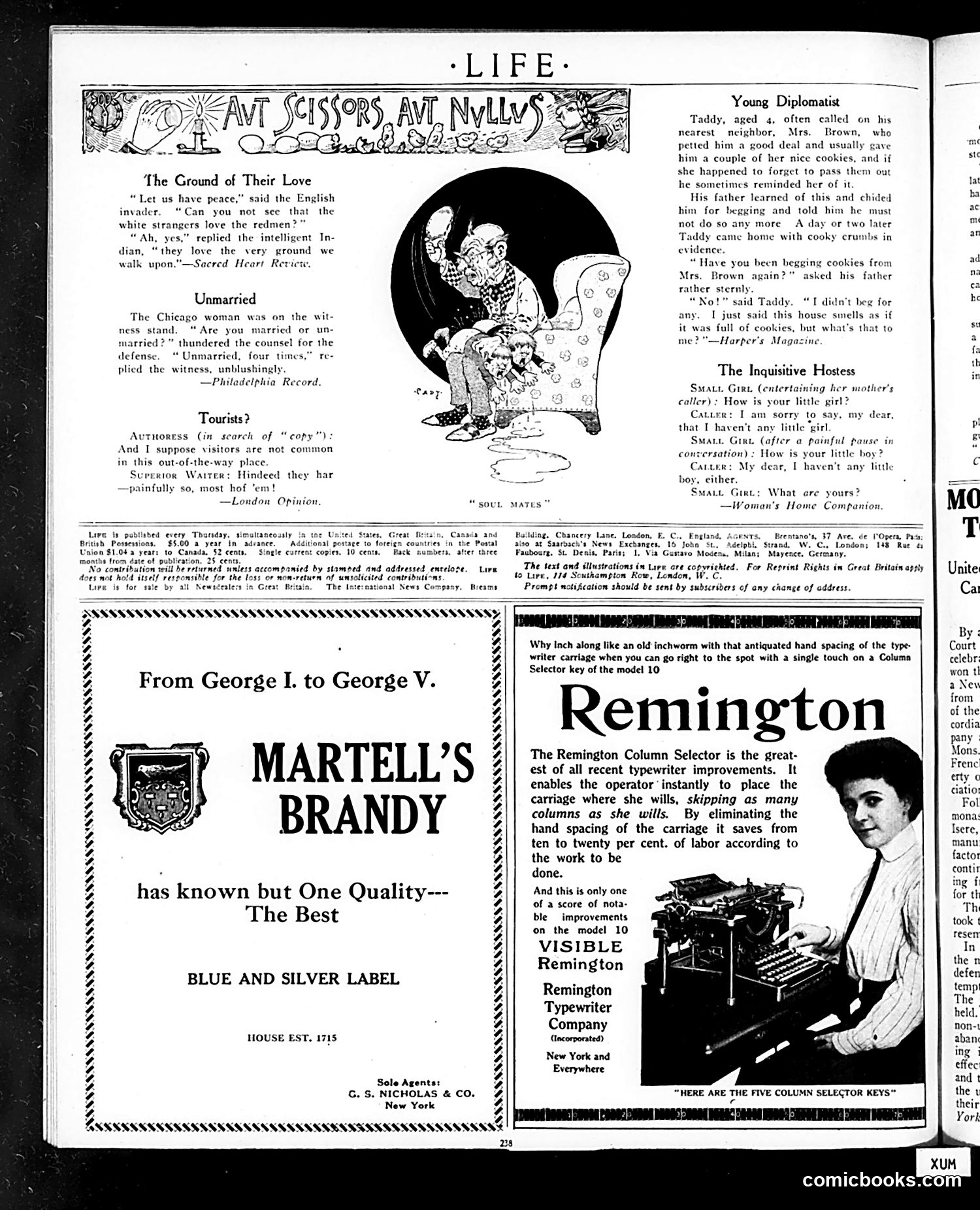
This page contains four brief satirical pieces typical of early 20th-century humor magazines: **"The Ground of Their Love"** jokes on a perceived contradiction: an English invader claims strangers love Native Americans, but an intelligent Indian replies they love "the very ground we walk upon"—a double meaning suggesting they love the land the invaders occupy, or perhaps that they're dead. **"Unmarried"** presents a woman testifying she's been "unmarried four times"—a joke about multiple divorces, shocking for the era when divorce was scandalous. **"Tourists?"** features a country innkeeper surprised a visitor claims tourists aren't common there, when they're "painfully" abundant. **"The Inquisitive Hostess"** shows a socially awkward woman asking a guest about her children, only to learn she has none, then asking "What are yours?"—implying the hostess assumes everyone has children. The page is otherwise dominated by period advertisements for Martell's Brandy and Remington typewriters.
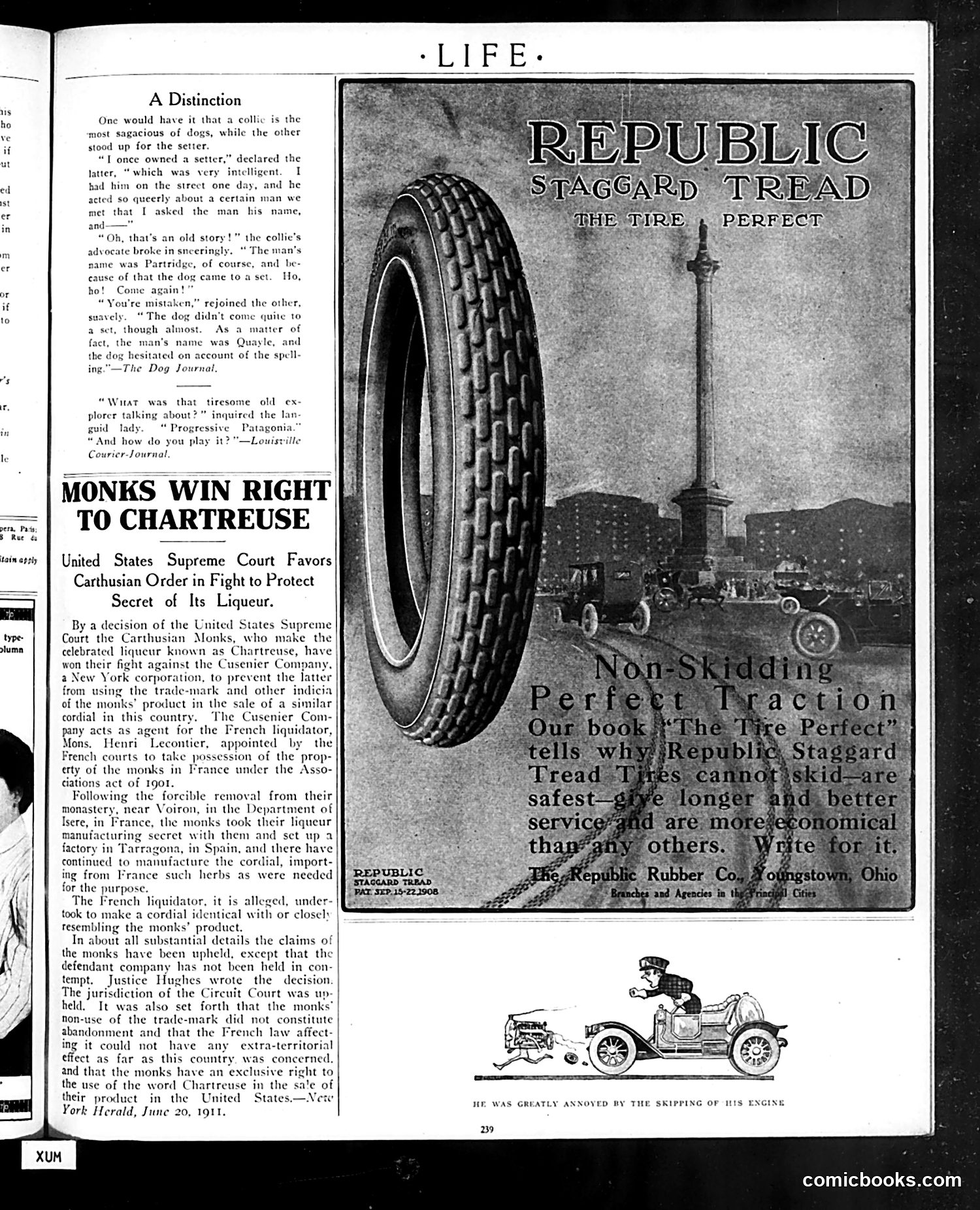
This page contains two separate elements: **Left side - Humor pieces:** Three short jokes about dogs and wordplay. The "Distinction" story plays on a pun: one dog owner claims his setter acted strangely around a man named "Partridge" (suggesting the dog wanted to "set" on game birds), but the other reveals the man's name was actually "Quayle"—a similar-sounding name that would cause the same behavioral confusion, deflating the first story's cleverness. **Right side - Advertisement:** Republic Rubber Company's ad for "Staggard Tread" tires, featuring a large tire image and an early automobile. The accompanying cartoon (bottom) shows a motorist frustrated by engine trouble, captioned "HE WAS GREATLY ANNOYED BY THE SKIPPING OF HIS ENGINE." **Separate news article:** "Monks Win Right to Chartreuse" reports a 1911 Supreme Court decision protecting Carthusian monks' trademark rights to their liqueur against a French company, even though the monks had relocated their operation to Spain.
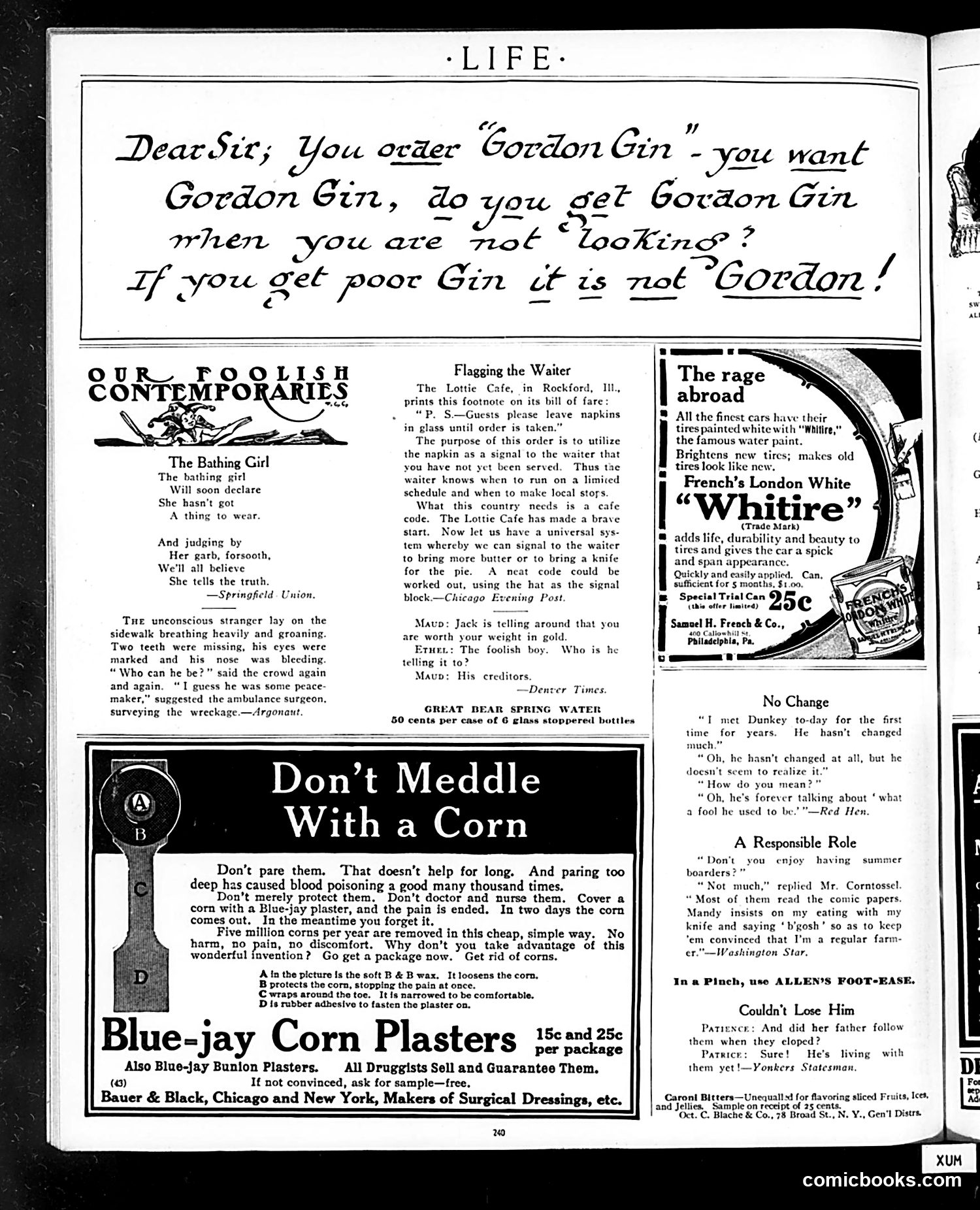
This page from *Life* contains several satirical pieces reflecting early 20th-century social humor: **"The Bathing Girl"** mocks the era's ongoing debate about women's swimwear becoming increasingly revealing, suggesting young women claim to have "nothing to wear" while visibly wearing very little. **"Flagging the Waiter"** satirizes restaurant inefficiency by highlighting a café's signal system using napkins to indicate whether customers have been served—poking fun at poor service standards. **"The Peacemaker"** joke implies someone beaten unconscious attempted to intervene in a fight, with the surgeon sarcastically suggesting he was a "peacemaker"—mocking naive peacekeeping efforts. The remaining items are **advertisements** (Gordon Gin, corn plasters, tires, foot powder) interspersed with brief humorous anecdotes about creditors, unchanged acquaintances, and domestic life. The page exemplifies *Life*'s formula: satirical commentary on modern inconveniences alongside commercial advertising—all targeting a middle-class readership amused by social observation and mild domestic humor.
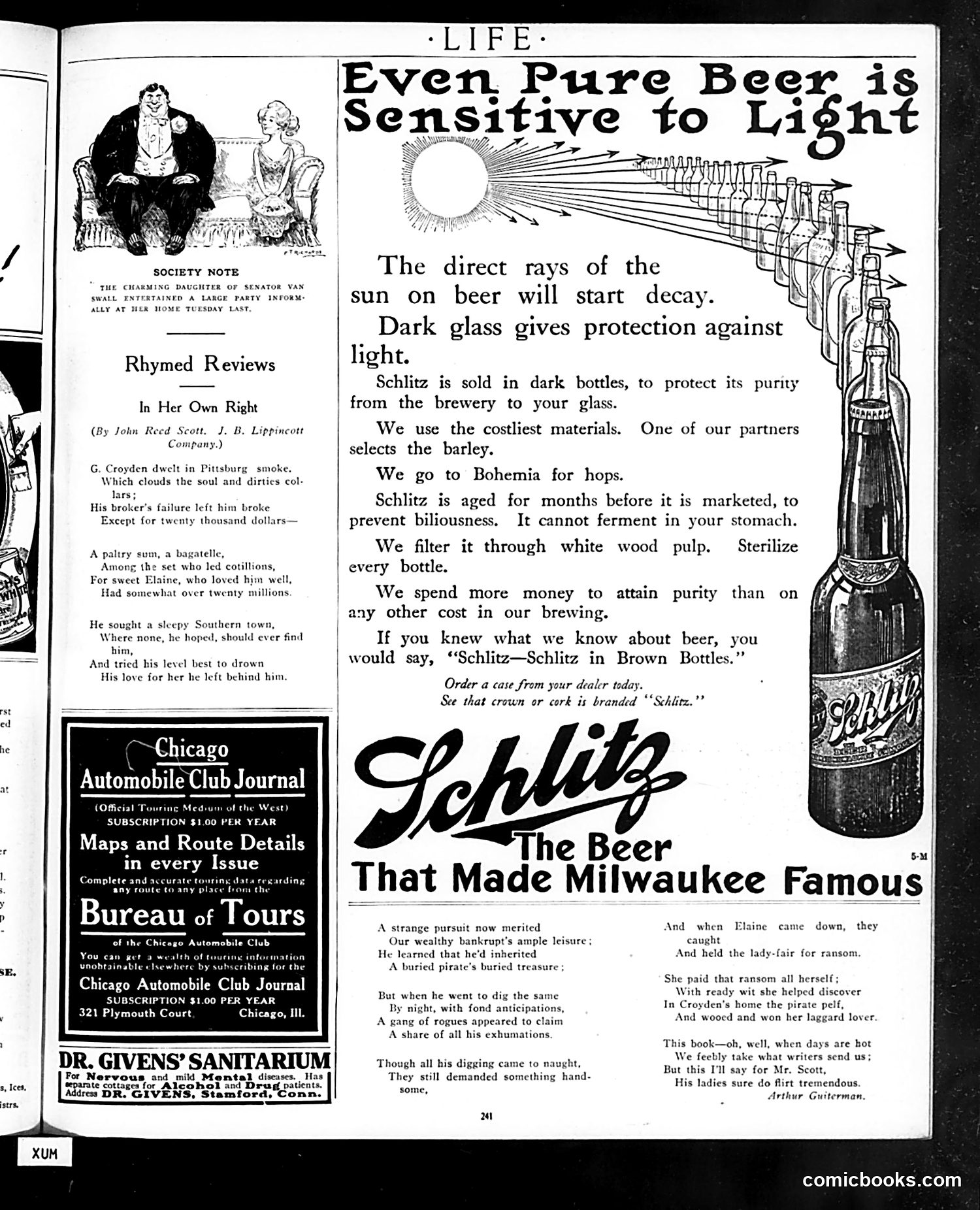
This page is primarily **advertising**, not satire or political commentary. The dominant content is a Schlitz beer advertisement occupying most of the right side. The ad employs scientific-sounding claims about beer's light sensitivity to justify why Schlitz uses dark bottles. It appeals to quality-conscious consumers by emphasizing expensive ingredients (Bohemian hops, selected barley) and elaborate processes (aging, white wood pulp filtration, sterilization). The left side contains minor content: a society note about a senator's daughter's party, and a "Rhymed Review" by Arthur Guiterman satirizing a mediocre adventure novel involving a broke man, inherited pirate treasure, and female characters who "sure do flirt tremendous." The review is mildly humorous but gentle—the author's main complaint is that the book is forgettable summer reading, not genuinely bad. There's no sharp political edge; this represents typical Life magazine content mixing light social commentary with commercial advertising.
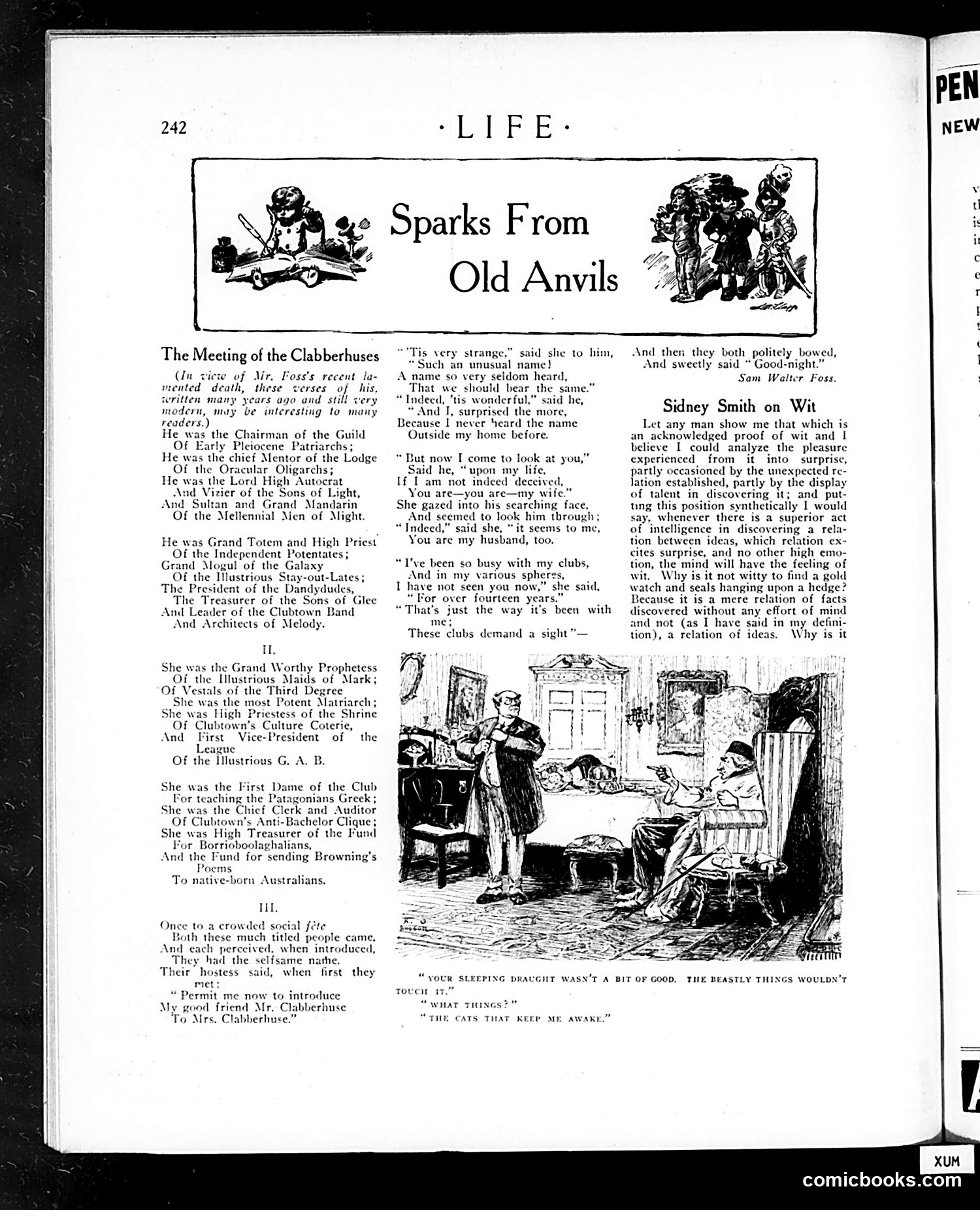
This humorous story by Sam Walter Foss satirizes the excessive club culture and social pretension of his era. The joke centers on two people—Mr. and Mrs. Clabberhuse—who share the same unusual surname yet meet at a social gathering as strangers. The satire works through their absurdly inflated titles (Chairman of various guilds, Grand Mogul, High Priestess, etc.), which mock the elaborate hierarchies of civic and social organizations. After fourteen years of marriage, they've been so consumed with their respective club activities and "spheres" that they've barely seen each other, discovering their relationship only through accident. The cartoon illustration shows a domestic scene, likely depicting the moment of their reunion. The humor targets both the pretentiousness of organizational titles and the neglect of actual family relationships in pursuit of social status—a pointed critique of American civic life in the early 1900s.
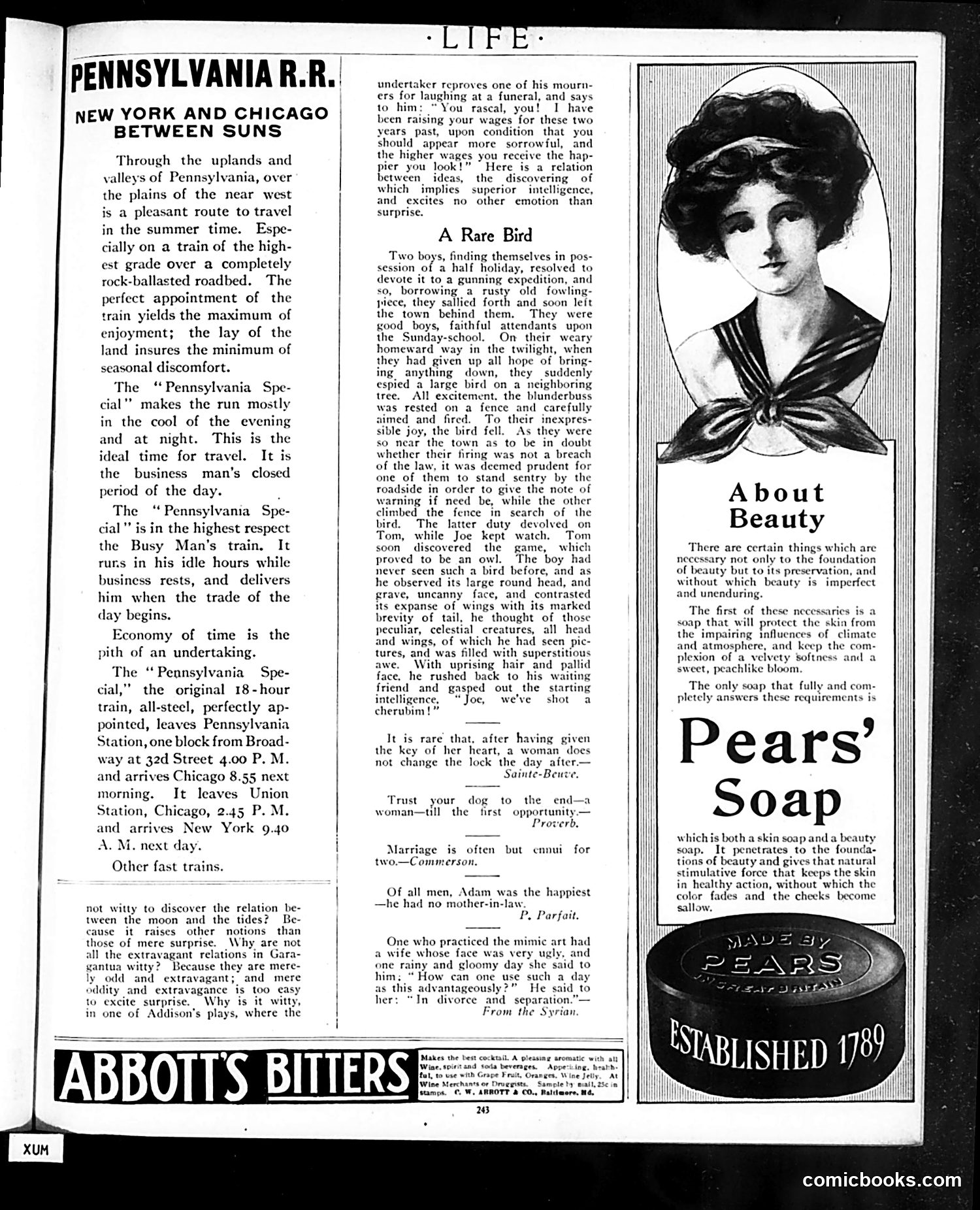
This page combines railroad advertising with short humorous pieces typical of early Life magazine's satirical format. **Main Content:** A Pennsylvania Railroad advertisement for the "Pennsylvania Special," an 18-hour train between New York and Chicago, emphasizing efficient travel during "business hours" for the busy man. **"A Rare Bird" Story:** A brief humorous tale about two boys who shoot what they believe is a supernatural creature (a "cherubim") but is actually an owl. The joke relies on the boys' superstitious misidentification—they've never seen an owl before and interpret its unusual appearance (round head, large wings, small tail) through a religious lens, creating comic panic. **Other Elements:** The page includes snippets of aphorisms and witty observations about human nature (relations between moon/tides, marriage, divorce), typical of Life's miscellaneous humor section. **Historical Note:** This represents Life before it became primarily a photojournalism magazine—here it functioned as a literary/satirical publication with advertising, short fiction, and philosophical quips.
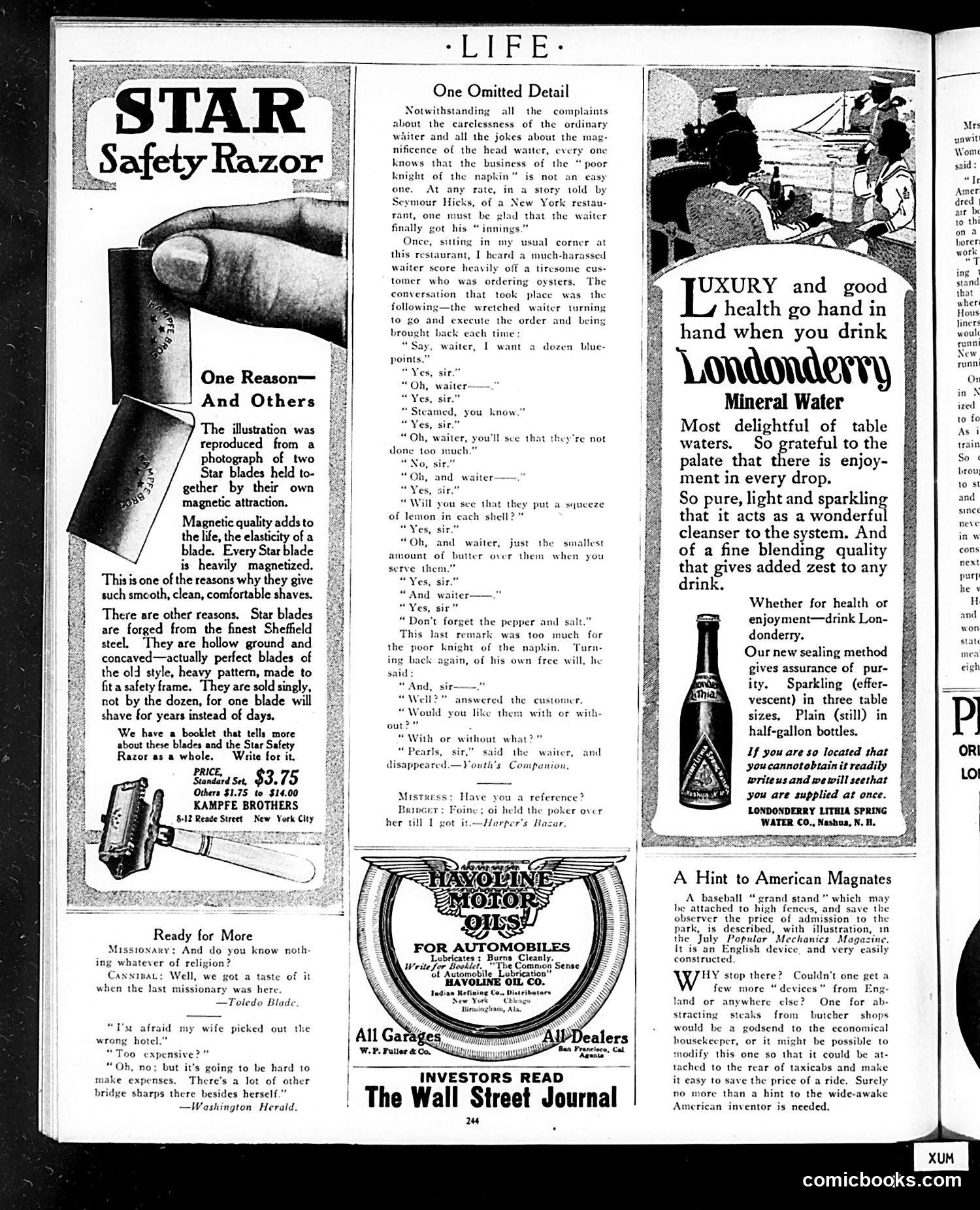
This page is primarily **advertisements and humor pieces**, typical of Life magazine's format. The main content includes: 1. **Star Safety Razor ad**: Uses magnetic attraction between two blades as a selling point, emphasizing Sheffield steel quality and durability ("shave for years instead of days"). 2. **Three brief jokes**: - A missionary encounter with a cannibal - A husband complaining about his wife's expensive hotel choice and her bridge-playing - A restaurant scene where a frustrated waiter sarcastically asks a fussy oyster-ordering customer if he wants his meal "with or without pearls"—the waiter's witty comeback to excessive demands 3. **Londonderry Mineral Water ad**: Marketing "luxury and good health" through pure spring water with sparkling options. 4. **Wall Street Journal and Hayoline Motor Oil ads**: Standard business/product advertising. 5. **Brief mention of an English baseball grandstand device** for fence-climbing spectators. The page reflects early 20th-century consumer culture, workplace humor, and class-based comedy (servants outwitting demanding customers). Nothing requires specific historical context beyond recognizing the era's advertising conventions.
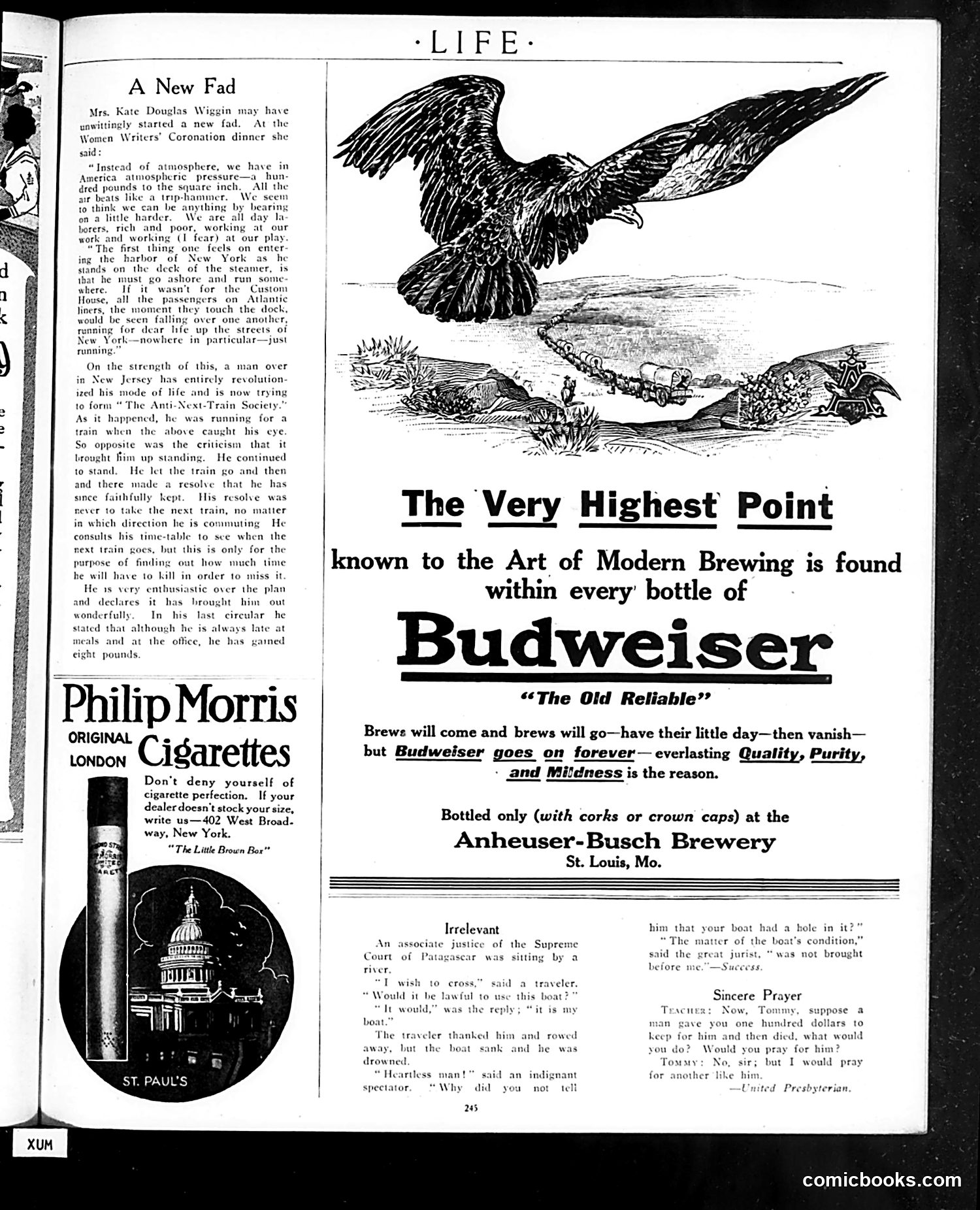
This page combines satirical commentary with period advertisements. The main article, "A New Fad," mocks a social trend allegedly sparked by writer Kate Douglas Wiggin's critique of American "atmospheric pressure" and constant rushing. The satire describes a New Jersey man who, inspired by her words, forms an "Anti-Next-Train Society"—deliberately *missing* trains to resist society's compulsion toward constant motion and productivity. The joke targets early 20th-century American hustle culture: the irony is that refusing to catch trains becomes itself a conscious lifestyle rebellion, suggesting how deeply ingrained the culture of rushing had become. The page also includes two brief humorous anecdotes ("Irrelevant" and "Sincere Prayer") and advertisements for Philip Morris cigarettes and Budweiser beer, typical of Life's mixed editorial-advertising format. These ads reflect contemporary marketing approaches quite different from modern standards.
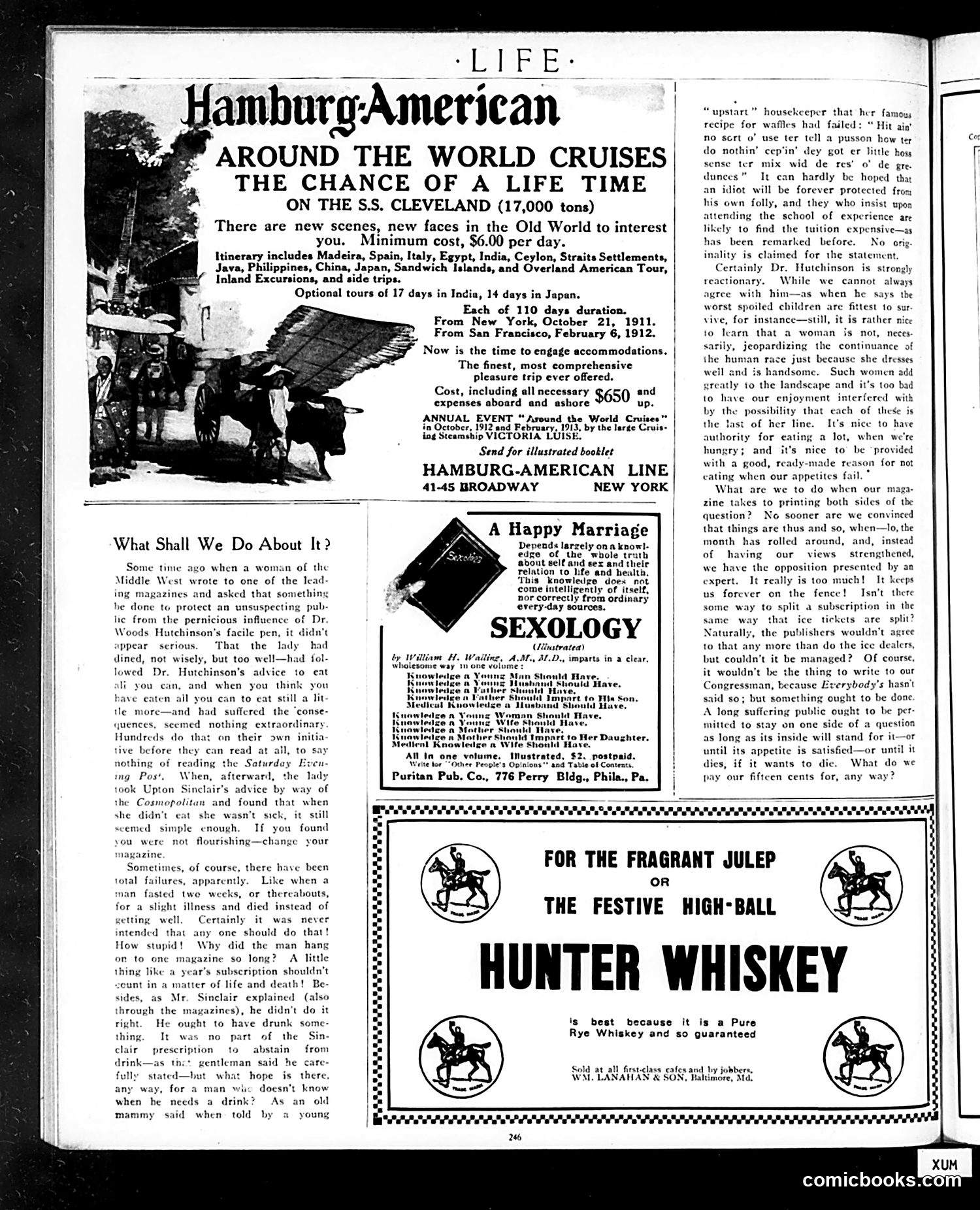
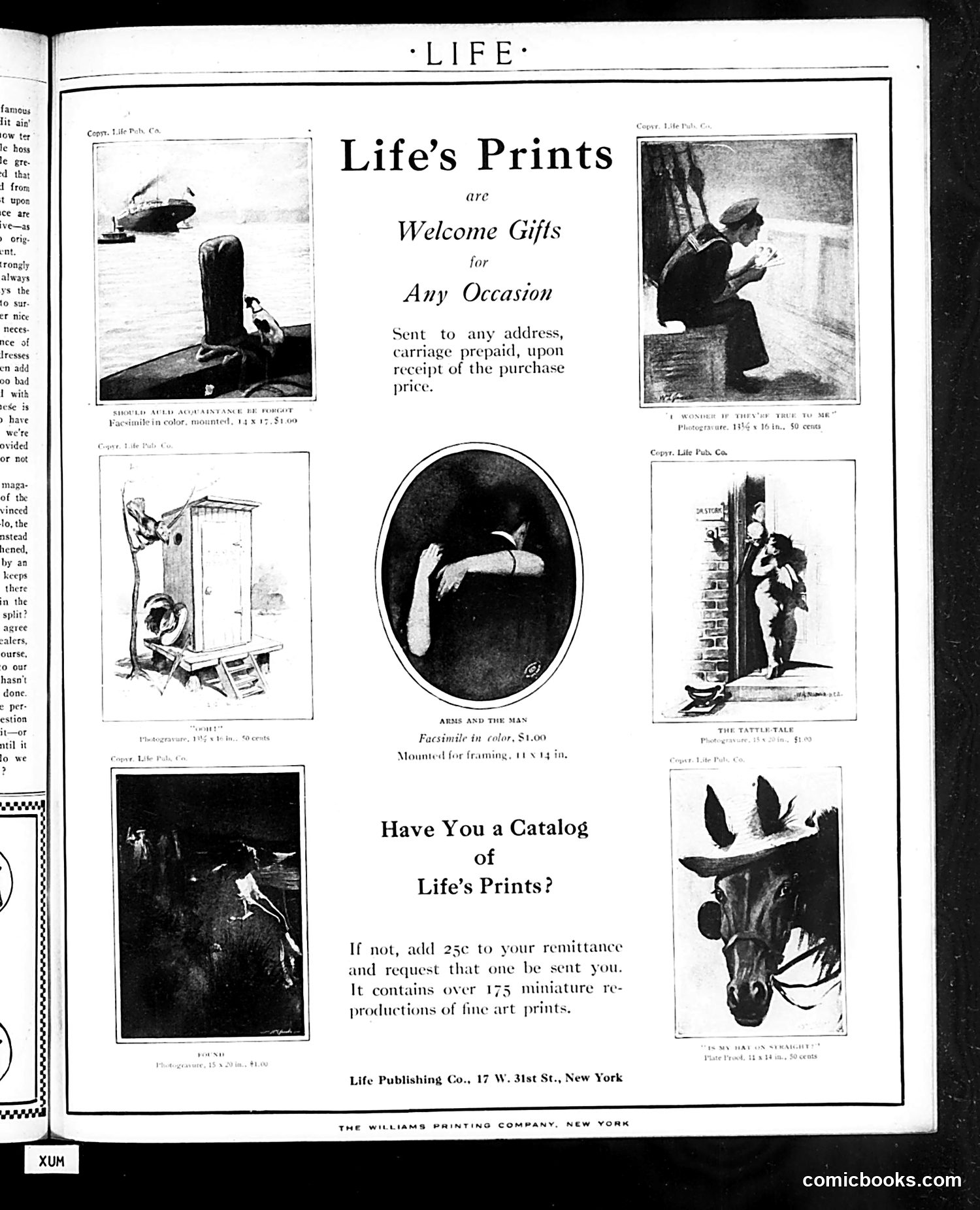
This is primarily a **product advertisement** for Life Publishing Company's art print catalog, not political satire. The page promotes framed prints as gifts, featuring six sample images with titles like "Short Acquaintance is Forgot," "Arms and the Man," "The Tattle Tale," and "In My Day on Starlight." The prints appear to be sentimental or humorous illustrations typical of early-20th-century magazine art—depicting scenes of romance, domestic life, and childhood moments. The advertisement emphasizes that these are "Welcome Gifts for Any Occasion," positioning them as affordable decorative items available through mail order (with carriage prepaid). The page includes pricing information (facsimiles ranging from 50 cents to $1.00) and promotes the full catalog containing "over 175 miniature reproductions of fine art prints" for 25 cents. This represents commercial rather than satirical content—a standard mail-order merchandise pitch from the era.
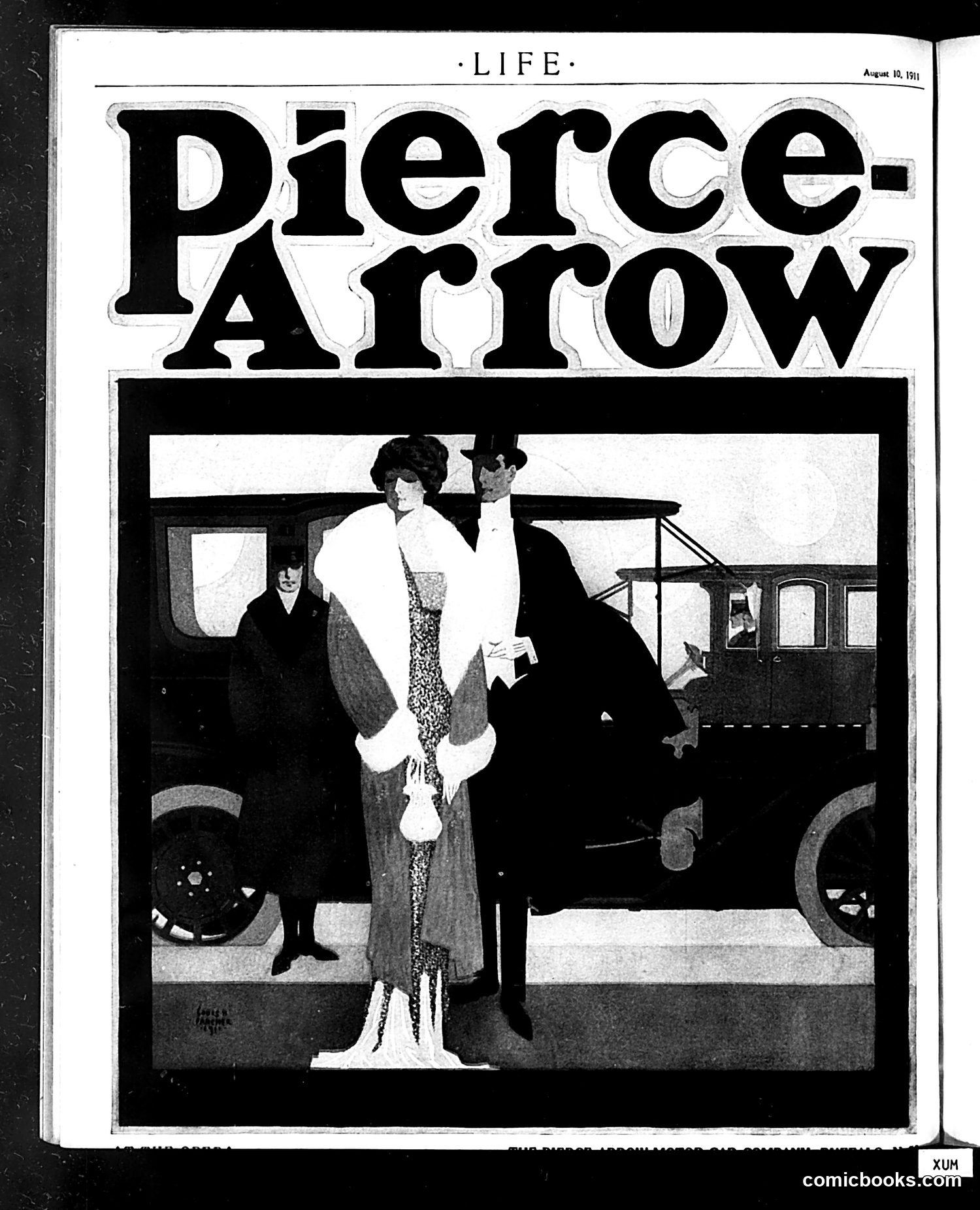
This is a Life magazine cover from August 10, 1911, featuring an advertisement for Pierce-Arrow automobiles. The illustration shows a wealthy couple and their chauffeur posed beside an elegant motorcar, with additional passengers visible inside the vehicle. The image satirizes early automotive luxury and class distinction. The elegantly dressed woman in furs and the well-dressed gentleman represent the affluent clientele who could afford Pierce-Arrow vehicles—among the most expensive cars of the era. The formal poses and fashionable clothing emphasize the automobile as a status symbol for the wealthy elite. The inclusion of a chauffeur underscores that ownership implied sufficient wealth to employ a driver. This reflects the pre-mass-production era when automobiles were exclusively luxury goods.