
Life, 1911-08-10 · page 23 of 40
Life — August 10, 1911 — page 23: what you’re looking at
What you’re looking at
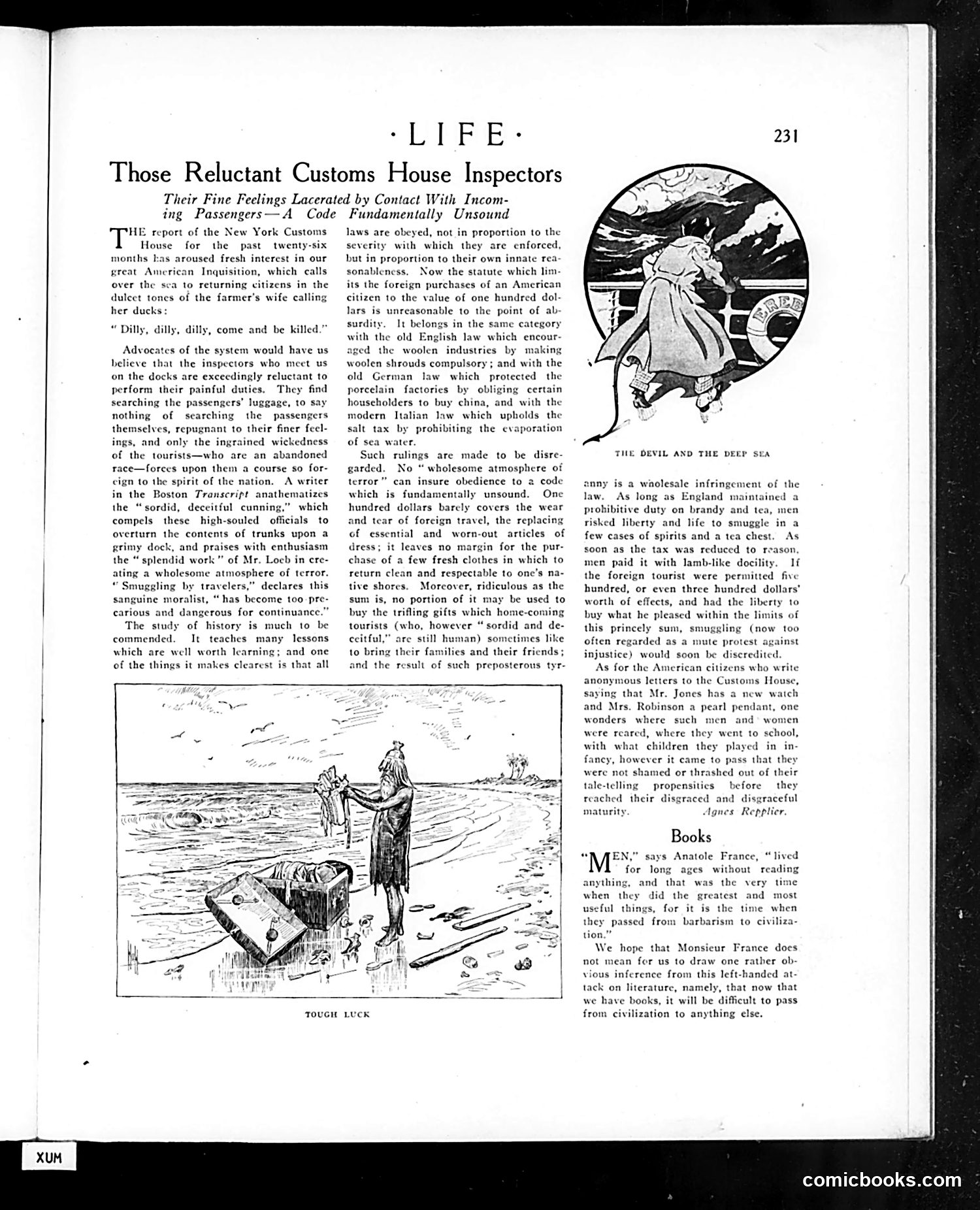
This satirical piece critiques the U.S. Customs House inspection system at ports of entry. The article argues that customs inspectors are portrayed as "reluctant" enforcers of an unjust law, when the real problem is the law itself—not the inspectors' supposed moral discomfort. The core argument: A $100 limit on returning Americans' foreign purchases is unreasonably low and inherently unenforceable. The author compares it to historically absurd laws (English wool shroud requirements, German china-buying mandates, Italian salt taxes) that people naturally circumvented. The article contends that reasonable laws achieve compliance without terror tactics; unreasonable ones breed systematic smuggling and moral corruption. The cartoons illustrate the tension: travelers arriving with contraband face inspection at customs. The satire targets both the flawed policy and self-righteous citizens who denounce smuggling while supporting an unjust statute.
📄 Transcribed text from this page (OCR, searchable)
Machine-transcribed from the original scan — historical spelling and the odd misread are preserved.
XUM ‘LIP Those Reluctant Customs House Inspectors Their Fine Feelings Lacerated by Contact With Incom- ing Passengers—A Code Fundamentally Unsound HE report of the New York Customs House for the past twenty-six months kas aroused fresh interest in our great American Inquisition, which calls over the sca to returning citizens in the dulcet tones of the farmer's wife calling her ducks: “ Dilly, dilly, dilly, come and be killed.” Advocates of the system would have us believe that the inspectors who meet us on the docks are excecdingly reluctant to perform their painful duties. They find searching the passengers’ luggage, to say nothing of searching the themselves, repugnant to their finer feel- ings, and only the ingrained wickedness of the tourists—who are an abandoned race—forces upon them a course so for- cign to the spirit of the nation. A writer in the Boston Transcript anathematizes the “sordid, deceitful cunning,” which compels these high-souled officials to overturn the contents of trunks upon a grimy dock, and praises with enthusiasm the “ splendid work” of Mr. Loch in cre- ating a wholesome atmosphere of terror. “ Smuggling by travelers,” declares this sanguine moralist, “has become too pre- carious and dangerous for continuance.” The study of history is much to be commended. It teaches many lessons which are well worth learning; and one of the things it makes clearest is that all passengers laws are obeyed, not in proportion to the severity with which they are enforced, but in proportion to their own innate rea sonableness. Now the statute which lim its the foreign purchases of an American citizen to the value of one hundred dol- lars is unreasonable to the point of ab- surdity. It belongs in the same category with the old English law which encour- aged the woolen industries by making woolen shrouds compulsory ; and with the old German law which protected the porcelain factories by obliging certain householders to buy china, and with the modern Italian Inw which upholds the salt tax by prohibiting the evaporation of sea w Such rulings are made to be disre- garded. No “wholesome atmosphere of terror” can insure obedience to a code which is fundamentally unsound. One hundred dollars barely covers the wear and tear of foreign travel, the replacin: of essential and worn-out articles of dress; it leaves no margin for the pur- chase of a few fresh clothes in which to return clean and respectable to one’s na- tive shores. Morcover, ridiculous as the sum is, no portion of it may be used to buy the trifling gifts which home-coming tourists (who, however “sordid and de- ccitful,” are still human) sometimes like to bring their families and their friends; and the result of such preposterous tyr- Toven LUCK 231 THE DEVIL AND THE DEEP SEA anny is a waolesale infringement of the law. As long as England maintained a probibitive duty on brandy and tea, men risked liberty and life to smuggle in a few cases of spirits and a tea chest. As soon as the tax was reduced to reason men paid it with lamb-like docility. If the foreign tourist were permitted five hundred, or even three hundred dollars’ worth of effects, and had the liberty to buy what he pleased within the limits of this princely sum, smuggling (now too often regarded as a mute protest against injustice) would soon be discredited. As for the American citizens who write anonymous letters to the Customs House, saying that Mr. Jones has a new watch and Mrs. Robinson a pearl pendant, one wonders where such men and) women were reared, where they went to school, with what children they played in in- fancy, however it came to pass that they were not shamed or thrashed out of their tale-telling propensities before they reached their disgraced and disgraceful maturity Agnes Repplier. Books “NEN,” says Anatole France, “lived for long ages without reading anything, and that was the very time when they did the greatest and most useful things, for it is the time when they sed from barbarism to civiliza- tion.” We hope that Monsieur France does not mean for us to draw one rather ob- vious inference from this left-handed at- tack on literature, namely, that now that we have books, it will be difficult to pass from civilization to anything else. comicbooks.com