
Life, 1911-08-10 · page 27 of 40
Life — August 10, 1911 — page 27: what you’re looking at
What you’re looking at
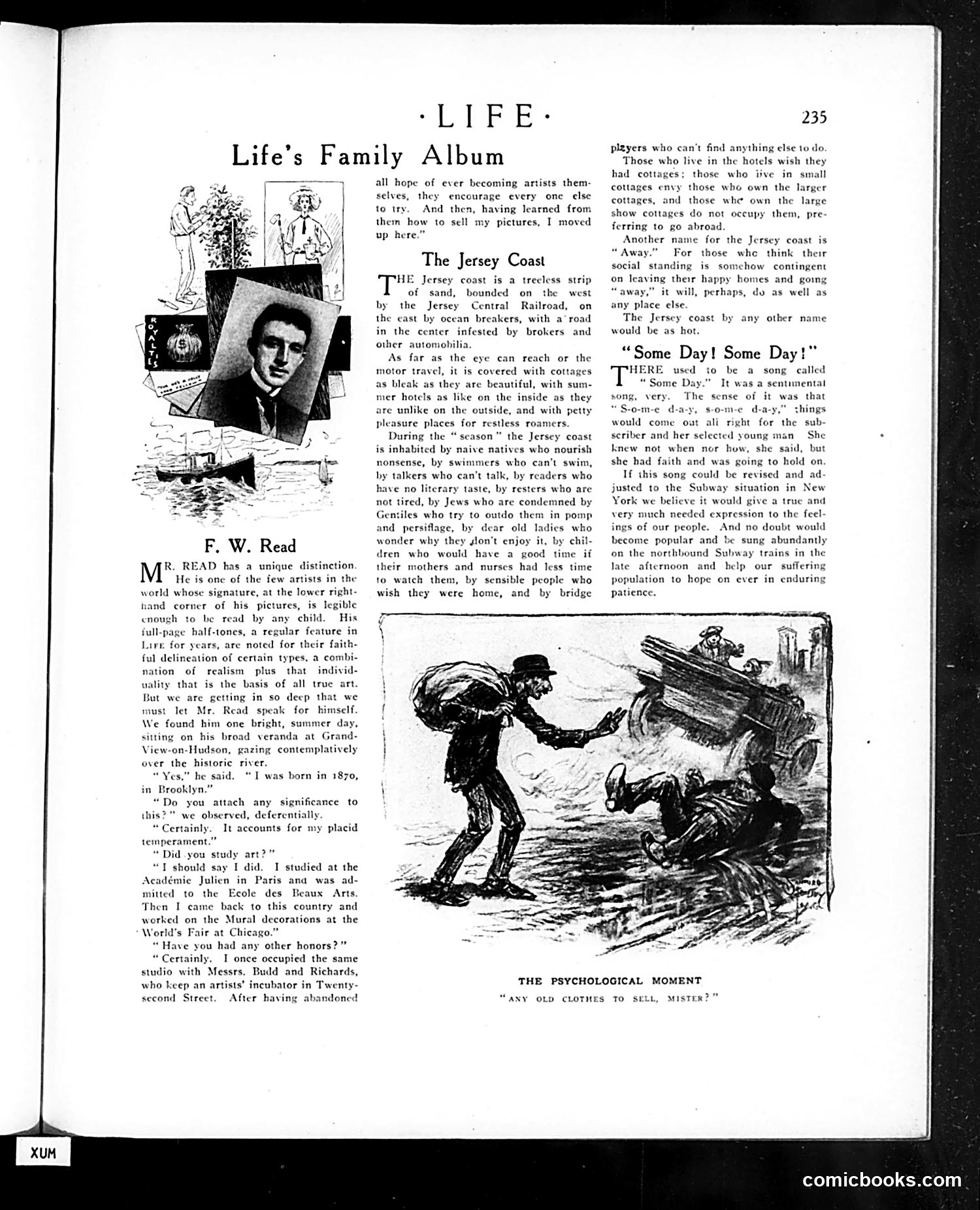
This page from *Life* magazine features F.W. Read, a prominent illustrator whose work regularly appeared in the publication. The text celebrates Read as an artist of particular skill—notably, his signature is legible enough for any child to read, a humorous distinction. The interview is satirical: Read claims to have studied at prestigious Paris academies and worked on the World's Fair murals, yet admits he ultimately learned "how to sell my pictures" from fellow artists at a studio in Manhattan. The page also includes two satirical essays: one mocking the Jersey Shore as crowded with pretentious vacationers and the socially anxious (people preferring hotels to cottages, or cottages to larger cottages), and another lamenting the NYC Subway experience, suggesting commuters need a sentimental song to endure their suffering. The cartoon "The Psychological Moment" shows a beggar attempting to sell worn clothes, capturing the absurdity of street commerce during the era.
📄 Transcribed text from this page (OCR, searchable)
Machine-transcribed from the original scan — historical spelling and the odd misread are preserved.
*LIPE® Life’s Family Album F. W. Read M* AD has a unique distinction. He is one of the few artists in the world whose signature, at the lower right- hand corner of his pictures, is legible enough to be read by any child. His iull-page half-tones, a regular feature in Lire for years, are noted for their faith- ful delineation of certain types, a comb nation of realism plus that indivi uality that is the basis of all true art. But we are getting in so deep that we must let Mr. Read speak for himself We found him one bright, summer day, sitting on his broad veranda at Grand- View-on-Hudson, gazing contemplatively over the historic river. “Yes,” he said. “I was born in 1870, in Brooklyn. “Do you attach any significance to we observed, deferentially. It accounts for my placid this?” * Certainly temperament.” “Did you study art?” “T should say I did. 1 studied at the Académie Julien in Paris ana was ad- mitted to the Ecole des Beaux Arts Then I came back to this country and worked on the Mural decorations at the World’s Fair at Chica “Have you had any other honors?” “Certainly. I once occupied the same studio with Messrs. Budd and Richards, who keep an artists’ incubator in Twent second Street. After having abandoned all hope of ever becoming artists them- selves, they encourage every one else to try. And then, having learned from them how to sell my pictures, I moved up here.” The Jersey Coast TH Jersey coast is a treeless strip of sand, bounded on the west by the Jersey Central Railroad, on the east by ocean breakers, with a’ road in the center infested by brokers and other automobilia. As far as the eye can reach or the motor travel, it is covered with cottages as bleak as they are beautiful, with sui mer hotels as like on the inside as they are unlike on the outside, and with petty pleasure places for restless roamers. During the “season” the Jersey coast is inhabited by naive natives who nourish nonsense, by swimmers who can't swim, by talkers who can’t talk, by readers who have no literary taste, by resters who are not tired, by Jews who are condemned by Gentiles who try to outdo them in pomp and persiflage, by dear old ladies who wonder why they slon't enjoy it, by chil- dren who would have a good time if their mothers and nurses had less time to watch them, by sensible people who wish they were home, and by bridge m= 235 plzyers who can’t find anything else to do. Those who live in the hotels wish they had cottages; who in small cottages envy those who own the larger cottages, and those whe own the show cottages do not occupy them, pre- ferring to go abroad. Another name for the Jersey coast is ” For those whe think their social standing is somehow contingent on leaving therr happy homes and going “ it will, perhaps, do as well as those live large way,” any place else. The Jersey coast by would be as hot. any other name “Some Day! Some Day!” HERE used to be a song. called Some Day.” It was a sentimental The sense of it that -o-m-e d-a-y, s-o-m-e d-a- things would come out ali right for the sub- scriber and her selected young man She knew not when nor how, she said, but she had faith and was going to hold on. If this song could be revised and ad justed to the Subway situation in New York we believe it would give a true and very much needed expression to the feel- ings of our people. And no doubt would become popular and be sung abundantly on the northbound Subway trains in the song, very late afternoon and help our suffering population to hope on ever in enduring patience. THE PSYCHOLOGICAL MOMENT ANY OLD CLOTHES TO SE MISTER?” comicbooks.com