
Life, 1911-08-10 · page 37 of 40
Life — August 10, 1911 — page 37: what you’re looking at
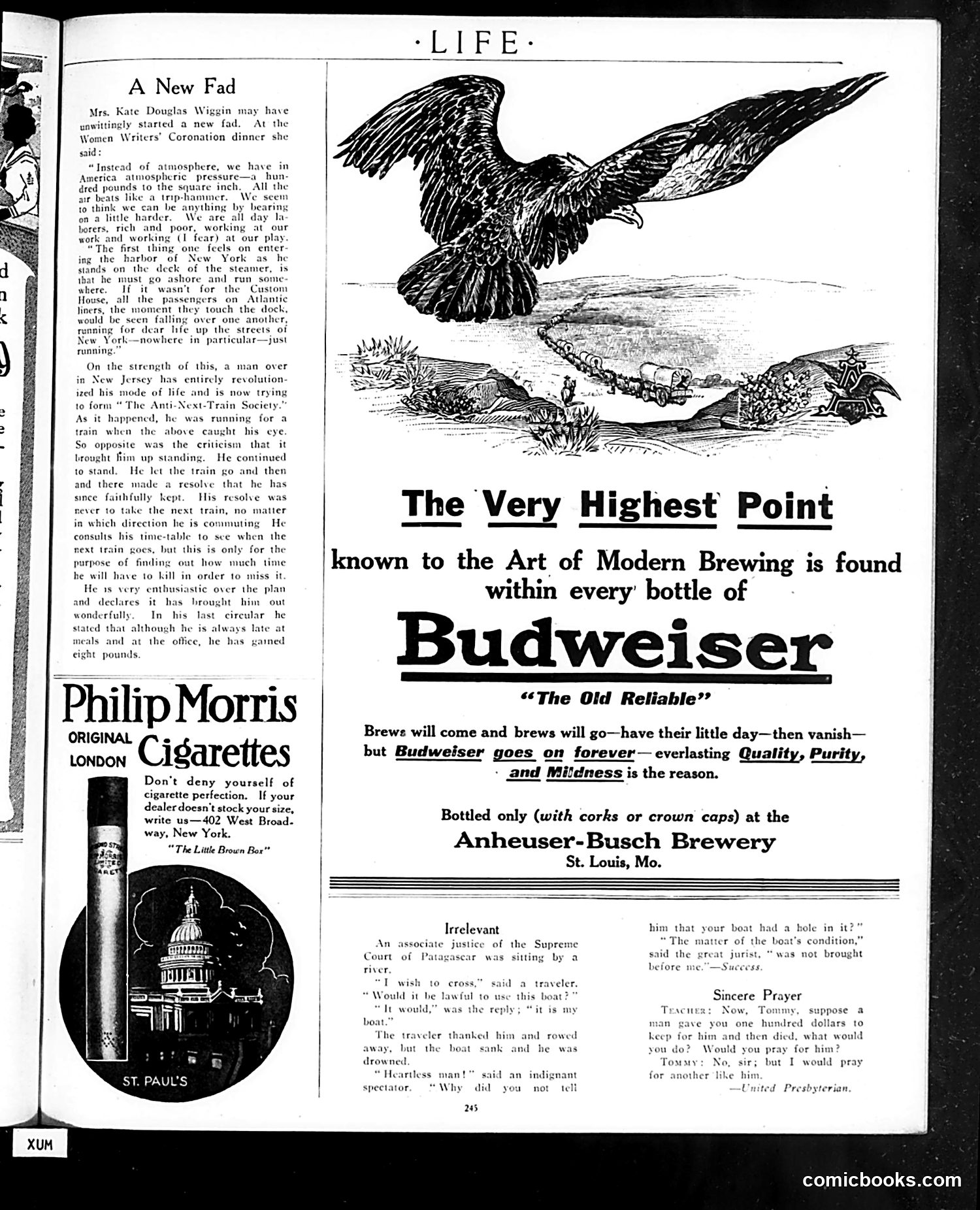
What you’re looking at
This page combines satirical commentary with period advertisements. The main article, "A New Fad," mocks a social trend allegedly sparked by writer Kate Douglas Wiggin's critique of American "atmospheric pressure" and constant rushing. The satire describes a New Jersey man who, inspired by her words, forms an "Anti-Next-Train Society"—deliberately *missing* trains to resist society's compulsion toward constant motion and productivity. The joke targets early 20th-century American hustle culture: the irony is that refusing to catch trains becomes itself a conscious lifestyle rebellion, suggesting how deeply ingrained the culture of rushing had become. The page also includes two brief humorous anecdotes ("Irrelevant" and "Sincere Prayer") and advertisements for Philip Morris cigarettes and Budweiser beer, typical of Life's mixed editorial-advertising format. These ads reflect contemporary marketing approaches quite different from modern standards.
📄 Transcribed text from this page (OCR, searchable)
Machine-transcribed from the original scan — historical spelling and the odd misread are preserved.
A New Fad Mrs. Kate Douglas Wiggin may have unwittingly started a new fad. At the Women Writers’ Coronation dinner she said: “Instead of atmosphere, we have i tica atmospheric pressure—a_hun- ed pounds to the square inch. All the air beats like a trip-hammer. We se k we can be anything by b der. We are all ¢ and poor, working a i (I fear) at our play The first thing one - ing the harbor of Ne nds on the deck of the ste. he must go ashore and run_some- where. If it wasn’t for the Custom House, all the passengers on Atlantic liners, the moment touch the dock, would be seen falling rs ¢ another, running for dear hfe up the streets of New York—nowhere in particular—just running.” On the strength of this, a man over in New Jersey has entirely revolution- ized his mode of life 1 is now trying to form “ The Anti-Next-Train Society.” As it happened, he was running for a train when the above caught his eye. So opposite was the criticism that it Lrought fim up standing. He continued to stand, He let the train go and then and there made a resolve that he has é since faithfully kept. His resolve was s bd ‘ s in which direction he is commuting He poinibad, — Aeiotoeth consults his time-table to sce when the next train goes, but this is only for the romose of fining eat how mach vine | KOwn to the Art of Modern Brewing is found he will have to kill in order to miss it He os very enthusiastic over the plan within every’ bottle of and declares it has brought him out wonderfully, In his last’ circular he Philip Morris “The Old Reliable” ORIGINAL Brewe will come and brews will go—have their little day—then vanish— LONDON Cigarettes but Budweiser goes on forever — everlasting Quality, Purity, : and Mildness is the reason. Don't deny yourself of cigarette perfection. If your dealer doesn’t stock ees, ‘ adic ext Wert Broad. Bottled only (with corks or crown caps) at the way, New York. | I a | Anheuser-Busch Brewery St. Louis, Mo. him that your boat had a hole in i “The matter of the boat's condition said the great jurist, “was not brought Irrelevant An associate justice of the Supreme Court of Patagascar was sitting by a river before me."—Success “LT owish t * said a traveler. “Would it be this boat?” Sincere Prayer “It would,” was the 5 it is my Trscnea: Now, Tommy, suppose a boat.” man gave you one hundred dollars to The traveler thanked him and rowed keep for him and then died, what would away, but the boat sank and he was you Would you pray for him? drowned Tomay: No, sir; but I would pray “Heartless man!” said an indignant for another spectator. “Why did you not tell 245 comicbooks.com