
Life, 1911-08-10 · page 16 of 40
Life — August 10, 1911 — page 16: what you’re looking at
What you’re looking at
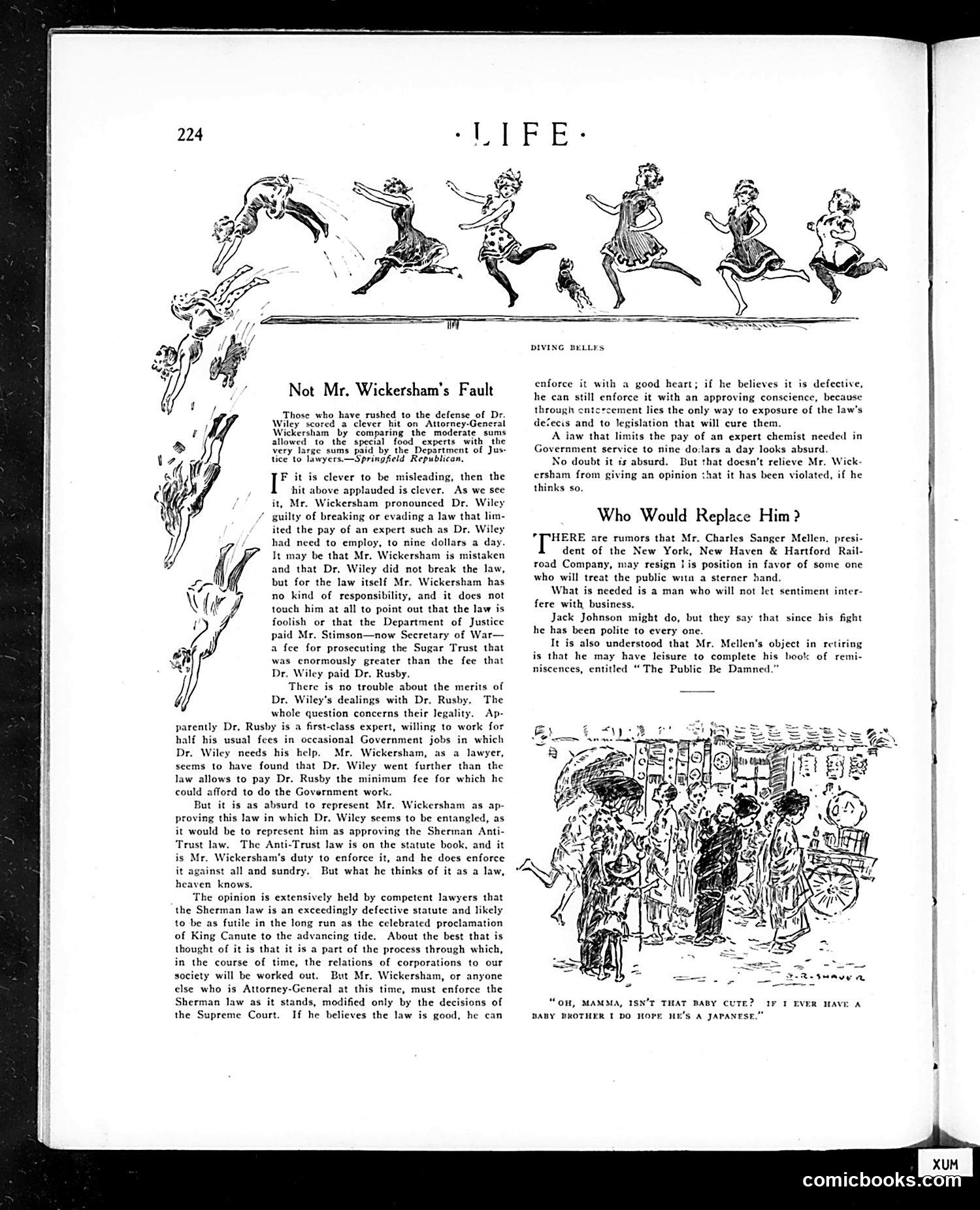
This page addresses two separate political-satirical topics: **"Not Mr. Wickersham's Fault"** defends Attorney-General Wickersham against criticism regarding Dr. Wiley, a food safety expert. Wiley allegedly violated a law limiting expert pay to $9/day by employing Dr. Rusby. Critics compared this to the Justice Department paying lawyers far more for similar work. Life argues the criticism is unfair: Wickersham merely enforced existing law, not created it. The piece defends a public official's duty to enforce laws deemed foolish, noting that exposing bad laws through enforcement enables legislative reform. **"Who Would Replace Him?"** sarcastically mocks Charles Sanger Mellen, president of the New York, New Haven & Hartford Railroad, who rumored to resign. Life jokes that his replacement should "not let sentiment interfere with business"—suggesting Mellen was too considerate to passengers. The cruel humor references Mellen's book titled "The Public Be Damned," implying railroad executives prioritize profits over public welfare. The "Diving Belles" cartoon illustration appears decorative rather than thematically connected.
📄 Transcribed text from this page (OCR, searchable)
Machine-transcribed from the original scan — historical spelling and the odd misread are preserved.
Not Mr. Wickersham’s Fault Those who have rushed to the defense of Dr. Wiley scored a clever hit on Attorney-General Wickersham by comparing the moderate sums allowed to the special food experts with the very large sums paid by the Department of Jus: tice to lawyers.—Springfield Republican, F it is clever to be misleading, then the hit above applauded is clever. As we sce it, Mr. Wickersham pronounced Dr. Wiley / guilty of breaking or evading a law that lim- ited the pay of an expert such as Dr. Wiley had need to employ, to nine dollars a day. It may be that Mr, Wickersham is mistaken and that Dr. Wiley did not break the law, but for the law itself Mr. Wickersham has no kind of responsibility, and it docs not touch him at all to point out that the law is foolish or that the Department of Justice paid Mr. Stimson—now Secretary of War— a fce for prosecuting the Sugar Trust that was enormously greater than the fee that Dr. Wiley paid Dr. Rusby. There is no trouble about the merits of Dr. Wiley’s dealings with Dr. Rusby. The whole question concerns their legality. Ap- parently Dr, Rusby is a first-class expert, willing to work for half his usual fees in occasional Government jobs in which Dr. Wiley needs his help. Mr. Wickersham, as a lawyer, seems to have found that Dr. Wiley went further than the law allows to pay Dr. Rusby the minimum fee for which he could afford to do the Government work. But it is as absurd to represent Mr. Wickersham as ap- proving this law in which Dr. Wiley seems to be entangled, as it would be to represent him as approving the Sherman Anti- Trust law. The Anti-Trust law is on the statute book, and it Mr. Wickersham’s duty to enforce it, and he does enforce it against all and sundry. But what he thinks of it as a law, heaven knows. The opinion is extensively held by competent lawyers that the Sherman law is an exceedingly defective statute and likely to be as futile in the long run as the celebrated proclamation of King Canute to the advancing tide. About the best that is thought of it is that it is a part of the process through which, in the course of time, the relations of corporations to our society will be worked out. But Mr. Wickersham, or anyone else who is Attorney-General at this time, must enforce the Sherman law as it stands, modified only by the decisions of the Supreme Court. If he believes the law is good, he can DIVING BELLES enforce it with a good heart; if he believes it is defective, he can still enforce it with an approving conscience, because through cntcrcement lies the only way to exposure of the law's defecis and to legislation that will cure them. A iaw that limits the pay of an expert chemist needed in Government service to nine do:lars a day looks absurd. No doubt it is absurd. But that doesn’t relieve Mr. Wick- ersham from giving an opinion <hat it has been violated, if he thinks so. Who Would Replace Him ? HERE are rumors that Mr. Charles Sanger Mellen, pre: dent of the New York, New Haven & Hartford Rail- road Company, may resign 1 is position in favor of some one who will treat the public wita a sterner hand. What is needed is a man who will not let sentiment inter- fere with business. Jack Johnson might do, but they say that since his fight he has been polite to every one. It is also understood that Mr. Mellen’s object in retiring is that he may have leisure to complete his book of remi- niscences, entitled “The Public Be Damned.” “OH, MAMMA, ISN’T THAT BABY CUTE? IF I EVER HAVE A BABY BROTHER I DO HOPE ME’S A JAPANESE.” comicbooks -com