
Life, 1911-08-10 · page 22 of 40
Life — August 10, 1911 — page 22: what you’re looking at
What you’re looking at
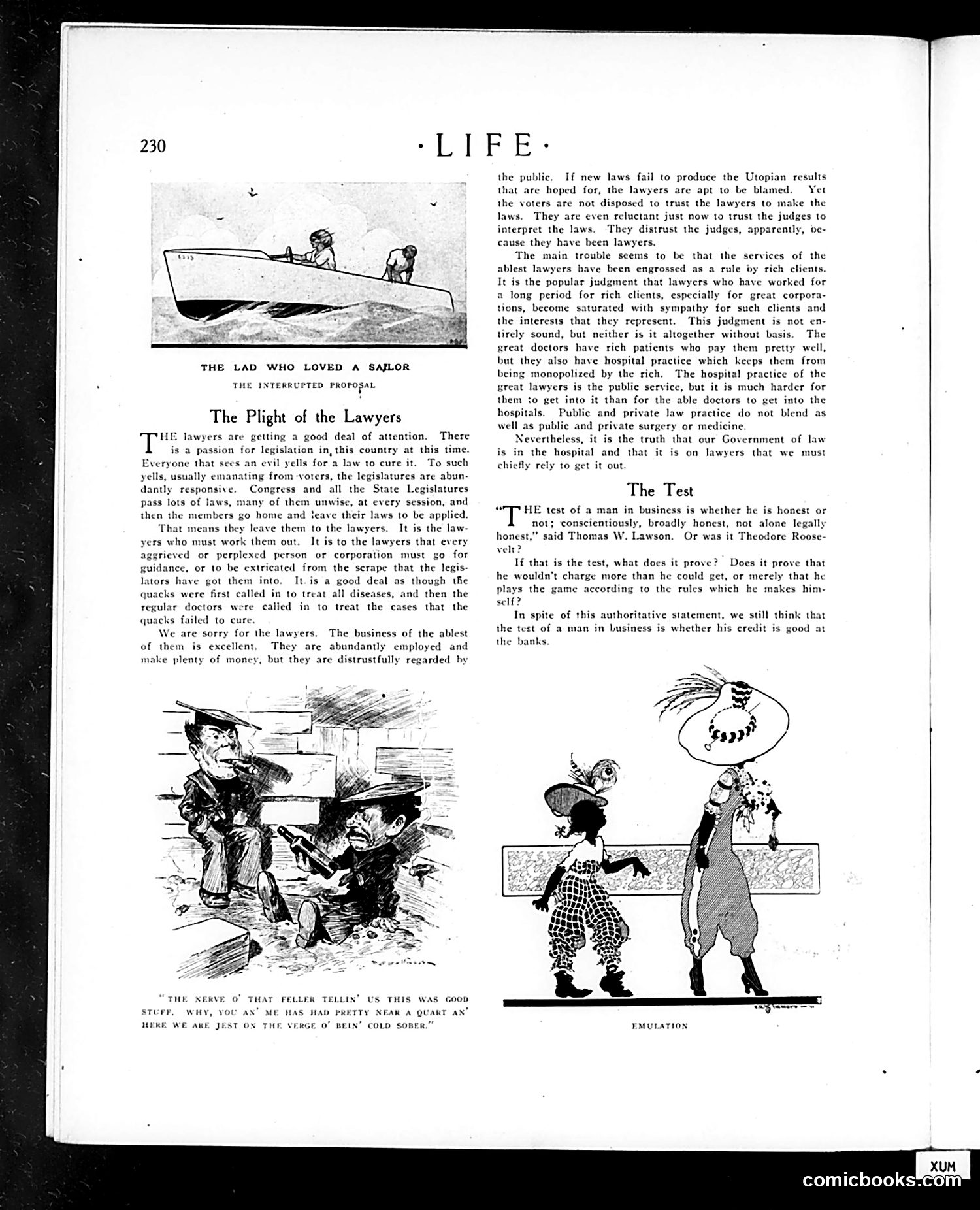
This page critiques the legal profession's entanglement with wealthy interests. The main article argues that while legislators pass numerous laws, **lawyers must implement them**, often blamed when laws fail. The central complaint: top lawyers become monopolized by rich corporate clients, losing sympathy for public service—unlike doctors who maintain hospital practice alongside private work. The cartoon at bottom-left depicts working-class men discussing drinking, illustrating common people's skepticism of authorities and institutions. A secondary piece, "The Test," satirizes business ethics by quoting Thomas Lawson and Theodore Roosevelt on honesty, then deflating their rhetoric: the *real* test of a businessman isn't moral integrity but simply whether banks extend him credit—a cynical observation that financial reputation, not conscience, determines success. Together, the page expresses progressive-era skepticism toward both legal elites serving the wealthy and corporate morality generally.
📄 Transcribed text from this page (OCR, searchable)
Machine-transcribed from the original scan — historical spelling and the odd misread are preserved.
THE LAD WHO LOVED A SAJLOR THE INTERRUPTED PROPOSAL The Plight of the Lawyers HE lawyers are getting a good deal of attention. There is a passion for legislation in, this country at this time. Everyone that sees an evil yells for a law to cure it. To such yells, usually emanating from voters, the legislatures are abun- Congress and all the State Legislatures ny of them unwise, at every session, and dantly_ responsiv pass lots of laws, m: then the members go home and feave their laws to be applied. That means they leave them to the lawyers. It is the law- yers who must work them out. It is to the lawyers that every aggrieved or perplexed person or corporation must go for guidance, or to be extricated from the scrape that the legis- Iators have got them into, It. is a good deal as though the quacks were first called in to treat all diseases, and then the regular doctors were called in to treat the cases that the quacks failed to cure. We are sorry for the lawyers. The business of the able of them is excellent, They are abundantly employed and make plenty of money, but they are distrustfully regarded by “THE NERVE O° THAT FELLER TELLIN’ US THIS WAS G op STUPP, WILY, YOU AN’ ME MAS HAD PRETTY NEAR A QUART AN’ MEKE WE AKE JEST ON THE VERGE 0” BEIN’ COLD soneR.” ‘LIP the publi If new laws fail to produce the Utopian results that are hoped for, the lawyers are apt to be blamed. Yet the voters are not disposed to trust the lawyers to make the laws. They are even reluctant just now to trust the judges to interpret the laws, They distrust the judges, apparently, ve- cause they have been lawyers. The main trouble seems to be that the services of the ablest lawyers have been engrossed as a rule by rich clients. It is the popular judgment that lawyers who have worked for a long period for rich clients, especially for great corpora- tions, become saturated with sympathy for such clients and the interests that they represent. This judgment is not en- tirely sound, but neither is it altogether without basis. The great doctors have rich patients who pay them pretty well, but they also have hospital practice which keeps them from being monopolized by the rich, The hospital practice of the great lawyers is the public service, but it is much harder for them to get into it than for the able doctors to get into the hospitals. Public and private law practice do not blend as well as public and private surgery or medicine. Nevertheless, it is the truth that our Government of law is in the hospital and that it is on lawyers that we must chiefly rely to get it out. The Test “THE test of a man in business is whether he is honest or not; conscientiously, broadly honest, not alone legally honest,” said Thomas W. Lawson. Or was it Theodore Roose- velt? If that is the test, what does it prove? Does it prove that he wouldn't charge more than he could get, or merely that he plays the game according to the rules which he makes him- self? In spite of this authoritative statement, we still think that the test of a man in business is whether his credit is good at the banks. > EMULATION comicbooks'