
A complete issue · 52 pages · 1911
Life — March 2, 1911
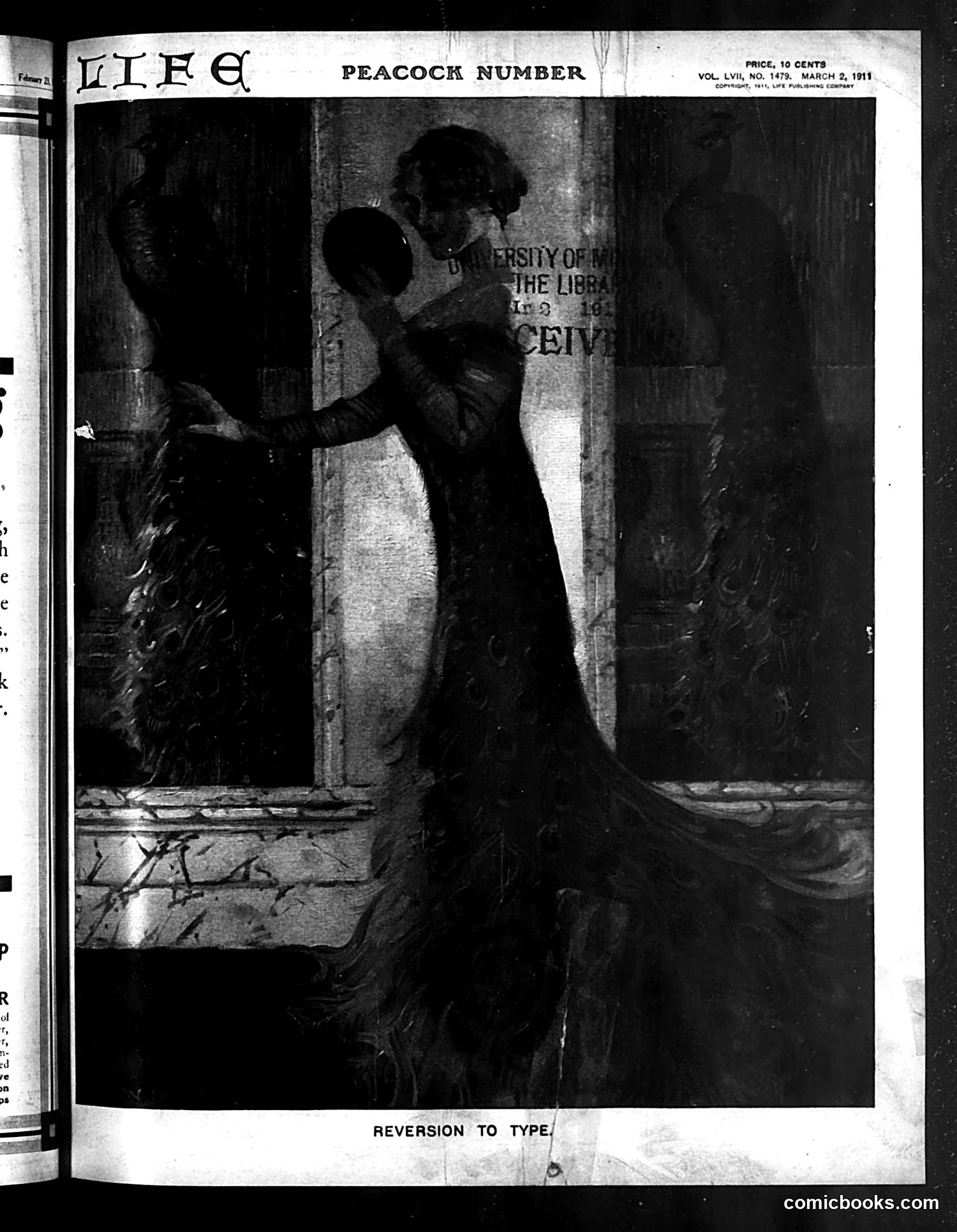
This appears to be a cover or feature page titled "Reversion to Type," showing a silhouetted figure in an elegant, flowing gown with dramatic peacock-feather styling. The image seems to satirize fashionable women's clothing of the era, particularly the ornate peacock-feather trend that was popular in early 1900s haute couture. The caption "Reversion to Type" suggests social commentary—likely mocking either the excessive ornamentation of contemporary fashion or criticizing women who adopt such elaborate plumage as representing a regression to primitive or animal-like behavior. This reflects turn-of-the-century anxieties about women's fashion and social roles, using the peacock metaphor to ridicule extravagance or vanity. The satirical intent is characteristic of Life magazine's sharp social commentary from this period.
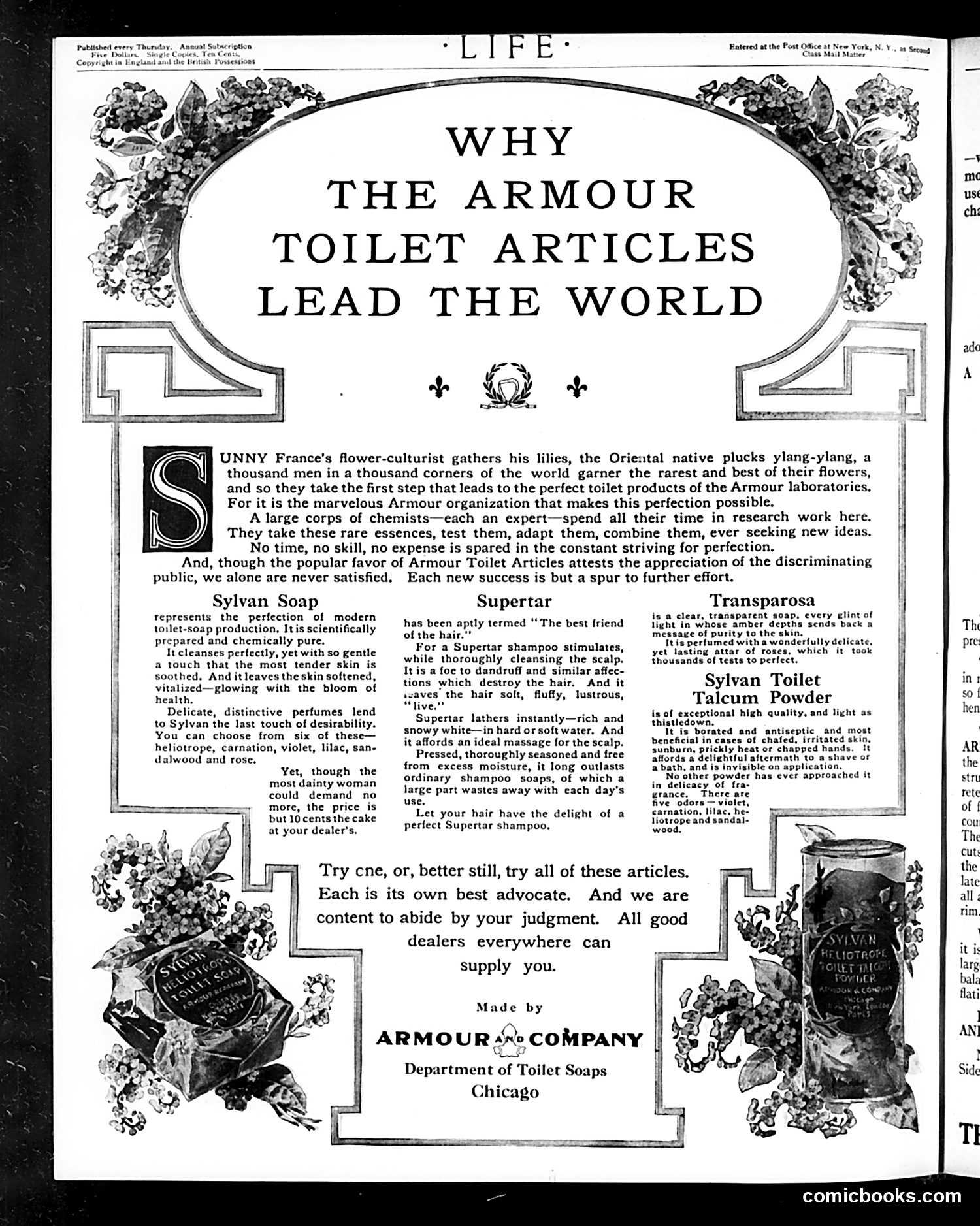
This is primarily **advertising content**, not satire or political commentary. It's a full-page advertisement for Armour and Company's toilet products (soaps and powders), published in *Life* magazine. The page uses decorative floral borders and ornamental typography typical of early 20th-century advertising. The headline claims Armour's toilet articles "lead the world," and the body text describes their manufacturing process—how they source rare essences and employ chemists to perfect formulations. Three specific products are advertised: Sylvan Soap, Supertar shampoo, and Sylvan Toilet Talcum Powder, each with descriptive text emphasizing quality and effectiveness. There is **no political cartoon or satire** present. This is straightforward commercial advertising using the prestige and authority of *Life* magazine's platform.
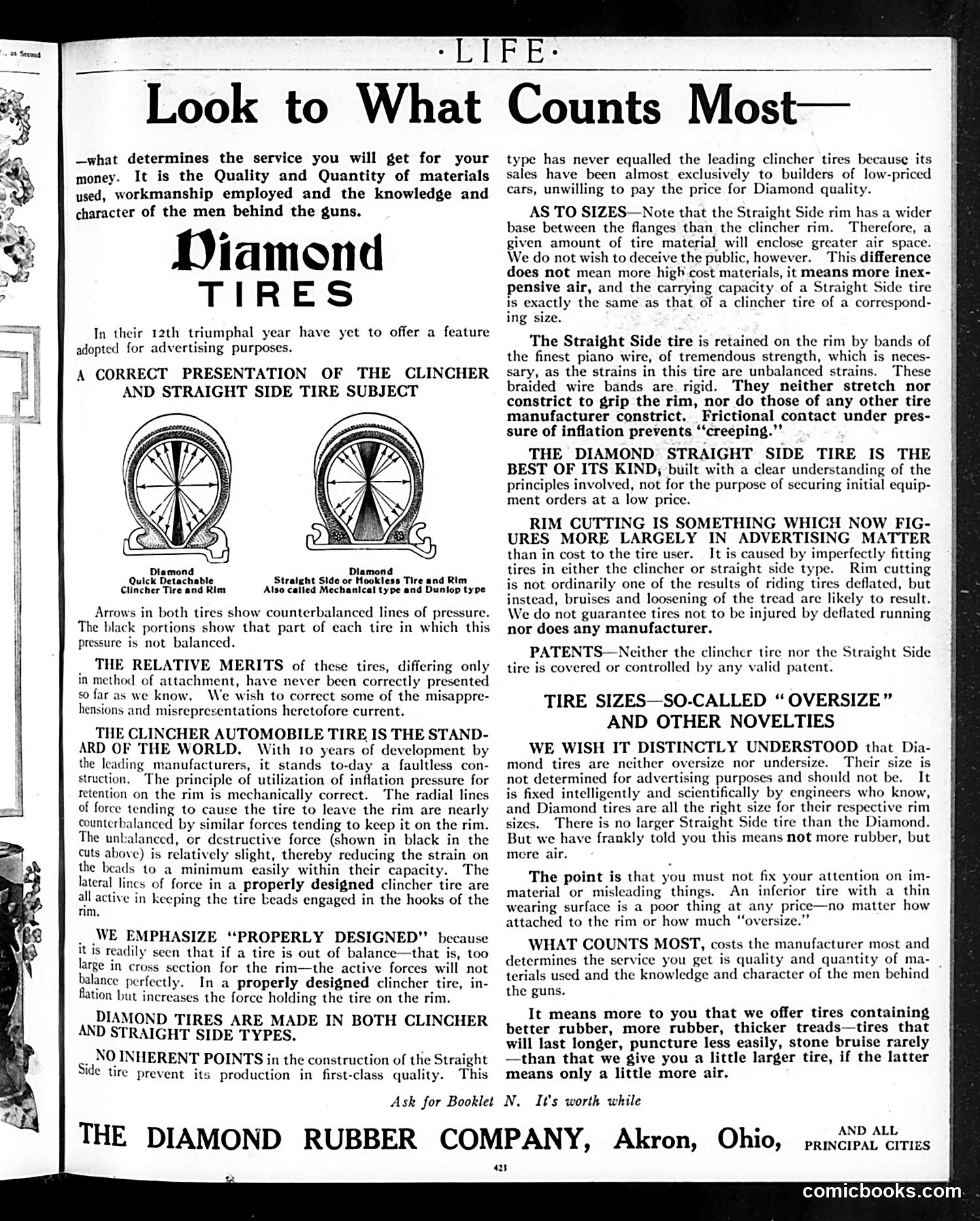
This is **not a cartoon or satirical page**—it's a straight advertisement for Diamond Tires, published in Life magazine. The page presents technical comparisons between two tire types: the "Clincher" and "Straight Side" models. The central image shows cross-sectional diagrams of both tire designs to illustrate their structural differences. The advertisement's strategy emphasizes engineering credibility rather than satire. It addresses common misconceptions about tire quality, arguing that Diamond tires offer superior construction based on balanced design principles, not size or novelty features. The text repeatedly stresses "quality" and "proper design" as what matters most to consumers. This represents early 20th-century automotive advertising when tire technology was still developing and manufacturers competed partly through technical education of the public.
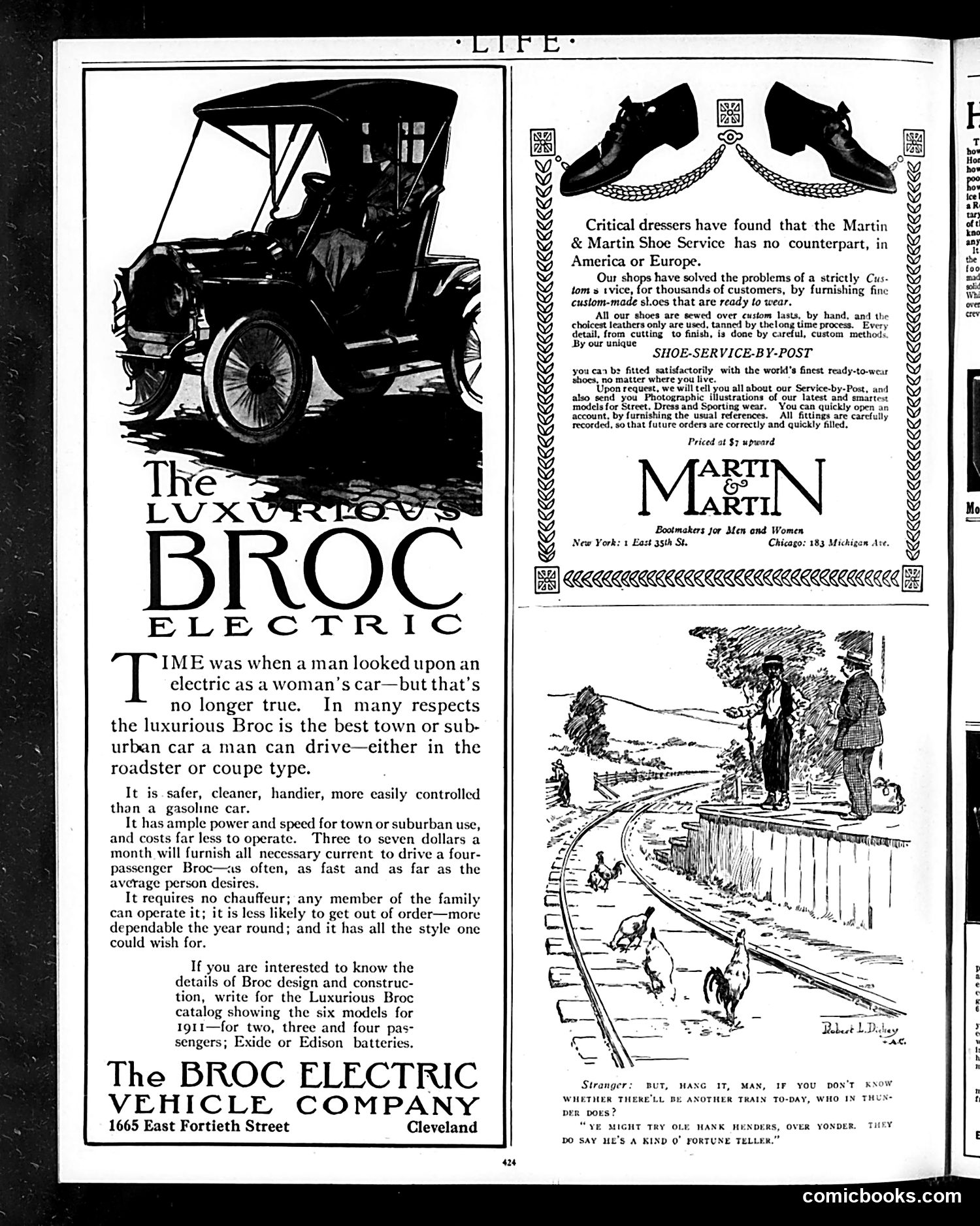
This page is **primarily advertising**, not satire or political commentary. The left advertisement promotes the **Broc Electric Vehicle** (a car powered by electric batteries, not gasoline). The pitch emphasizes practicality: safer, cleaner, cheaper to operate than gas cars, requiring no chauffeur, and suitable for family use. It specifically notes women could operate it easily—reflecting early 1900s marketing that positioned electric cars as "women's vehicles" before gasoline engines dominated. The right side advertises **Martin & Martin Shoes**, emphasizing custom-made quality and mail-order service. The bottom illustration appears to be humorous filler—two men on railroad tracks with a fortune-teller joke about predicting "another train to-day." This page represents typical early-20th-century *Life* magazine content: satirical humor mixed with period advertising reflecting contemporary technologies and gender assumptions.
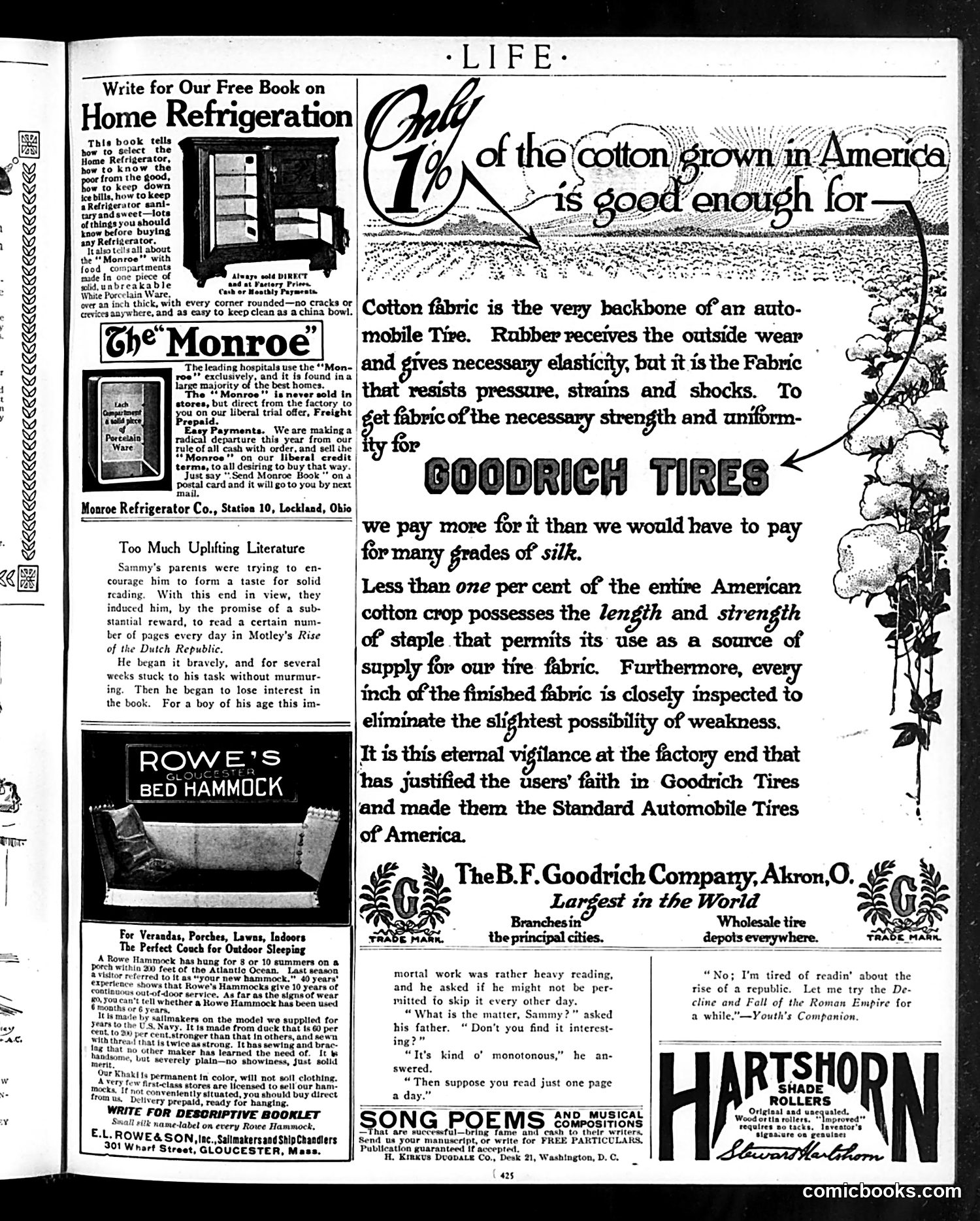
This page is primarily **advertising rather than editorial content or satire**. The dominant feature is a large Goodrich Tires advertisement claiming that only one percent of American cotton crop possesses suitable quality for tire fabric. The ad emphasizes factory quality control and positions Goodrich as "Standard Automobile Tires of America." The smaller editorial content includes a brief humorous piece titled "Too Much Uplifting Literature" about a boy named Sammy whose parents encourage him to read *Tales of the Dutch Republic*, but he finds it tedious—a gentle joke about overly earnest parental guidance regarding children's reading material. Additional advertisements for Monroe Refrigerators and Rowe's Bed Hammock fill remaining space. The page reflects early 20th-century publication economics relying heavily on paid advertising.
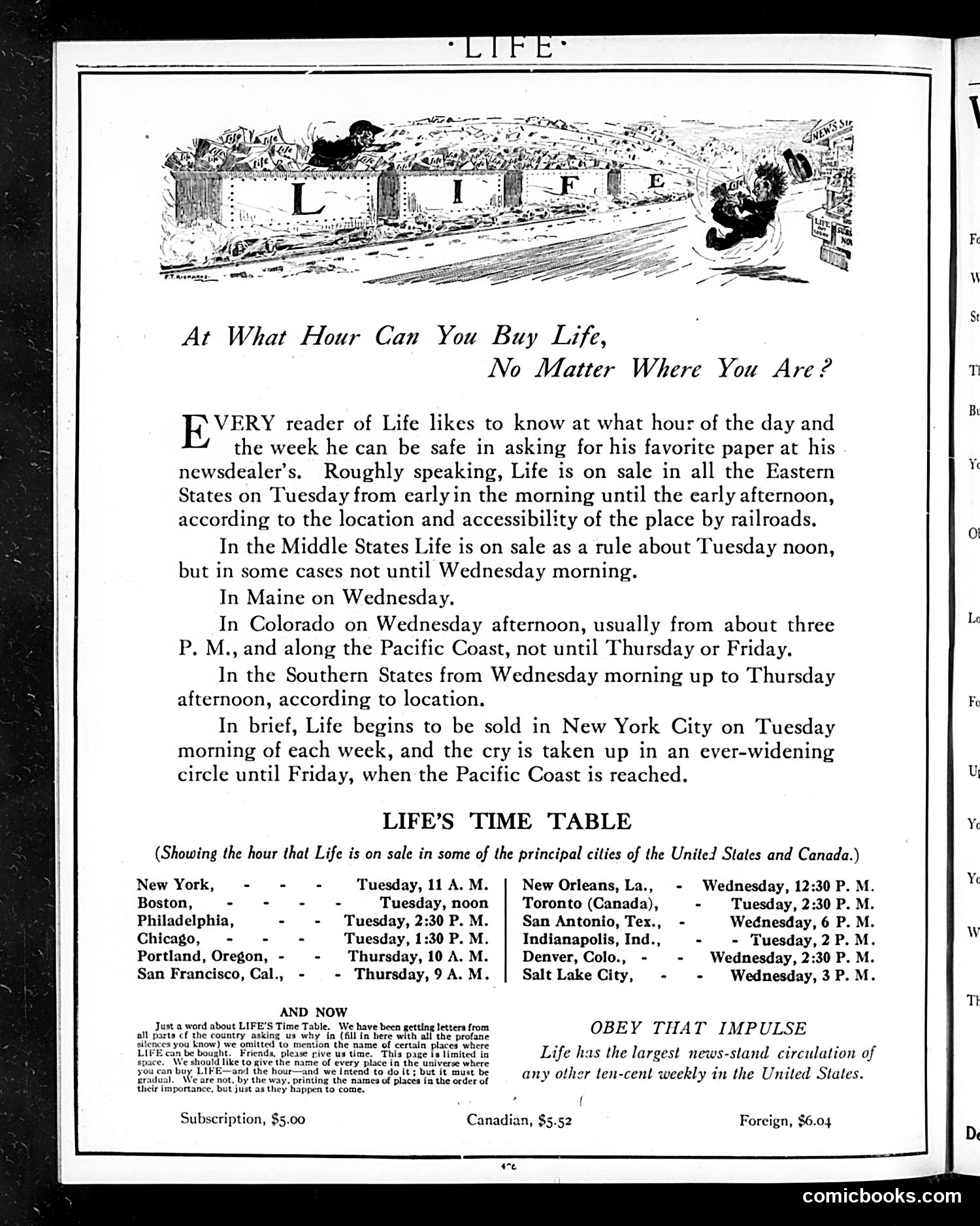
This page is primarily an **advertisement for Life magazine's circulation and subscription details**, not a political cartoon. The decorative header shows a train labeled "LIFE" moving across the country, with a figure riding atop it—a visual metaphor for how the magazine distributes nationwide. The main text explains **when Life magazine arrives at newsstands** across different regions of the United States and Canada, ranging from Tuesday morning in New York to Thursday/Friday on the Pacific Coast. This was necessary information for readers wanting to purchase the weekly publication, as distribution depended on railroad accessibility. The advertisement emphasizes Life's "largest news-stand circulation of any other ten-cent weekly," promoting subscription rates ($5.00 domestically, $5.52 Canadian, $6.04 foreign). It's essentially a practical guide for readers about availability.
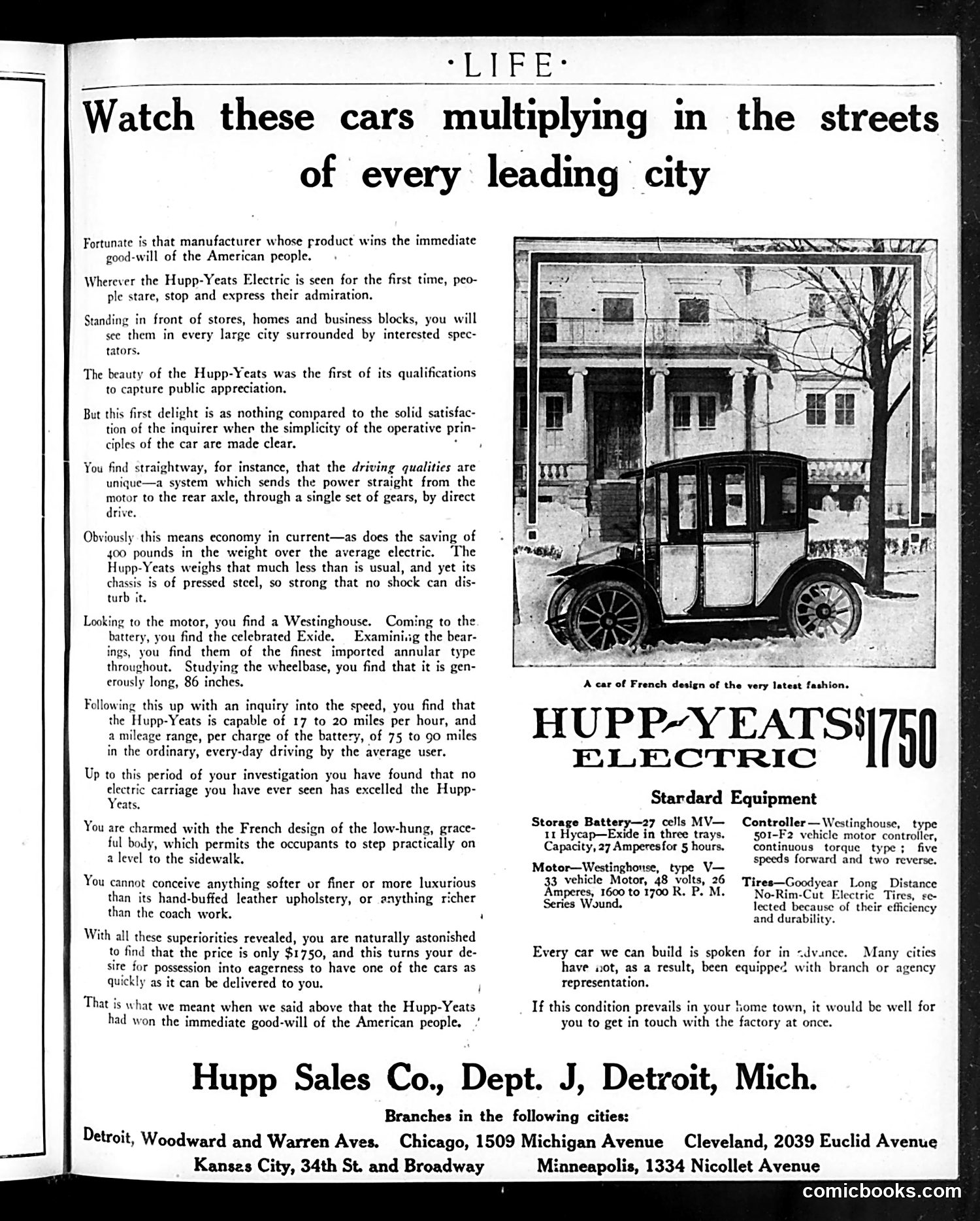
This is primarily a **product advertisement**, not satirical content. It promotes the Hupp-Yeats Electric car, priced at $1,750, marketed as a French-designed luxury vehicle available in major American cities. The ad emphasizes technical features—Westinghouse motor, Exide battery, 17-20 mile range per charge, lightweight construction—positioning it as superior to competing electric vehicles of the era. The accompanying photograph shows a elegant, enclosed carriage parked before a mansion, targeting wealthy buyers. The "joke" is implicit: despite claiming French sophistication and superiority, the car still suffers the severe practical limitations of early electric vehicles (limited range, slow speed). The text's breathless enthusiasm about features we'd now consider obvious deficiencies reflects early 1900s automotive culture.
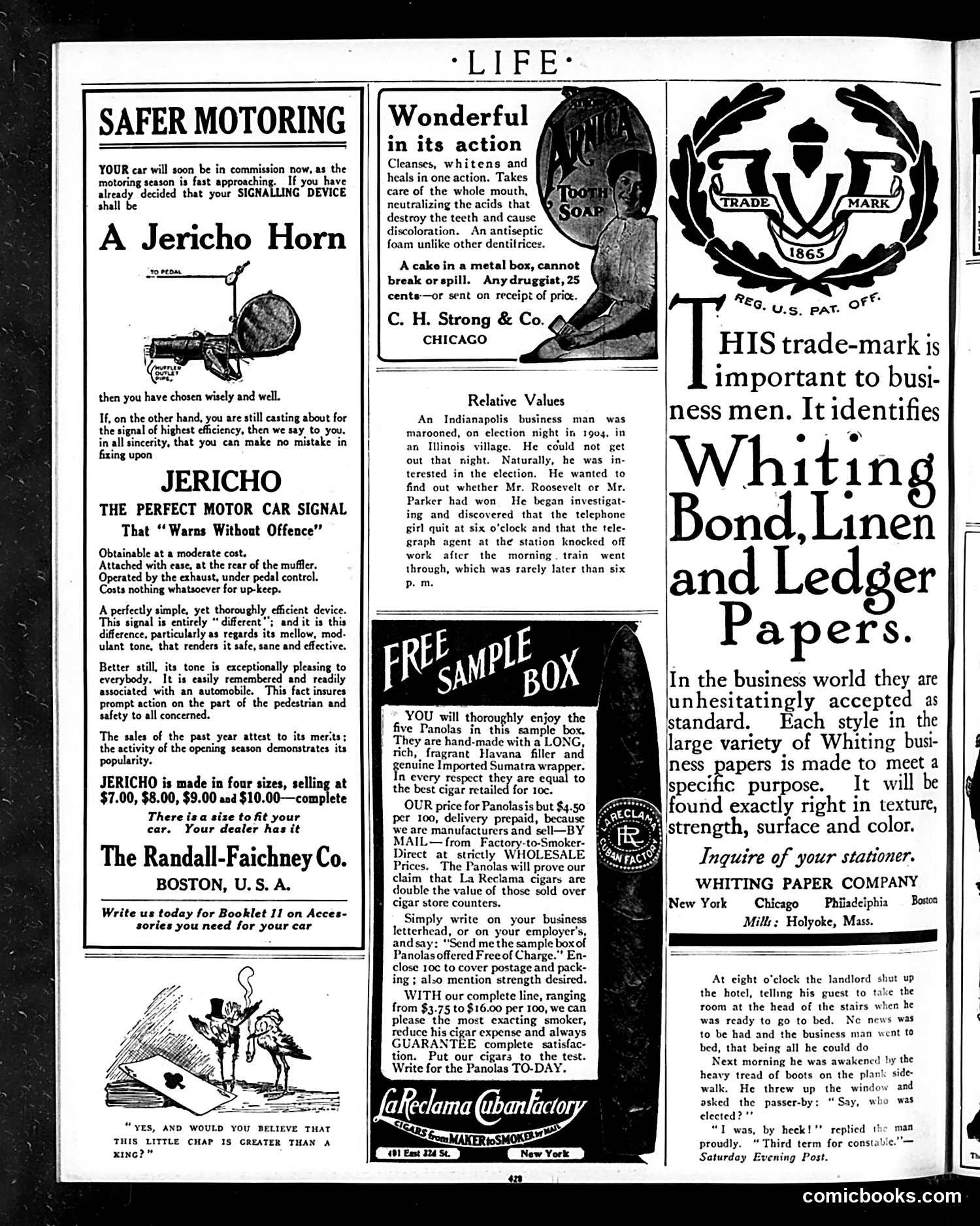
This page is primarily **advertisements** with one brief humorous anecdote at bottom right. The ads promote: - **Jericho Horn** (car signal device) - a motor accessory - **Tooth Soap** by C.H. Strong & Co. - a dental product - **Whiting Bond, Linen and Ledger Papers** - business stationery - **Panolas cigars** - with a free sample offer - **La Reclama Cuban factory** cigars The small cartoon/anecdote (bottom right) depicts a hotel landlord shutting guests out at 8pm, demanding they retire. A guest protests being locked out, claiming it's only 8:15. The landlord insists on his rules. The humor lies in the absurd strictness—the humorous complaint appears in *Saturday Evening Post*. This reflects early 1900s boarding house/hotel culture where proprietors maintained rigid schedules, presenting this as satirical commentary on overly authoritarian innkeepers.
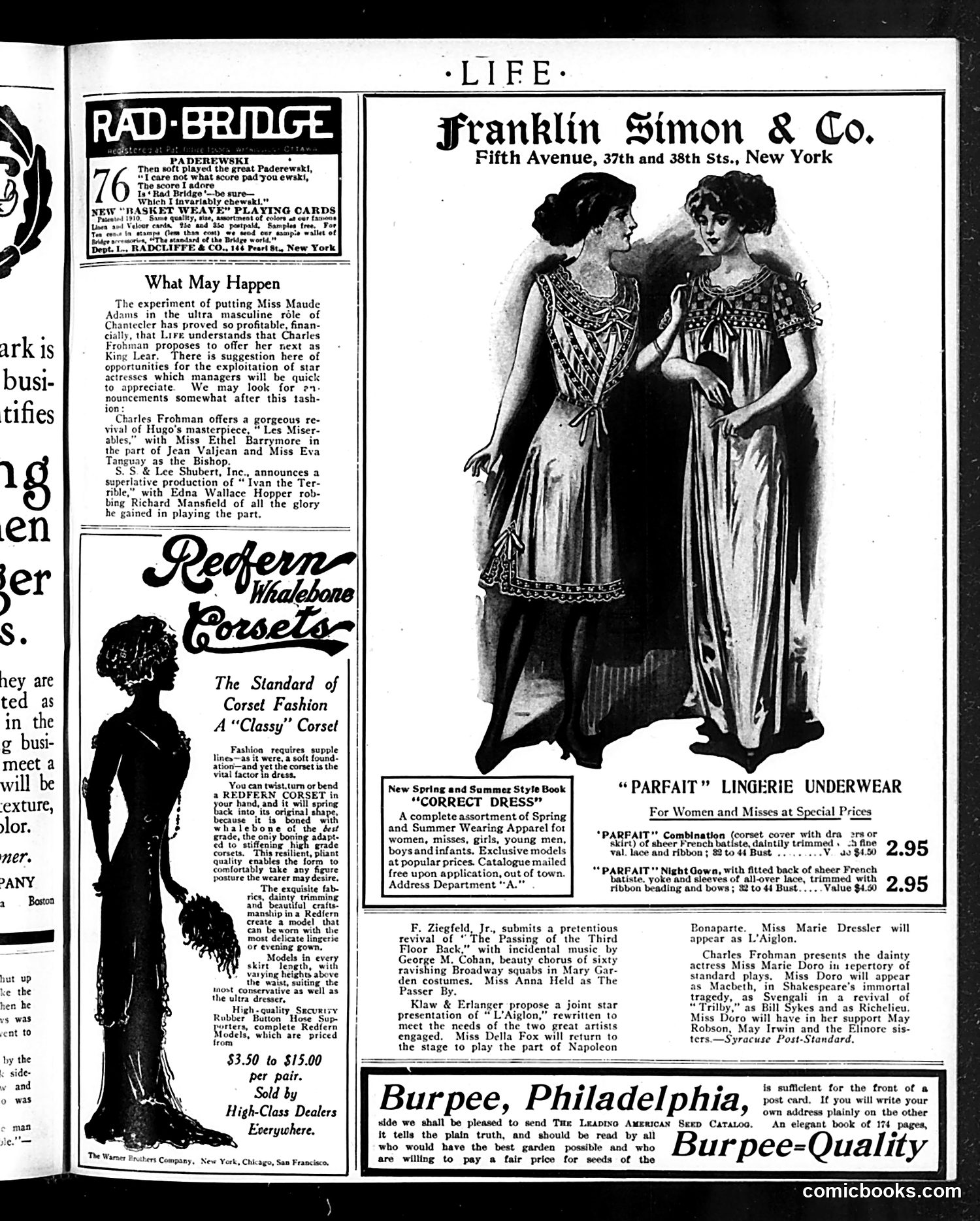
This page is primarily **advertising and entertainment announcements** rather than political satire. The left column features ads for **Redfern Whalebone Corsets** (with a silhouetted figure showing the corset's shaping effect) and **Rad-Bridge playing cards**. The right side showcases **Franklin Simon & Co.** department store advertising women's lingerie and undergarments, with an illustration of two fashionably-dressed women. Below is a **"Parfait" lingerie advertisement** offering nightgowns and camisoles at $2.95. The bottom contains theatrical announcements and a **Burpee seed catalog advertisement**. There is **no political cartoon** on this page. It represents typical Life magazine content from this era—a mix of satirical editorial matter, fashion advertising, and commercial notices targeting affluent urban readers.
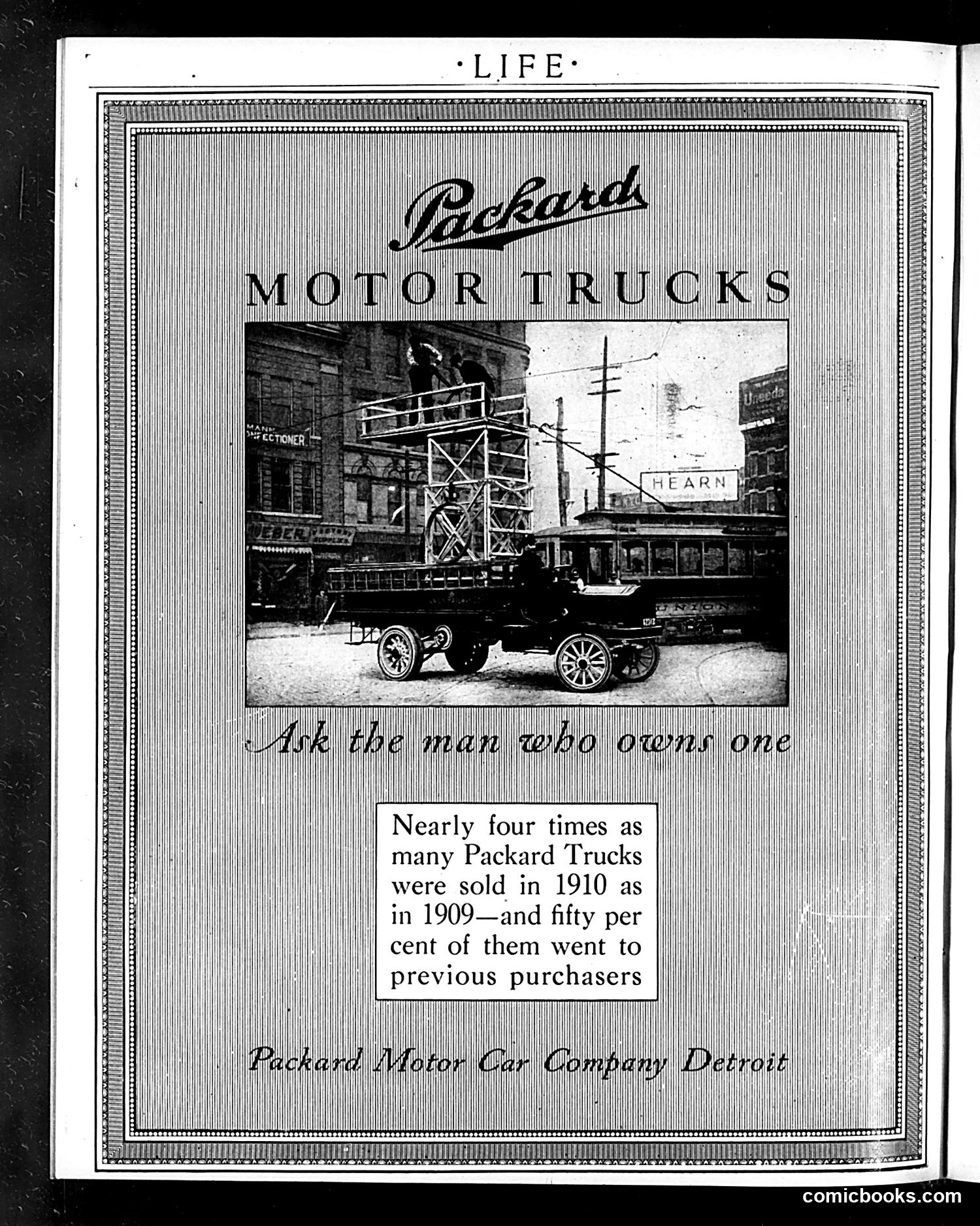
This is a straightforward advertisement, not satire. It promotes Packard Motor Trucks from the Packard Motor Car Company in Detroit. The image shows a truck laden with cargo positioned in an urban industrial setting, suggesting commercial utility. The ad's sales pitch emphasizes customer satisfaction and repeat business: nearly four times as many Packard trucks sold in 1910 compared to 1909, with fifty percent going to previous purchasers. This statistic aims to demonstrate reliability and customer loyalty. The tagline "Ask the man who owns one" was a common advertising strategy of the era, appealing to peer recommendation as marketing validation. There is no political satire present—this is purely commercial promotion typical of *Life* magazine's advertising content.
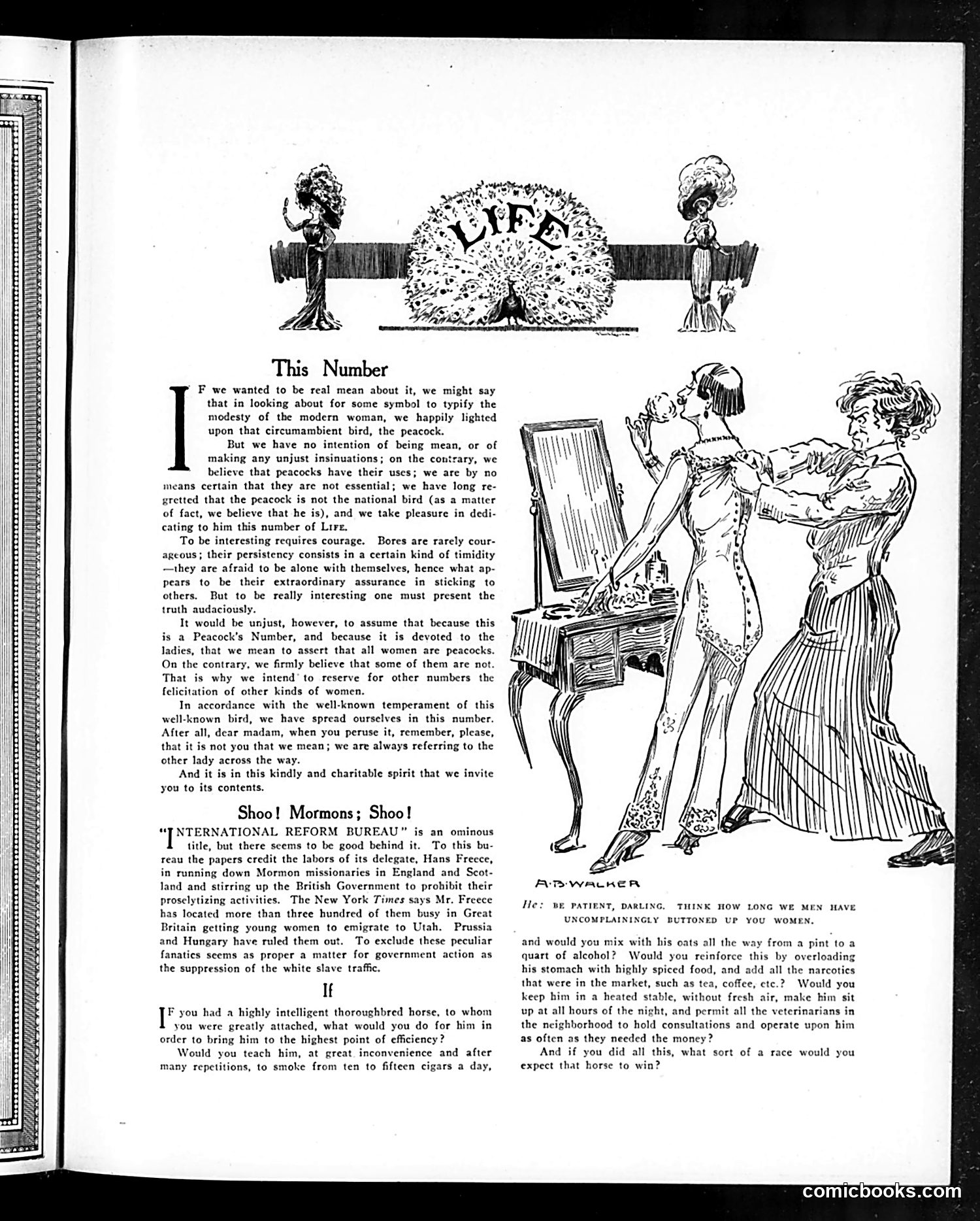
This page satirizes the "International Reform Bureau," which the text identifies as an organization running Mormon missionaries in England and Scotland to prohibit their proselytizing activities. The cartoon by Art Walker depicts a woman scolding a man about his lifestyle habits—smoking cigars, drinking alcohol, and neglecting his horse. The satire's point: the magazine ridicules the Bureau's presumption to dictate moral behavior to others. The accompanying "If" section uses a horse-care analogy to mock the organization's intrusive approach, suggesting that imposing such strict behavioral standards is as absurd as over-regulating animal husbandry. The overall message criticizes moral reformers as busybodies who lack practical wisdom about human nature and individual liberty.
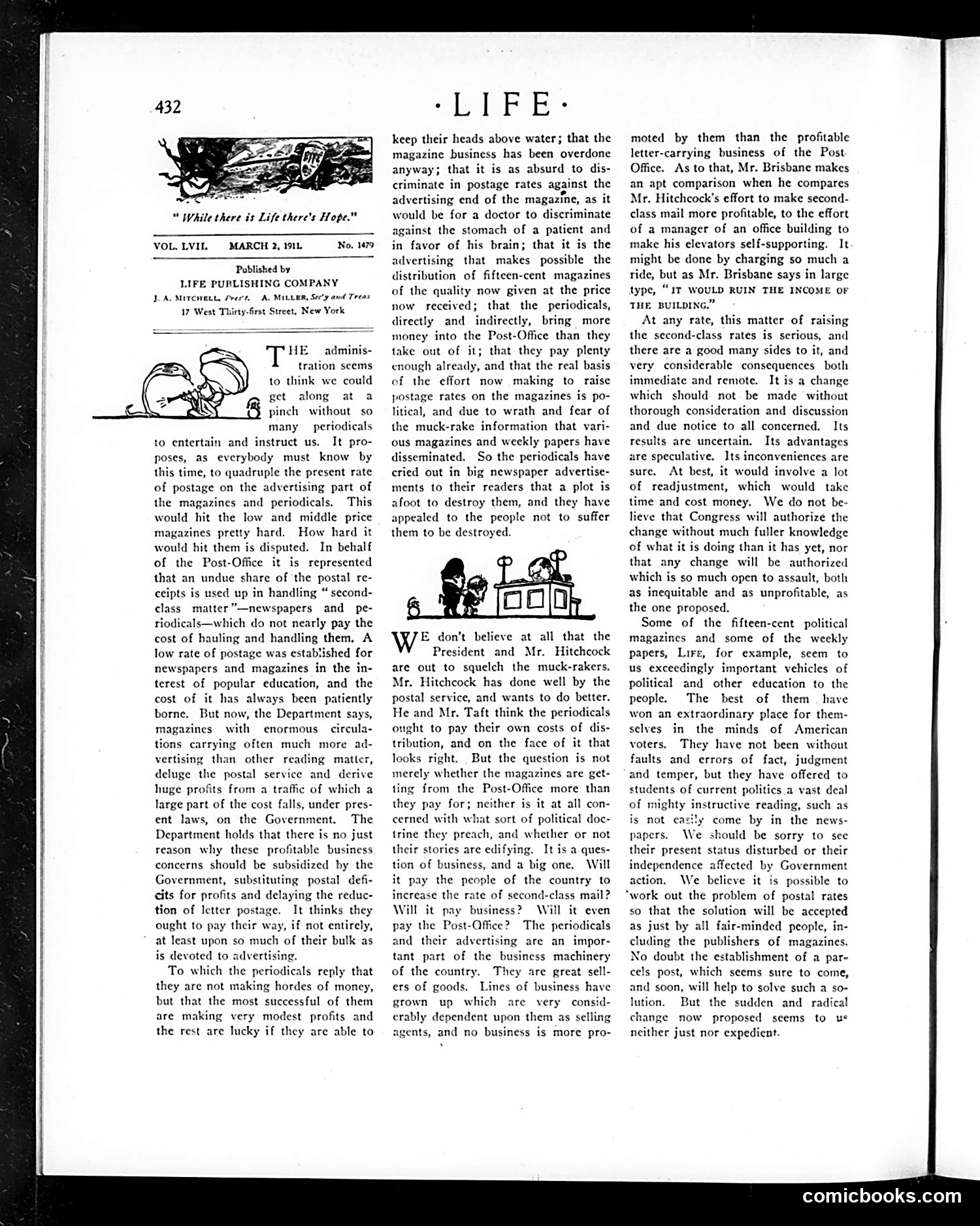
This page contains editorial text discussing postal rate increases and magazine economics, rather than a political cartoon. The small illustration shows a figure at a desk, likely representing a postal administrator or magazine editor dealing with business matters. The text argues that magazines should absorb postal rate increases themselves rather than pass costs to readers or reduce quality. It criticizes claims that a "plot" exists to destroy magazines, while defending the Post Office and Mr. Hitchcock's postal administration. The editorial advocates for fair postal policy without government subsidy, asserting that profitable magazines can manage rate increases independently. The cartoon appears to illustrate the administrative burden these postal debates created for magazine publishers and postal officials.
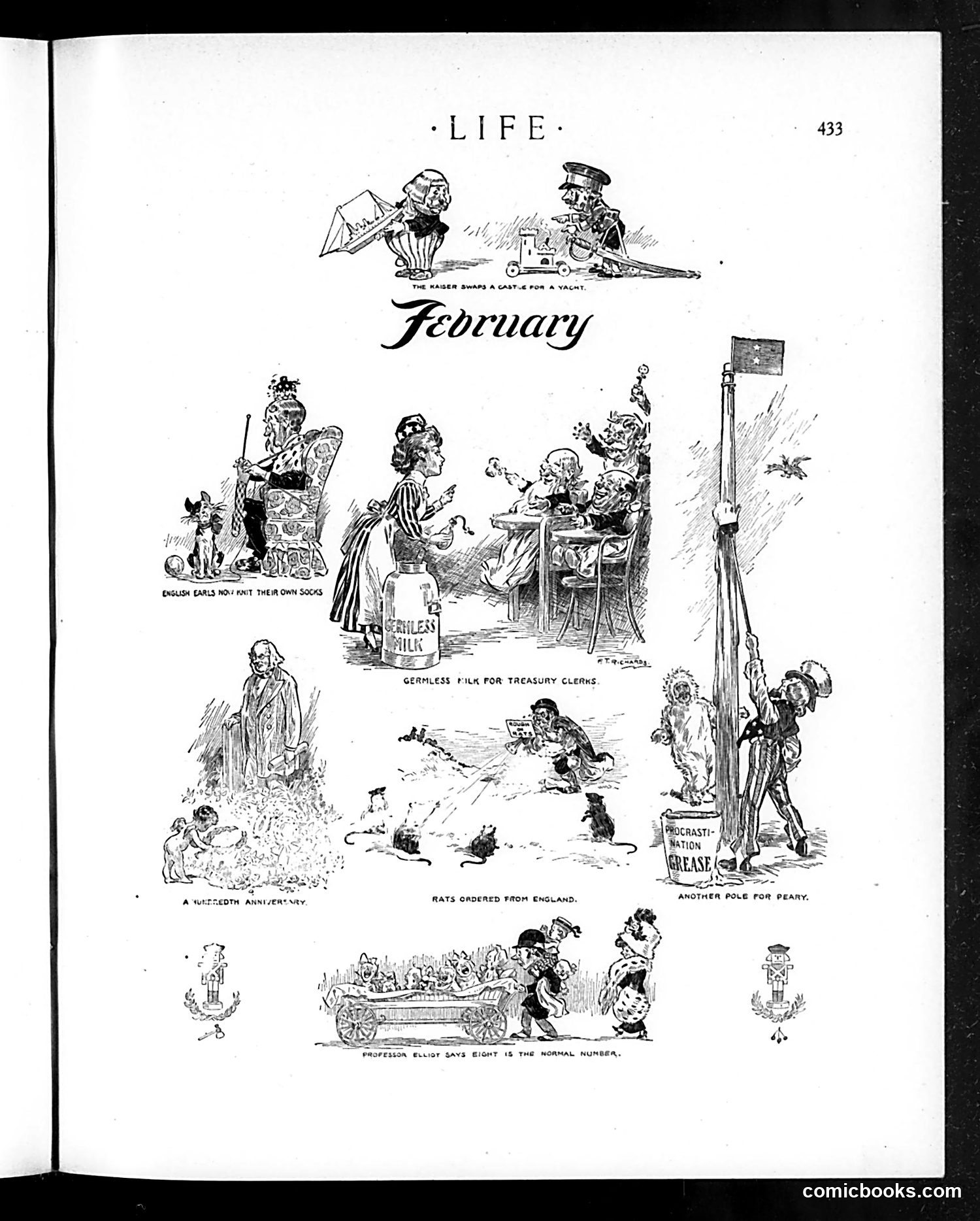
This satirical page mocks early 20th-century British political and social issues through multiple cartoons: 1. **"The Kaiser sends a cart of toys for a yacht"** - appears to reference German-British tensions, likely WWI-era, with Kaiser Wilhelm II portrayed as a military threat. 2. **"English Earls knit their own socks"** - satirizes wealthy English nobility economizing during wartime. 3. **"Germless milk for treasury clerks"** - mocks public health initiatives or government efficiency measures. 4. **"Rats ordered from England"** and **"Procrastination release pole"** - reference British problems or delays. 5. **"A wistful anniversary"** - unclear without more context. 6. **"Professor Eliot says eight is the normal number"** - possibly references academic commentary on fertility or family size. The cartoons collectively satirize British wartime austerity, bureaucratic inefficiency, and social contradictions.
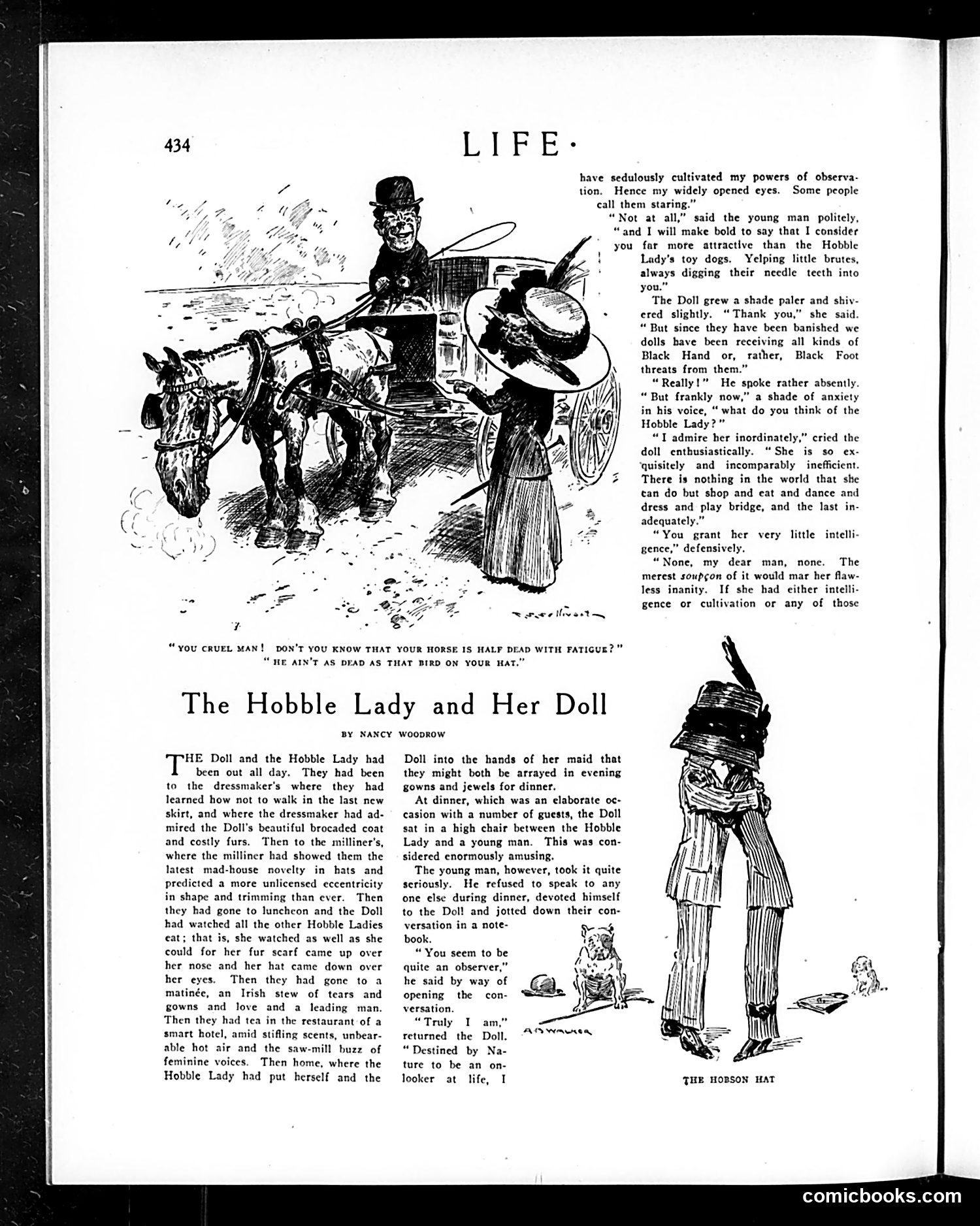
This story satirizes the "hobble skirt" craze of the 1910s—restrictive skirts so narrow women could barely walk. The cartoon at top mocks this: a man complains his horse is exhausted; another responds the dead bird on his companion's hat is worse—mocking the era's grotesquely oversized, ornament-laden women's hats (often featuring real feathers or taxidermied birds). The story itself uses a doll as a mouthpiece to critique wealthy society women. A young man takes the doll seriously while ignoring the actual Hobble Lady, finding the doll's observations more intelligent. The doll praises the Hobble Lady as "exquisitely and incomparably inefficient"—capable only of shopping, eating, dancing, and bridge-playing. The satire suggests these fashionable women were intellectually empty, slaves to passing trends, and socially useless despite their leisure and wealth. Author Nancy Woodrow uses absurdist humor to expose the vapidity Life magazine associates with high fashion.
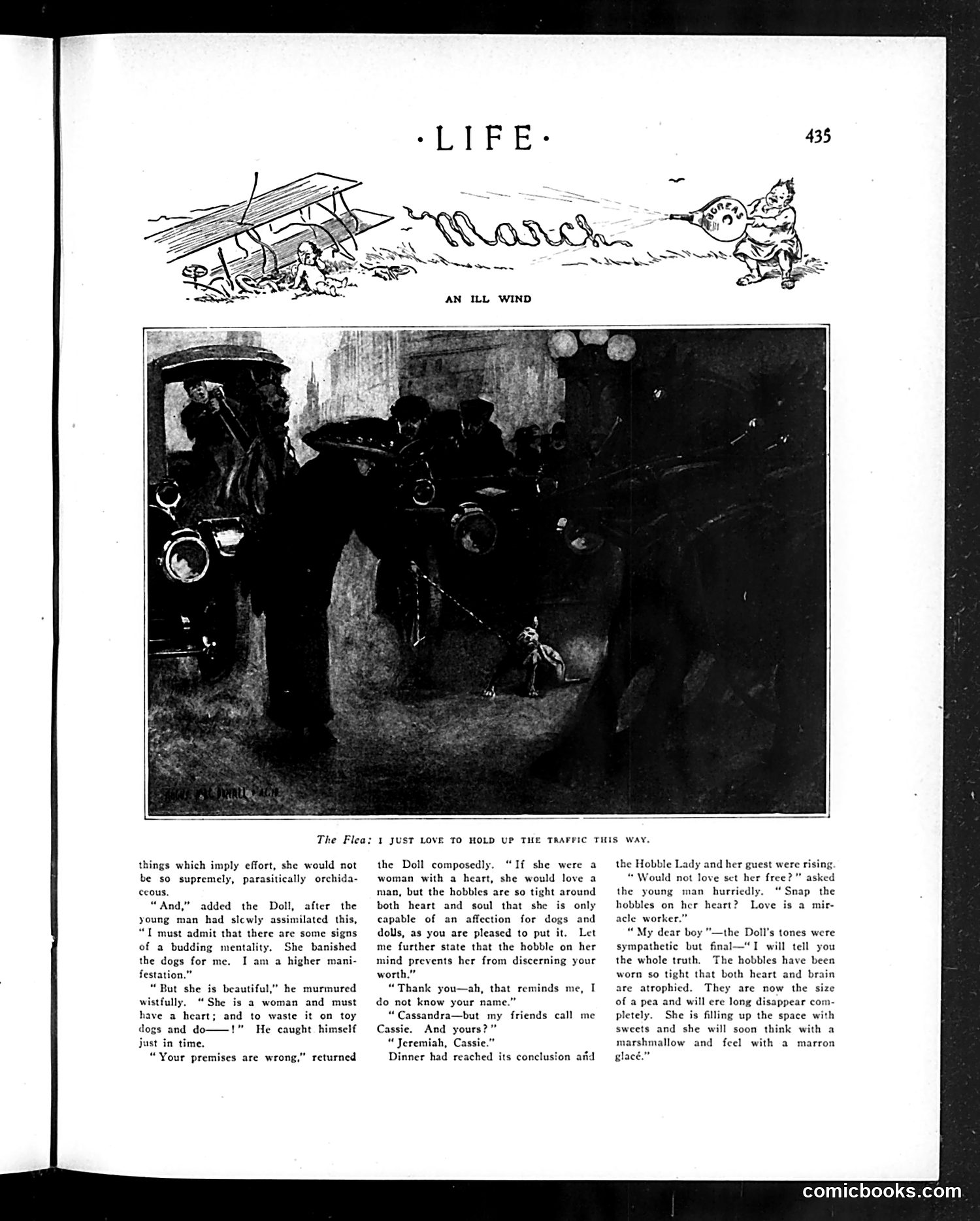
This page satirizes the "Hobble Skirt," a women's fashion trend of the early 1900s that severely restricted leg movement. The dialogue features a young man conversing with a sentient Doll about a woman ("the Hobble Lady") who wears these constrictive garments. The satire's point: the fashion is so limiting—physically and mentally—that it's atrophying women's faculties. The Doll argues the hobbles prevent the woman from thinking clearly or feeling genuine emotion, reducing her to superficial concerns (sweets, toys, dogs). The "Flea" cartoon header comments on traffic disruption caused by hobbled women's slow movement. This reflects contemporary anxieties about fashion's effects on women's health and intellect, though delivered through the magazine's characteristic mocking tone toward both the fashion and its wearers.
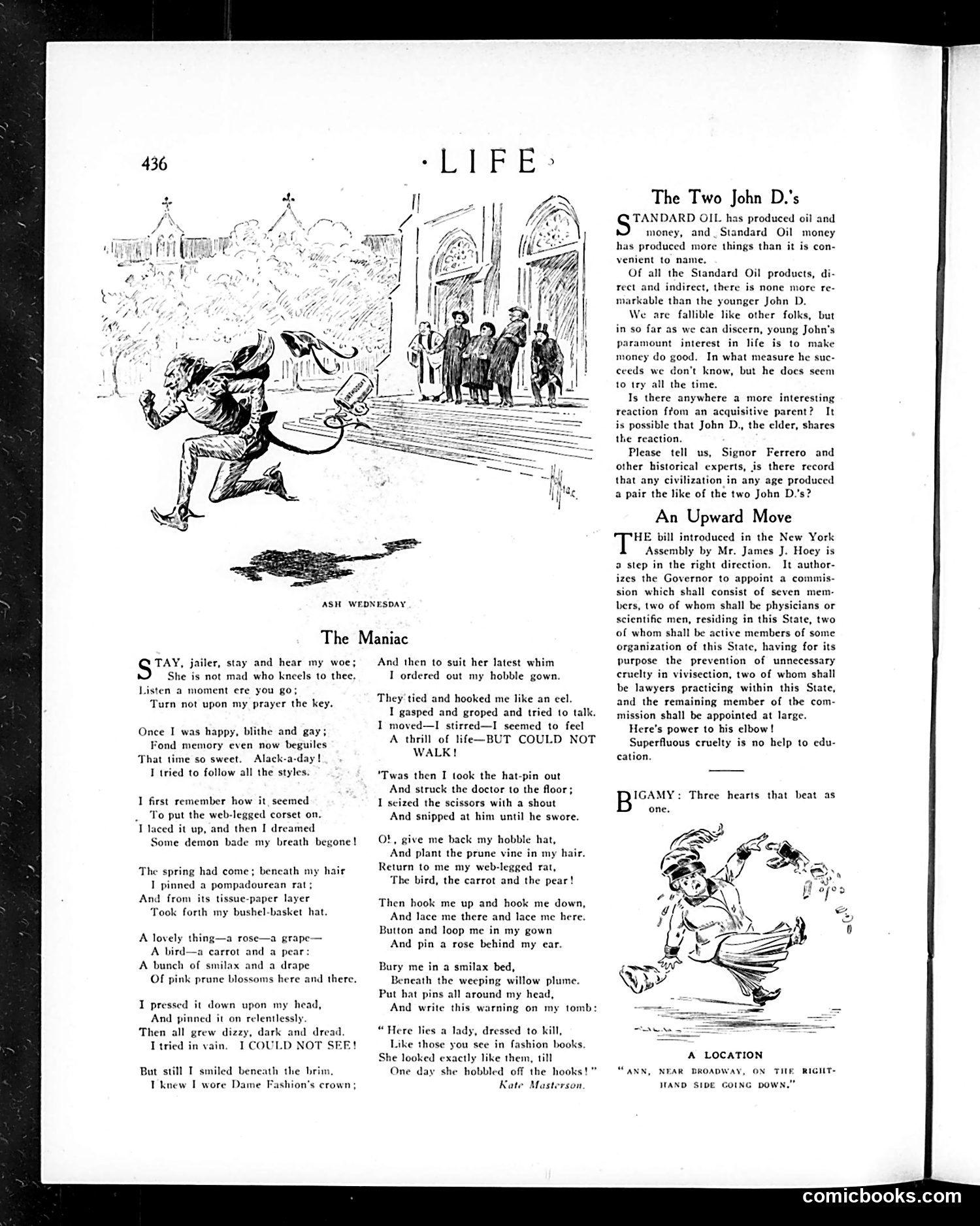
This page satirizes early-1900s women's fashion through the perspective of a woman driven to madness by extreme style demands. The poem depicts a progression of increasingly restrictive and impractical fashions: corsets that prevent breathing, enormous hats weighted with fruit and flowers that obstruct vision, and "hobble gowns" that make walking impossible. The satire's point: blind adherence to fashion trends creates physical suffering and mental breakdown. The woman's violent attack on her doctor (striking him with a hat-pin, cutting with scissors) represents the breaking point of this absurdity. The final epitaph mocks how women conform to fashion magazines without questioning whether the styles are actually functional or sensible. This reflects genuine contemporary complaints about Edwardian fashion's impracticality—particularly the S-bend corset and hobble skirt—while criticizing women's perceived willingness to sacrifice health and mobility for appearance.
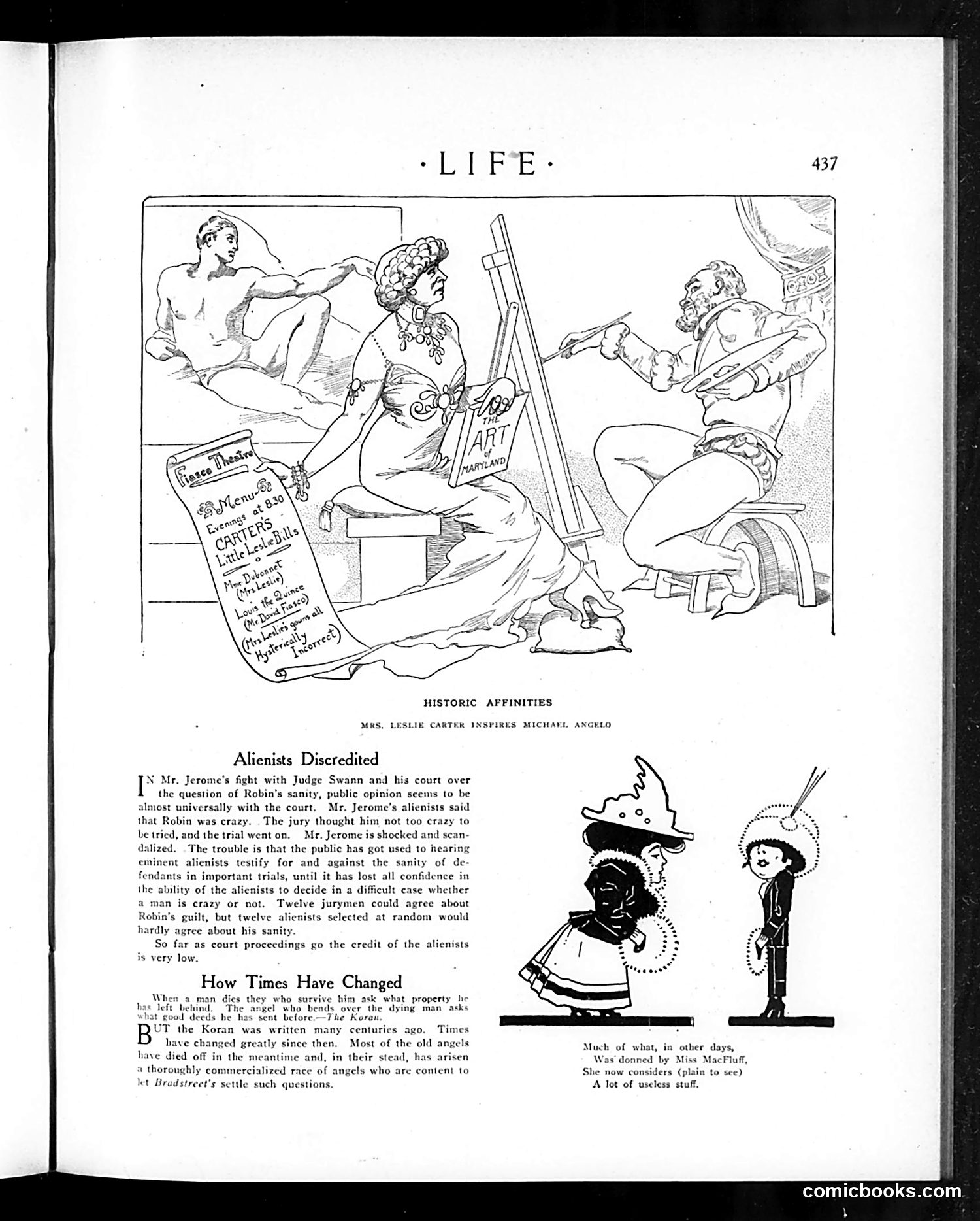
**Top Cartoon: "Historic Affinities"** This satirizes actress Mrs. Leslie Carter by comparing her to Michelangelo's famous artistic subjects. The cartoon depicts her posing as a model for male artists, with a playbill visible. The joke appears to be about Carter's theatrical prominence and the pretension of treating commercial entertainment as high art comparable to Renaissance masterworks. **"Alienists Discredited" Article** This discusses a legal case involving someone named Robin and Judge Swann. The text criticizes "alienists" (psychiatric expert witnesses) whose credibility has eroded because they routinely testify on opposite sides of sanity cases. The article argues the public has lost confidence in their ability to reach reliable conclusions about defendants' mental state. **"How Times Have Changed" Section** This contrasts religious ideals with modern materialism—the Koran asks what charitable deeds a dying man performed, but modern society (represented by "Bradstreet's," a credit-rating agency) focuses instead on property and financial worth. The accompanying cartoon suggests wealthy figures now concern themselves with material goods rather than moral legacy.
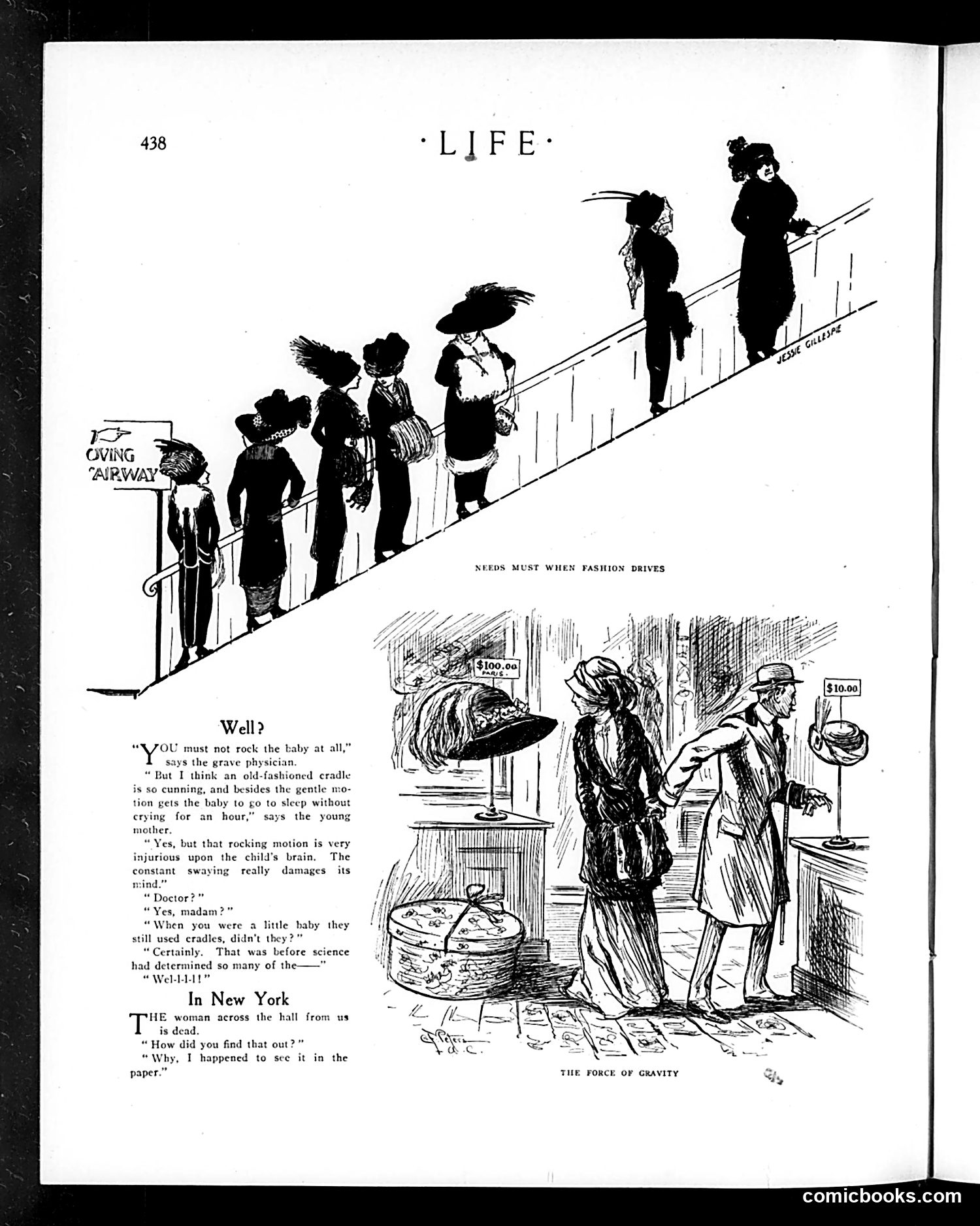
This page satirizes the conflict between modern scientific advice and traditional parenting practices, circa early 1900s. **Top cartoon**: Shows fashionable women in a line following an "Oving Airway" sign—mocking how blindly people follow trends. **Bottom section**: A doctor insists rocking cradles damage infants' brains (reflecting contemporary pseudo-scientific fads), but a mother points out the doctor himself was rocked as a baby without harm. The doctor's weak response—that this was "before science had determined" the dangers—exposes the absurdity: he's contradicting lived experience with unproven theory. **"The Force of Gravity" cartoon** depicts people buying expensive hats that blow away in the wind, illustrating how fashion demands override practical sense. The satire's point: society blindly adopts whatever scientists or fashion dictate, even when it contradicts common sense and tradition, earning the title "Needs Must When Fashion Drives."
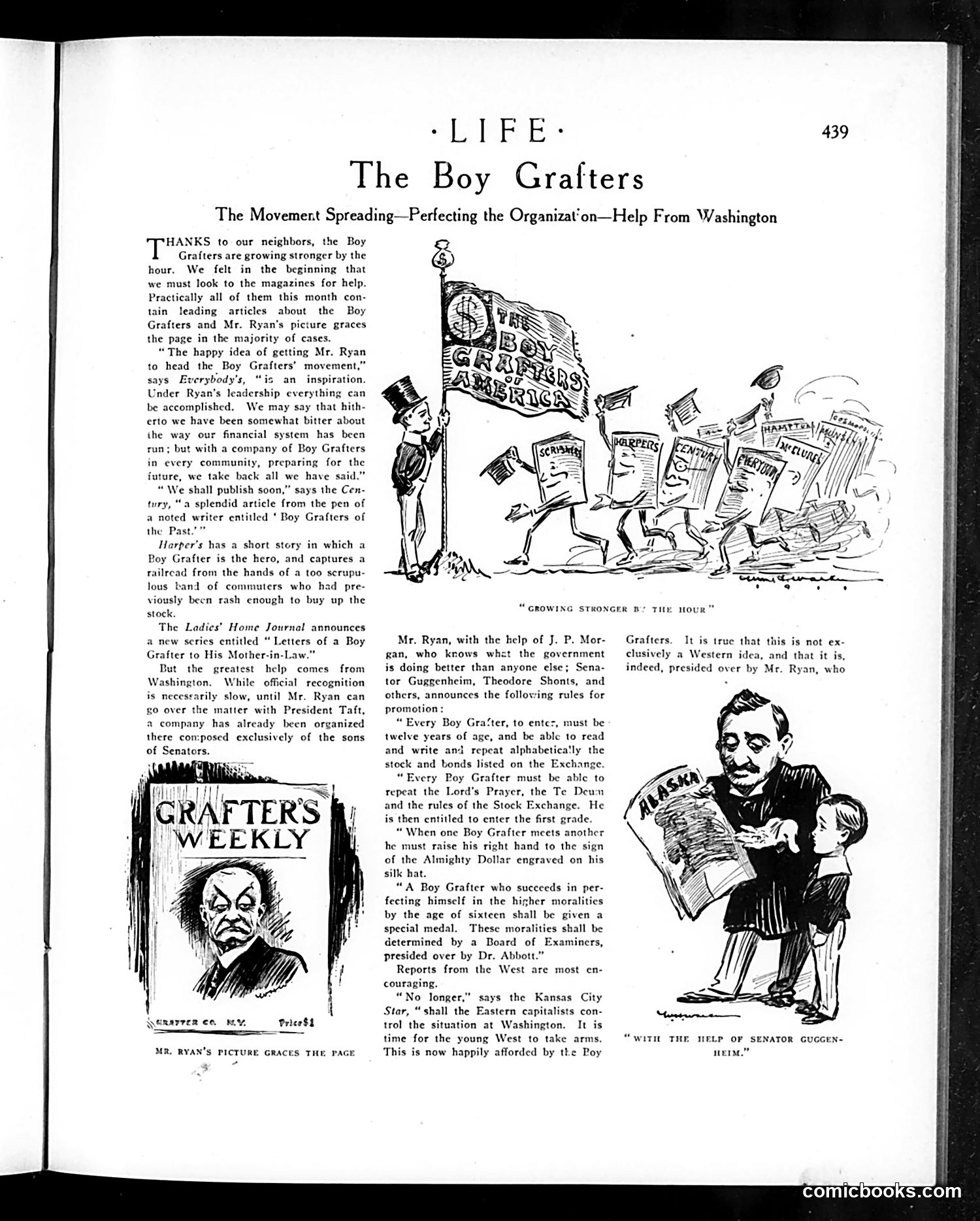
This is satirical commentary on corporate corruption and financial manipulation in the early 1900s. "Boy Grafters" is Life's mock organization parodying how wealthy financiers and politicians systematize unethical business practices. The satire targets: **Key figures**: J.P. Morgan, Senator Guggenheim, and Theodore Shonts—real power brokers accused of manipulating government and markets. "Mr. Ryan" (likely Thomas Fortune Ryan, a railroad magnate) leads this fictional "organization." **The joke**: Life ridicules how magazines uncritically celebrate this corruption, and how the scheme now has official Washington support—a company of senators' sons is formed. The "rules" mock stock-market manipulation disguised as moral instruction (memorizing bonds alongside the Lord's Prayer). **Political point**: The cartoon exposes how Eastern capitalists controlled American finance and politics, positioning it as an accepted institutional practice rather than criminality. The satire suggests this corruption is so normalized that it can be openly organized and celebrated.
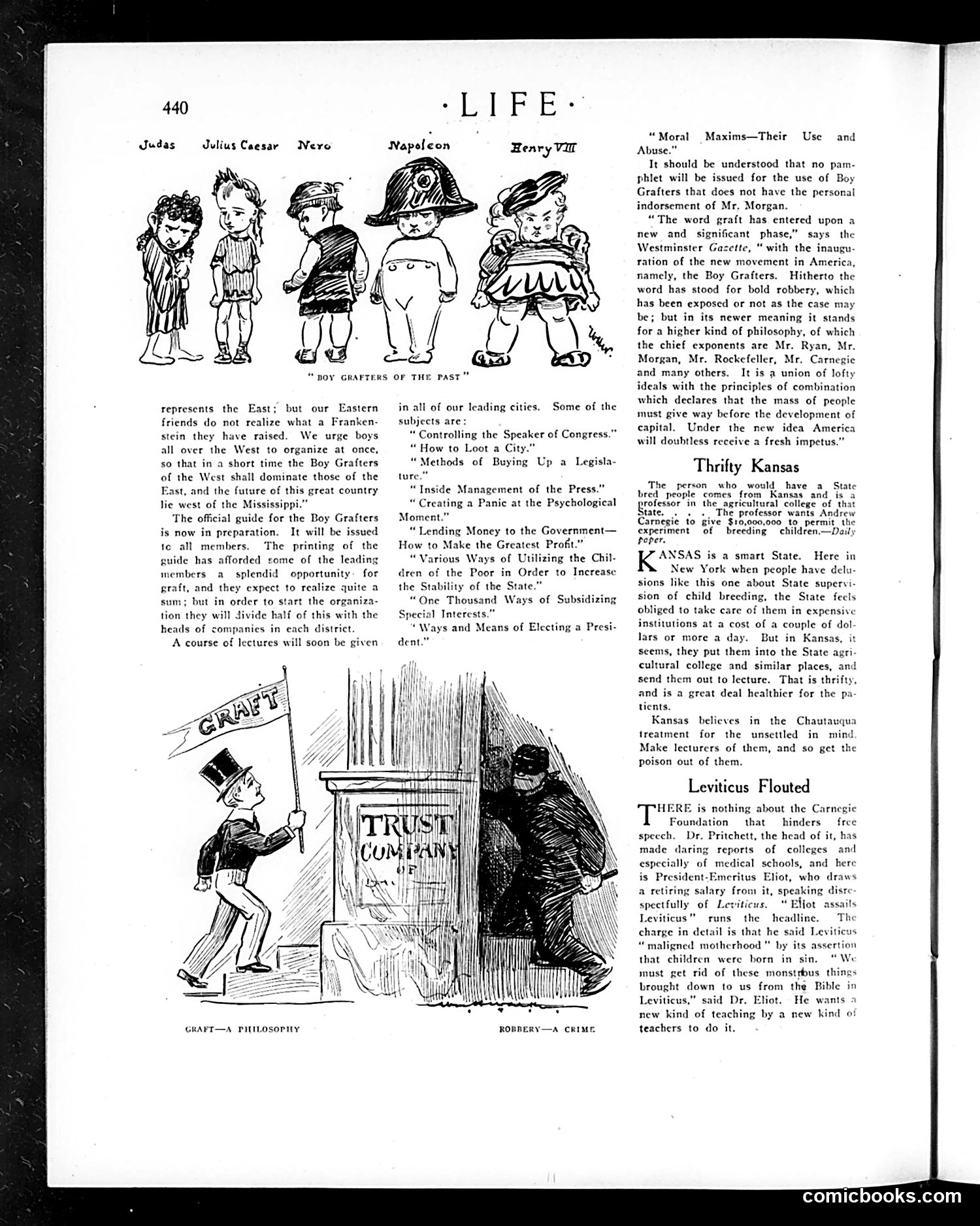
This page satirizes early 20th-century American corruption and reform movements. The top cartoon, "Boy Grafters of the Past," mockingly compares contemporary American corruption to historical villains (Judas, Julius Caesar, Nero, Napoleon, Henry VIII), suggesting modern "grafters" (corrupt businessmen) are similarly infamous. The text sarcastically presents a fake "Boy Grafters" organization with courses like "How to Loot a City" and "Controlling Congress," explicitly naming J.P. Morgan and Rockefeller as philosophical leaders—exposing how wealthy industrialists openly practiced corruption while claiming noble intentions. The accompanying articles mock specific reform proposals: Kansas's professor seeking Carnegie's funding to breed "superior" children through state control, and Charles Eliot's criticism of Biblical teachings about original sin. The satire suggests these reformers are as dangerous as the grafters they oppose, revealing Life magazine's skepticism toward both corruption and naive progressive remedies.
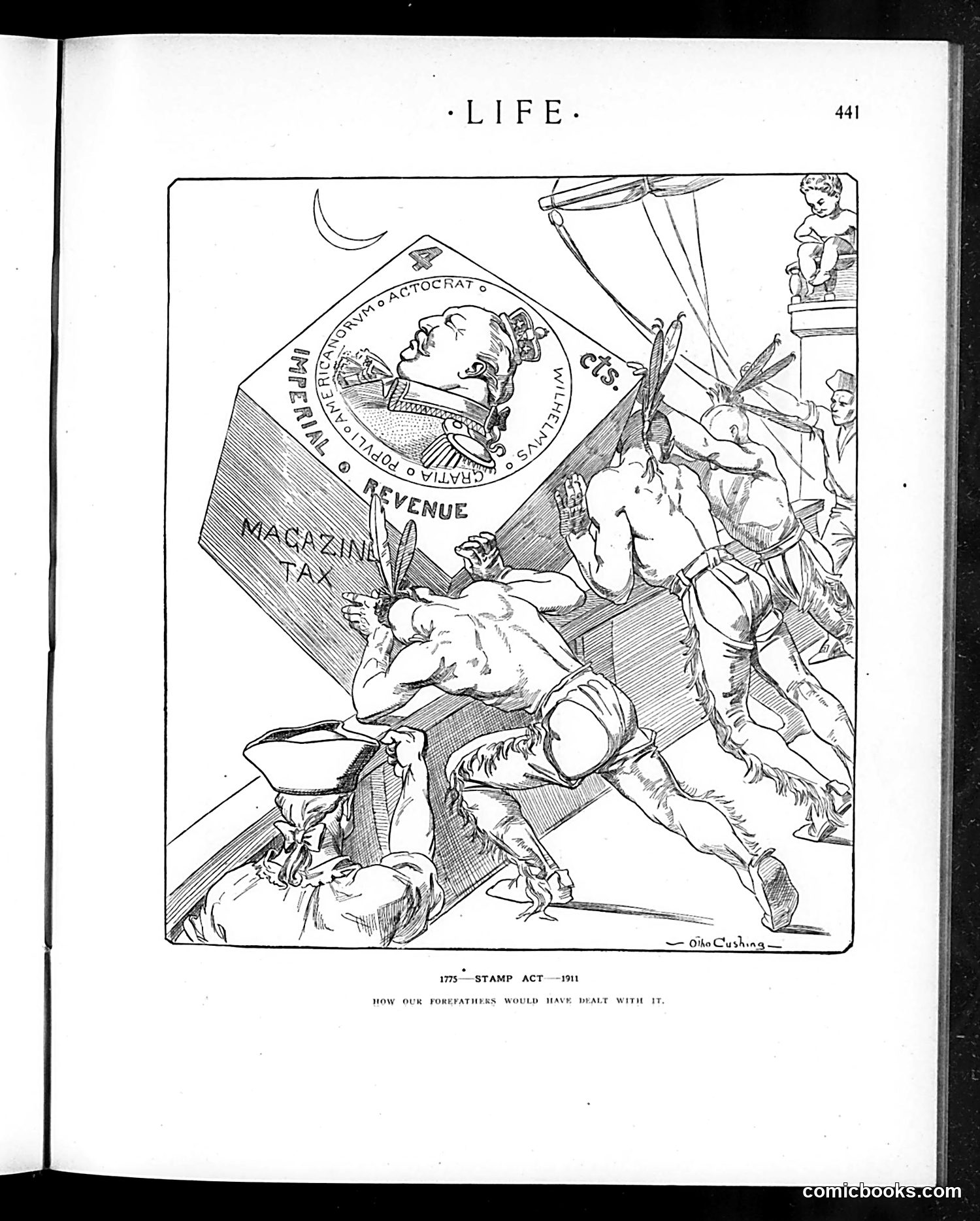
This 1911 Life magazine cartoon satirizes the **Stamp Act** controversy (labeled "1775—STAMP ACT—1911"). The image depicts cherubs/allegorical figures struggling with a large stamp bearing a profile (likely a British monarch), labeled with "REVENUE" and "MAGAZINE TAX." The caption reads: "HOW OUR FOREFATHERS WOULD HAVE DEALT WITH IT." **The satire**: Americans in 1911 faced new magazine taxation they resented. The cartoonist compares this to the hated British Stamp Act of 1765, which sparked American Revolutionary anger. By showing cherubs violently rejecting the stamp, the artist suggests that founding fathers would have fiercely opposed such taxation—implying modern Americans should do likewise. The joke targets both contemporary tax policy and invokes patriotic Revolutionary nostalgia to criticize government revenue measures on publishers and magazines.
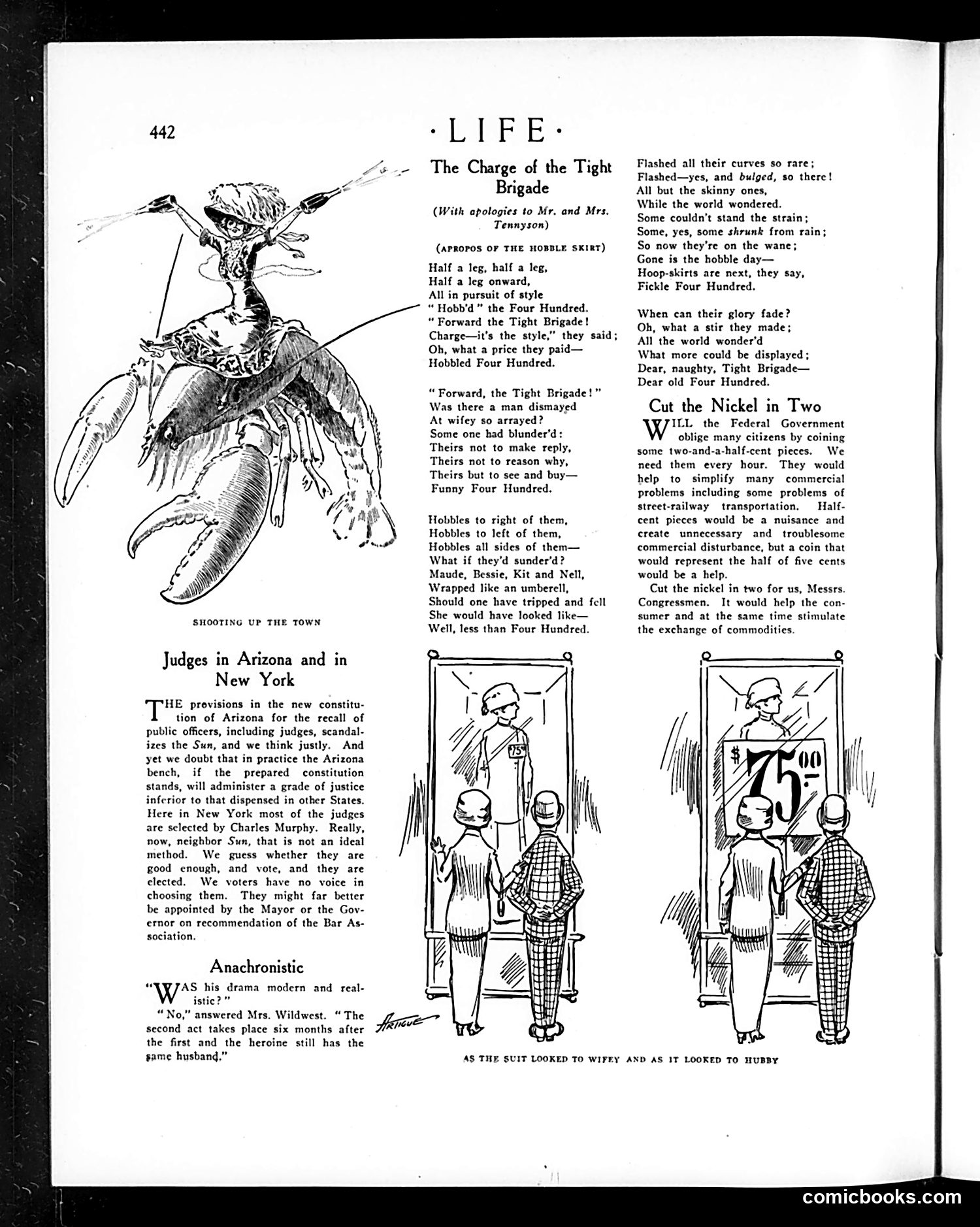
**"The Charge of the Tight Brigade"** parodies Tennyson's famous poem, mocking the hobble skirt—a restrictive women's fashion trend of the early 1900s that severely limited leg movement. The satire ridicules wealthy women ("the Four Hundred"—New York's elite social class) for slavishly adopting an impractical, uncomfortable style purely for fashion's sake. The poem suggests the trend is already fading ("Gone is the hobble day"). **"Judges in Arizona and New York"** critiques political appointments: Life argues Arizona's recall provision for judges, while radical, may produce better results than New York's system where judges are selected by political boss Charles Murphy without voter input. **"Cut the Nickel in Two"** advocates creating 2.5-cent coins to simplify commerce and streetcar fares—a practical economic proposal. The bottom cartoons illustrate how differently husband and wife perceive a new suit's cost ($7.50).
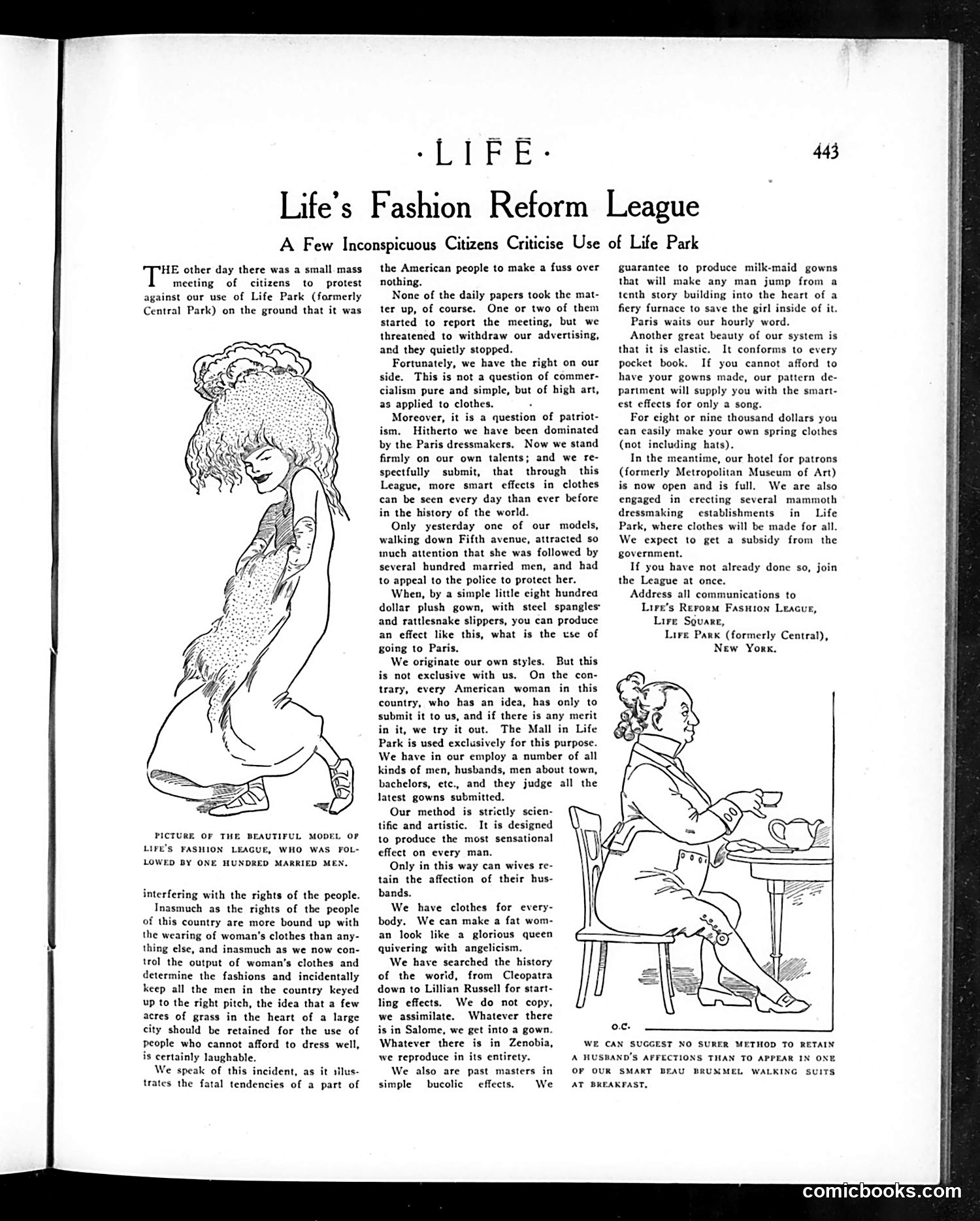
This is satirical commentary on commercialism and media manipulation in 1920s America. Life magazine (a real publication) mocks a fictional "Fashion Reform League" that uses Life Park (formerly Central Park) as a venue for modeling extravagant clothing. The satire targets several absurdities: **The Figures**: An unnamed fashion league that claims patriotic virtue while actually pursuing pure commercialism through controlling women's fashion and male attention. **The Social References**: The league threatens newspapers with advertising withdrawal to suppress criticism—satirizing corporate media influence. It openly admits to controlling fashion output and "keeping men keyed up" through women's clothing. **The Joke**: The exaggerated claims about clothing's power (a $800 gown causes "several hundred married men" to follow a model) expose the vanity of the fashion industry and male susceptibility to it. The league's self-aggrandizing claims about improving on historical figures like Cleopatra reveal pretentiousness masking pure profit motive. The cartoon illustrates the fashionable model mobbed by admirers, embodying the absurd scenario described.
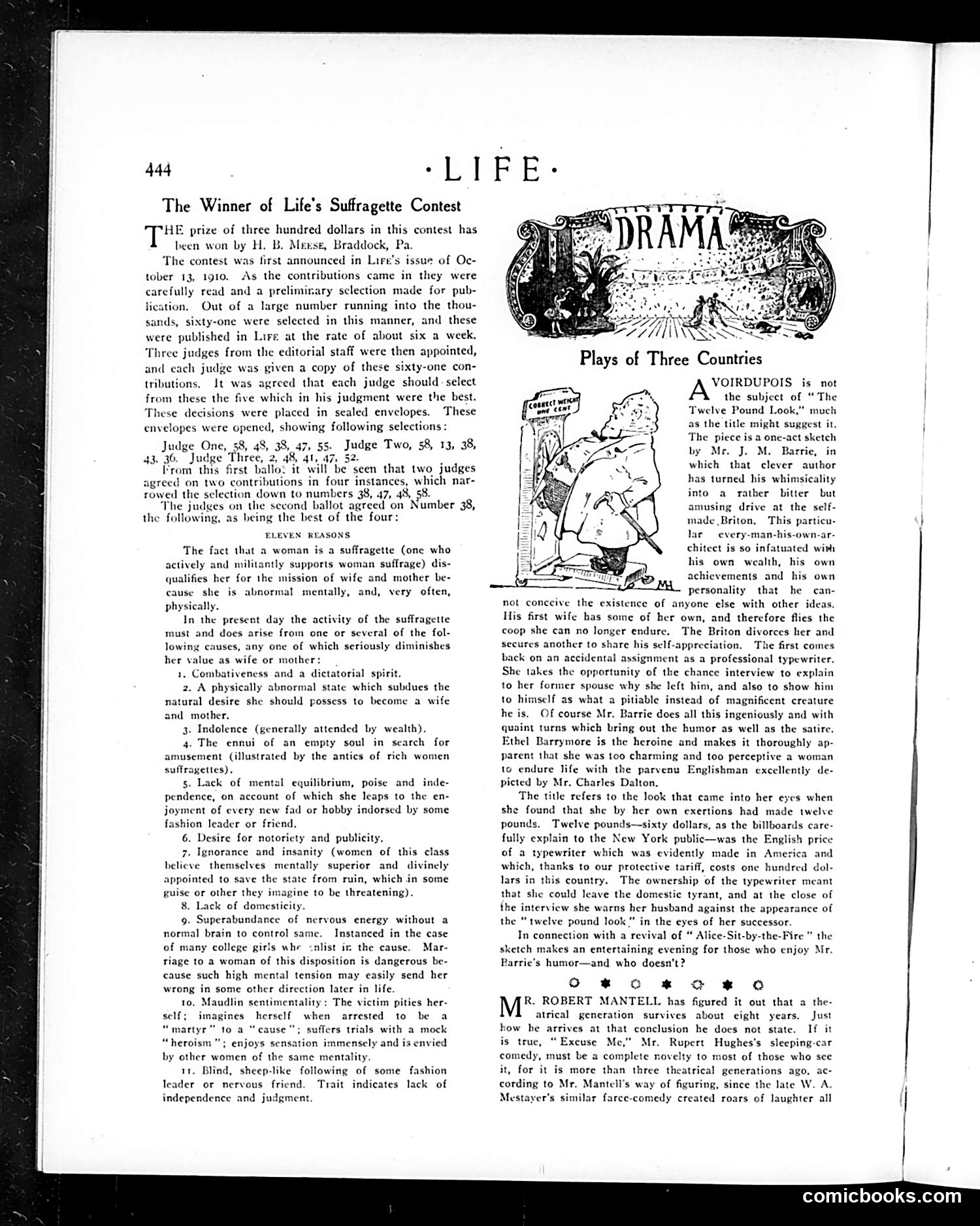
This page announces the winner of *Life* magazine's contest attacking women's suffrage. The winning entry lists "Eleven Reasons" why suffragettes are unfit as wives and mothers, claiming they are mentally abnormal, combative, physically defective, or driven by vanity and notoriety-seeking. The satire operates inversely: *Life*, a satirical publication, is publishing what appears to be genuine anti-suffrage arguments to mock their absurdity. The elaborate pseudo-scientific reasoning—attributing suffragism to nervous disorders, lack of domesticity, and "maudlin sentimentality"—exposes the era's irrational opposition to women's voting rights. The page also reviews theatrical works, including a J.M. Barrie play about a self-made British man so absorbed in his own achievements he cannot recognize his wife's independent thinking. This thematic pairing strengthens the page's critique of male-centered worldviews. Published around 1910, this reflects the heated debate preceding women's suffrage victories.
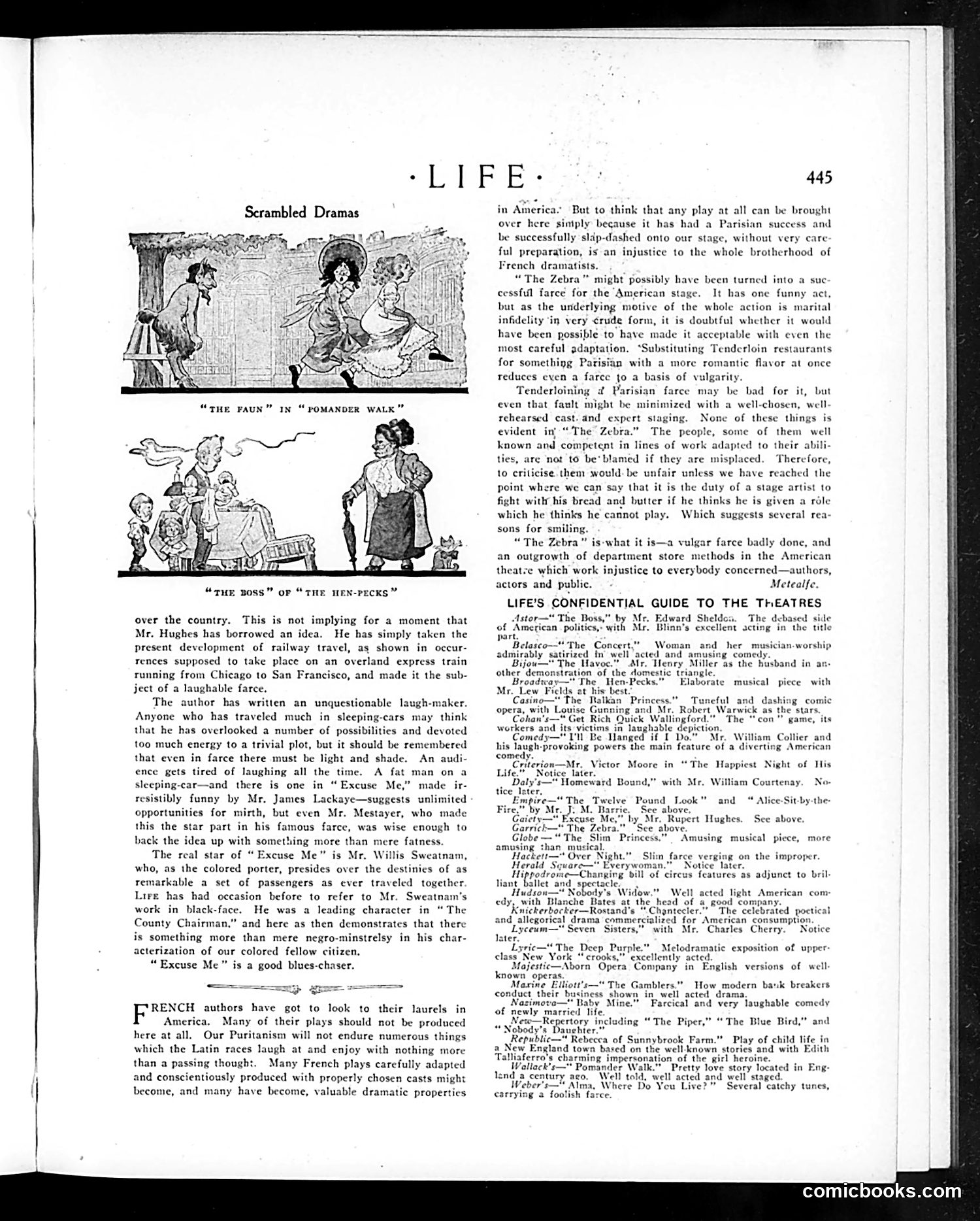
This page reviews contemporary theatrical productions, focusing on American farces adapted from French plays. The two cartoon sketches illustrate scenes from stage productions—"The Faun in Pomander Walk" (top) and "The Boss" or "The Hen-Pecks" (bottom)—showing typical comedic scenarios of the era. The main critique targets the indiscriminate importation of French plays to America. The reviewer argues that simply because a play succeeds in Paris doesn't mean it will work on American stages, which have stricter moral standards regarding marital infidelity and sexual content. The review specifically condemns "The Zebra," a French farce deemed too vulgar and poorly adapted for American audiences, and criticizes theater management for careless casting and staging. The text praises Willis Sweatnam's portrayal of a sleeping-car porter in "Excuse Me," noting his talent transcends typical minstrel stereotypes—reflecting early 20th-century attitudes toward Black performers.
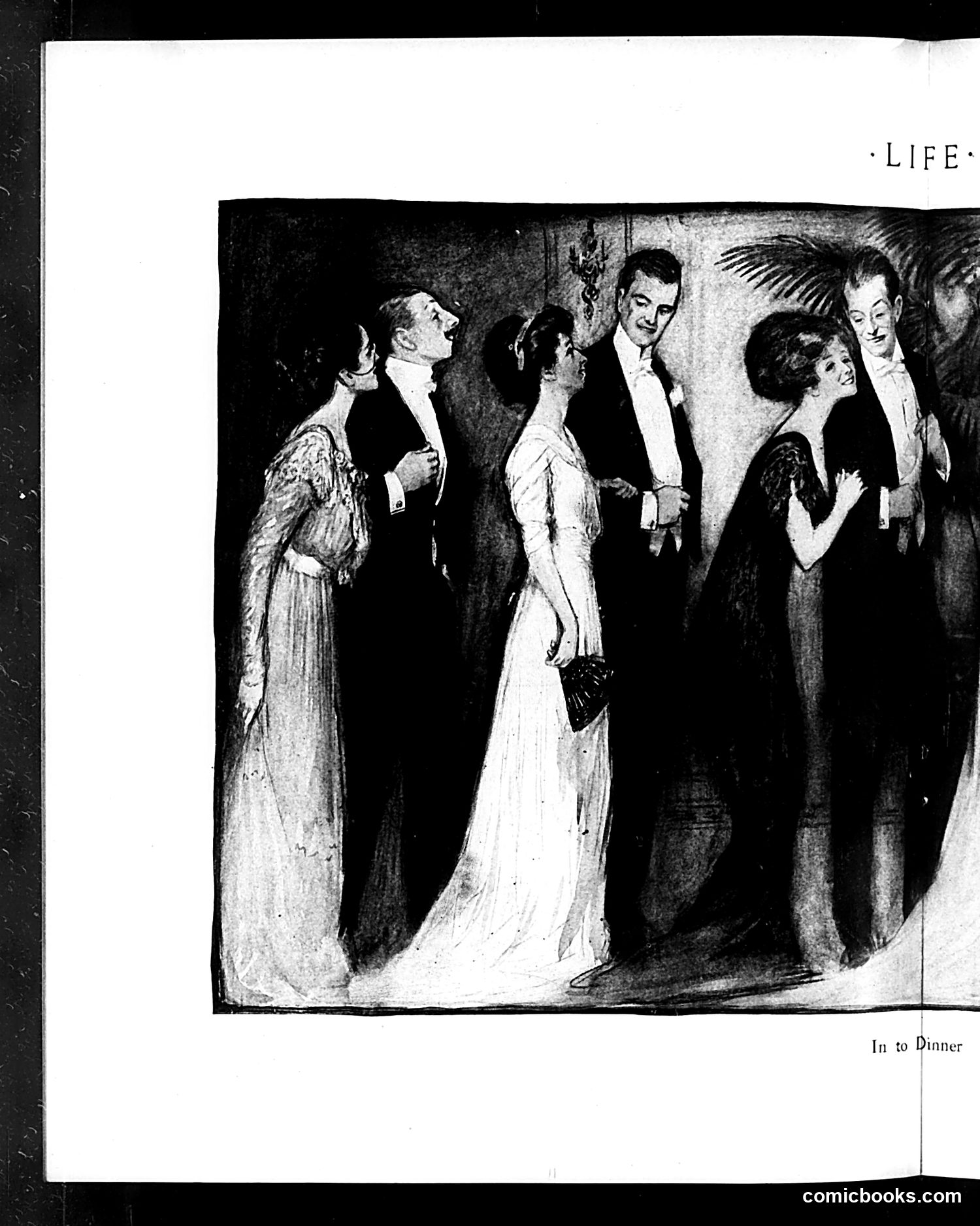
This appears to be a satirical illustration from Life magazine showing a formal dinner party scene. The caption "In to Dinner" suggests the guests are preparing to enter for the meal. The drawing depicts well-dressed men in tuxedos and women in evening gowns in what appears to be an elegant social setting. Without additional context or clearer identifying details, I cannot definitively identify the specific figures or pinpoint the exact satirical target. The illustration likely mocks upper-class social conventions and formal dinner etiquette of the era, possibly commenting on the artificiality or pretension of high society gatherings. The formal dress and posturing suggest satire about social hierarchies or behavior among the wealthy, which was a common subject for Life magazine's humor.
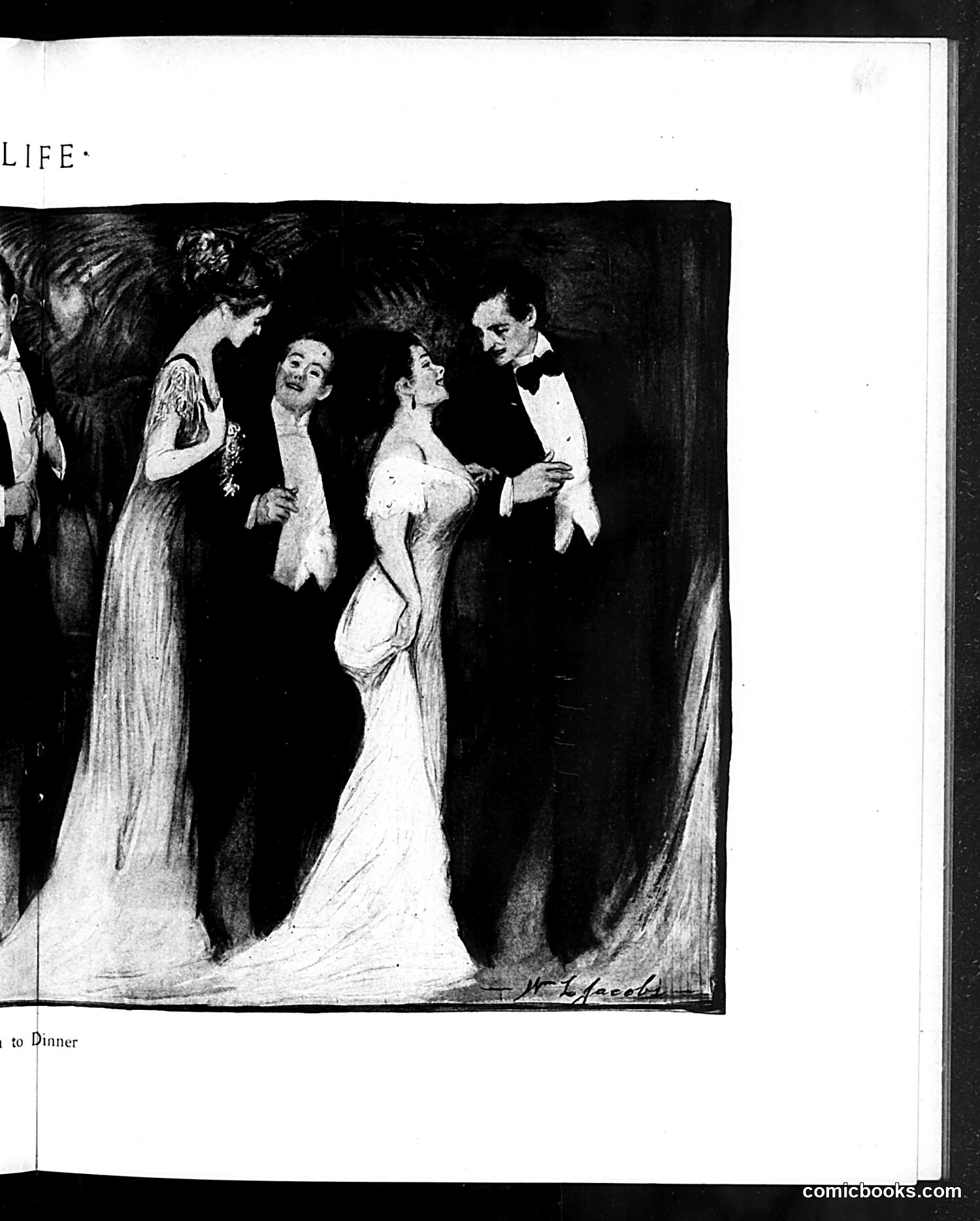
This appears to be a satirical illustration from Life magazine depicting a formal dinner scene. The image shows five elegantly dressed figures in evening wear - a woman in a white gown is the focal point, surrounded by four men in formal attire (tuxedos). The composition and body language suggest social interaction or gossip at a high-society event. The title "to Dinner" is visible, though the full caption appears cut off. Without additional context or visible text identifying the specific figures, it's unclear whether this satirizes particular individuals or comments more broadly on upper-class social dynamics and formal etiquette of the era. The artistic style and formal dress suggest this mocks wealthy society's conventions, though the exact targets remain uncertain from this page alone.
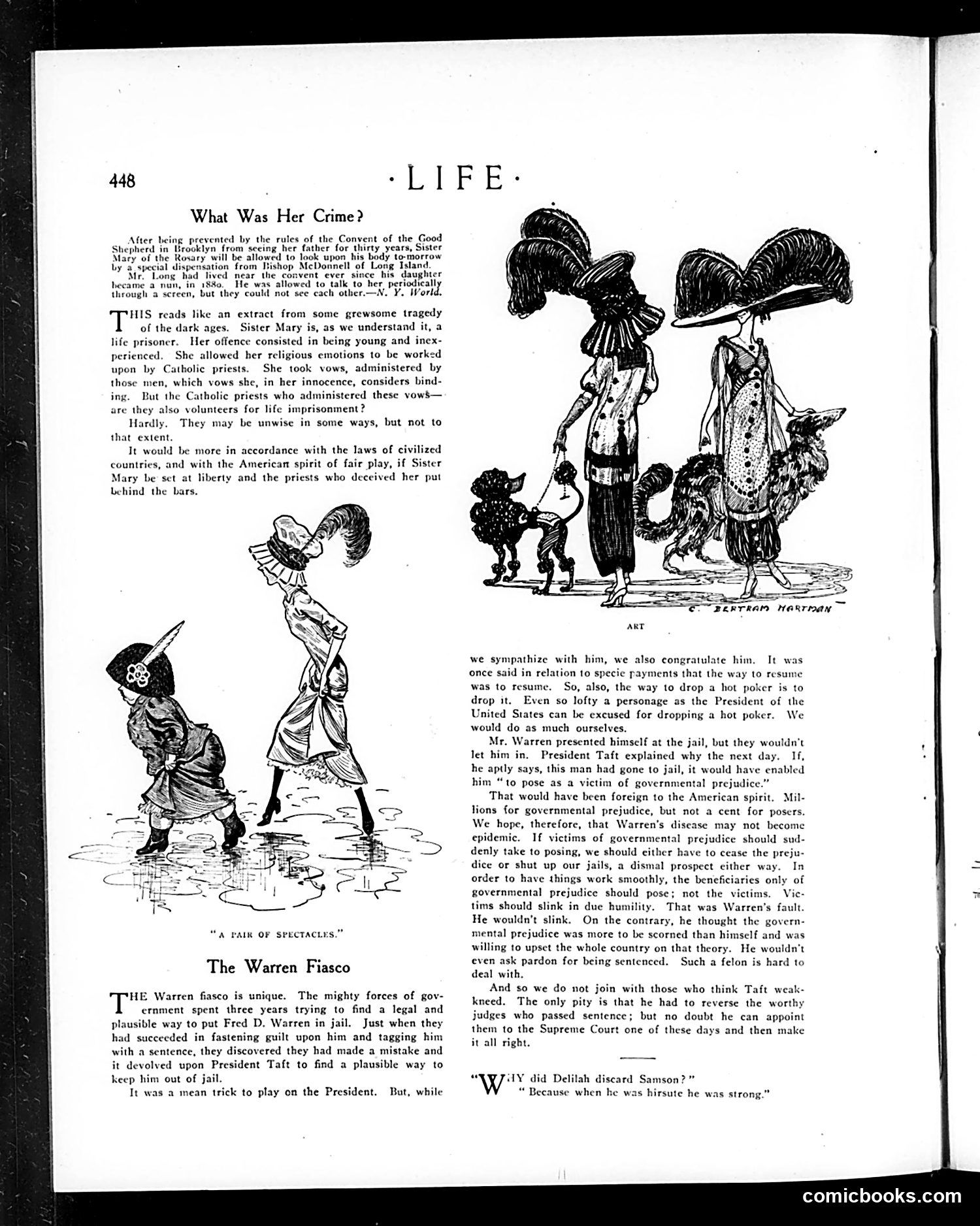
This page contains two distinct critiques: **"What Was Her Crime?"** attacks the Catholic Church's treatment of women. Sister Mary has been confined to a convent for 30 years, separated from her dying father by institutional rules, because she took vows as a young, inexperienced woman. The article sarcastically notes priests administered these binding vows but didn't take them themselves—suggesting the Church exploited her religious emotions while avoiding the same consequences. The cartoon depicts nuns as controlling figures. Life argues Sister Mary should be freed and the priests held legally accountable. **"The Warren Fiasco"** satirizes President Taft's handling of Fred D. Warren's imprisonment. The government spent three years prosecuting Warren, then realized they'd made a legal error. Rather than imprison him (which would make him appear a victim of "governmental prejudice"), Taft kept him out of jail. Life mocks this as cowardly—sarcastically praising Taft for "dropping the hot poker"—while criticizing Warren for not accepting his unjust sentence with humble silence.
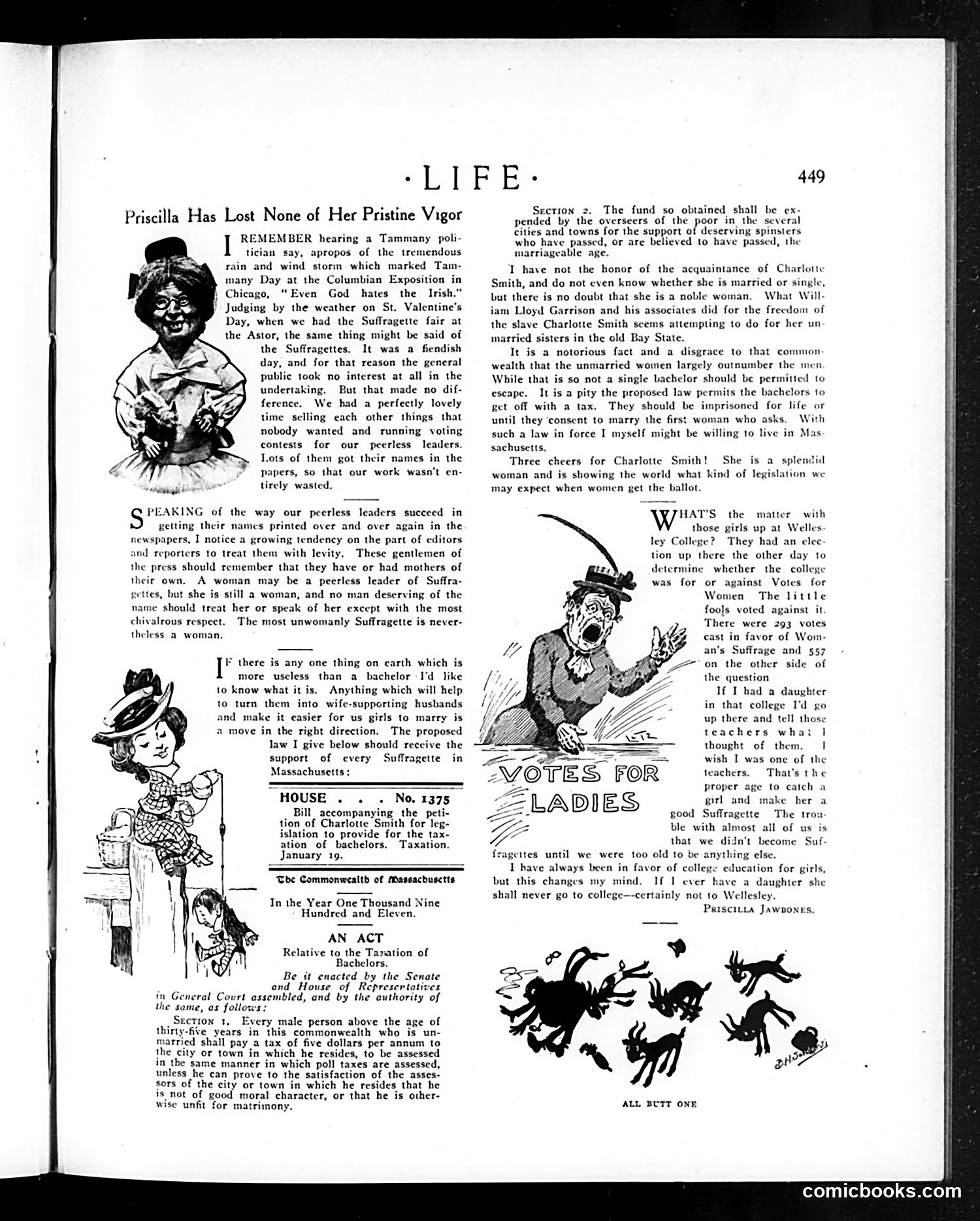
This page satirizes the women's suffrage movement through the voice of "Priscilla," a self-identified suffragette. The author mocks her cause by having her propose absurd legislation: taxing unmarried men over 35 to support unmarried women past "marriageable age." The cartoon's point is ironic—by advocating punitive taxation of bachelors, the suffragette character undermines her own credibility. The satire suggests that suffragettes are not serious political reformers but rather bitter, irrational women motivated by personal grievance rather than principle. The referenced "Charlotte Smith" appears to have actually proposed such bachelor-tax legislation in Massachusetts (House Bill 1375, 1911), which Life's editors treated as risible proof of suffragette frivolousness. The illustrations—showing women as scattered-brained and chaotic—reinforce the stereotype that women shouldn't vote because they lack sound judgment. This was standard anti-suffrage propaganda of the era.
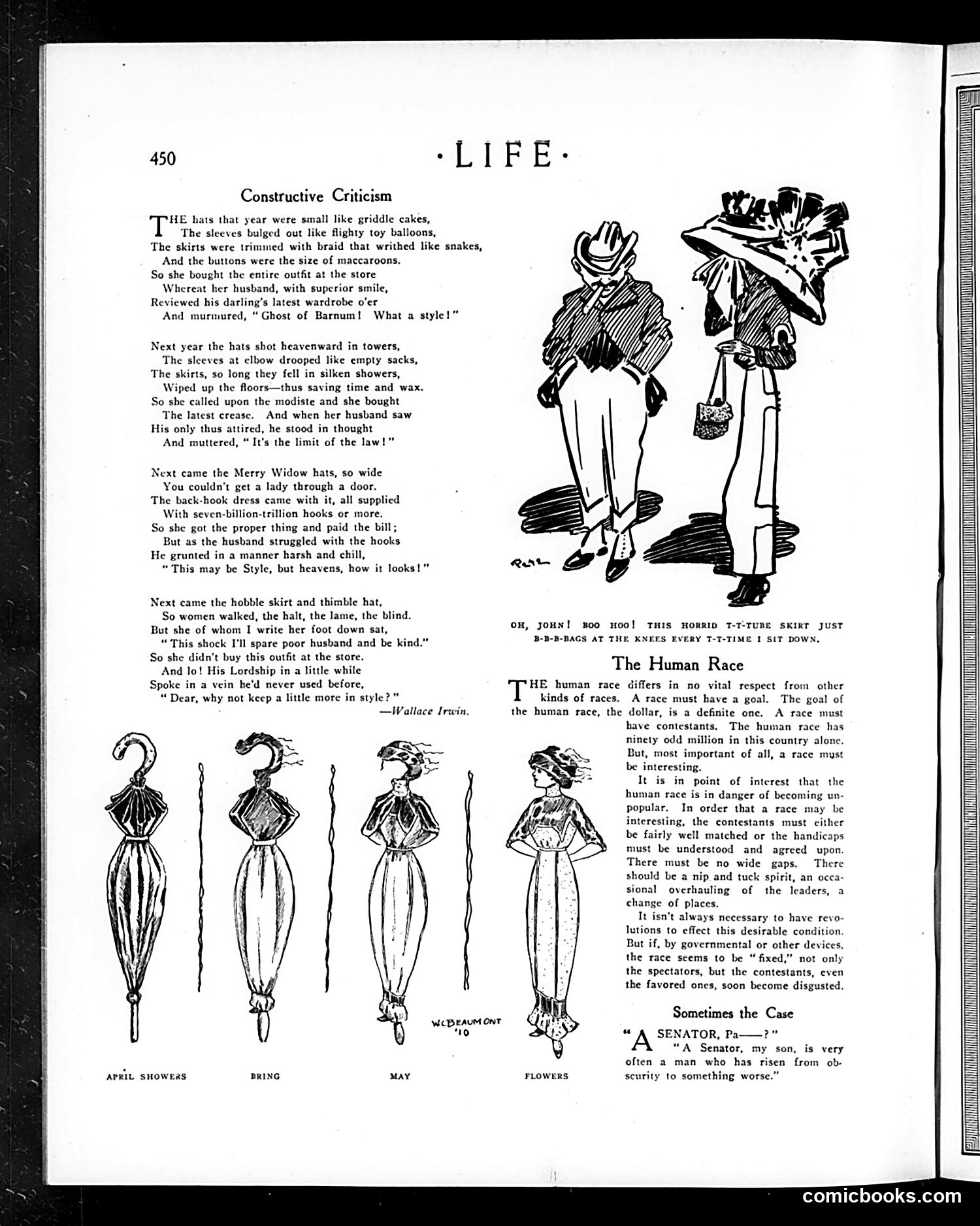
This page contains two distinct satirical pieces about early 1900s fashion and social commentary. **"Constructive Criticism"** (poem by Wallace Irwin with umbrella illustrations) mocks the husband-wife dynamic around women's rapidly changing fashions. Each year brings new absurd styles—griddle-cake hats, balloon sleeves, snake-like braids, then towering hats, drooping sleeves, and dangerously long skirts. The husband criticizes each outfit with exasperation, until his wife finally refuses to buy the ridiculous "hobble skirt" to spare him. Paradoxically, he then *demands* she keep up with fashion. The satire targets both women's fashion slavery and men's contradictory, impossible expectations. **"The Human Race"** (upper right) uses horse-racing metaphor to criticize American wealth inequality and "fixed" economic competition. For a race to be interesting, contestants must be evenly matched or handicaps understood—but when the system appears rigged (through governmental favoritism), even winners lose interest. **"Sometimes the Case"** (bottom) is a brief joke about senators rising "from obscurity to something worse"—political corruption satire.
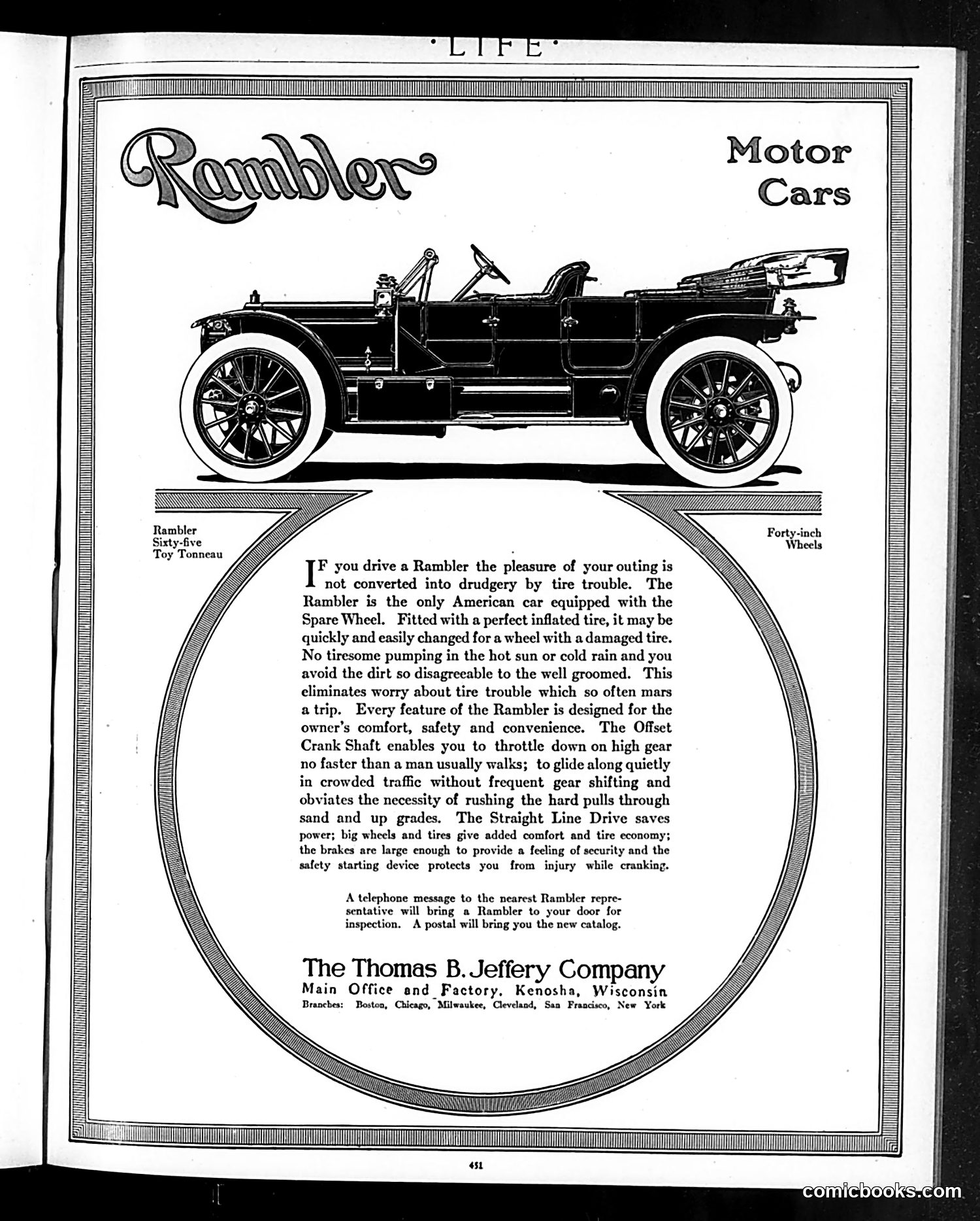
This is not a cartoon or satire—it's a **straightforward automobile advertisement** from Life magazine's early automotive era. The page advertises the Rambler motor car manufactured by the Thomas B. Jeffery Company of Kenosha, Wisconsin. The ad highlights practical features aimed at early-1900s motorists: a spare wheel (novel at the time), ease of tire changes, an offset crankshaft for smooth driving, and reliable brakes. The text emphasizes comfort, safety, and convenience—selling points for a vehicle class still establishing itself against horse-drawn carriages. The illustration shows a side-profile technical drawing of the vehicle, labeled with specifications ("Sixty-five Toy Tonneau," "Forty-inch Wheels"). This is typical period advertising: detailed, informational, and designed to demonstrate mechanical superiority. There is no political or satirical content here—merely commercial promotion of automotive technology to a readership learning about motorized transportation.
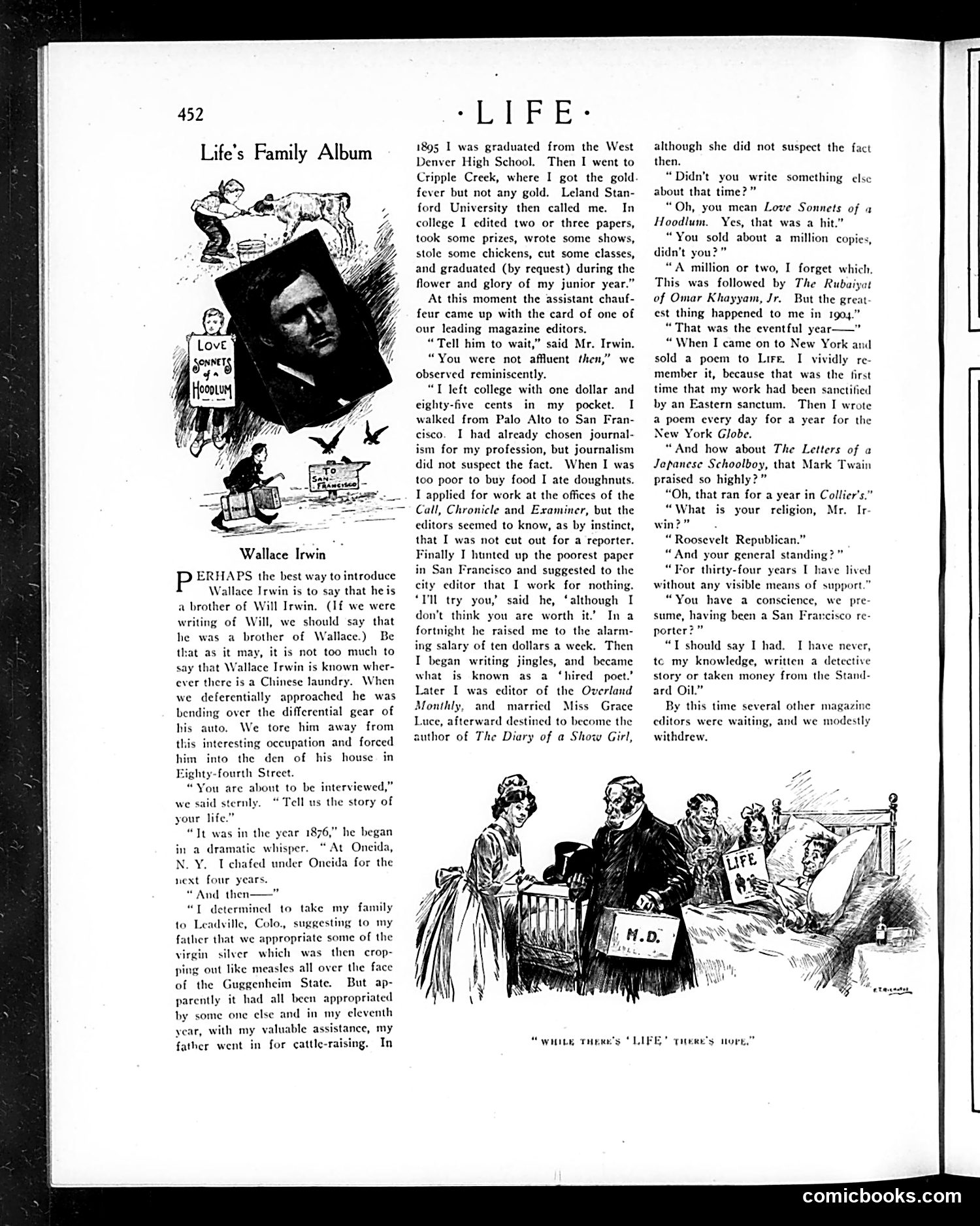
This is a biographical interview with writer Wallace Irwin, presented as satirical humor. The cartoon shows Irwin as a successful but irreverent author who built a career through unconventional means—starting impoverished, working for newspapers, and becoming known for humorous writing including *Love Sonnets of a Hoodlum* and *The Letters of a Japanese Schoolboy*. The satire targets his bohemian lifestyle and tongue-in-cheek self-presentation. He claims to have lived "thirty-four years without any visible means of support" while achieving literary success, sold "a million or two" copies of a book, and identifies as a "Roosevelt Republican"—likely referencing Theodore Roosevelt's Progressive politics. The bottom cartoon's caption—"While there's 'Life' there's hope"—is a pun on the magazine's name, suggesting that Irwin's improbable success exemplifies American opportunity and satirizing the self-made literary figure.
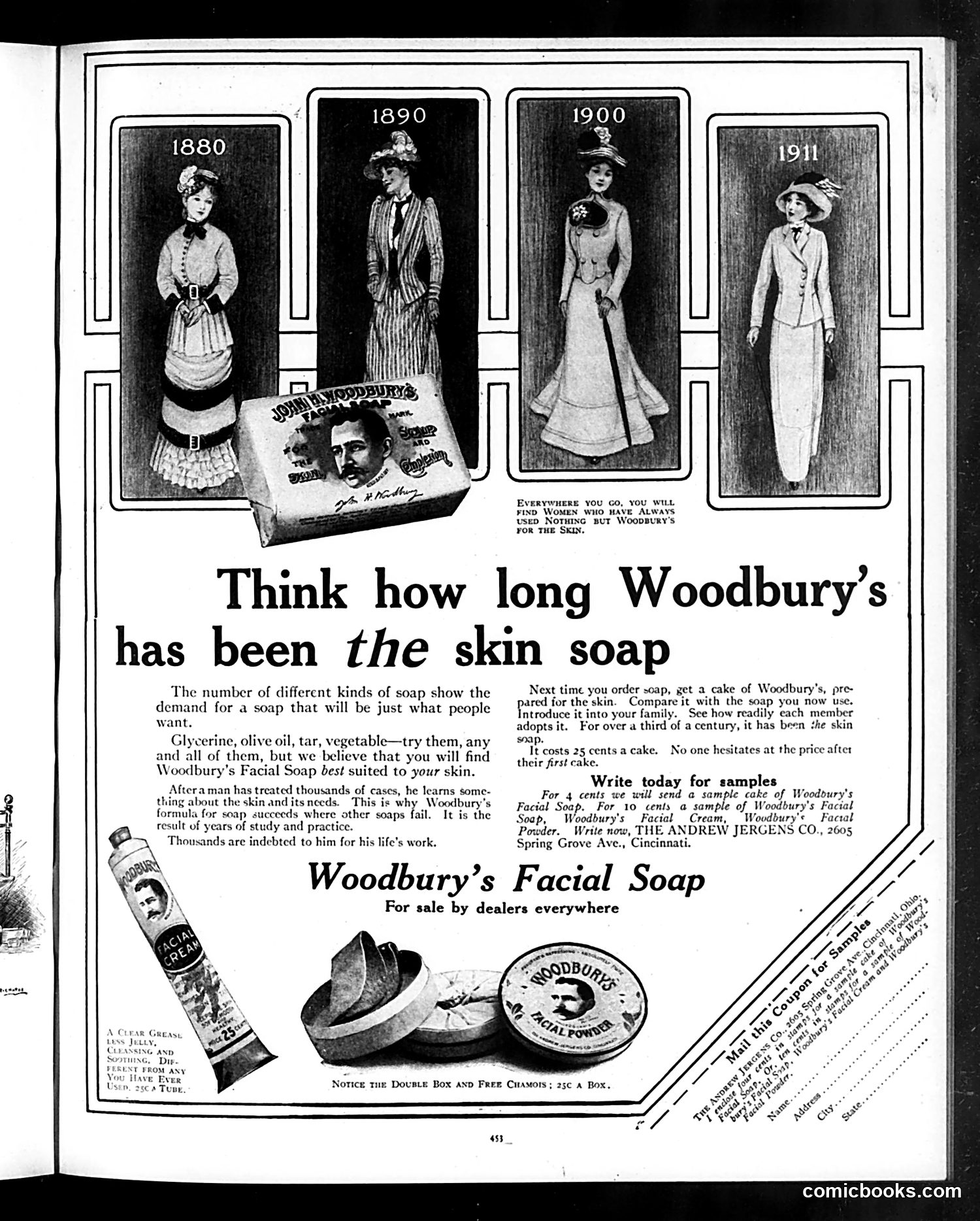
This is **not a political cartoon** but a commercial advertisement for Woodbury's Facial Soap, circa early 1900s. The page shows fashion evolution (1880-1911) at top to suggest women's enduring beauty needs across decades. The main ad emphasizes that Woodbury's has been "the skin soap" for over thirty years, using pseudo-scientific language about a formula developed by someone (likely a dermatologist, though unnamed) who treated "thousands of cases." The appeal targets women's vanity and beauty anxiety—a common advertising strategy of the era. The price of 25 cents is highlighted as reasonable for such a proven product. Samples are offered for 4-10 cents to encourage trial purchases. This represents early mass-market consumer advertising that positioned branded soap as a scientifically-backed necessity rather than a commodity.
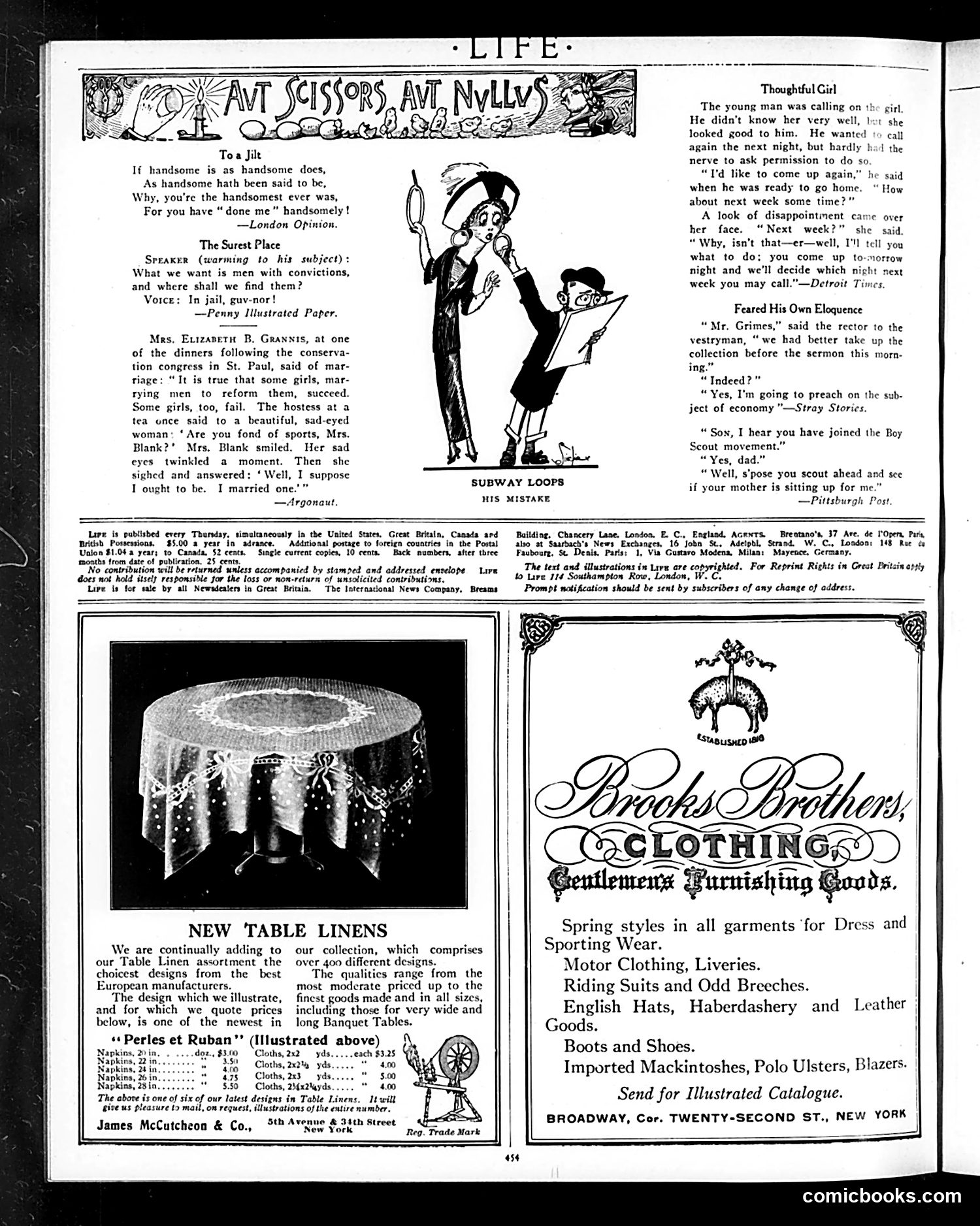
This cartoon satirizes male social awkwardness. A young man visiting a girl attempts to arrange a return visit by tentatively asking to call "about next week sometime?" The girl responds with visible disappointment, then redirects him: come *tomorrow* night instead, and *then* you can decide which night next week to visit. The joke's point: the man's hesitant, vague request ("next week sometime") lacks confidence and commitment. His "mistake" is not showing enough interest or decisiveness. The girl essentially teaches him that a gentleman should be more direct and eager—implying his timidity is romantically off-putting. The title "His Mistake" confirms the humor centers on his social misstep in courtship etiquette.
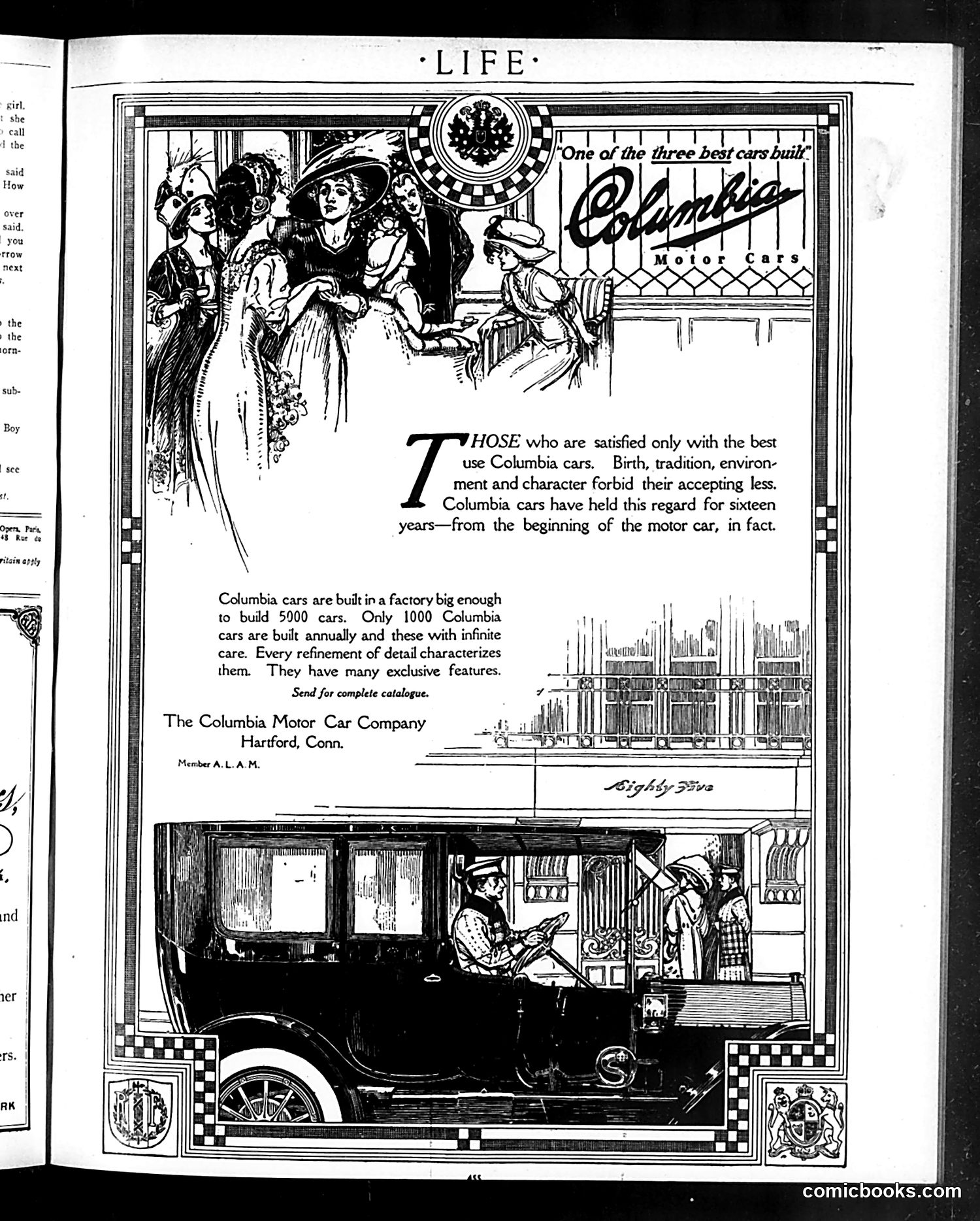
This is a **full-page advertisement**, not satire or political content. It promotes Columbia automobiles from Hartford, Connecticut, positioning them as luxury vehicles for the wealthy elite. The top illustration shows fashionably-dressed women admiring the car, establishing it as aspirational and refined. The text emphasizes exclusivity: only 1,000 cars built annually (versus 5,000 capacity), sixteen years of tradition, and meticulous craftsmanship. The lower technical drawing displays the automobile's engineering. The messaging appeals to class consciousness—suggesting that those of "birth, tradition, environment and character" naturally choose Columbia cars. This reflects early automotive marketing when cars were status symbols for the wealthy, before mass-production made them commonplace. The "A.L.A.M." membership reference indicates industry standardization bodies of the era.
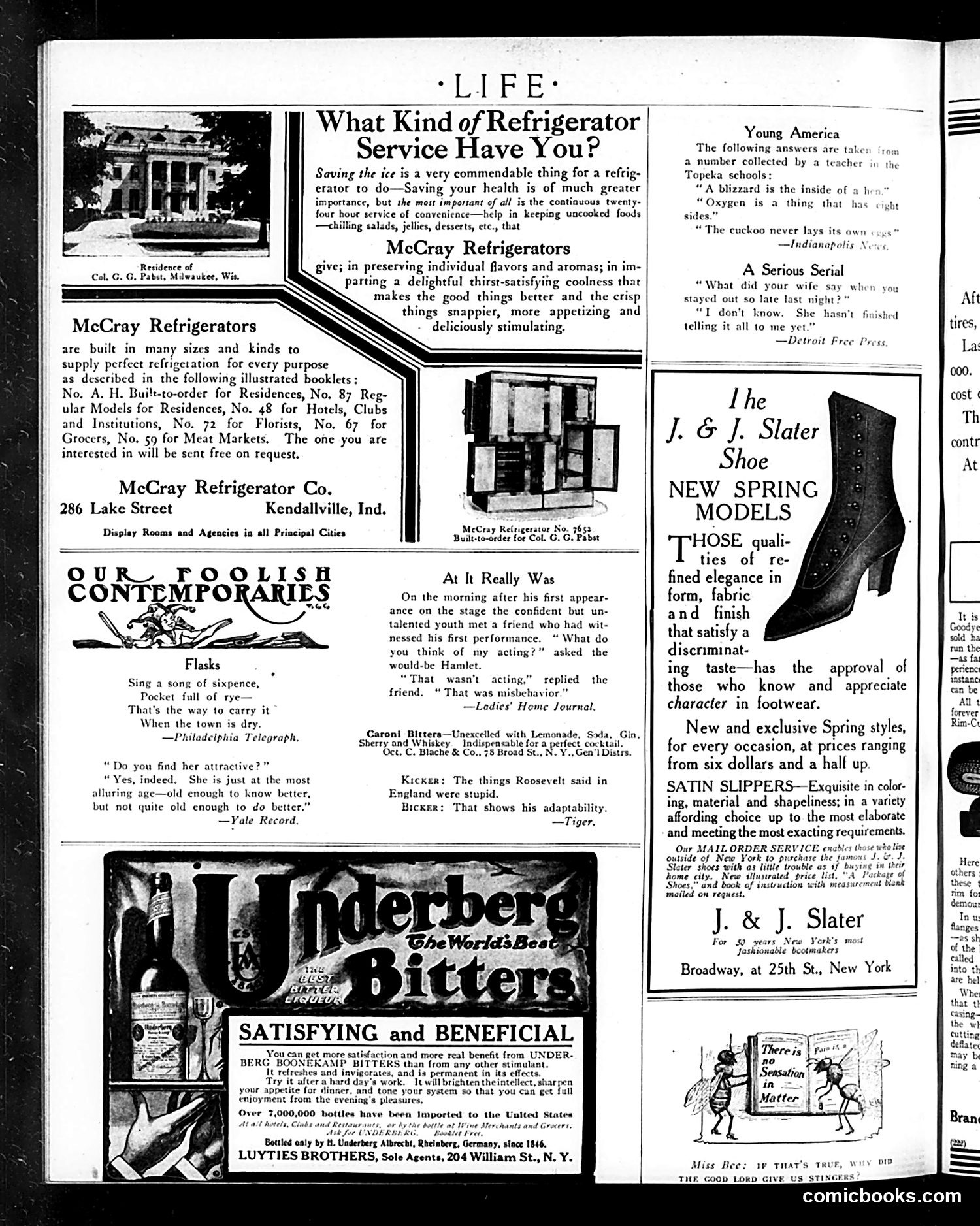
This page is primarily **advertising**, with scattered humor pieces typical of early 20th-century Life magazine's satirical format. **Main advertisements:** - McCray Refrigerators dominate the left side, featuring Col. G.G. Pabst's Milwaukee residence - J. & J. Slater shoes (spring models) occupy the right - Underberg and Caront Bitters ads promote alcohol as medicinal tonics **Humor sections ("Young America," "A Serious Serial"):** These present children's malapropisms and marital jokes reflecting period sensibilities—mild mockery of innocence and domestic friction. **Notable reference:** A brief "Kicker" joke about **Theodore Roosevelt**'s recent England visit (circa 1910), calling his statements "stupid" while joking about his "adaptability"—typical contemporary political ribbing. **Context:** The page reflects Prohibition-era America (alcohol still advertised as health products), early refrigeration technology as luxury goods, and Life's mix of consumer marketing with light satire. The jokes are genteel rather than pointed.
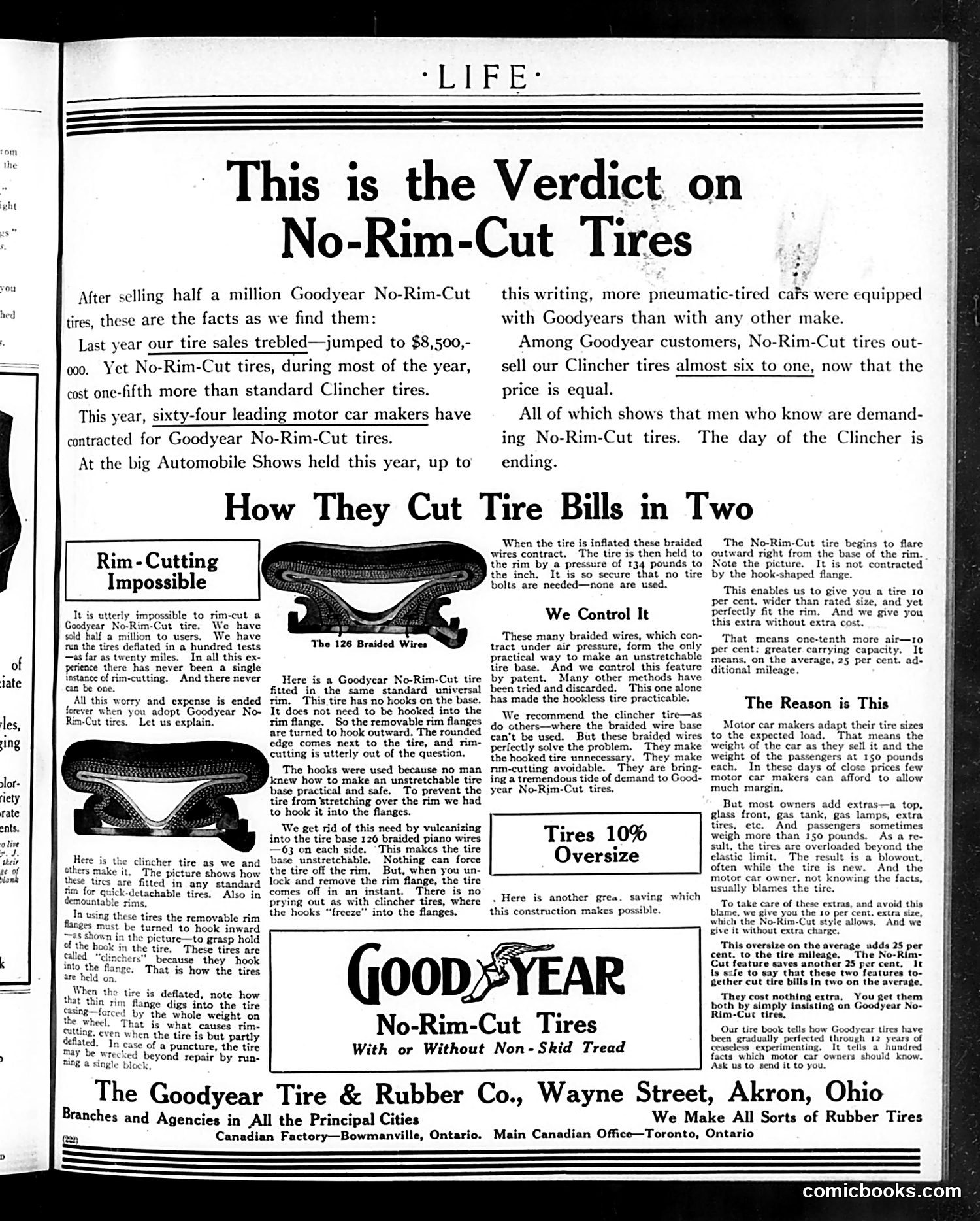
This page is a **Goodyear tire advertisement**, not political satire. There are no cartoons or political figures to analyze. The content describes Goodyear's "No-Rim-Cut" tire innovation—a technical improvement where 126 braided wires vulcanized into the tire base eliminated the need for hook-shaped rims. The diagrams compare the old "clincher" tire (which required hooks and could be damaged by rim-cutting) to the new design. The "verdict" claims commercial success: tire sales tripled to $8.5 million, sixty-four car manufacturers adopted the product, and No-Rim-Cut tires outsell competing Clincher tires nearly six-to-one despite once costing 20% more. This is straightforward product promotion disguised as objective reporting—typical early 20th-century advertising rhetoric claiming engineering superiority and market dominance as "facts."
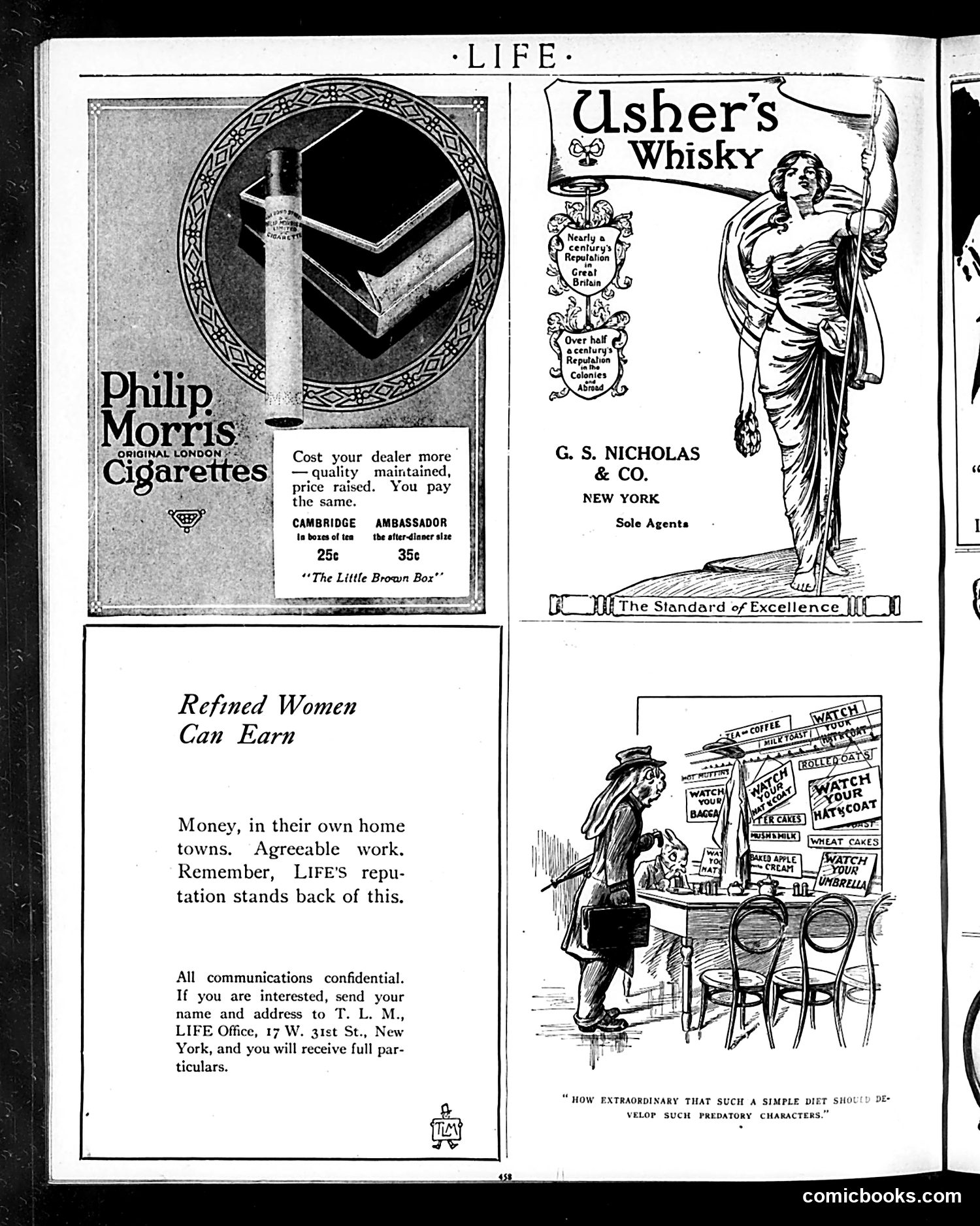
This page is primarily **advertisements** interspersed with one satirical cartoon. The ads promote Philip Morris cigarettes, Usher's whisky, and a work-from-home scheme for "refined women"—typical early 20th-century marketing. The main cartoon (bottom right) shows a woman observing predatory animals at what appears to be a zoo or animal display. The caption sarcastically suggests that a "simple diet" produces dangerous creatures. This likely satirizes contemporary debates about **nutrition and animal behavior**—possibly mocking pseudoscientific theories linking diet to aggression or moral character. The joke targets those who drew overly broad conclusions from dietary studies, a common subject of satire during this era. The cartoon's humor relies on the absurdity of applying dietary determinism to wild predators, implying similar pseudoscientific thinking was being applied to human behavior and society.
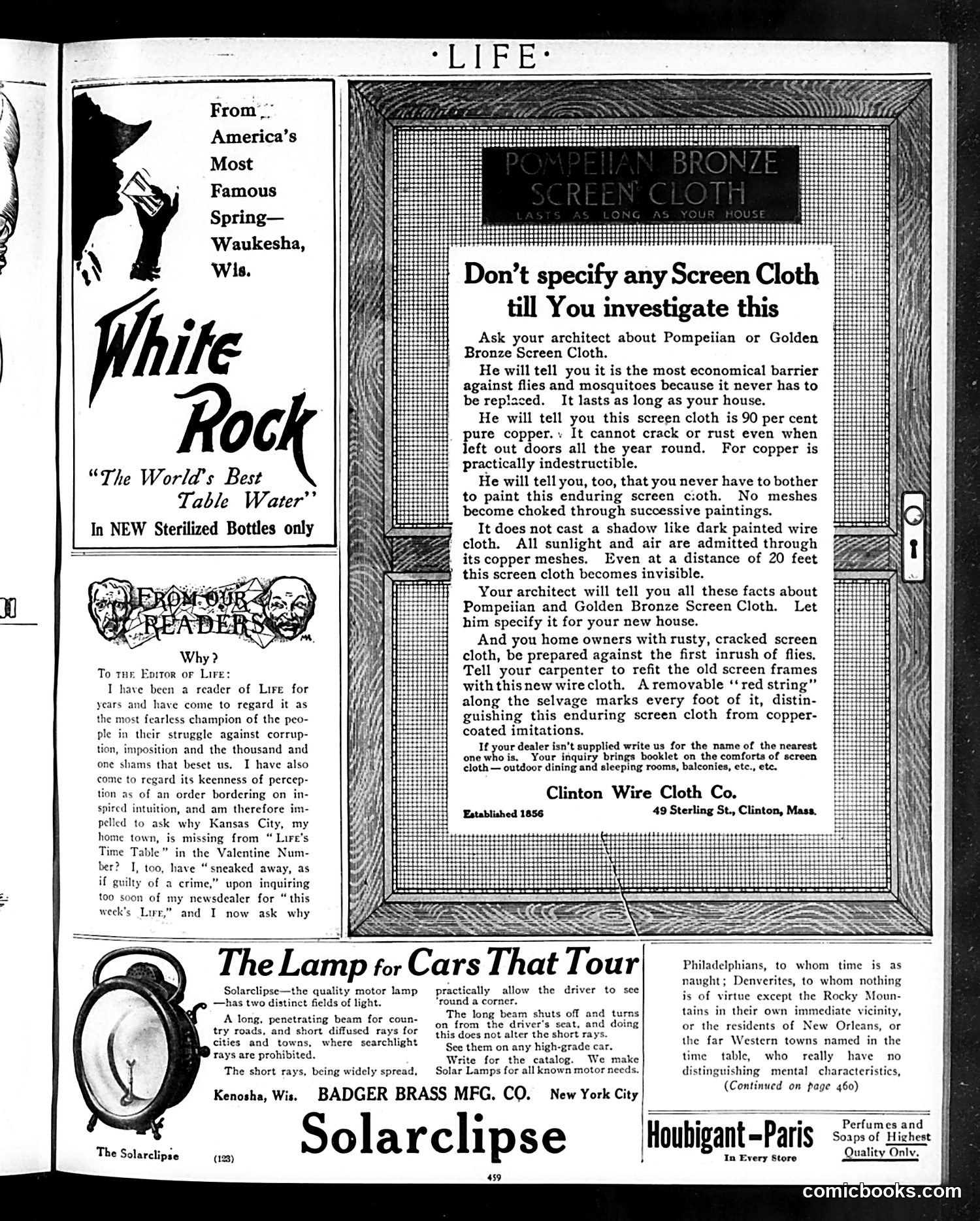
This page is primarily **advertisements** with one reader letter, not political satire. The **White Rock ad** (top left) shows a silhouette of a woman drinking from a bottle, advertising spring water from Waukesha, Wisconsin—a straightforward product pitch with no satirical content. The reader's letter ("From Our Reader") expresses genuine praise for *Life* magazine's investigative journalism against corruption, then asks why Kansas City wasn't featured in a recent "Valentine Number" time table. This is authentic reader feedback, not satire. The remaining content—ads for screen cloth, car lamps, and perfume—are commercial advertisements with no political or social commentary. **Bottom text fragment** references Philadelphia, Denver, and New Orleans residents' characteristics in what appears to be a separate article (continued on page 460), but is incomplete here. This page contains **no cartoons or identifiable satirical targets**.
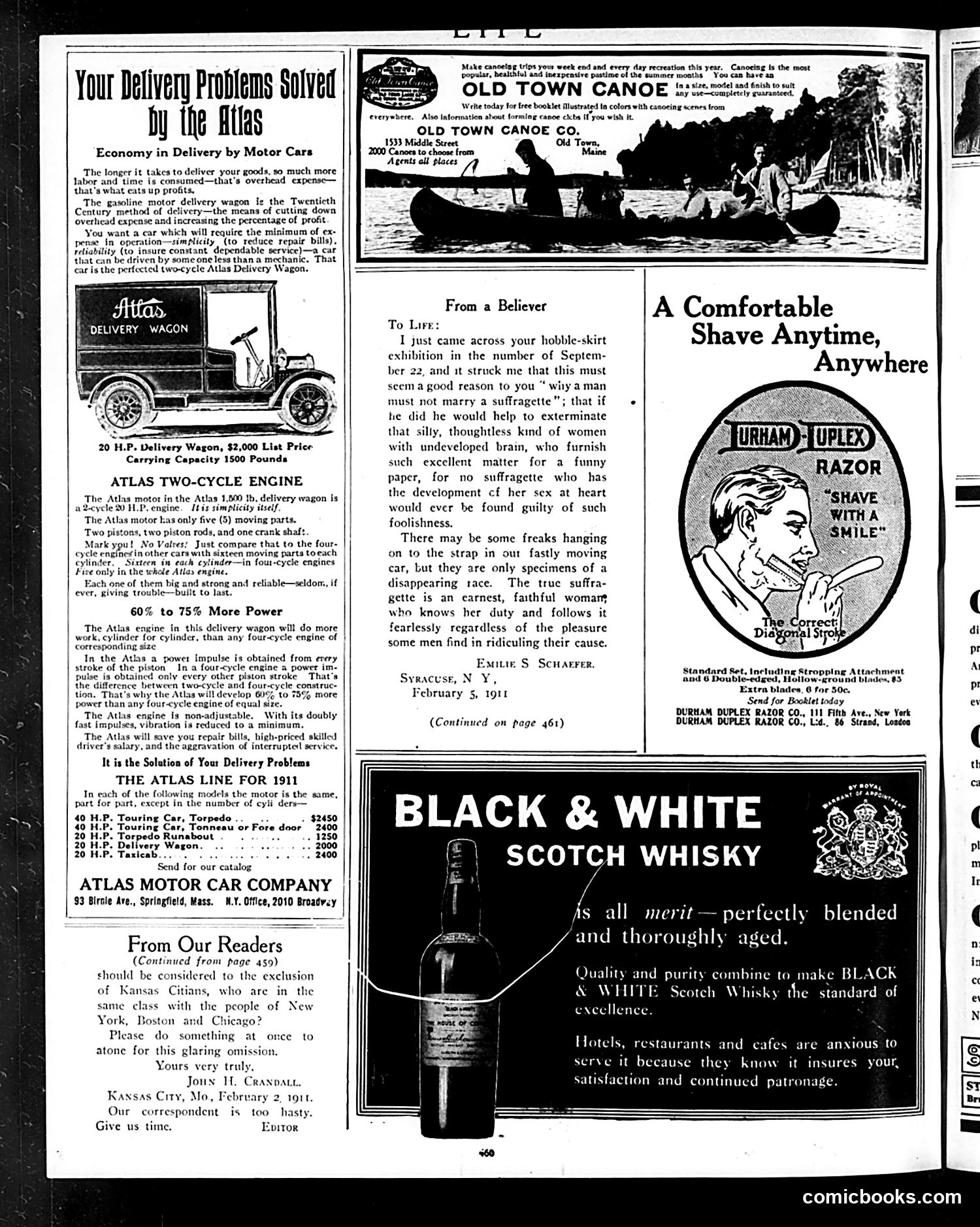
This page is primarily **advertising and reader correspondence**, not political satire. The dominant content includes: **Main Advertisements:** - Atlas Motor Car Company promotes delivery wagons with two-cycle engines, emphasizing efficiency and low operating costs for business use - Old Town Canoe Company advertises recreational canoeing - Durham Duplex Razor promotes comfortable shaving - Black & White Scotch Whisky advertisement **Reader Correspondence:** A Kansas City reader complains that Life magazine has excluded Kansas City from recent coverage while featuring New York, Boston, and Chicago. The editor responds dismissively: "Our correspondent is too hasty. Give us time." **Social Context:** The only potentially satirical element is a letter titled "From a Believer" discussing women's suffrage—someone argues against men marrying suffragettes, calling such women "silly" and "thoughtless." This reflects anti-suffrage sentiment common in 1911, though the full context is cut off. The page primarily reflects early-20th-century consumer culture and period attitudes toward women's rights.
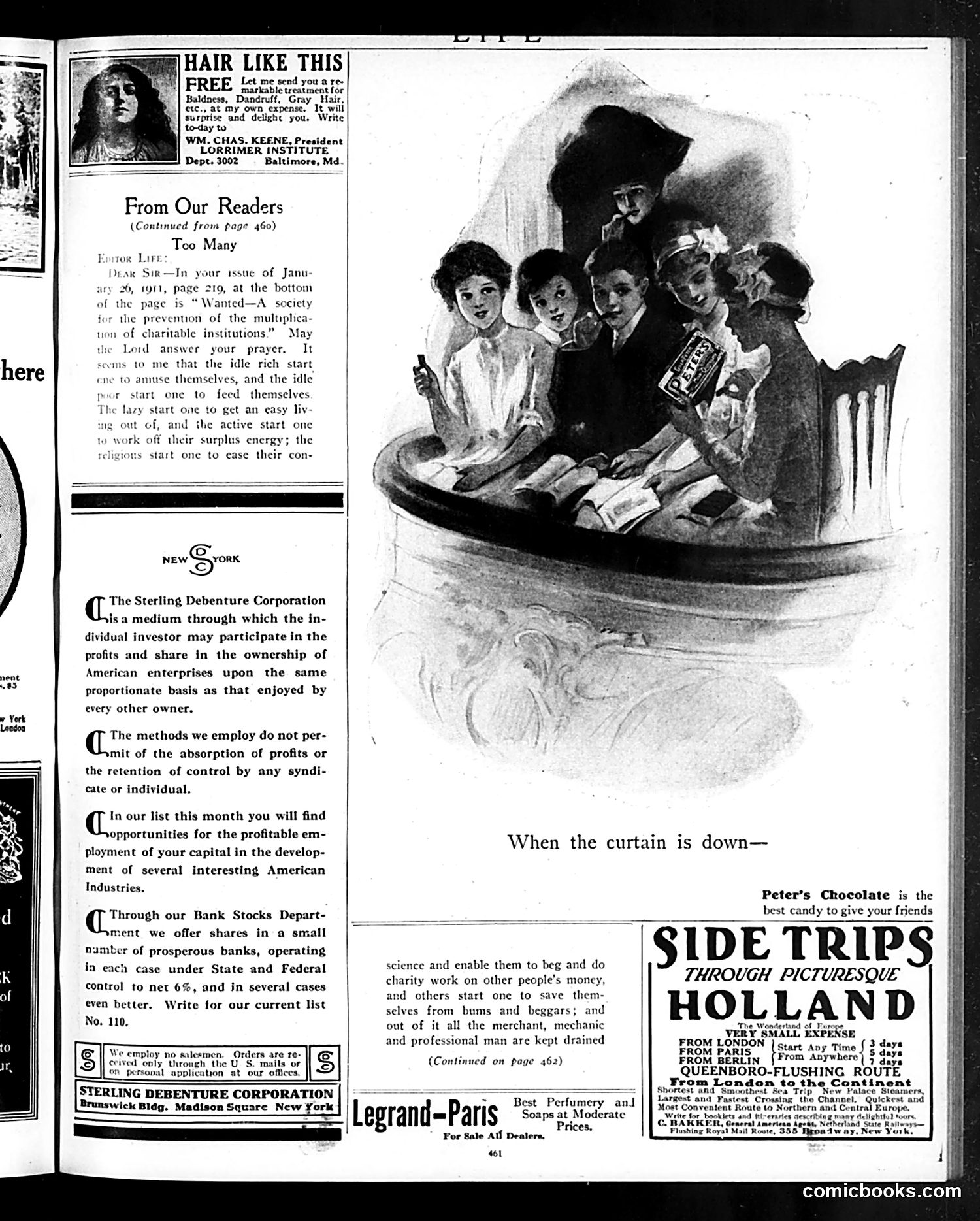
This page is primarily **advertising and reader letters**, not political satire. The main illustrated content—"When the curtain is down"—shows a theatrical scene of a woman and five young people in a boat, apparently promoting Peter's Chocolate candy. It's sentimental rather than satirical. The "From Our Readers" section contains a letter critical of proliferating charitable institutions (1911), arguing that different social classes create charities for self-interested reasons: the idle rich for amusement, the idle poor for easy income, and the wealthy for surplus energy outlet—draining productive merchants and professionals of resources. The surrounding ads promote financial investments (Sterling Debenture Corporation), hair treatment, perfume, and European travel packages—typical early-20th-century magazine filler aimed at middle and upper-class readers. **No specific political figures or events are identifiable or referenced on this page.**
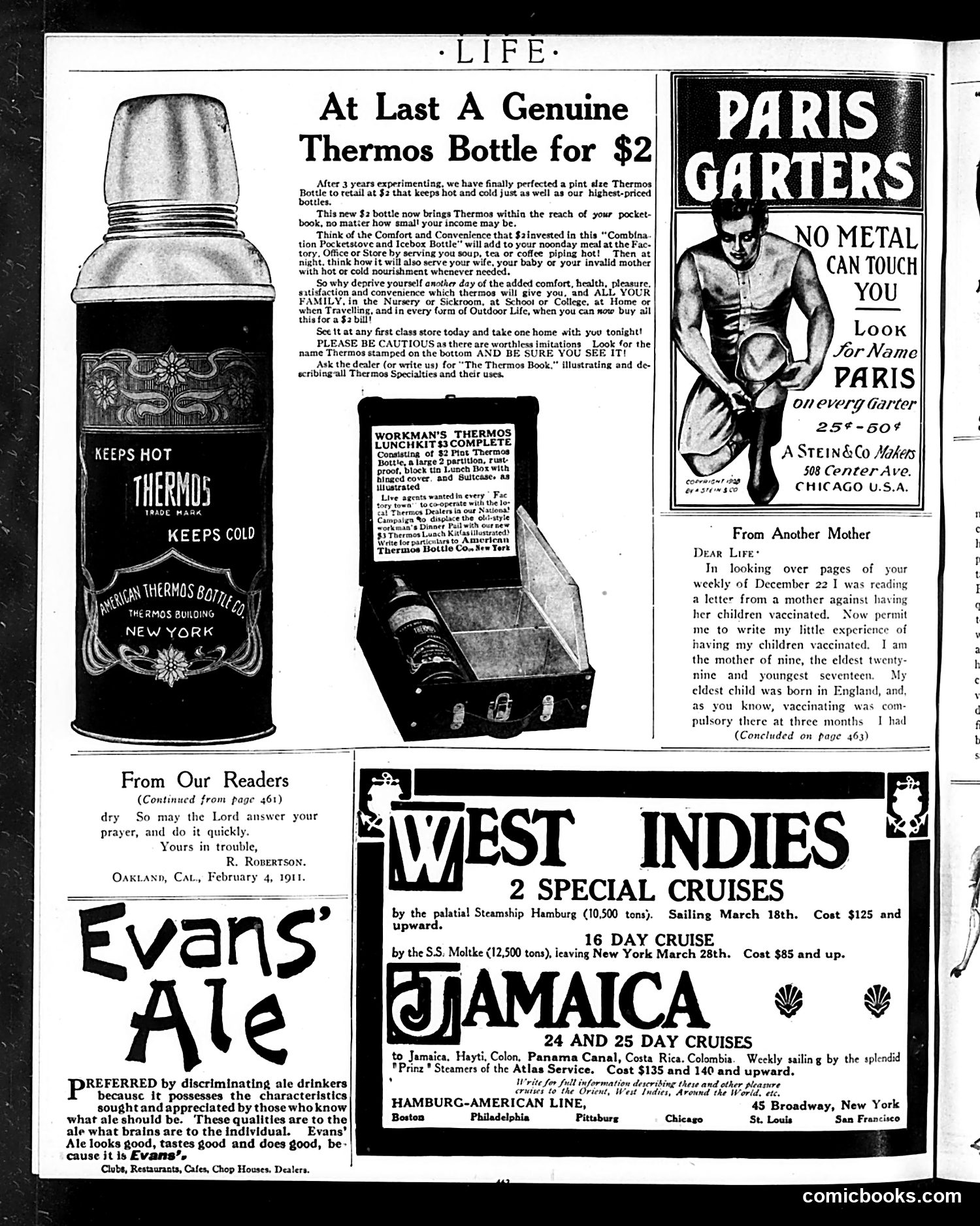
This page is primarily **advertisements and reader letters**, not editorial satire. The content includes: **Main Advertisement:** A Thermos bottle company promoting an affordable $2 pint-sized bottle, emphasizing its utility for workers, families, and invalids. The copy stresses accessibility and practicality. **Side Advertisements:** Paris Garters (hosiery), Evans' Ale, and cruise lines (West Indies, Jamaica). **Reader Letters:** Two letters to Life's editor—one from a troubled reader in Oakland seeking prayer, and a longer piece from a mother defending vaccination against a previous anti-vaccination letter published in Life's December 22 issue. **Historical Context:** The vaccination letter is notable as it reflects early-1900s public debate over mandatory childhood vaccination, a contentious issue then. The mother's support for vaccination (compulsory in England) was apparently responding to anti-vaccine sentiment Life had recently published. This appears to be a regular magazine page blending commerce with reader correspondence, typical of Life's format during this era.
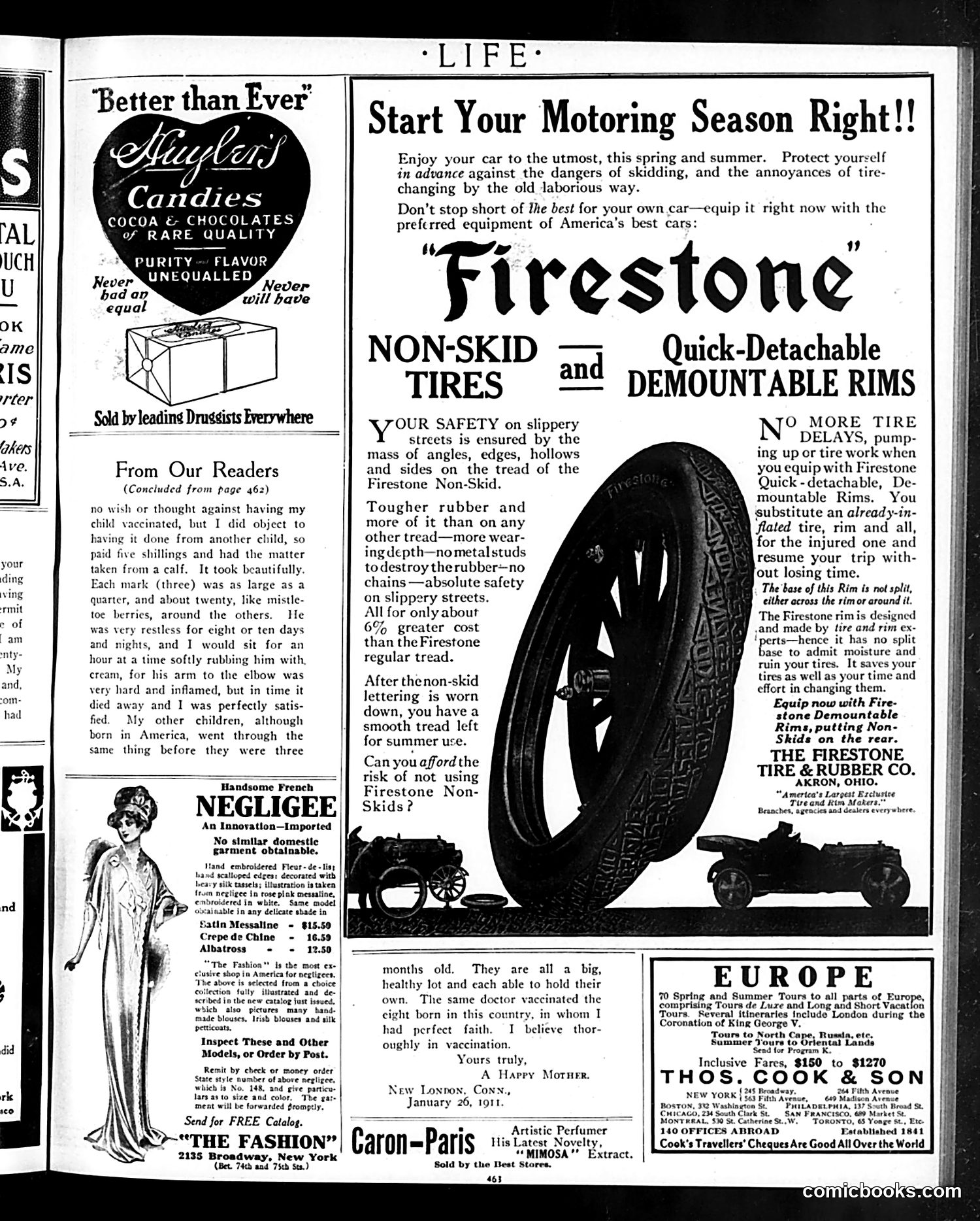
This page is primarily **advertising**, not political satire. It contains four commercial ads: 1. **Suydam's Candies** — a chocolate brand marketed for quality 2. **A French negligee** from "The Fashion" shop — an imported women's garment 3. **Firestone Non-Skid Tires** — the main advertisement, emphasizing automobile safety 4. **Caron-Paris perfume** — a luxury fragrance The only non-advertisement content is a reader's letter about **childhood vaccination**. A mother describes having her child vaccinated using matter from a calf rather than another child, detailing the inflammation and recovery. This reflects early-20th-century vaccination practices and parental concerns about disease transmission. The Firestone ad is notable for addressing contemporary anxieties about automobile safety—specifically skidding on wet streets—a genuine hazard of early motoring. The "demountable rims" represent technological innovation allowing quick tire changes. Overall, this is a typical Life magazine page from 1911 showcasing consumer products and reader correspondence.
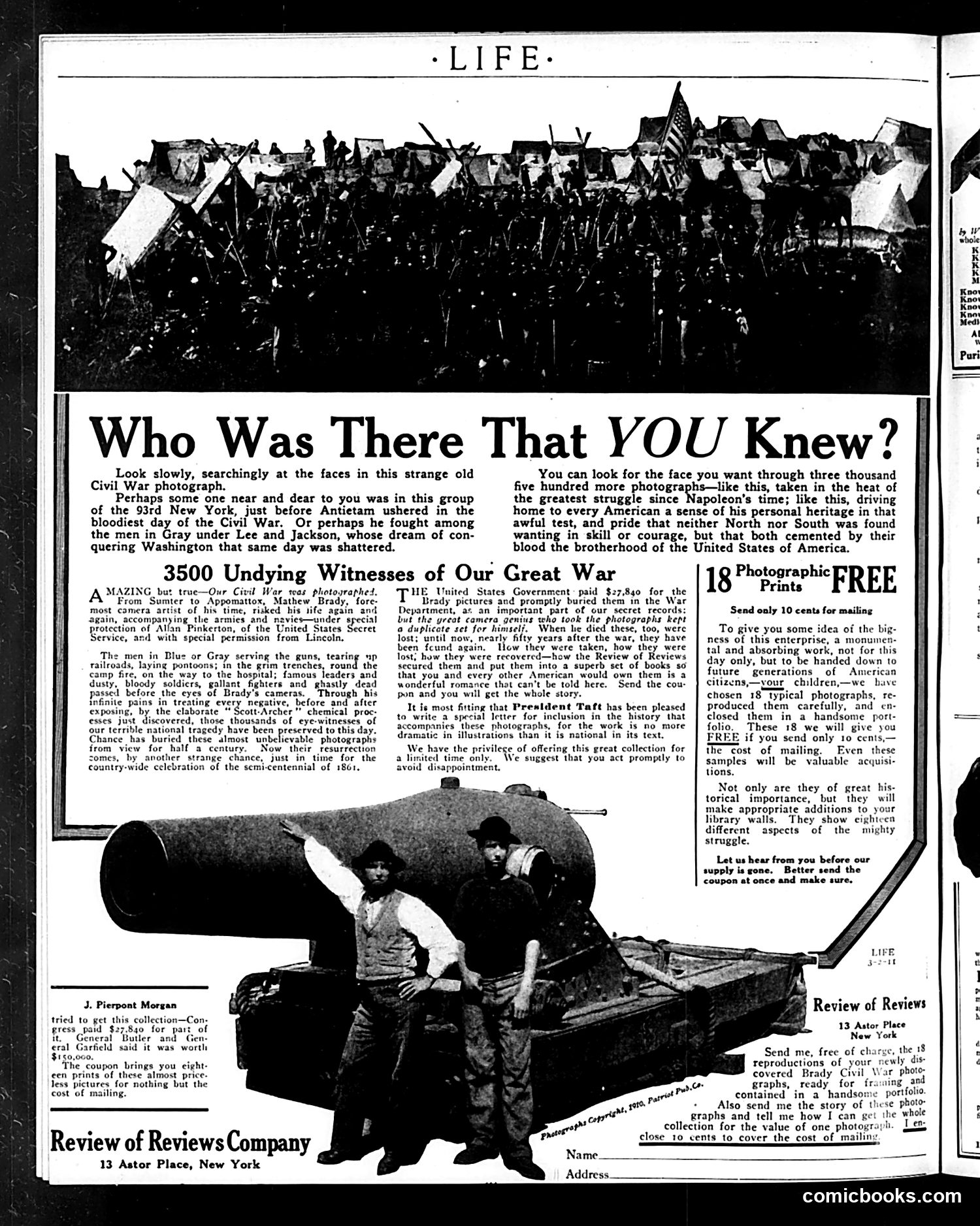
This is primarily an **advertisement for Civil War photographs**, not a satirical cartoon. The page promotes a collection of approximately 3,500 Civil War photographs taken by Mathew Brady, the famous documentary photographer who traveled with Union and Confederate armies during the 1861-1865 conflict. **Key content:** - Brady photographed major battles and figures (Lee, Jackson, Lincoln's protection) - The original prints were buried by the U.S. Government; Brady kept duplicates that were "lost" for 50 years then rediscovered - The Review of Reviews company is offering 18 sample photographs for 10 cents (mailing cost) - President Taft endorsed the project with a letter - The pitch appeals to American patriotism and family heritage—suggesting readers might recognize ancestors in the photos **The appeal:** This was marketed during the Civil War's 50th anniversary (around 1911) as both a historical document and personal connection to America's "great struggle," emphasizing that North and South were united by shared sacrifice.
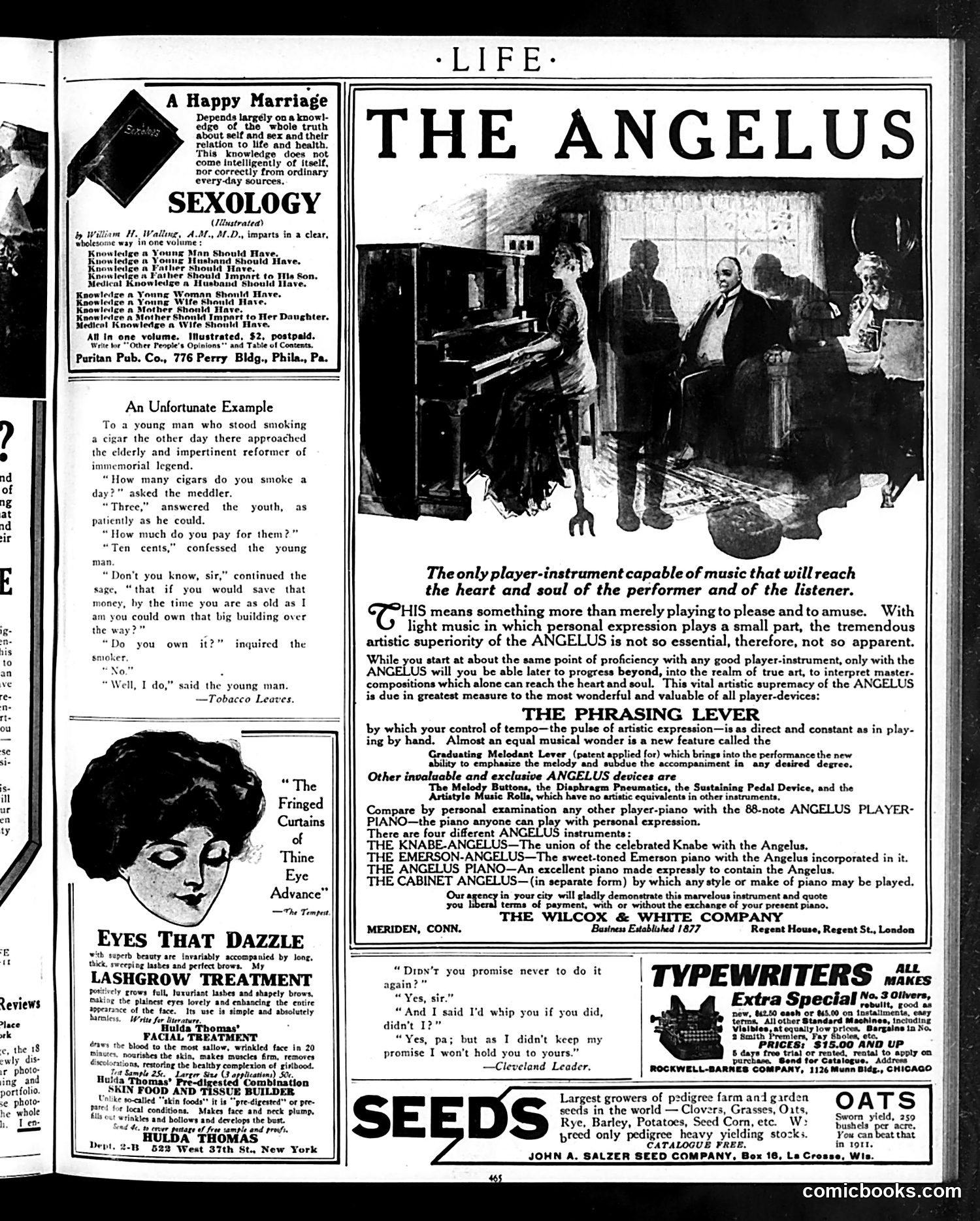
This page is primarily **advertisements and advice columns**, not political satire. The main content includes: 1. **"A Happy Marriage"** (left): An ad for a sex education book by Dr. William H. Walling, reflecting early 20th-century concerns about marital knowledge and health. 2. **"An Unfortunate Example"** (left): A brief morality tale where a young man dismisses an elderly reformer's advice about saving money from cigars—a common "wasteful youth" trope of the era, mocking both the self-righteous busybody and the spendthrift. 3. **"The Angelus"** (center/right): A substantial advertisement for player pianos, emphasizing artistic expression and the "Phrasing Lever" innovation—marketing these instruments to aspirational middle-class homes. 4. **Additional ads** (right): For typewriters, seeds, and beauty treatments. There is **no political cartoon** here. The page reflects period concerns about morality, self-improvement, consumerism, and the piano as a symbol of refined domesticity.
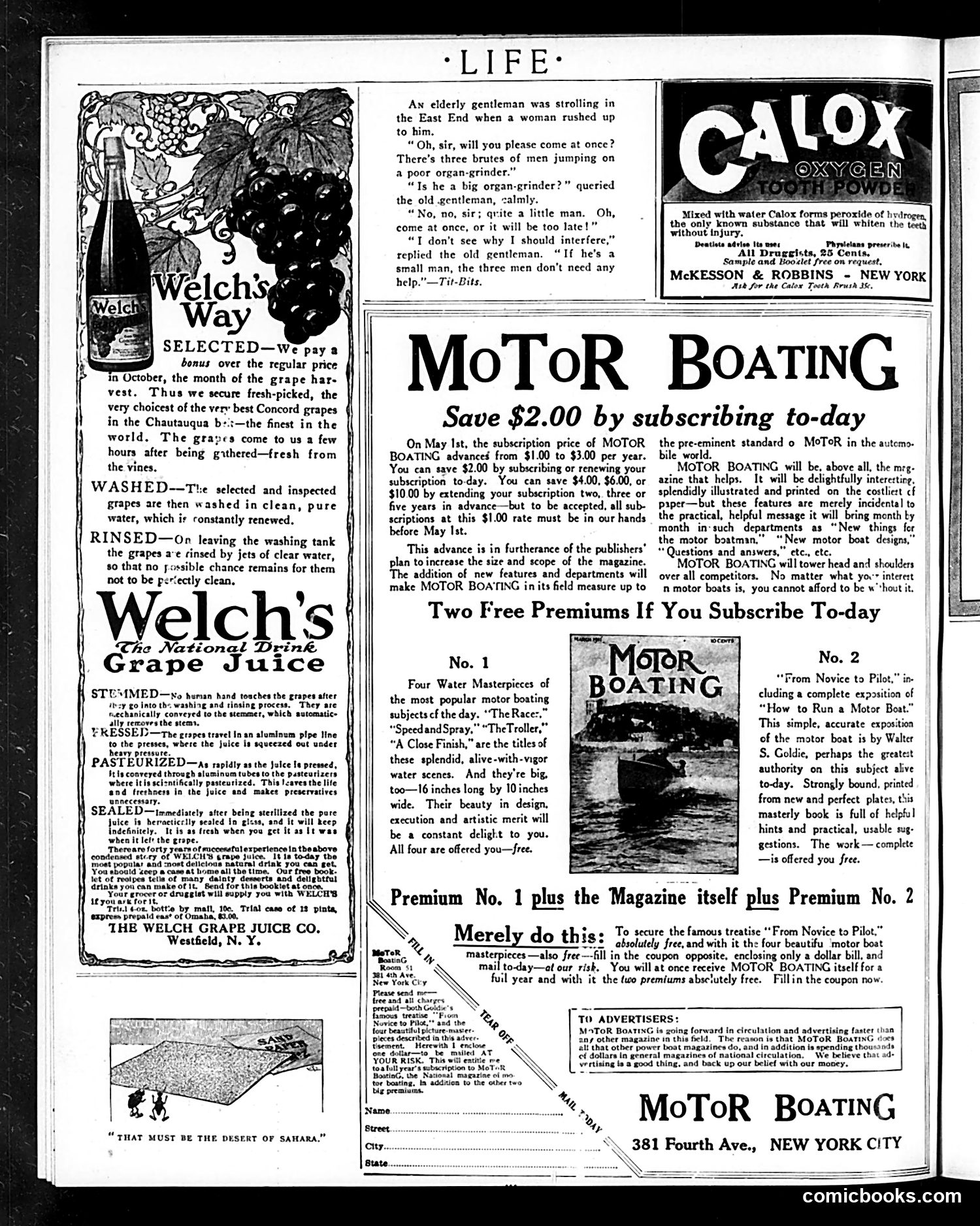
This page is primarily **advertising**, not political satire. It contains three major advertisements: 1. **Welch's Grape Juice** (left): Details the production process emphasizing cleanliness and quality control—a marketing appeal to early 20th-century consumers concerned about food safety and purity. 2. **Calox Tooth Powder** (top right): Advertises a teeth-whitening product using hydrogen peroxide, endorsed by dentists. 3. **Motor Boating Magazine** (center/right): A subscription offer with a price increase announcement, offering free premiums to encourage advance subscriptions. The small **cartoon anecdote** (top center) is a humorous British joke from *Tit-Bits* magazine about an elderly gentleman's unflappable logic when asked to help someone being attacked—he reasons that if the victim is small and outnumbered three-to-one, the attackers don't need his assistance. It's gentle humor, not satire. The page reflects period concerns: food safety, dental hygiene, and recreational boating culture.
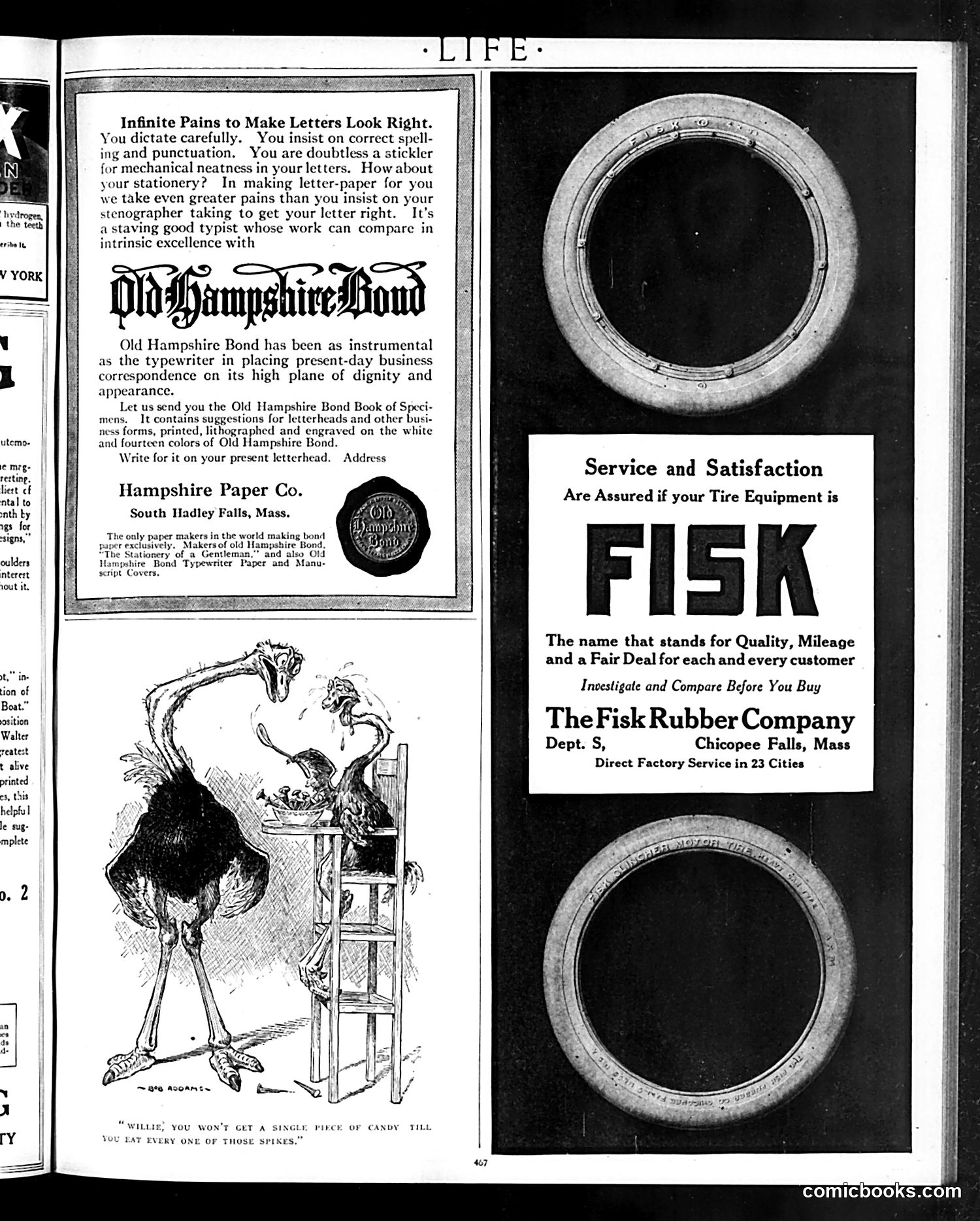
This is primarily an **advertising page** rather than editorial content. It contains three advertisements: 1. **Hampshire Paper Co.** (top left): Promotes high-quality bond paper for business correspondence, emphasizing the care taken in stationery production to match the care writers take in their letters. 2. **Cartoon** (bottom left): A humorous illustration showing a thin, spiky-haired child being threatened by an adult with the caption about not getting candy until eating "spikes." This appears to be a visual joke about a difficult child—likely referencing a contemporary figure or type—though the specific reference is unclear without more context. 3. **Fisk Rubber Company** (right side): Tire advertisement emphasizing quality, mileage, and fair dealing, with two tire photographs as product displays. The page reflects early 20th-century advertising conventions, mixing product pitches with light humor. The cartoon's specific satirical target isn't identifiable from the image alone.
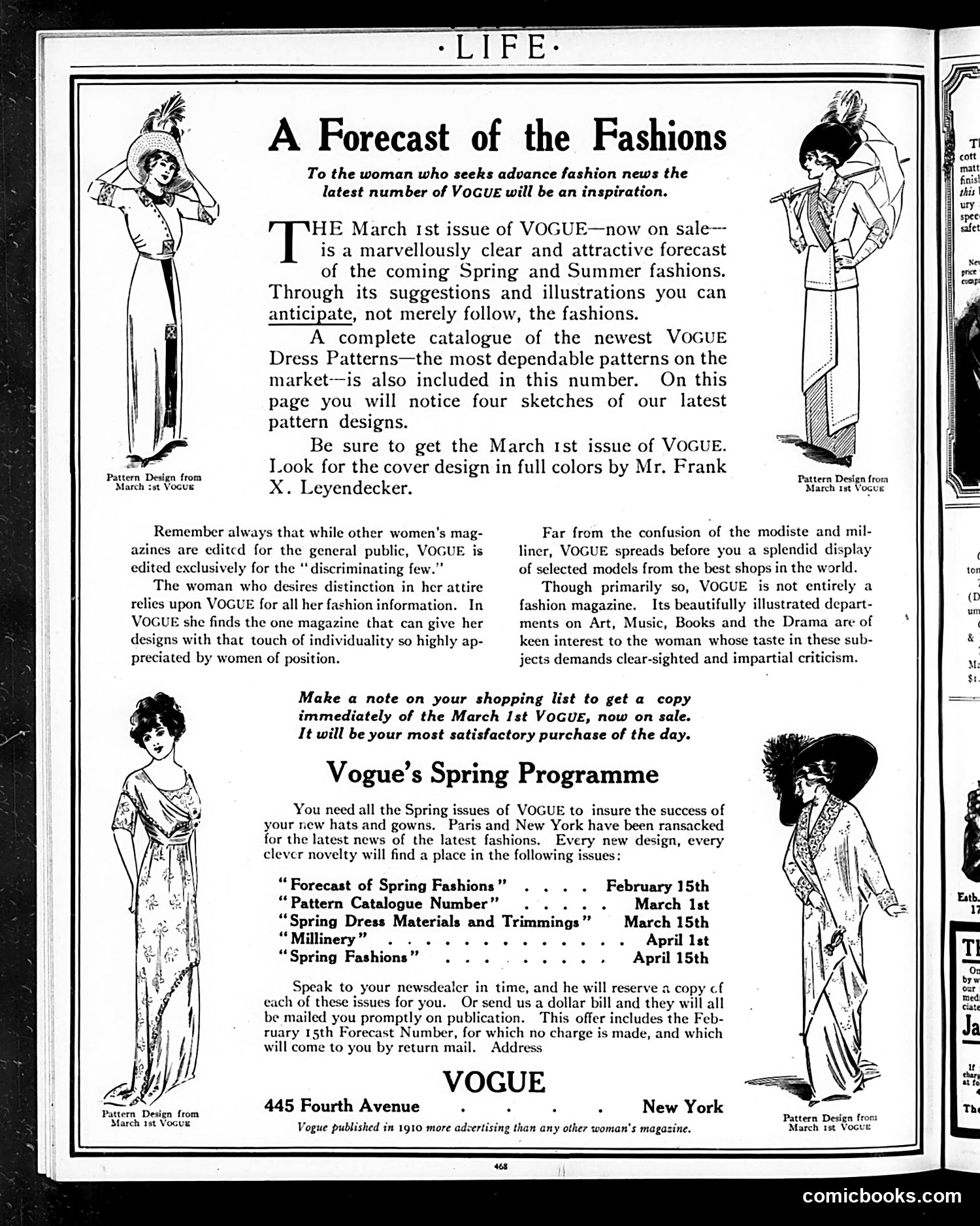
This is **not a cartoon or satire**—it's a straightforward advertisement for *Vogue* magazine's spring fashion issues, placed in *Life* magazine (circa 1910). The page promotes *Vogue*'s March 1st issue as essential for fashionable women seeking advance knowledge of coming trends. Four fashion sketches illustrate the latest dress patterns available through *Vogue*. The pitch emphasizes *Vogue*'s exclusivity: it's edited for "discriminating" women of "position," not the general public. The magazine offers not just fashion but also cultural content (art, music, drama criticism), positioning it as sophisticated and authoritative. A secondary pitch encourages readers to subscribe to the full spring series (February–April issues), promising Paris and New York fashion intelligence. The final line boasts that *Vogue* published more advertising than any competitor—a selling point to readers wanting comprehensive shopping information.
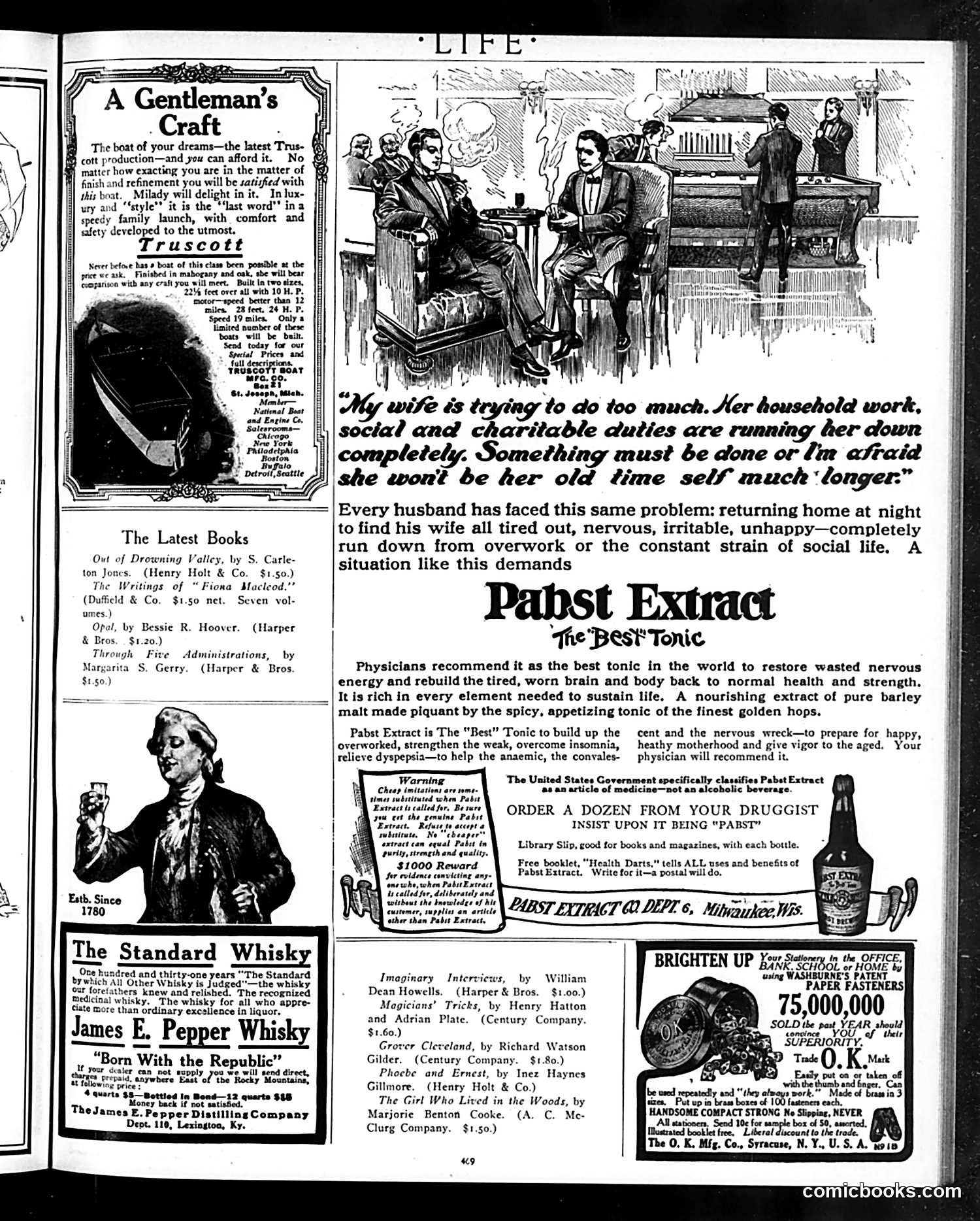
This page mixes boat advertising with a domestic advice scenario and patent medicine promotion. **The Main Cartoon/Scenario:** The illustrated scene shows a husband complaining that his wife is exhausted from household work plus "social and charitable duties." The quote frames this as a widespread problem husbands face: wives returning home "tired out, nervous, irritable, unhappy—completely run down." **The "Solution":** Pabst Extract—a patent medicine marketed as a tonic—is presented as the remedy. The ad claims it "restores wasted nervous energy" and rebuilds "the tired, worn brain and body." Notably, the government classified it as medicine, not alcohol, though it's a barley-malt extract. **Context for Modern Readers:** This reflects early 1900s attitudes: women's fatigue from dual responsibilities (domestic and social) was normalized as a medical problem requiring treatment rather than reduced expectations. The advertisement exploits gender anxiety, implying wives needed pharmaceutical intervention rather than relief from overwork. The "tonic" solution was common-era pseudomedicine targeting women's health complaints.
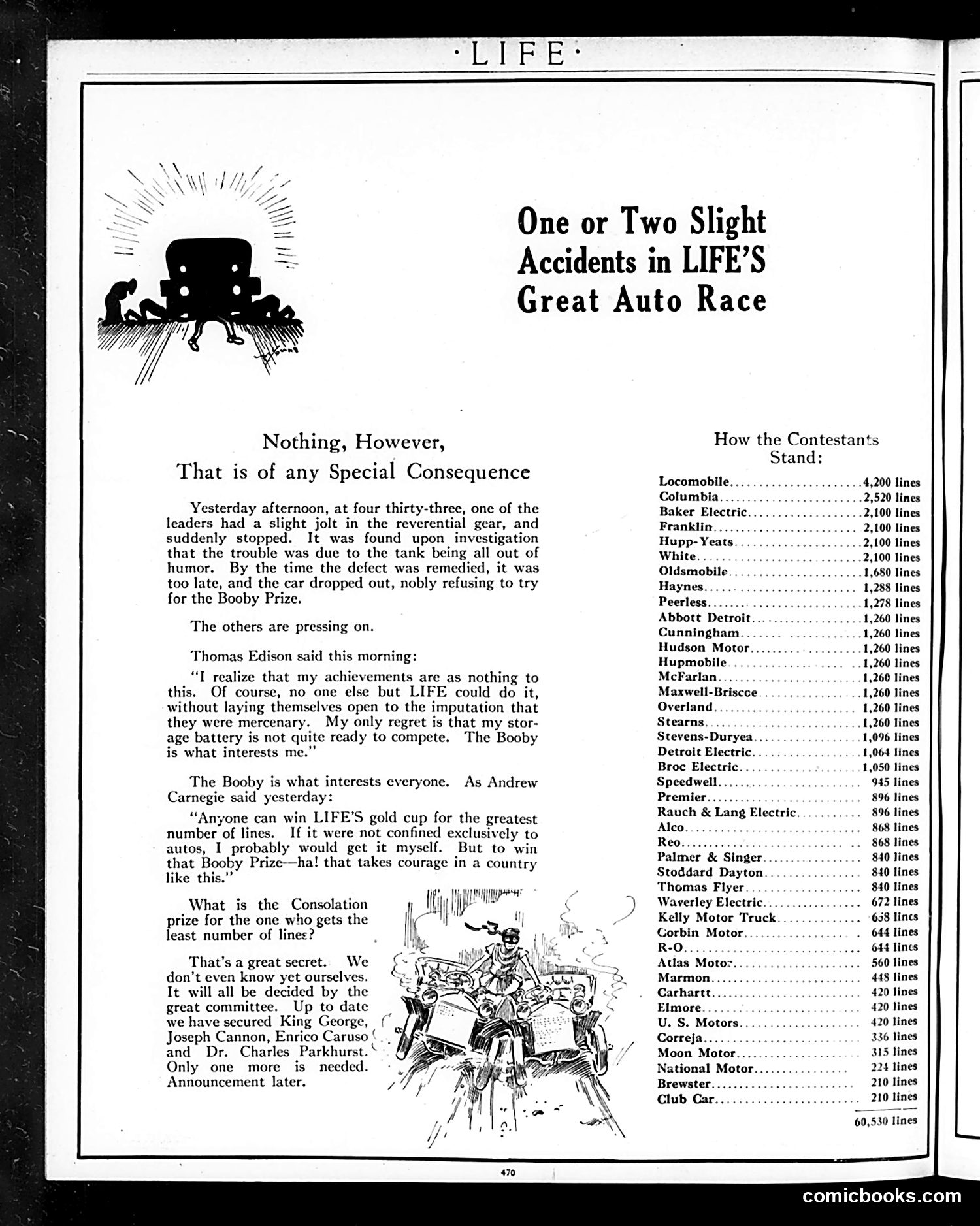
This page documents LIFE magazine's early 1900s promotional competition tracking automobile manufacturers by lines of printed advertising. The satire works on multiple levels: **The Joke:** LIFE mock-seriously reports on a "race" where winning means generating the *most* advertising copy—the opposite of prestige. A minor mechanical failure is treated as tragedy; the real prize everyone wants is the "Booby Prize" (for least lines). **The Celebrities:** Edison and Carnegie (quoted) express satirical "regret" they can't compete, playing along with the absurdity that advertising volume represents achievement. **The Point:** The page lampoons both corporate vanity and the advertising-driven media economy. By openly tallying how much ad space each company bought, LIFE highlights the commercialism underlying magazine publishing—treating it as comedy rather than business secret. The full contestant list (60,530 lines total) proves the satire's central claim: *this entire magazine issue is essentially an advertising competition disguised as editorial content.*
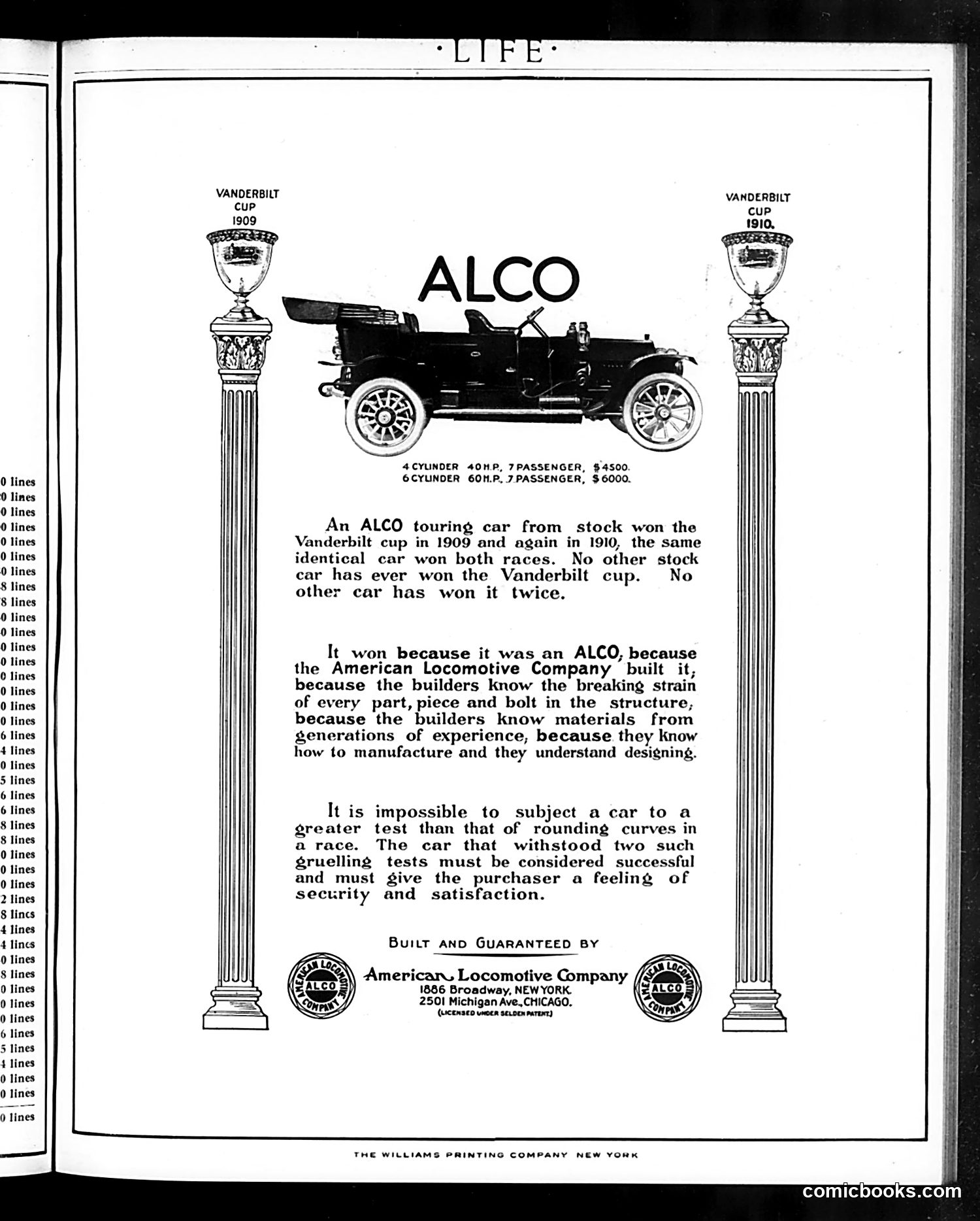
This is a full-page advertisement, not a cartoon or satire. It promotes ALCO (American Locomotive Company) automobiles by emphasizing their racing credentials. The ad features an illustration of a 1909-1910 era touring car flanked by images of the prestigious Vanderbilt Cup trophies. The key claim: an identical ALCO stock car won this major racing competition in both 1909 and 1910—unprecedented achievements that no other manufacturer matched. The advertisement argues that ALCO's racing success proves superior engineering and manufacturing quality. The text emphasizes that winning grueling races demonstrates reliability, giving potential buyers "security and satisfaction." For modern readers: this represents early automotive marketing strategy, using racing victories to validate quality claims to consumers. The Vanderbilt Cup was a genuine, prestigious motorsports event of the era, making this competitive achievement significant for establishing brand prestige in a nascent automobile industry.
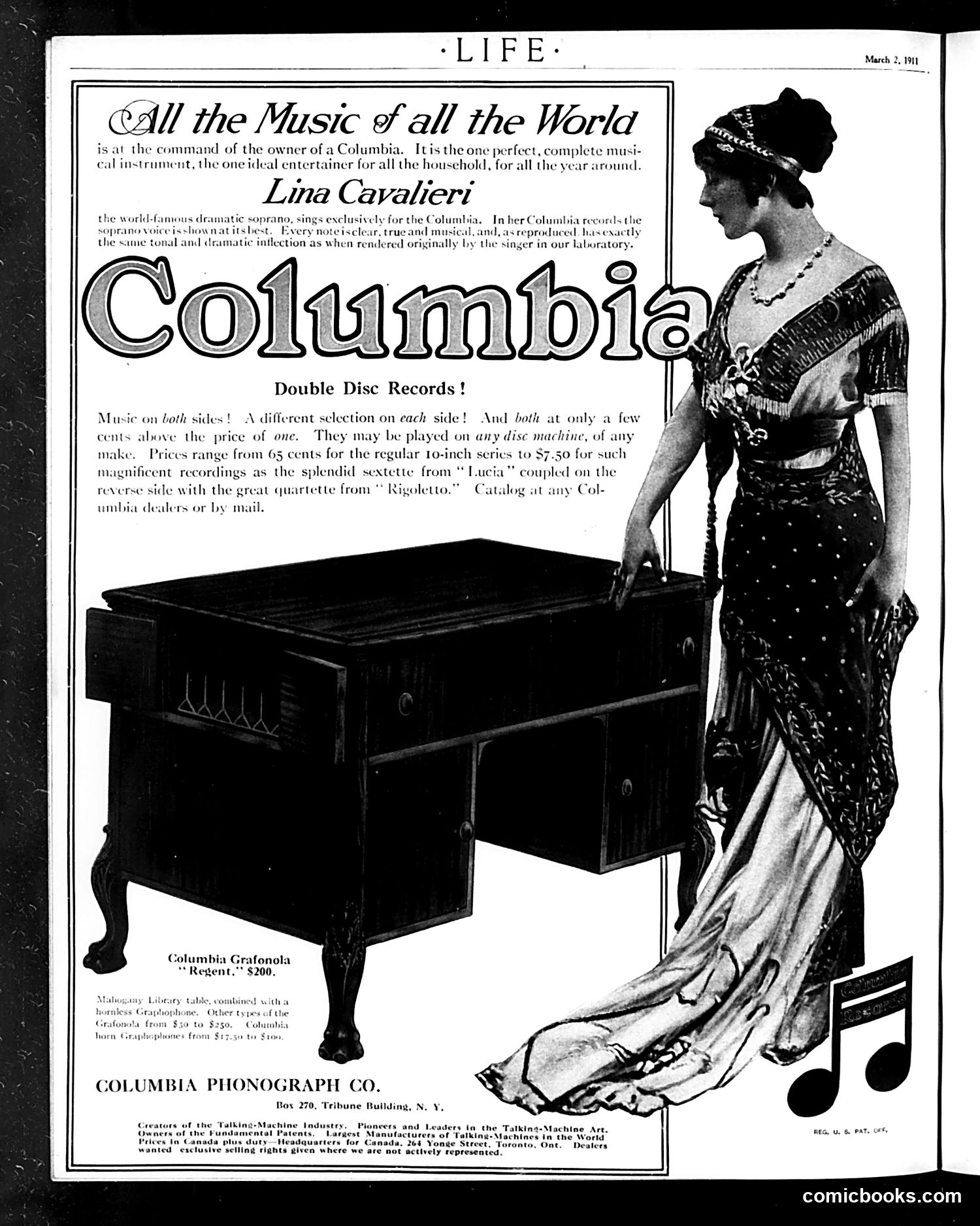
This is primarily a **product advertisement**, not a political cartoon. It promotes Columbia's Grafonola phonograph by featuring **Lina Cavalieri**, a world-famous Italian dramatic soprano of the era. The ad's appeal relies on celebrity endorsement—Cavalieri's exclusive recordings for Columbia supposedly capture her voice at its "best," with perfect fidelity. The messaging emphasizes the Grafonola as a luxury household item ("the one perfect, complete musical instrument") positioned for upper-class homes. The elegantly dressed woman in the illustration represents refined taste and entertainment. The "double disc records" feature—two different selections per record—is presented as a technical innovation justifying the premium price ($7.50 for deluxe recordings). This reflects early 20th-century consumer culture: using celebrity endorsements and technological superiority claims to market expensive entertainment technology to affluent households.