
Life, 1911-03-02 · page 30 of 52
Life — March 2, 1911 — page 30: what you’re looking at
What you’re looking at
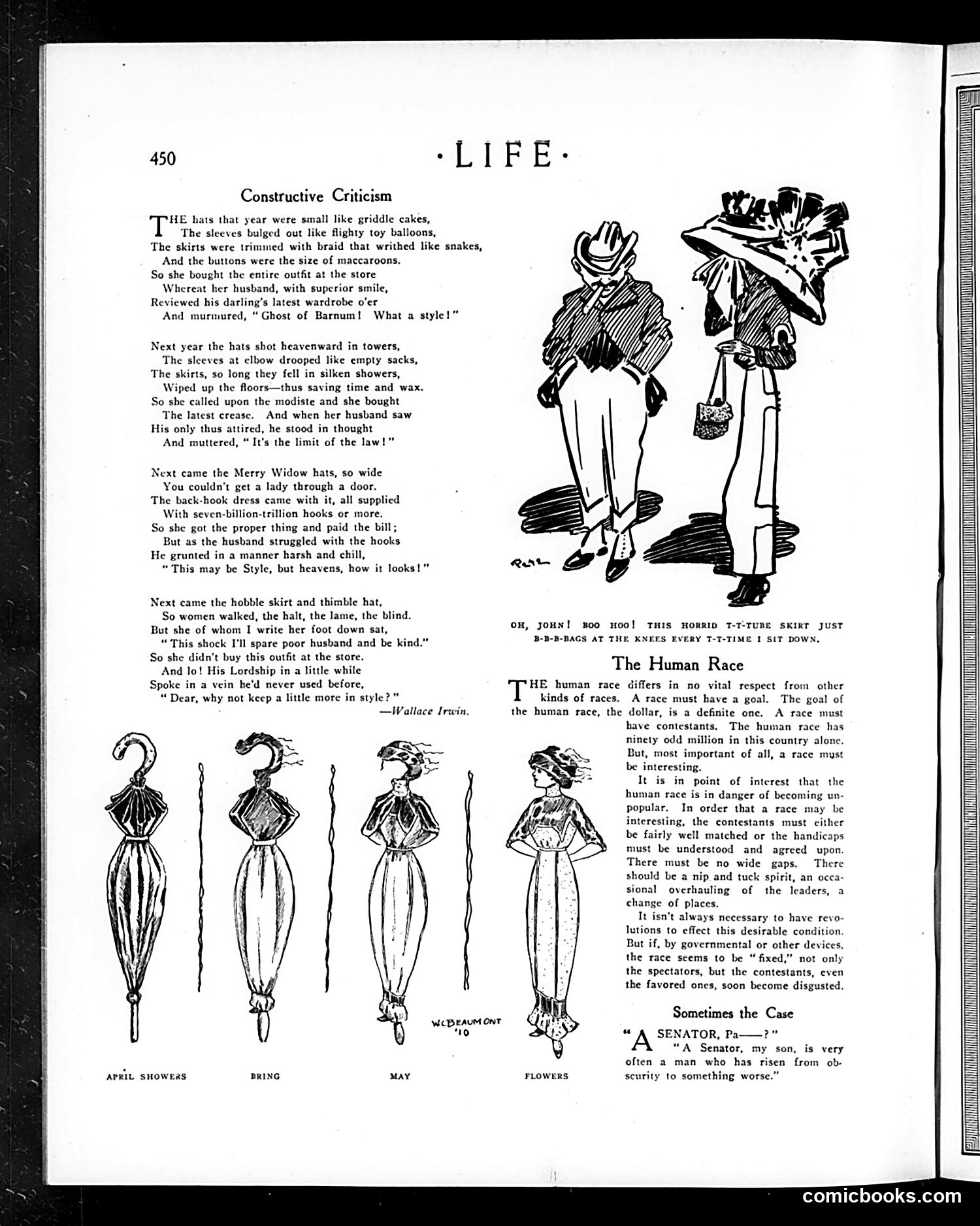
This page contains two distinct satirical pieces about early 1900s fashion and social commentary. **"Constructive Criticism"** (poem by Wallace Irwin with umbrella illustrations) mocks the husband-wife dynamic around women's rapidly changing fashions. Each year brings new absurd styles—griddle-cake hats, balloon sleeves, snake-like braids, then towering hats, drooping sleeves, and dangerously long skirts. The husband criticizes each outfit with exasperation, until his wife finally refuses to buy the ridiculous "hobble skirt" to spare him. Paradoxically, he then *demands* she keep up with fashion. The satire targets both women's fashion slavery and men's contradictory, impossible expectations. **"The Human Race"** (upper right) uses horse-racing metaphor to criticize American wealth inequality and "fixed" economic competition. For a race to be interesting, contestants must be evenly matched or handicaps understood—but when the system appears rigged (through governmental favoritism), even winners lose interest. **"Sometimes the Case"** (bottom) is a brief joke about senators rising "from obscurity to something worse"—political corruption satire.
📄 Transcribed text from this page (OCR, searchable)
Machine-transcribed from the original scan — historical spelling and the odd misread are preserved.
450 -LIFE- Constructive Criticism HE hats that year were small like griddle cakes, The sleeves bulged out like flighty toy balloons, The skirts were trimmed with braid that writhed like snakes, And the buttons were the size of macaroons. So she bought the entire outfit at the store Whereat her husband, with superior smile, Reviewed his darling’s latest wardrobe o'er And murmured, “Ghost of Barnum! What a style!” Next year the hats shot heavenward in towers, The sleeves at elbow drooped like empty sacks, The skirts, so long they fell in silken showers, Wiped up the floors—thus saving time and wax. So she called upon the modiste and she bought The latest crease. And when her husband saw His only thus attired, he stood in thought And muttered, “It’s the limit of the law!” Next came the Merry Widow hats, so wide You couldn't get a lady through a door. The back-hook dress came with it, all supplied With seven-billion-trillion hooks or more. So she got the proper thing and paid the bill; But as the husband struggled with the hooks He grunted in a manner harsh and chill, “This may be Style, but heavens, how it looks!" xt came the hobble skirt and thimble hat, So women walked, the halt, the lame, the blind. But she of whom I write her foot down sat, “This shock I'll spare poor husband and be kind.” So she didn’t buy this outfit at the store. And lo! His Lordship in a little while Spoke in a vein he'd never used before, “Dear, why not keep a little more in style —Wallace Irwin, 2” WCBEAUM ONT 4 ° APRIL SHOWERS on, JouN! noo noo! THIS HoRRID T-T-TUBE SKIRT JUST B-B-B-DAGS AT THE KNEES EVERY T-T-TIME I SIT DOWN. The Human Race HE human race differs in no vital respect from other kinds of races. A race must have a goal. The goal of the human race, the dollar, is a definite one. A race must have contestants. The human race has ninety odd million in this country alone. But, most important of all, a race myst be interesting. It is in point of interest that the human race is in danger of becoming un- popular, In order that a race may be interesting, the contestants must cither be fairly well matched or the handicaps must be understood and agreed upon. There must be no wide gaps. There should be a nip and tuck spirit, an occ: sional overhauling of the leaders, a change of places. Tt isn’t always necessary to have revo- lutions to effect this desirable condition. But if, by governmental or other devices, the race scems to be “ fixed,” not only the spectators, but the contestants, even the favored ones, soon become disgusted. Sometimes the Case “ SENATOR, Pa——?" “A Senator, my son, is very often a man who has risen from ob- FLOWERS scurity to something worse.” TT | AAA comicbooks.com