
Life, 1911-03-02 · page 24 of 52
Life — March 2, 1911 — page 24: what you’re looking at
What you’re looking at
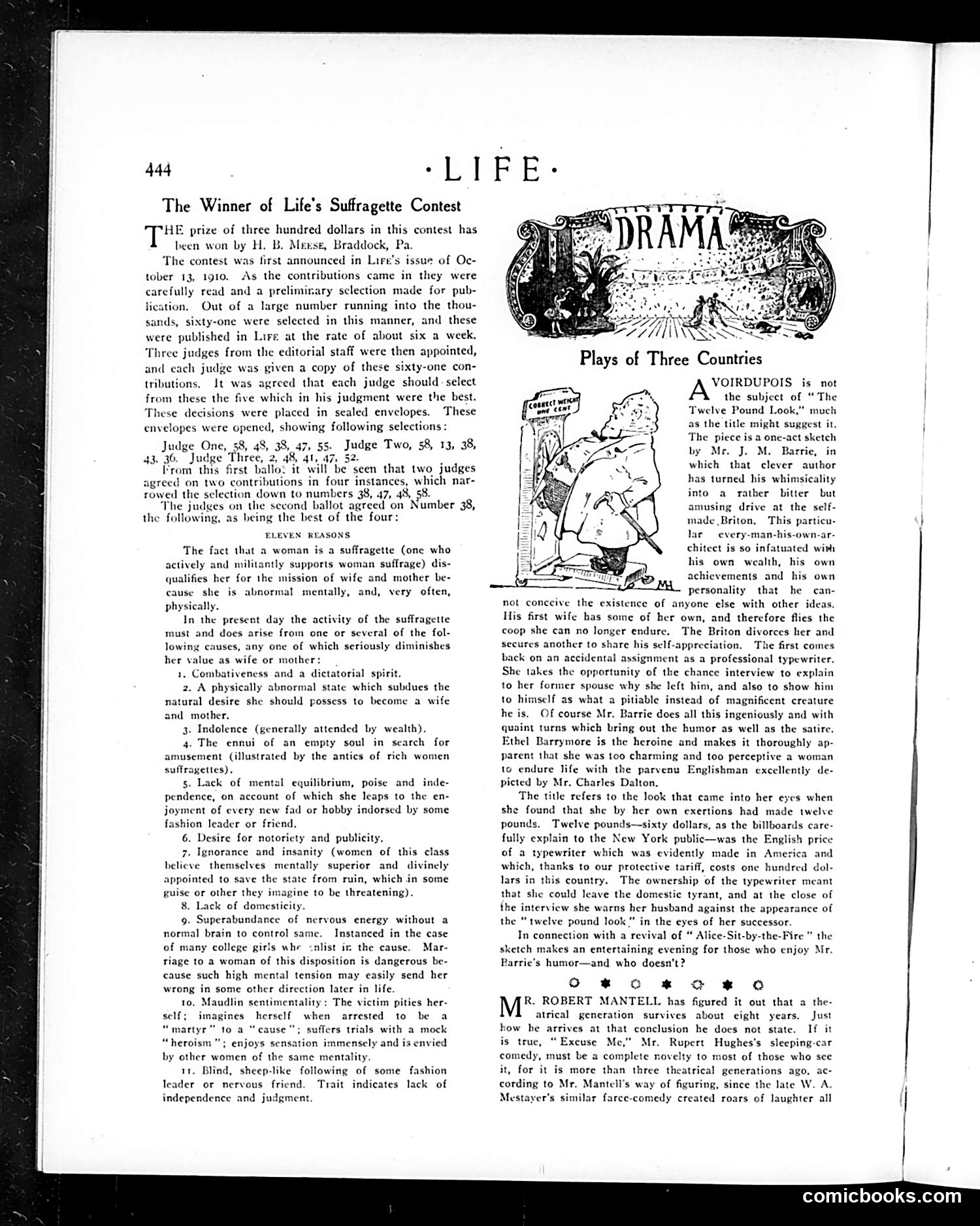
This page announces the winner of *Life* magazine's contest attacking women's suffrage. The winning entry lists "Eleven Reasons" why suffragettes are unfit as wives and mothers, claiming they are mentally abnormal, combative, physically defective, or driven by vanity and notoriety-seeking. The satire operates inversely: *Life*, a satirical publication, is publishing what appears to be genuine anti-suffrage arguments to mock their absurdity. The elaborate pseudo-scientific reasoning—attributing suffragism to nervous disorders, lack of domesticity, and "maudlin sentimentality"—exposes the era's irrational opposition to women's voting rights. The page also reviews theatrical works, including a J.M. Barrie play about a self-made British man so absorbed in his own achievements he cannot recognize his wife's independent thinking. This thematic pairing strengthens the page's critique of male-centered worldviews. Published around 1910, this reflects the heated debate preceding women's suffrage victories.
📄 Transcribed text from this page (OCR, searchable)
Machine-transcribed from the original scan — historical spelling and the odd misread are preserved.
4a -LIFE: The Winner of Life's Suffragette Contest HE prize of three hundred dollars in this contest has £, Braddock, Pa been won by H. B. M The contest was first announced in Lire’s issue of Oc- tober 13, 1910. As the contributions came in they were carefully read and a preliminary sclection made for pub- lication. Out of a large number running into the thou- sands, sixty-one were selected in this manner, and these were published in Lire at the rate of about six a week. Three judges from the editorial staff were then appointed, and each judge was given a copy of these sixty-one con- tributions, It was agreed that each judge should. select from these the five which in his judgment were the best. These decisions were placed in sealed envelopes. These envelopes were opened, showing following selections : Judge One, 58, 48, 38, 47, 55. Judge Two, 58 13, 38, 43. 36. Judge Three, 2, 48 41, 47, 52. From this first ballot it will be seen that two judges agreed on two contributions in four instances, which nar- rowed the selection down to numbers 38, 47, 48, 58. ‘The judges on the second ballot agreed on Number 38, the following, as being the best of the four: ELEVEN REASONS The fact that a woman is a suffragette (one who actively and militantly supports woman suffrage) dis- qualifies her for the mission of wife and mother be- cause she is abnormal mentally, and, very often, physically. In the present day the activity of the suffragette must and does arise from one or several of the fol- lowing causes, any one of which seriously diminishes her value as wife or mother: 1. Combativeness and a dictatorial spirit. 2. A physically abnormal state which subdues the natural desire she should possess to become a wife and mother, 3. Indolence (generally attended by wealth). 4. The ennui of an empty soul in search for amusement (illustrated by the antics of rich women suffragettes). s. Lack of mental equilibrium, poise and inde- pendence, on account of which she leaps to the en- joyment of every new fad or hobby indorsed by some fashion leader or friend, 6. Desire for notoriety and publicity, 7. Ignorance and insanity (women of this class believe themselves mentally superior and divinely appointed to save the state from ruin, which in some aise or other they imagine to be threatening). 8. Lack of domesticity. 9. Superabundance of nervous energy without a normal brain to control same. Instanced in the case of many college girls whe <nlist in the cause. Mar- riage to a woman of this disposition is dangerous be- cause such high mental tension may easily send her wrong in some other direction later in life. 10. Maudlin sentimentality : The victim pities her- self; imagines herself when arrested to be a “martyr” to a “cause”; suffers trials with a mock “heroism”; enjoys sensation immensely envied by other women of the same mentality 11, Blind, sheep-like following of some fashion leader or nervous friend. Trait indicates lack of independence and judgment. p Nabetiee iets is not the subject of “The Twelve Pound Look,” much as the title might suggest it. The ce is a one-act sketch by Mr. J. M. Barrie, in which that clever author has turned his whimsicality into a rather bitter but amusing drive at the self- made Briton. This particu- lar ever, chitect is so infatuated his own wealth, hi: achievements and his own -— MA personality that he can- not conceive the existence of anyone else with other ideas. His first wife has some of her own, and therefore flies the coop she can no longer endure. The Briton divorces her and secures another to share his self-appreciation. The first comes back on an accidental assignment as a professional typewriter. She takes the opportunity of the chance interview to explai to her former spouse why she left him, and also to show him to himself as what a pitiable instead of magnificent creature he is. Of course Mr. Barrie does all this ingeniously and with quaint turns which bring out the humor as well as the satire. Ethel Barrymore is the heroine and makes it thoroughly ap- parent that she was too charming and too perceptive a woman to endure life with the parvenu Englishman excellently de- picted by Mr. Charles Dalton, The title refers to the look that came into her eyes when she found that she by her own exertions had made twelve pounds. Twelve pounds—sixty dollars, as the billboards fully explain to the New York public—was the English price of a typewriter which was evidently made in America and which, thanks to our protective tariff, costs one hundred dol- lars in this country. The ownership of the typewriter meant that she could leave the domestic tyrant, and at the close of {he interview she warns her husband against the appearance of the “twelve pound look” in the eyes of her successor. In connection with a revival of “ Alice-Sit-by-the-Fire ” the sketch makes an entertaining evening for those who enjoy \ Barrie’s humor—and who doesn't? o *# © * O29 * 0 R. ROBERT MANTELL has figured it out that a the- atrical generation survives about eight years, Just how he arrives at that conclusion he docs not state. If it is true, “Excuse Me,” Mr. Rupert Hughes's sleeping-car comedy, must be a complete novelty to most of those who sce it, for it is more than three theatrical generations ago, ac- cording to Mr. Mantell’s way of figuring, since the late W. A. Mestayer’s similar farce-comedy created roars of laughter all man-his-own-ar- own are comicbooks.com