
Life, 1911-03-02 · page 32 of 52
Life — March 2, 1911 — page 32: what you’re looking at
What you’re looking at
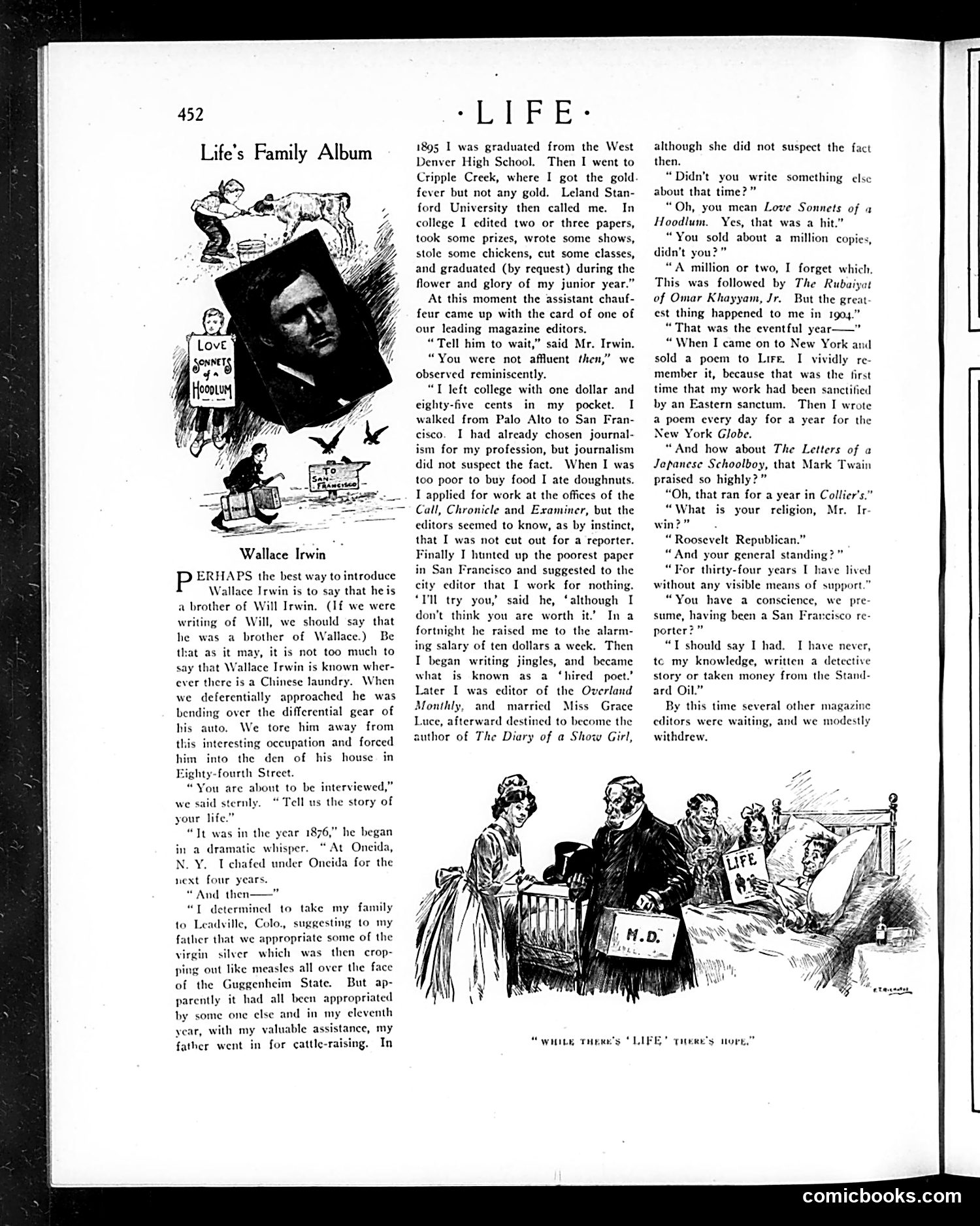
This is a biographical interview with writer Wallace Irwin, presented as satirical humor. The cartoon shows Irwin as a successful but irreverent author who built a career through unconventional means—starting impoverished, working for newspapers, and becoming known for humorous writing including *Love Sonnets of a Hoodlum* and *The Letters of a Japanese Schoolboy*. The satire targets his bohemian lifestyle and tongue-in-cheek self-presentation. He claims to have lived "thirty-four years without any visible means of support" while achieving literary success, sold "a million or two" copies of a book, and identifies as a "Roosevelt Republican"—likely referencing Theodore Roosevelt's Progressive politics. The bottom cartoon's caption—"While there's 'Life' there's hope"—is a pun on the magazine's name, suggesting that Irwin's improbable success exemplifies American opportunity and satirizing the self-made literary figure.
📄 Transcribed text from this page (OCR, searchable)
Machine-transcribed from the original scan — historical spelling and the odd misread are preserved.
452 Life’s Family Album Wallace Irwin ERHAPS the best way to introduce Wallace Irwin is to say that he is a brother of Will Irwin. (If we were writing of Will, we should say that he was a brother of Wallace.) Be tas it may, it is not too much to say that Wallace Irwin is known wher- ever there is a Chinese laundry. When we deferentially approached he was bending over the differential gear of his auto. We tore him away from this interesting occupation and forced him into the den of his house in Fighty-fourth Street. “You are about to be interviewed,” we said sternly. “Tell us the story of your lif “Tt was in the year 1876," he began in a dramatic whisper. “At Oneida, N.Y. I chafed under Oneida for the next four years. “And then—” “T determined to take my family to Leadville, Colo., suggesting to my father that we appropriate some of the virgin silver which was then crop- ping out like measles all over the face of the Guggenheim State. But ap- parently it had all been appropriated by some one else and in my eleventh , with my valuable assistance, my father went in for cattle-raising. In “EE = 1895 1 was graduated from the West Denver High School. Then I went to Cripple Creek, where I got the gold fever but not any gold. Leland Stan- ford University then called me. In college I edited two or three papers, took some prizes, wrote some shows, stole some chickens, cut some classes, and graduated (by request) during the flower and glory of my junior year.” At this moment the assistant chauf- feur came up with the card of one of our leading magazine editors. “Tell him to wait,” said Mr. Irwin. “You were not affluent then,” we observed reminiscently, “T left college with one dollar and eighty-five cents in my pocket. I walked from Palo Alto to San Fran- cisco. I had already chosen journal- ism for my profession, but journalism did not suspect the fact. When I was too poor to buy food I ate doughnuts. I applied for work at the offices of the Call, Chronicle and Examiner, but the editors seemed to know, as by instinct, that I was not cut out for a reporter. Finally I hunted up the poorest paper in San Francisco and suggested to the city editor that I work for nothing. ‘I'l try you,’ said he, ‘although I don't think you are worth it’ In a fortnight he raised me to the alarm- ing salary of ten dollars a week. Then I began writing jingles, and became what is known as a ‘hired poet.’ Later I was editor of the Overland Monthly, and married Miss Grace Luce, afterward destined to become the author of The Diary of a Show Girl, “whitg tTHexe’s ‘LIFE? although she did not suspect the fact then. “Didn't you write something else about that time?” “Oh, you mean Love Sonnets of a Hoodlum. Yes, that was a hit.” “You sold about a million copies, didn’t you? “A million or two, I forget which, This was followed by The Rubaiyat of Omar Khayyam, Jr. But the great est thing happened to me in 1904.” “That was the eventful year—' “When I came on to New York ar sold a poem to Lire. I vividly re- member it, because that was the first time that my work had been sanctified by an Eastern sanctum. Then I wrote a poem every day for a year for the New York Globe. “And how about The Letters of a Japanese Schoolboy, that Mark Twain praised so highly?” “Oh, that ran for a year in Collier's. “What is your religion, Mr. Ir win?” ‘ “Roosevelt Republican.” “And your general standing?” “For thirty-four years I have lived without any visible means of support.” “You have a conscience, we pre- sume, having been a San Francisco re- porter?” “T should say I had. I have never, te my knowledge, written a detective story or taken money from the Stand- ard Oil.” By this time several other magazine editors were waiting, and we modestly withdrew. i SN ‘aS THeRe’s Hore,” comicbooks.com