
Life, 1911-03-02 · page 25 of 52
Life — March 2, 1911 — page 25: what you’re looking at
What you’re looking at
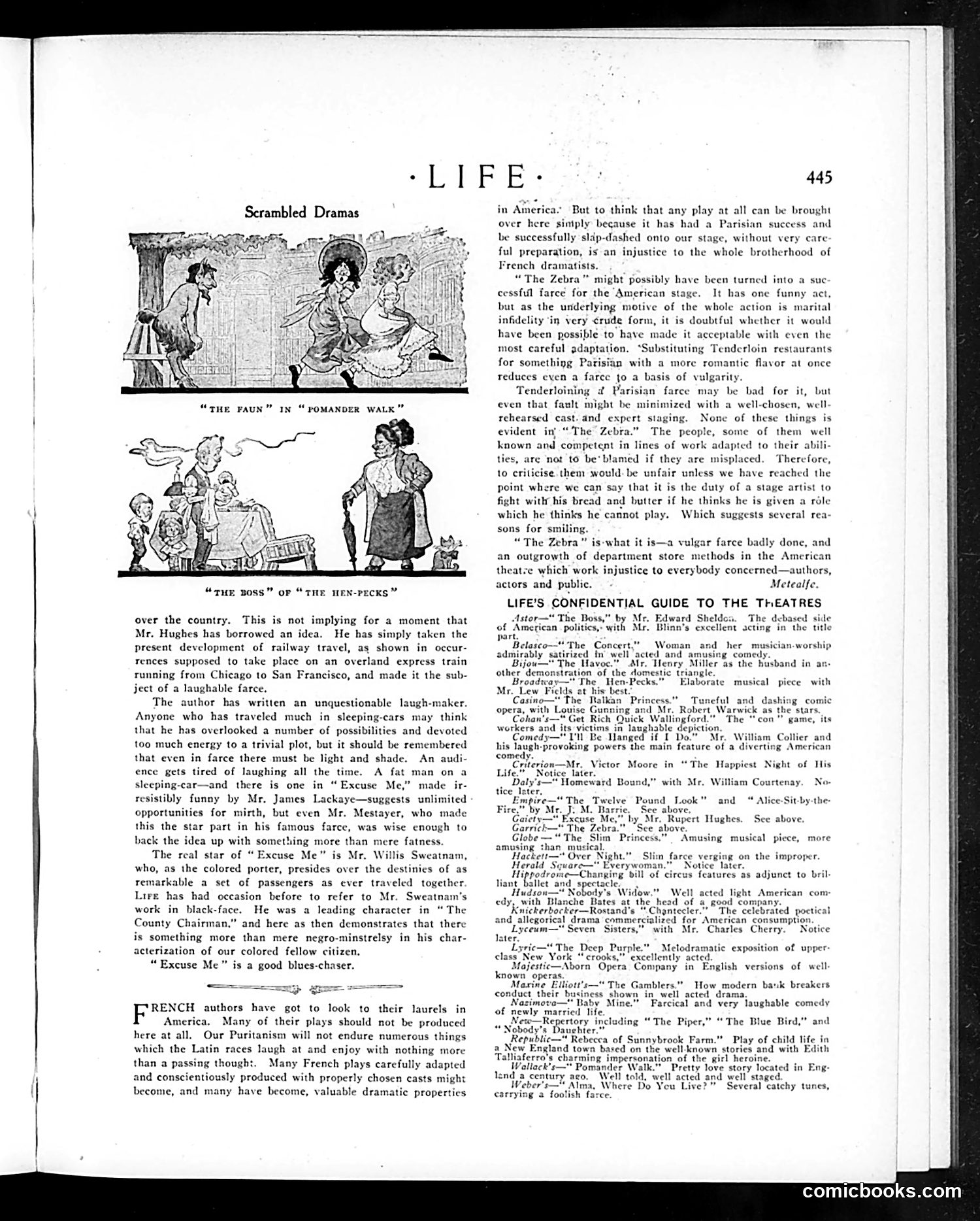
This page reviews contemporary theatrical productions, focusing on American farces adapted from French plays. The two cartoon sketches illustrate scenes from stage productions—"The Faun in Pomander Walk" (top) and "The Boss" or "The Hen-Pecks" (bottom)—showing typical comedic scenarios of the era. The main critique targets the indiscriminate importation of French plays to America. The reviewer argues that simply because a play succeeds in Paris doesn't mean it will work on American stages, which have stricter moral standards regarding marital infidelity and sexual content. The review specifically condemns "The Zebra," a French farce deemed too vulgar and poorly adapted for American audiences, and criticizes theater management for careless casting and staging. The text praises Willis Sweatnam's portrayal of a sleeping-car porter in "Excuse Me," noting his talent transcends typical minstrel stereotypes—reflecting early 20th-century attitudes toward Black performers.
📄 Transcribed text from this page (OCR, searchable)
Machine-transcribed from the original scan — historical spelling and the odd misread are preserved.
Scrambled Dramas “Tue Boss” oF “THE 1EN-PECKS” over the country. This is not implying for a moment that Mr. Hughes has borrowed an idea. He has simply taken the present development of railway travel, as shown in occur- rences supposed to take place on an overland express train running from Chicago to San Francisco, and made it the sub- ject of a laughable farce. The author has written an unquestionable laugh-maker. Anyone who has traveled much in sleeping-cars may think that he has overlooked a number of possibilities and devoted too much energy to a trivial plot, but it should be remembered that even in farce there must be light and shade. An audi- ence gets tired of laughing all the time. A fat man on a sleeping-car—and there is one in “Excuse Me,” made ir- resistibly funny by Mr. James Lackaye—suggests unlimited opportunities for mirth, but even Mr. Mestayer, who made this the star part in his famous farce, was wise enough to back the idea up with something more than mere fatness. The real star of “Excuse Me” is Mr. Willis Sweatnam, who, as the colored porter, presides over the destinies of as remarkable a set of passengers as ever traveled together. Lire has had occasion before to refer to Mr. Sweatnam’s work in black-face. He was a leading character in “The County Chairman,” and here as then demonstrates that there is something more than mere negro-minstrelsy in his char- acterization of our colored fellow citizen. “Excuse Me” is a good blues-chaser. wo =e RENCH authors have got to look to their laurels in America. Many of their plays should not be produced here at all, Our Puritanism will not endure numerous things which the Latin races laugh at and enjoy with nothing more than a passing though:. Many French plays carefully adapted and conscientiously produced with properly chosen casts might become, and many have become, valuable dramatic properties op a ae 445 in America’ But to think that any play at all can be brought over here simply because it has had a Parisian success and be successfully slip-dashed onto our stage, without very care ful preparation, is an injustice to the whole brotherhood of French dramatists. “The Zebra” might possibly have been turned into a suc cessful farcé for the American stage. It has one funny act, but as the underlying motive of the whole action is marital infidelity ‘in very <rude form, it is doubtful whether it would have been possible to have made it acceptable with even the most careful adaptation. ‘Substituting Tenderloin restaurants for something Parisian with a more romantic flavor at once reduces even a farce to a basis of vulgarity. Tenderloining @ Parisian farce may be bad for it, but even that fault might be minimized with a well-chosen, well rehearsed cast. and expert staging. None of these things is evident in “The a The people, some of them well known and competent in lines of work adapted to their abili ties, are not to be‘ blamed if they are misplaced. Therefore, to criticise. them would: be unfair unless we have reached the point where we can say that it is the duty of a stage artist to fight withr his bread and butter if he thinks he is given a rdle which he thinks he cannot play. Which suggests several rea- sons for smiling. “The Zebra” is-what it is—a vulgar farce badly done, and an outgrowth of department store methods in the American theatze which’ work injustice to everybody concerned—authors, actors and public. Metealfe. LIFE’S CONFIDENTIAL GUIDE TO THE THEATRES -Astor—" The Boss,” by Mr. Edward Sheldon. The debase of American politics," with Mr. Blinn’s excellent acting in th part. Belasco! The Concert," Woman and her musician.worship admirably satirized in well’acted and amusing comedy. Bijou—" The Hav Air. Henry Miller as the husband in an other demonstration of the domestic triangle. Broadway—" The Hen-Pecks.” Elaborate musical piece with Mr. Lew Fields at his best. Casino—" The Malkan Princess." Tuneful and dashing coi opera, with Louise C ng and Mr. Robert Warwick as the star Cohan's—* Get Rich Quick Wallingford.” The “con " game, its workers and its victims in laughable depiction. Comedy—"1'N Be Hanged if f Do.” Mr. Willian his Taugh-provoking powers the main feature of a diver comedy side title Collier and American Mr. Vietor Moore in “The Happiest Night of His ¢ later. Homeward Boun * with Mr. William Courtenay pire—" The Twelve Pound Look" and “ Alice-Sit-by-the- by Mr J. M. Marre, | See above, Excuse Me,” by Mr. Rupert Hughes. $ Garrick—" The Zebra.” See above. Globe—“ The Slim Princess.” Amusing musical piece, more amusing than, musical Hackett—* Over Night.” ng on the improper. Herald Square—" Everywon " No later. Hippodrome—Changirg bill of circus features as adjunct to bril iant ballet and spectacle. Hudson— Nobody's Widow." Well acted light American com: edy, with Blanche Bates at the head of a good company. Knickerbocker—Rostand’s “Chantecler.”” The celebrated poetical and allegorical drama commercialized for American consumption. wencePeeum—" Seven Sisters,” with Mr. Charles Cherry. Notice ater Lyric—" The Deep Purple." Melodramatic exposition of upper class New York “crooks,” excellently acted. ! Majestic—Aborn Opera Company in English versions of well- known operas. Marine Elliott's—" The Gamblers." How modern bak breakers conduct their business shown in. well acted drama, Nazimove—" Baby Mine.” Farcical and very laughable comedy of newly married life. New—Repertory including “The Piper,” “The Blue Bird,” and “Nobody's Dauehter.”” Republic— Rebecca of Sunnybrook Farm.” Play of child life in a New England town based on the well-known stories and with Edith Talliaferro's charming impersonation of the girl heroine. Wallack's—* Pomander Walk.” Pretty love story located in Eng: Isnd a century aco. Well told, well acted and well staged Weber's—" Alma, Where Do Yeu Live?” Several catchy tu carrying a foolish farce. ce above. nes, comicbooks.com