
A complete issue · 44 pages · 1911
Life — January 26, 1911
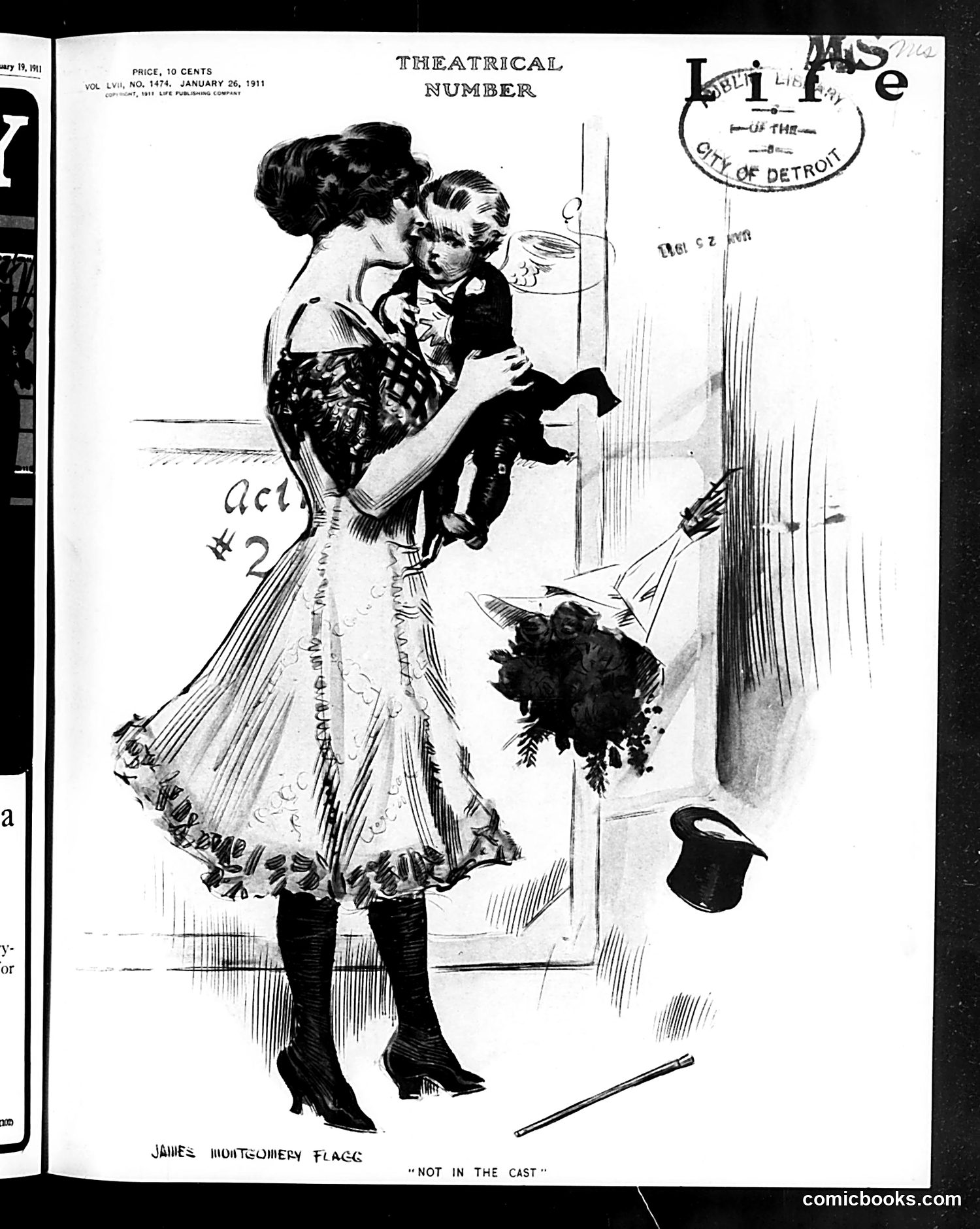
This is a *Life* magazine "Theatrical Number" cover from January 26, 1911, priced at 10 cents. The cartoon, credited to James Montgomery Flagg, is titled **"Not in the Cast."** The illustration shows an elegantly dressed woman holding a small child, looking at theatrical notices or playbills on a wall. A top hat lies on the ground—likely belonging to a man. The title's meaning appears to be a joke about theater casting: the woman and child, though present, are "not in the cast" of whatever production is being advertised. This likely satirizes theatrical world pretensions or the gap between those involved in theater production and casual observers. The specific theatrical reference is unclear without additional context about 1911 Broadway productions.
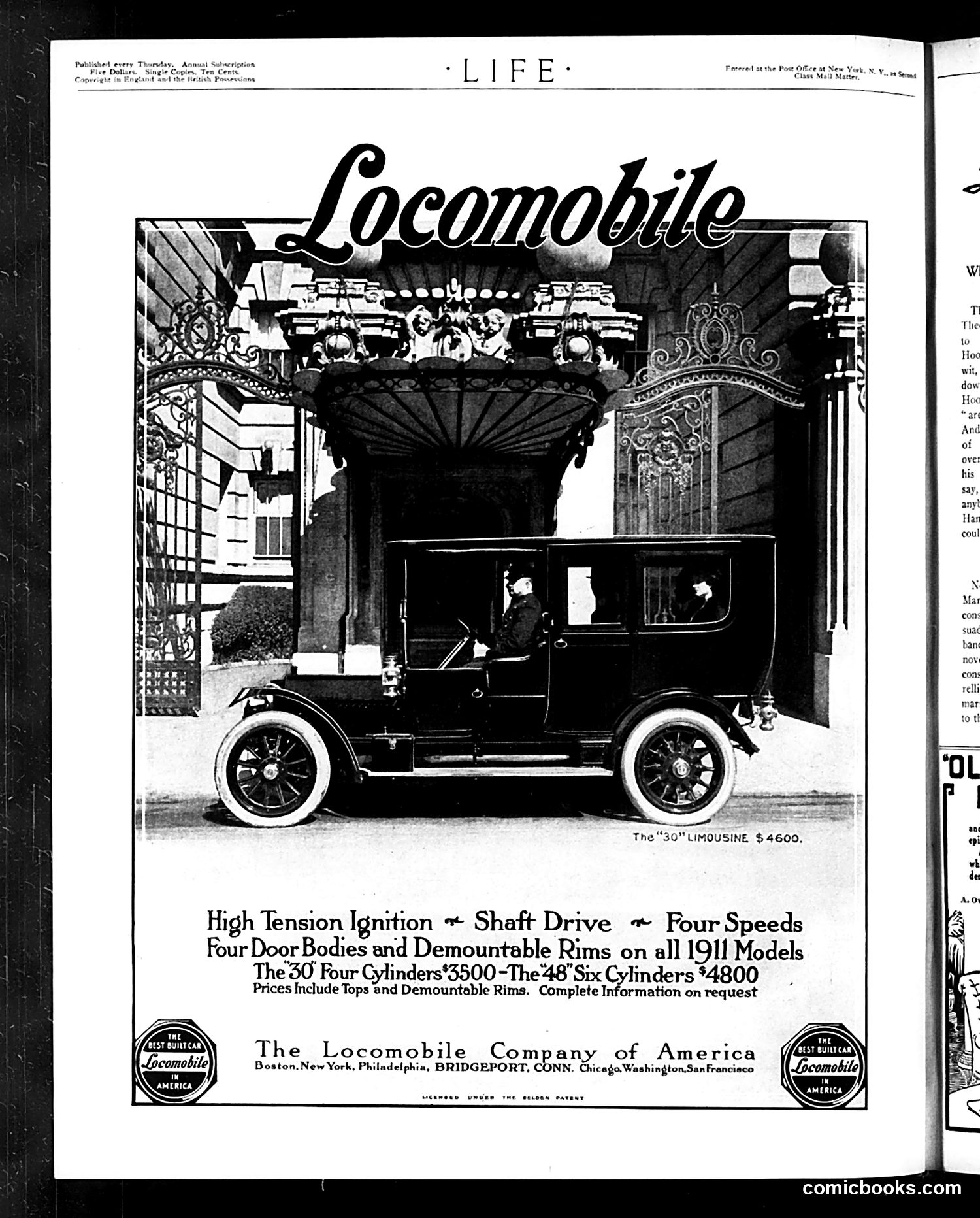
This page is **primarily an advertisement**, not satire or editorial content. It features a Locomobile automobile advertisement from the Locomobile Company of America, headquartered in Bridgeport, Connecticut. The ad showcases a "30" Limousine model priced at $4,600, displayed parked beneath an ornate architectural entrance. The image emphasizes luxury features: high-tension ignition, shaft drive, four speeds, four-door bodies, and demountable rims on 1911 models. The ad targets wealthy consumers by photographing the vehicle in an elegant setting with people visible in the background, suggesting sophistication and status. This represents early automotive advertising strategies emphasizing prestige and technical innovation to upper-class buyers during the automobile industry's formative decade.
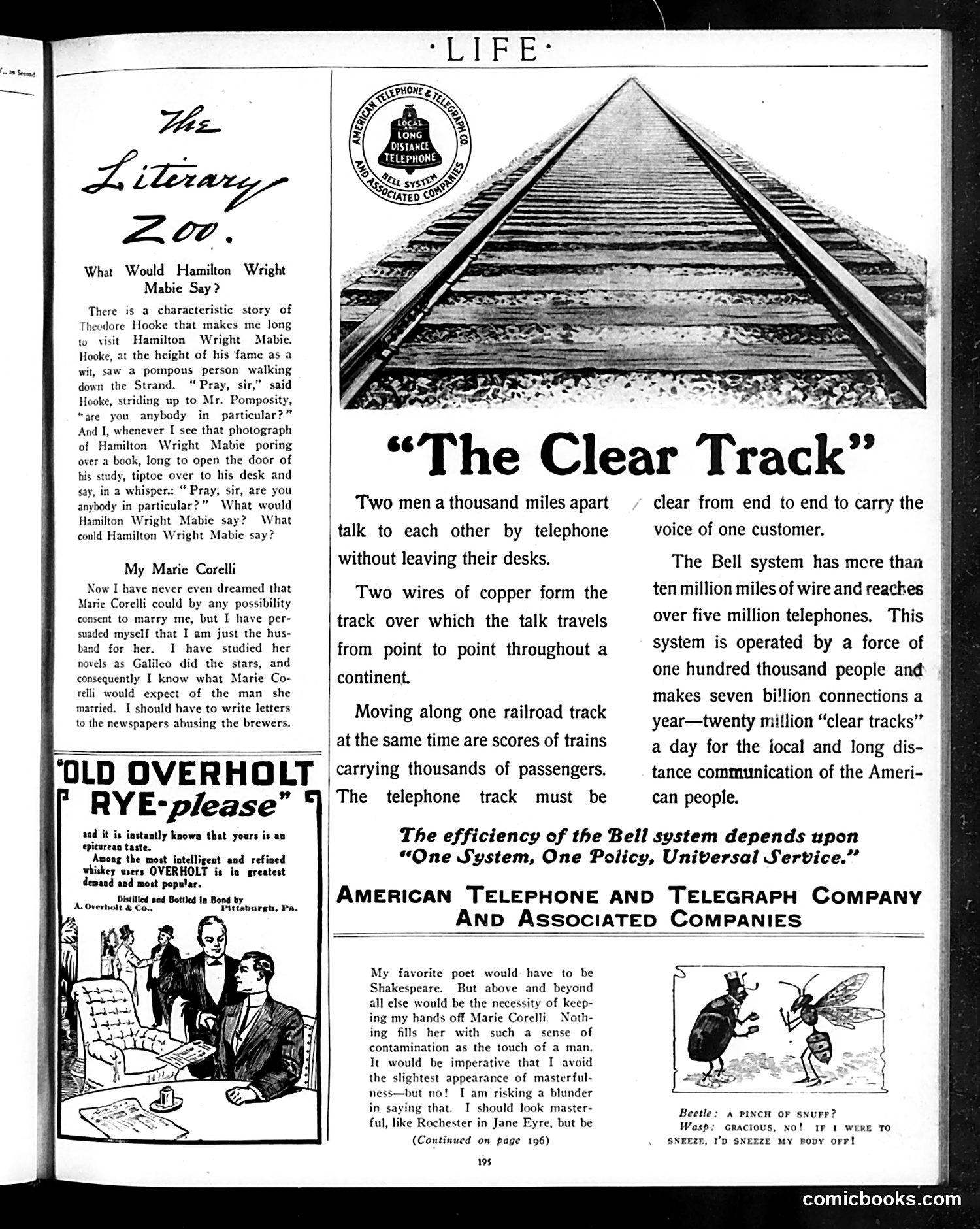
**"The Literary Zoo"** section opens with a Theodore Hooke anecdote about Hamilton Wright Mabie, a prominent literary figure. The joke: when Hooke encountered Mabie reading pompously, he sarcastically asked "Pray, sir, are you anybody in particular?"—mocking Mabie's self-importance. **The main advertisement** is "The Clear Track," promoting Bell Telephone's long-distance capabilities. It emphasizes the system's infrastructure (copper wires, ten million miles of wire, five million phones) and efficiency—enabling communication across vast distances without travel. **The bottom cartoon** depicts beetles discussing a pinch or sneeze, appearing to be light naturalistic humor rather than political satire. The page blends literary mockery with early-twentieth-century telecommunications boasting, typical of Life's mix of cultural commentary and advertising.
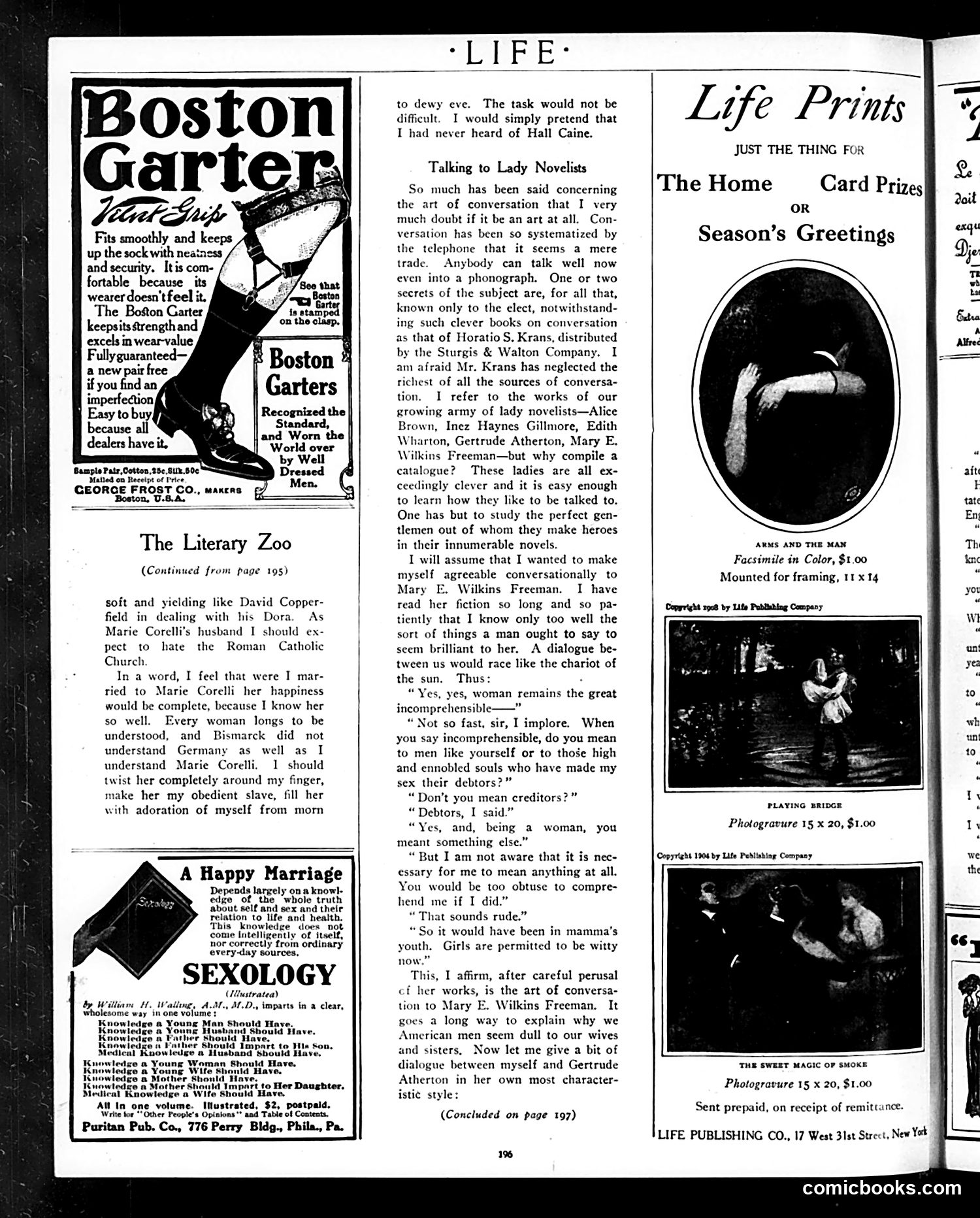
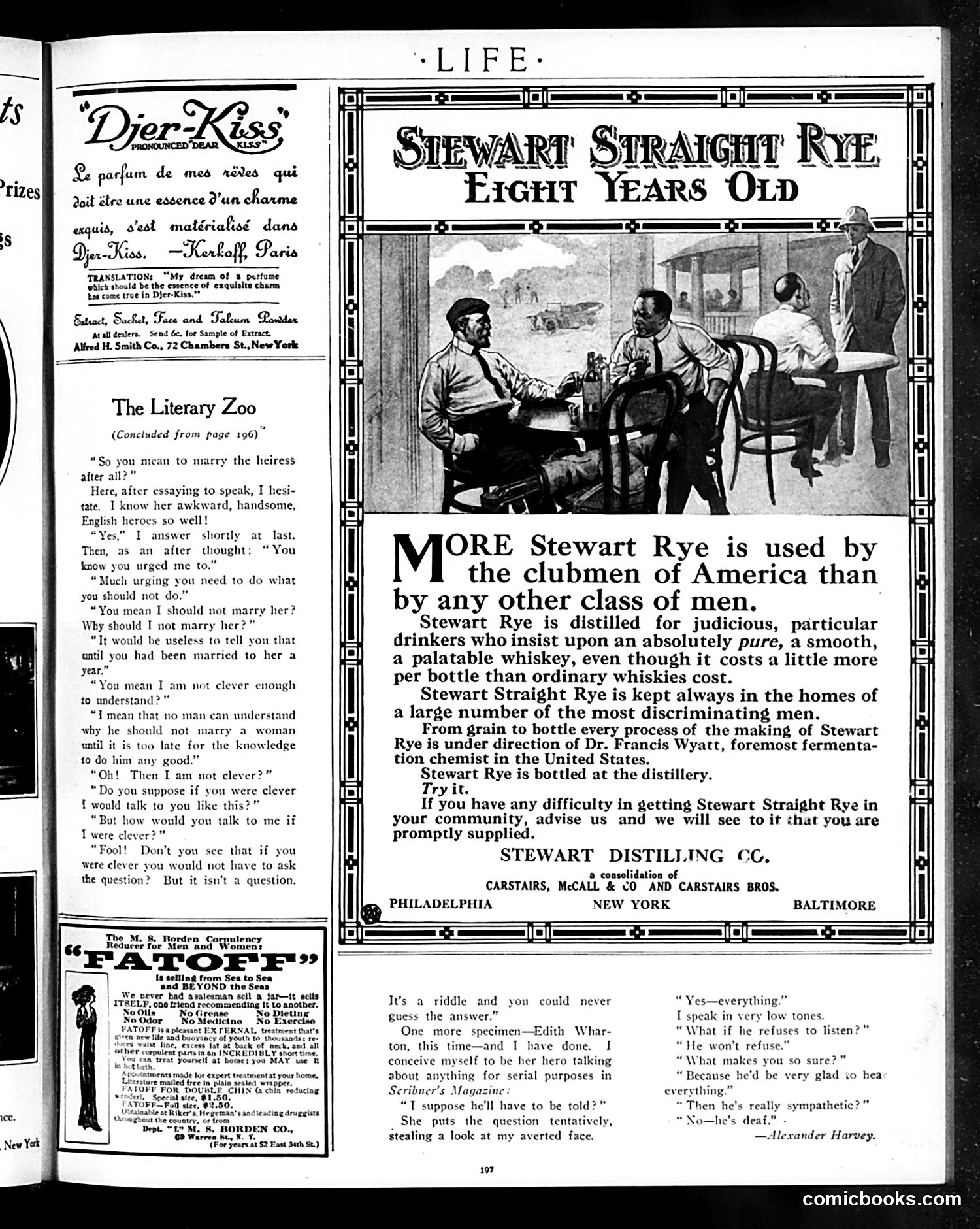
This page contains primarily **advertising and literary content** rather than political cartoons. The main feature is "The Literary Zoo" (continued from page 196), a dialogue satirizing courtship and marriage conventions. Two characters debate whether the male should marry an heiress—the humor derives from the woman's logical arguments exposing the man's contradictory reasoning about cleverness and marriage. The large advertisement promotes **Stewart Straight Rye whiskey**, claiming it's preferred by American clubmen and emphasizing its purity and cost-effectiveness compared to "ordinary whiskies." A smaller advertisement at bottom left promotes "Fatoff," appearing to be a medical or cosmetic product. **No political commentary or social satire targeting specific figures is evident on this page.**
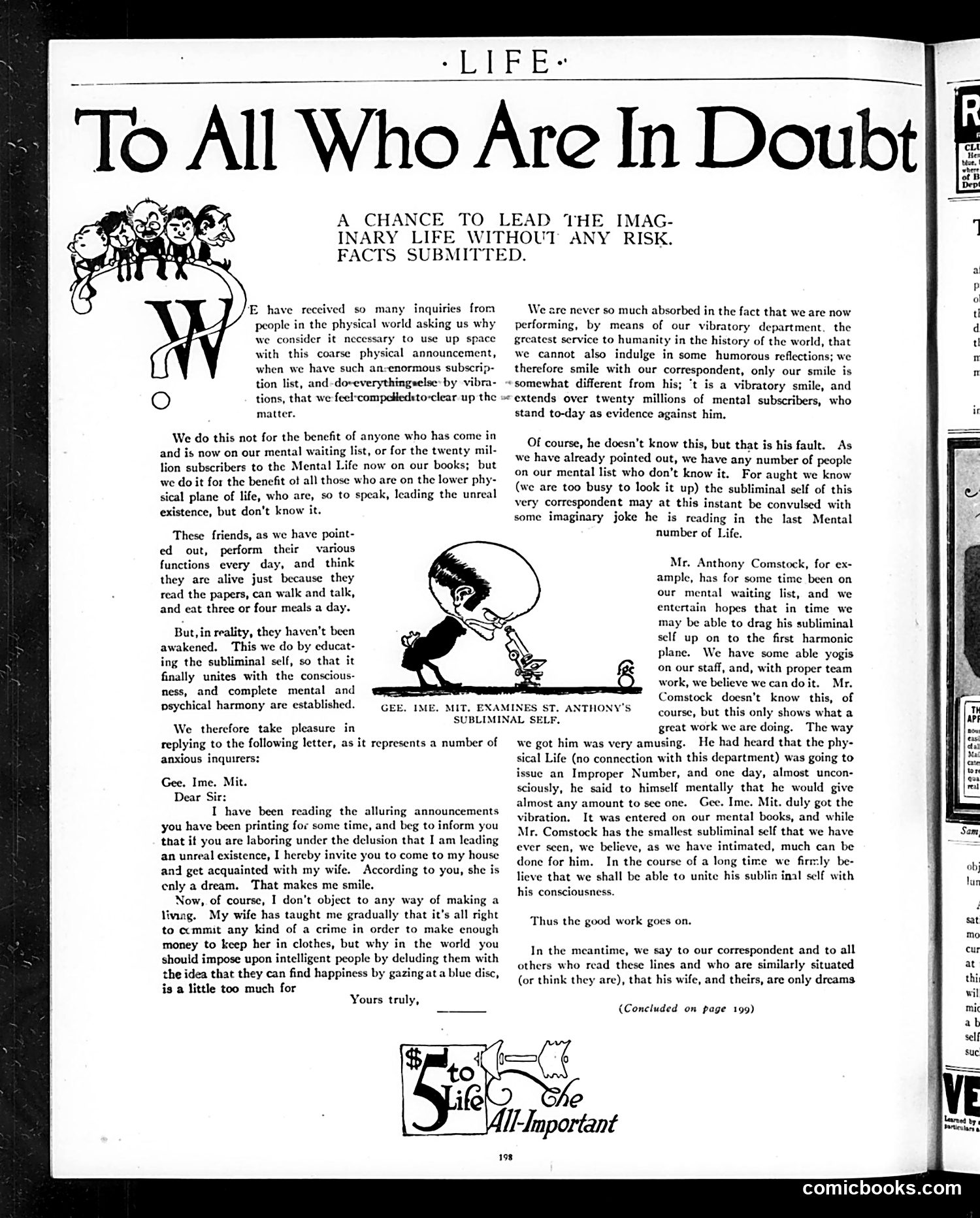
This is an editorial page addressing readers' inquiries about the magazine's mental health department. The main cartoon shows a figure (labeled "GEE. IME. MIT.") examining what appears to be St. Anthony's subliminal self—a visual pun on psychological self-examination. The text discusses the magazine's mental waiting list and efforts to help readers achieve "psychical harmony." It highlights a correspondent named Anthony Comstock who sought mental assistance, playfully suggesting the magazine's yogis and methods might help unite his "subliminal self" with his consciousness. The satire targets early 20th-century pseudoscientific mental wellness trends, particularly the appeal of Eastern philosophy (yoga) and subliminal psychology to educated Americans. Life mocks both the credulity of seekers and the magazine's own pretensions to offering legitimate psychological help through correspondence.
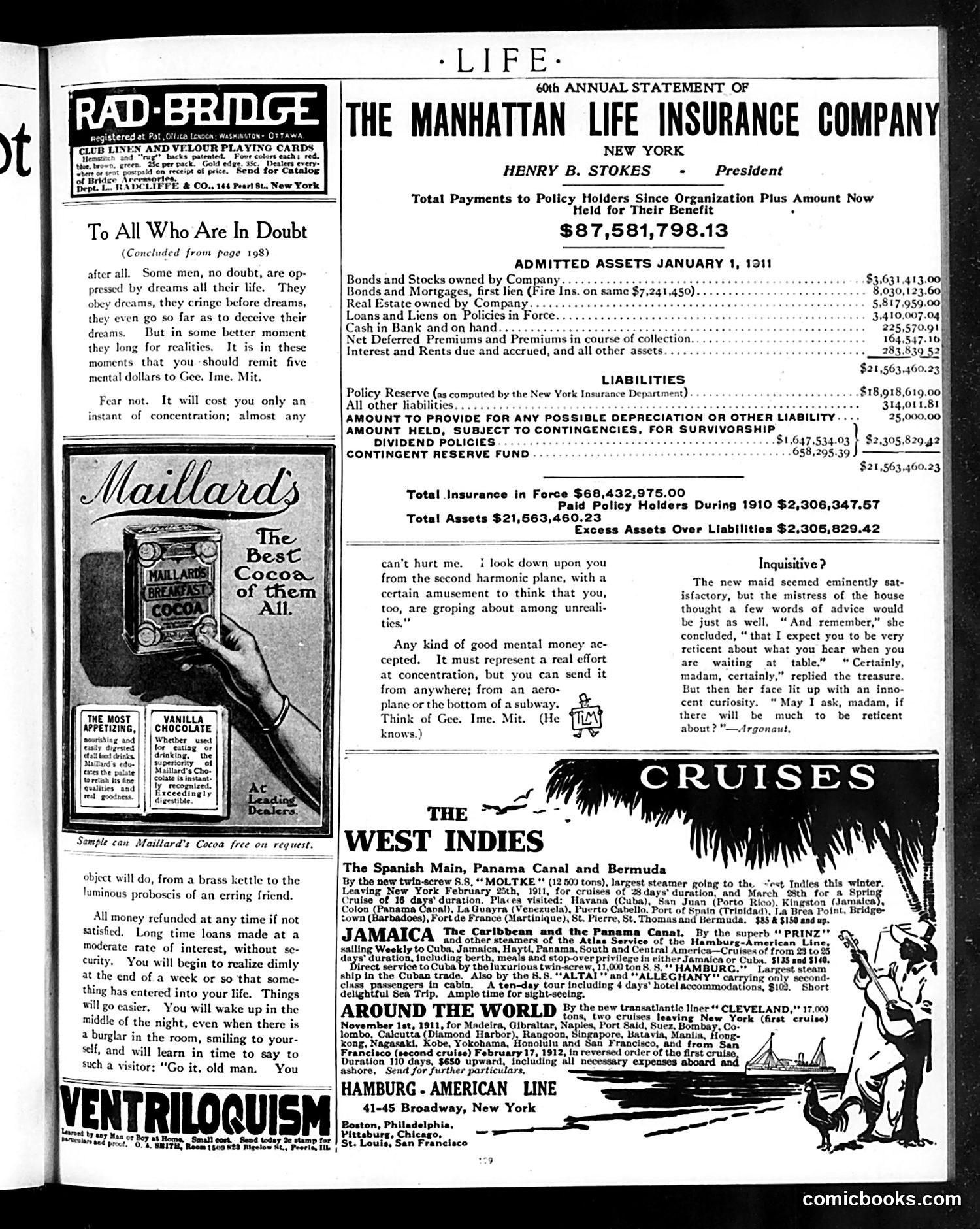
This page is primarily **advertising and financial reporting**, not political satire. The top half contains The Manhattan Life Insurance Company's 60th annual statement (1911), listing assets, liabilities, and payments to policyholders totaling $87.5 million. Below the insurance data is a philosophical piece titled "To All Who Are In Doubt" about accepting life's disappointments, followed by advertisements for **Maillard's Cocoa** and **Ventriloquism** lessons. The bottom half advertises cruise vacations—West Indies, Jamaica, and around-the-world voyages via the Hamburg-American Line. There is **no political cartoon or satire** on this page. It's a standard early-20th-century magazine layout mixing editorial content with commercial advertisements typical of *Life* magazine during this period.
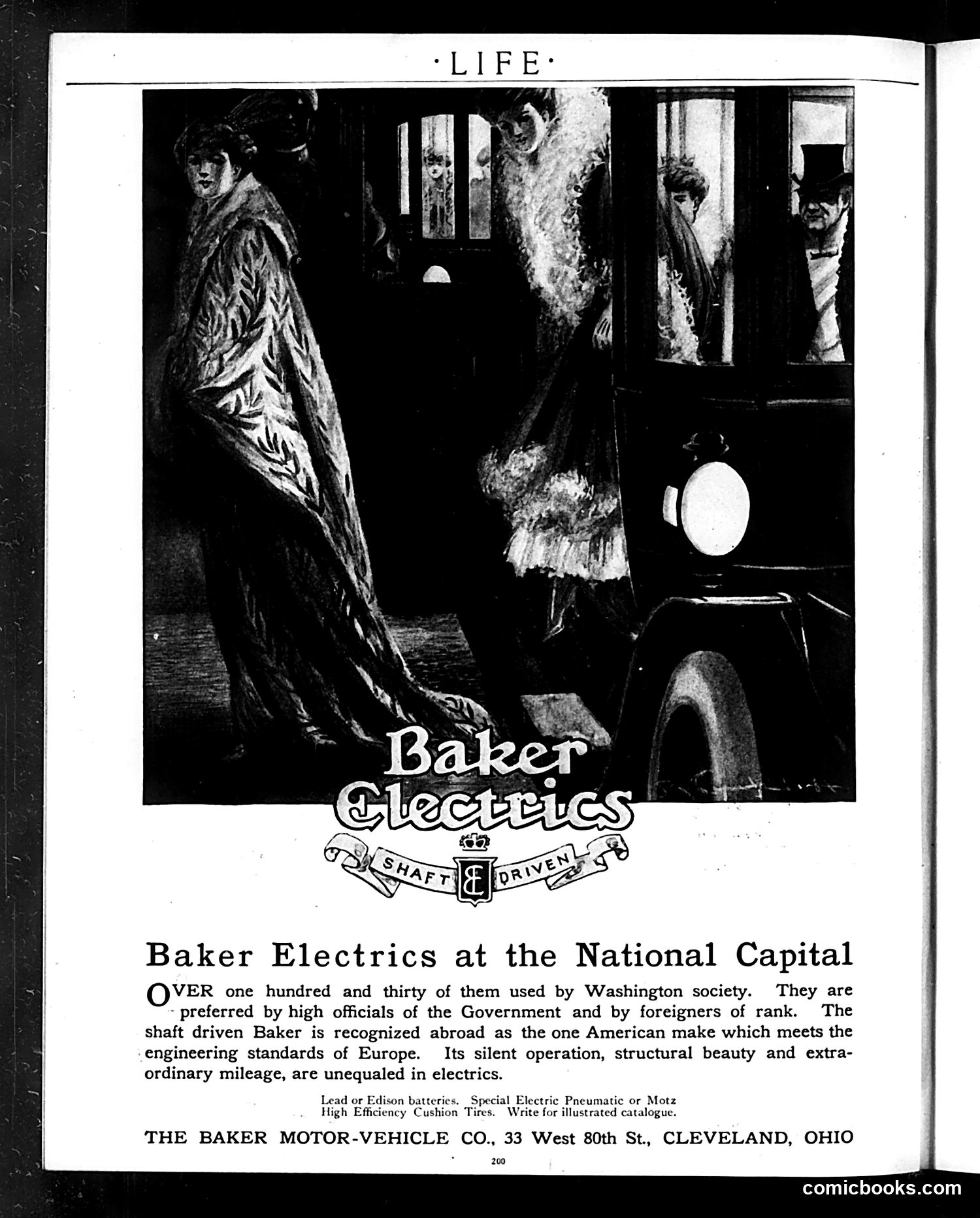
This is **advertising content, not satire**. The page promotes Baker Electrics, a manufacturer of electric vehicles based in Cleveland, Ohio. The illustration depicts well-dressed figures (appearing to be wealthy Washington society members and government officials) near an early electric automobile. The advertisement claims over 130 Baker vehicles are used by Washington society and preferred by "high officials of the Government and by foreigners of rank." The pitch emphasizes the vehicle's silent operation, structural elegance, and engineering quality—positioning it as the American electric car meeting European standards. This reflects the early 1900s when electric vehicles competed with gasoline cars before internal combustion engines dominated the market. The "shaft driven" tagline references the vehicle's mechanical system.
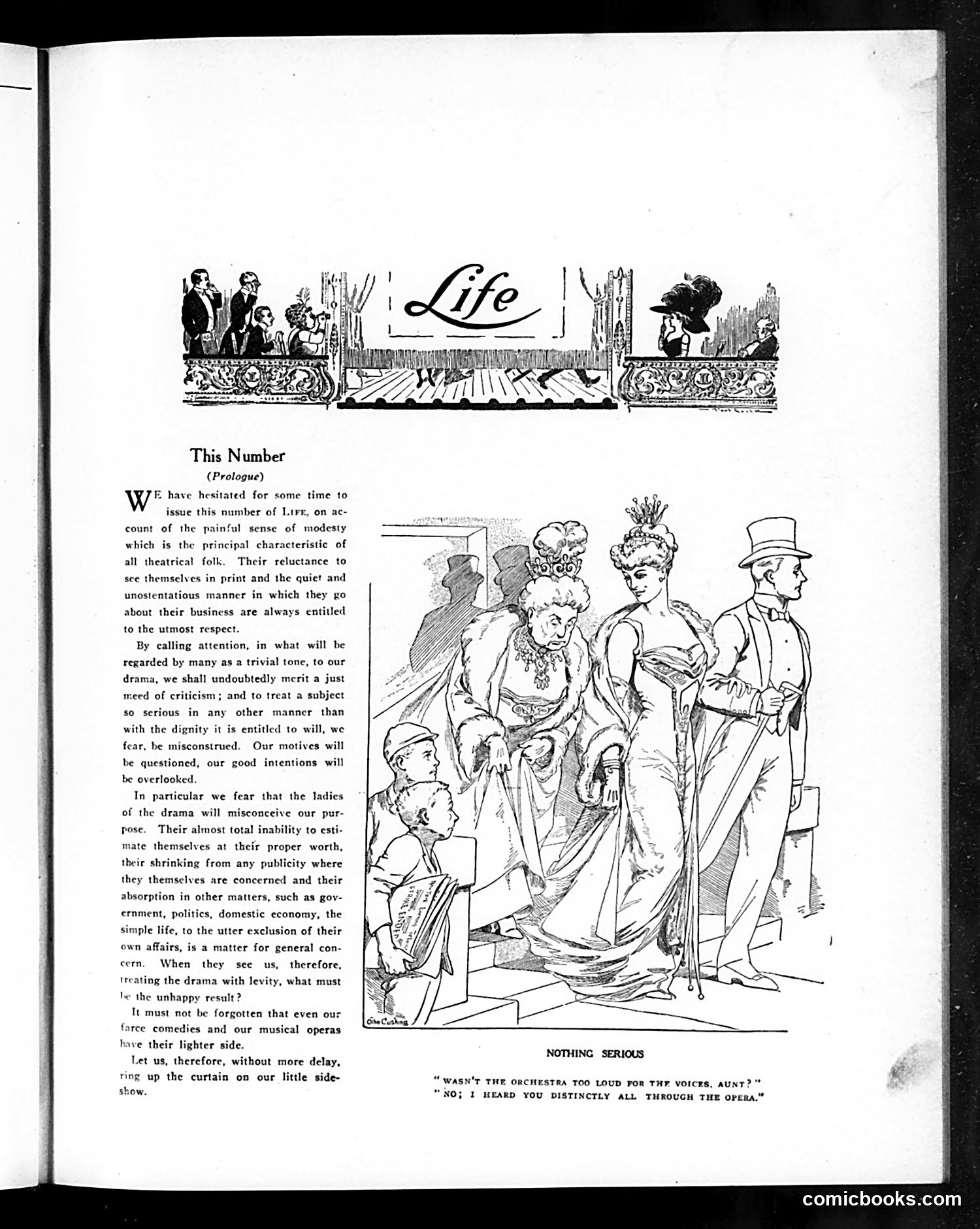
This page is a "Prologue" introducing a theatrical satire called "Nothing Serious." The accompanying illustration shows a group of well-dressed figures in what appears to be an elegant social setting—likely representing the theatrical world or high society. The editorial text defends the upcoming satirical treatment of drama, arguing that theatrical folk deserve the same critical scrutiny as any other subject. The editors express concern that theatrical ladies might misunderstand their intentions, worried that actresses will think the satire reflects poorly on their worth or suggests they're too absorbed in drama while neglecting serious matters like government and domestic economy. The caption beneath the illustration presents dialogue mocking orchestral volume during opera performance—a common complaint about theatrical productions. Overall, this is a preface justifying lighthearted satire of the theater world and its participants.
This page discusses the Sulloway bill regarding war pensions and tariff policy. The text argues against protective tariffs, claiming they benefit factory owners while harming workers and consumers. The article criticizes Miss Tarbell (likely Ida Tarbell, the muckraking journalist) for supporting tariffs to protect Rhode Island textile mills, and attacks Senator Aldrich's assertion that protective duties benefit American workers and employment. The second section praises George Loftus of Minneapolis and James Monahan regarding Pullman car profits, sarcastically noting that while the Pullman Company claims modest earnings, their actual profits far exceed stated figures. The overall satire targets what the writer sees as hypocritical arguments by tariff supporters who claim to champion workers while actually enriching industrial owners.
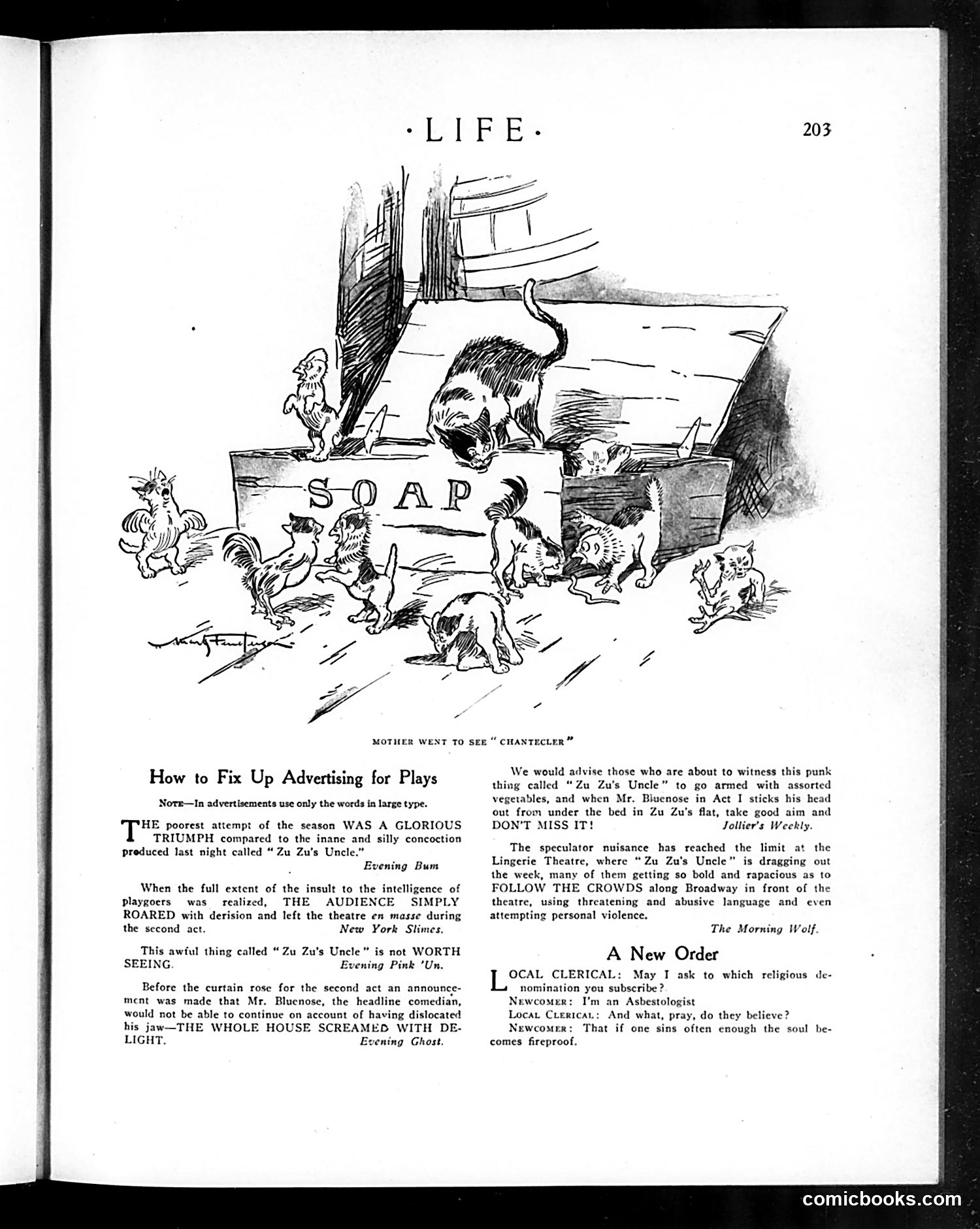
This cartoon satirizes a poorly-received theatrical production. The image shows a soap box surrounded by various farm animals (chickens, roosters, cats, dogs), with a mother pig sniffing at it. The title references "Chanticler," a play that apparently was a critical and commercial failure. The accompanying text criticizes the play's advertising as "insane and silly," quoting negative reviews from major newspapers. Critics complained the audience "roared with derision" and left the theater. The soap box label is likely a pun—the animals gathering around it suggest both the farm setting of the play and the slang meaning of "soap box" (ranting or preaching). The satire mocks both the failed production and its desperate advertising attempts.
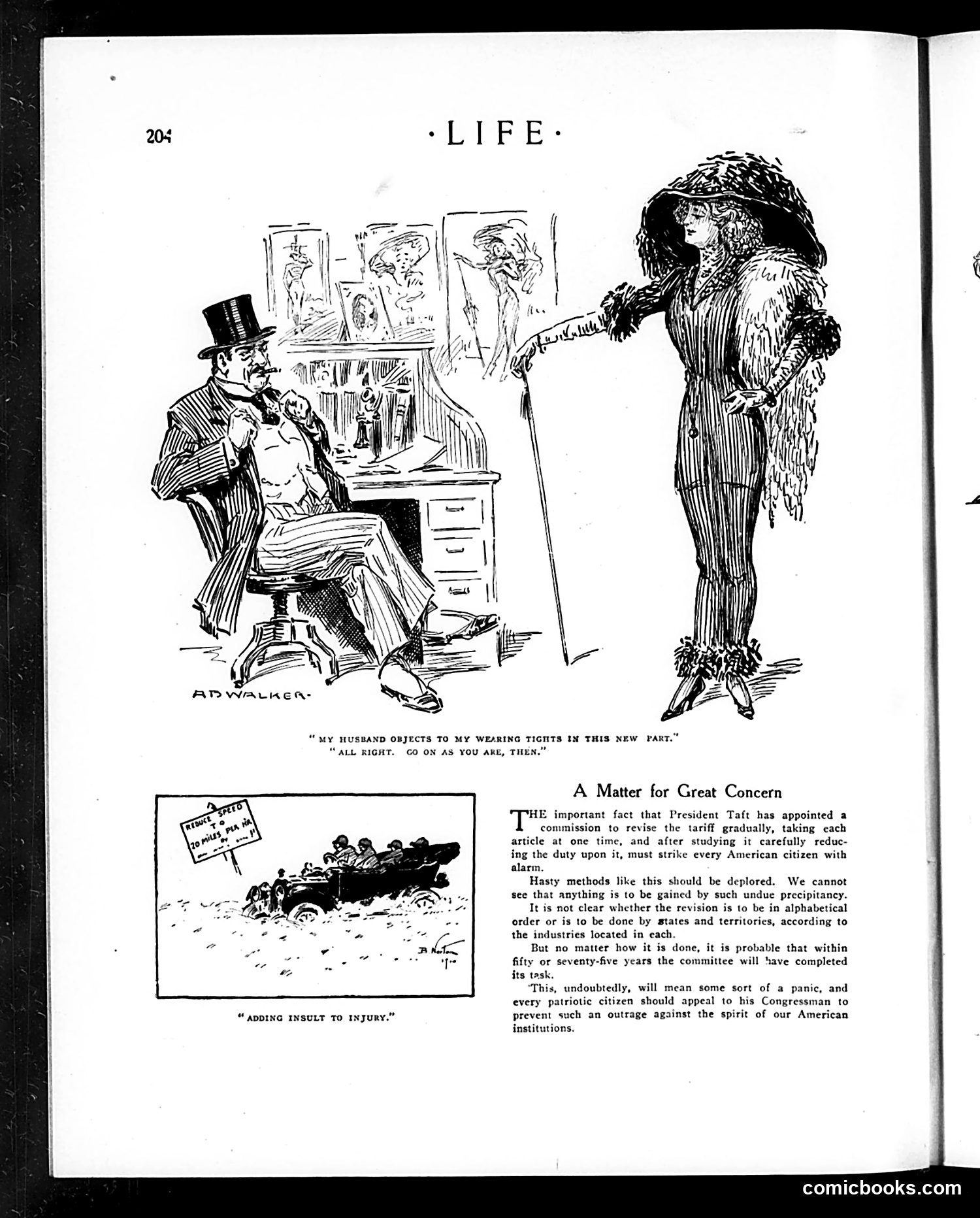
This page from *Life* magazine contains two satirical cartoons about early 20th-century social issues. The top cartoon shows a man in formal dress objecting to his wife wearing "tights in this new part," to which she responds "All right. Go on as you are, then." The joke satirizes male hypocrisy about women's fashion—he objects to her revealing clothing while he himself wears theatrical costume. The bottom cartoon, captioned "Adding Insult to Injury," depicts a car accident with a sign reading "Tariff Commission Report," suggesting the government's tariff policies compound economic harm. This references President Taft's tariff commission, criticized in the accompanying article "A Matter for Great Concern" as moving too slowly and potentially causing economic disruption to American industries.
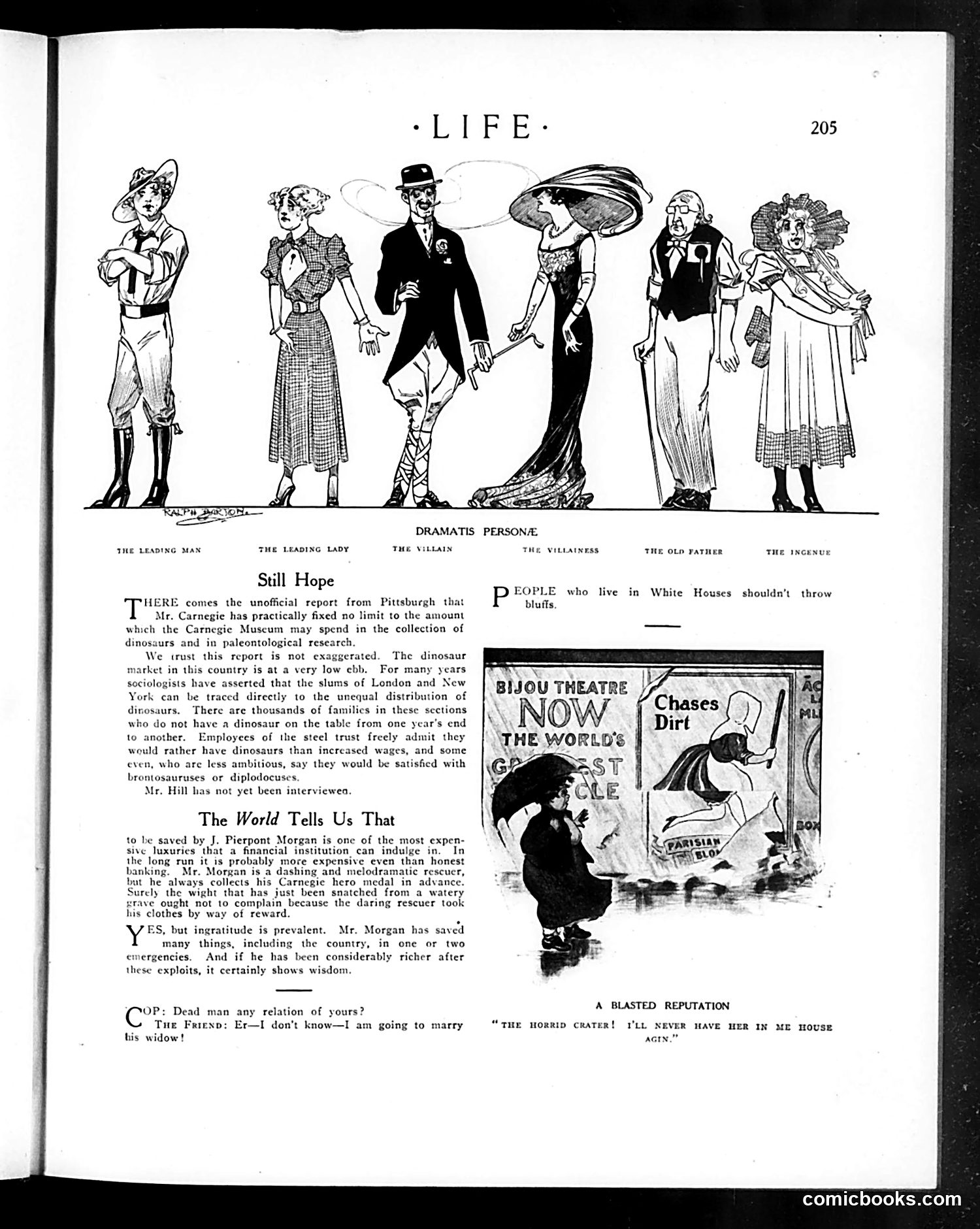
**Top Illustration**: Six character types labeled "Dramatis Personæ" - stock theatrical archetypes including "The Leading Man," "The Leading Lady," "The Villain," "The Villainess," "The Old Father," and "The Ingenue." This appears to be a visual guide to conventional stage characters rather than political satire. **Articles**: The page contains three brief pieces: "Still Hope" (discussing Carnegie Museum dinosaur displays and wage expectations), "The World Tells Us That" (about J.P. Morgan's financial exploits and rescue activities), and "A Blasted Reputation" (a comedic dialogue about marriage and widow inheritance). **Advertisement**: Features "Bijou Theatre" and film advertisements, including "Chase's Dirt." The page is primarily satirical social commentary and theatrical humor rather than political cartoons. The humor targets wealthy industrialists and conventional social attitudes.
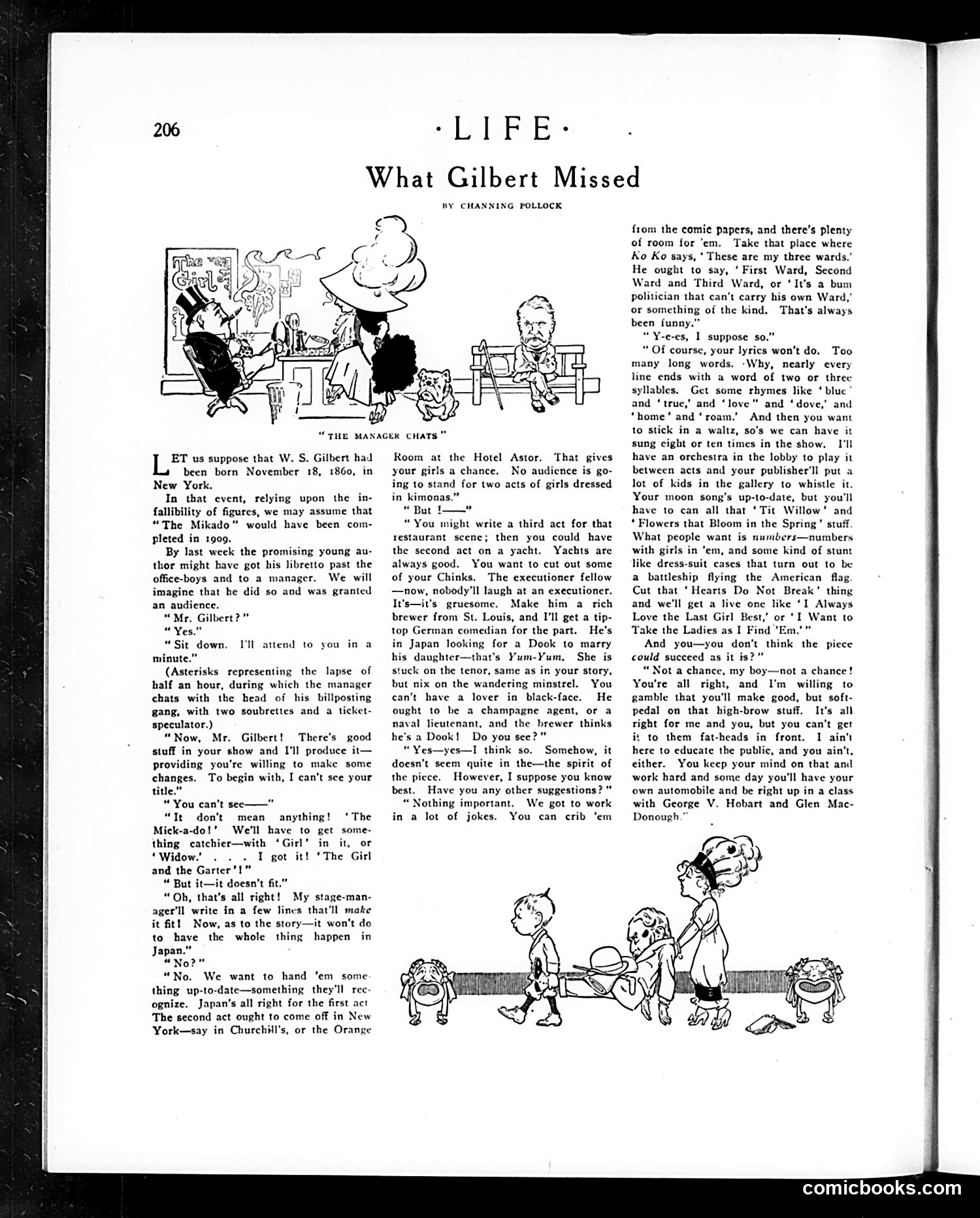
This satirical piece by Channing Pollock imagines W.S. Gilbert (the famous Gilbert & Sullivan librettist) born in 1860 New York instead of England. The humor lies in showing how a 1909 American theatrical manager would "improve" *The Mikado* by destroying everything that makes it work. The manager demands: renaming it "The Girl and the Garter," relocating scenes to New York hotels and yachts, removing Asian characters as "gruesome," replacing the clever tenor with a "champagne agent," eliminating sophisticated wordplay for simple rhymes ("blue/true," "love/dove"), and adding commercial gimmicks like orchestras in lobbies and children whistling in galleries. The satire targets early 1900s American commercial theater's philistinism—its obsession with spectacle, numbers, topical references, and profit over artistic integrity. It's a critique of how crass producers would butcher a masterpiece through "improvements." The irony: Gilbert's actual genius lay precisely in what this manager wants removed.
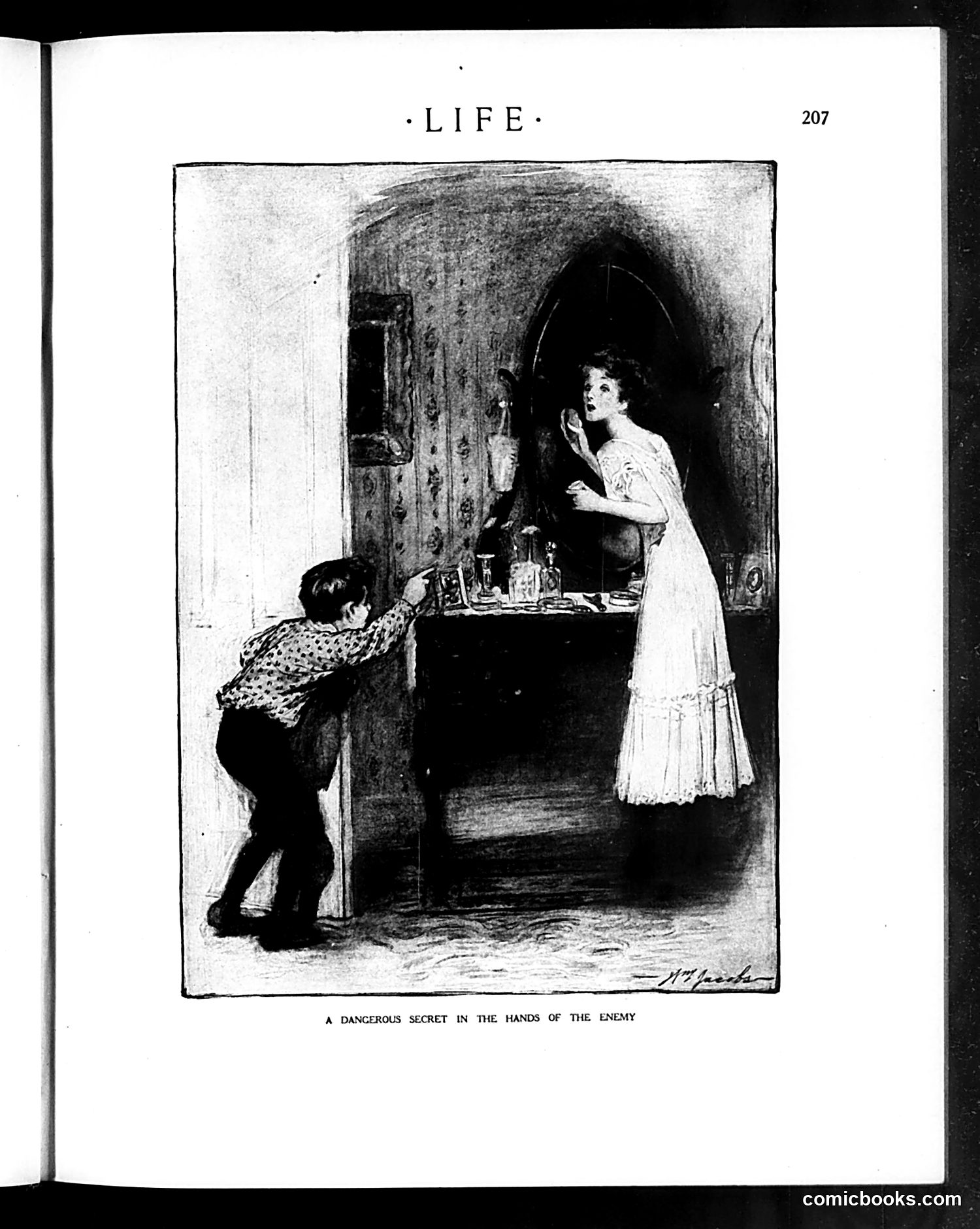
This Life magazine cartoon depicts a woman in a nightgown at a vanity mirror, while a man in patterned clothing peers through the doorway behind her. The caption warns of secrets "in the hands of the enemy." The satire appears to address concerns about espionage or information leaks during wartime (likely WWI or WWII era, based on Life's publication period). The "enemy" likely refers to foreign spies or agents. The joke plays on the Victorian/early 20th-century anxiety about women's intimate spaces and secrets being vulnerable to hostile foreign forces—conflating personal privacy breaches with national security threats. The woman's casual obliviousness to the spy watching her emphasizes the danger of carelessness with sensitive information, whether domestic gossip or state secrets.
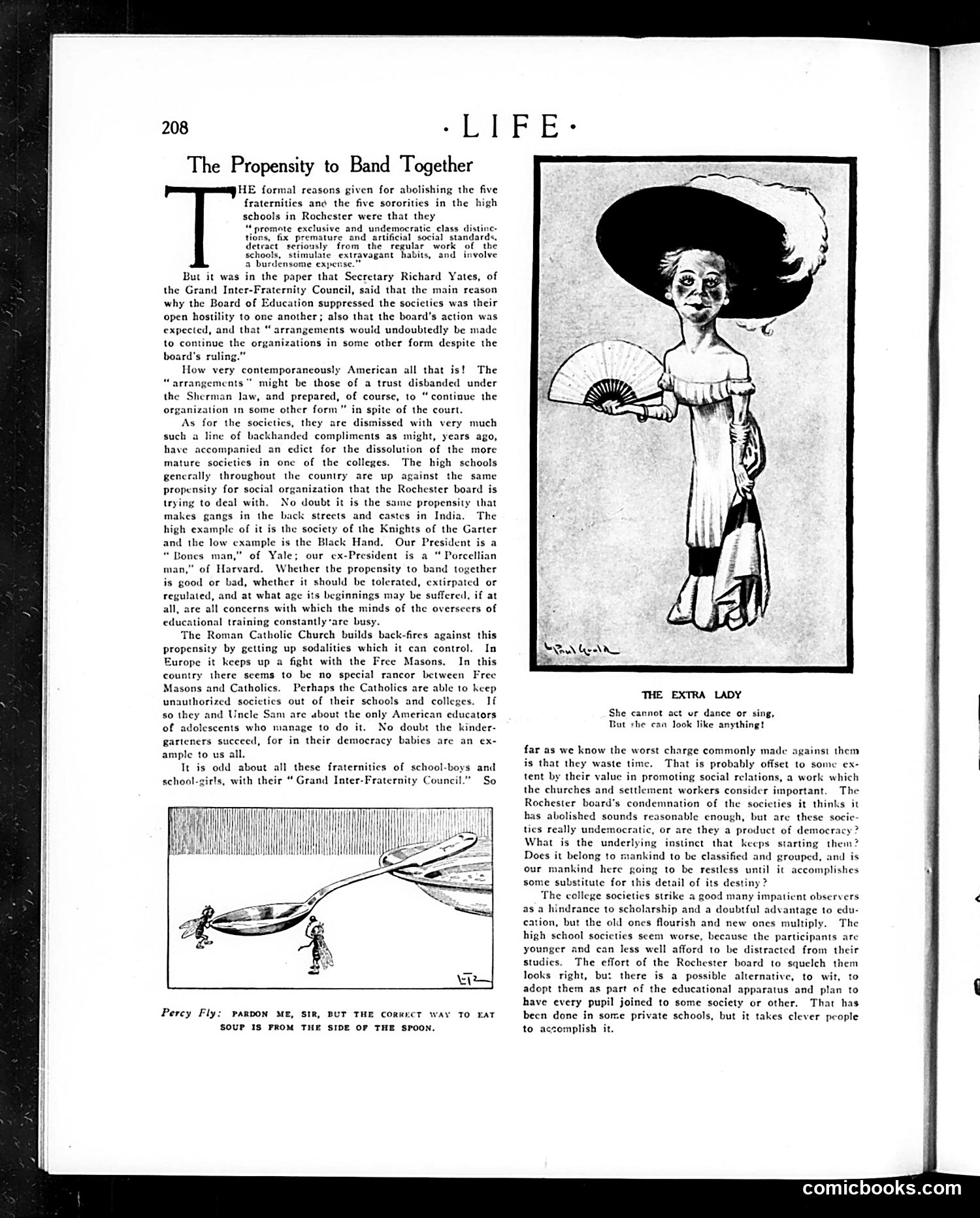
This page discusses the Rochester Board of Education's suppression of college fraternities and sororities, citing concerns about "exclusive and undemocratic class distinctions." **The cartoons satirize this:** 1. **"The Extra Lady"** (top right): A caricatured woman in fashionable dress, captioned that she "cannot act or dance or sing, / But she can back like anything!" — mocking sorority women as decorative but useless. 2. **"Percy Fly"** (bottom): A fly eating soup "from the side of the spoon" — humorously suggesting improper etiquette, likely analogizing fraternity members to those lacking social refinement. The text argues this propensity for social organization is universal and natural, comparing American fraternities to comparable European organizations. It questions whether suppression serves democracy or merely postpones inevitable reorganization.
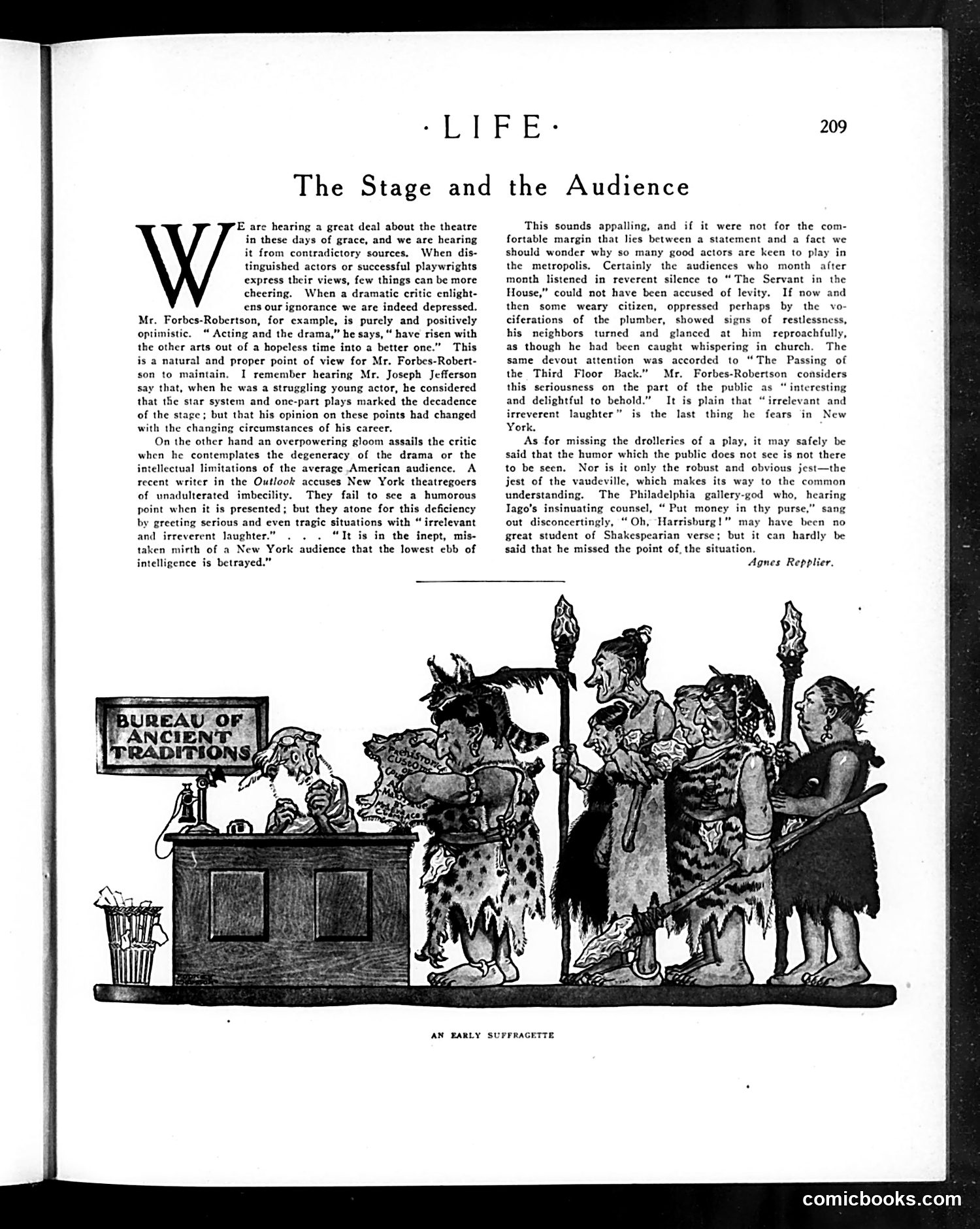
This article discusses theatrical quality and American audiences. The text critiques a recent *Outlook* writer who called New York theatergoers "imbeciles" for failing to appreciate humor and laughing inappropriately at serious scenes. The author (Agnes Repplier) defends audiences, noting that respected actors like Forbes-Robertson actively seek to perform in New York, suggesting the audiences cannot be as unintelligent as claimed. She cites examples of audiences sitting in reverent silence during serious plays like "The Servant in the House" and "The Passing of the Third Floor Back." **The cartoon below** shows what appears to be an ancient Greek or Roman theatrical scene labeled "An Early Suffragette"—likely a humorous comparison suggesting that female audience participation in theater has ancient roots, though the exact political reference remains unclear without additional context about contemporary suffrage debates. The piece argues audiences appreciate drama appropriately when it merits appreciation.
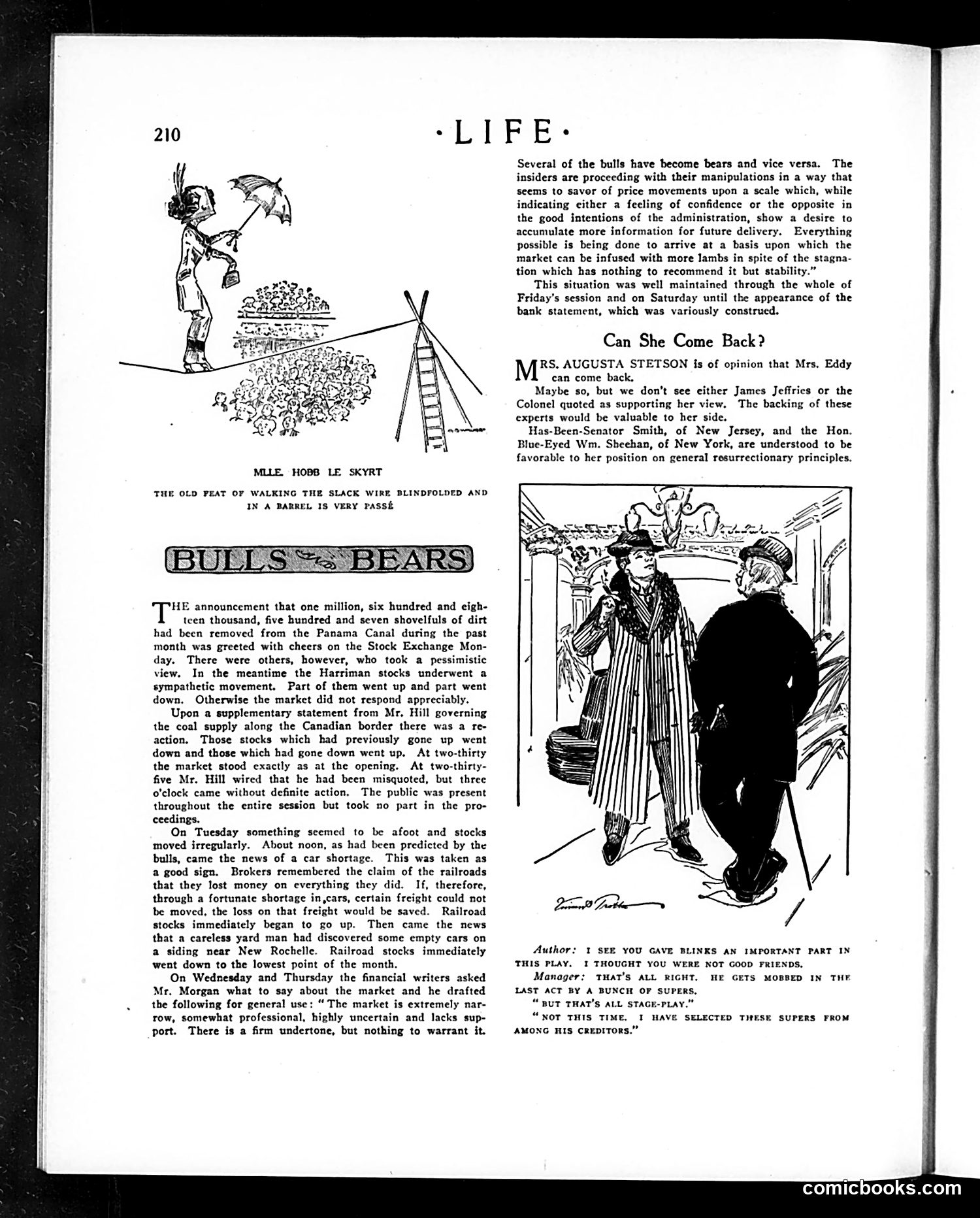
This page contains two distinct satirical pieces: **"Bulls & Bears"** (main article): Satirizes the stock market's absurd volatility and the manipulation by financial insiders like J.P. Morgan. The piece mocks how meaningless market movements are—stocks rise and fall based on trivial rumors (car shortages, canal dirt removal), often reversing within hours. Morgan's quoted statement is deliberately nonsensical financial jargon, exposing how brokers use pretentious language to mask ignorance. The satire suggests markets are rigged speculation with no rational foundation. **Theater cartoon**: Depicts a manager explaining to an author why an unpopular actor (Blinks) was cast—he gets "mobbed" in the final act because the "supers" (background actors) are actually his creditors, ready to physically attack him. This jokes that creditors will pursue debtors so aggressively they'd assault someone on stage, and that even theater casting depends on settling debts rather than talent. Together, these pieces satirize how financial systems and social relationships are driven by manipulation and debt rather than merit or logic.
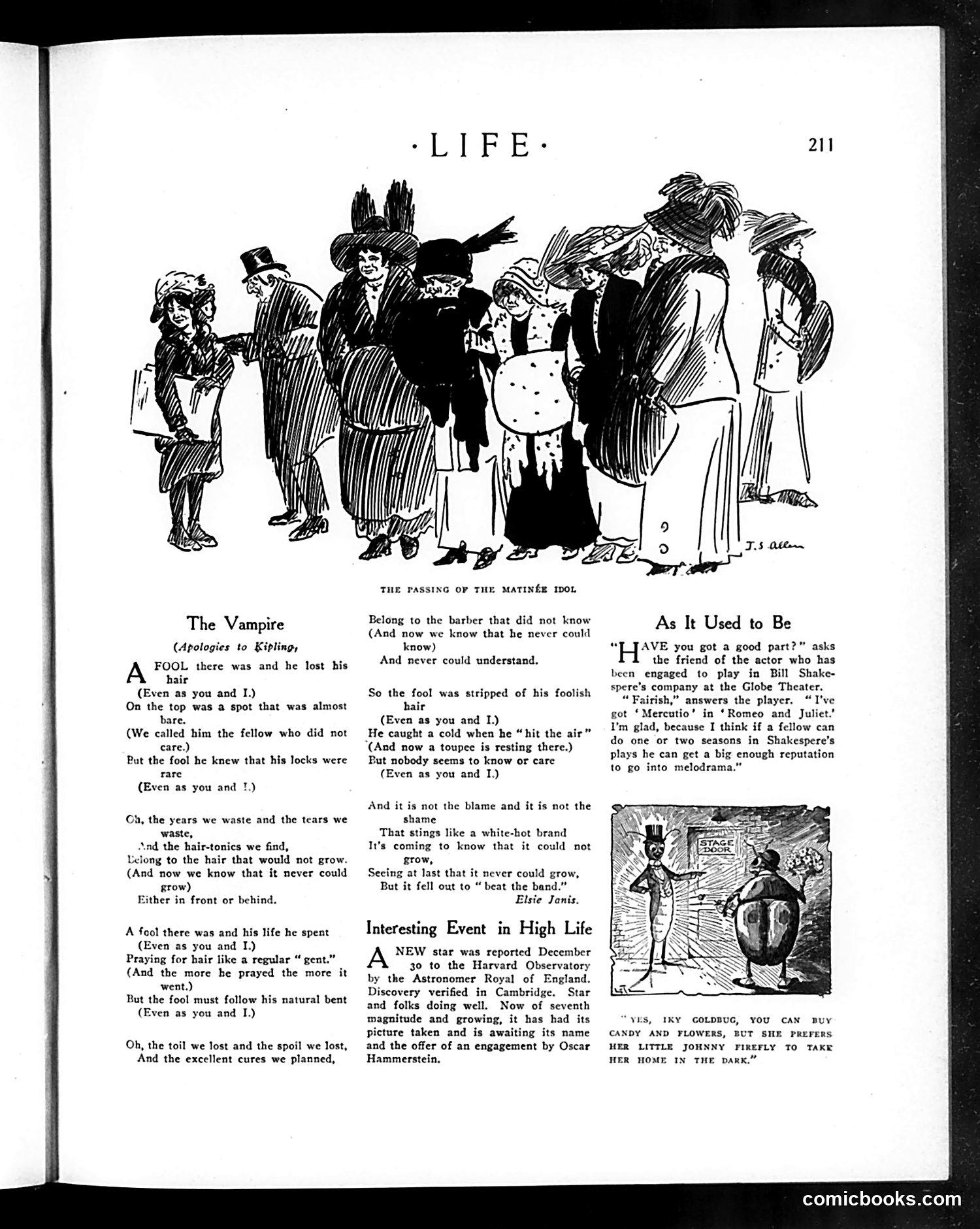
This page contains three satirical pieces mocking early 20th-century vanity and theatrical pretension. **"The Vampire"** is a parody of Kipling's famous poem structure, mocking men obsessed with hair loss remedies. It satirizes the desperation and futility of trying to regrow lost hair despite worthless "tonics"—a common scam of the era. **"The Passing of the Matinee Idol"** ridicules aging theater stars becoming irrelevant. The cartoon shows an elderly actor surrounded by younger competitors, lamenting lost prominence. The accompanying text humorously announces a new star to Harvard Observatory as if discovering a celestial body—mocking the inflated egos of minor theatrical celebrities. **"As It Used to Be"** satirizes Shakespearean actors' delusions. A player accepts a minor role expecting it will launch him into melodrama fame, revealing the desperation and unrealistic ambitions of struggling theater performers. All three pieces target vanity, false remedies, and theatrical pretension—common Life magazine targets for educated, urban readers skeptical of both commercial hucksterism and show-business self-importance.
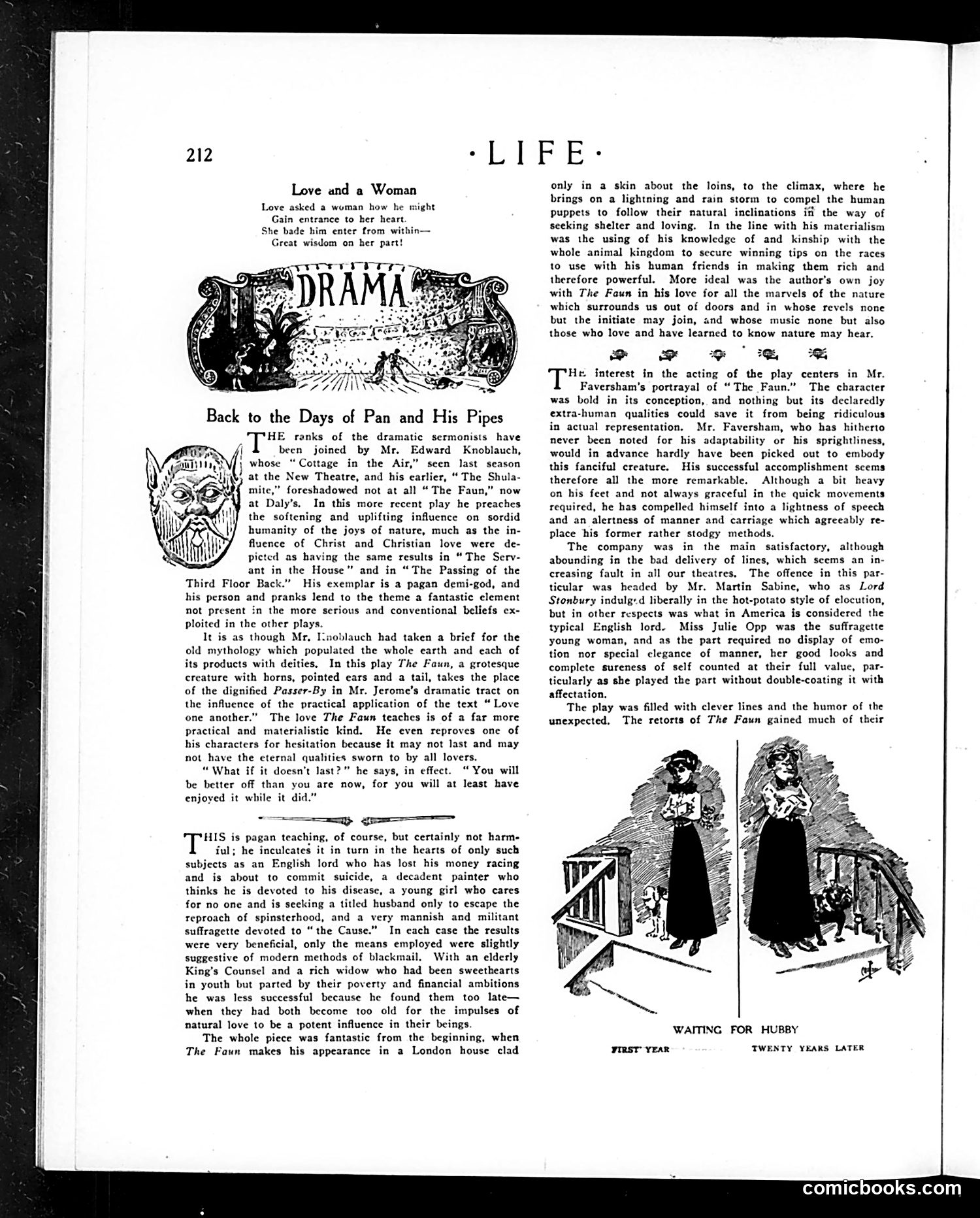
This *Life* magazine page reviews "The Faun," a play by Edward Knoblauch at Daly's Theatre, starring actor Faversham. The production features a mythological creature—part-man, part-beast with horns and tail—who teaches hedonistic philosophy to troubled London socialites: a suicidal nobleman, a dissolute painter, a marriage-hunting woman, and a militant suffragette. The satire targets the play's pretension: it frames itself as spiritually uplifting (like Christian morality plays of the era) while actually promoting selfish materialism and pleasure-seeking. The Faun's "teaching" includes race-fixing and seduction. The reviewer finds this amusing—simultaneously mocking the play's philosophical contradictions and the fashionable London audiences who'd accept such transparent moral relativism dressed in theatrical spectacle. The illustration shows the protagonist in domestic Victorian settings, emphasizing the absurdity of introducing pagan amorality into respectable society.
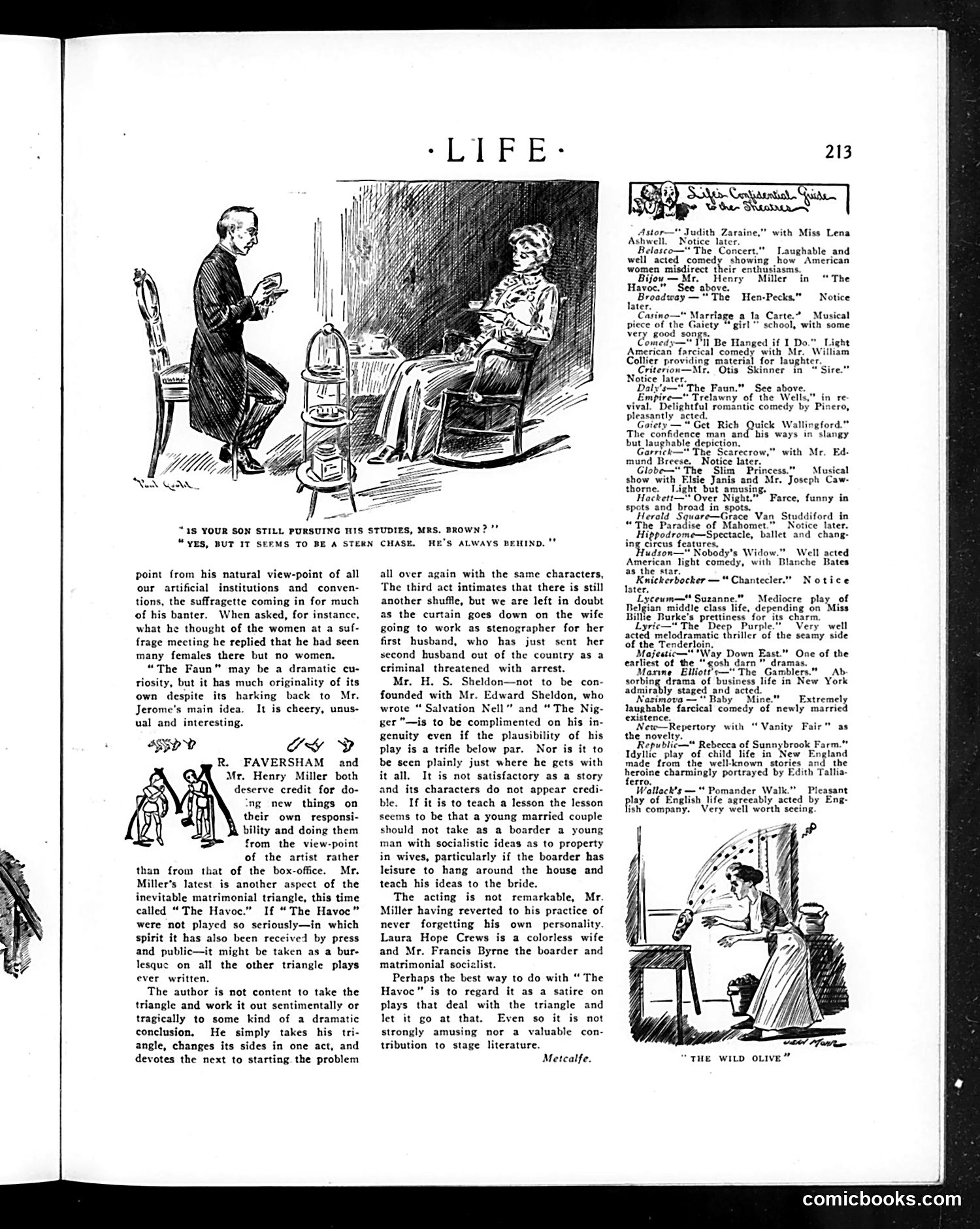
The main cartoon depicts a domestic scene with the caption "Is your son still pursuing his studies, Mrs. Brown? Yes, but it seems to be a stern chase. He's always behind." This is a visual pun playing on the phrase "stern chase"—a nautical term meaning pursuit from behind. The humor lies in the double meaning: the mother claims her son pursues his studies, but he's always "behind" (academically lagging), creating a literal "chase" scenario where studies pursue *him* rather than vice versa. The page primarily consists of theater reviews by Metcalfe, critiquing contemporary Broadway productions. Reviews discuss plays like "The Havoc" and matrimonial comedies, with particular attention to suffragette satire and social commentary. The accompanying illustrations are theatrical sketches, not political cartoons. This appears to be Life's standard theatrical criticism section rather than political satire content.
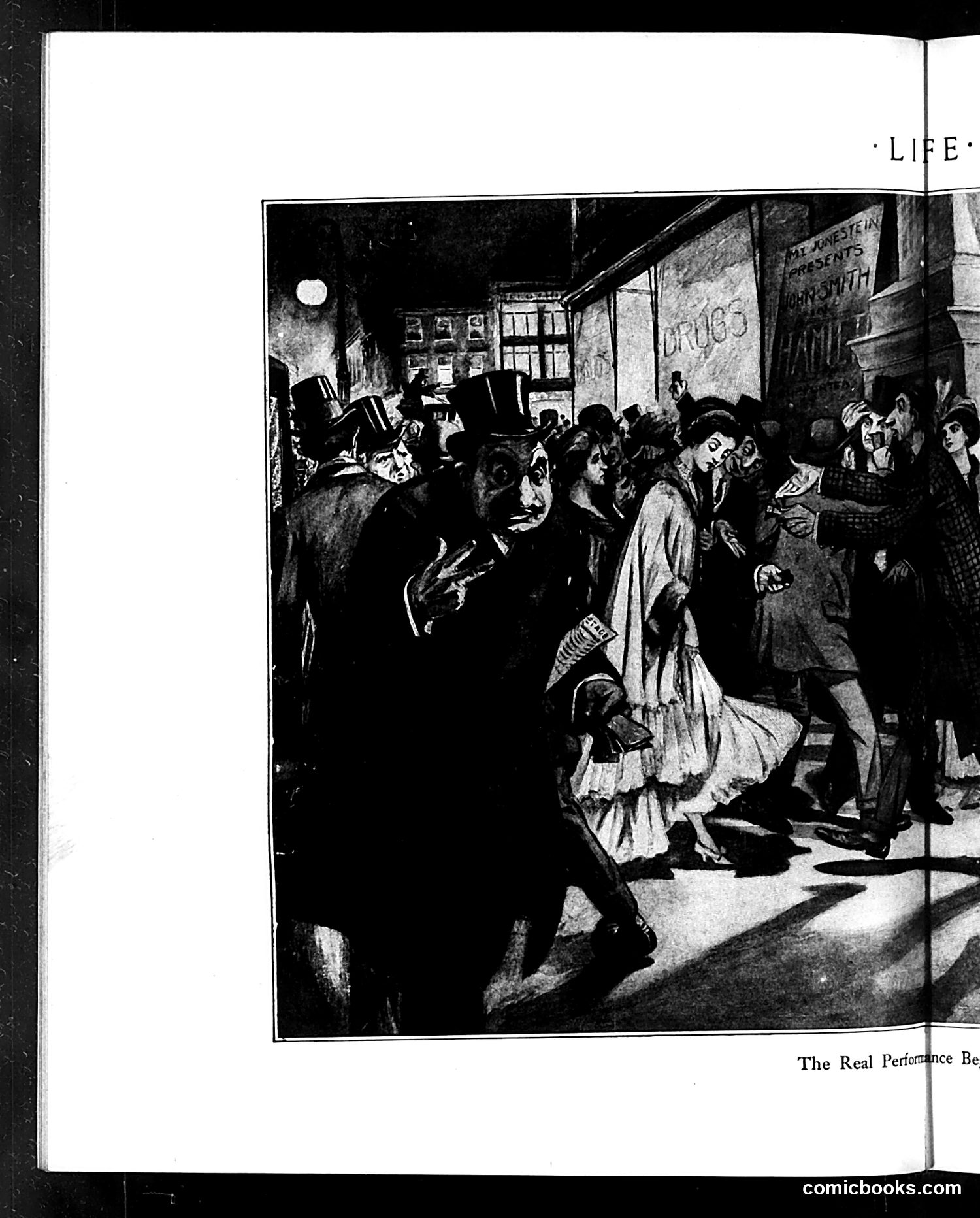
This appears to be a page from *Life* magazine showing a crowded indoor scene—possibly a pharmacy, drugstore, or medical establishment, given the partial text visible ("DRUGS" on signage). A woman in a light-colored dress with a child stands prominently in the center, surrounded by a dense crowd of darkly-dressed figures. The caption reads "The Real Performance Be[gins]" (text cut off). The satirical point likely critiques either: - **Patent medicine fraud**: exposing how crowds gathered for dubious health treatments - **Medical quackery**: mocking the spectacle around ineffective remedies - **Social chaos**: depicting urban overcrowding or commercial hysteria Without the complete caption and clearer signage, the exact target is unclear, but the image suggests mockery of public gullibility around medical or commercial claims popular in early 20th-century America.
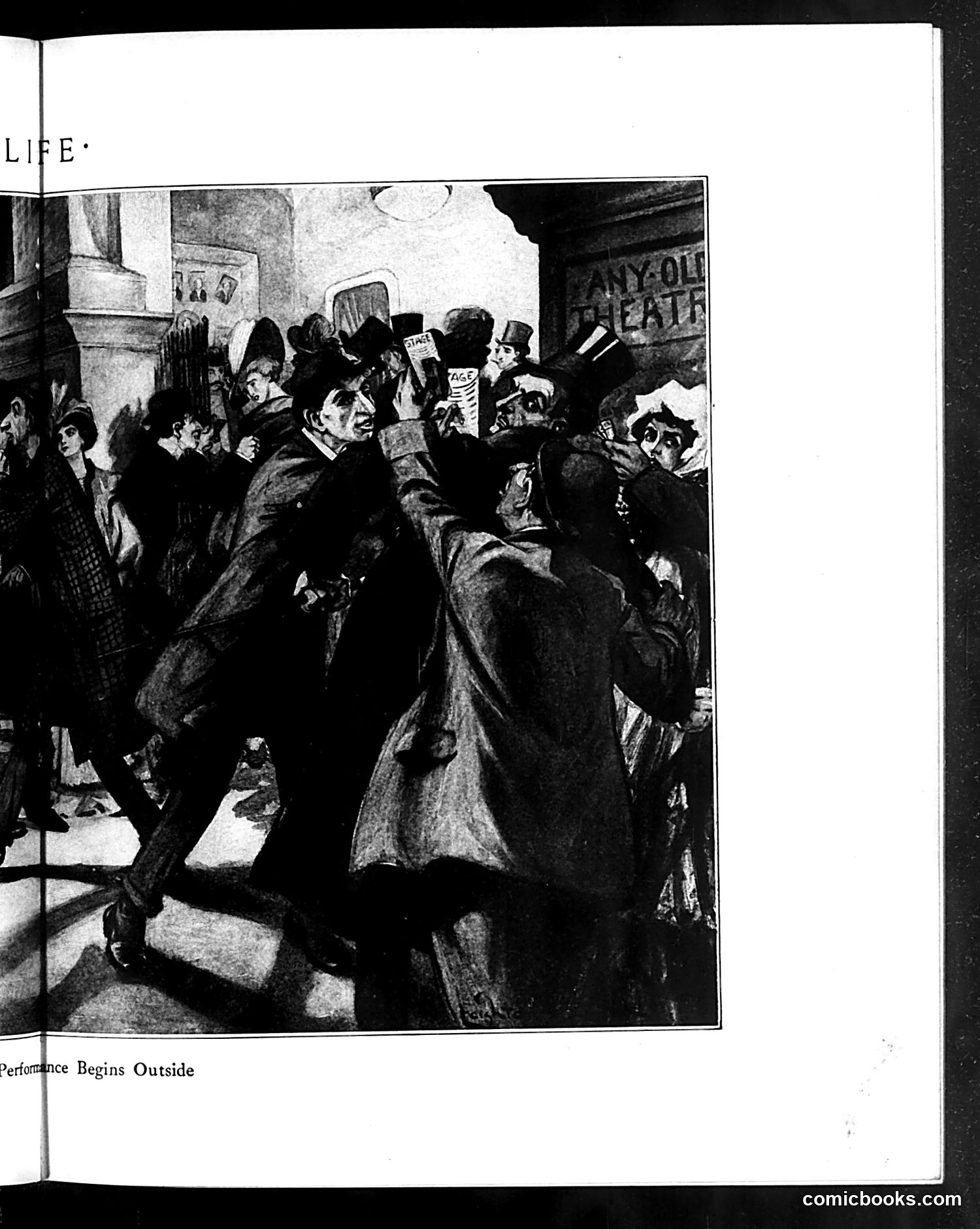
This satirical image depicts a crowded street scene of people gathered outside what appears to be a theater or performance venue (visible signage includes "THEATRE"). The crowd consists of well-dressed figures in period clothing (top hats, formal coats) holding what appear to be placards or signs, suggesting a protest or demonstration. The caption "Performance Begins Outside" implies the real spectacle or "performance" is the commotion outside the venue rather than whatever entertainment occurs within. This likely satirizes either theatrical controversy, social agitation, or the public's attraction to disorder and protest as entertainment—mocking how crowds gather around disruption or conflict rather than engaging with legitimate cultural events. The specific figures and context remain unclear without additional publication details.
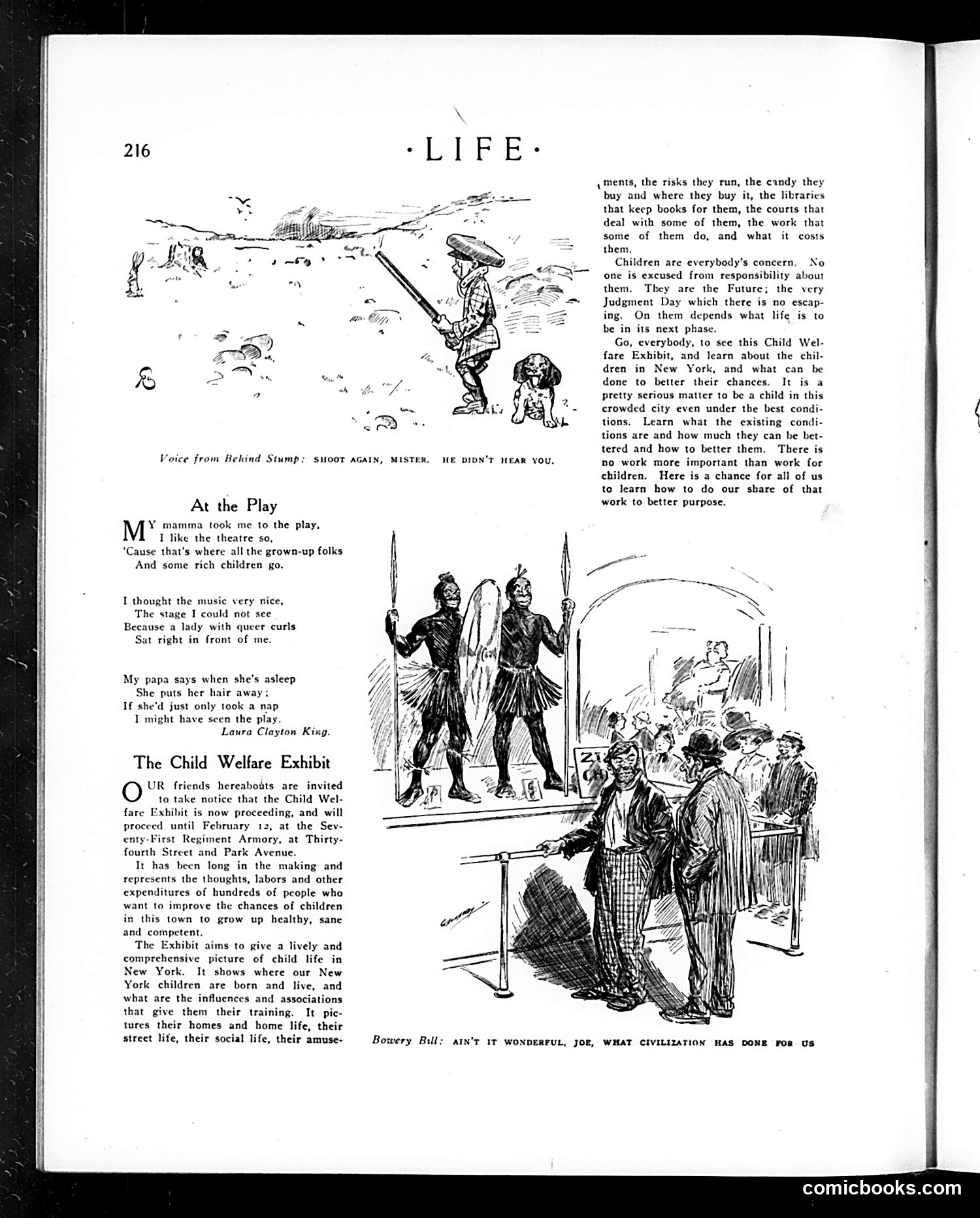
This page combines advocacy journalism with humor about urban childhood. The top cartoon shows a child being told to "shoot again" by someone behind a stump—likely satirizing street violence or dangerous play in New York City. The poem "At the Play" humorously depicts a child's theater experience ruined by a woman with an elaborate hairstyle blocking the view—a common complaint about theater etiquette that Life's readership would recognize. The main content promotes the Child Welfare Exhibit (February 12, at a New York armory), which documented conditions of poor urban children. The editorial urges readers' responsibility toward children's welfare as a moral imperative. The bottom cartoon shows "Bowery Bill" and "Joe," likely working-class characters, sarcastically commenting on "civilization"—probably reacting to the exhibit's revelations about poverty and poor conditions, with dark humor about what society has "done for us."
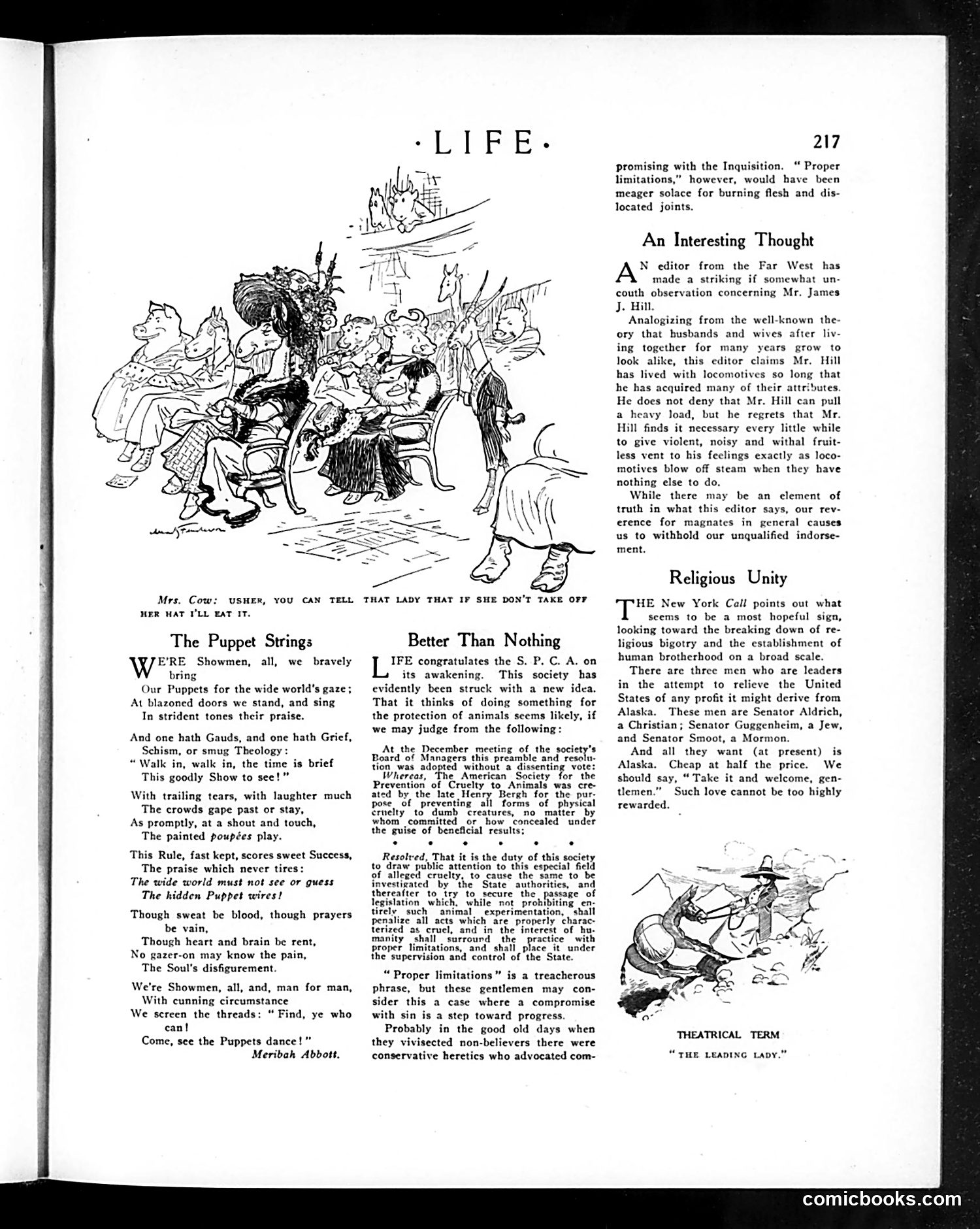
This page contains three satirical pieces: **"The Puppet Strings"** (left, with cartoon): A poem by Meribah Abbott critiques society's showmanship—how people and institutions present false facades to the public while hiding suffering and moral compromise behind the scenes. The accompanying cartoon shows performers manipulating puppet-like figures. **"Better Than Nothing"** (center): Life congratulates the S.P.C.A. (Society for the Prevention of Cruelty to Animals) for finally addressing animal experimentation, but sarcastically dismisses their proposed "proper limitations" as inadequate compromise. The editorial compares permitting regulated vivisection to medieval authorities compromising with the Inquisition—both fail to genuinely protect victims. **"An Interesting Thought"** (right): A humorous piece about railroad magnate James J. Hill, quoting a Far West editor's observation that Hill has become like locomotives through prolonged association—powerful but prone to violent, noisy emotional outbursts without purpose. The page reflects Progressive-era concerns: institutional hypocrisy, animal welfare, and criticism of industrial titans.
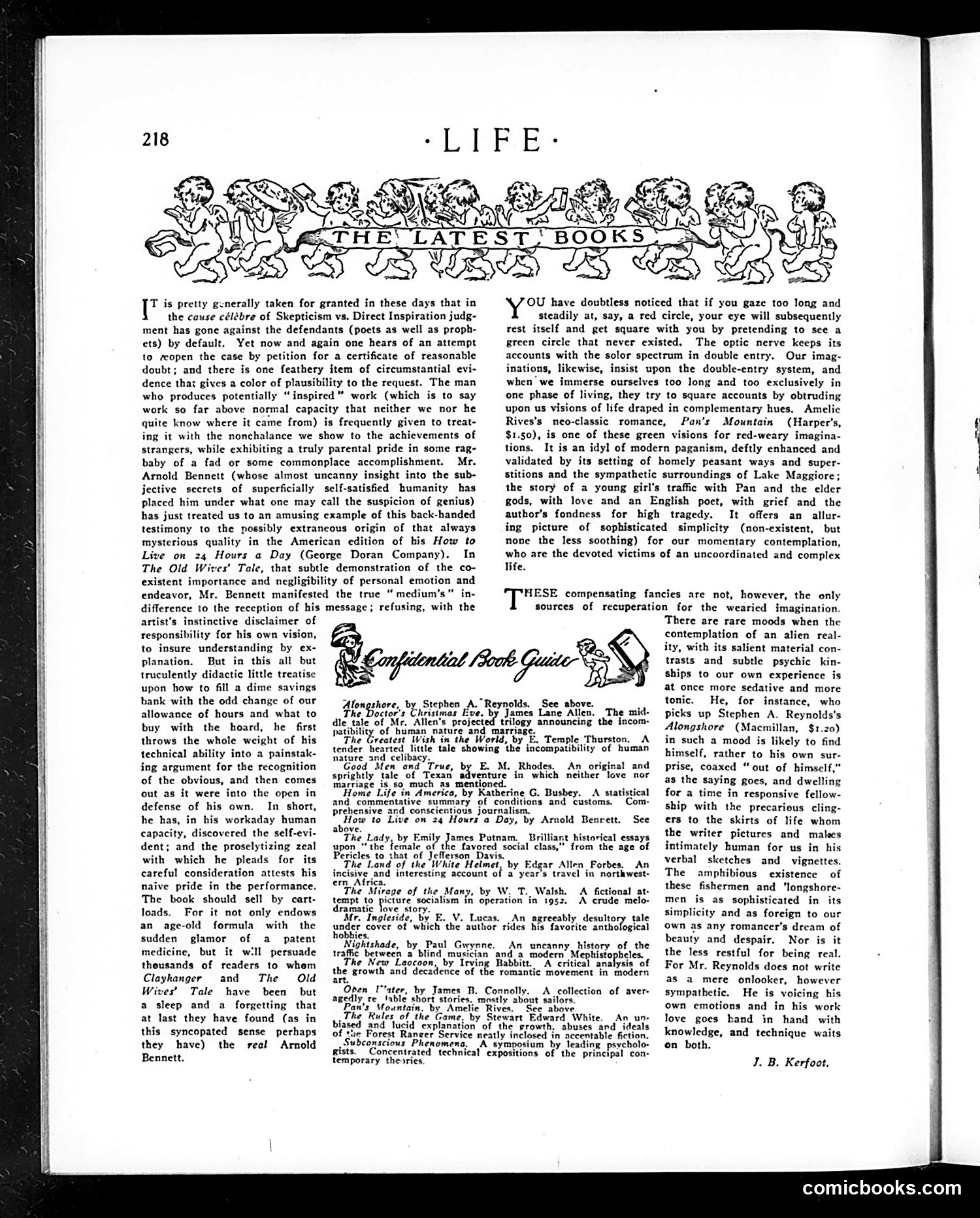
This page from *Life* magazine discusses Arnold Bennett, the British novelist, and his contradictory creative behavior. The satire's point: Bennett demonstrates "inspired" genius in major works like *The Old Wives' Tale*, yet treats them with careless indifference, while lavishing pride on mundane self-help books like *How to Live on 24 Hours a Day*. The author humorously suggests this reversal—caring more about obvious advice than profound art—implies Bennett may be a mere "medium" channeling inspiration unknowingly, rather than a conscious artist. It's gentle mockery of the gap between an artist's actual accomplishments and what he values in his own work. The page also reviews other contemporary books, including Amelie Rives's *Pan's Mountain*, discussing how readers seek compensatory fantasy experiences from literature. The decorative "Cupids" header reading "The Latest Books" frames this as a book review section.
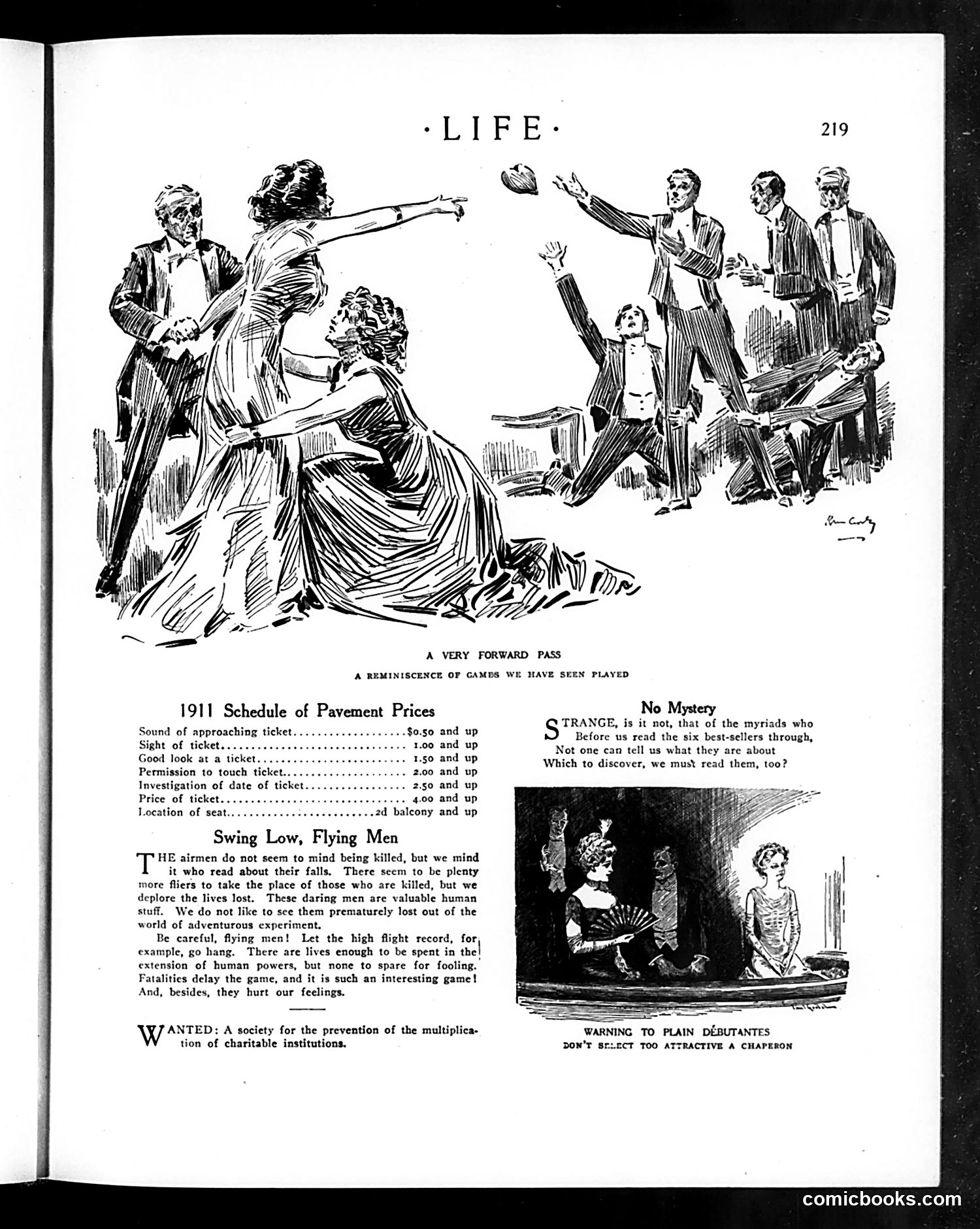
**Top Cartoon - "A Very Forward Pass":** A satirical critique of theater ticket pricing. The sketch shows a woman aggressively approaching men, labeled as a "reminiscence of games we have seen played." The accompanying price list mockingly suggests that experiencing a theater performance requires escalating payments—not just for the ticket itself, but for viewing it, touching it, and discovering its price and seat location. This attacks the practice of hidden fees and price gouging in early 1900s entertainment venues. **"Swing Low, Flying Men":** An editorial commentary mourning aviation fatalities. The piece expresses concern about early airplane crash deaths, acknowledging aviators' courage while urging caution. It suggests fatalities are slowing aviation progress and asks pilots to prioritize safety over record-breaking. **"No Mystery":** A quip about bestselling books—suggesting readers cannot understand what they're about even after finishing them. **Bottom cartoon:** Warns debutantes against choosing overly attractive chaperones, implying such choices create complications.
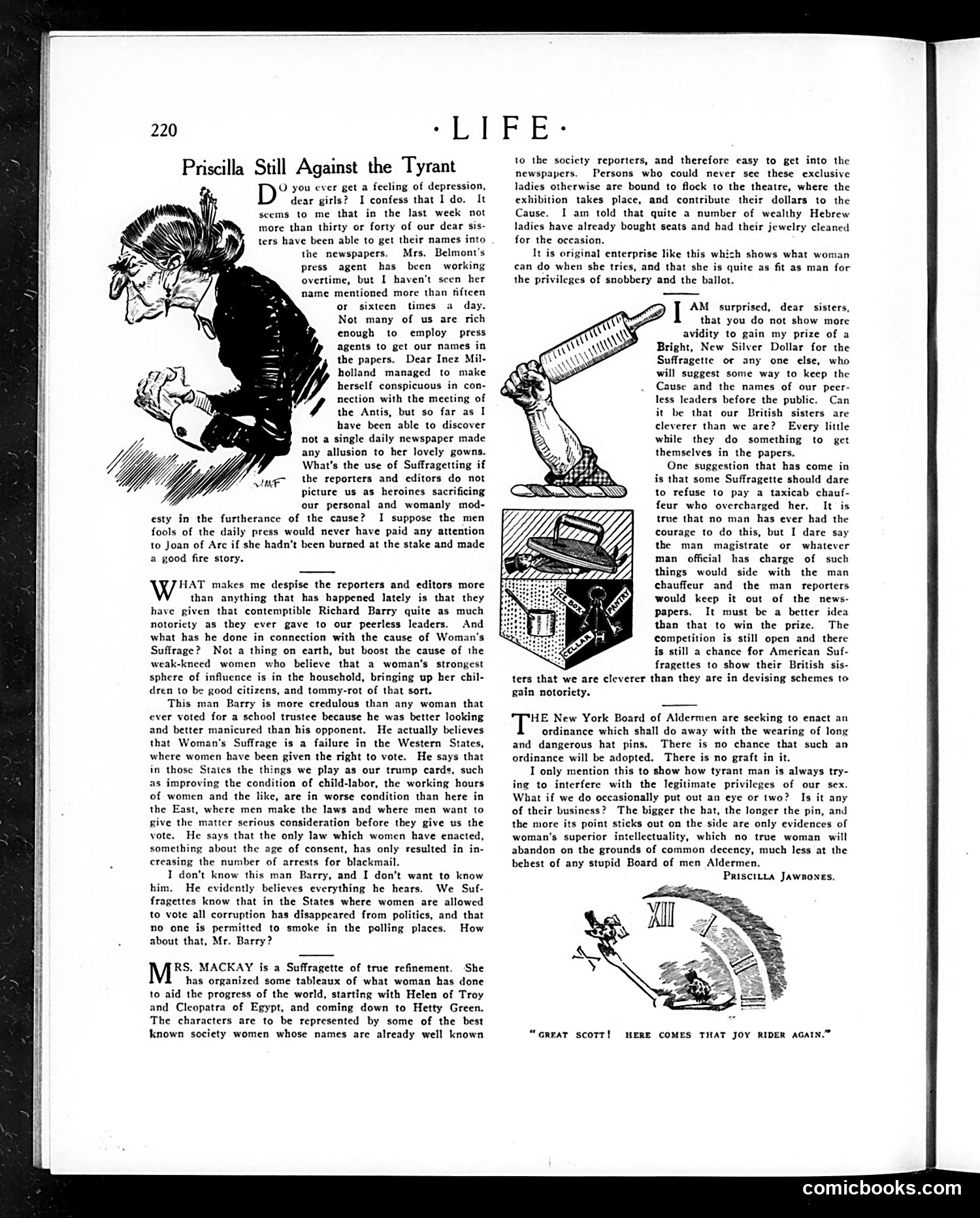
This satirical piece mocks suffragettes' obsession with publicity and their contradictory claims. "Priscilla" (the author's pseudonym) attacks wealthy suffragettes like Mrs. Belmont who employ press agents to gain newspaper coverage, suggesting they care more about fame than actual reform. She ridicules Richard Barry—likely a critic of women's suffrage in Western states—for questioning whether voting women actually improved conditions like child labor. Priscilla defensively claims that where women vote, corruption vanished and smoking is banned at polls (clearly absurd exaggerations). The piece also mocks Mrs. Mackay's fundraising "tableaux" featuring society women as historical figures (Helen of Troy to Hetty Green), suggesting wealthy suffragettes simply want exclusive social events that keep out ordinary women—undermining their democratic claims. The satire suggests the suffrage movement's leaders prioritized high-society respectability and media attention over genuine reform.
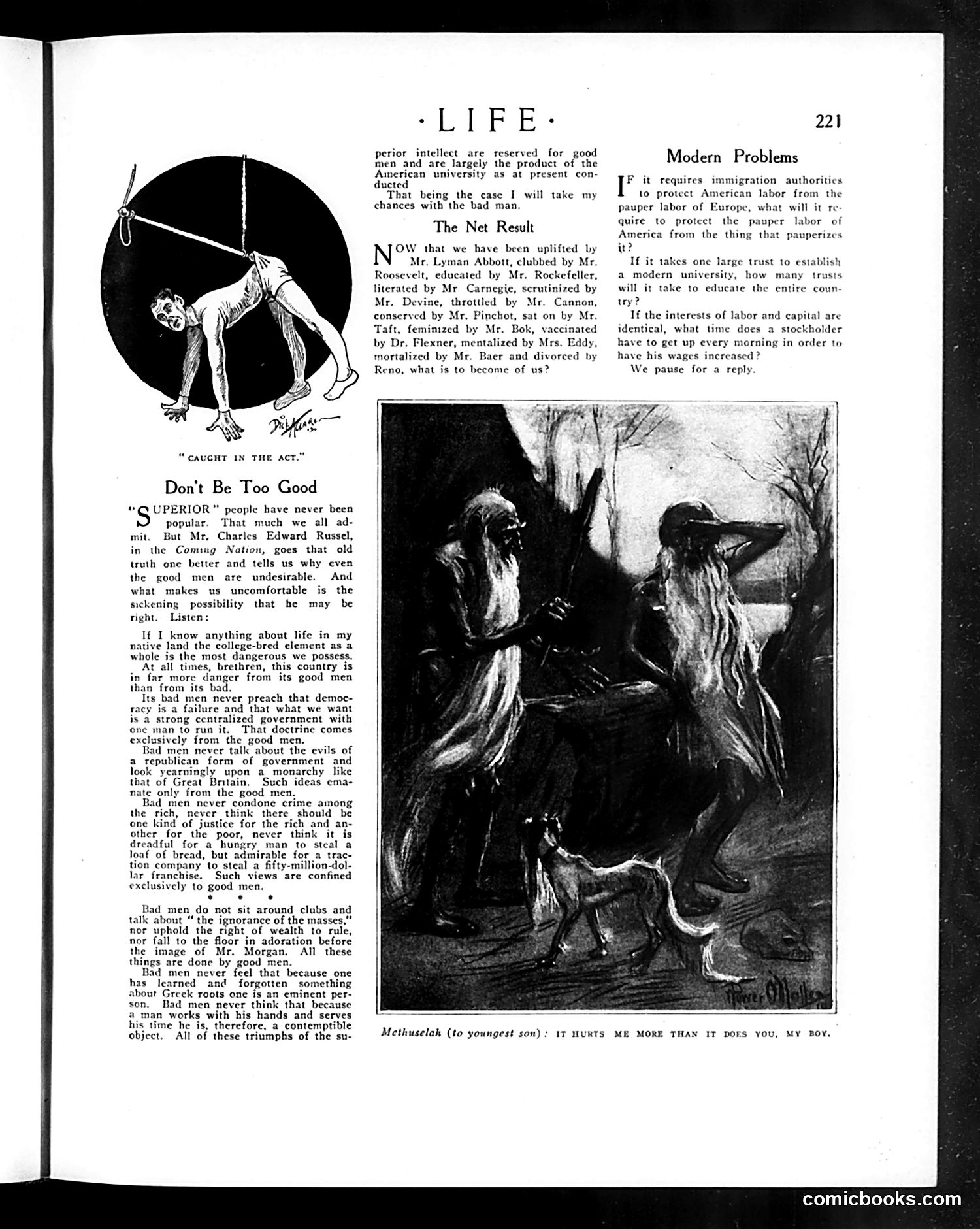
This *Life* magazine page satirizes wealthy philanthropists and politicians who positioned themselves as social reformers while maintaining systems that harmed ordinary people. **"The Net Result"** mocks the contradiction: prominent figures like Lyman Abbott, Theodore Roosevelt, John D. Rockefeller, and Andrew Carnegie—presented as "uplifting" society—paradoxically leave Americans worse off. The sarcastic list suggests their interventions are self-serving rather than genuinely beneficent. **"Don't Be Too Good"** (attributed to Charles Edward Russell) argues that educated elites are *more* dangerous than "bad men" because they rationalize injustice through philosophy: they defend monopolies, mock working people, worship wealth, and create two-tiered justice systems—all while claiming moral superiority. The cartoon "Caught in the Act" (left) appears to show someone trapped or ensnared, likely illustrating how the privileged are caught in their own contradictions. The page reflects Progressive Era skepticism toward wealthy "reformers" whose philanthropy masked exploitation and class contempt.
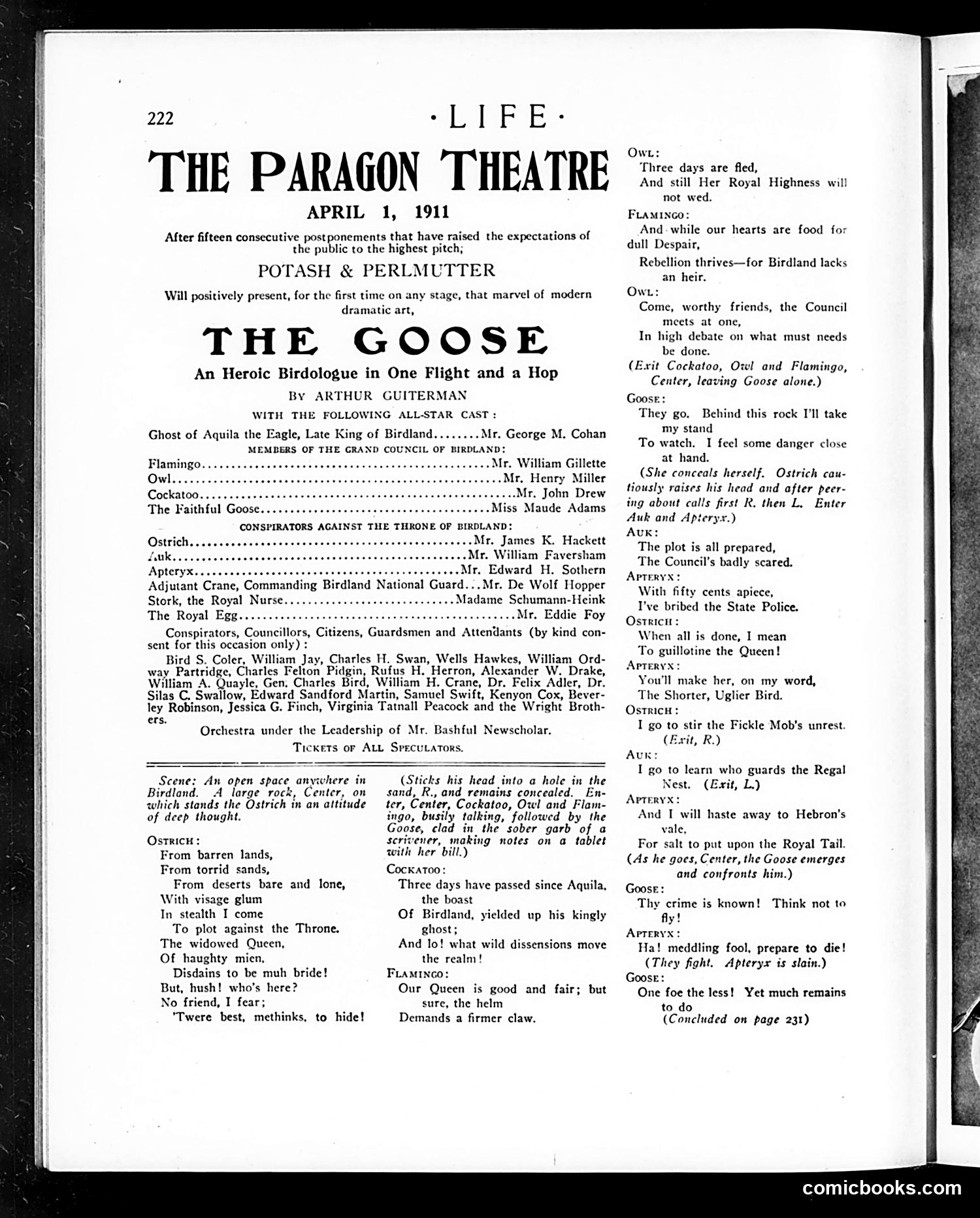
This is a theatrical advertisement for a satirical play debuting April 1, 1911, at the Paragon Theatre. Arthur Guiterman's "The Goose: An Heroic Birdologue" uses anthropomorphic birds to lampoon political instability and succession crises. The plot depicts a power struggle following the death of King Aquila (the eagle—likely representing established authority). A widowed Queen faces conspirators including an Ostrich, Apteryx, and Auk plotting her overthrow and murder. The Goose—a humble court scribe—discovers and opposes this conspiracy. The satirical point appears to be commentary on political upheaval and the unexpected heroism of ordinary citizens. The all-star cast (George M. Cohan, William Gillette, John Drew, Maude Adams) advertises prestige. The "fifteen consecutive postponements" likely references real theatrical delays, adding humorous meta-commentary about the production itself.
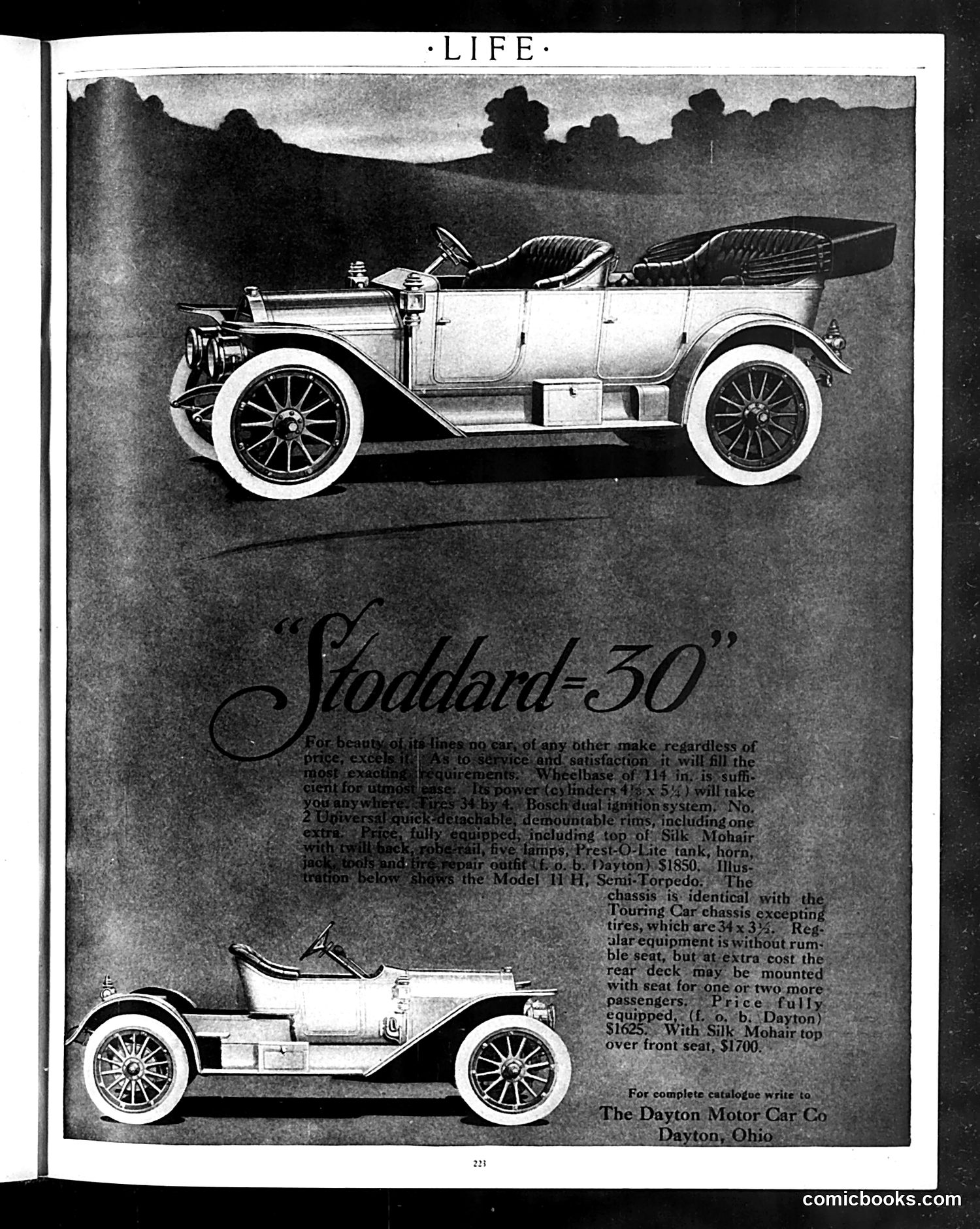
This is not a cartoon or satire page. It's a **straightforward automobile advertisement** from *Life* magazine for the Stoddard-30 automobile, manufactured by the Dayton Motor Car Co. in Dayton, Ohio. The page features two side-view illustrations of the vehicle—a touring car model shown from different angles—along with detailed specifications about its engine (4½x5½ cylinders), wheelbase (114 inches), equipment, and pricing ($1,625-$1,700 depending on configuration). There is no political satire, caricature, or social commentary present. This is period advertising copy typical of early 20th-century automotive trade publications, emphasizing the vehicle's engineering features and reliability to potential buyers.
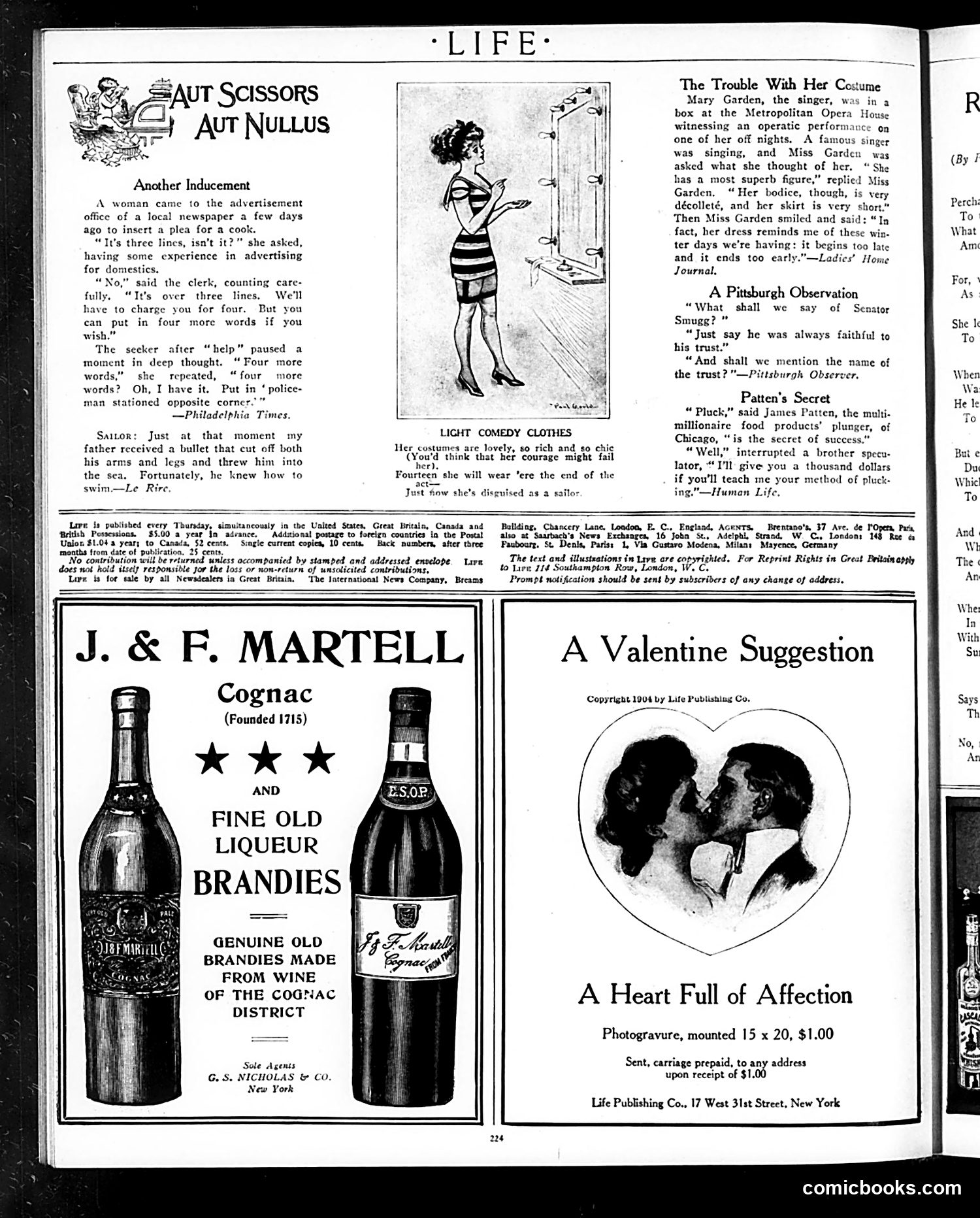
This page from *Life* magazine contains satirical humor pieces typical of early 1900s American comedy journalism: **"Another Inducement"** jokes about advertising inefficiency. A woman seeking a cook wants to add the phrase "policeman stationed opposite corner"—implying she needs to advertise that police protection is available, sarcastically suggesting domestic help is so scarce (or undesirable) that extra incentives are necessary. **"Light Comedy Clothes"** mocks a woman's scanty outfit by comparing it to winter weather: her dress "begins too late and ends too early"—a double entendre about both her clothing's brevity and its seasonal inappropriateness. **"A Pittsburgh Observation"** satirizes political corruption. A senator is praised for faithfulness to "his trust," but when asked to name which trust, the joke implies he's beholden to corporate monopolies rather than constituents. **"Patten's Secret"** plays on homophonic wordplay: "pluck" (determination) versus "plucking" (swindling)—James Patten was a real Chicago commodities speculator known for market manipulation. The page is otherwise advertisements for Martell Cognac and a Valentine's Day photograph.
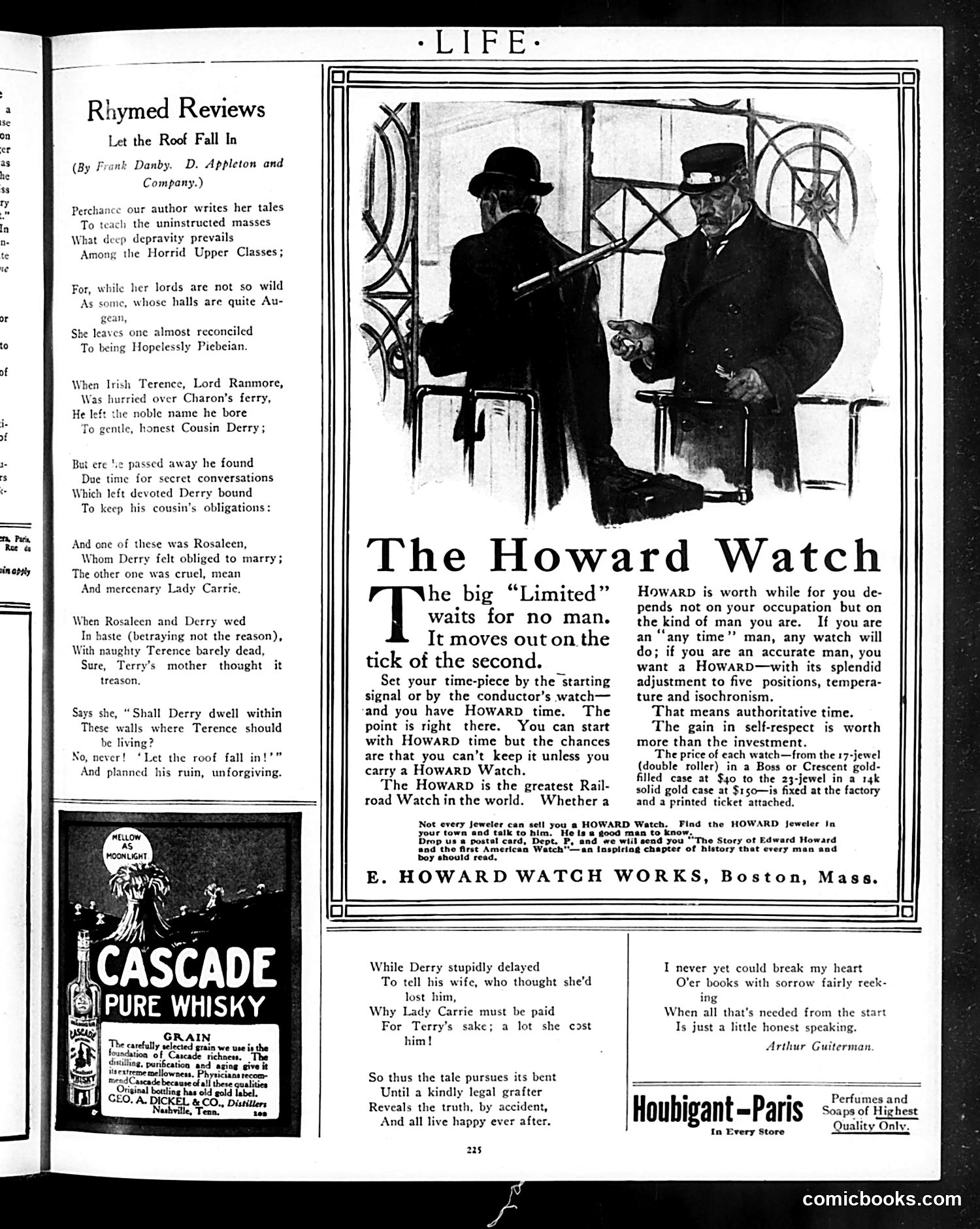
This page contains a rhymed book review of Frank Danby's novel about Irish aristocracy and social obligation. The reviewer uses verse to summarize a melodramatic plot: an Irish nobleman dies, leaving his cousin Derry obligated to marry two women—virtuous Rosaleen (whom he loves) and mercenary Lady Carrie (whom he owes money to). Derry's mother, outraged that he'd live in the family house after marrying beneath his station, declares "Let the roof fall in!"—essentially wishing ruin upon him. The satire targets both the novel's overwrought sentimentality and Victorian upper-class pretensions. Reviewer Arthur Guiterman criticizes overly sentimental literature, noting he can't get worked up over books that just need "a little honest speaking." The title itself is ironic—the dramatic threat comes to nothing. The page also includes period advertisements (Howard Watch, Cascade Whisky, Houbigant Perfume), typical of Life magazine's format.
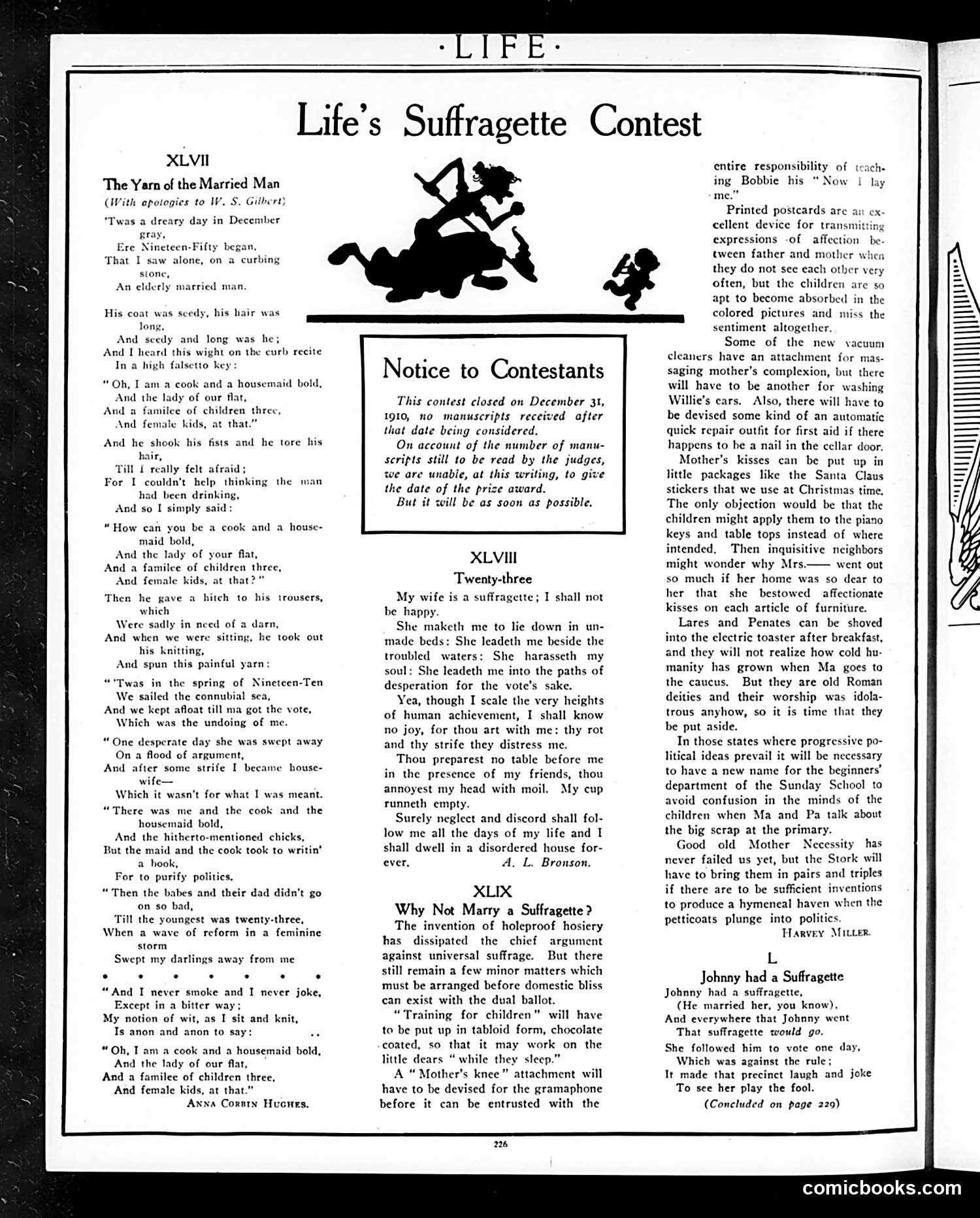
This page satirizes the women's suffrage movement through humorous poetry contests. The central cartoon depicts a disheveled married man, representing the feared consequence of female voting rights. The satirical pieces mock anti-suffrage anxieties: "The Yarn of the Married Man" presents a husband reduced to cooking and housework after his wife gained the vote in 1910, his life destroyed by "waves of reform." The parody of religious psalms ("Twenty-three") portrays a suffragette wife as an instrument of domestic chaos and neglect. "Why Not Marry a Suffragette?" sarcastically lists absurd "solutions" needed before suffragettes can be wives—including tabloid child-rearing instructions and gramaphone attachments. The humor targets contemporary fears that women voting would abandon domestic duties, destroy marriages, and create chaos at home. These pieces represent *anti-suffrage* satire—mocking both the movement and male anxieties about women's independence and political power threatening traditional gender roles.
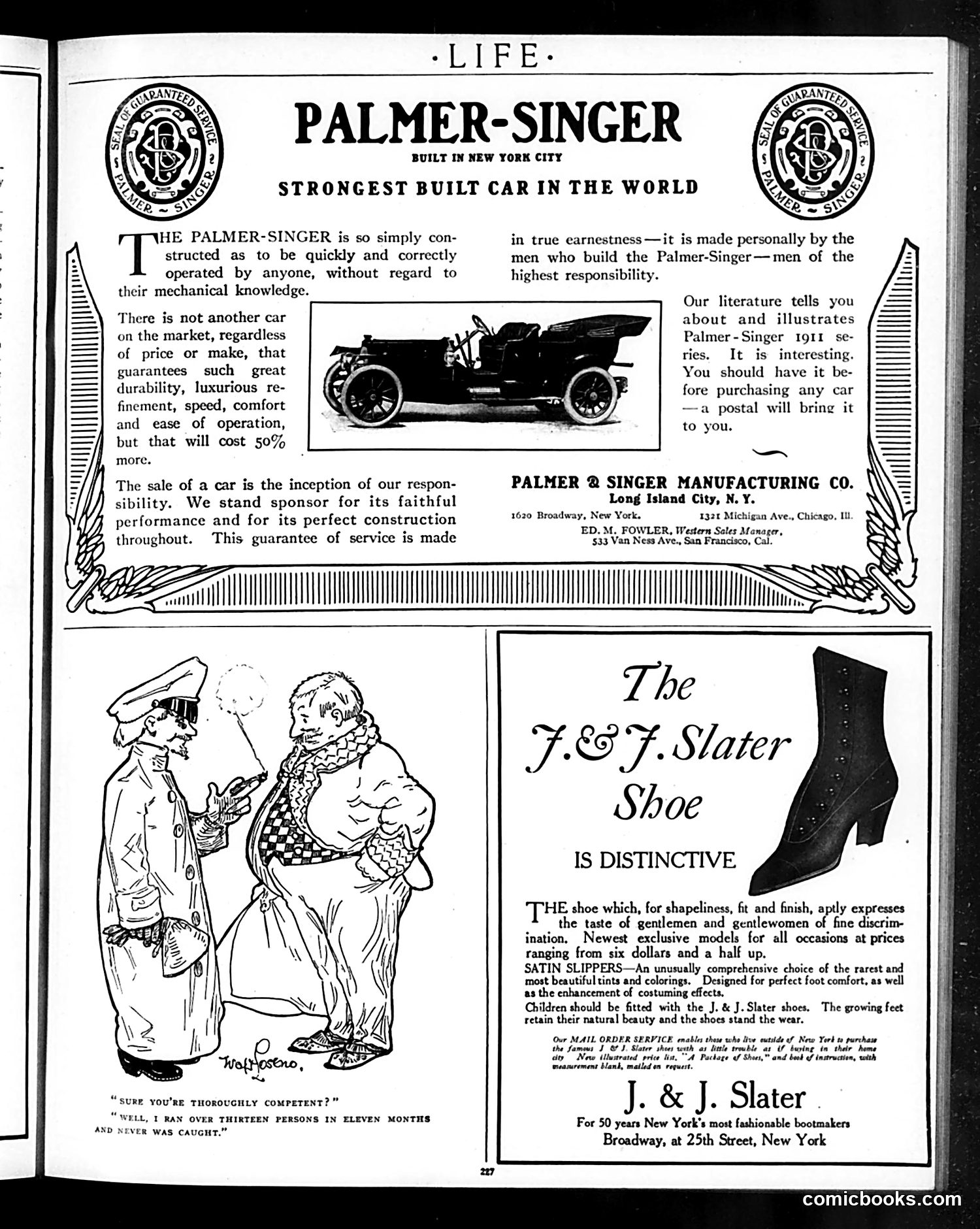
This page consists primarily of **advertisements**, not political satire. The Palmer-Singer automobile ad dominates the top half, marketing a 1911 car built in New York City as "the strongest built car in the world," emphasizing durability and ease of operation. Below is a **cartoon joke** (caption: "Sure you're thoroughly competent?") showing two figures in 18th-century dress. One boasts of running over thirteen people in eleven months without being caught—a dark humor joke about reckless driving. This appears to be commentary on the dangers of early automobiles and unaccountable operators, presented as absurdist comedy. The right side advertises **J. & J. Slater shoes**, marketed as fashionable footwear for discriminating New Yorkers. The page reflects early 1910s consumer culture and emerging anxieties about automobile safety.
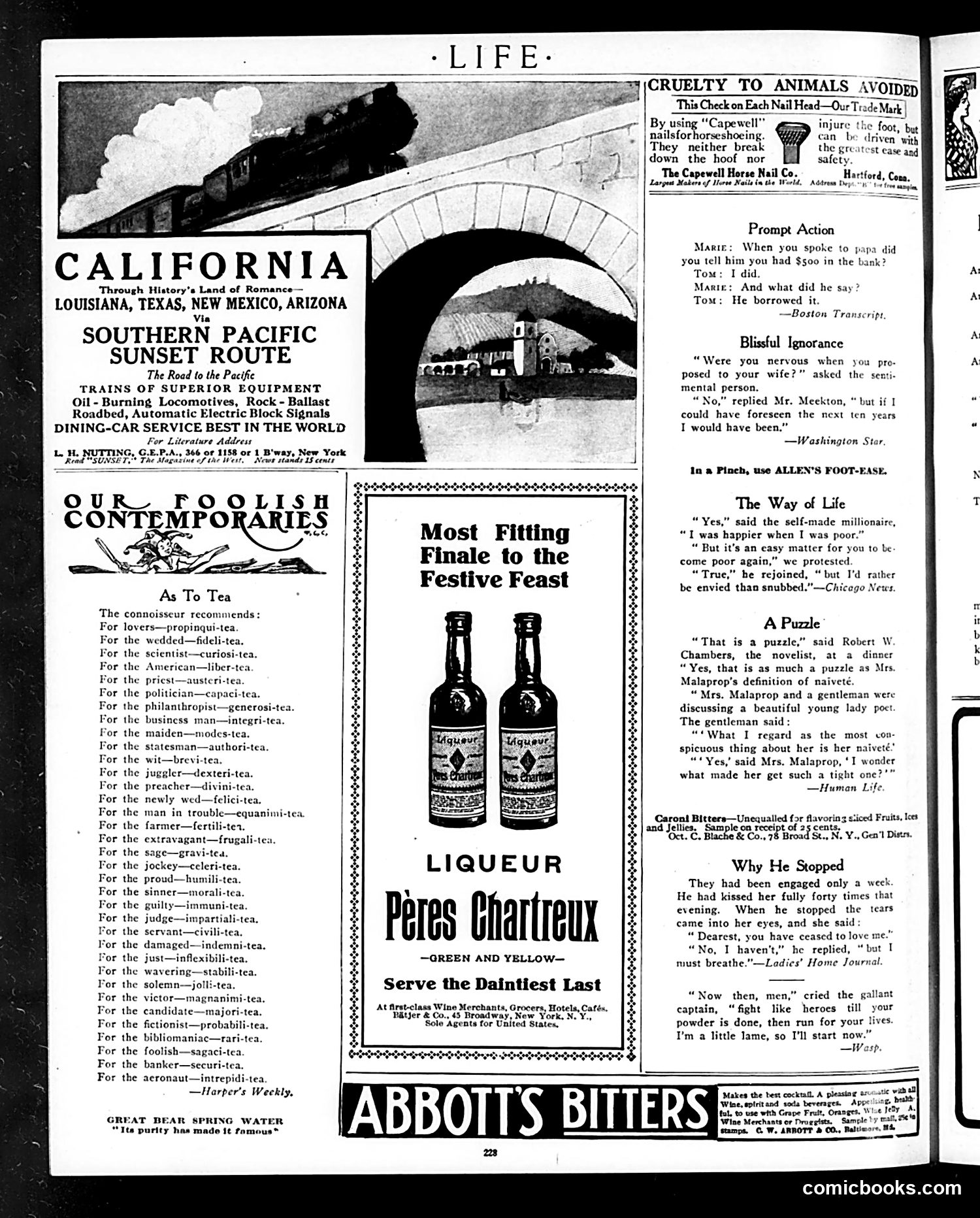
This page is primarily **advertising and humor columns** rather than political cartoons. The content includes: **Main Features:** - Railroad and liqueur advertisements (Southern Pacific, Pères Chartreaux liqueur, Abbott's Bitters) - A "Foolish Contemporaries" humor column with tea-themed puns ("propinqui-tea" for lovers, "integri-tea" for businessmen, etc.) - Brief humorous anecdotes about marriage, wealth, and romance **The Jokes:** These are gentle domestic humor pieces typical of early 20th-century Life magazine—a wealthy man borrows money from his fiancé; a self-made millionaire misses poverty; a couple's engagement consists mainly of kissing. **No Political Satire:** Unlike Life's famous political cartoons, this page contains no caricatures of public figures or political commentary. It's lifestyle advertising and light social humor aimed at middle-class readers, reflecting period attitudes about courtship, money, and propriety. The "Cruelty to Animals Avoided" box at top is a product advertisement for horseshoe nails.
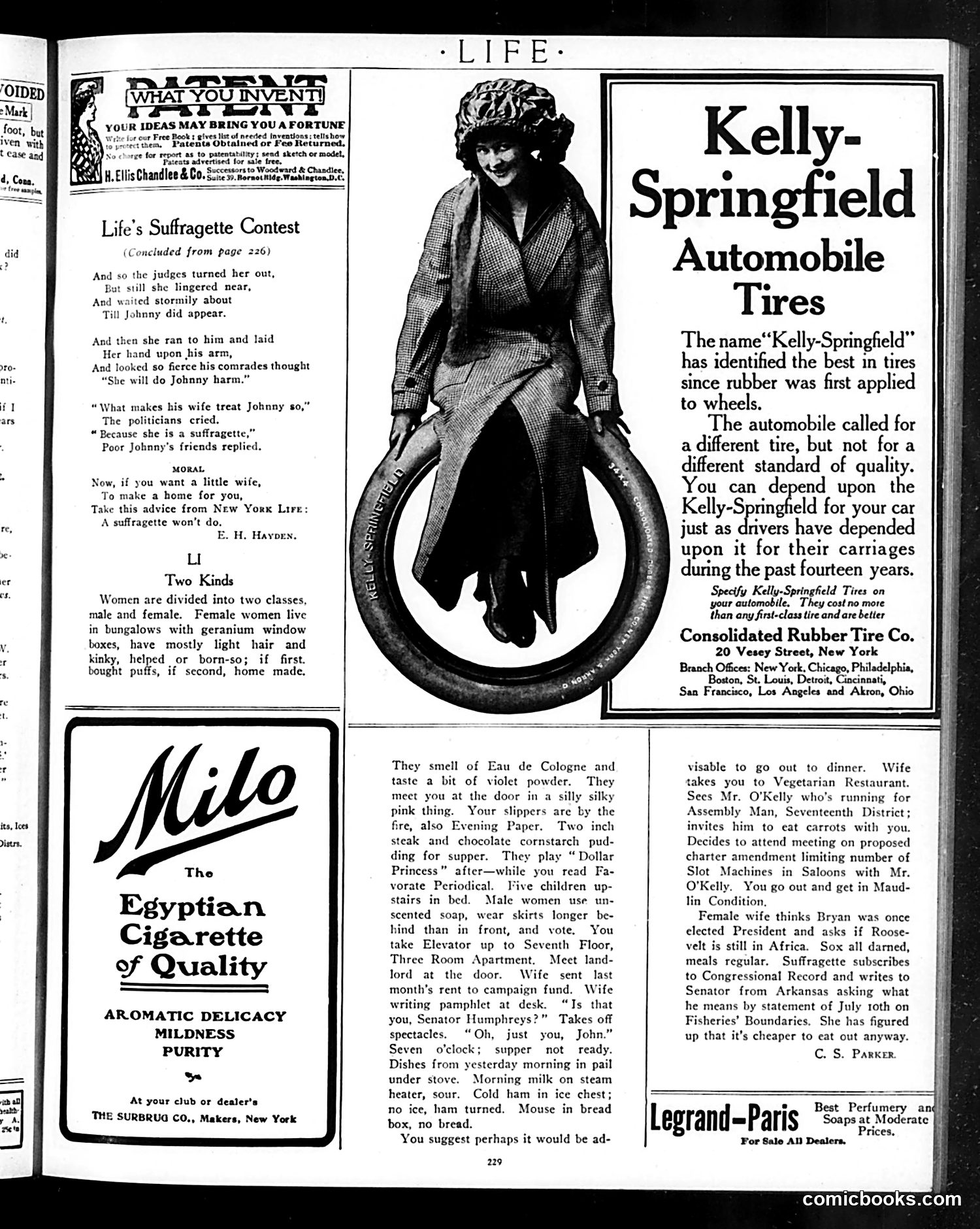
This page satirizes the early 20th-century women's suffrage movement through contrasting "two kinds" of women. The main poem "Life's Suffragette Contest" depicts a suffragette wife physically attacking her husband Johnny for unknown reasons—the joke being that her political activism makes her an unfit wife. The accompanying essay "Two Kinds" divides women into "female women" (traditional homemakers: decorative, domestic, child-rearing) and "male women" (suffragettes who vote, read newspapers, attend political meetings, neglect housework). The satire's point: suffragettes are unfeminine, bad housekeepers, and neglectful spouses. A detailed example contrasts a traditional wife who serves proper meals with a suffragette wife whose kitchen contains spoiled food and dead mice—implying political engagement destroys domestic competence. The humor relies on anti-suffrage arguments common before women gained voting rights (1920): that female suffrage would harm families and society by making women masculine and negligent of their "natural" domestic roles.
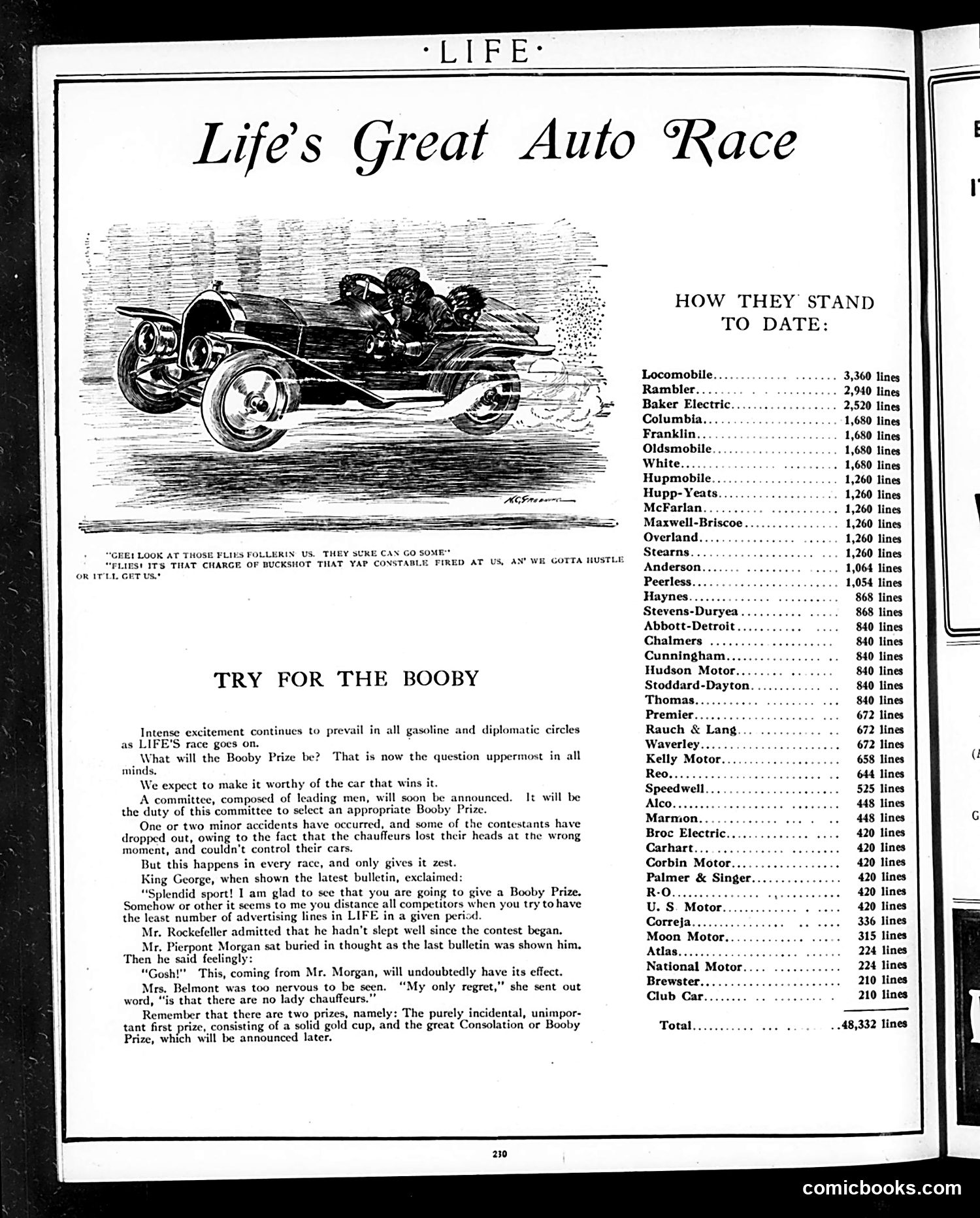
This page satirizes an ongoing competition in *Life* magazine tracking which automobile brand receives the most advertising lines. The "race" humorously treats advertising as a competitive sport, with a leaderboard showing Locomobile leading with 3,360 lines. The cartoon depicts a reckless driver fleeing from constables, captioned with dialect humor about buckshot and evading arrest—a visual metaphor for the frantic competition itself. The satire mocks wealthy industrialists' obsession with the contest: King George approves, Rockefeller can't sleep, J.P. Morgan feels moved to comment, and Mrs. Belmont regrets the lack of "lady chauffeurs." The joke is that advertisers compete so intensely for magazine space that *Life* ironically announces a "Booby Prize" (consolation prize) for whoever advertises *least*—turning corporate vanity into absurdist comedy while simultaneously promoting the magazine's advertising appeal.
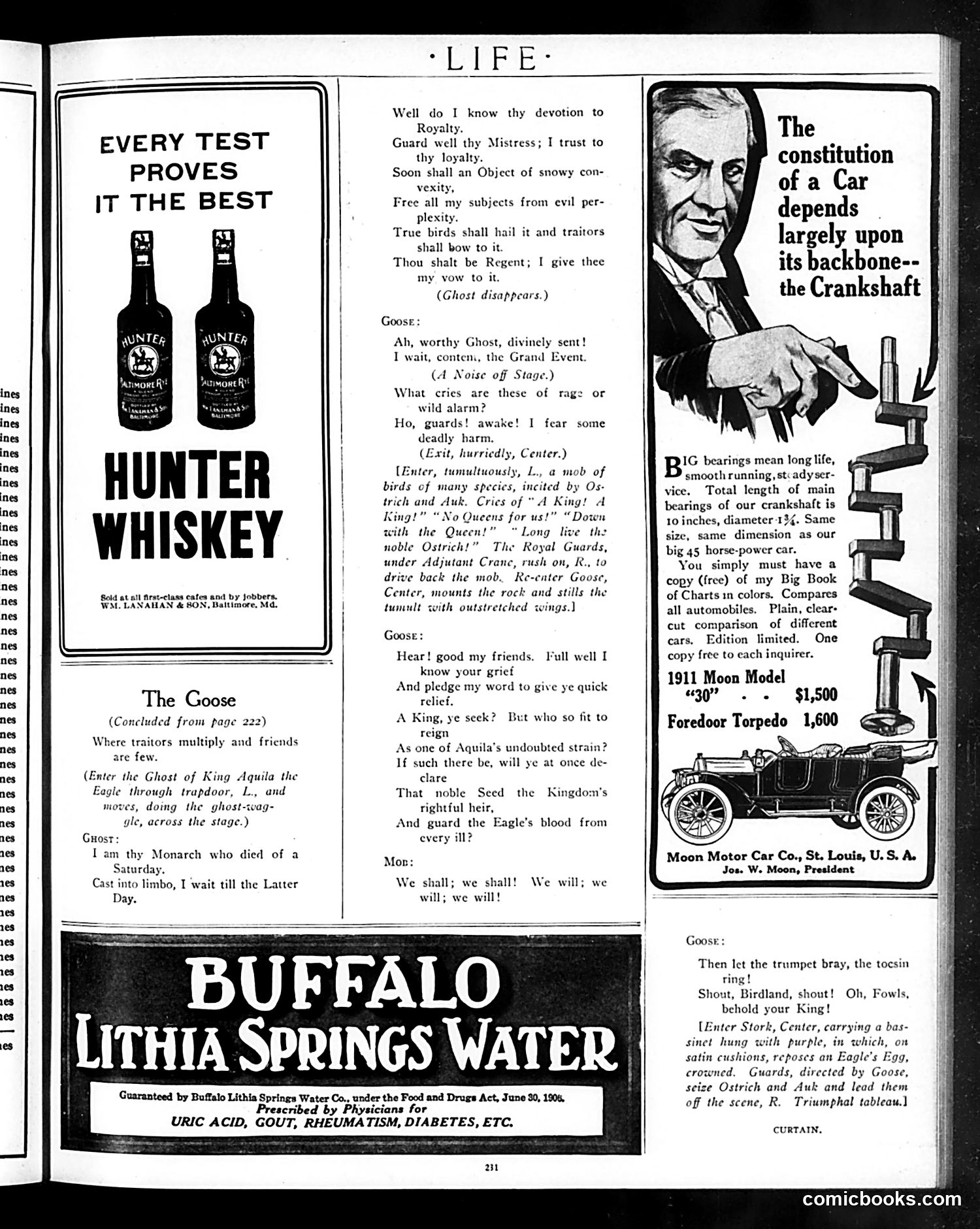
This page combines theatrical content with period advertising. The main feature is "The Goose," a multi-act theatrical play (concluded from page 222) that uses bird characters as political allegory. The plot involves a kingdom of birds seeking a rightful heir to their deceased monarch, King Aquila (the Eagle). A goose serves as regent, managing competing factions—an ostrich and auk inciting mob unrest—until a legitimate successor appears in the form of an eagle's egg. The satire likely comments on succession disputes and political legitimacy, though the specific historical reference remains unclear without earlier context. The advertisements—Hunter Whiskey, Moon automobiles, and Buffalo Lithia Springs Water—are typical of Life's commercial content from this era, positioning luxury products as markers of quality and health.
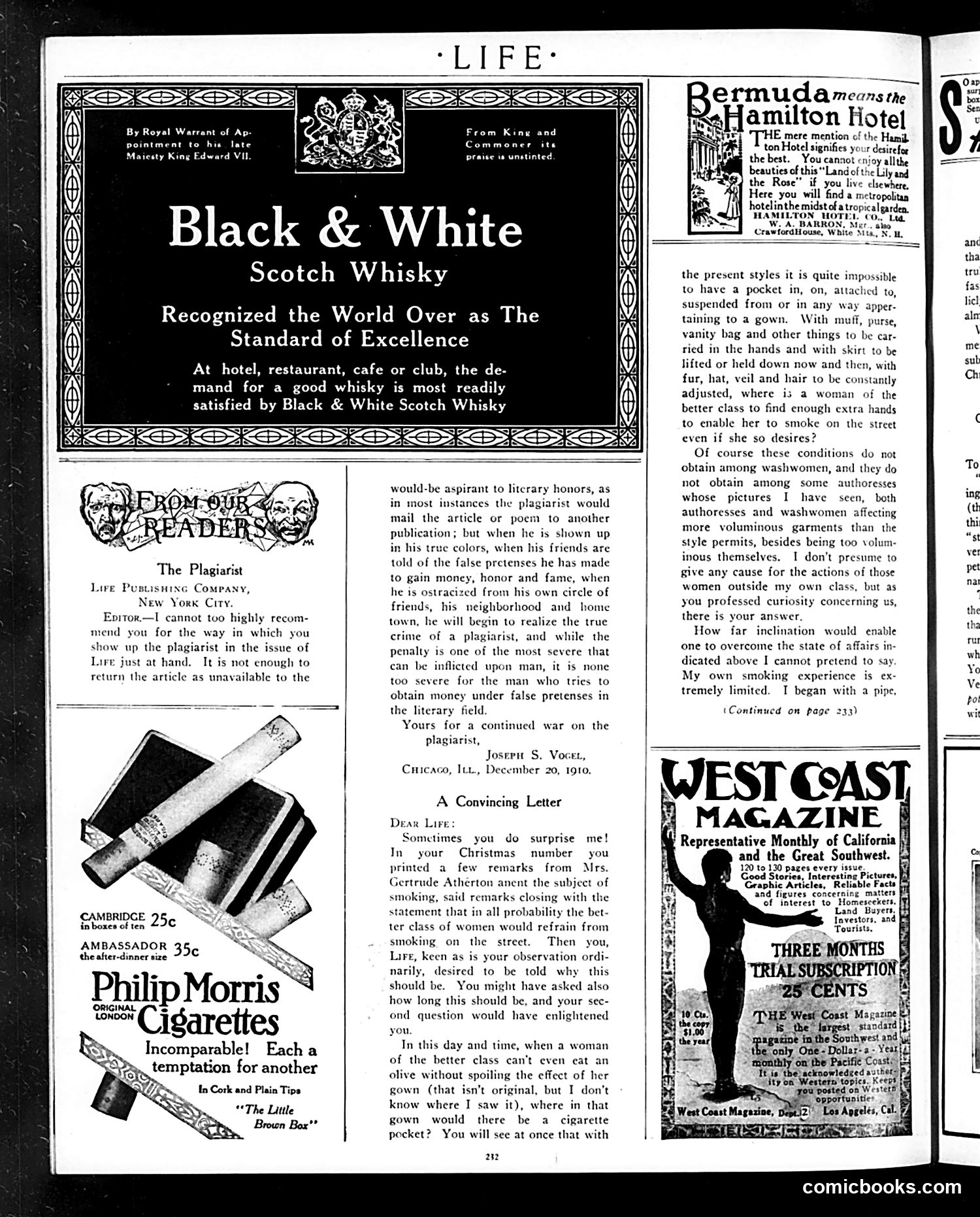
This page is primarily **advertisements and readers' letters**, not political satire. The main content includes: 1. **Black & White Scotch Whisky ad** — a luxury liquor advertisement claiming royal endorsement 2. **"The Plagiarist" letter** — a reader praising *Life* for exposing literary plagiarism and calling for public shaming of plagiarists 3. **Philip Morris Cigarettes ad** — marketing cigarettes as desirable luxuries 4. **A reader's letter on women smoking** — a woman responds to an earlier article (apparently by Gertrude Atherton) arguing that upper-class women cannot smoke in public because modern fashions lack pockets, requiring hands for muffs, purses, and skirts. She notes working-class women and unconventional authoresses face no such constraints. The social commentary reflects early 1900s class anxieties: concerns about literary theft, marketing of vice, and *gendered* restrictions on women's public behavior based on fashion and social standing.
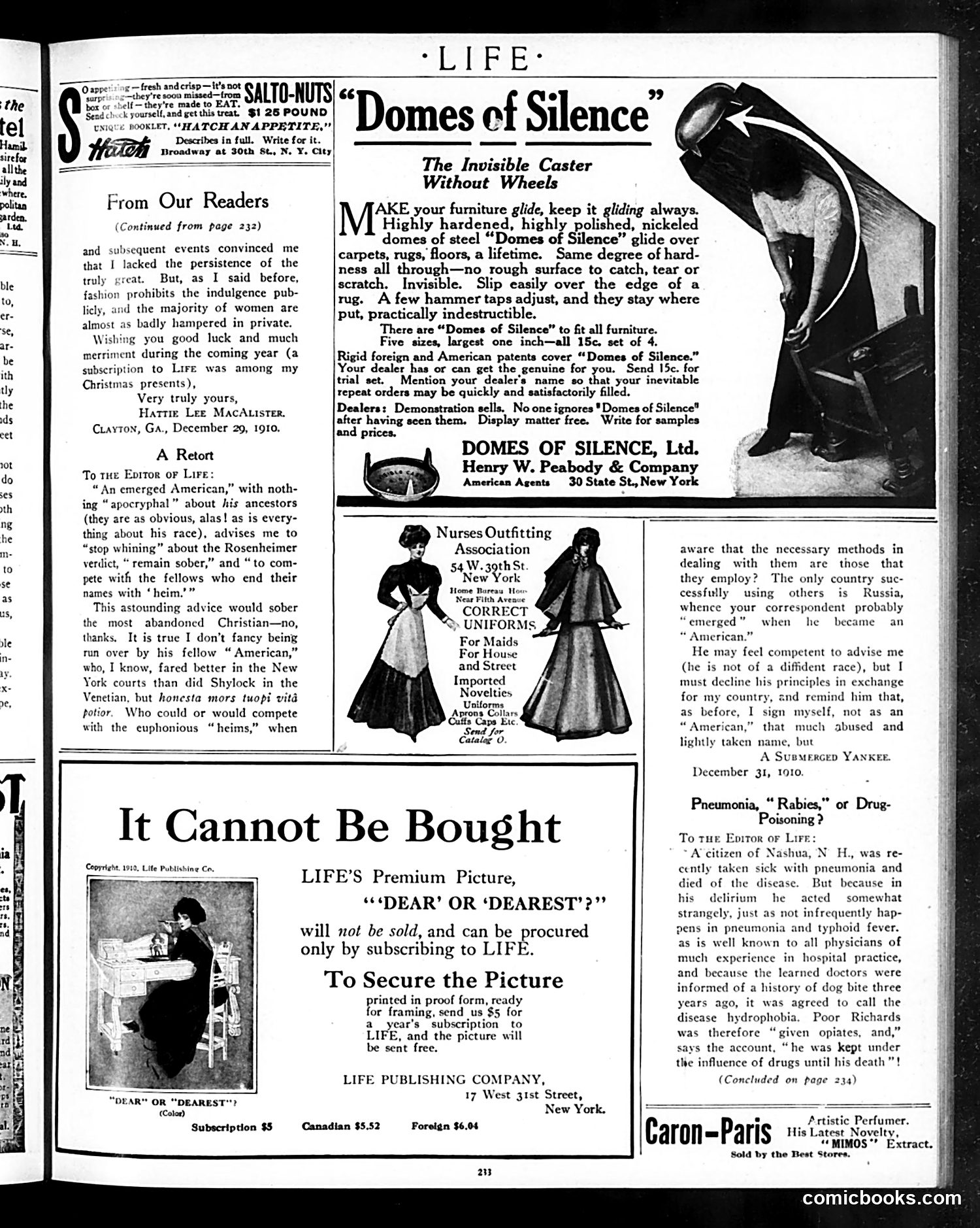
This page is primarily **advertising and reader letters**, not political satire. The main content includes: **Reader Letters**: Two letters debate American identity and immigrant assimilation. "A Submerged Yankee" responds defensively to an earlier letter from "An Emerged American" about the Rosenheimer verdict (a legal case). The Yankee letter contains **antisemitic undertones**, referencing "fellows who end their names with 'heim'" (implying German-Jewish immigrants) and invoking Shylock from *The Merchant of Venice*—a classic antisemitic trope. This reflects early 1900s nativist anxieties about immigration and cultural assimilation. **Advertisements**: The page features product ads for Salto-Nuts, Domes of Silence (furniture glides), nurse uniforms, and a premium picture ("Dear or Dearest?") available only to Life subscribers. No cartoon or satire appears on this page. The "satire" lies in the letters themselves—reflecting genuine contemporary prejudices rather than mocking them.
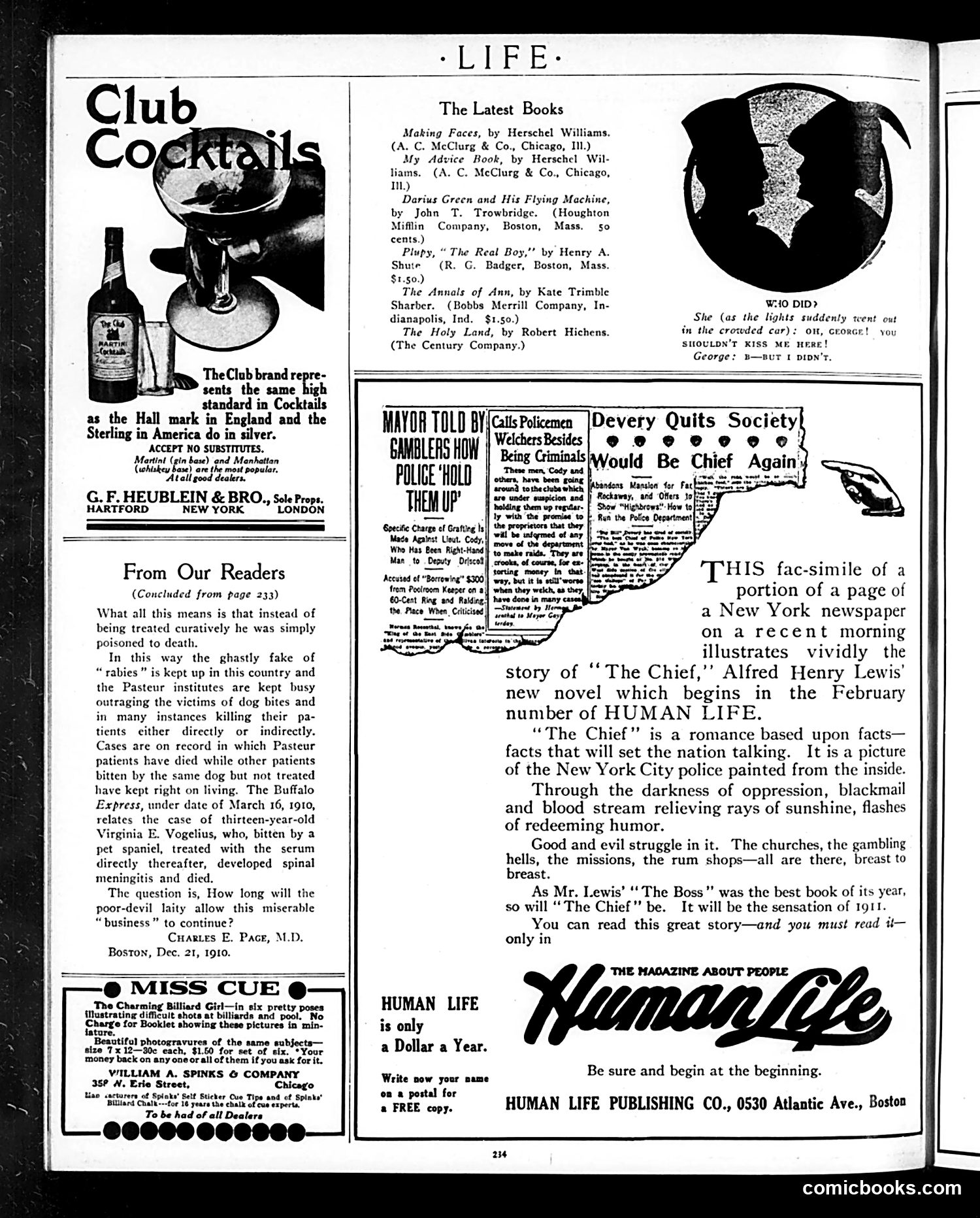
This page mixes advertisements with editorial content from 1910. The main cartoon appears in the upper right: a silhouetted couple in a darkened streetcar, with the woman saying "Oh, crocus! you shouldn't kiss me here!" and the man responding "B—but I didn't." The joke relies on a double misunderstanding—the woman assumes the man kissed her when the lights went out, but he denies it, leaving ambiguity about what actually happened. This plays on era-typical anxieties about impropriety in public spaces and the darkness enabling anonymous misbehavior. The page also features a reader's letter criticizing the Pasteur Institute's rabies treatment as ineffective and dangerous, promoting anti-vaccination skepticism common in that period. Below that are advertisements for billiard instruction, cocktails, and notably, promotion of Alfred Henry Lewis's serialized novel "The Chief" about New York City police corruption—presented as sensational, scandalous fiction.
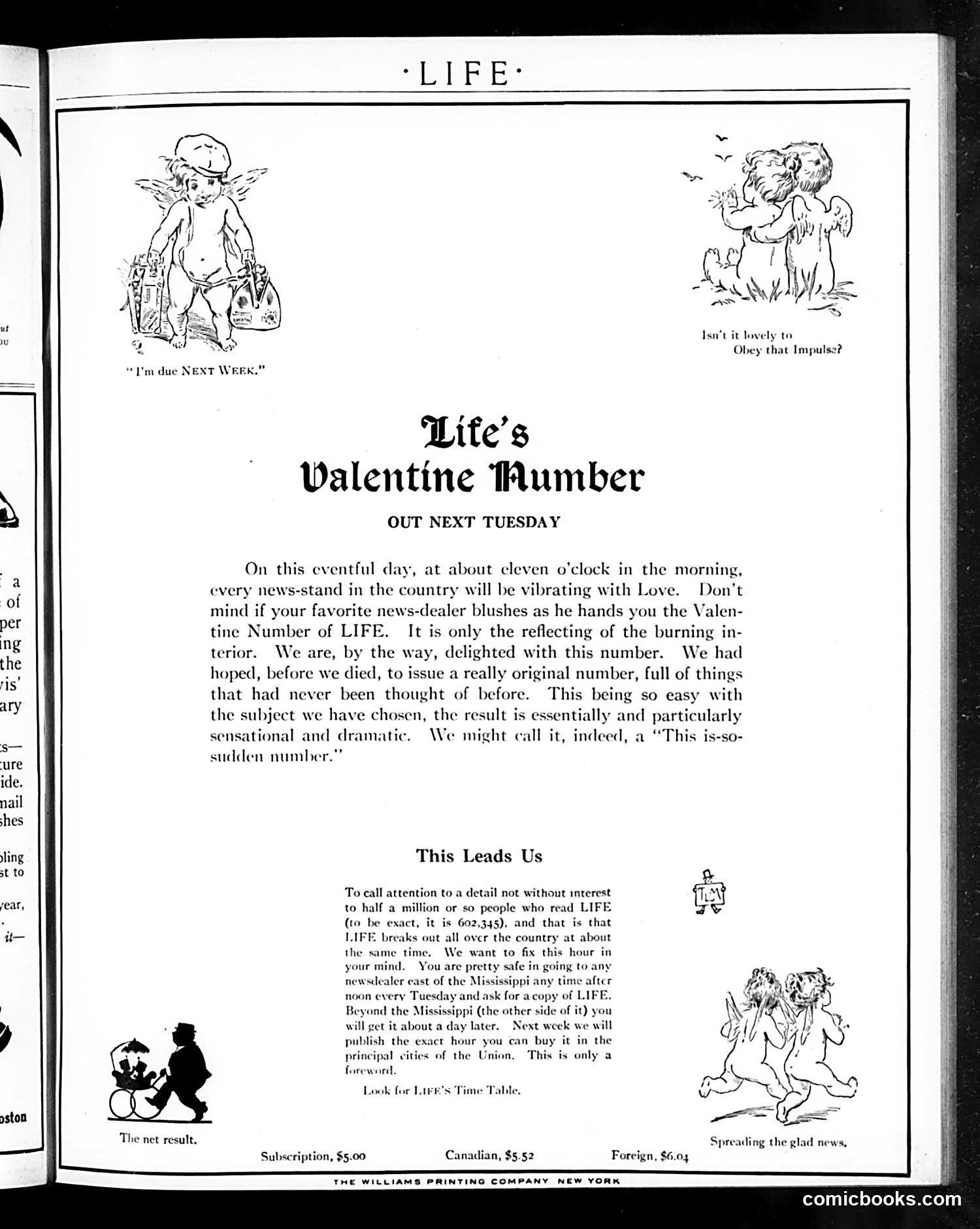
This is a promotional page announcing Life magazine's upcoming Valentine's Day special issue. The page uses playful cherub illustrations and light humor to advertise the edition. The top cartoons depict cupids: one carrying shopping bags saying "I'm due NEXT WEEK" (suggesting last-minute Valentine's purchases), and another labeled "Isn't it lovely to Obey that Impulse?" (encouraging spontaneous buying). The main text humorously boasts that Life achieved originality with a Valentine-themed issue—something they claim had "never been thought of before"—and calls it a "This-is-so-sudden number," playing on the romantic cliché. The practical section "This Leads Us" addresses distribution logistics, noting Life reaches approximately 602,345 readers across the country. It promises simultaneous nationwide release on Tuesday at noon east of the Mississippi, with a one-day delay westward. Small illustrations show cupids "spreading the glad news." This is essentially a self-promotional advertisement announcing the special issue's availability and subscription rates.
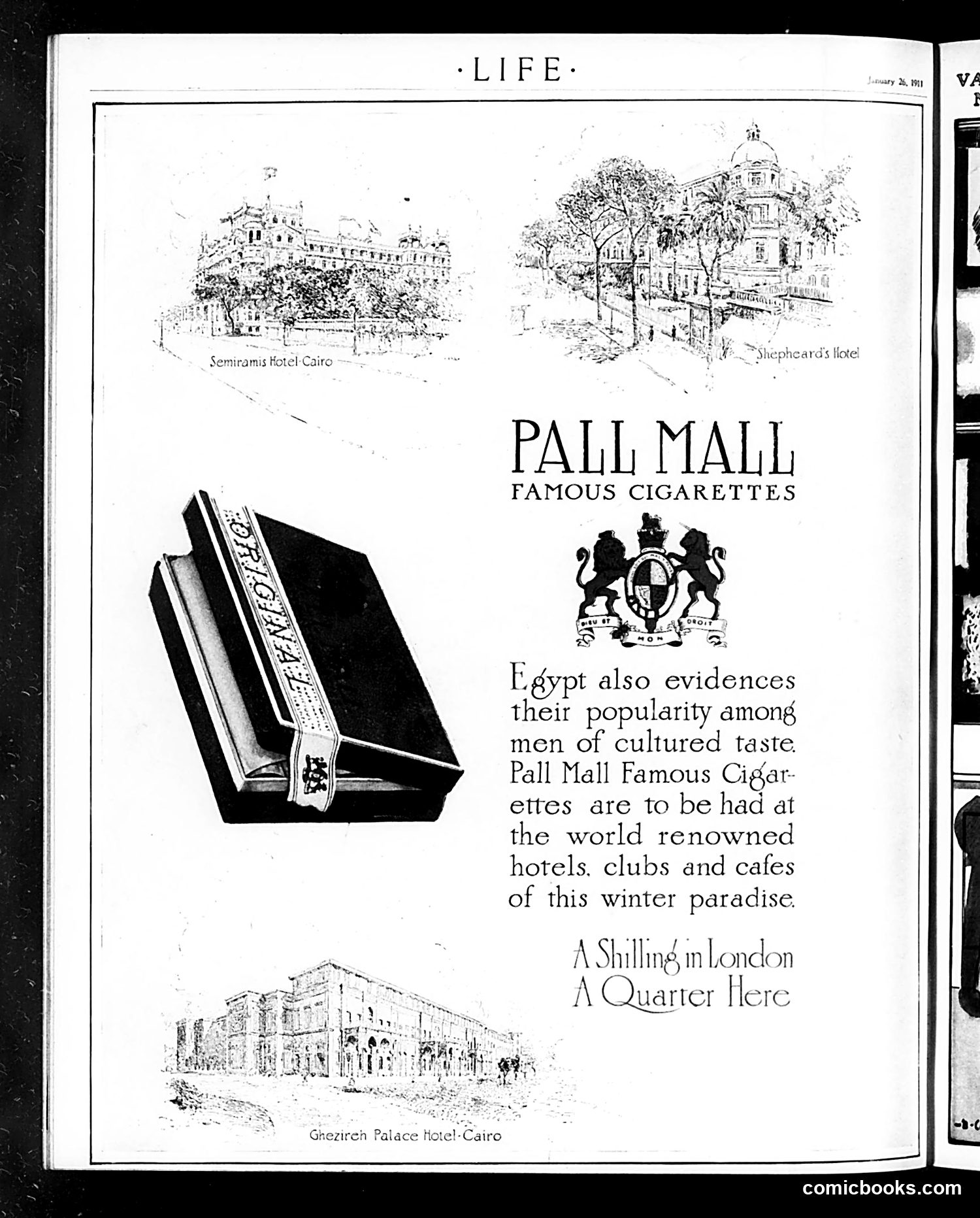
This is a Pall Mall cigarette advertisement, not a political cartoon. The page features architectural sketches of luxurious Egyptian hotels (Semiramis Hotel Cairo, Shepherd's Hotel, and Ghezireh Palace Hotel) to establish an upscale setting. The ad targets wealthy, cultured men by associating the cigarettes with exclusive venues in Egypt—then a fashionable winter destination for the British elite. The price notation ("A Shilling in London / A Quarter Here") suggests this appeared in a British publication, emphasizing the product's availability in prestigious international locations. The heraldic crest reinforces the brand's sophistication and status appeal.