
Life, 1911-01-26 · page 14 of 44
Life — January 26, 1911 — page 14: what you’re looking at
What you’re looking at
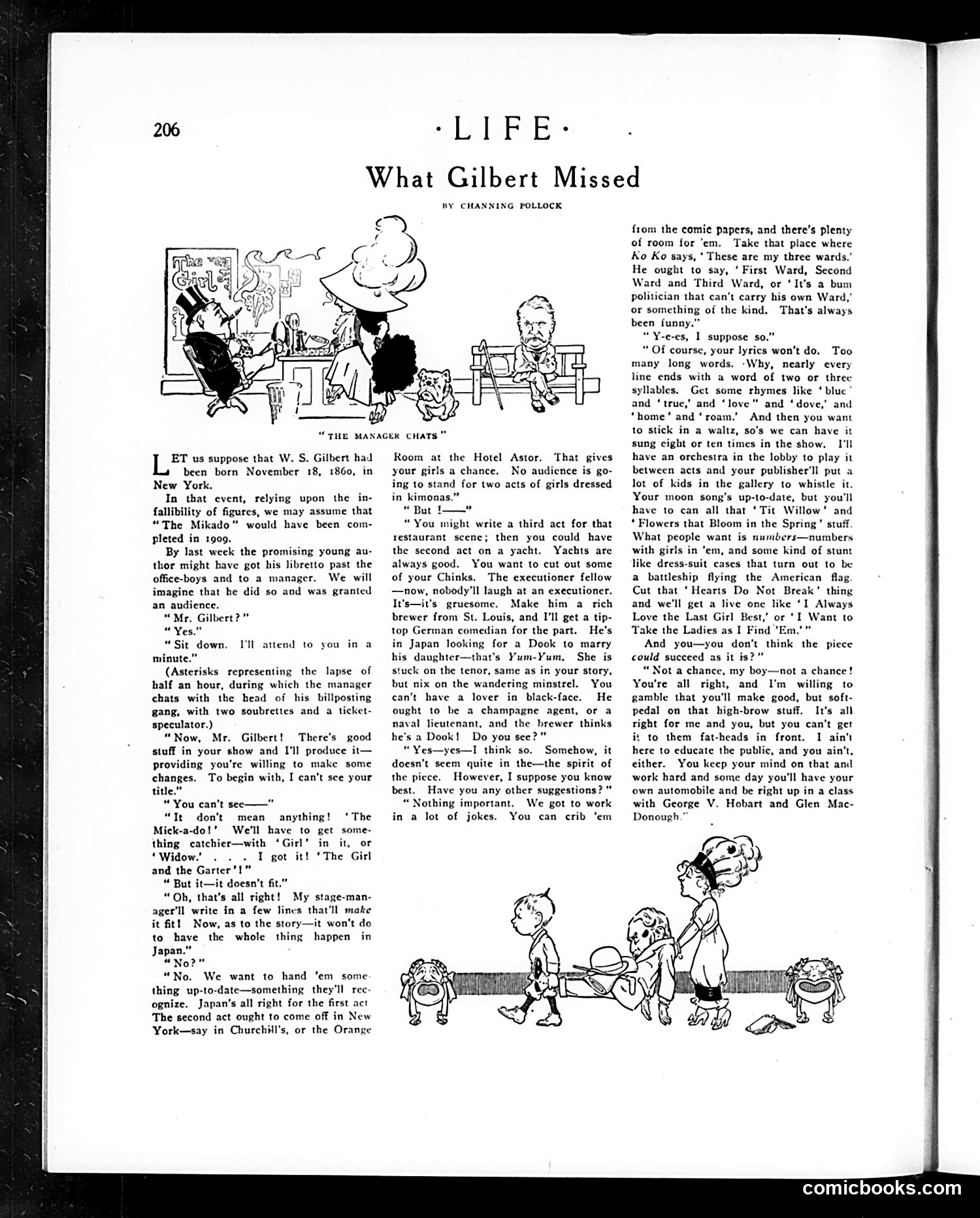
This satirical piece by Channing Pollock imagines W.S. Gilbert (the famous Gilbert & Sullivan librettist) born in 1860 New York instead of England. The humor lies in showing how a 1909 American theatrical manager would "improve" *The Mikado* by destroying everything that makes it work. The manager demands: renaming it "The Girl and the Garter," relocating scenes to New York hotels and yachts, removing Asian characters as "gruesome," replacing the clever tenor with a "champagne agent," eliminating sophisticated wordplay for simple rhymes ("blue/true," "love/dove"), and adding commercial gimmicks like orchestras in lobbies and children whistling in galleries. The satire targets early 1900s American commercial theater's philistinism—its obsession with spectacle, numbers, topical references, and profit over artistic integrity. It's a critique of how crass producers would butcher a masterpiece through "improvements." The irony: Gilbert's actual genius lay precisely in what this manager wants removed.
📄 Transcribed text from this page (OCR, searchable)
Machine-transcribed from the original scan — historical spelling and the odd misread are preserved.
“LAPE What Gilbert Missed RY CHANNING POLLOCK “THE MANAGER CHATS" ET us suppose that W. S. Gilbert had been born November 18, 1860, in New York. In that event, relying upon the in- fallibility of figures, we may assume that “The Mikado” would have been com- pleted in 1909. By last week the promising young au- thor might have got his libretto past the office-boys and to a manager. We will imagine that he did so and was granted an audience. “Mr. Gilbert?” “Yes.” “ Sit down. minute.” (Asterisks representing the lapse of half an hour, during which the manager chats with the head of his billposting gang, with two soubrettes and a ticket- speculator.) “Now, Mr. Gilbert! There's good stuff in your show and I'll produce it— providing you're willing to make some changes. To begin with, I can't sce your title.” “You can't sec- “Tt don't. mean anything! ‘The Mick-a-do!’ We'll have to get some- thing catchier—with ‘Girl’ in it, or ‘Widow.’ . I got it! ‘The Girl and the Garter’! “ But it—it doesn’t fit.” “Oh, that’s all right! My stage-man- ager’ll write in a few lines that'll make it fit! Now, as to the story—it won't do to have the whole thing happen in Japan.” “Nor” “No. We want to hand 'em some thing up-to-date—something they'll rec- ognize. Japan's all right for the first act The second act ought to come off in New York—say in Churchill's, or the Orange I'll attend to you in a Room at the Hotel Astor. That gives your girls a chance. No audience is go- ing to stand for two acts of girls dressed “You might write a third act for that restaurant scene; then you could have the second act on a yacht. Yachts are always good. You want to cut out some of your Chinks. The executioner fellow —now, nobody’ll laugh at an executioner. It's—it's gruesome. Make him a rich brewer from St. Louis, and I'll get a tip- top German comedian for the part. He's in Japan looking for a Dook to marry his daughter—that's Yum-Yum. She is stuck on the tenor, same as in your story, but nix on the wandering minstrel. You can't have a lover in black-face. He ought to be a champagne agent, or a naval lieutenant, and the brewer thinks he’s a Dook! Do you see?” “Yes—yes—I think so. Somehow, it doesn’t seem quite in the—the spirit of the piece. However, I suppose you know best. Have you any other suggestions? ” “Nothing important. We got to work in a lot of jokes. You can crib ‘em {rom the comie papers, and there's plenty of room for ‘em. Take that place where Ko Ko says, ‘ These are my three wards.’ He ought to say, ‘First Ward, Second Ward and Third Ward, or ‘It’s a bum politician that can’t carry his own Ward,’ or something of the kind. That's always been funny.” “Y-e-es, I suppose so.” “ Of course, your lyrics won't do. Too many long words. -Why, nearly every line ends with a word of two or three syllables. Get some rhymes like ‘ blue and ‘true,’ and ‘love” and ‘dove,’ and ‘home’ and ‘roam.’ And then you want to stick in a waltz, so’s we can have it sung cight or ten times in the show. I'll have an orchestra in the lobby to play it between acts and your publisher'll put a lot of kids in the gallery to whistle it. Your moon song’s up-to-date, but you'll have to can all that ‘Tit Willow’ and * Flowers that Bloom in the Spring’ stuff. What people want is numbers—numbers with girls in ‘em, and some kind of stunt like dress-suit cases that turn out to be a battleship flying the American flag Cut that ‘Hearts Do Not Break’ thing and we'll get a live one like ‘I Always Love the Last Girl Best,’ or ‘I Want to ‘Take the Ladies as 1 Find ’Em.’” And you—you don’t think the piece could succeed as it is?” “Not a chance, my boy—not a chance! You're all right, and I'm willing to gamble that you'll make good, but soft- pedal on that high-brow stuff. It’s all right for me and you, but you can’t get it to them fat-heads in front. I ain't here to educate the public, and you ain't, either. You keep your mind on that and work hard and some day you'll have your own automobile and be right up in a class with George V. Hobart and Glen Mac- Donough.” comicbooks.com