
Life, 1911-01-26 · page 21 of 44
Life — January 26, 1911 — page 21: what you’re looking at
What you’re looking at
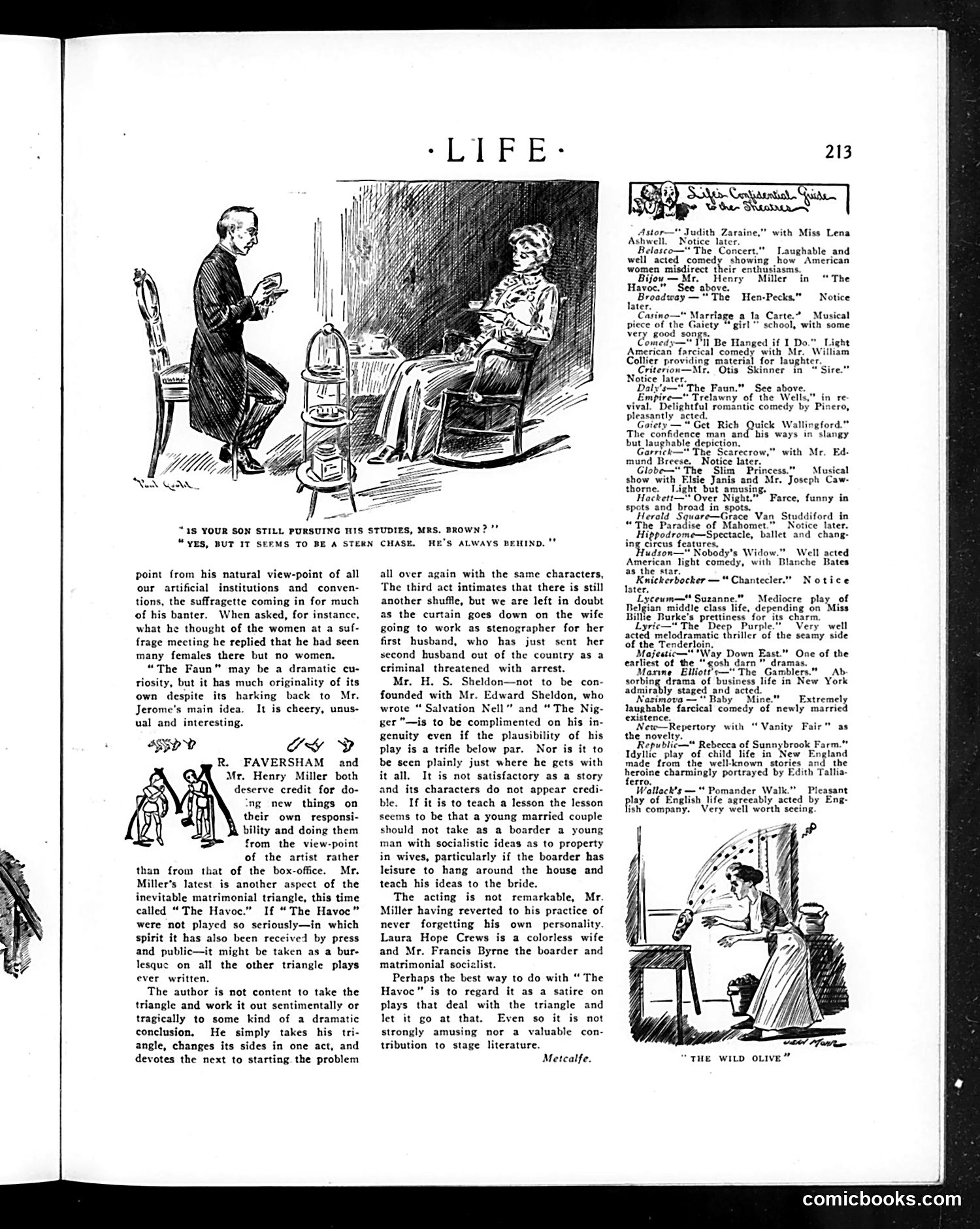
The main cartoon depicts a domestic scene with the caption "Is your son still pursuing his studies, Mrs. Brown? Yes, but it seems to be a stern chase. He's always behind." This is a visual pun playing on the phrase "stern chase"—a nautical term meaning pursuit from behind. The humor lies in the double meaning: the mother claims her son pursues his studies, but he's always "behind" (academically lagging), creating a literal "chase" scenario where studies pursue *him* rather than vice versa. The page primarily consists of theater reviews by Metcalfe, critiquing contemporary Broadway productions. Reviews discuss plays like "The Havoc" and matrimonial comedies, with particular attention to suffragette satire and social commentary. The accompanying illustrations are theatrical sketches, not political cartoons. This appears to be Life's standard theatrical criticism section rather than political satire content.
📄 Transcribed text from this page (OCR, searchable)
Machine-transcribed from the original scan — historical spelling and the odd misread are preserved.
GAR “18 YOUR SON STILL PURSUING HIS STUDIES, MRS. BROWN? “YES, BUT IT SEEMS TO BE A STERN CHASE. point from his natural view-point of all our artificial institutions and conven- tions, the suffragette coming in for much of his banter. When asked, for instance, what he thought of the women at a suf- frage mecting he replied that he had seen many females there but no women. “The Faun" may be a dramatic cu- riosity, but it has much originality of its own despite its harking back to Mr. Jerome's main idea. It is cheery, unus- ual and interesting. Av oy 2 R. FAVERSHAM and Mr. Henry Miller both deserve credit for do- ing new things on their own respon: bility and doing them from the view-point of the artist rather than from that of the box-office. Mr, Miller’s latest is another aspect of the inevitable matrimonial triangle, this time called “ The Havoc.” If “The Havoc” were not played so seriously—in which spirit it has also been received by press and public—it might be taken as a bur- lesquc on all the other triangle plays ever written. The author is not content to take the triangle and work it out sentimentally or tragically to some kind of a dramatic conclusion, He simply takes his tri- angle, changes its sides in one act, and devotes the next to starting the problem He's ALWAYS BEMIND. "* all over again with the same characters, The third act intimates that there is still another shuffle, but we are left in doubt as the curtain goes down on the wife going to work as stenographer for her first husband, who has just sent her second husband out of the country as a criminal threatened with arrest. Mr. H. S. Sheldon—not to be con- founded with Mr. Edward Sheldon, who wrote “ Salvation Nell” and “The Nig- ger "—is to be complimented on his in- genuity even if the plausibility of his play is a trifle below par. Nor is it to be scen plainly just where he gets with it all. It is not satisfactory as a story and its characters do not appear credi- ble. If it is to teach a lesson the lesson seems to be that a young married couple should not take as a boarder a young man with socialistic ideas as to property in wives, particularly if the boarder has leisure to hang around the house and teach his ideas to the bride. The acting is not remarkable, Mr. Miller having reverted to his practice of never forgetting his own personality. Laura Hope Crews is a colorless wife and Mr. Francis Byrne the boarder and matrimonial sociclist. Perhaps the best way to do with “ The Havoc” is to regard it as a satire on plays that deal with the triangle and let it go at that. Even so it is not Strongly amusing nor a valuable con- tribution to stage literature. Metcalfe. Astor—" Judith Zaraine,” with Miss Lena Ashwell, Belasco" The Concert." Laughable and well acted comedy showing how American women misdirect their enthusiasms. Bijow—Mr. Henry Miller in Havoc.” See above. Broadway —“ The Hen-Pecks.” la Carte.” Musical later. "school, with some “The Notice piece of the Gaiety “ girl very good song ° Comeds—" I'll Be Hanged if 1 Do.” Light American farcical comedy with Mr. William ing material for laughter. Mr. Otis Skinner in “ Sire." Dals's— "See above. Empire—" Trelawny of the Wells,” § vival. Delightful romantic comedy by Pinero, pleasantly acted. Gaiety —“ Get Rich Quick Wallingford.” dence man and his ways in slangy le depiction, “The Scarecrow,” with Mr. Ed- mund Breese. Notice later. Globe—""The Slim Princess." Musical show with Elsie Janis and Mr. Joseph Caw- thorne. Light bat amusing. Hockett—" Over Night.” spots and broad in spots. Herald Square—Grace Van Studdiford in “The Paradise of Mahomet.” Notice later. Hippodrome—Spectacle, ballet and chang: ing circus fe udson—" Nobody's Widow.” Well acted American light comedy, with Blanche Bates as the star. Knickerbocker — “ Chantecler: later. Lyceum— Suzanne.” Mediocre play of Belgian middle class life, depending on Miss Bille Burke's prettiness for its charm. Lyric—" The Deep Purple.” Very well acted melodramatic thriller of the seamy side of the Tenderloi Majestic—* "Way Down East." One of the earliest of the “gosh darn" dramas. Maxine Elliott’ s—" The Gamblers.” Ab sorbing drama of business life in New York admirably staged and acted. Nazimova—" Baby Mine.” Extremely laughable farcical comedy of newly married existence. New—Repertory with “Vanity Fair as the novelty. Republic—" Rebecca of Sunnybrook Farm." Idyllic play of child life in New England made from the well-known stories and the heroine charmingly portrayed by Edith Tallia- ferro. Wallack’s —" Pomander Walk.” Pleasant lay of English life agreeably acted by Eng: ish company. Very well worth seeing Farce, funny in Notice “THE WILD OLIVE” comicbooks.com