
Life, 1911-01-26 · page 20 of 44
Life — January 26, 1911 — page 20: what you’re looking at
What you’re looking at
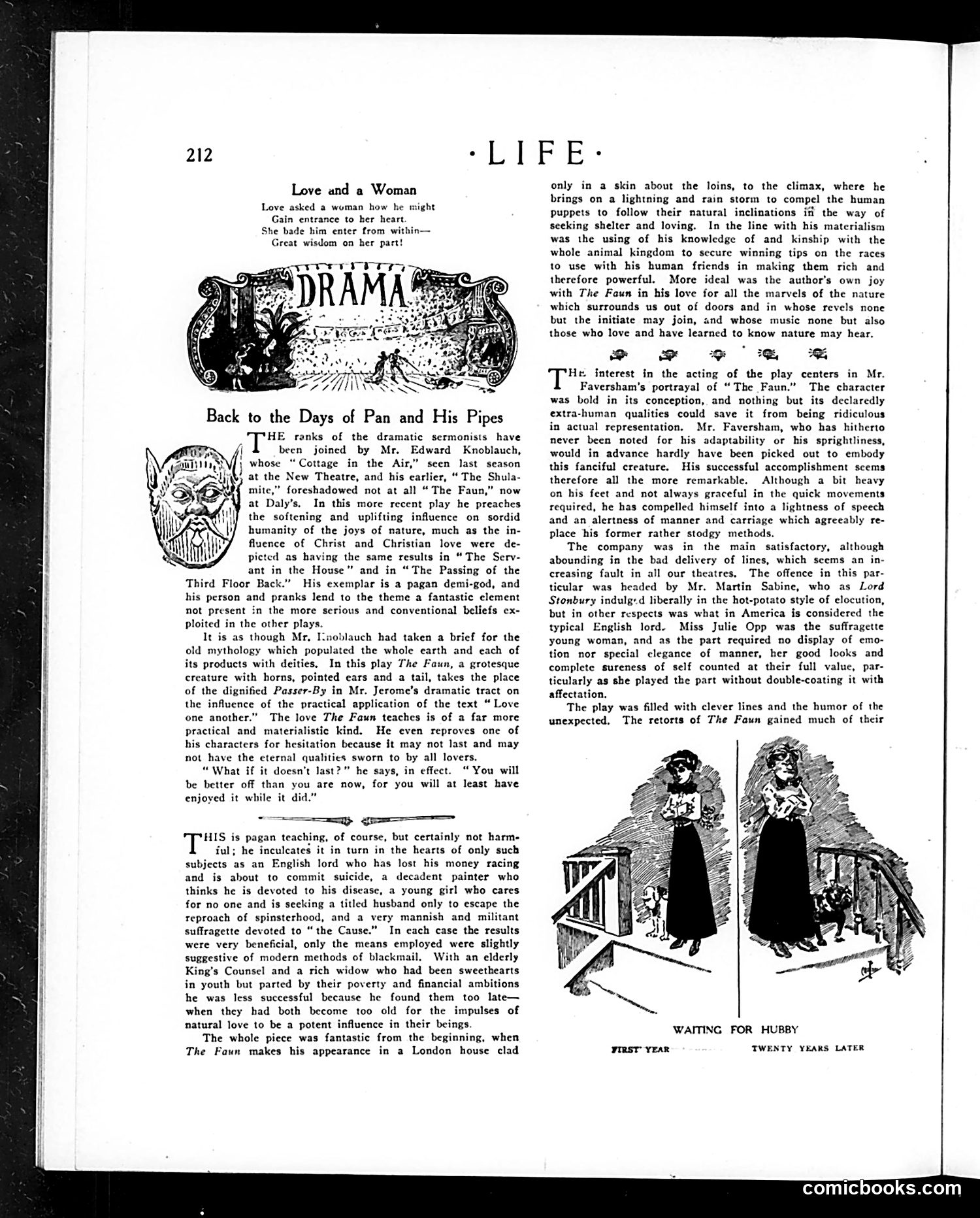
This *Life* magazine page reviews "The Faun," a play by Edward Knoblauch at Daly's Theatre, starring actor Faversham. The production features a mythological creature—part-man, part-beast with horns and tail—who teaches hedonistic philosophy to troubled London socialites: a suicidal nobleman, a dissolute painter, a marriage-hunting woman, and a militant suffragette. The satire targets the play's pretension: it frames itself as spiritually uplifting (like Christian morality plays of the era) while actually promoting selfish materialism and pleasure-seeking. The Faun's "teaching" includes race-fixing and seduction. The reviewer finds this amusing—simultaneously mocking the play's philosophical contradictions and the fashionable London audiences who'd accept such transparent moral relativism dressed in theatrical spectacle. The illustration shows the protagonist in domestic Victorian settings, emphasizing the absurdity of introducing pagan amorality into respectable society.
📄 Transcribed text from this page (OCR, searchable)
Machine-transcribed from the original scan — historical spelling and the odd misread are preserved.
‘LIFE: Love and a Woman Love asked a woman how he might Gain entrance to her heart She bade him enter from within— Great wisdom on her part! Back to the Days of Pan and His Pipes HE ranks of the dramatic sermonists have been joined by Mr. Edward Knoblauch, whose “Cottage in the Air,” seen last season at the New Theatre, and his earlier, “The Shula- mite,” foreshadowed not at all “The Faun,” now at Daly's, In this more recent play he preaches the softening and uplifting influence on sordid humanity of the joys of nature, much as the in- fluence of Christ and Christian love were de- picted as having the same results in “The Serv- ant in the House” and in “The Passing of the Third Floor Back.” His exemplar is a pagan demi-god, and his person and pranks lend to the theme a fantastic element not present in the more serious and conventional beliefs cx- ploited in the other plays. It is as though Mr, I:noblauch had taken a brief for the old mythology which populated the whole earth and each of its products with deities. In this play The Faun, a grotesque creature with horns, pointed ears and a tail, takes the place of the dignified Passer-By in Mr. Jerome's dramatic tract on the influence of the practical application of the text “Love one another.” The love The Faun teaches is of a far more practical and materialistic kind. He even reproves one of his characters for hesitation because it may not last and may not have the eternal qualities sworn to by all lovers. “What if it doesn’t last?” he says, in effect. “ You will be better off than you are now, for you will at least have enjoyed it while it did.” Sey ge HIS is pagan teaching, of course, but certainly not harm- iul; he inculcates it in turn in the hearts of only such subjects as an English lord who has lost his money racing and is about to commit suicide, a decadent painter who thinks he is devoted to his disease, a young girl who cares for no one and is secking a titled husband only to escape the reproach of spinsterhood, and a very mannish and militant suffragette devoted to “the Cause.” In each case the results were very beneficial, only the means employed were slightly suggestive of modern methods of blackmail. With an elderly King’s Counsel and a rich widow who had been sweethearts in youth but parted by their poverty and financial ambitions he was less successful because he found them too late— when they had both become too old for the impulses of natural love to be a potent influence in their beings The whole piece was fantastic from the beginning, when The Faun makes bis appearance in a London house clad only in a skin about the loins, to the climax, where he brings on a lightning and rain storm to compel the human puppets to follow their natural inclinations in the way of seeking shelter and loving. In the line with his materialism was the using of his knowledge of and kinship with the whole animal kingdom to secure winning tips on the races to use with his human friends in making them rich and therefore powerful. More ideal was the author's own joy with The Faun in his love for all the marvels of the nature which surrounds us out of doors and in whose revels none but the initiate may join, and whose music none but also those who love and have learned to know nature may hear. Hr. interest in the acting of the play centers in Mr. Faversham’s portrayal of “The Faun.” The character was bold in its conception, and nothing but its declaredly extra-human qualities could save it from being ridiculous in actual representation, Mr. Faversham, who has hitherto never been noted for his adaptability or his sprightliness, would in advance hardly have been picked out to embody this fanciful creature. His successful accomplishment scems therefore all the more remarkable. Although a bit heavy on his feet and not always graceful in the quick movements required, he has compelled himself into a lightness of speech and an alertness of manner and carriage which agreeably re- place his former rather stodgy methods. The company was in the main satisfactory, although abounding in the bad delivery of lines, which seems an in- creasing fault in all our theatres, The offence in this par- ticular was headed by Mr. Martin Sabine, who as Lord Stonbury indulg-d liberally in the hot-potato style of elocution, but in other respects was what in America is considered the typical English lord. Miss Julie Opp was the suffragette young woman, and as the part required no display of emo- tion nor special clegance of manner, her good looks and complete sureness of self counted at their full value, par- ticularly as she played the part without double-coating it with affectation. The play was filled with clever lines and the humor of the unexpected, The retorts of The Faun gained much of their WAITING FOR HUBBY TWENTY YEARS LATER comicbooks.com