
Life, 1911-01-26 · page 17 of 44
Life — January 26, 1911 — page 17: what you’re looking at
What you’re looking at
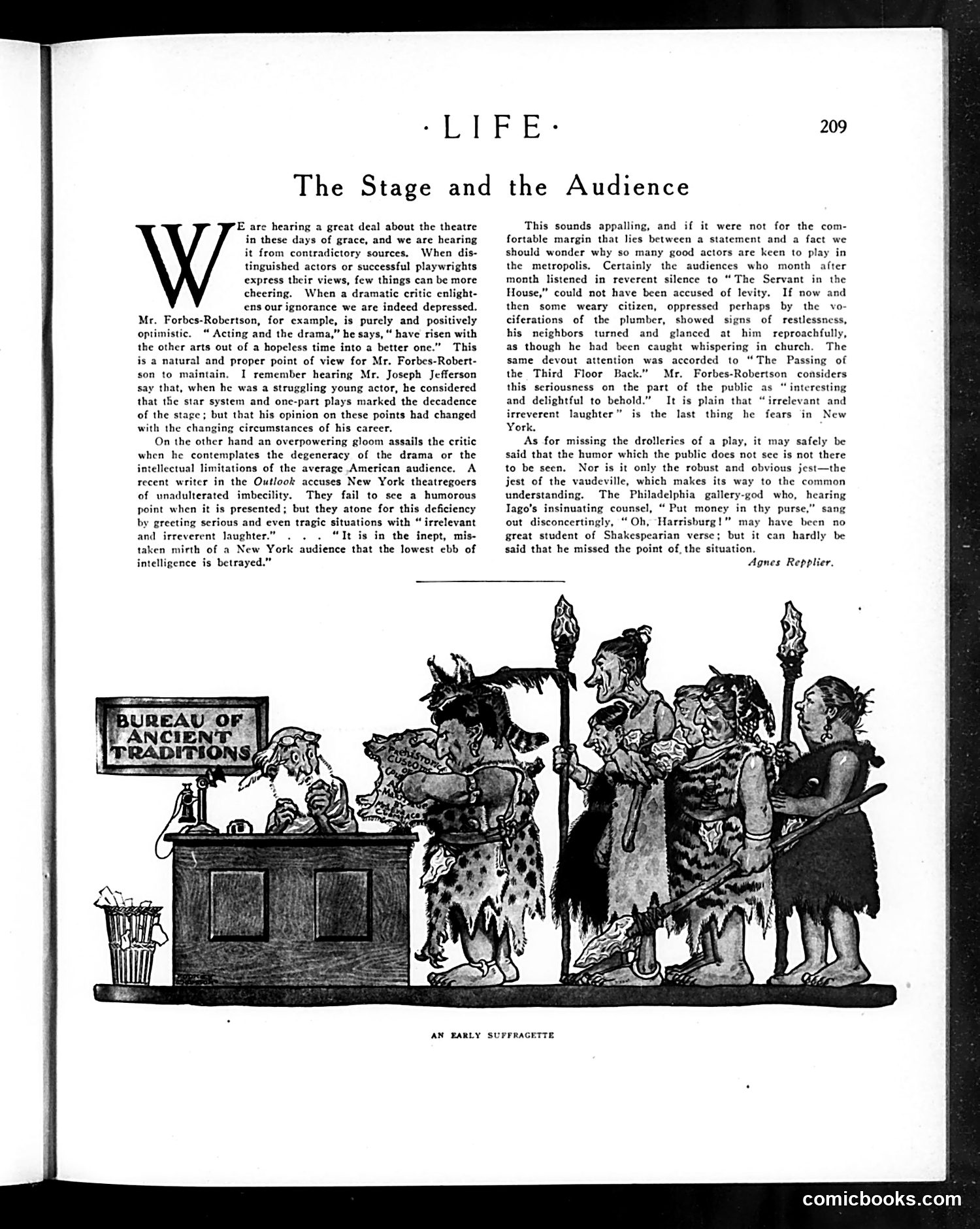
This article discusses theatrical quality and American audiences. The text critiques a recent *Outlook* writer who called New York theatergoers "imbeciles" for failing to appreciate humor and laughing inappropriately at serious scenes. The author (Agnes Repplier) defends audiences, noting that respected actors like Forbes-Robertson actively seek to perform in New York, suggesting the audiences cannot be as unintelligent as claimed. She cites examples of audiences sitting in reverent silence during serious plays like "The Servant in the House" and "The Passing of the Third Floor Back." **The cartoon below** shows what appears to be an ancient Greek or Roman theatrical scene labeled "An Early Suffragette"—likely a humorous comparison suggesting that female audience participation in theater has ancient roots, though the exact political reference remains unclear without additional context about contemporary suffrage debates. The piece argues audiences appreciate drama appropriately when it merits appreciation.
📄 Transcribed text from this page (OCR, searchable)
Machine-transcribed from the original scan — historical spelling and the odd misread are preserved.
-LIFE* The Stage and the Audience E are hearing a great deal about the theatre in these days of grace, and we are hearing it from contradictory sources. When dis- tinguished actors or successful playwrights express their views, few things can be more cheering. When a dramatic critic enlight- ens our ignorance we are indeed depressed. Mr. Forbes-Robertson, for example, is purely and positively optimistic. “ Acting and the drama,” he says, “ have risen with the other arts out of a hopeless time into a better one.” This is a natural and proper point of view for Mr. Forbes-Robert- son to maintain. I remember hearing Mr. Joseph Jefferson say that, when he was a struggling young actor, he considered that the star system and one-part plays marked the decadence of the stage; but that his opinion on these points had changed with the changing circumstances of his career. On the other hand an overpowering gloom assails the critic when he contemplates the degeneracy of the drama or the intellectual limitations of the average American audience. A recent writer in the Outlook accuses New York theatregoers of unadulterated imbecility. They fail to sce a humorous point when it is presented; but they atone for this deficiency by greeting serious and even tragic situations with “ irrelevant and irreverent laughter.” . . . “It is in the inept, mis- taken mirth of a New York audience that the lowest ebb of intelligence is betrayed.” This sounds appalling, and if it were not for the com- fortable margin that lies between a statement and a fact we should wonder why so many good actors are keen to play in the metropolis. Certainly the audiences who month after month listened in reverent silence to “The Servant in the House,” could not have been accused of levity. If now and then some weary citizen, oppressed perhaps by the vo- ciferations of the plumber, showed signs of restlessness, his neighbors turned and glanced at him reproachfully as though he had been caught whispering in church. The same devout attention was accorded to “The Passing of the Third Floor Back.” Mr. Forbes-Robertson considers this seriousness on the part of the public as “ interesting and delightful to behold.” It is plain that “irrelevant and irreverent laughter” is the last thing he fears in New York. As for missing the drolleries of a play, it may safely be said that the humor which the public does not see is not there to be seen. Nor is it only the robust and obvious jest—the jest of the vaudeville, which makes its way to the common understanding. The Philadelphia gallery-god who, hearing Tago’s insinuating counsel, “ Put money in thy purse,” sang out disconcertingly, “Oh, Harrisburg!” may have been no great student of Shakespearian verse; but it can hardly be said that he missed the point of, the situation. Agnes Repplier. AN EARLY SUFFRAGETTE comicbooks.com