
Life, 1911-01-26 · page 10 of 44
Life — January 26, 1911 — page 10: what you’re looking at
What you’re looking at
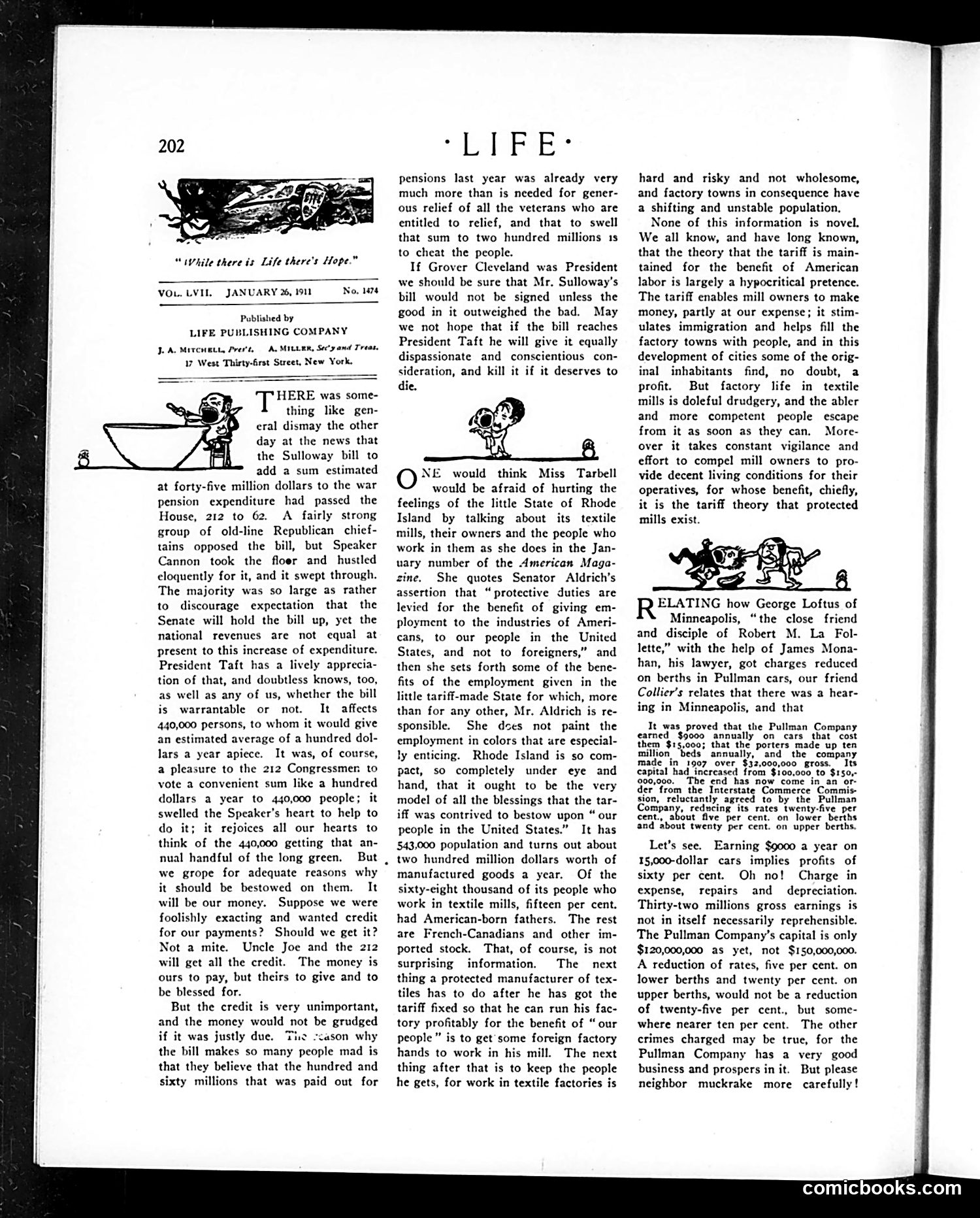
This page discusses the Sulloway bill regarding war pensions and tariff policy. The text argues against protective tariffs, claiming they benefit factory owners while harming workers and consumers. The article criticizes Miss Tarbell (likely Ida Tarbell, the muckraking journalist) for supporting tariffs to protect Rhode Island textile mills, and attacks Senator Aldrich's assertion that protective duties benefit American workers and employment. The second section praises George Loftus of Minneapolis and James Monahan regarding Pullman car profits, sarcastically noting that while the Pullman Company claims modest earnings, their actual profits far exceed stated figures. The overall satire targets what the writer sees as hypocritical arguments by tariff supporters who claim to champion workers while actually enriching industrial owners.
📄 Transcribed text from this page (OCR, searchable)
Machine-transcribed from the original scan — historical spelling and the odd misread are preserved.
“While there is Life there's Hope.” No, 1474 VOL. LVI, JANUARY 2, 1911 Published by LIFE PUBLISHING COMPANY AL MILLER, Sec’y and Treas. J. A. MITCHELL, Pret, 1 West Thirty-frst Street, New York. HERE was some- thing like gen- eral dismay the other day at the news that the Sulloway Dill to add a sum estimated at forty-five million dollars to the war pension expenditure had passed the House, 212 to 62. A fairly strong group of old-line Republican chief- tains opposed the bill, but Speaker Cannon took the floer and hustled eloquently for it, and it swept through. The majority was so large as rather to discourage expectation that the Senate will hold the bill up, yet the national revenues are not equal at present to this increase of expenditure. President Taft has a lively apprecia- tion of that, and doubtless knows, too, as well as any of us, whether the bill is warrantable or not. It affects 440,000 persons, to whom it would give an estimated average of a hundred dol- lars a year apiece. It was, of course, a pleasure to the 212 Congressmen to vote a convenient sum like a hundred dollars a year to 440,000 people; it swelled the Speaker's heart to help to do it; it rejoices all our hearts to think of the 440,000 getting that an- nual handful of the long green. But we grope for adequate reasons why it should be bestowed on them. It will be our money. Suppose we were foolishly exacting and wanted credit for our payments? Should we get it? Not a mite. Uncle Joe and the 212 will get all the credit. The money is ours to pay, but theirs to give and to be blessed for. But the credit is very unimportant, and the money would not be grudged if it was justly due. The scason why the bill makes so many people mad is that they believe that the hundred and sixty millions that was paid out for * bal IEVE:* pensions last year was already very much more than is needed for gener- ous relief of all the veterans who are entitled to relief, and that to swell that sum to two hundred millions 1s to cheat the people. If Grover Cleveland was President we should be sure that Mr. Sulloway’s bill would not be signed unless the good in it outweighed the bad. May we not hope that if the bill reaches President Taft he will give it equally dispassionate and conscientious con- sideration, and kill it if it deserves to die, NE would think Miss Tarbell would be afraid of hurting the feelings of the little State of Rhode Island by talking about its textile mills, their owners and the people who work in them as she does in the Jan- uary number of the American Maga- zine. She quotes Senator Aldrich’s assertion that “protective duties are levied for the benefit of giving em- ployment to the industries of Ameri- cans, to our people in the United States, and not to foreigners,” and then she sets forth some of the bene- fits of the employment given in the little tariff-made State for which, more than for any other, Mr. Aldrich is re- sponsible. She dees not paint the employment in colors that ure especial- ly enticing. Rhode Island is so com- pact, so completely under eye and hand, that it ought to be the very model of all the blessings that the tar- iff was contrived to bestow upon “ our people in the United States.” It has 543,000 population and turns out about two hundred million dollars worth of manufactured goods a year. Of the sixty-eight thousand of its people who work in textile mills, fifteen per cent. had American-born fathers. The rest are French-Canadians and other im- ported stock. That, of course, is not surprising information. The next thing a protected manufacturer of tex- tiles has to do after he has got the tariff fixed so that he can run his fac- tory profitably for the benefit of “our people” is to get'some foreign factory hands to work in his mill. The next thing after that is to keep the people he gets, for work in textile factories is hard and risky and not wholesome, and factory towns in consequence have a shifting and unstable population, None of this information is novel. We all know, and have long known, that the theory that the tariff is main- tained for the benefit of American labor is largely a hypocritical pretence. The tariff enables mill owners to make money, partly at our expense; it stim- ulates immigration and helps fill the factory towns with people, and in this development of cities some of the orig- inal inhabitants find, no doubt, a profit. But factory life in textile mills is doleful drudgery, and the abler and more competent people escape from it as soon as they can. More- over it takes constant vigilance and effort to compel mill owners to pro- vide decent living conditions for their operatives, for whose benefit, chiefly, it is the tariff theory that protected mills exist. RELATING how George Loftus of Minneapolis, “the close friend and disciple of Robert M. La Fol- lette,” with the help of James Mona- han, his lawyer, got charges reduced on berths in Pullman cars, our friend Collier's relates that there was a hear- ing in Minneapolis, and that It was proved that the Pullman Company earned $9000 annually on cars that cost them $15,000; that the porters made up ten million ‘beds’ annually, and the company made in 1907 over $32,000,000 gross. Its capital had increased from $100,000 to $150,- 900,000. The end has now come in_an or- der from the Interstate Commerce Commis- sion, reluctantly agreed to by the Pullman Company, reducing its rates twenty-five per cent., about five per cent. on lower berths and ‘about twenty per cent. on upper berths. Let’s see. Earning $9000 a year on 1§,000-dollar cars implies profits of sixty per cent. Oh no! Charge in expense, repairs and depreciation. Thirty-two millions gross earnings is not in itself necessarily reprehensible. The Pullman Company’s capital is only $120,000,000 as yet, not $150,000,000. A reduction of rates, five per cent. on lower berths and twenty per cent. on upper berths, would not be a reduction of twenty-five per cent., but some- where nearer ten per cent. The other crimes charged may be true, for the Pullman Company has a very good business and prospers in it. But please neighbor muckrake more carefully! comicbooks.com