
Life, 1911-01-26 · page 26 of 44
Life — January 26, 1911 — page 26: what you’re looking at
What you’re looking at
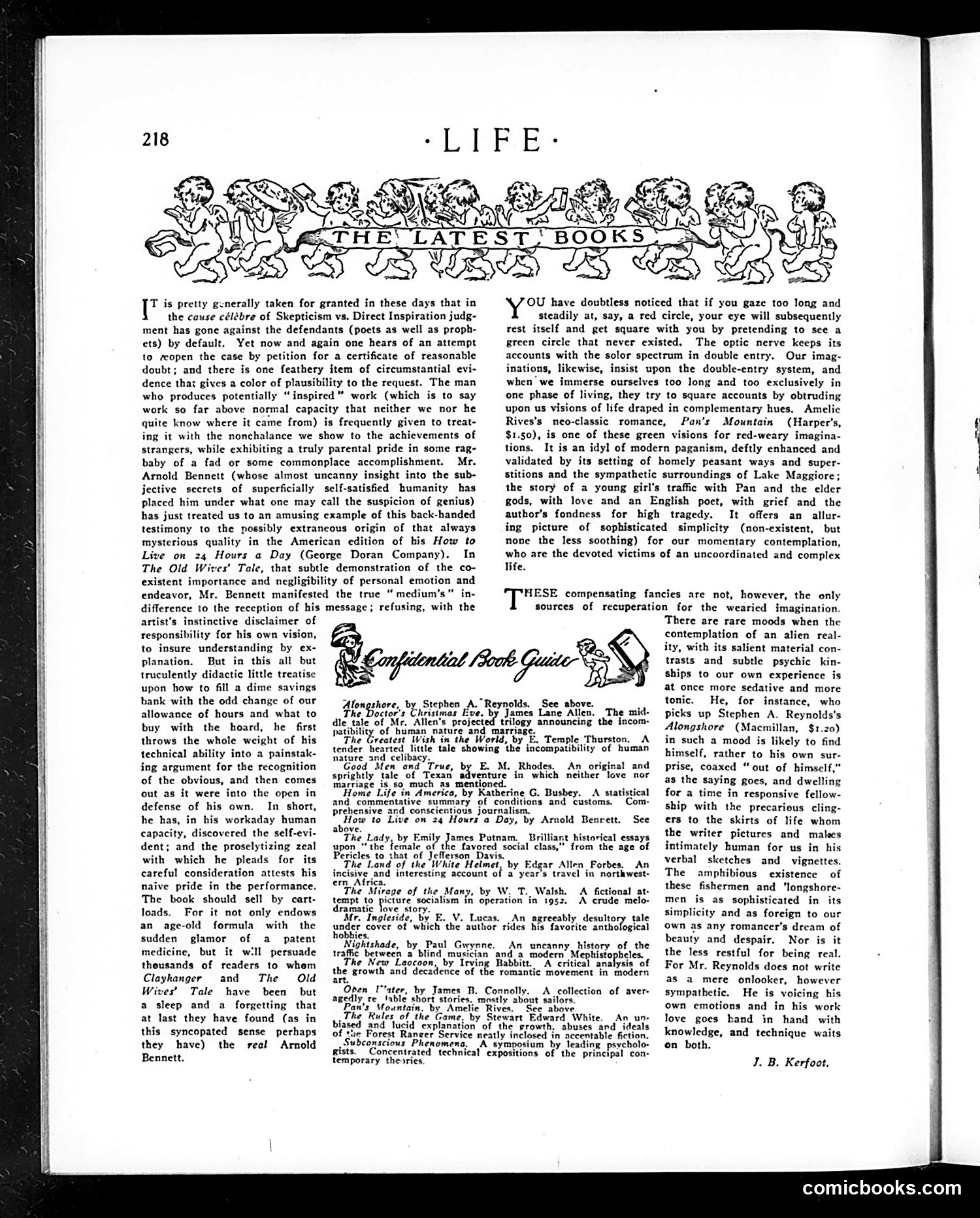
This page from *Life* magazine discusses Arnold Bennett, the British novelist, and his contradictory creative behavior. The satire's point: Bennett demonstrates "inspired" genius in major works like *The Old Wives' Tale*, yet treats them with careless indifference, while lavishing pride on mundane self-help books like *How to Live on 24 Hours a Day*. The author humorously suggests this reversal—caring more about obvious advice than profound art—implies Bennett may be a mere "medium" channeling inspiration unknowingly, rather than a conscious artist. It's gentle mockery of the gap between an artist's actual accomplishments and what he values in his own work. The page also reviews other contemporary books, including Amelie Rives's *Pan's Mountain*, discussing how readers seek compensatory fantasy experiences from literature. The decorative "Cupids" header reading "The Latest Books" frames this as a book review section.
📄 Transcribed text from this page (OCR, searchable)
Machine-transcribed from the original scan — historical spelling and the odd misread are preserved.
T is pretty generally taken for granted in these days that in the cause célébre of Skepticism vs. Direct Inspiration judg- ment has gone against the defendants (poets as well as proph- ets) by default. Yet now and again one hears of an attempt to reopen the case by petition for a certificate of reasonable doubt; and there is one feathery item of circumstantial evi- dence that gives a color of plausibility to the request. The man who produces potentially “inspired” work (which is to say work so far above normal capacity that neither we nor he quite know where it came from) is frequently given to treat- ing it with the nonchalance we show to the achievements of strangers, while exhibiting a truly parental pride in some rag- baby of a fad or some commonplace accomplishment. Mr. Arnold Bennett (whose almost uncanny insight into the sub- jective secrets of superficially self-satisfied bumanity has placed him under what one may call the suspicion of genius) has just treated us to an amusing example of this back-handed testimony to the possibly extrancous origin of that always mysterious quality in the American edition of his How to Live on 24 Hours a Day (George Doran Company). In The Old Wives’ Tale, that subtle demonstration of the co- existent importance and negligibility of personal emotion and endeavor, Mr. Bennett manifested the true “ medium’s” in- difference to the reception of his message; refusing, with the artist's instinctive disclaimer of responsibility for his own vision, to insure understanding by ex- OU have doubtless noticed that if you gaze too long and steadily at, say, a red circle, your eye will subsequently rest itself and get square with you by pretending to see a green circle that never existed. The optic nerve keeps its accounts with the solor spectrum in double entry. Our imag- inations, likewise, insist upon the double-entry system, and when we immerse ourselves too long and too exclusively in one phase of living, they try to square accounts by obtruding upon us visions of life draped in complementary hues, Amelic Rives's neo-classic romance, Pan's Mountain (Harper's, $1.50), is one of these green visions for red-weary imagina- tions. It is an idyl of modern paganism, deftly enhanced and validated by its setting of homely peasant ways and super- stitions and the sympathetic surroundings of Lake Maggiore; the story of a young girl's traffic with Pan and the elder gods, with love and an English poet, with grief and the author’s fondness for high tragedy. It offers an allur- ing picture of sophisticated simplicity (non-existent, but none the less soothing) for our momentary contemplation, who are the devoted victims of an uncoordinated and complex life. ESE compensating fancies are not, however, the only sources of recuperation for the wearied imagination. There are rare moods when the contemplation of an alien real- ity, with its salient material con- planation. But in this all but truculently didactic little treatise upon how to fill a dime savings bank with the odd change of our allowance of hours and what to buy with the hoard, he first throws the whole weight of his technical ability into a painstak- ing argument for the recognition of the obvious, and then comes out as it were into the open in defense of his own. In short, he has, in his workaday human capacity, discovered the self-evi- dent; and the proselytizing zeal with which he pleads for its careful consideration attests his naive pride in the performance. The book should sell by cart- loads. For it not only endows an age-old formula with the sudden glamor of a patent medicine, but it will persuade thousands of readers to whem Clayhanger and The Old Wives’ Tale have been but a sleep and a forgetting that at last they have found (as in this syncopated sense perhaps they have) the real Arnold Bennett. Afongshore, by. Stephen A. Reynolds, See above The Doctor's Christmas Eve, by James Lane Allen. |The mid- dle tale of Me. Allen's projected trilogy announcing the incom- patibility of human nature and marriage, The Greatest Wish in the World, by E. Temple ‘Thurston, A tender hearted little tale showing the incompatibility of human nature and celibacy, a Nes Good Men ond True, by E. M. Rhodes, An original and sprightly tale of Texan adventure in which neither love nor marriage is so much as mentioned. ‘ ‘Home Life in America, by Katherine G, Busbey. A statistical and commentative summary of conditions and customs. Com- prehensive and conscientious journalism, jilow to Live on 24 Hours a Day, by Arnold Benrett. See above. The, Lady, by Emily James Putnam. Brilliant historical essays upon “the female of the favored social class,” from the age of Pericles to that of Jefferson Davis. The Land of the White Helmet, by Edgar Allen Forbes, An incisive and interesting account of a year's travel in northwest- ern Africa. The Mirage of the Many, by W. T., Walsh. tempt to picture socialism in operation in 1952. dramatic love story. Mr. Ingleside, by E. V. Lucas. An agreeably desultory tale under cover of which the author rides his favorite anthofogical hobbies. Nightshade, by Paul Gwynne. An uncanny history of the traffic between a blind musician and a modern Mephistopheles. The New Laocoon, by Irving Babbitt. A critical analysis of the growth and decadence of the romantic movement in modern a Open I'ater, by James B. Connolly. A collection of aver- agedly, re, table short stories, mostly about sailors. Pan's Mountain. by Amelie Rives. See above The Rules of the Game, by Stewart Edward White. An. un- biased and lucid explanation of the growth. abuses and ideals of sue Forest Raneer Service neatly inclosed in accentable fiction. Subconscious Phenomena, A symposium by leading psycholo- gists. Concentrated technical expositions of the principal con- temporary theories A fictional at- A crude melo- trasts and subtle psychic kin- ships to our own experience is at once more sedative and more tonic. He, for instance, who Picks up Stephen A. Reynolds's Alongshore (Macmillan, $1.20) in such a mood is likely to find himself, rather to his own sur- prise, coaxed “out of himself,” as the saying goes, and dwelling for a ¢ in responsive fellow- ship with the precarious cling- ers to the skirts of life whom the writer pictures and makes intimately human for us in his verbal sketches and vignettes. The amphibious existence of these fishermen and ‘longshore- men is as sophisticated in its simplicity and as foreign to our own as any romancer’s dream of beauty and despair. Nor is it the less restful for being real. For Mr. Reynolds does not write as a mere onlooker, however sympathetic. He is voicing his own emotions and in his work love goes hand in hand with knowledge, and technique waits on both. J. B. Kerfoot. comicbooks.com