
A complete issue · 40 pages · 1910
Life — September 29, 1910
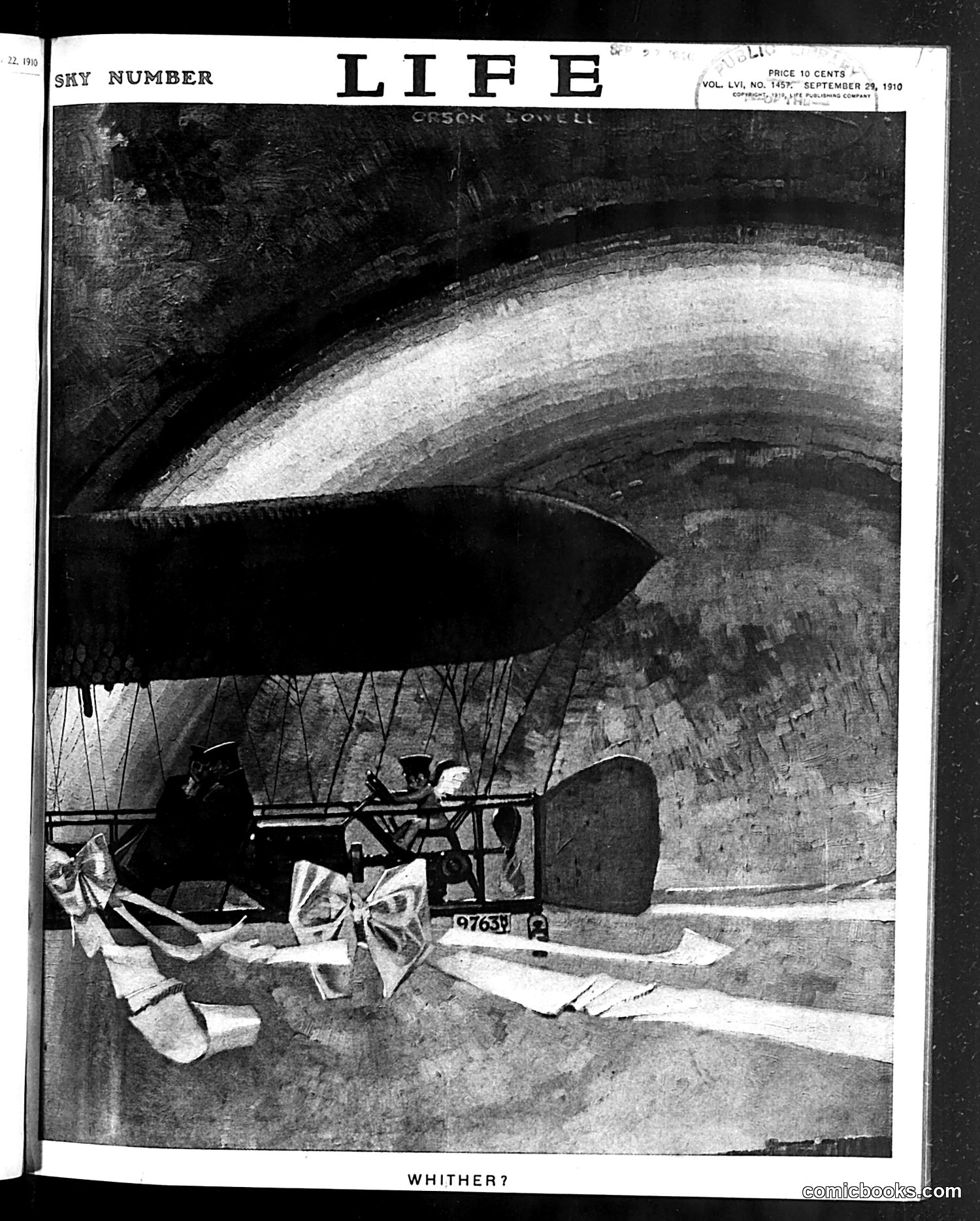
This satirical cartoon depicts a small automobile balanced precariously on the edge of a massive cliff or chasm, with two figures inside appearing uncertain about direction. The title "Whither?" (meaning "Where are we going?") suggests confusion or anxiety about the future course. Given the 1910 date, this likely comments on early automobile safety concerns or the rapid, sometimes reckless expansion of motorcar culture. The cliff metaphor suggests society is headed toward danger without clear guidance. The image captures turn-of-the-century anxieties about new technology and whether this "horseless carriage" innovation represented progress or peril—a common satirical theme in Life during the auto's infancy.
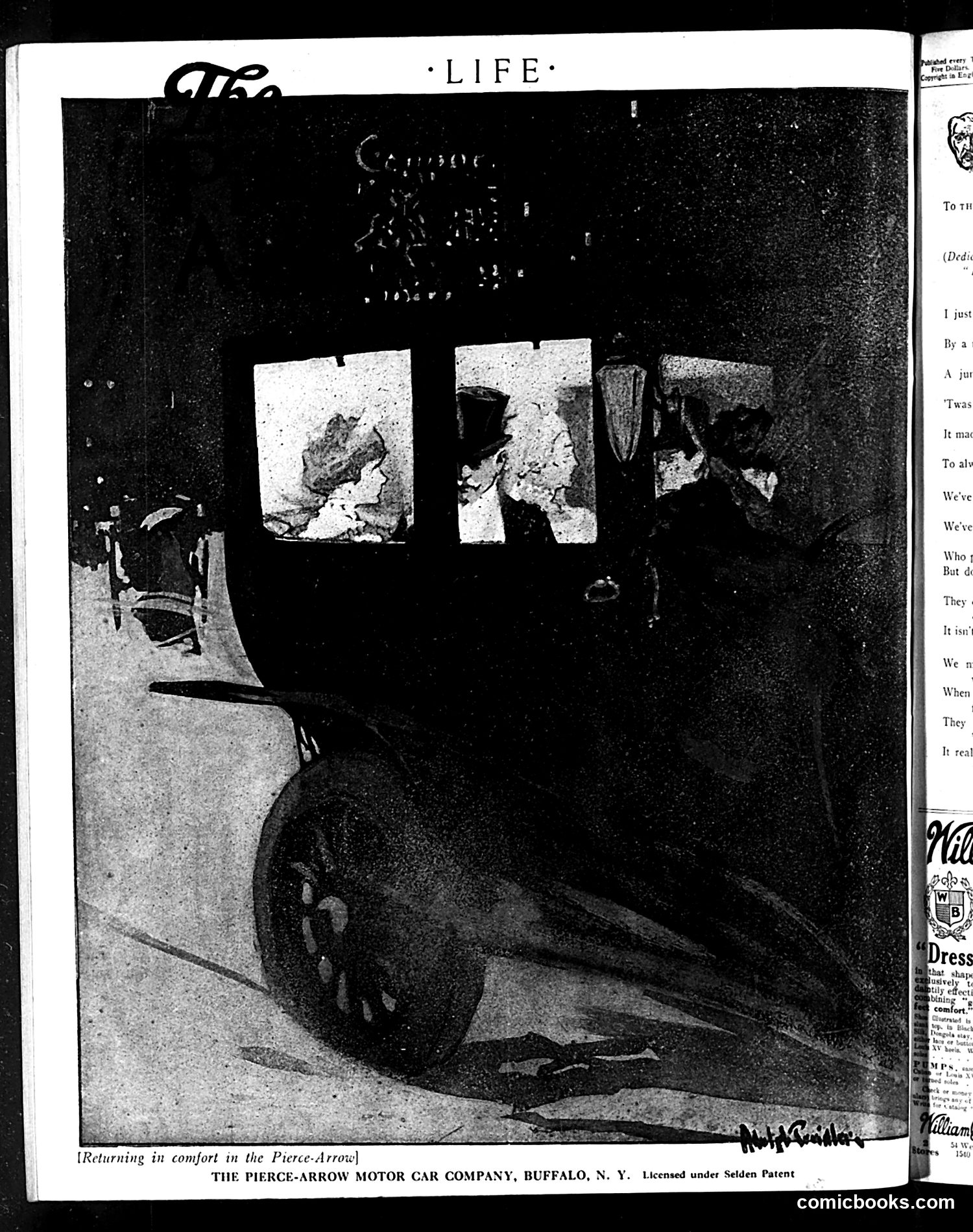
This page from *Life* magazine features an advertisement for the Pierce-Arrow Motor Car Company of Buffalo, New York. The image shows a Pierce-Arrow automobile with several passengers visible through its windows, parked outside what appears to be a building or establishment. The caption reads "Returning in comfort in the Pierce-Arrow," suggesting the ad is promoting the vehicle's comfort and reliability for passengers. The photograph demonstrates the car in actual use, a common advertising approach of the era. The advertisement emphasizes the Pierce-Arrow's comfort features and appears designed to appeal to wealthy or upper-class consumers who valued both luxury and dependable transportation. This is primarily commercial content rather than political satire.
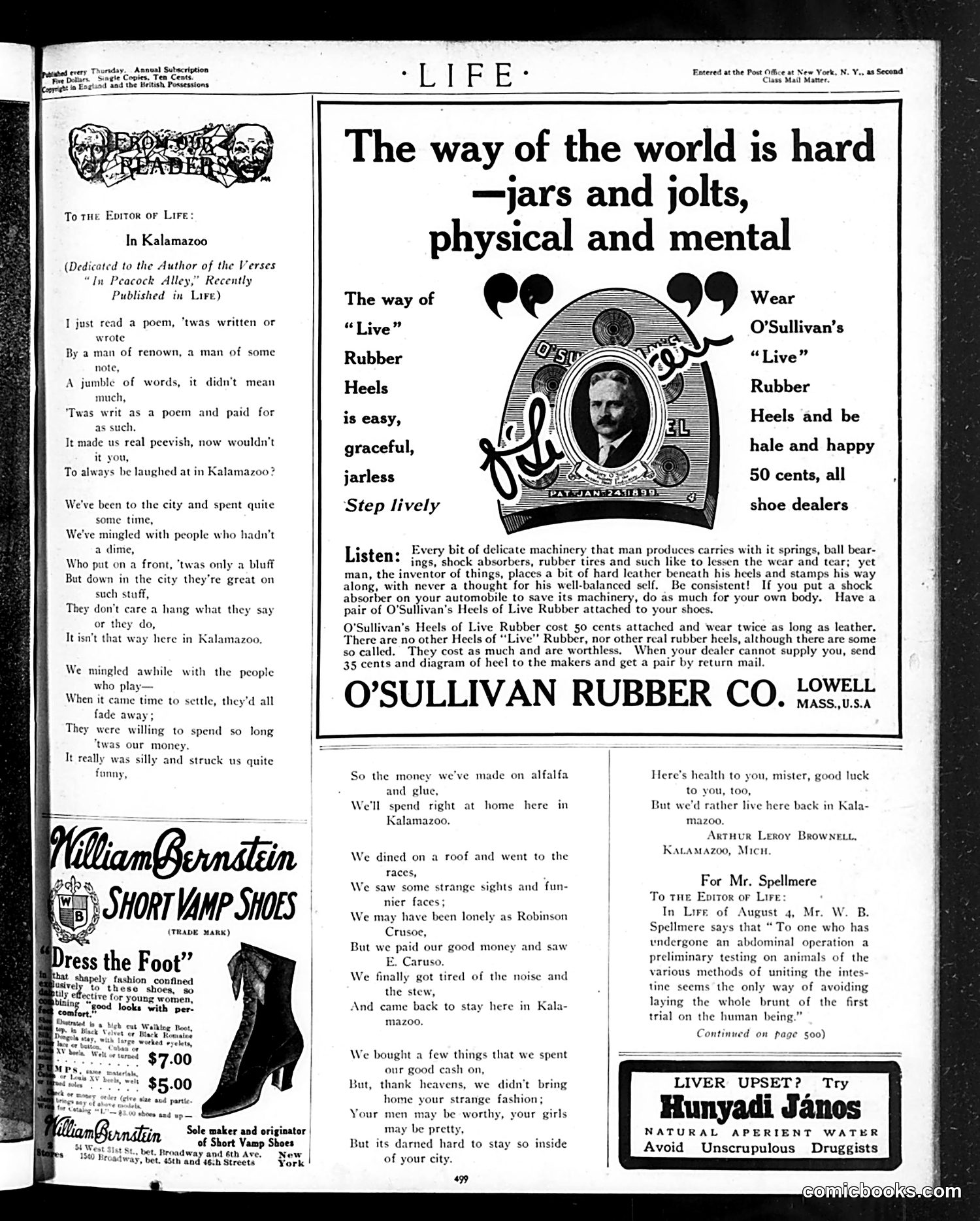
This page is primarily **advertising and reader correspondence**, not political satire. The main content includes: 1. **Reader letters** to Life's editor about a poem published in the magazine, with one correspondent from Kalamazoo, Michigan sharing humorous reflections on visiting the city. 2. **Two product advertisements**: William Bernstein's "Short Vamp Shoes" ($7.00 and $5.00) and O'Sullivan Rubber Heels ($0.50), featuring the company's trademark image of a man's face. 3. **A small health advertisement** for "Hunyadi János" natural water. There is **no identifiable political cartoon or social satire** on this page. It represents typical early 20th-century magazine content mixing reader engagement with commercial advertising.
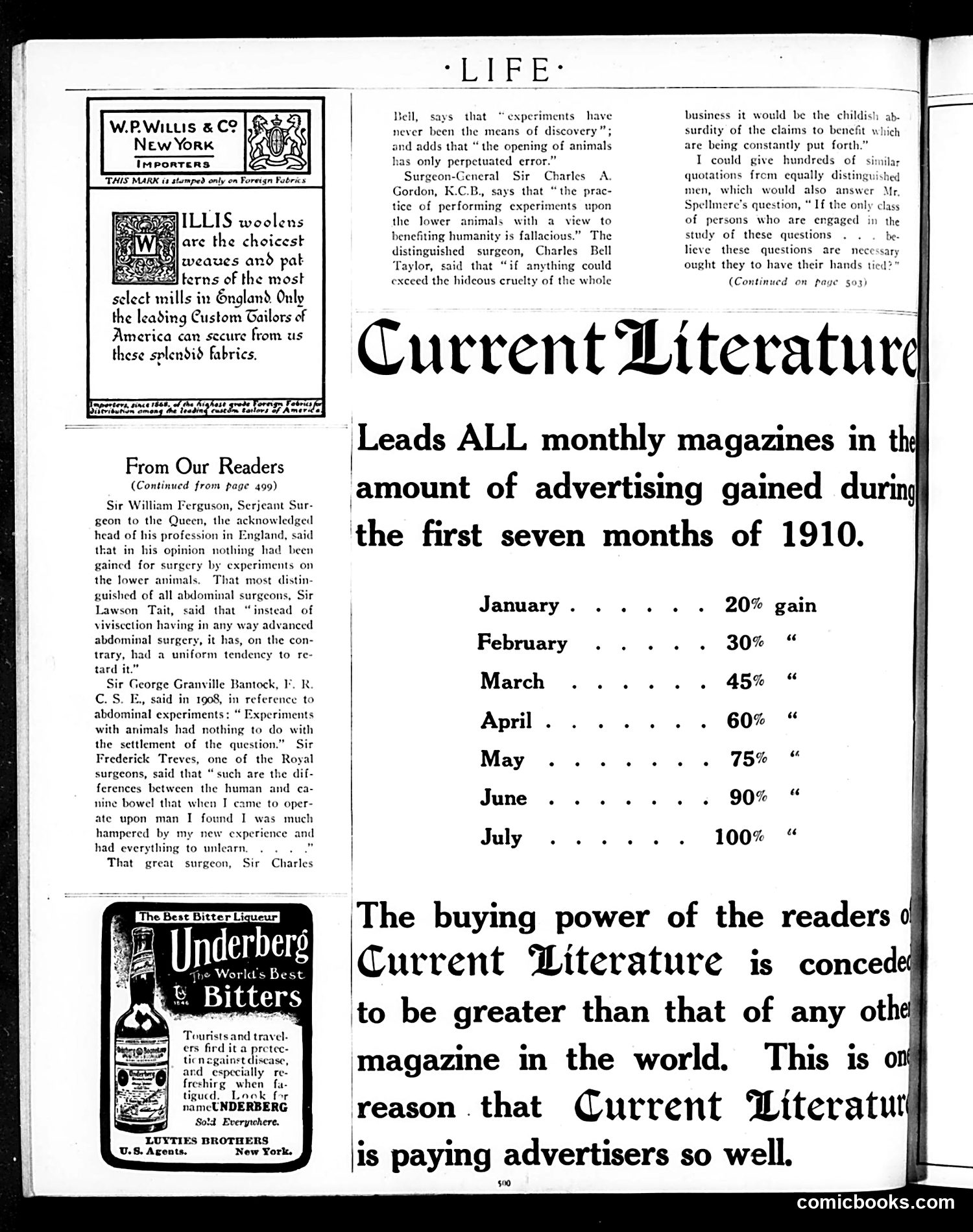
This page is primarily **advertising and promotional content** rather than satirical editorial material. The main feature is a self-promotional advertisement for *Current Literature* magazine, claiming it leads all monthly magazines in advertising gains during the first seven months of 1910—showing progressive increases from 20% in January to 100% by July. The advertisement asserts that *Current Literature* readers possess greater "buying power" than any other magazine's audience, positioning this as the reason advertisers favor the publication. The page also includes period advertisements: a W.P. Willis & Co. fabric ad featuring decorative heraldry, and an Underberg Bitters liqueur advertisement. The "From Our Readers" section contains letters from notable figures (Sir William Ferguson, Sir George Granville Bantock, Sir Frederick Treves) discussing medical experiments on animals—a contemporary controversy—but this appears to be genuine reader correspondence rather than satire.
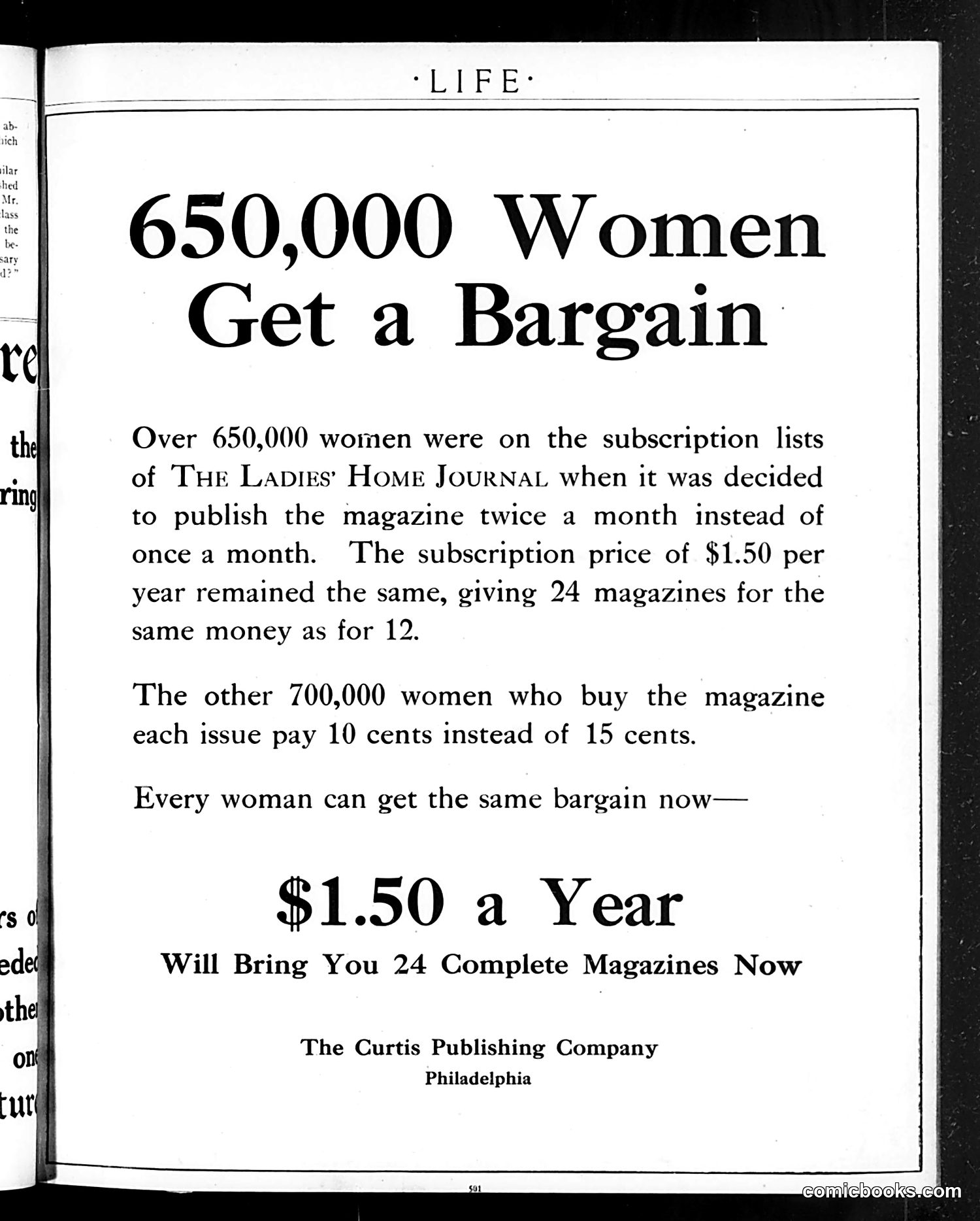
This page is **not a cartoon or satire** — it's a straightforward advertisement for *The Ladies' Home Journal*. The ad announces a business decision: the magazine will increase publication from 12 to 24 issues yearly while keeping the annual subscription price at $1.50. This effectively doubles the value for subscribers. The headline "650,000 Women Get a Bargain" emphasizes the large subscriber base receiving this benefit. The ad also notes that casual buyers (700,000 additional women) will pay 10 cents per issue instead of 15 cents. This is a **marketing appeal** highlighting customer value, not political or social satire. It reflects early-20th-century magazine industry competition and demonstrates how publishers promoted subscription advantages to consumers.
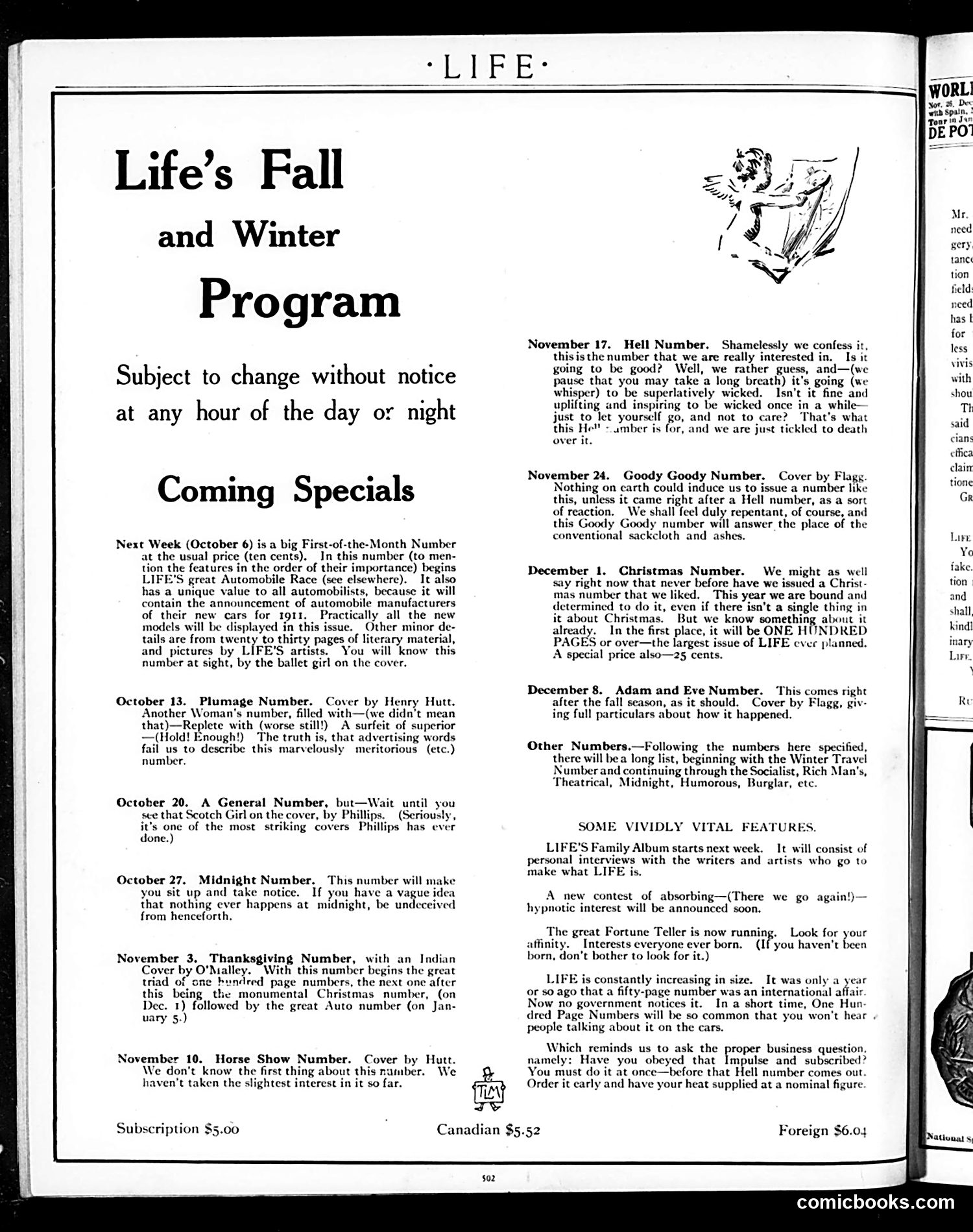
This page is primarily **editorial/promotional content** for Life magazine's upcoming special issues, not political cartoons. The small illustration shows a figure sledding, accompanying announcement of the magazine's "Fall and Winter Program." The text announces themed special issues: a "Hell Number" (Nov 17), "Goody Goody Number" (Nov 24), Christmas Number (Dec 1), and "Adam and Eve Number" (Dec 8), among others. These appear to be thematic entertainment issues rather than hard-hitting satire. The page emphasizes that Life is "constantly increasing in size" and proudly notes it will feature "hundred Page Numbers," positioning the magazine as an expanding, ambitious publication. This reflects early 20th-century Life as a humor and society magazine focused on entertainment and lifestyle content rather than sharp political commentary.
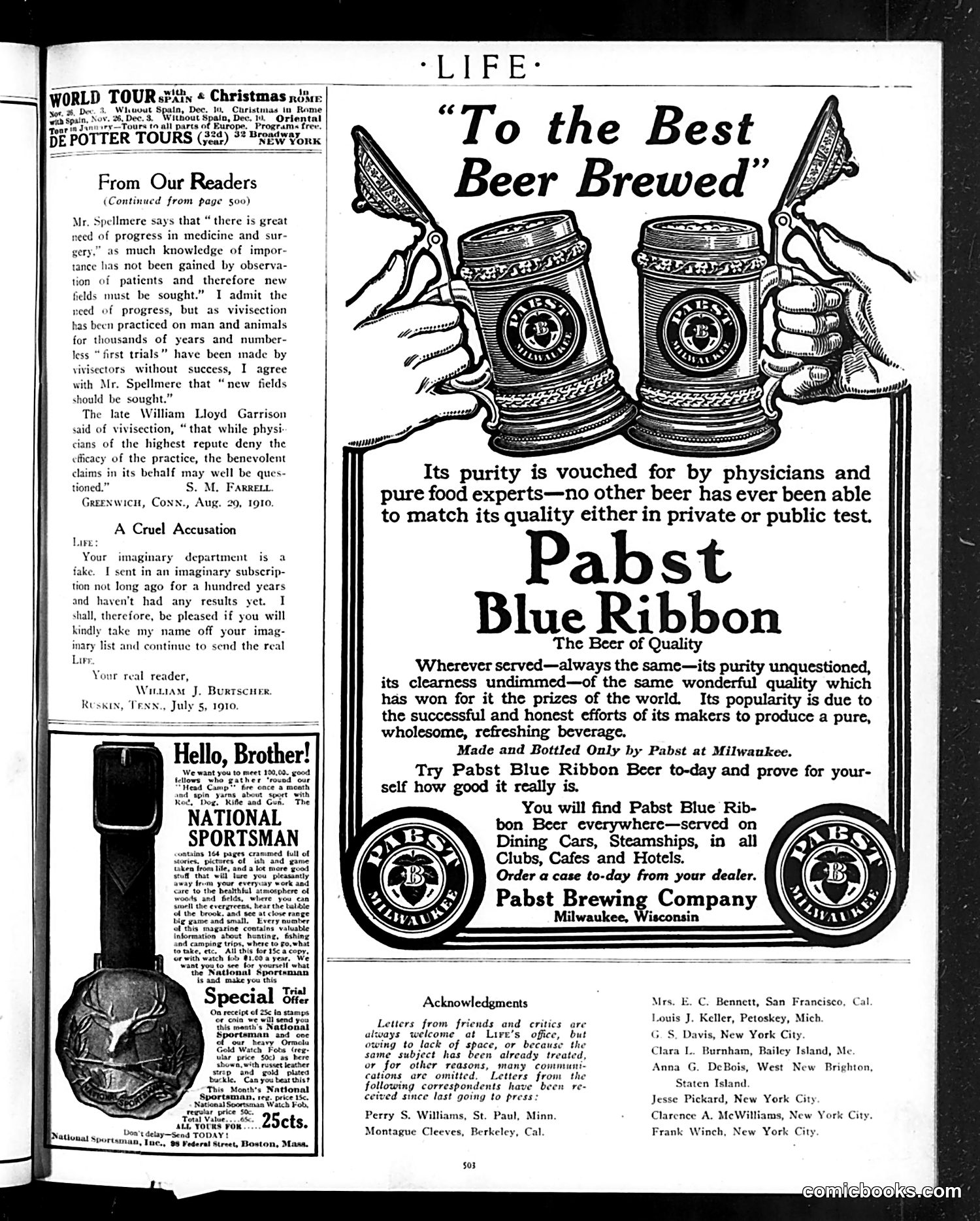
This page is primarily **advertising and reader letters**, not political satire or editorial cartooning. The dominant content is a full-page advertisement for **Pabst Blue Ribbon Beer**, featuring two ornate beer steins being clinked together. The ad claims the beer's "purity is vouched for by physicians and pure food experts," reflecting early 1900s marketing that positioned beer as a wholesome, even medicinal beverage. The left column contains reader correspondence and a small advertisement for the "National Sportsman" magazine (showing a rifle scope). **Historical context**: This pre-Prohibition era advertisement is notable for its confident health claims about alcohol—a pitch that would become illegal after the 18th Amendment (1920). The appeal to medical authority was standard marketing practice at the time.
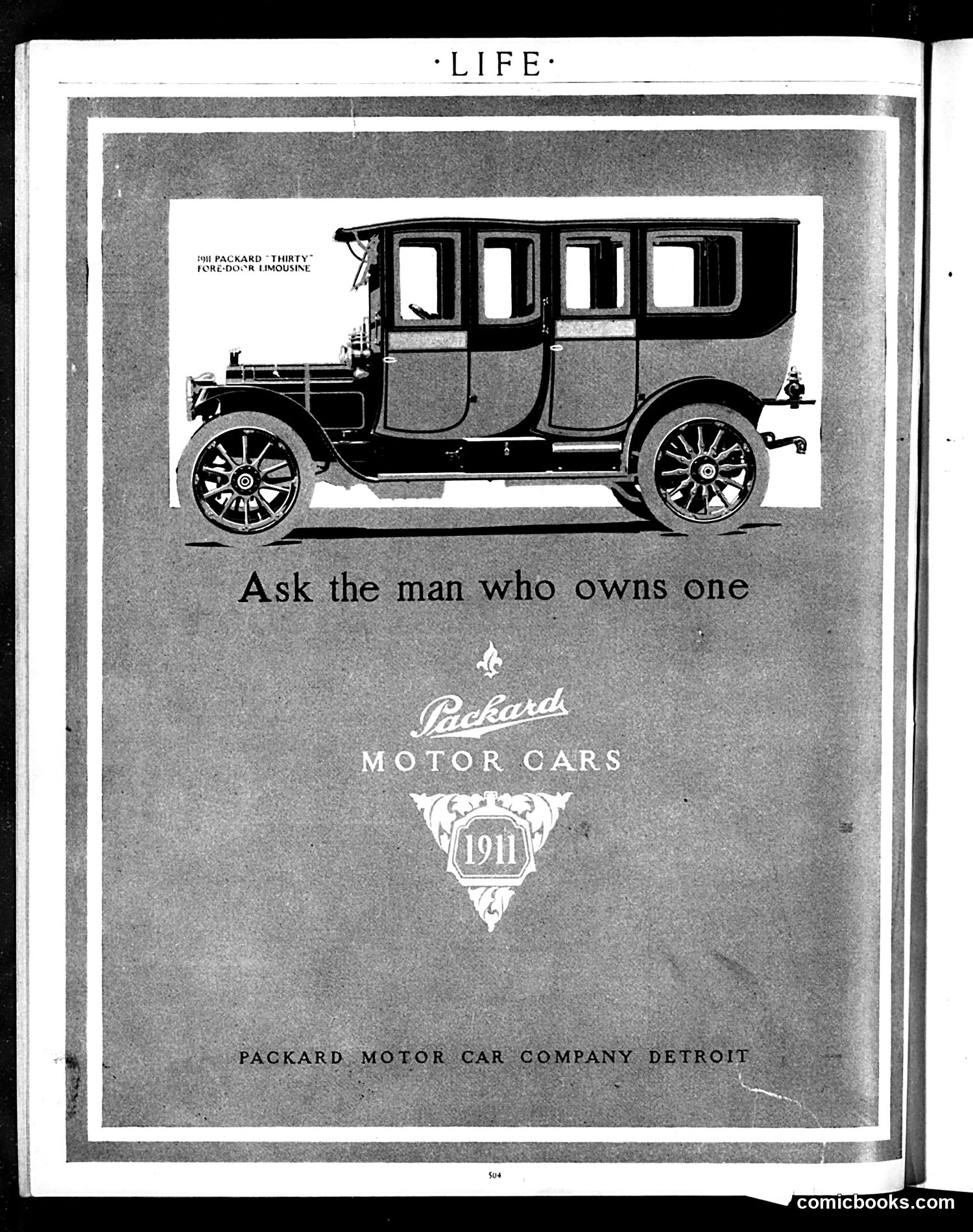
This is a **Packard Motor Car advertisement**, not political satire. The page shows a 1911 Packard "Thirty" four-door limousine with the slogan "Ask the man who owns one." This was a legitimate advertising strategy of the era—appealing to consumer testimony rather than making direct claims. The phrase became famous as Packard's actual marketing motto. The luxury vehicle's features (enclosed cabin, multiple large windows, spoke wheels) represent premium automobile technology of the early 1900s. The ad appears in *Life* magazine, which regularly published advertisements alongside humor and satire. There is no political commentary here—simply a high-end car manufacturer marketing to wealthy readers of an upscale publication.
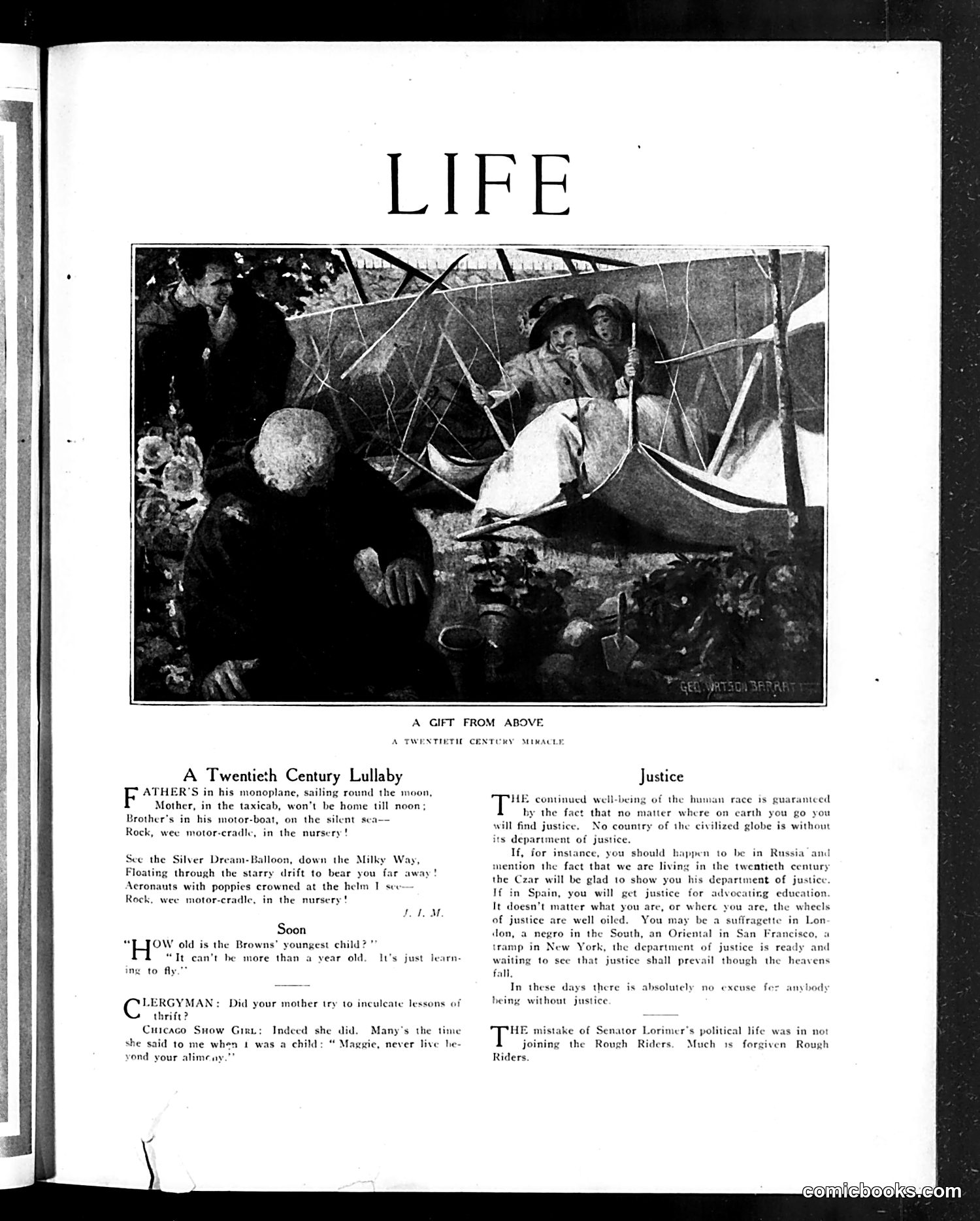
This page contains three distinct pieces of satirical content: 1. **"A Gift From Above"** - The illustration depicts an early airplane with passengers, captioned as "A Twentieth Century Miracle." This satirizes the novelty and wonder of early aviation technology (likely from the 1900s-1910s era). 2. **"A Twentieth Century Lullaby"** - A poem mocking modern life, referencing fathers in monoplanes and brothers in motorboats, contrasting technological progress with traditional family values. 3. **"Justice"** - An editorial section arguing that justice should be universally accessible across America—regardless of geography or social status (mentioning a "suffragette in London" and "a negro in the South"). This appears to address early 20th-century inequality in the American legal system. 4. **Brief humor exchanges** about a child's age and maternal thrift lessons. The page collectively satirizes modernity's promises versus social realities.
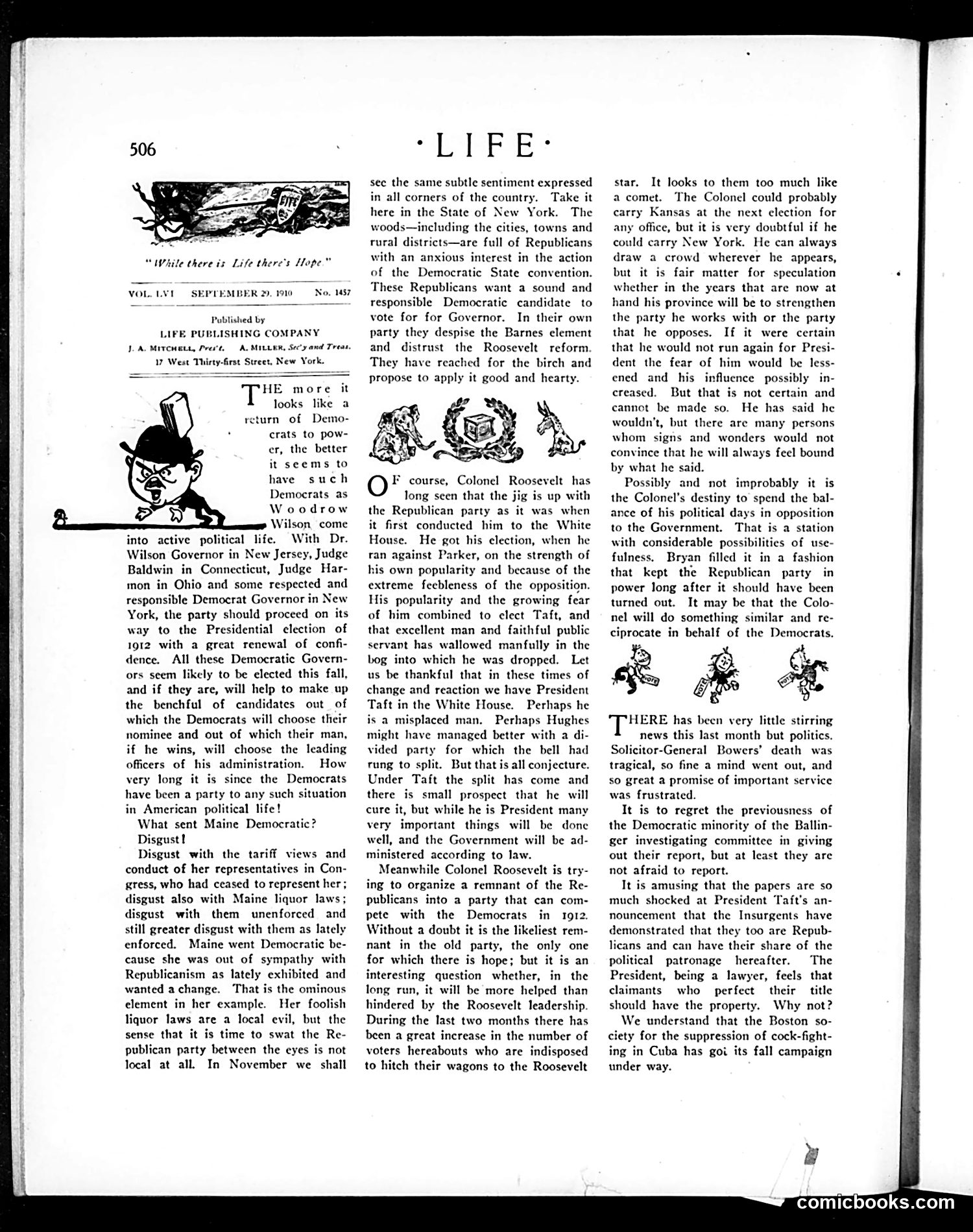
This Life magazine page (September 29, 1910) discusses the upcoming 1912 presidential election with considerable anxiety about Colonel Theodore Roosevelt's political future. The cartoon depicts a caricatured figure (likely representing Roosevelt or Democratic concerns) with exaggerated features in a top hat. The text expresses Republican worry that Roosevelt might run against their preferred candidate, possibly splitting the party. It references Maine Democrats' disgust with their own party's direction, particularly regarding tariff policies and liquor laws. The commentary suggests Roosevelt might organize a third party to challenge Democrats in 1912—a prescient concern, as Roosevelt did form the Progressive "Bull Moose" Party that year, fundamentally reshaping American politics and fracturing Republican unity.
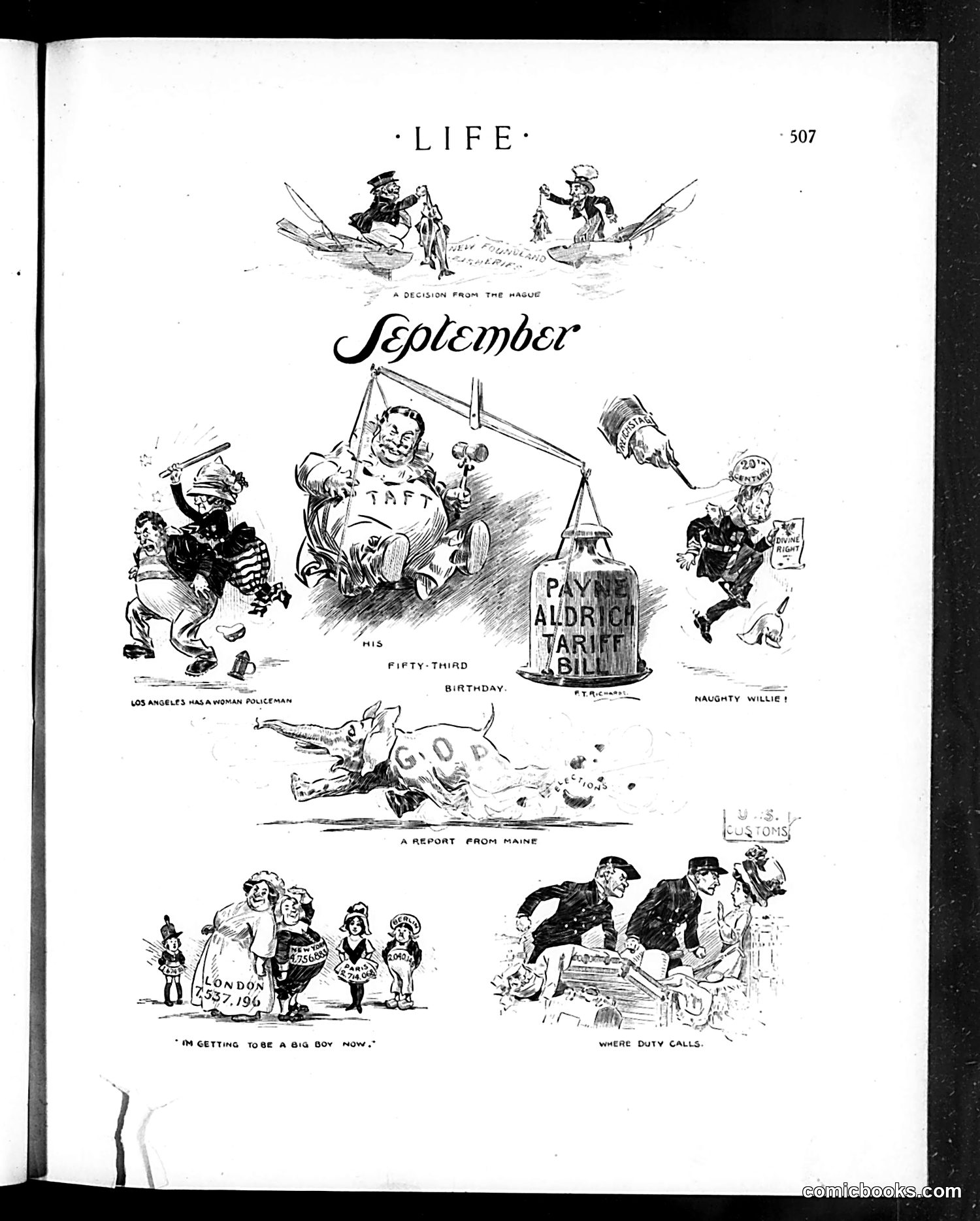
This page from *Life* magazine presents several political cartoons commenting on September 1913 events: **Central cartoon**: A large figure labeled "His Fifty-Third Birthday" sits beneath a bell labeled "Pay Aldrich Tariff Bill," with figures around it appearing to operate pulleys—likely satirizing efforts to raise tariff rates, a contentious political issue of the era. **Side panels** reference: - "Los Angeles Has a Woman Policeman"—noting a novelty for the time - "Naughty Willie I"—appears to reference a European figure - "A Report from Maine"—showing what appears to be a moose, likely a hunting reference **Bottom panels**: One references London's growing population; another titled "Where Duty Calls" depicts customs officials, suggesting trade/tariff commentary. The cartoons mock contemporary political and social developments through exaggerated caricature.
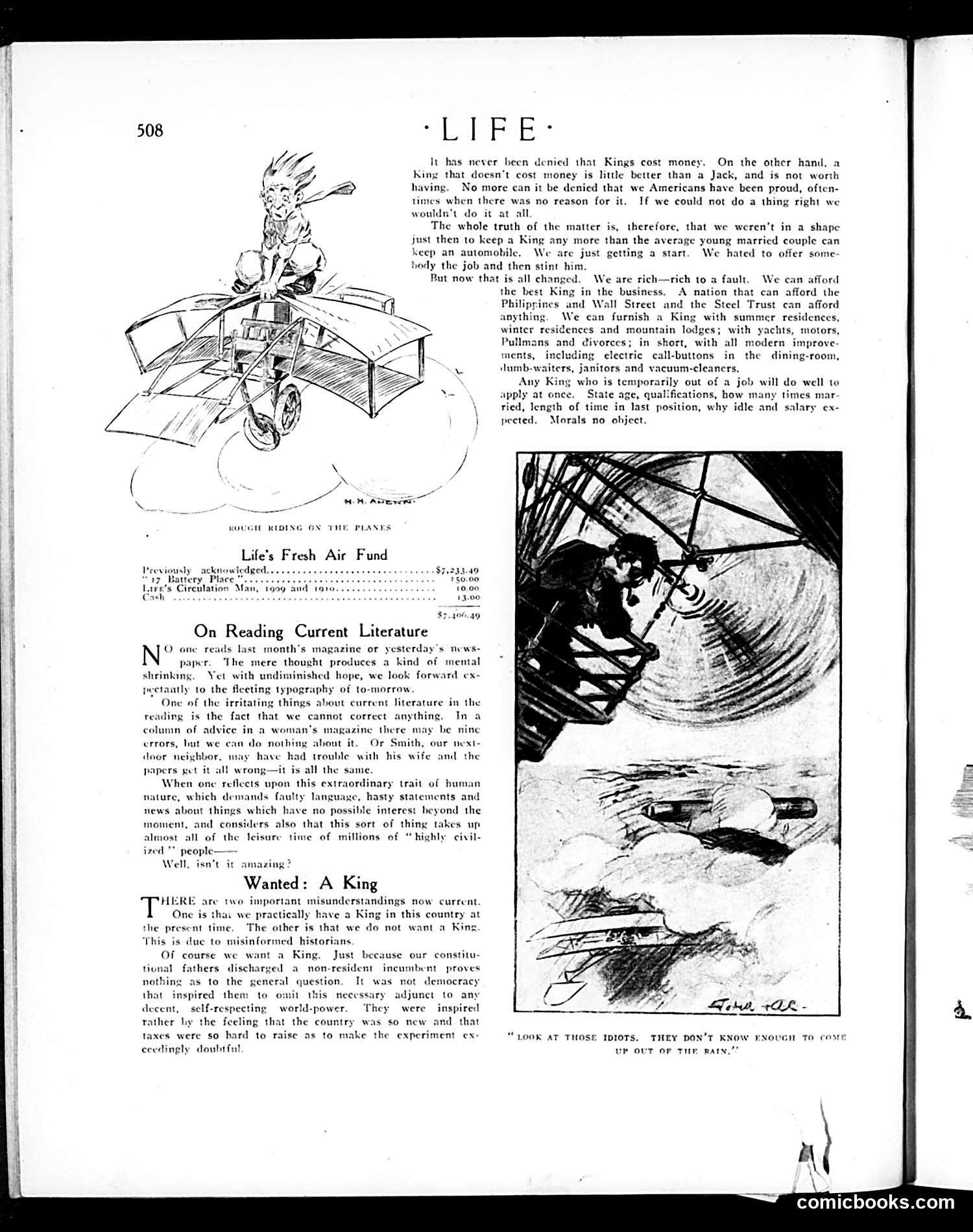
The page contains two distinct satirical pieces: **"Rough Riding on the Planes"** (top left): A cartoon depicting a figure riding in an unconventional vehicle, likely satirizing extravagant or wasteful spending—possibly related to government expenditures or wealthy excess during the period. **"Wanted: A King"** (bottom): This article argues that America needs a king to manage its finances, satirizing the difficulty of governing the country and raising taxes. The piece suggests that maintaining a modern monarch would be cheaper than current administrative costs. **Right illustration**: Shows figures caught in rain without shelter, captioned "Look at those idiots. They don't know enough to come up out of the rain," apparently satirizing public ignorance or foolishness. The overall theme critiques American governance, fiscal mismanagement, and public behavior during what appears to be the early 20th century.
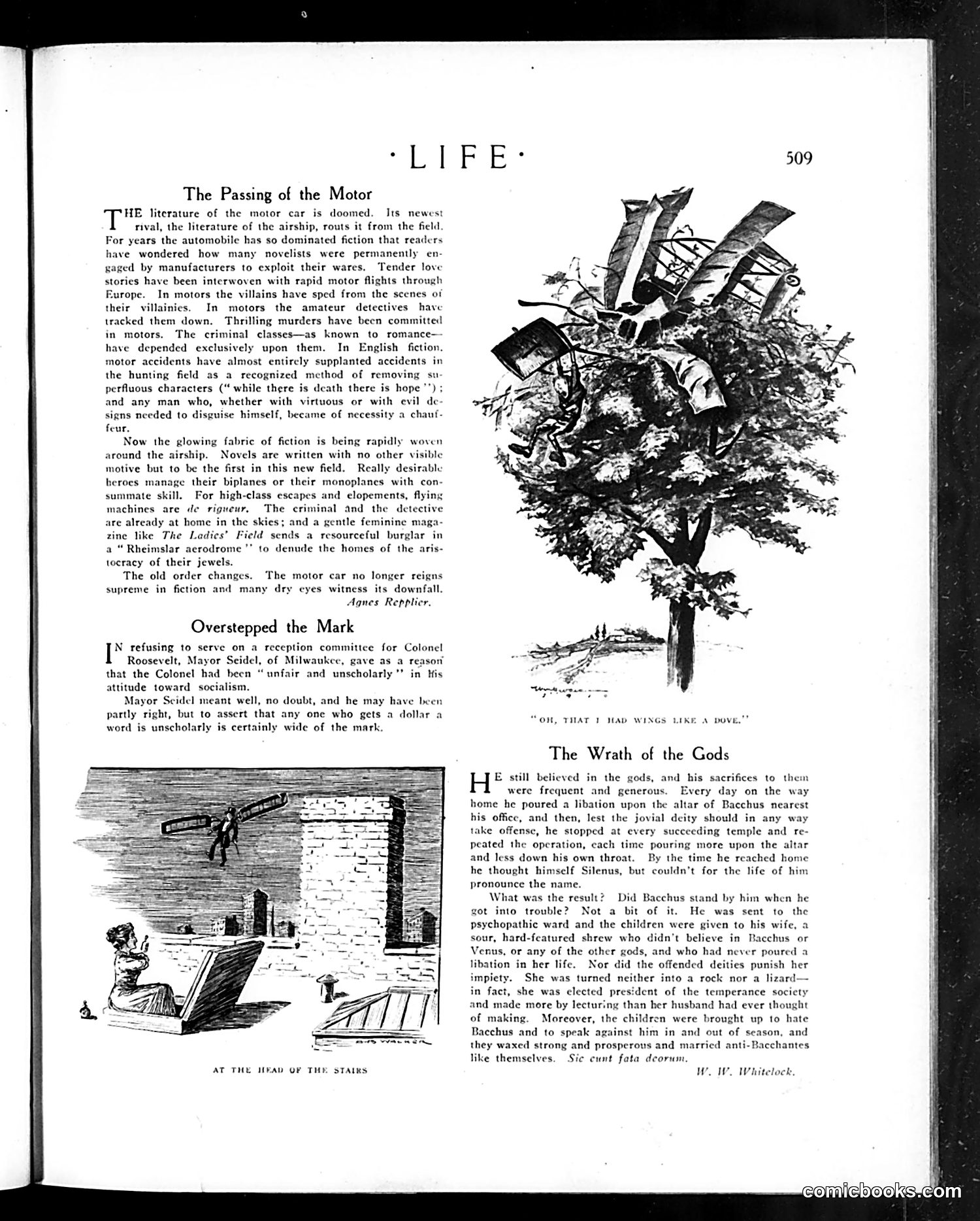
This page contains literary criticism and social commentary rather than political cartoons. The main article "The Passing of the Motor" discusses how the automobile, once literature's newest rival to the airship, is losing its dominance in fiction. The author notes that motor cars now appear less frequently in novels compared to earlier years. The accompanying illustrations show: a crashed or wrecked automobile tangled in a tree (captioned "Oh, that I had wings like a dove"), and a separate sketch labeled "At the Head of the Stairs" depicting someone on stairs. The text critiques how the motor car's literary prominence has declined, suggesting changing public interest in this once-celebrated technology as a fictional subject.
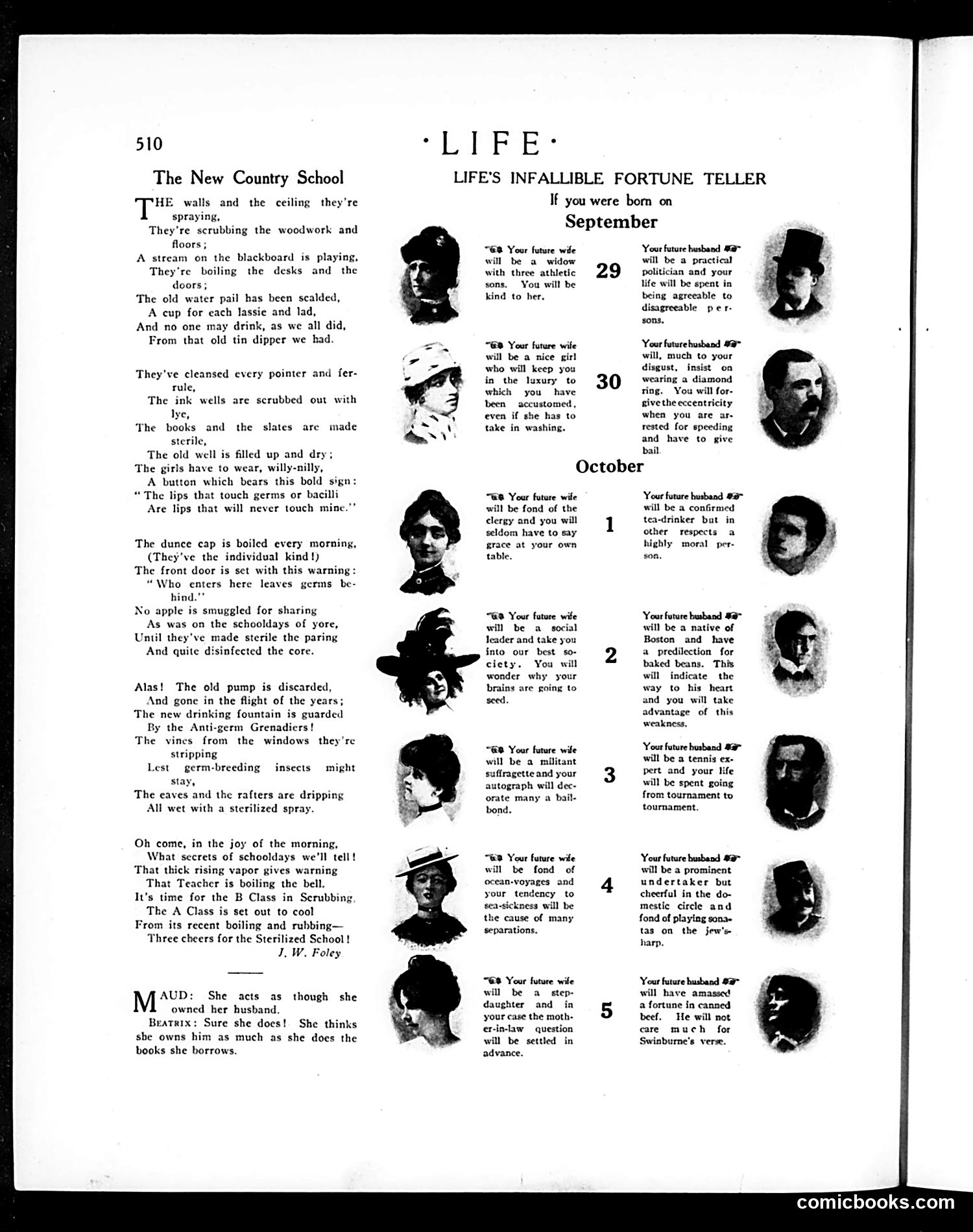
**Left page ("The New Country School"):** A satirical poem by J.W. Foley mocking the early 20th-century germ-theory obsession in schools. The school has gone to absurd extremes—sterilizing everything from dunce caps to water dippers, employing "Anti-germ Grenadiers" to guard fountains, and boiling bells. Students wear buttons warning "lips that touch germs...will never touch mine." The satire targets how schools applied new scientific understanding of bacteria with comical hysteria, turning education into an endless sanitization operation. **Right page ("Life's Infallible Fortune Teller"):** A humorous dating/marriage fortune-telling feature for people born in September-October. Each numbered date offers tongue-in-cheek predictions about future spouses, poking fun at contemporary concerns: militant suffragettes, gold-digging wives, sea-sickness, social climbing, and financial status. The jokes reflect Edwardian anxieties about matrimony and gender roles.
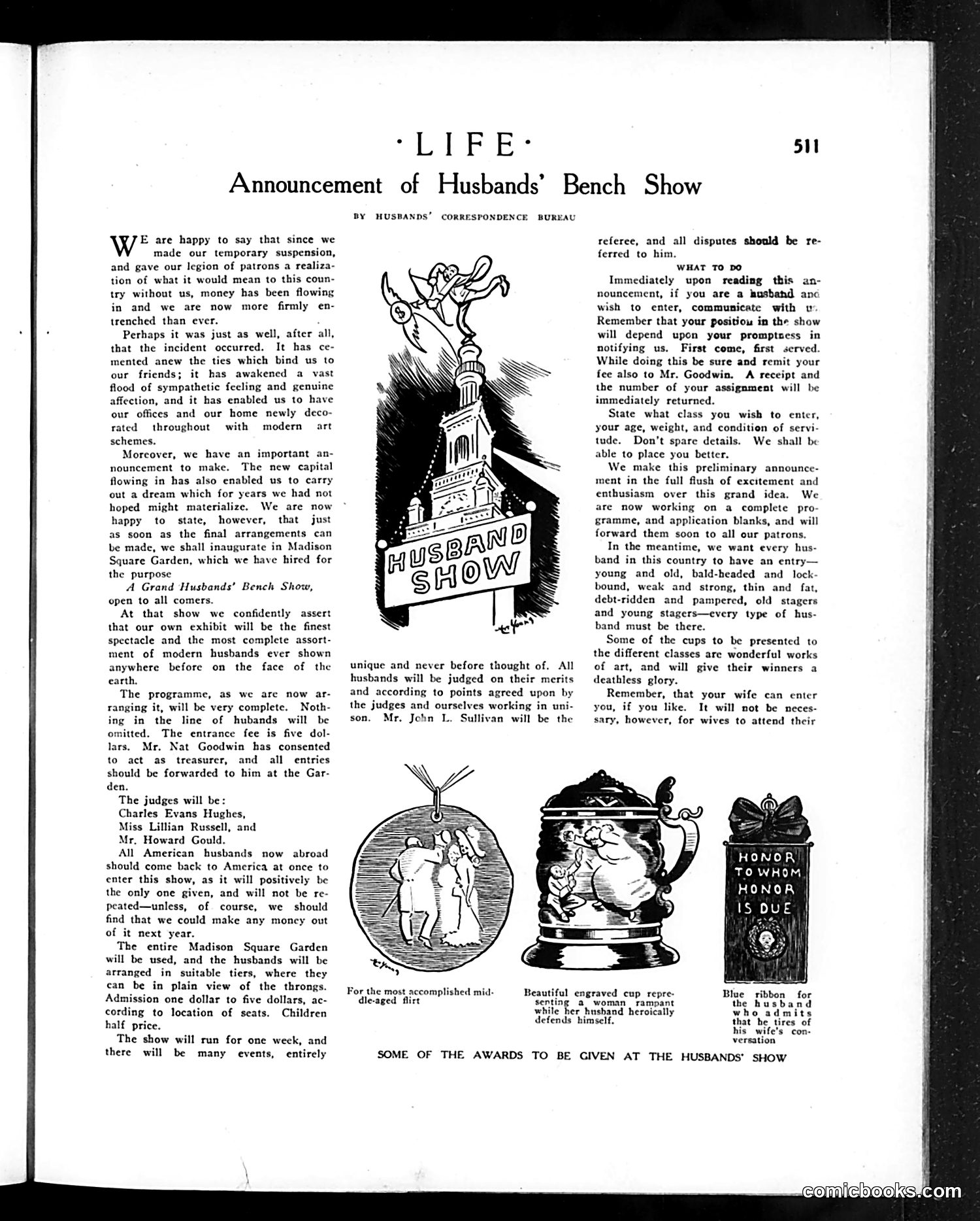
This is satirical social commentary disguised as an announcement for a dog-show-style exhibition of husbands at Madison Square Garden. Life magazine is mocking contemporary marriage dynamics and male behavior by proposing to categorize and judge husbands like livestock. The judges listed—Charles Evans Hughes (prominent politician), Lillian Russell (famous actress), and Howard Gould (wealthy businessman)—were contemporary celebrities whose involvement adds absurdist humor. John L. Sullivan, the famous boxer, serves as "referee," which is incongruous comedy. The satirical awards shown (medals for "the most accomplished middle-aged flirt," cups depicting wives defending themselves from husbands) mock male infidelity and domestic conflict. The submission form requesting "condition of servitude" ridicules marriage itself. The satire targets husbands' supposed inadequacies, marital discord, and the era's gender tensions. By treating husbands as exhibitable specimens to be ranked and judged, Life inverts typical social hierarchies in witty, cutting fashion.
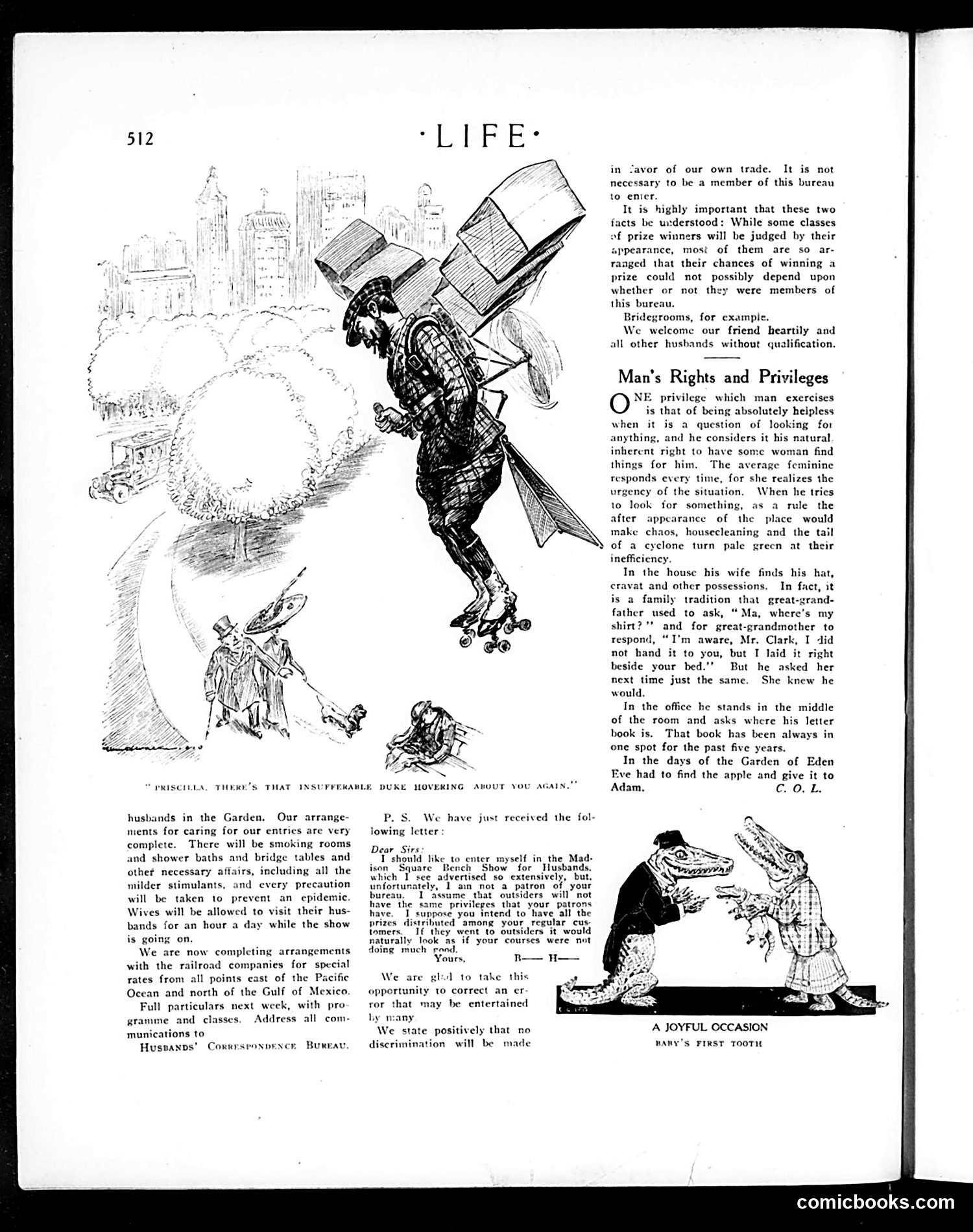
This page satirizes early 20th-century gender dynamics through two interconnected pieces: **Main Cartoon**: A chaotic illustration of a man on roller skates, precariously balancing stacked boxes while a woman's voice warns about "that insufferable Duke." The visual joke: men are comically incompetent and dependent, needing women to manage their lives and warn them of social dangers. **"Man's Rights and Privileges" Essay**: A tongue-in-cheek article mocking men's helplessness. It claims men have the "privilege" of being utterly unable to locate anything—hats, cravats, letter books—requiring women to constantly find things for them. The piece traces this behavior back to Adam and Eve, suggesting it's biblical and eternal. **The Satire**: Life inverts "men's rights" language. Rather than celebrating male privilege, it reveals male dependency and incompetence in daily life, positioning women as the actual capable operators. This critiques both male helplessness and the societal expectation that women serve as domestic managers. The tone is lighthearted but points to real power imbalances masked by traditional gender roles.
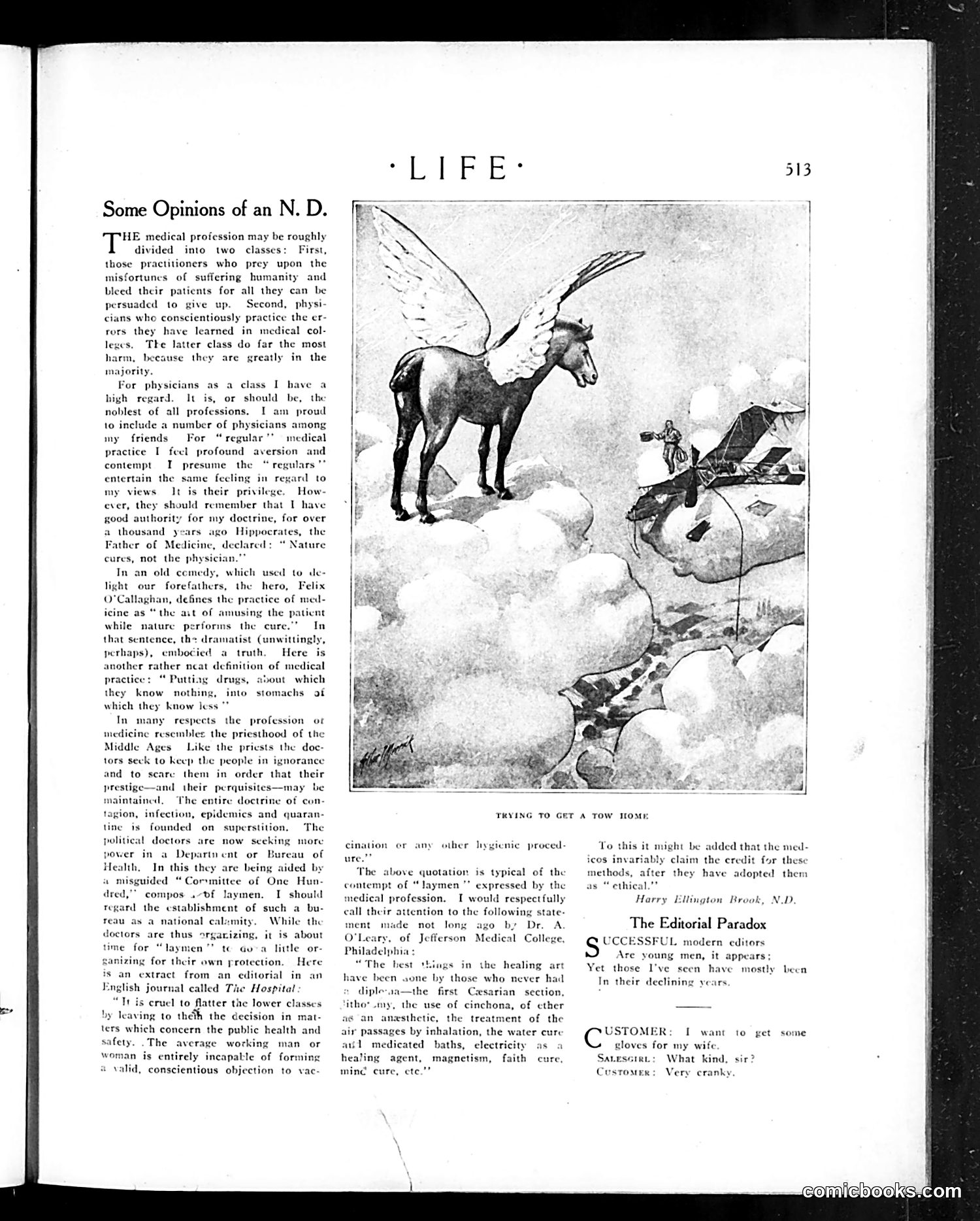
This page contains a scathing critique of the medical profession, attributed to "Harry Ellington Brook, N.D." (likely a pseudonym—"N.D." possibly meaning "Non-Doctor"). The author attacks "regular" physicians as ignorant practitioners who exploit patients while claiming credit for cures actually achieved by nature or non-medical discoveries. The cartoon "Trying to Get a Tow Home" depicts a winged, skeletal figure (Death or a grim reaper) attending to a fallen horse and rider—a visual metaphor for medical malpractice or the profession's inability to help. The author cites historical medical innovations (Caesarean sections, use of cinchona and electricity) credited to physicians but actually developed by non-credentialed practitioners, arguing doctors maintain power through secrecy and fear, like medieval priests. A brief joke at page's end about "cranky" gloves provides comic relief from the polemical tone. This represents early-20th-century skepticism toward professional medical establishment authority.
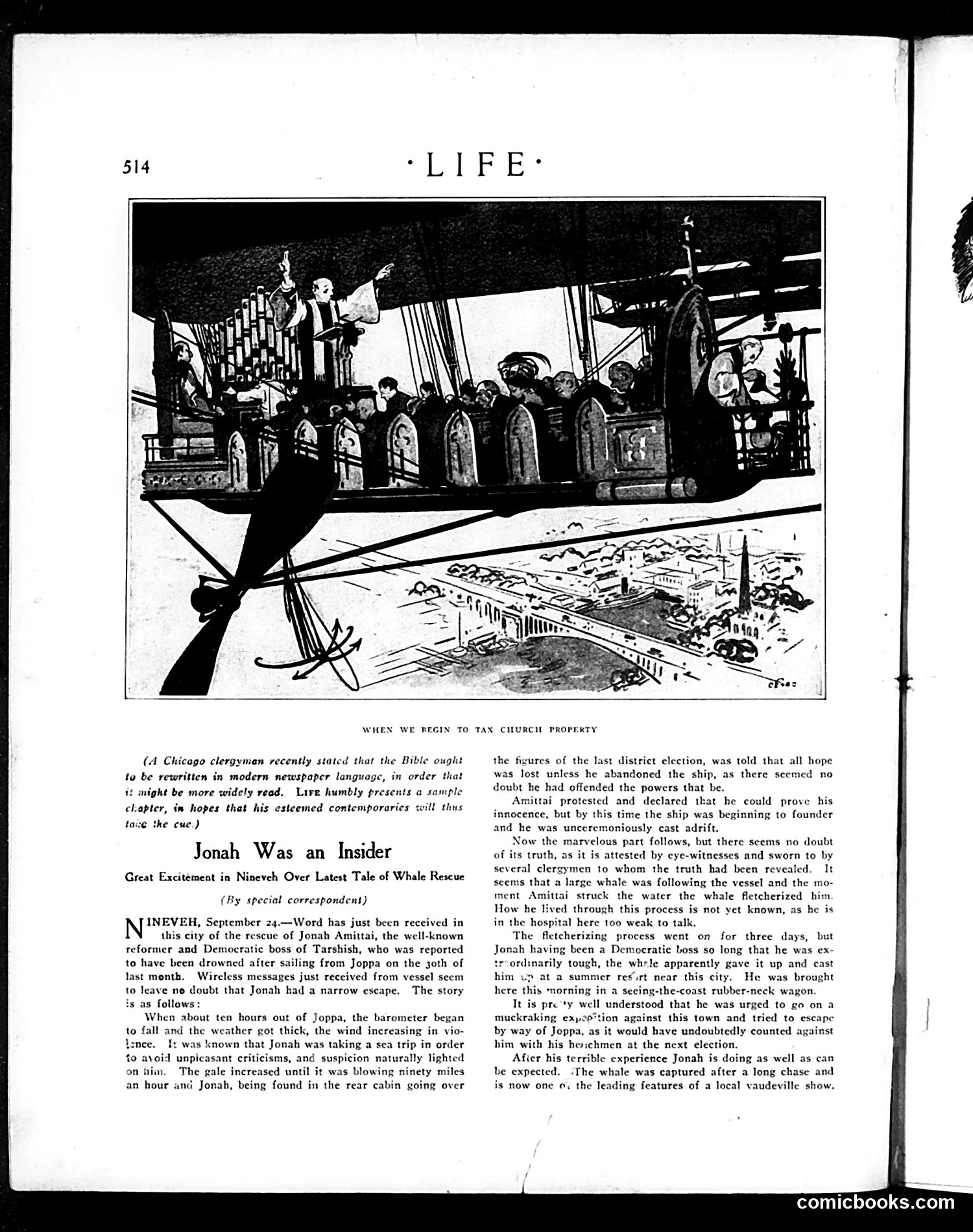
This is a satirical rewriting of the Biblical story of Jonah in modern newspaper style, mocking early 1900s political corruption. The piece reimagines Jonah as a Democratic political boss fleeing Tarshish to escape criticism—a transparent reference to a contemporary politician dodging scandal. The satire targets: - **Political corruption**: Jonah is a "boss" traveling to avoid "unpleasant criticisms," implying he's guilty - **Party loyalty**: His toughness as a Democrat literally saves him; the whale can't digest him - **Voter manipulation**: He fears his "henchmen" will turn against him at "the next election" - **Yellow journalism**: The mock-serious tone parodies sensationalist newspaper coverage of political scandals The opening editor's note criticizes a Chicago clergyman's proposal to modernize Biblical language, and Life uses this exact device to satirize contemporary politics by applying modern newspaper conventions to ancient scripture. The whale's exhibition in a vaudeville show adds comedic absurdity to the ending.
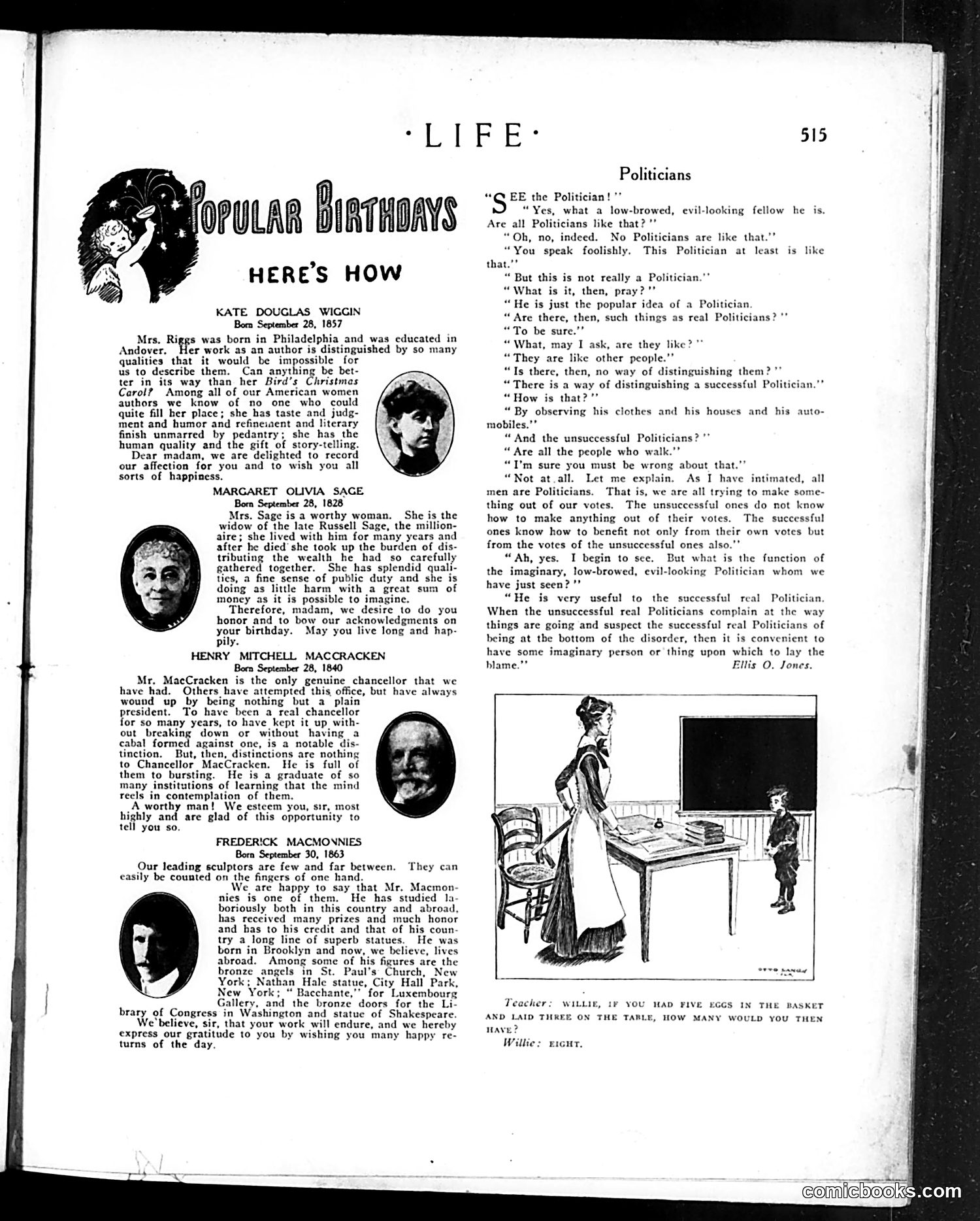
This page from *Life* magazine satirizes American politicians through a dialogue format. The cartoon contrasts the public's stereotype of politicians—depicted as ugly, evil-looking men—with the reality that politicians actually look like ordinary people. The satire's key point: **the only way to distinguish successful politicians from unsuccessful ones is by their material wealth**. Successful politicians display expensive clothes, houses, and automobiles, while unsuccessful politicians are indistinguishable from common pedestrians. The joke critiques both public perception and political corruption. It suggests that politicians succeed not through merit or character but through accumulating wealth, implying that political success equals financial exploitation. The dialogue format allows the author to present this cynical observation as obvious common sense, making the critique more cutting. This reflects *Life*'s role as a satirical publication exposing American social hypocrisy and political corruption during the Gilded Age era.
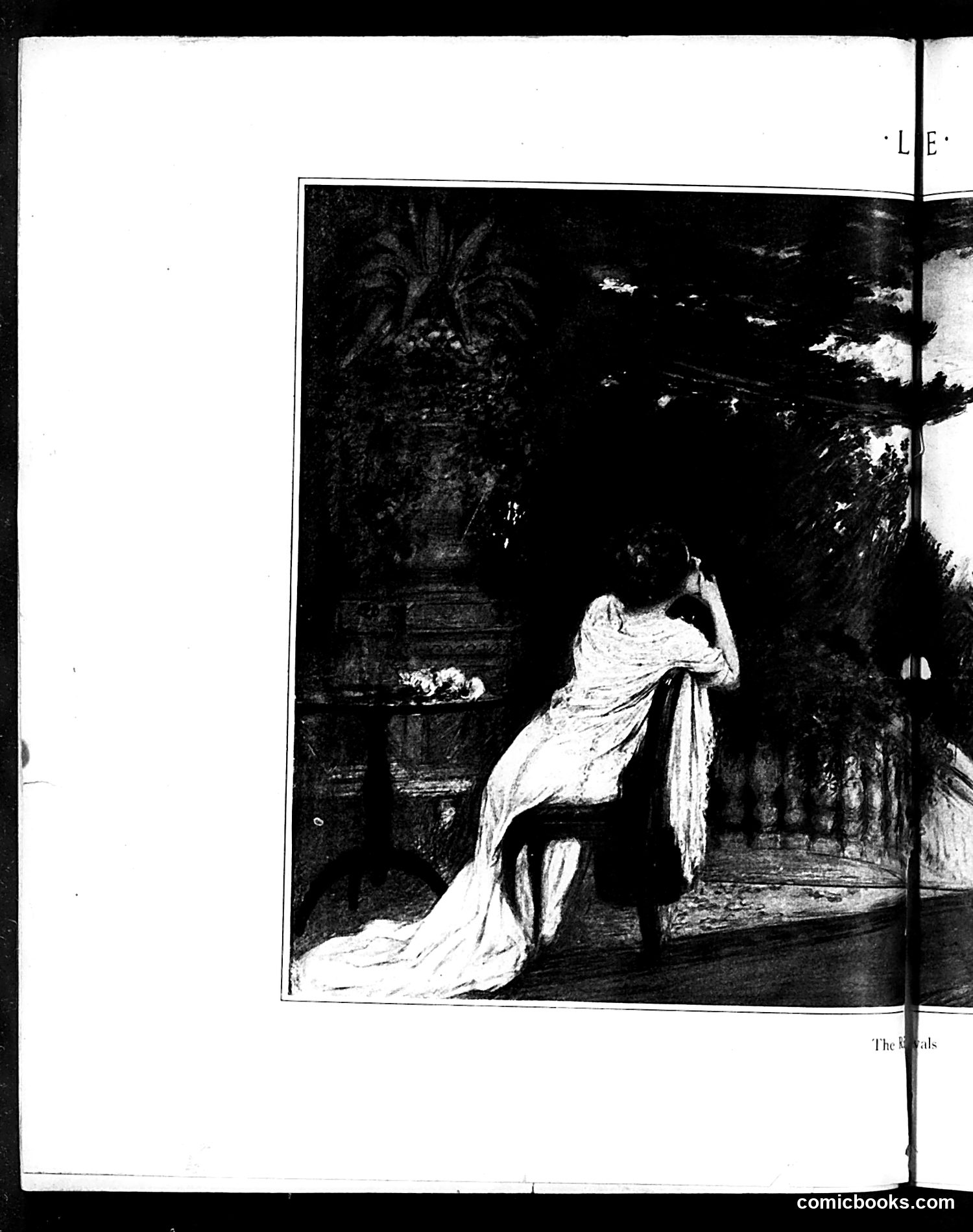
This page from *Life* magazine shows an illustration titled "The Rivals" depicting a woman in classical/romantic dress reclining in an exotic interior setting with palm trees visible in the background. The woman appears to be in a contemplative or melancholic pose, gazing outward. Without additional visible text explaining the specific satire, I cannot definitively identify who "the rivals" are or what political/social commentary this makes. The exotic setting and classical styling suggest either a commentary on orientalism, romance literature, or possibly theatrical/operatic themes popular in the era. The artistic style and presentation indicate this is satirical social commentary typical of *Life* magazine, but the precise target of the satire remains unclear from the image alone.
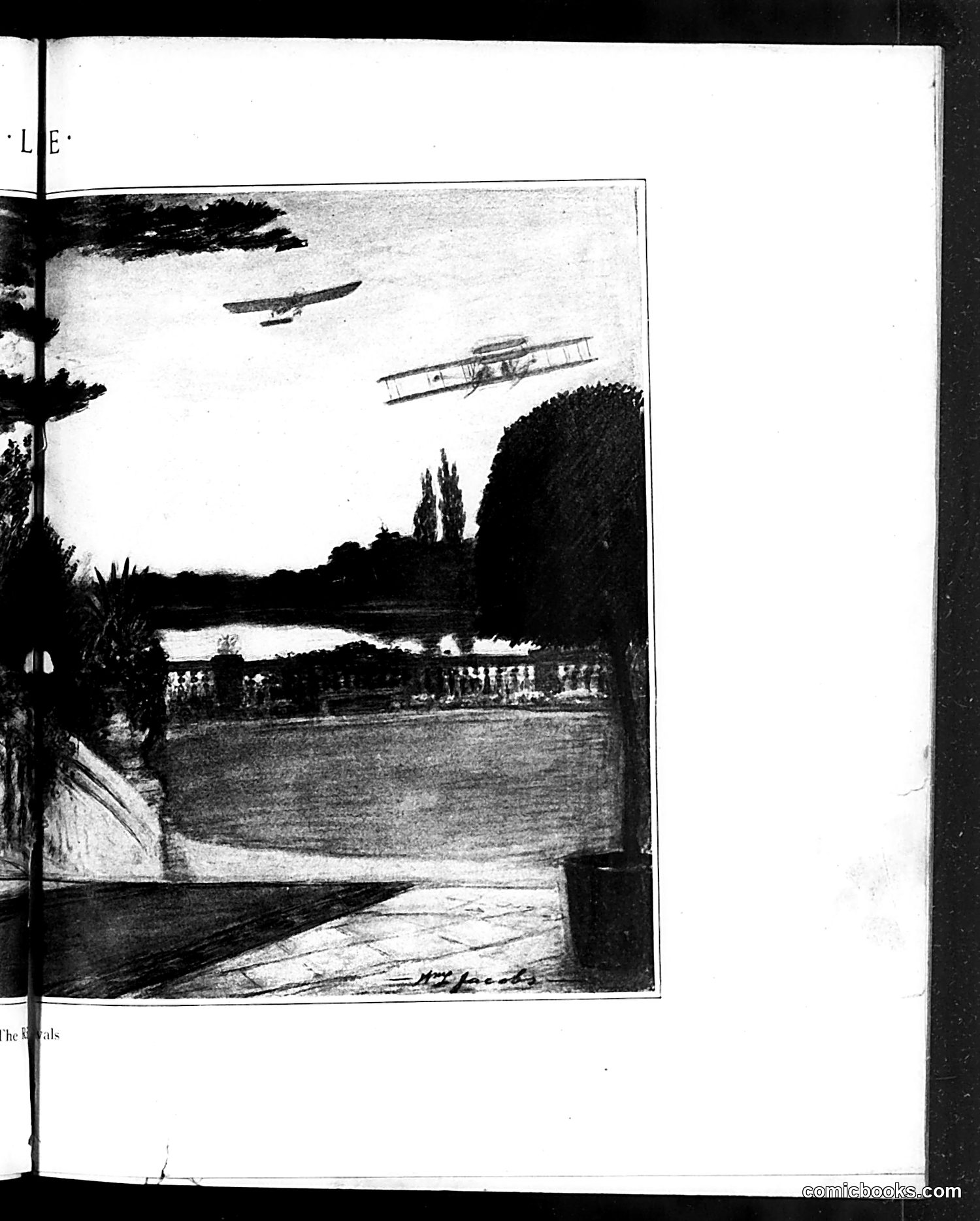
This page appears to be from an early aviation-themed publication or section. The illustration depicts a scenic landscape view with a terrace or balcony overlooking a river or waterway, framed by trees and vegetation. Two early aircraft are shown flying in the sky above. Given the artistic style and the presence of aircraft designs that appear to be from the early 1900s, this likely celebrates the novelty and wonder of powered flight as a modern achievement. The composition—with the aircraft integrated into an idealized landscape scene viewed from a leisurely vantage point—suggests this artwork aims to position aviation as an exciting new technology entering everyday life and leisure culture. However, without clearer text or additional context, I cannot definitively identify specific figures, satirical intent, or particular historical references this page means to convey.
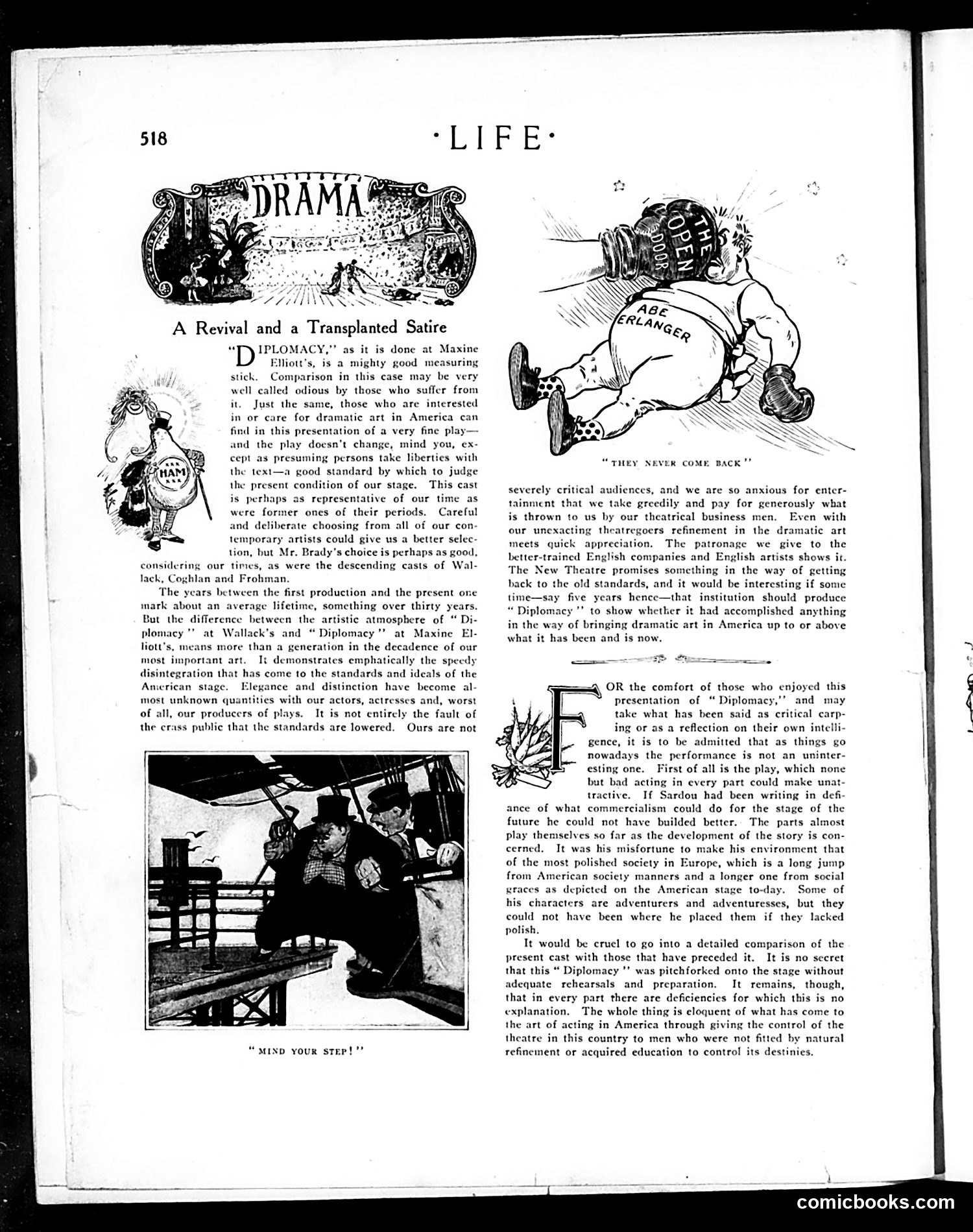
This Life magazine page critiques a revival of the play "Diplomacy" at Maxine Elliott's Theatre, comparing it unfavorably to earlier productions at Wallack's Theatre (performed generations prior). The cartoons illustrate the article's theme about theatrical decline. One shows a figure labeled "Age & Creaker" carrying a large bomb labeled "Diplomacy"—suggesting the old play is struggling under its own weight. Another cartoon, captioned "Mind Your Step!", depicts someone navigating backstage obstacles. The text argues that American theater standards have deteriorated significantly since the original production. The reviewer credits the excellent script (by Sardou) but faults the current cast's lack of refinement, polish, and proper rehearsal. He contrasts this with superior English theatrical companies and suggests the newly-founded New Theatre might restore dramatic art standards in America. The implicit critique: American commercial theater prioritizes profit over artistic quality.
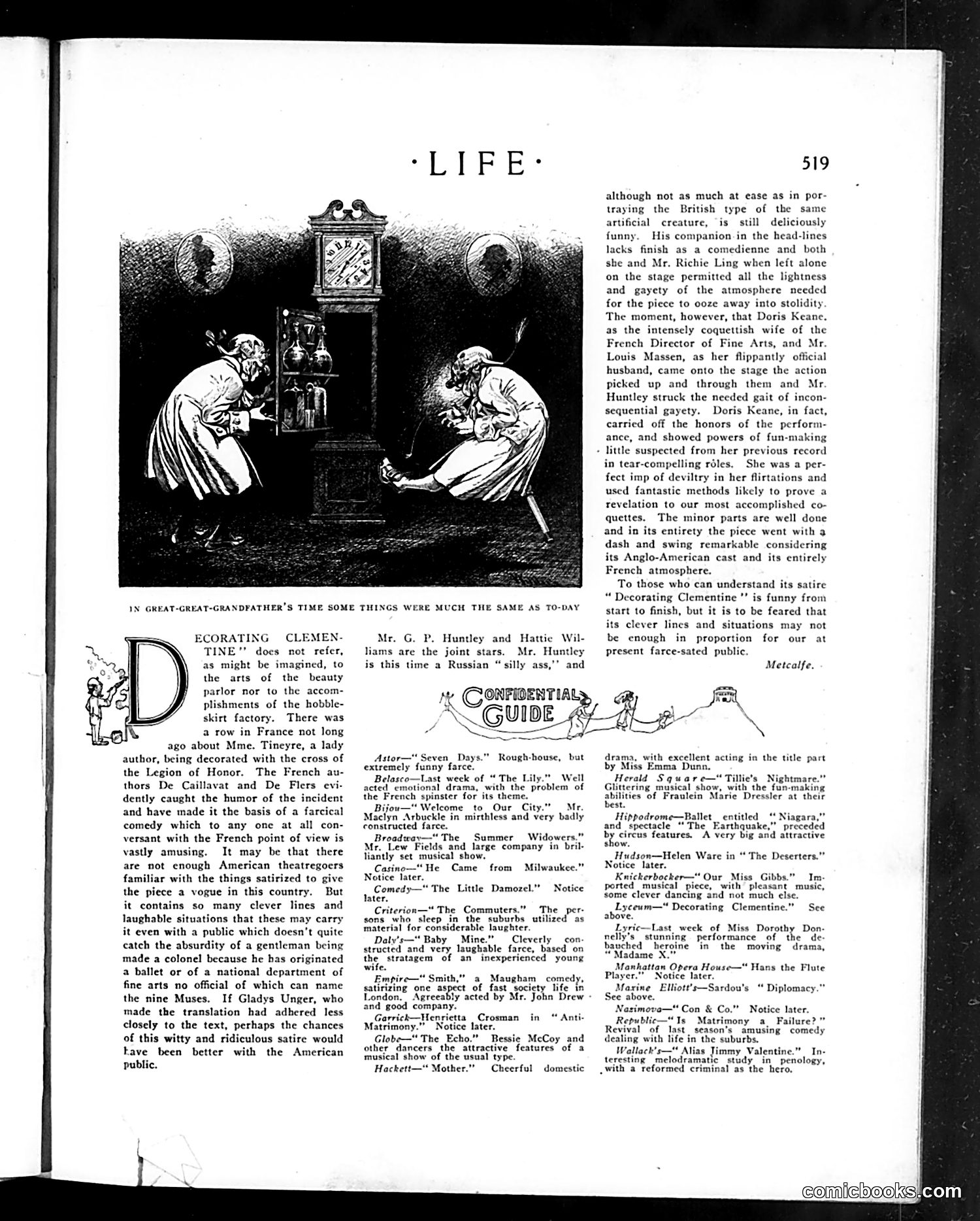
The illustration shows two figures in period dress examining a grandfather clock, satirizing French bureaucratic absurdity. The page reviews a farcical comedy based on a real 1910 French scandal: author Mme. Tineyre's decoration with the Legion of Honor, which provoked outrage from male authors De Caillavat and De Flers. The satire mocks the ridiculousness of France's national arts bureaucracy—specifically that officials couldn't even name the nine Muses, yet awarded honors to writers. The playwrights amplified this absurdity: a man becomes a colonel for choreographing a ballet; a woman receives honors through absurd circumstances. The American production stars G.P. Huntley (as a Russian fool) and Doris Keane (as a coquettish French wife). The reviewer notes American audiences unfamiliar with French institutional pretension might miss the joke's target, though the play's clever dialogue and Keane's comedic performance carry it anyway.
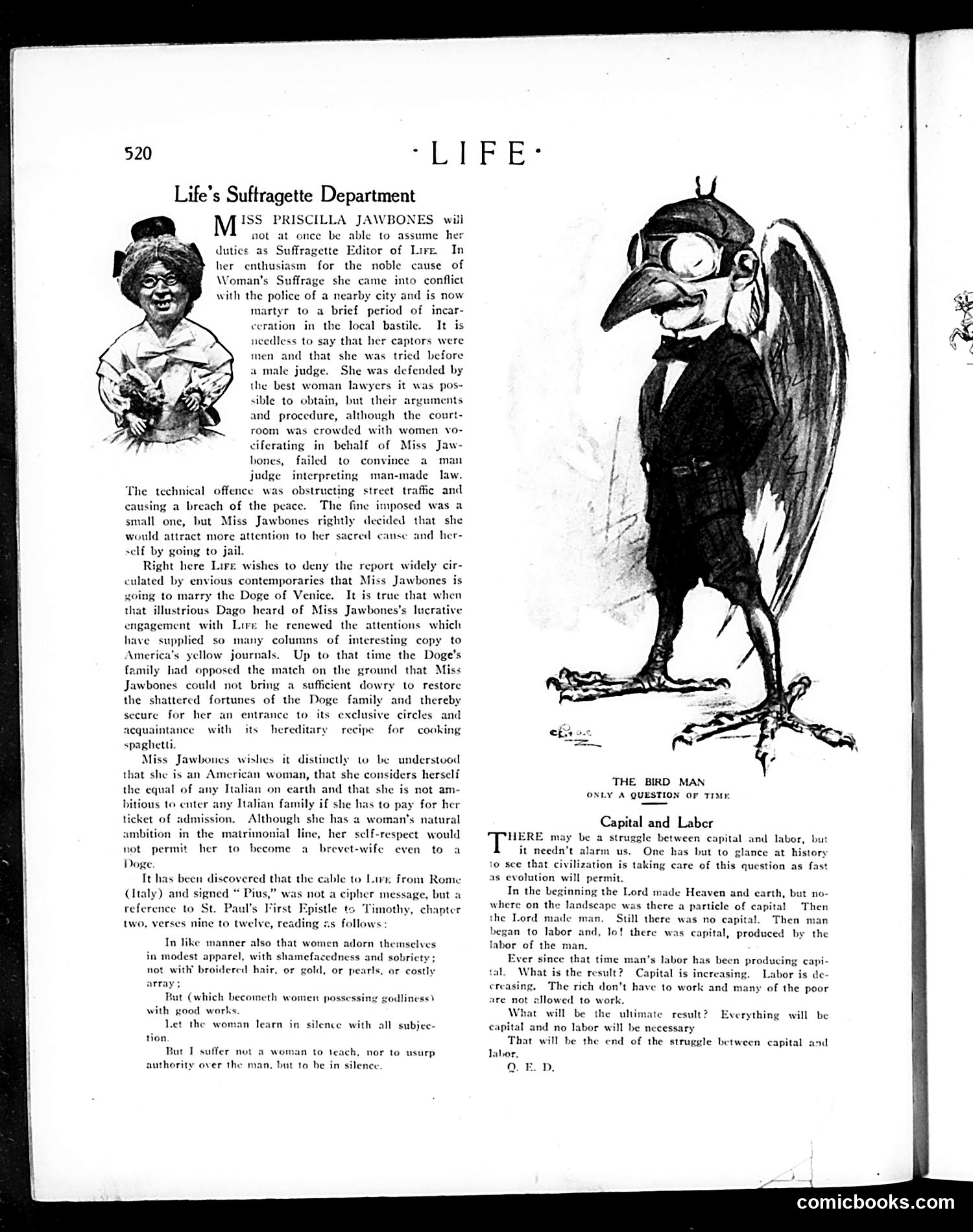
This Life magazine page contains two satirical pieces: **"Life's Suffragette Department"** mocks women's suffrage activism through the fictional character Priscilla Jawbones, who was jailed for obstructing traffic during a suffrage protest. The piece sarcastically defends her while reporting absurd gossip (a rumored engagement to the "Doge of Venice"). The accompanying caricature appears to depict a suffragette. Life concludes by quoting St. Paul's epistles commanding women's silence and submission—presenting anti-suffrage arguments as divine authority. This represents Life's editorial opposition to women's voting rights. **"The Bird Man"** cartoon (right) shows a vulture-like creature, likely representing capitalism or wealthy industrialists exploiting labor. The accompanying essay sardonically argues that capital naturally increases while labor decreases, predicting an eventual utopia where capital exists without labor—a cynical critique of capitalism's trajectory and class inequality. Both pieces use satire to mock progressive causes: suffrage through ridicule, and capitalism through dark economic projection.
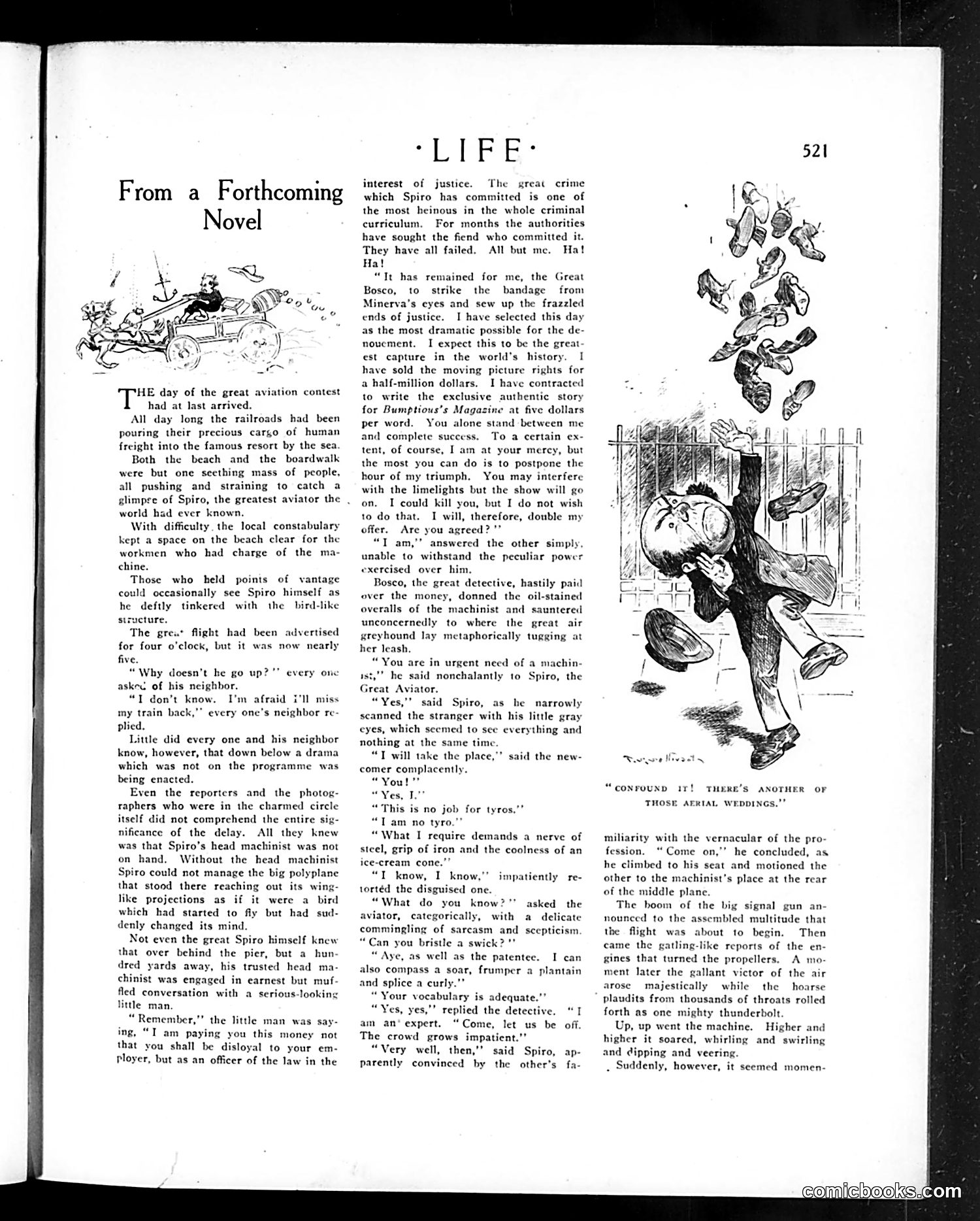
This page excerpts a serialized short story titled "From a Forthcoming Novel" about an aviation contest featuring a character named Spiro, "the greatest aviator the world had ever known." The satire targets **detective fiction and sensationalism**. The villain is "the Great Bosco," a self-aggrandizing detective who has bribed Spiro's head machinist to delay the flight so Bosco can dramatically arrest Spiro for an unspecified crime. Bosco explicitly states he's sold movie rights for half a million dollars and contracted to write the story for a magazine at five dollars per word—satirizing how detectives and law enforcement exploited publicity and media deals. The humor lies in Bosco's transparent vanity: he values the theatrical "capture" and financial opportunity more than actual justice, and he freely admits bribing a witness while lecturing about justice. The accompanying pen-and-ink illustrations show chaotic aviation-contest crowds, typical of the era's fascination with early flight. This mocks both celebrity detective narratives popular in the 1910s-1920s and the commercialization of crime reporting.
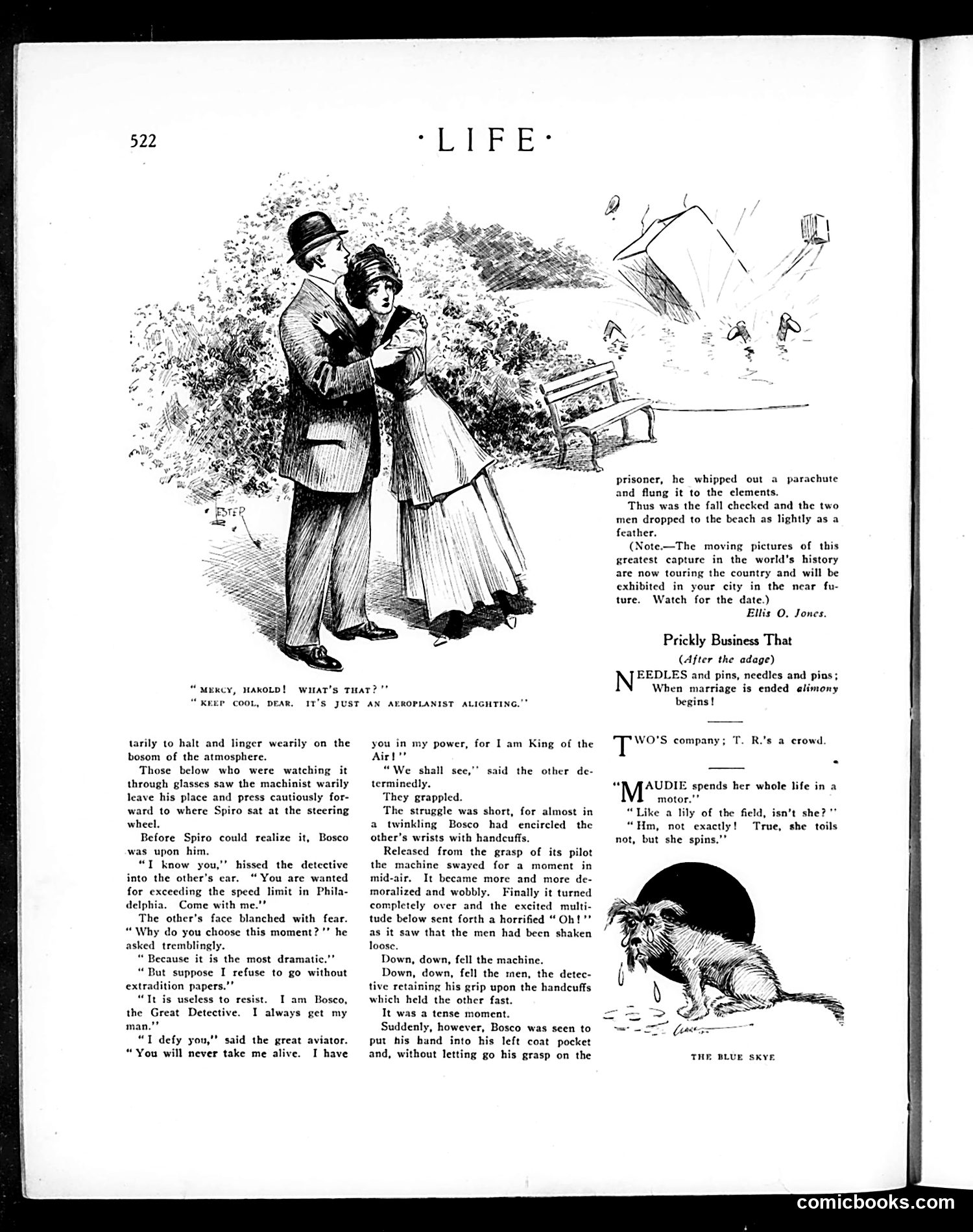
This page satirizes early aviation sensationalism and detective fiction. The main cartoon depicts "Bosco, the Great Detective" apprehending an aviator mid-flight for speeding violations—an absurdly dramatic scenario. The humor lies in the over-the-top melodrama: a police capture conducted thousands of feet in the air, complete with handcuffs and a parachute rescue. The caption's mock-serious tone ("greatest capture in the world's history") mocks both pulp detective stories and breathless newspaper coverage of aviation's early feats. The accompanying text snippets are brief satirical quips about marriage and social behavior—typical Life magazine "shorts" poking fun at contemporary life. The illustration of a bird labeled "THE BLUE SKYE" likely completes the aviation theme. Overall, this page lampoons public fascination with both sensational crime narratives and the spectacle of early powered flight, suggesting Americans' appetite for melodramatic entertainment.
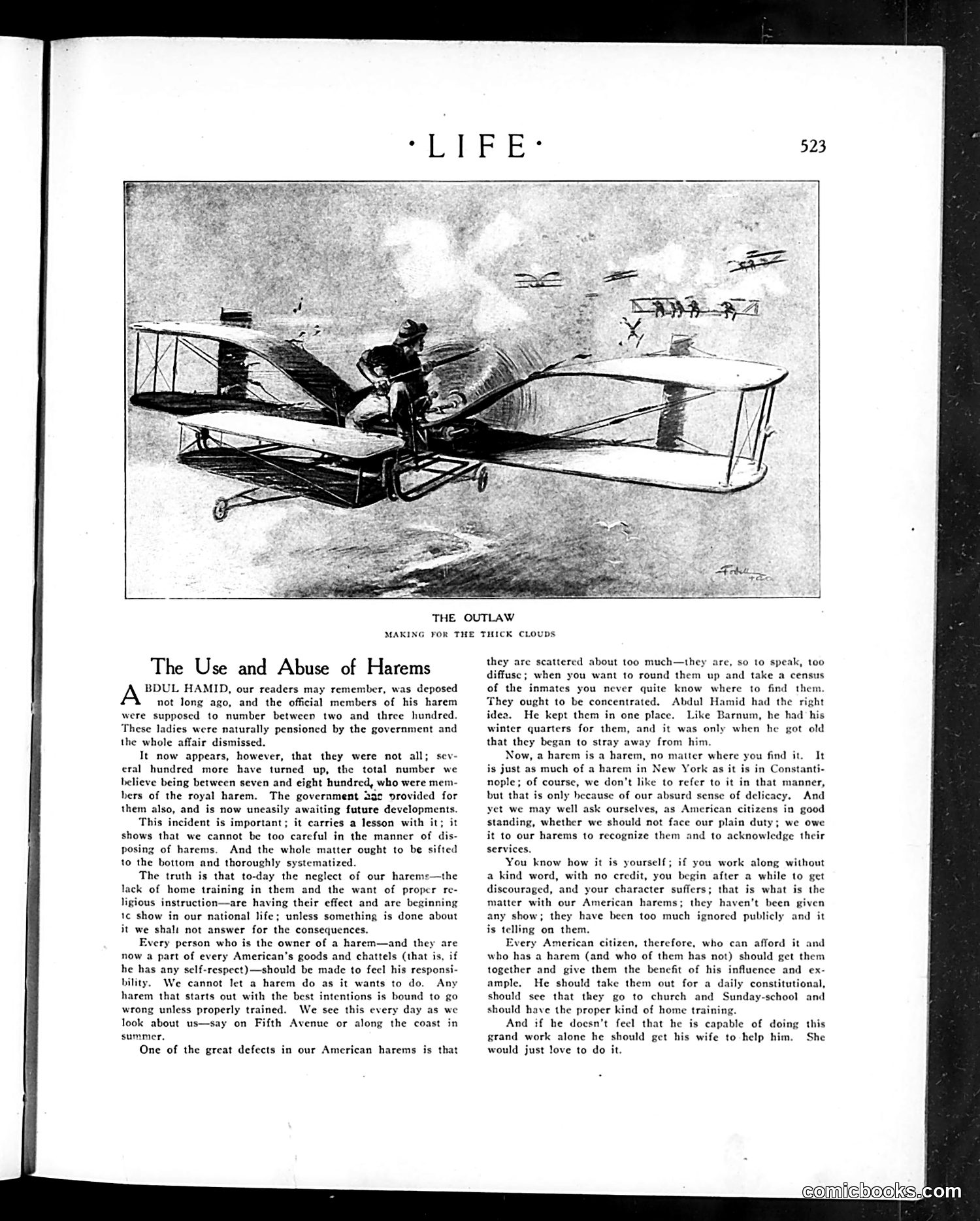
This is political satire targeting American society's hypocrisy regarding women's status, using Sultan Abdul Hamid II's recent deposition as a springboard. **The Setup:** Abdul Hamid (Ottoman Sultan, deposed 1909) maintained a massive harem of 700-800 women. The satirist uses this as a mirror to mock American men's treatment of wives and women. **The Joke:** By calling American wives "harems" and applying Hamid's management practices to American domestic life, the piece sarcastically exposes how American men treat women as possessions requiring "proper training" and "home training"—essentially no better than an Oriental despot's practices. **The Sting:** The satire suggests Americans smugly criticize foreign "barbarism" while maintaining equally problematic attitudes toward women domestically. References to "Fifth Avenue" anchor this critique in contemporary American wealth and respectability. **The Airplane Cartoon:** "The Outlaw Making for Thick Clouds" appears to be separate—likely satirizing early aviation or reckless behavior, though context is unclear from this page alone. The piece mocks masculine entitlement and the era's casual misogyny.
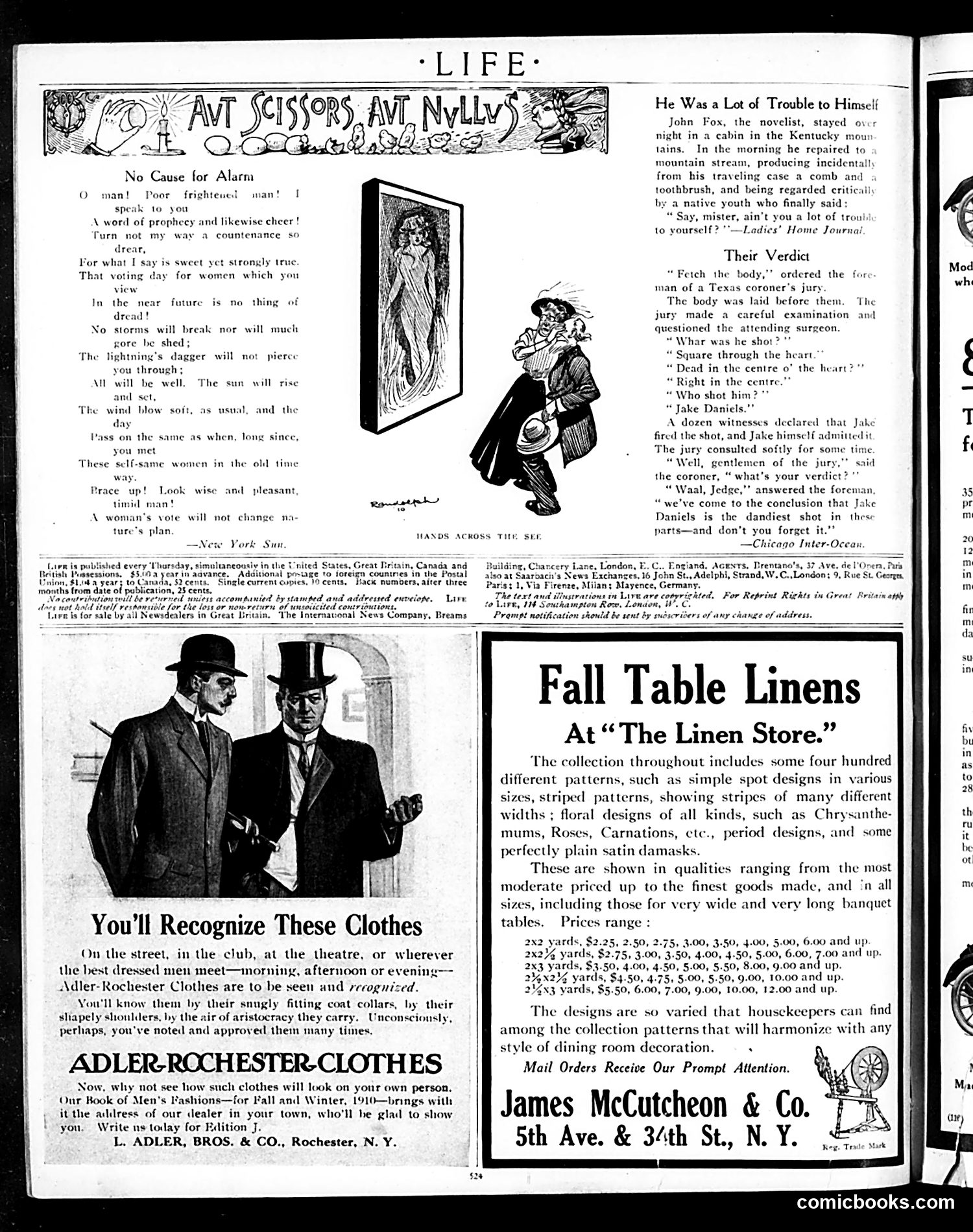
This page from *Life* magazine contains three distinct sections: **Top: "No Cause for Alarm"** — A poem reassuring anxious men about women's suffrage. The verse argues that granting women voting rights won't cause societal collapse or "gore" — life will continue unchanged. This satirizes male fears about women's political participation, a major social debate of the early 1900s. **Middle: "Hands Across the Sea"** — An illustration showing a man viewing a woman's portrait through a window. The accompanying anecdote mocks pretentious travelers: a novelist staying in the Kentucky mountains is criticized by a local youth for being excessively fastidious (carrying grooming supplies), satirizing affected city sophistication. **Bottom: Two advertisements** — One for Adler-Rochester Clothes emphasizing refined tailoring for well-dressed men, and another for James McCutcheon & Co.'s fall table linens. The page reflects early 20th-century concerns: women's rights debates, class anxieties about urbanity versus rural simplicity, and consumer culture targeting affluent gentlemen.
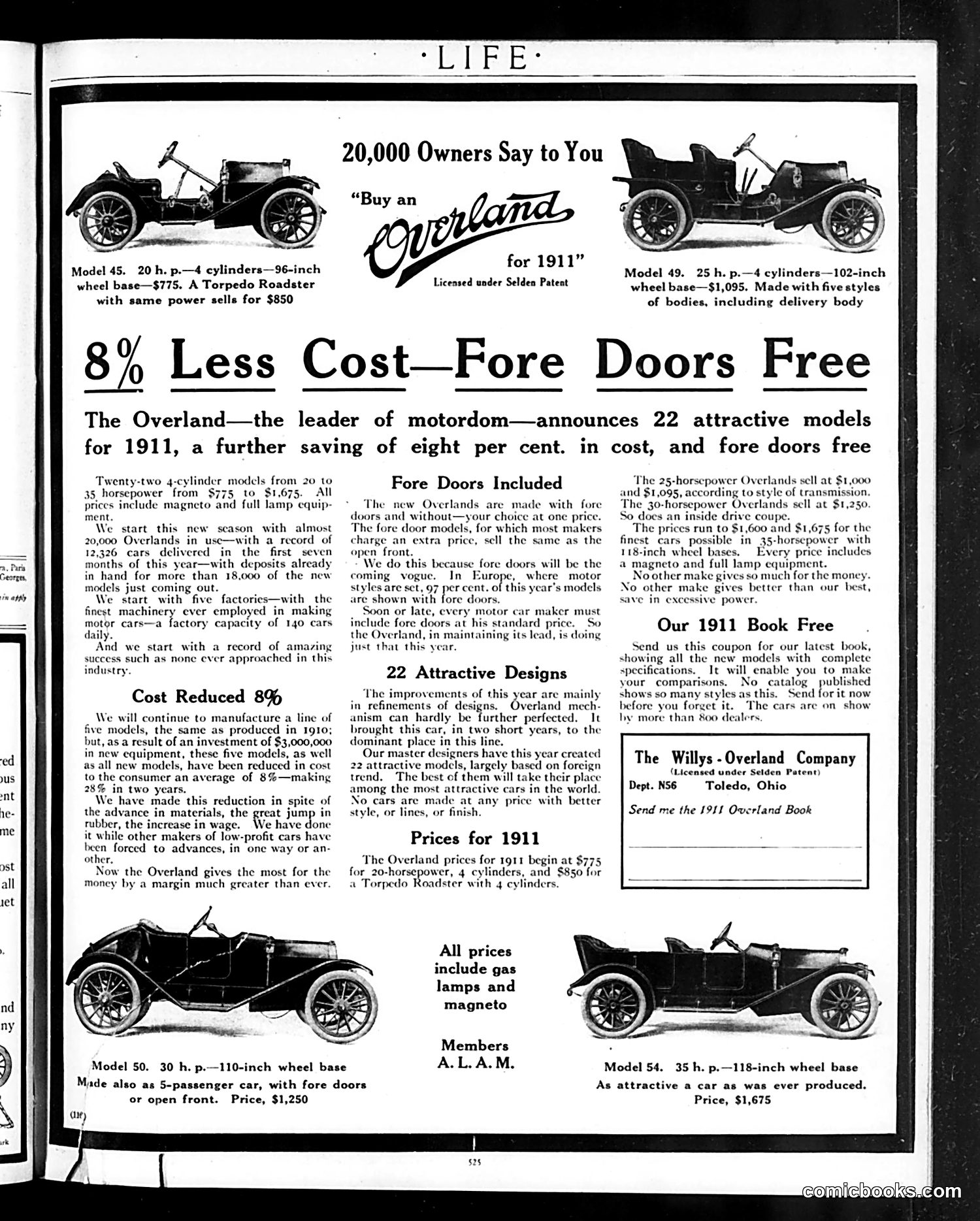
This is primarily a **1911 automobile advertisement**, not political satire. The Overland company announces 22 new car models for 1911, emphasizing cost reduction (8% cheaper than 1910 models) and a new feature: "fore doors" (front-opening doors) included at no extra charge. The page shows four different Overland models with specifications and prices ranging from $775 to $1,675. The headline's reference to "20,000 Owners Say to You" leverages customer testimonials as marketing. The only quasi-satirical element is the implicit competitive jab: Overland claims to offer fore doors—a European luxury feature—as standard while competitors charge extra. This positions Overland as the smart consumer choice. There is no political cartoon on this page. It's a straightforward commercial pitch typical of *Life* magazine's advertising content from the early 1910s automobile boom.
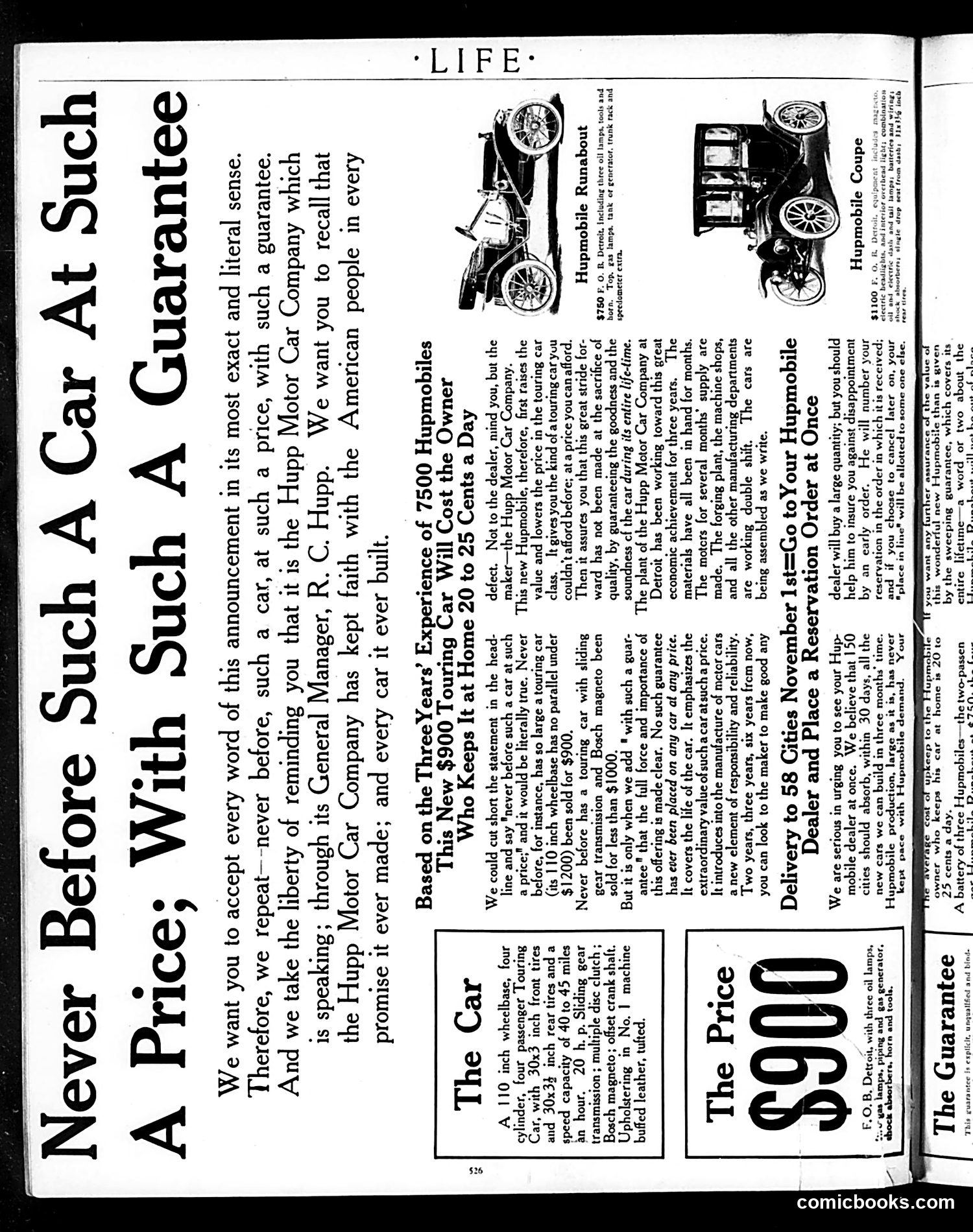
This page is primarily **automobile advertising** for what appears to be a early 1900s car model, priced at $900. The OCR text is largely corrupted/illegible, making detailed interpretation difficult. The visible header reads: "Never Before Such A Car At Such A Price; With Such A Guarantee" — a common advertising claim of the era emphasizing value and reliability. The advertisement includes three vehicle illustrations (appearing to be different model views or configurations) and references to "three years' experience" and "7,500 Hupmobiles" in use, suggesting this is promoting a specific manufacturer's track record. The "Guarantee" section promises customer satisfaction and product durability — standard reassurance language for early automotive sales when car ownership was still novel and purchasing was a major investment. Without legible OCR text, I cannot identify the specific manufacturer or satirical content, if any exists on this page.
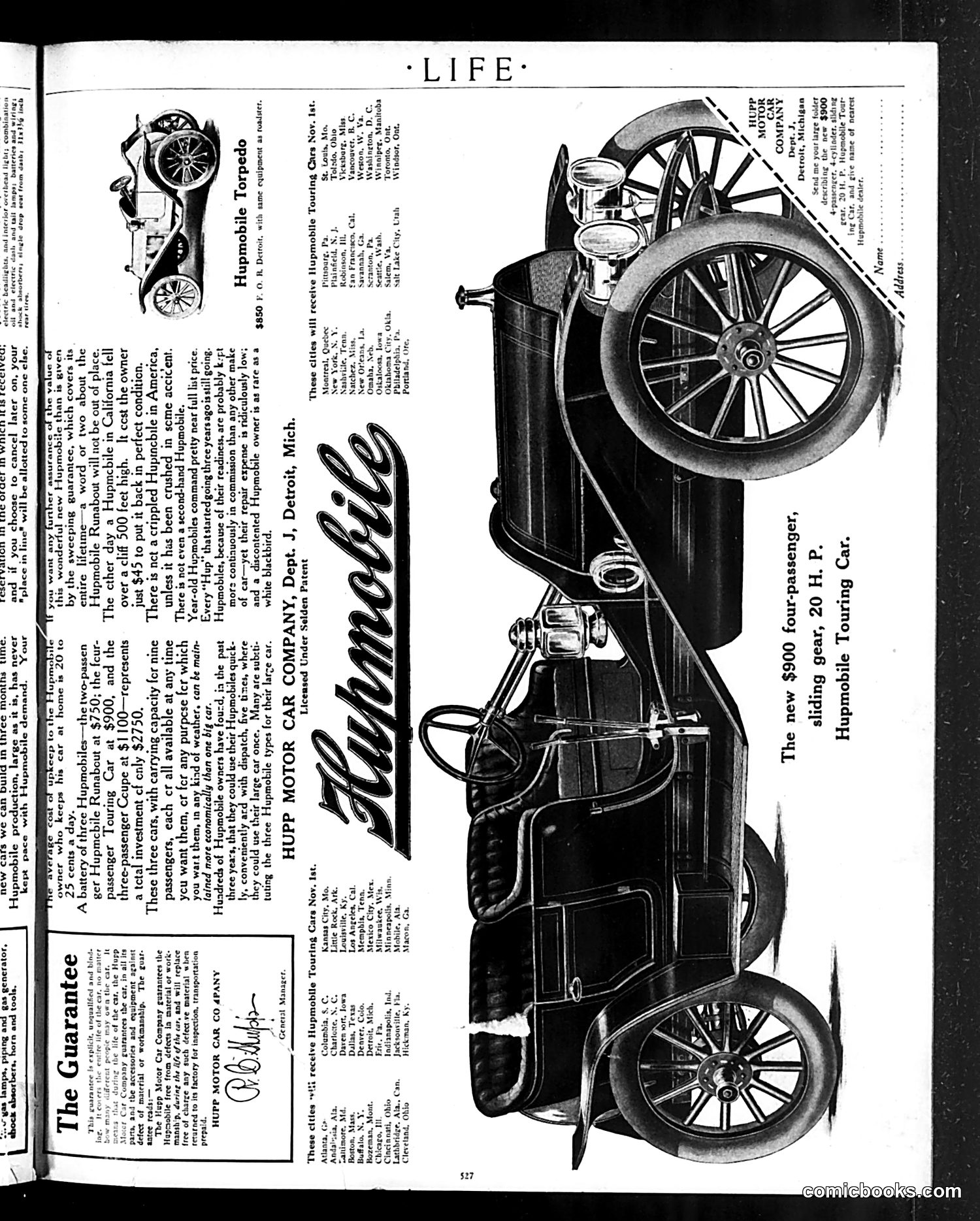
This page is primarily a **commercial advertisement** for the Hupmobile automobile, not a political cartoon. The ad features two illustrations of the Hupmobile touring car shown from different angles, highlighting its design and features. The accompanying text emphasizes the vehicle's specifications: it advertises a "$900 four-passenger, hidden gear, Hupmobile Touring Car" with competitive pricing and performance claims. There is also "The Guarantee" section (bottom left), which appears to outline the manufacturer's warranty or reliability promises to potential buyers. The OCR text is heavily corrupted and largely illegible, making detailed interpretation difficult. However, the visual content is clearly meant to showcase the automobile's appeal to consumers during the early automotive era, emphasizing both its mechanical features and affordability compared to competitors. This represents typical early 20th-century automobile marketing in a major American magazine.
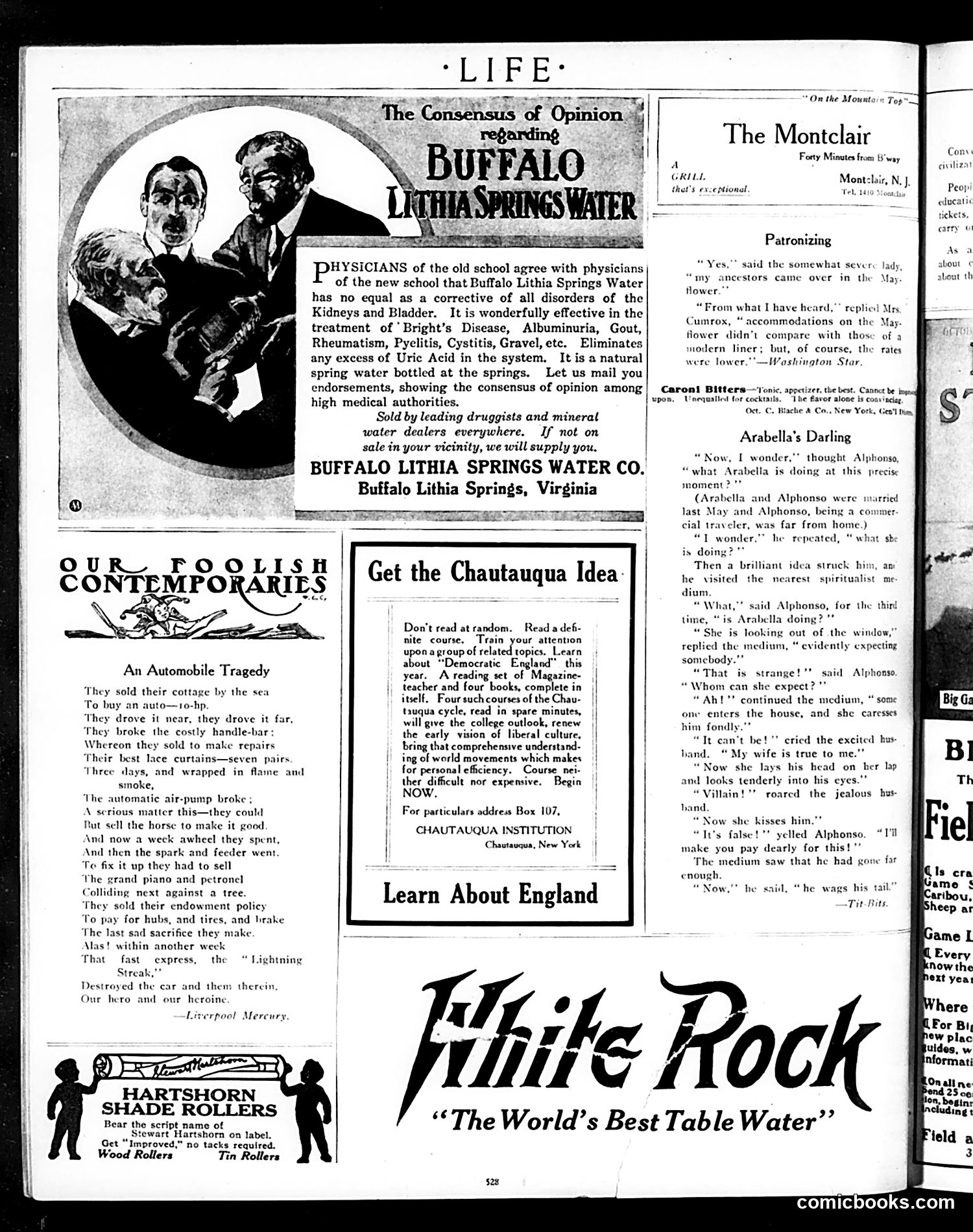
This page is primarily **advertising**, not political satire. The dominant content includes: **Buffalo Lithia Springs Water**: A medical advertisement claiming the mineral water treats kidney, bladder, and rheumatic disorders—typical of early 20th-century patent medicine marketing that exaggerated health benefits. **"An Automobile Tragedy"**: A humorous verse about a couple who sell their cottage to buy a car, then must repeatedly sell their possessions to repair it, culminating in their death. This satirizes the then-new automobile craze and the financial burden of car ownership. **Other advertisements**: Hartshorn Shade Rollers, the Chautauqua Institution (educational reading courses), and White Rock mineral water occupy remaining space. The **fictional stories** ("Patronizing," "Arabella's Darling") are light comic tales—the latter using a spiritualist séance for domestic comedy. This appears to be a standard Life magazine page mixing advertising, light humor, and brief stories rather than political commentary.
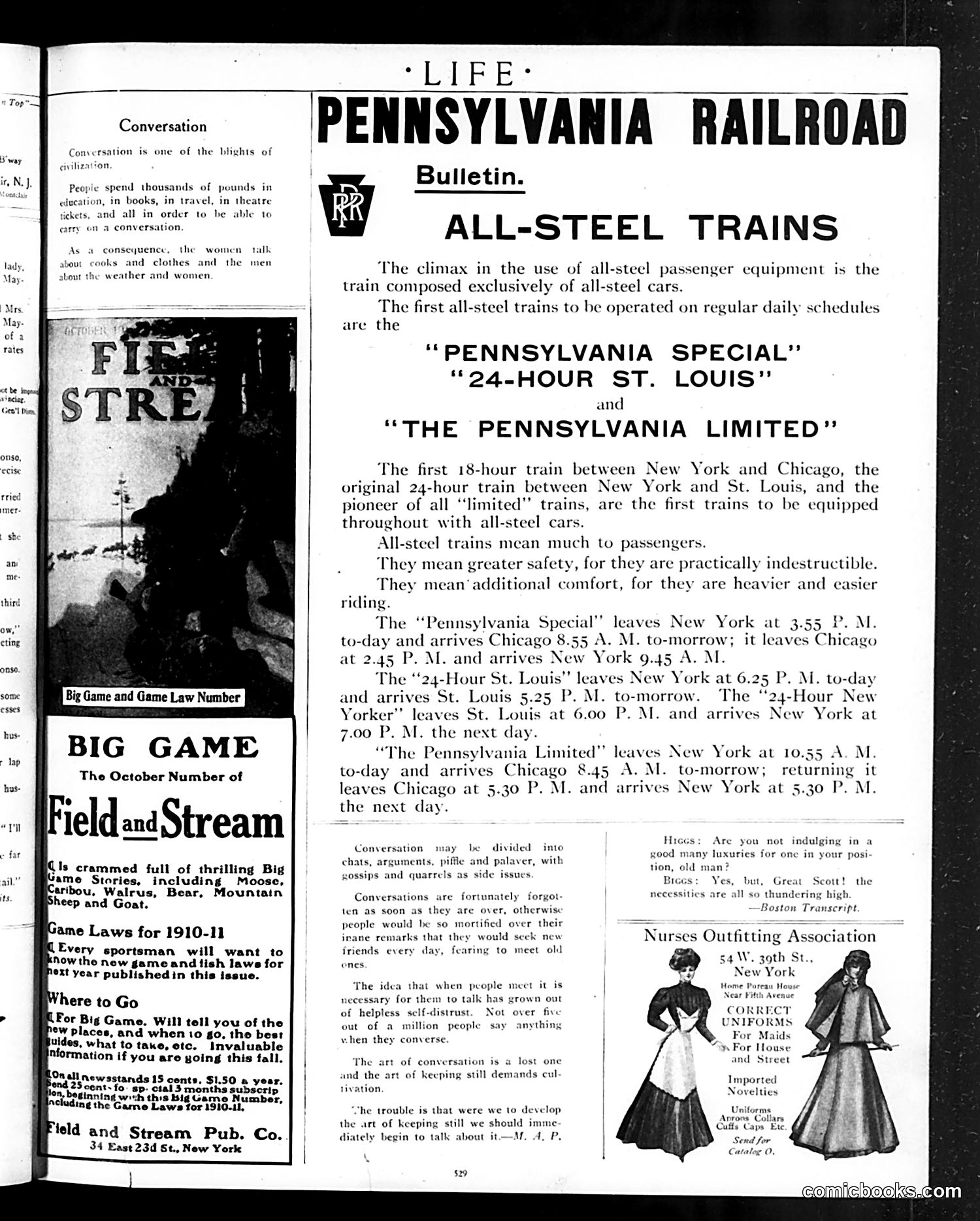
This page contains **advertisements and editorial content, not political satire**. The main content is a Pennsylvania Railroad bulletin promoting three new all-steel passenger trains: the "Pennsylvania Special," "24-Hour St. Louis," and "Pennsylvania Limited." The ad emphasizes safety and comfort benefits of all-steel construction for interstate rail travel. The left column features a brief essay titled "Conversation," which satirizes social convention by arguing that conversation itself is "one of the blights of civilization"—people spend money on culture and travel merely to have something to discuss. The piece humorously suggests conversations are forgettable and that most people say nothing meaningful when they talk. Surrounding advertisements include *Field and Stream* magazine's October hunting issue and a "Nurses Outfitting Association" promoting uniforms and accessories. **There are no political cartoons on this page.** The satire is mild social commentary about human behavior, typical of *Life*'s editorial voice in this era.
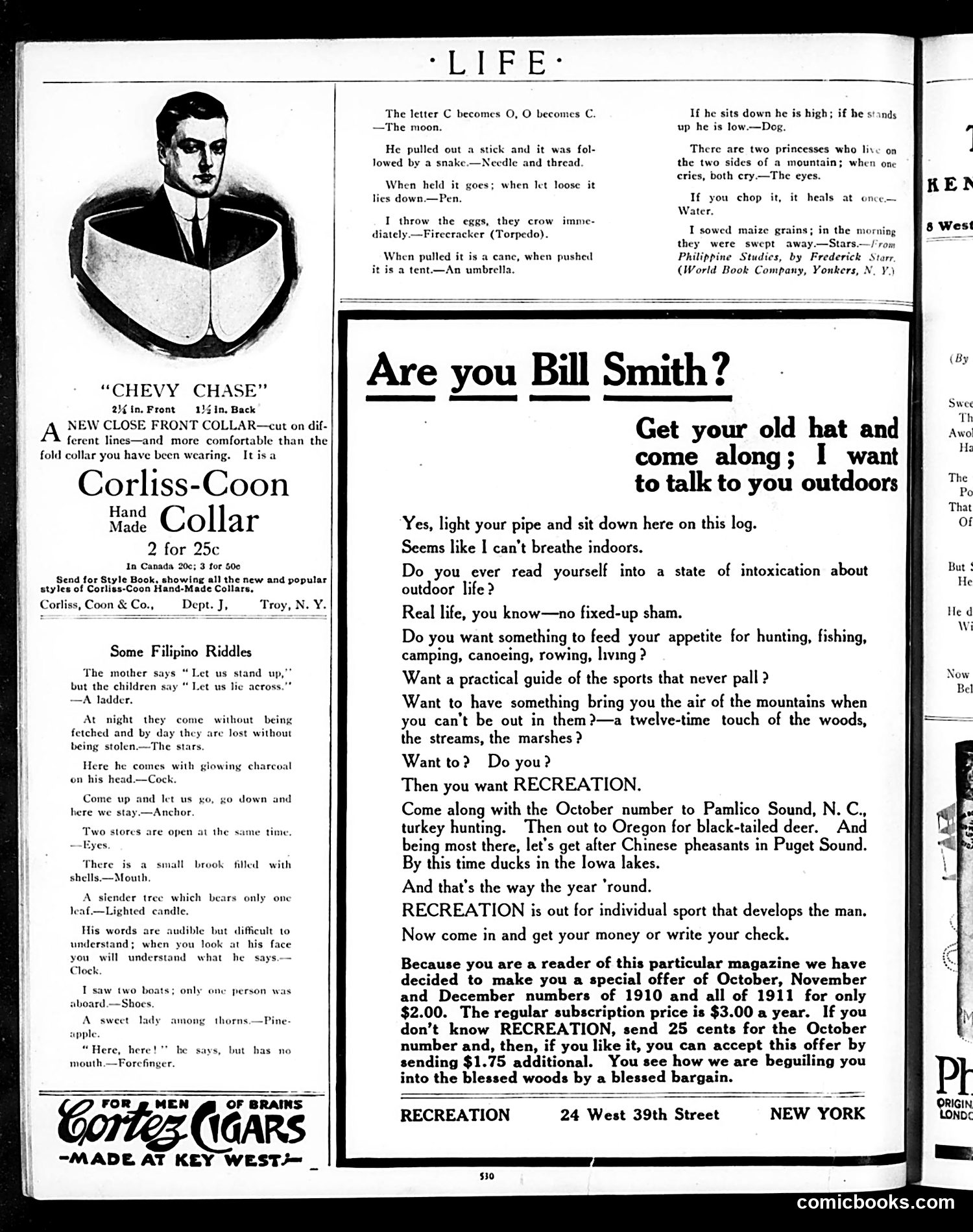
This page is primarily **advertising and editorial content**, not political satire. The main elements are: **Collar Advertisement**: The "Chevy Chase" collar by Corliss-Coon is a men's fashion ad for a new comfortable collar style—nothing satirical. **Filipino Riddles Section**: A collection of traditional riddles from the Philippines, presented as educational/entertaining content. This reflects early 1900s American interest in colonial territories and "exotic" cultures following the Philippine-American War. **Recreation Magazine Advertisement**: The dominant piece is a lengthy pitch for *Recreation* magazine, using colloquial outdoor adventure language ("Bill Smith") to recruit subscribers. It promises coverage of hunting, fishing, and camping across American landscapes—targeting masculine leisure interests of the era. **Cortez Cigars Ad**: A simple product advertisement at bottom. The page reflects **early 1900s consumer culture and masculinity**—targeting men's sporting interests and colonial-era curiosity about non-Western cultures. No satire is apparent; these are straightforward period advertisements and content.
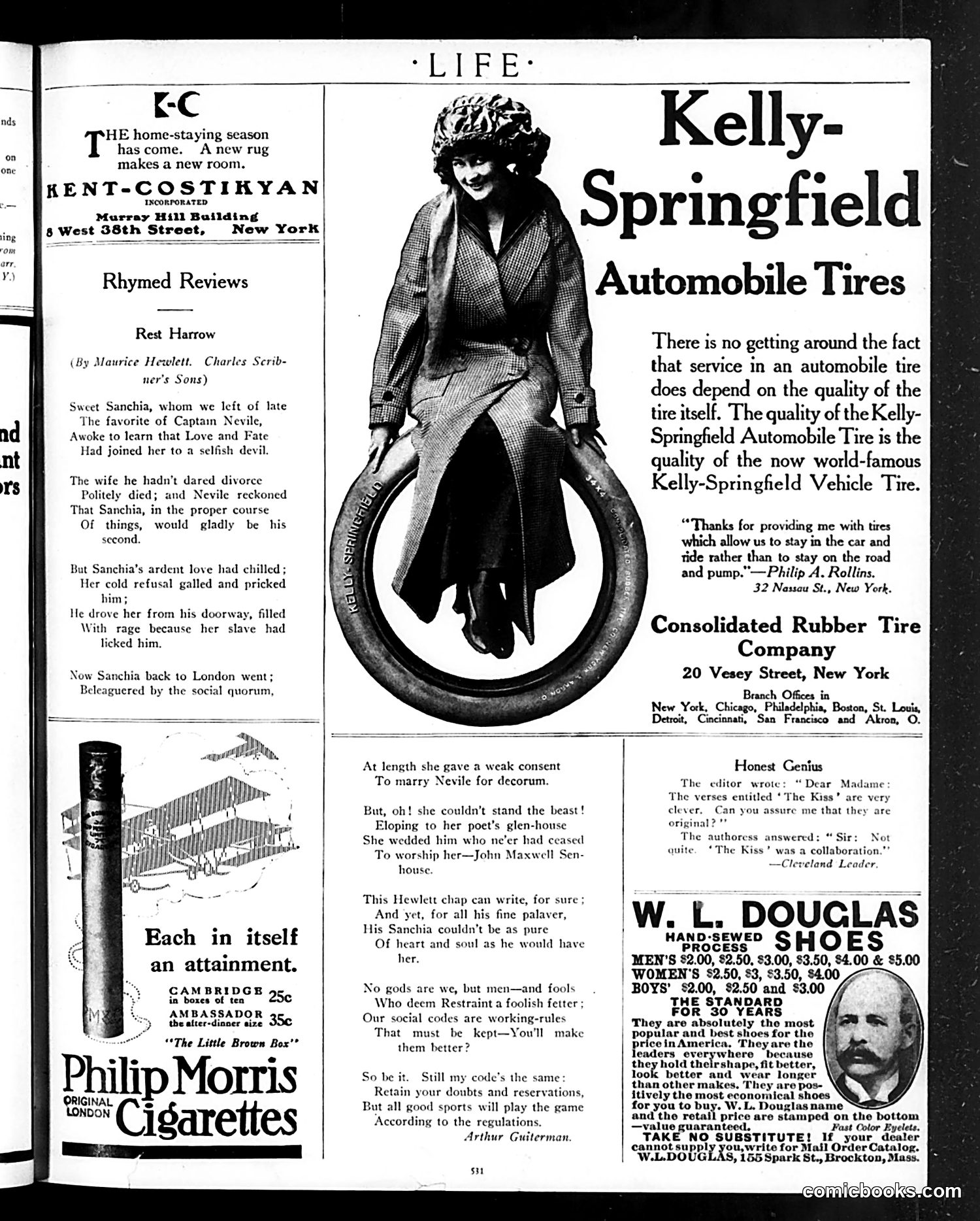
This page is primarily **advertising and book review content**, not political satire. The main feature is a **book review** of Maurice Hewlett's novel *Rest Harrow*, presented as verse by Arthur Guiterman. It summarizes a romantic plot involving characters named Sanchia and Captain Nevile—a morality tale about a woman who initially accepts a loveless marriage "for decorum" but ultimately elopes with her true love. Guiterman's concluding verses suggest that while social codes exist and should be followed, genuine human connection matters. The page is dominated by **period advertisements**: Kelly-Springfield automobile tires, Philip Morris cigarettes, and W.L. Douglas shoes—typical early 20th-century product placements aimed at middle-class readers. The book review's only satirical element appears mild: Guiterman gently critiques Hewlett's moralizing while acknowledging his literary skill, suggesting the author's characters don't quite achieve the purity he portrays. Overall, this is a standard Life magazine page mixing entertainment content with commercial advertising rather than political or social commentary.
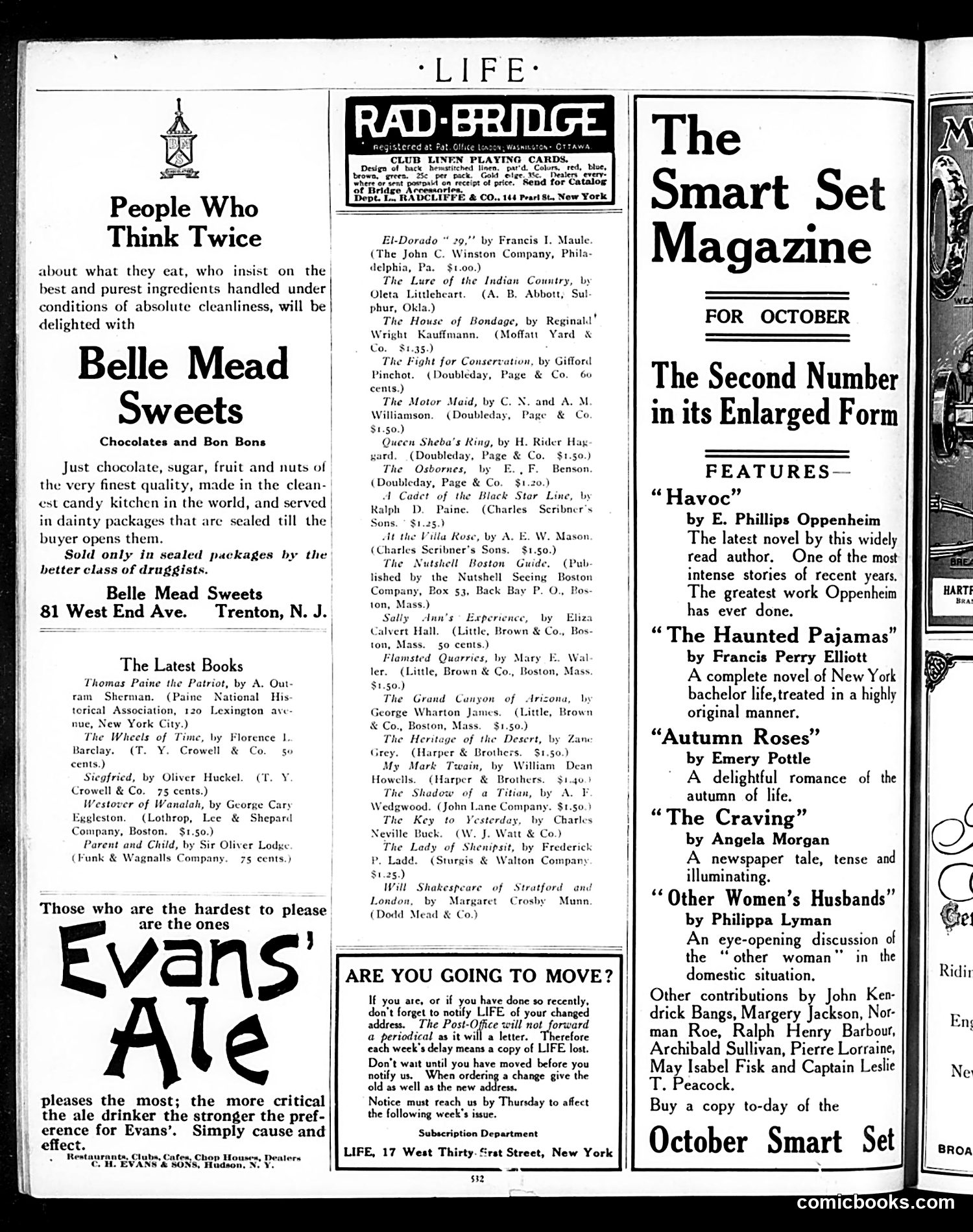
This is primarily an **advertising and book review page** from *Life* magazine's October issue, not a political cartoon page. The page contains: 1. **Belle Mead Sweets advertisement** — emphasizing pure ingredients and cleanliness, appealing to health-conscious consumers of the era 2. **Evans' Ale advertisement** — using large bold typography to target "critical" drinkers 3. **"The Latest Books"** — a book review section listing 1910s-era publications on diverse topics (history, fiction, biography) 4. **"The Smart Set Magazine"** — promotion for the October issue, highlighting serialized novels and stories by popular authors 5. **Moving notification notice** — a public service announcement reminding readers to notify *Life* of address changes There are **no political cartoons or satirical commentary visible** on this page. It represents typical early 20th-century magazine advertising and content promotion aimed at educated, affluent readers concerned with refined consumption and current literature.
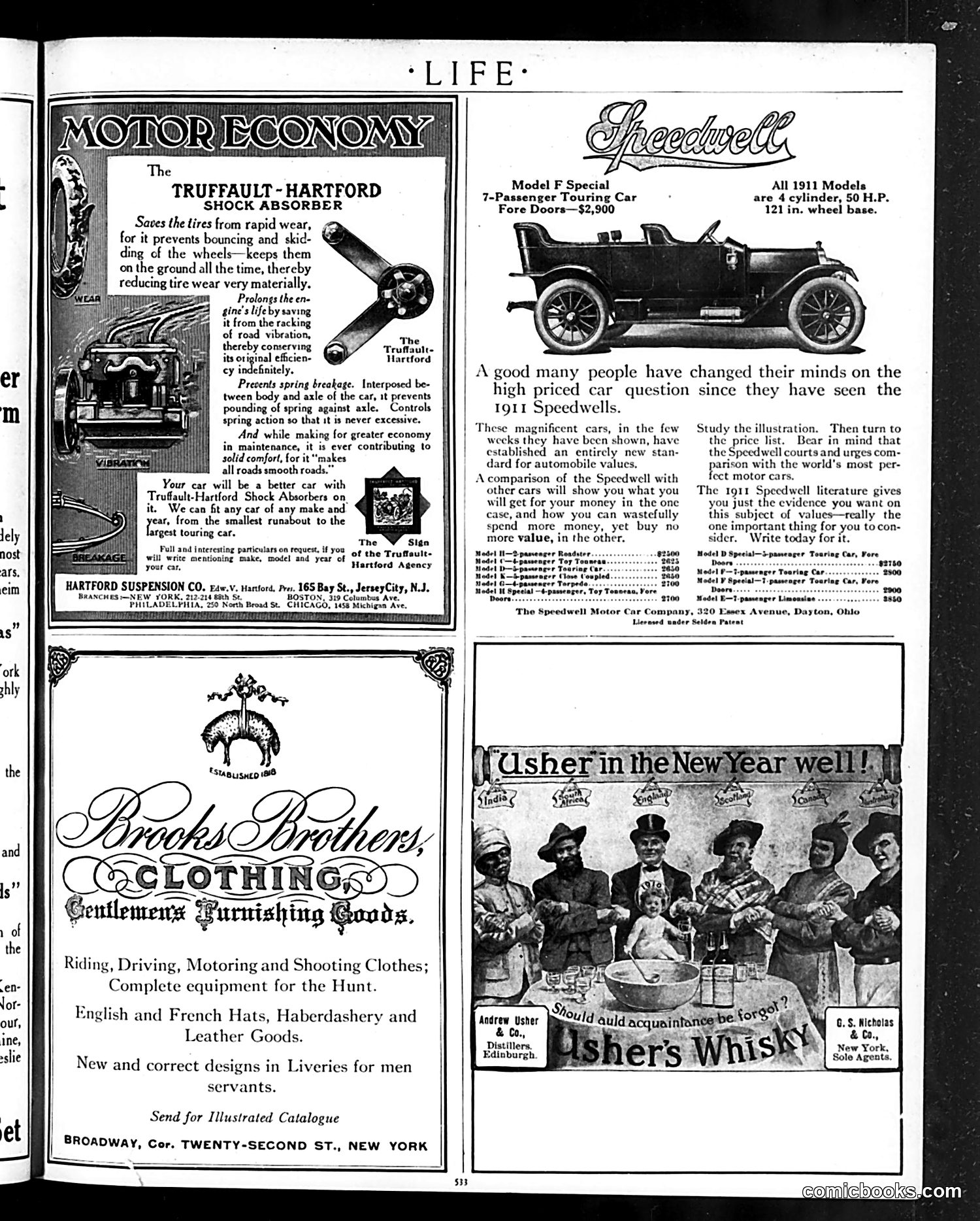
This is primarily an **advertising page** from Life magazine (circa 1911), containing no political cartoons or satire requiring historical context. The page features three automobile advertisements promoting 1911 car models—the Truffault-Hartford (shock absorber component), Speedwell (7-passenger touring car at $2,900), and Brooks Brothers clothing for motorists. Each ad uses technical specifications and value comparisons to appeal to wealthy automobile buyers. The only image with figures is an **Usher's Whisky advertisement** at bottom right, showing six men and a child in period dress gathered around a barrel with the caption "Should auld acquaintance be for sae"—a New Year's themed ad playing on the Scottish song "Auld Lang Syne." This is straightforward product promotion, not satire. The page reflects early 20th-century consumer culture targeting affluent readers, with emphasis on new automotive technology and luxury goods.
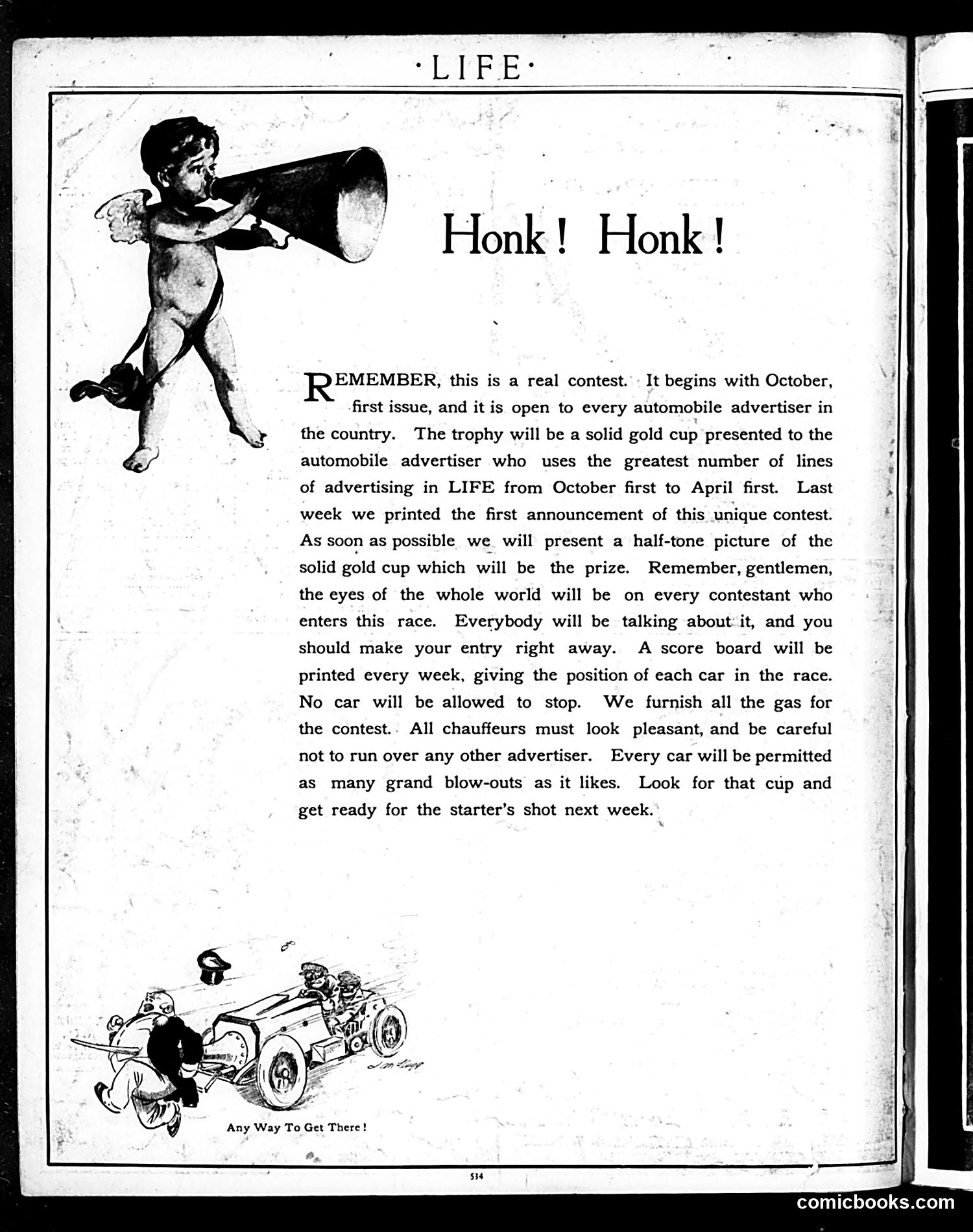
This page announces a satirical advertising contest in *Life* magazine. The headline "Honk! Honk!" and the cherub-like figure blowing a horn reference the automobile industry's aggressive marketing practices of the early 20th century. The contest invites automobile advertisers to compete for a solid gold cup by purchasing the most advertising lines in *Life* from October through April. The satire mocks the competitive excess of auto advertising—the text humorously includes absurd rules like "grand blow-outs" (likely referring to tire blowouts) and instructions that "no car will be allowed to stop." The bottom cartoon shows a chaotic race scene labeled "Any Way To Get There!"—visual commentary on reckless automotive culture. Overall, the page satirizes both the frenzied automobile boom and the cutthroat advertising wars of the era.
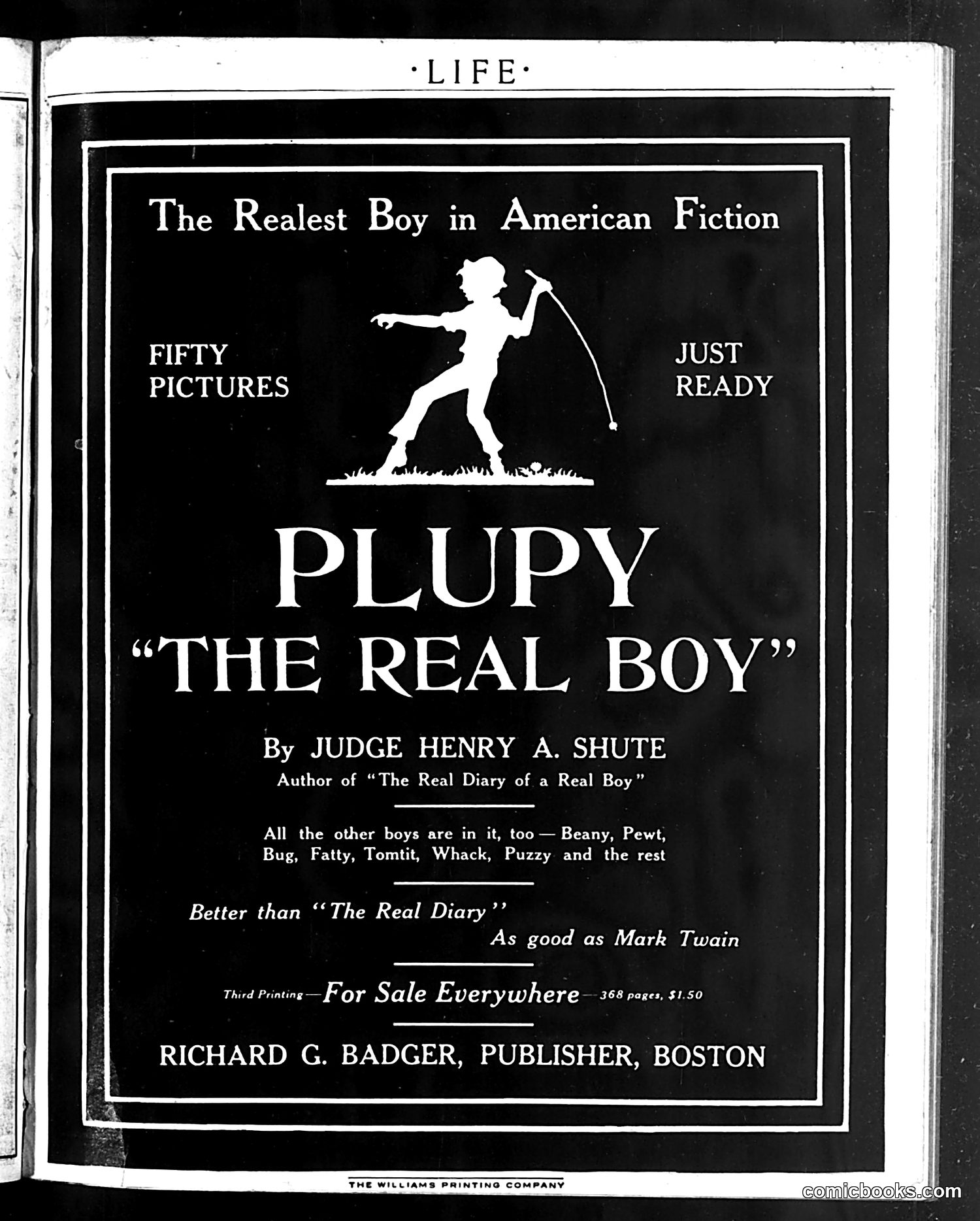
This is an advertisement for "Plupy: The Real Boy," a book by Judge Henry A. Shute. The ad promotes a collection of fifty pictures from what appears to be a humorous children's or young-adult novel featuring a cast of boys with colorful nicknames (Beany, Pewt, Bug, Fatty, etc.). The marketing compares it favorably to Shute's earlier work "The Real Diary of a Real Boy" and claims it rivals Mark Twain's writing—high praise for the era. The silhouette illustration depicts a boy fishing, evoking wholesome Americana and boyhood adventure. Published by Richard G. Badger in Boston, this third printing advertisement emphasizes the book's popularity and availability, priced at $1.50. The ad targets readers seeking authentic, relatable depictions of American boyhood.
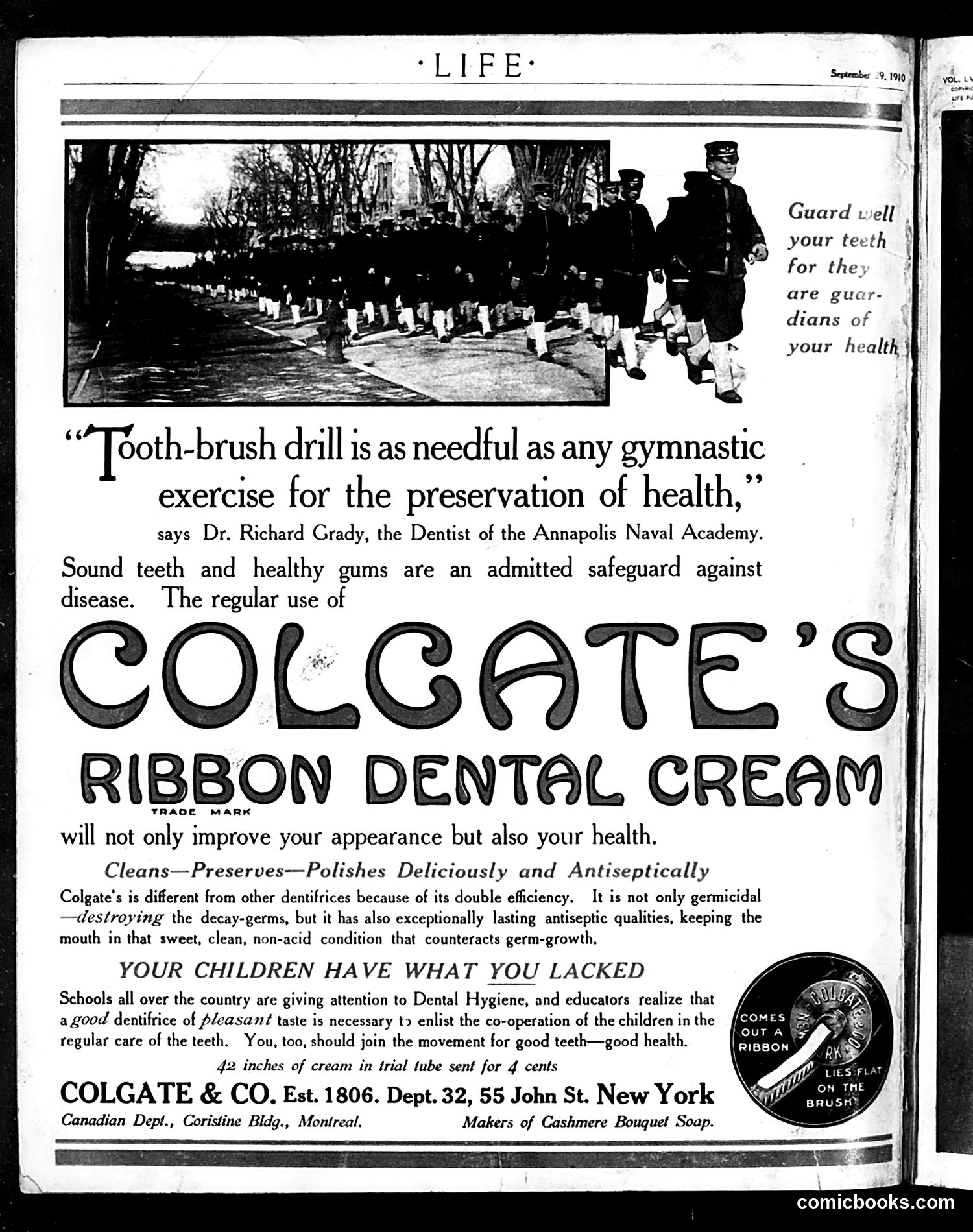
This is primarily a **product advertisement**, not satire. The page promotes Colgate's Ribbon Dental Cream by invoking health authority and social progress themes relevant to 1919. The top photograph shows what appears to be a **military or naval ceremony** with uniformed figures and white markers (possibly graves), lending gravitas to the endorsement by "Dr. Richard Grady, the Dentist of the Annapolis Naval Academy." The ad's central pitch is that dental hygiene is a modern scientific necessity, comparing toothbrushing to gymnastics. A key selling point targets parents: "YOUR CHILDREN HAVE WHAT YOU LACKED"—positioning good dental care as educational progress the younger generation enjoys. The appeal combines **patriotic authority** (naval academy dentist), **scientific claims** (germicidal, antiseptic properties), and **generational advancement** to market the product as both health-essential and socially progressive for early 20th-century consumers.