
Life, 1910-09-29 · page 19 of 40
Life — September 29, 1910 — page 19: what you’re looking at
What you’re looking at
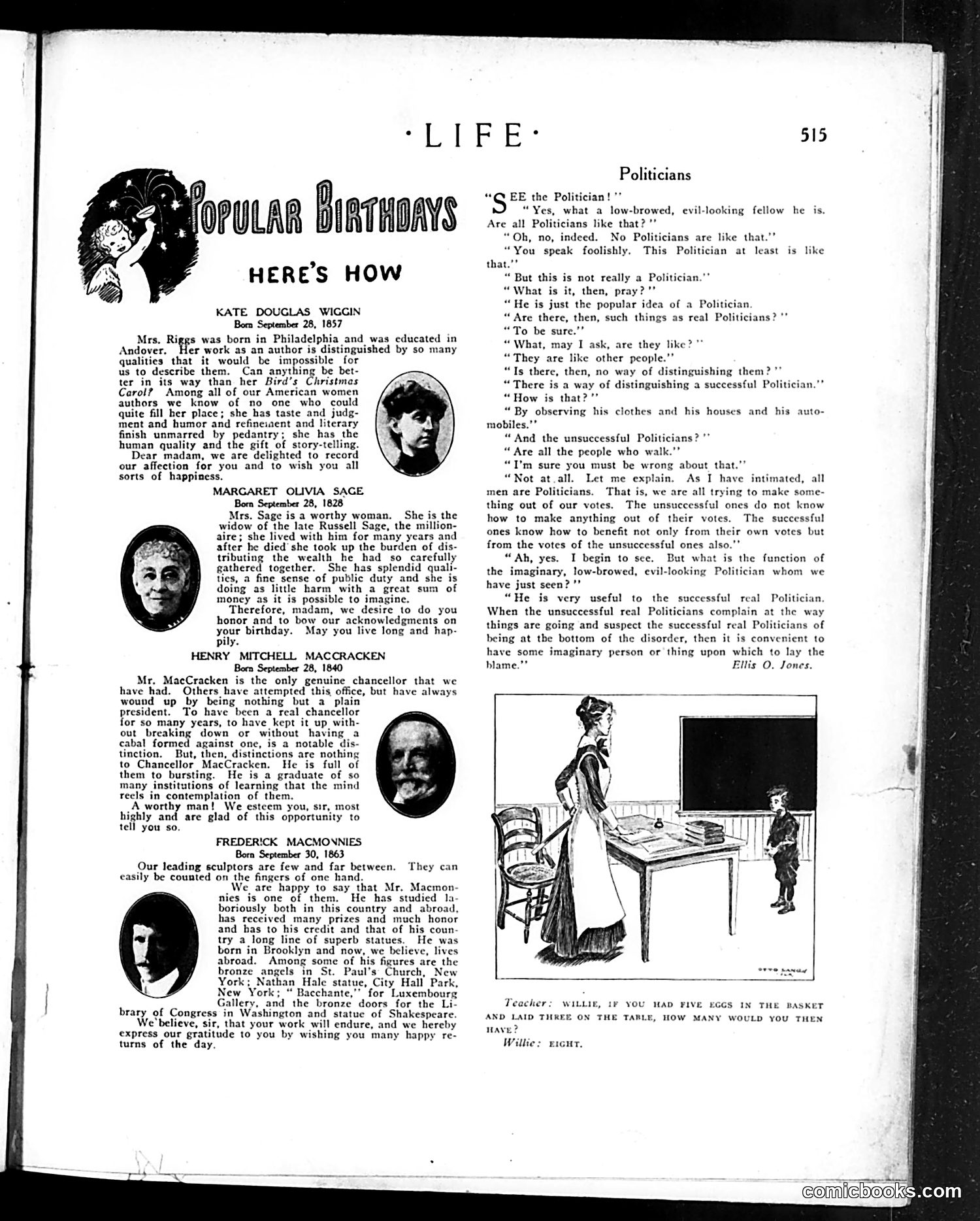
This page from *Life* magazine satirizes American politicians through a dialogue format. The cartoon contrasts the public's stereotype of politicians—depicted as ugly, evil-looking men—with the reality that politicians actually look like ordinary people. The satire's key point: **the only way to distinguish successful politicians from unsuccessful ones is by their material wealth**. Successful politicians display expensive clothes, houses, and automobiles, while unsuccessful politicians are indistinguishable from common pedestrians. The joke critiques both public perception and political corruption. It suggests that politicians succeed not through merit or character but through accumulating wealth, implying that political success equals financial exploitation. The dialogue format allows the author to present this cynical observation as obvious common sense, making the critique more cutting. This reflects *Life*'s role as a satirical publication exposing American social hypocrisy and political corruption during the Gilded Age era.
📄 Transcribed text from this page (OCR, searchable)
Machine-transcribed from the original scan — historical spelling and the odd misread are preserved.
*LILPFE* PULAR DIRTHOAYS HERES HOW KATE DOUGLAS WIGGIN Born September 28, 1857 Mrs. Riggs was born in Philadelphia and was cducated in Andover, ler work as an author is distinguished by so many qualities that it would be impossible for us to describe them. Can anything be bet- ter in its way than her Bird’s Christmes Carol? Among all of our American women authors we know of no one who could quite fill her place; she has taste and judg- ment and humor and refineiaent and literary finish unmarred by pedantry; she has the human quality and the gift of story-telling. Dear madam, we are delighted to record our affection for you and to wish you all sorts of happiness. MARGARET OLIVIA SAGE Born September 28, 1828 Mrs. Sage is a worthy woman. She widow of the late Russell Sage, the mil aire; she lived with him for many years and after he died she took up the burden of dis- tributing the wealth he had so carefully gathered together. She has splendid quali- ties, a fine sense of public duty and she is doing as little harm with a great sum of money as it is possible to imagine. Therefore, madam, we desire to do you honor and to bow our acknowledgments on your birthday. May you live long and hap- pily. HENRY MITCHELL MACCRACKEN Bora September 28, 1840 Mr. MaeCracken is the only genuine chancellor that we have had. Others have attempted this office, but have always wound up by being nothing but a plain president. To have been a real chancellor for so many years, to have kept it up with- out breaking down or without having a cabal formed against one, is a notable dis- tinction. But, then, distinctions are nothing to Chancellor MacCracken. He is full of them to bursting. He is a graduate of so many institutions of learning that the mind reels in contemplation of them. A worthy man! We estcem you, sir, most highly and are glad of this opportunity to tell you so. FREDERICK MACMONNIES Born September 30, 1863 Our leading sculptors are few and far between. They can easily be counted on the fingers of one hand. We are happy to say that Mr. Macmon- nies is one of them. He has studied la boriously both in this country and abroad, has received many prizes and much honor and has to his credit and that of his coun try a long line of superb statues. He was born in Brooklyn and now, we believe, lives abroad. Among some of his figures are the bronze angels in St. Paul's Church, New York; Nathan Hale statue, City Hall Park, New York; “ Bacchante,”” for Luxembourg Gallery, and the bronze doors for the Li- brary of Congress in Washington and statue of Shakespeare. We'believe, sir, that your work will endure, and we hereby express our gratitude to you by wishing you many happy re- turns of the day. Politicians “QEE the Politician!" what a low-browed, evil-looking fellow he is. Are all Politicians like that? “Oh, no, indeed. No Politicians are like that.’ You speak foolishly, This Politician at least is like “ But this is not really a Politician.”” “What is it, then, pray?" “He is just the popular idea of a Politician “Are there, then, such things as real Politicians? "’ “To be sure.’” “What, may I ask, are they like? “They are like other people. “Is there, then, no way of distinguishing them?” “There is a way of distinguishing a successful Politician.”” “How is that?” “ By observing his clothes and his houses and his auto- mobiles.”” “And the unsuccessful Politicians?" “Are all the people who walk.”” “T’'m sure you must be wrong about tha “Not at all. Let me explain. As I have intimated, all men are Politicians, That is, we arc all trying to make some- thing out of our votes. The unsuccessful ones do not know how to make anything out of their votes. The successful ones know how to benefit not only from their own votes but from the votes of the unsuccessful ones also.”” “Ah, yes. I begin to see, But what is the function of the imaginary, low-browed, evil-looking Politician whom we have just seen? “He is very useful to the successful real Politic When the unsuccessful real Politicians complain at the wa things are going and suspect the successful real Politic being at the bottom of the disorder, then it is convenient to have some imaginary person or thing upon which to lay the blame.” Ellis O. Jones. Teacher: Wittir, iy YOU MAD FIVE EGGS IN THE BASKET AND LAID THREE ON THE TABLE, HOW MANY WOULD You THEN Mave? Willie: ercur,