
Life, 1910-09-29 · page 22 of 40
Life — September 29, 1910 — page 22: what you’re looking at
What you’re looking at
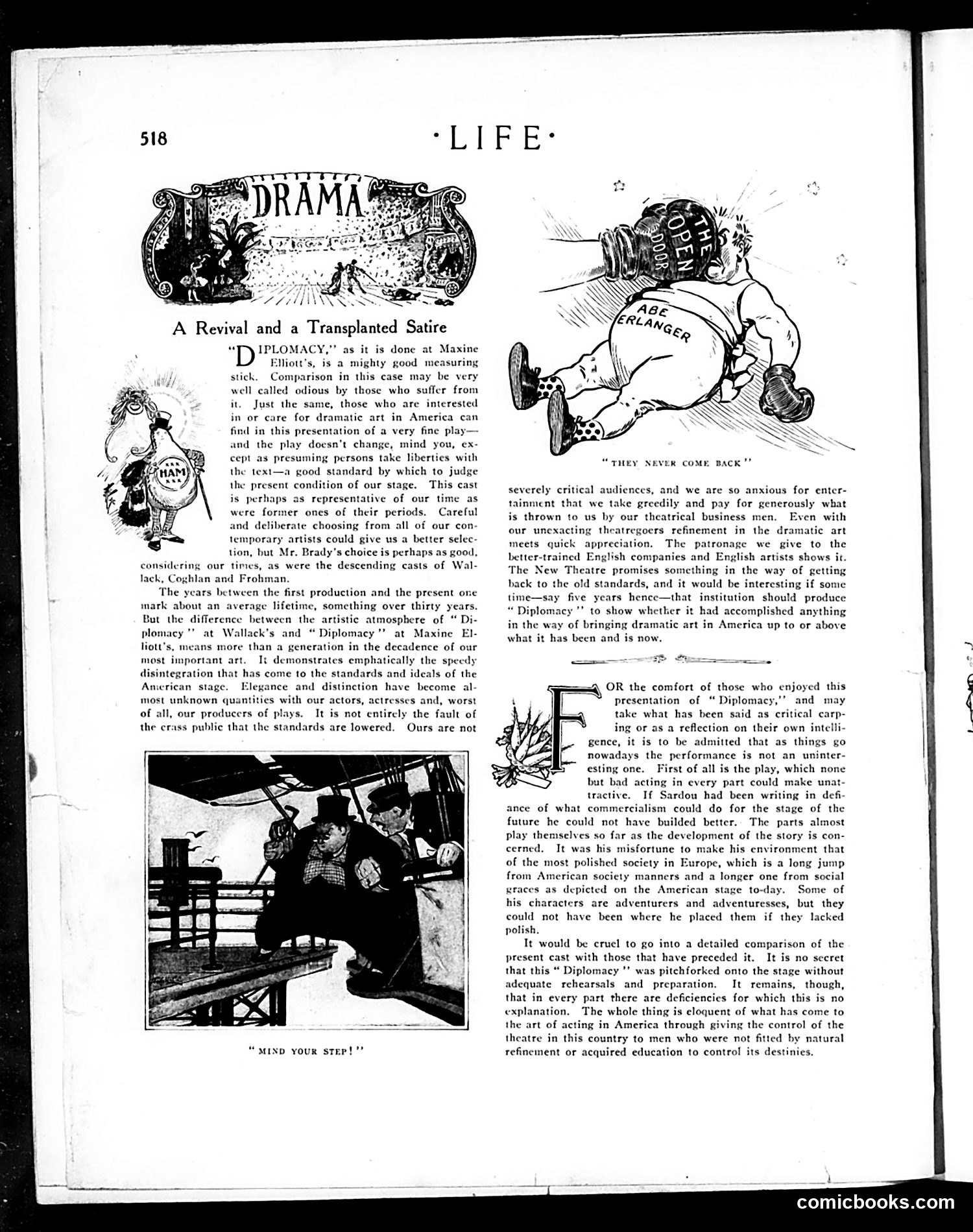
This Life magazine page critiques a revival of the play "Diplomacy" at Maxine Elliott's Theatre, comparing it unfavorably to earlier productions at Wallack's Theatre (performed generations prior). The cartoons illustrate the article's theme about theatrical decline. One shows a figure labeled "Age & Creaker" carrying a large bomb labeled "Diplomacy"—suggesting the old play is struggling under its own weight. Another cartoon, captioned "Mind Your Step!", depicts someone navigating backstage obstacles. The text argues that American theater standards have deteriorated significantly since the original production. The reviewer credits the excellent script (by Sardou) but faults the current cast's lack of refinement, polish, and proper rehearsal. He contrasts this with superior English theatrical companies and suggests the newly-founded New Theatre might restore dramatic art standards in America. The implicit critique: American commercial theater prioritizes profit over artistic quality.
📄 Transcribed text from this page (OCR, searchable)
Machine-transcribed from the original scan — historical spelling and the odd misread are preserved.
A Revival and a Transplanted Satire “DIPLOMACY,” as it is done at Maxine Elliott's, is a mighty good measuring stick. Comparison in this case may be very well called odious by those who suffer from it. Just the same, those who are interested in or care for dramatic art in America can find in this presentation of a very fine play— nd the play doesn’t change, mind you, ¢ cept as presuming persons take liberties with the text—a good standard by which to judge the present condition of our stage. This cast is perhaps as representative of our time as were former ones of their periods. Careful and deliberate choosing from all of our con- temporary artists could give us a better selec- tion, but Mr. Brady's choice is perhaps as good, considering our times, as were the descending casts of Wal- lack, Coghlan and Frohman. The years between the first production and the present one mark about an average lifetime, something over thirty years. But the difference hetwecn the artistic atmosphere of “ Di- plomacy "? at Wallack’s and “ Diplomacy’? at Maxine EI- liott's, means more than a generation in the decadence of our most important art. I: demonstrates emphatically the speedy disintegration that has come to the standards and ideals of the American stage. FE nce and distinction have become al- most unknown quantities with our actors, actresses and, worst of all, our producers of plays. It is not entirely the fault of the crass public that the standards are lowered. Ours are not “MIND YouR steP!’’ “TMEY NEVER COME BACK’? severely critical audiences, and we are so anxious for enter- tainment that we take greedily and pay for generously what is thrown to us by our theatrical business men. Even with our unexacting theatregoers refinement in the dramatic art meets quick appreciation, The patronage we give to the better-trained English companies and English artists shows it. The New Theatre promises something in the way of getting back to the old standards, and it would be interesting if some time—say five years hence—that institution should produce “ Diplomacy "’ to show whether it had accomplished anything in the way of bringing dramatic art in America up to or above what it has been and is now. presentation of “ Diplomacy,’? and may take what has been said as critical carp- ing or as a reflection on their own intelli- gence, it is to be admitted that as things go nowadays the performance is not an uninter- esting one. First of all is the play, which none but bad acting in every part could make unat- tractive. If Sardou had been writing in defi- ance of what commercialism could do for the stage of the future he could not have builded better. The parts almost play themselves so far as the development of the story is con- cerned. It was his misfortune to make his environment that of the most polished society in Europe, which is a long jump from American society manners and a longer one from social graces as depicted on the American stage to-day. Some of his characters are adventurers and adventuresses, but they could not have been where he placed them if they lacked polish, It would be cruel to go into a detailed comparison of the present cast with those that have preceded it. It is no secret that this “ Diplomacy ’’ was pitchforked onto the stage without adequate rehearsals and preparation. It remains, though, that in every part there are deficiencies for which this is no explanation. The whole thing is eloquent of what has come to the art of acting in America through giving the control of the theatre in this country to men who were not fitted by natural refinement or acquired education to control its dest comicbooks.com