
Life, 1910-09-29 · page 17 of 40
Life — September 29, 1910 — page 17: what you’re looking at
What you’re looking at
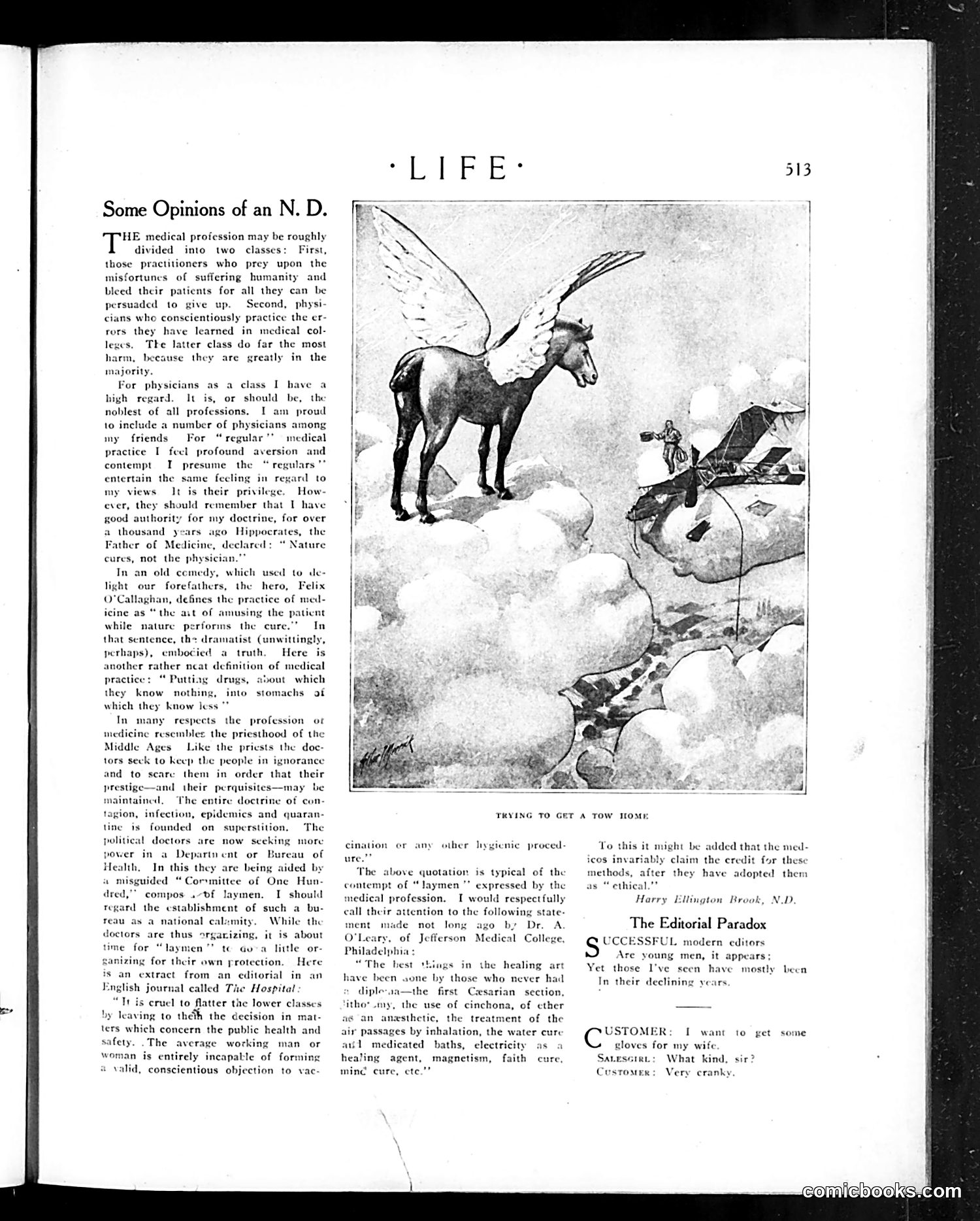
This page contains a scathing critique of the medical profession, attributed to "Harry Ellington Brook, N.D." (likely a pseudonym—"N.D." possibly meaning "Non-Doctor"). The author attacks "regular" physicians as ignorant practitioners who exploit patients while claiming credit for cures actually achieved by nature or non-medical discoveries. The cartoon "Trying to Get a Tow Home" depicts a winged, skeletal figure (Death or a grim reaper) attending to a fallen horse and rider—a visual metaphor for medical malpractice or the profession's inability to help. The author cites historical medical innovations (Caesarean sections, use of cinchona and electricity) credited to physicians but actually developed by non-credentialed practitioners, arguing doctors maintain power through secrecy and fear, like medieval priests. A brief joke at page's end about "cranky" gloves provides comic relief from the polemical tone. This represents early-20th-century skepticism toward professional medical establishment authority.
📄 Transcribed text from this page (OCR, searchable)
Machine-transcribed from the original scan — historical spelling and the odd misread are preserved.
Some Opinions of an N. D. HE medical profession may be roughly divided into two classes: First, those practitioners who prey upon the misfortunes of suffering humanity and Diced their patients for all they can be persuaded to give up. Second, physi- cians who conscientiously practice the er- rors they have learned in medical col- The latter class do far the most they are greatly in the exes. harm, beeause najority. For physicians as a class I high regard. It is, or should be, the noblest of all professions. I am proud to include a number of physicians among my friends For “regular ’* medical practice I feel profound aversion and contempt. I presume the “ regulars’ entertain the same fecling in regard to my views It is their privilege. How- ever, they should remember that I have good authority for my doctrine, for over thousand years ago Hippocrates, the ther of Medicine, declared: “ Nature cures, not the physician In an old comedy, which used to de- light our forefathers, the hero, Felix O'Callaghan, defines the practice of med- icine as “the ast of amusing the patient while nature performs the cure. that sentence, the dramatist (un perhaps), truth, Here another rather ncat definition of medical practice dout which they know stomachs of have a embocied a “Puttiag drugs, nothing, in which they know less In many the profession medicine resembles the priesthood of the Middle Ages Like the priests the doc- tors seck to keep the people in ignorance and to scare them in order that their prestige—and their perquisites—may be maintained, ‘The entire doctrine of con- sand quaran- founded on superstition, The political doctors are now seeking more Departn ent or Bureau of Health, In this they are being aided by a misguided “Cormmittee of One Hun- compos .-df nen, I should blishment of such a bu- nity. While the doctors are thus organizing, it is about respects, tagion, infection, epidem! tine is power in a dred,”” regard the esta reau as a national cal: time for “laymen”? to ao-a little or- izing for their own protection. Here an extract from an editorial in. an English journal called The Hospital “It is cruel to flatter the lower classes by leaving to theth the decision in mat- ters which concern the public health and safety. .The average woman is entirely incapatle of for: valid, conscientious objection to vac- working man or si] TRYING TO GET A TOW HoMN tion or any other hygienic proced- ur The above quotation is typical of the contempt of “ laymen" expressed by the medical profession. I would respectfully call their attention to the following state- ade not long ago bs Dr. A of Jefferson Medical College, Philadelphia : “The best things in the healing art have been sone by those who never had diple itho: ja—the first Cxsarian section, y, the use of cinchona, of cther ag an anesthetic, the treatment of the air passages by inhalation, the water cure ail medicated baths, electricity as a healing agent, magnetism, faith cure, mined cure, cte."" To this it might be added that the me icos invariably claim the credit for these methods, after they have adopted them as “ethi Harry Ellington Brook, ND. The Editorial Paradox UCCESSFUL modern editors young men, it appears: Yet those I've seen have mostly In their declining years been to get some Cestomen I want gloves for my wife Savesciei: What kind, sir? Customer: Very cranky,