
Life, 1910-09-29 · page 13 of 40
Life — September 29, 1910 — page 13: what you’re looking at
What you’re looking at
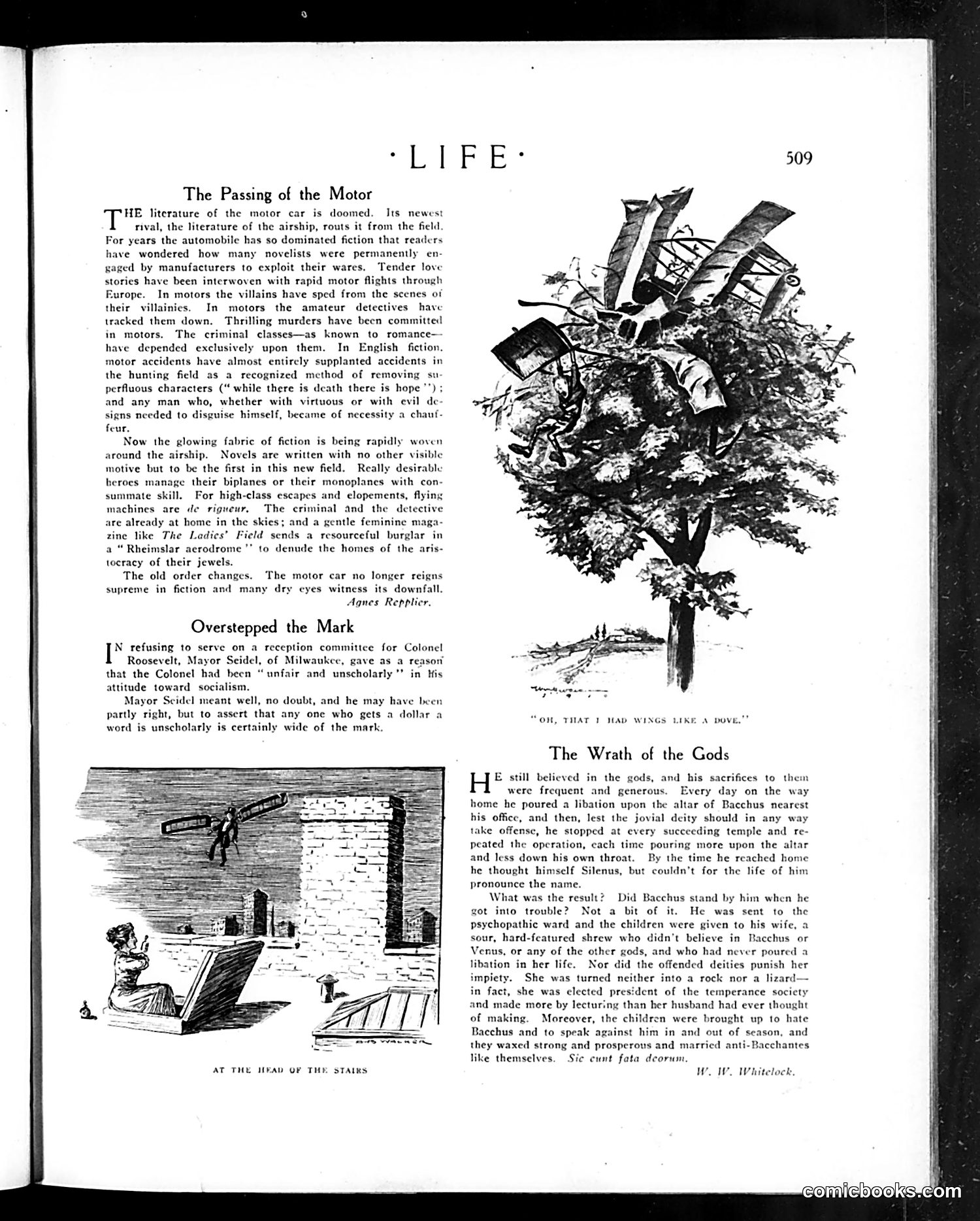
This page contains literary criticism and social commentary rather than political cartoons. The main article "The Passing of the Motor" discusses how the automobile, once literature's newest rival to the airship, is losing its dominance in fiction. The author notes that motor cars now appear less frequently in novels compared to earlier years. The accompanying illustrations show: a crashed or wrecked automobile tangled in a tree (captioned "Oh, that I had wings like a dove"), and a separate sketch labeled "At the Head of the Stairs" depicting someone on stairs. The text critiques how the motor car's literary prominence has declined, suggesting changing public interest in this once-celebrated technology as a fictional subject.
📄 Transcribed text from this page (OCR, searchable)
Machine-transcribed from the original scan — historical spelling and the odd misread are preserved.
“LIFE: The Passing of the Motor HE literature of the motor car is doomed. Its newest rival, the literature of the airship, routs it from the field For years the automobile has so dominated fiction that readers have wondered how many novelists were permanently en- gaged by manufacturers to exploit their wares. Tender love stories have been interwoven with rapid motor flights through Europe. In motors the villains have sped from the scenes oi their villainies. In motors the amateur detectives have tracked them down. Thrilling murders have becn committed in motors. The criminal classes—as known to romance- have depended exclusively upon them. In English fiction. motor accidents have almost entirely supplanted accidents in the hunting field as a recognized method of removing su- perfluous characters (“while there is death there is hope") ; and any man who, whether with virtuous or with evil de- signs needed to disguise himself, became of necessity a chauf- feur. Now the glowing fabric of fiction is being rapidly woven around the airship. Novels are written with no other visible motive but to be the first in this new field. Really desirable heroes manage their biplanes or their monoplanes with con- summate skill. For high-class escapes and elopements, flying machines are de rigueur, The criminal and the detective are already at home in the skies; and a gentle feminine maga- zine like The Ladies’ Field sends a resourceful burglar in a “Rheimslar aerodrome " to denude the homes of the aris- tocracy of their jewels. The old order changes. The motor car no longer reigns supreme in fiction and many dry cyes witness its downfall. Aanes Repplier. Overstepped the Mark IX refusing to serve on a reception committee for Colonel Roosevelt, Mayor Scidel, of Milwaukce, that the Colonel had been “unfair and unscholarly attitude toward socialism, Mayor Scidel meant well, no doubt, and he may have be partly right, but to assert that any one who gets a dollar word is unscholarly is certainly wide of the mark. AT THE HEAD OF THE STALKS. “OM, THAT 1 MAD WINGS LIKE \ DOVE,” The Wrath of the Gods E still believed in the gods, and his sacrifices to them were frequent and generous. Every day on the way home he poured a libation upon the altar of Bacchus nearest his office, and then, lest the jovial deity should in any way take offense, he stopped at every succeeding temple and re- peated the operation, cach time pouring more upon the altar and less down his own throat. By the time he reached home he thought himself Silenus, but couldn't for the life of him pronounce the name. What was the result? Did Bacchus stand by him when he got into trouble? Not a bit of it. He was sent to the psychopathic ward and the children were given to his wife, a sour, hard-featured shrew who didn’t believe in Bacchus or Venus, or any of the other gods, and who had never poured a libation in her life. Nor did the offended deities punish her impiety. She was turned neither into a rock nor a lizard— in fact, she was elected president of the temperance society and made more by lecturing than her husband had ever thought of making. Moreover, the children were brought up to hate Bacchus and to speak against him in and out of season, and they waxed strong and prosperous and married anti-Bacchantes like themselves. Sic cunt fata deorum. WW. Whitele