
A complete issue · 48 pages · 1910
Life — September 1, 1910
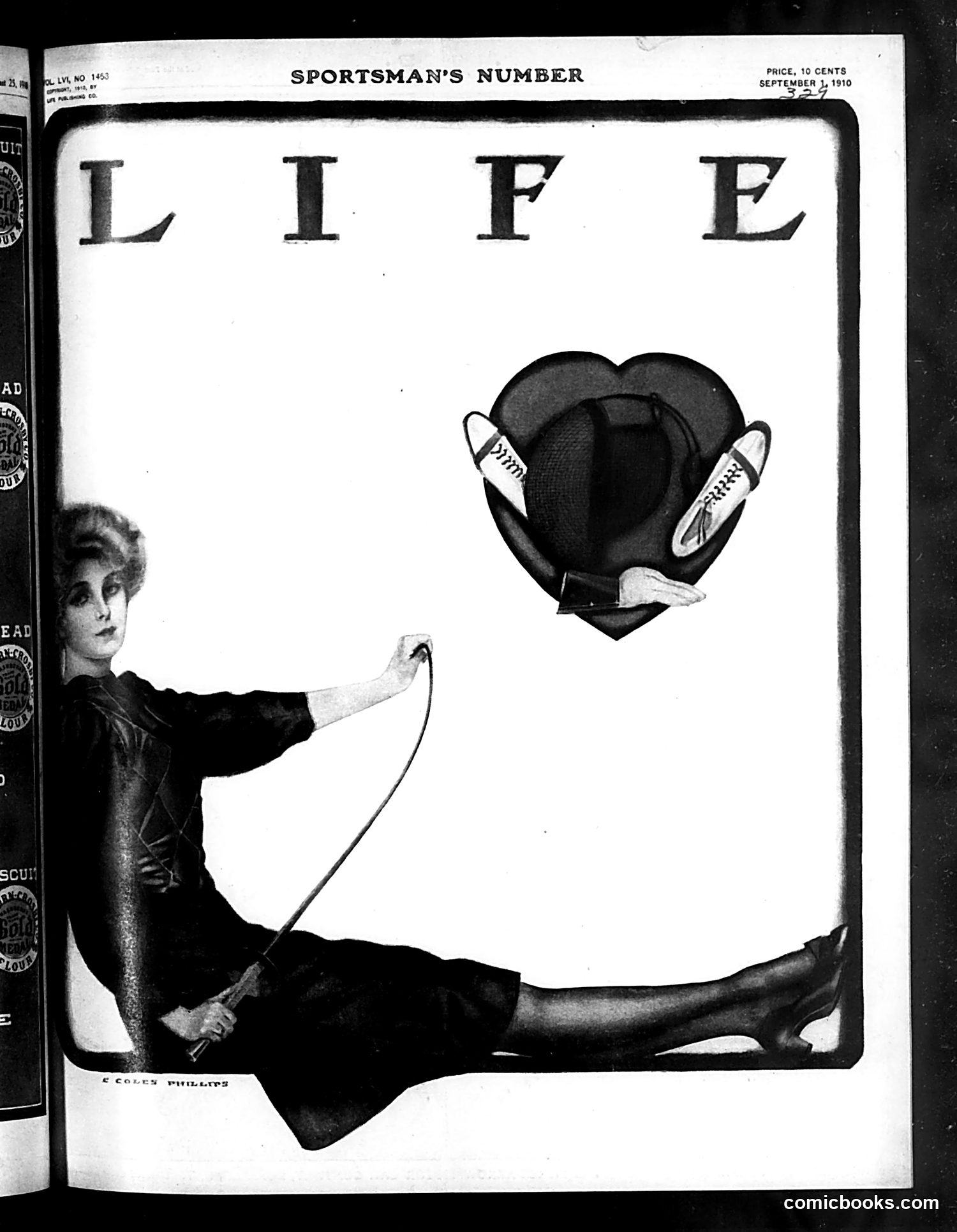
This is the cover of Life magazine's "Sportsman's Number" from September 1, 1910 (price: 10 cents). The illustration depicts a woman in athletic pose, wielding a whip toward a heart-shaped target containing a man's shoe and hat. The satire appears to comment on **women's increasing athletic participation and independence** during the early 1900s. The woman's confident, commanding stance—cracking a whip at a heart containing symbols of masculinity—suggests anxiety about shifting gender roles. The "sportsman" theme combined with the woman dominating the male symbol likely satirizes contemporary concerns about women's liberation and their encroachment into traditionally male-dominated sports and social spheres. This reflects broader Edwardian-era tensions about women's emancipation.
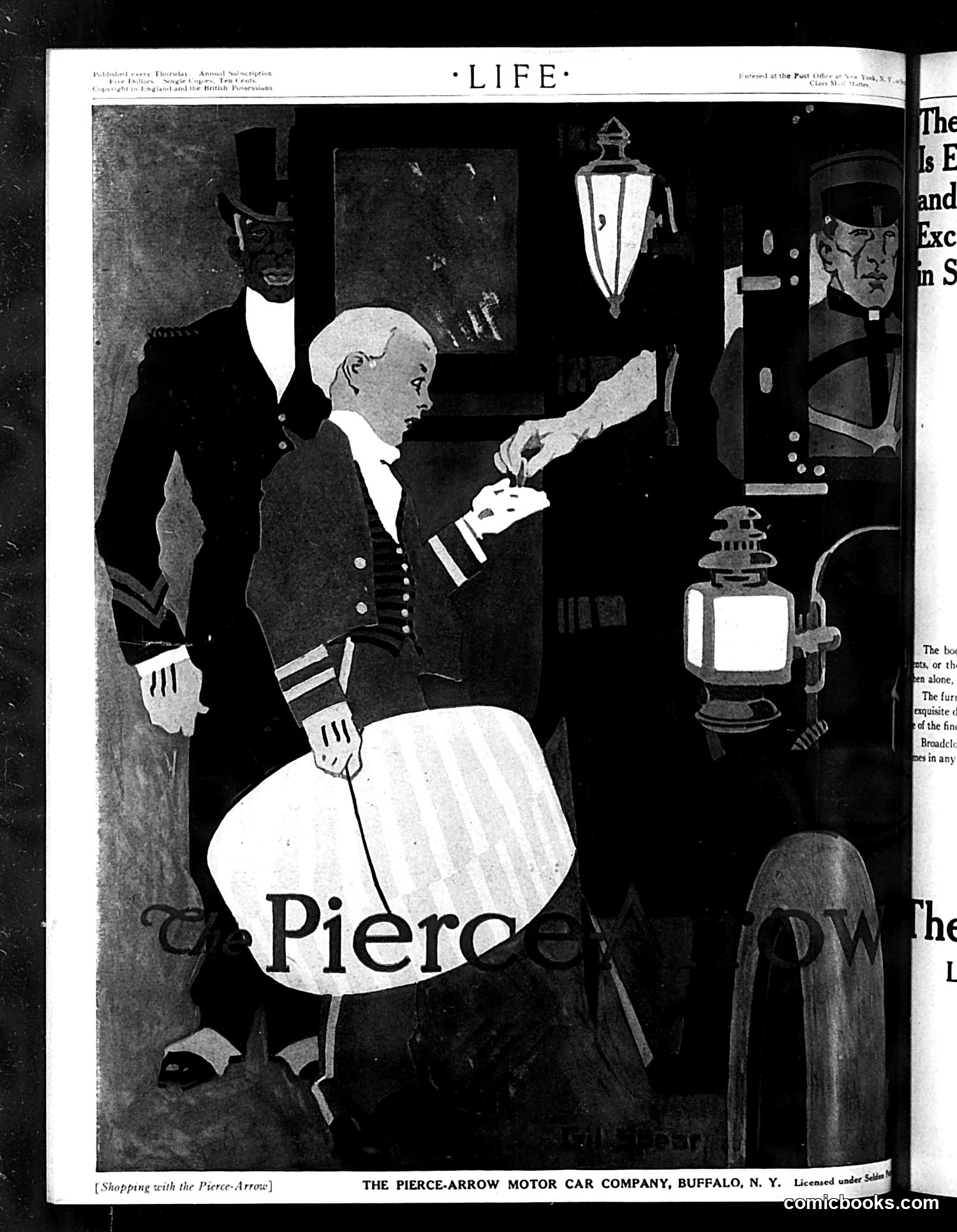
This is an advertisement for the **Pierce-Arrow Motor Car Company of Buffalo, N.Y.**, not a political cartoon. The image depicts a wealthy gentleman in formal attire (top hat and white tie) being attended by servants in what appears to be an elegant interior setting. Various luxury fixtures—an ornate lamp, lantern, and heating device—surround the scene. The advertisement's humor relies on **class satire**: the caption "Shopping with the Pierce-Arrow" suggests that owning this luxury automobile is equivalent to possessing refined, expensive taste in all things. The servants and opulent surroundings humorously imply that Pierce-Arrow ownership signals membership in high society. This was typical early-20th-century advertising strategy—associating products with wealth and status to appeal to aspirational consumers.
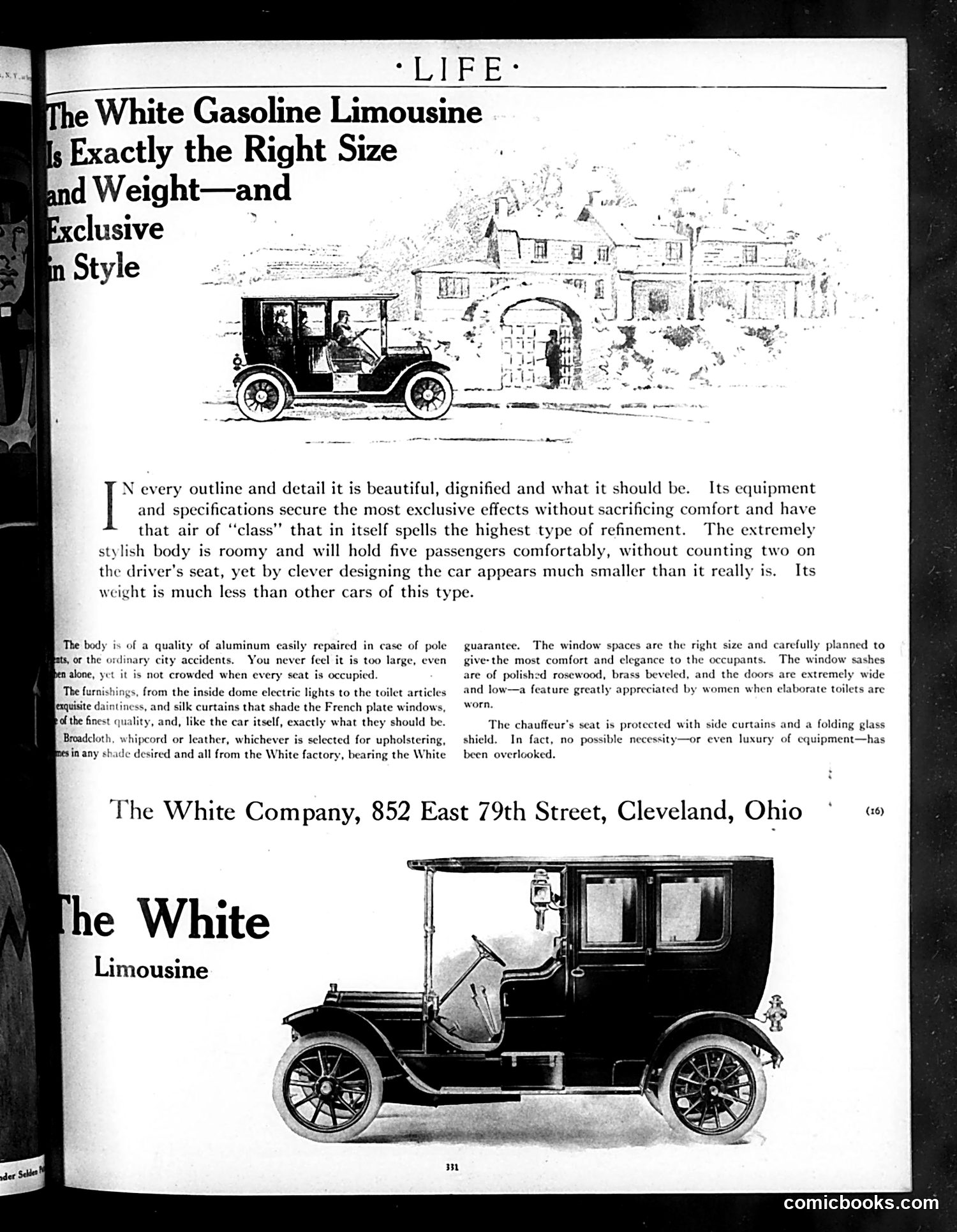
This page is primarily **advertising**, not satire or political commentary. It promotes the White Gasoline Limousine, manufactured by the White Company in Cleveland, Ohio. The advertisement emphasizes luxury features: an aluminum body that's lighter than competitors, spacious interior accommodating five passengers, stylish design that "appears much smaller than it really is," polished woodwork, brass fittings, and wide window spaces. The two illustrations show the vehicle in elegant settings—one outside a mansion, one in profile—to convey exclusivity and refined taste. The text stresses that all these premium features don't compromise comfort, positioning the White Limousine as the choice of discerning, wealthy buyers. There is no evident political satire or social commentary on this page.
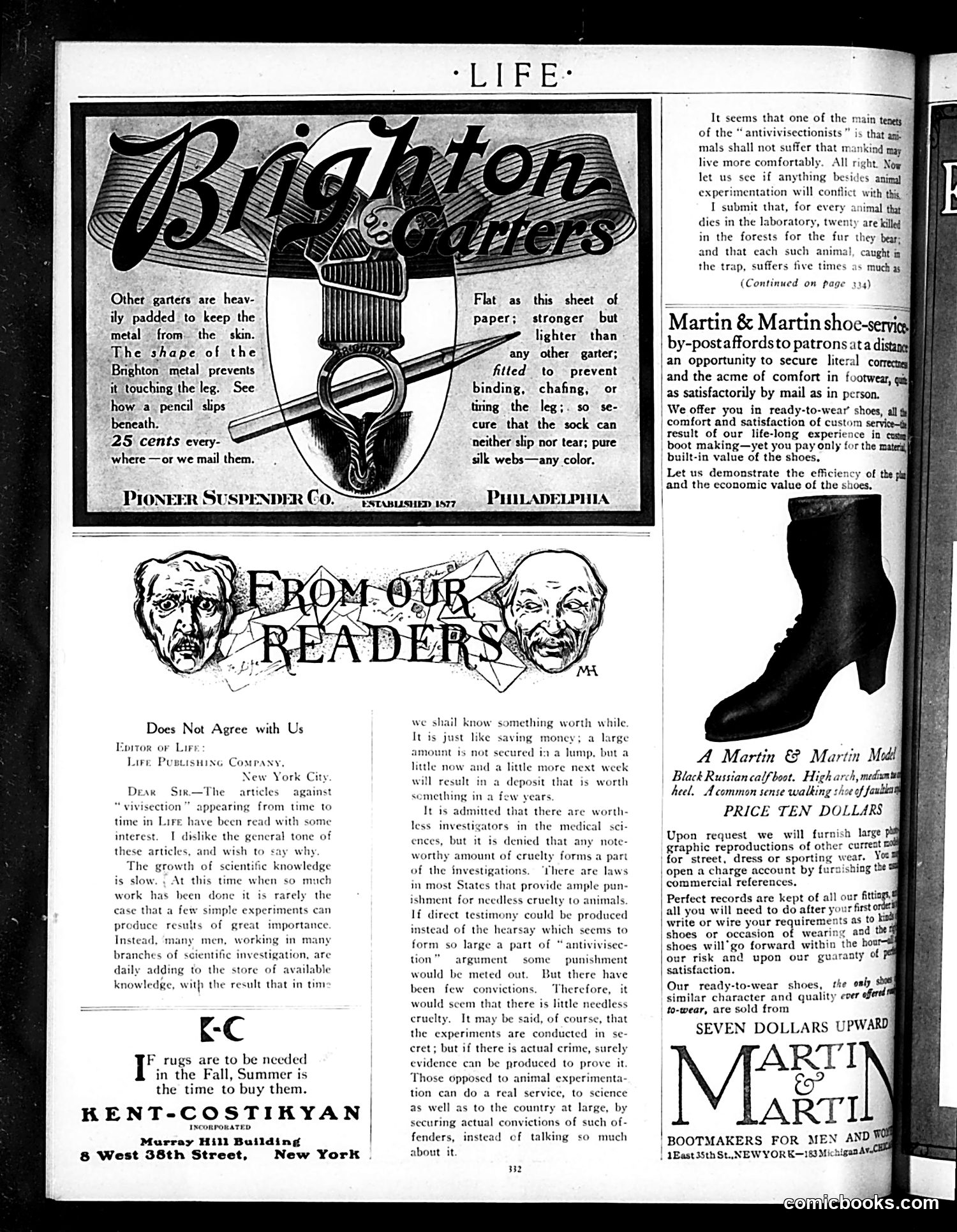
This page is primarily **advertising and letters to the editor**, not political satire. The main visual content shows: 1. **Brighton Garters advertisement** (top) - a detailed technical drawing of a suspender/garter designed to prevent binding and chafing on legs. The Pioneer Suspender Co. emphasizes the product's practical engineering. 2. **"From Our Readers" section** - a letter criticizing Life magazine's prior articles against animal experimentation in scientific research. The writer argues that medical advancement requires some animal testing and questions whether sufficient evidence exists to prosecute researchers for cruelty. 3. **Martin & Martin shoe advertisements** (right side) - promoting mail-order footwear services. The page reflects early 20th-century debates about scientific ethics and animal welfare, presented through conventional magazine format rather than satirical cartooning.
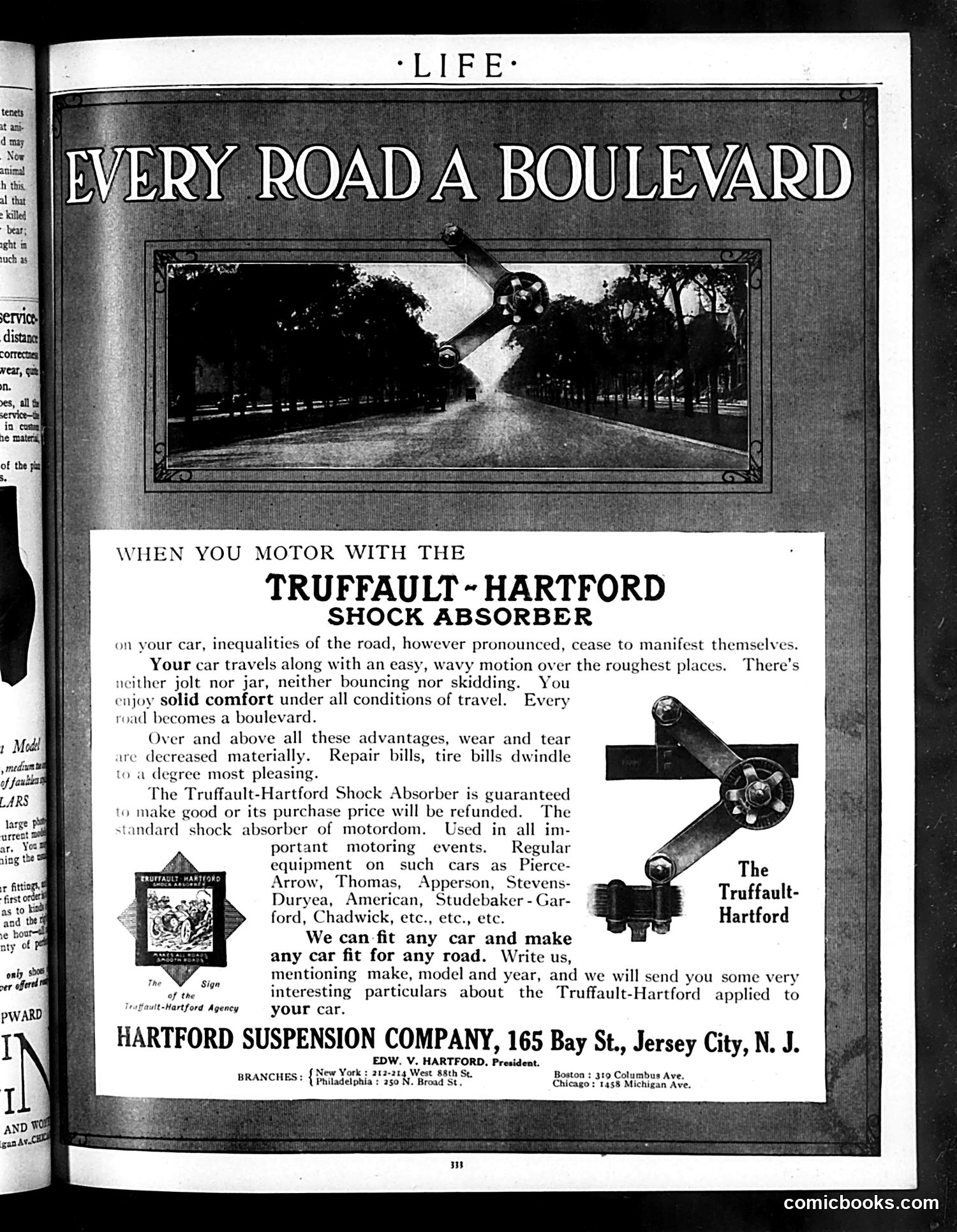
This is **not a cartoon or satire page** — it's a straightforward advertisement for the Truffault-Hartford Shock Absorber, a car suspension component. The page features: - A header image showing a tree-lined boulevard, illustrating smooth road travel - Product description emphasizing comfort and reduced wear on vehicles - A technical illustration of the shock absorber mechanism - Company contact information (Hartford Suspension Company, Jersey City, NJ) - Branch locations listed The only potentially humorous element is the headline "EVERY ROAD A BOULEVARD," which uses hyperbole to suggest the shock absorber makes any rough road feel like a smooth, tree-lined boulevard. This is standard early-twentieth-century advertising copy, not political satire. The page is purely commercial messaging aimed at automobile owners.
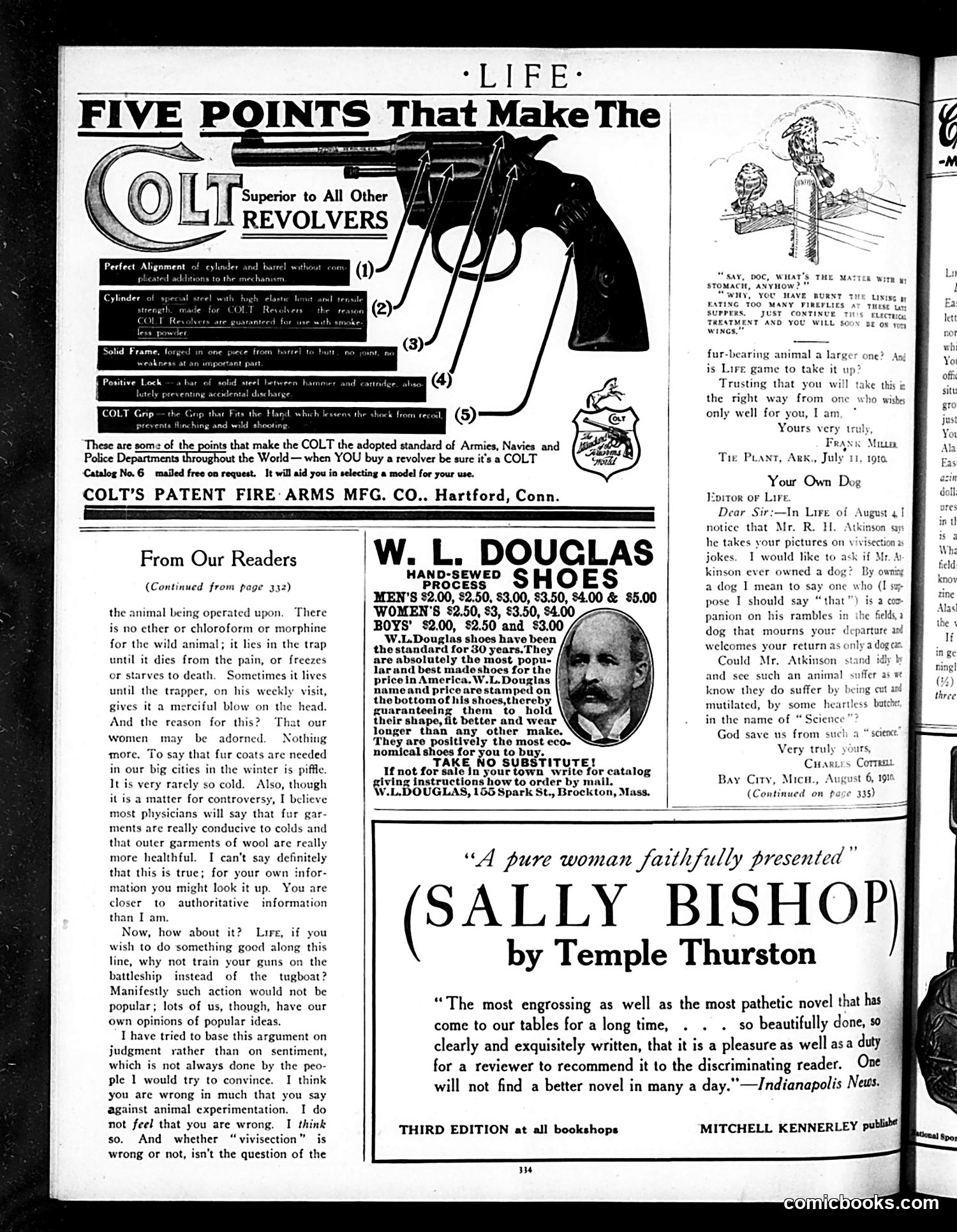
This page is primarily **advertising and reader correspondence**, not political satire. The main content includes: - **Colt Revolvers ad**: A technical diagram listing five features claiming superiority over competitor revolvers, marketed to military and police. - **W.L. Douglas Shoes ad**: Promoting hand-sewn shoes at various price points ($2-$5 for men's, $2-$3 for women's), emphasizing durability and American manufacturing. - **Reader letters** discussing animal welfare—specifically whether fur coats are ethical and whether guns should be trained for battlefield use rather than hunting. - **Book advertisement** for *Sally Bishop* by Temple Thurston (third edition). The page reflects early 20th-century consumer culture and middle-class concerns about morality and practical goods rather than political commentary.
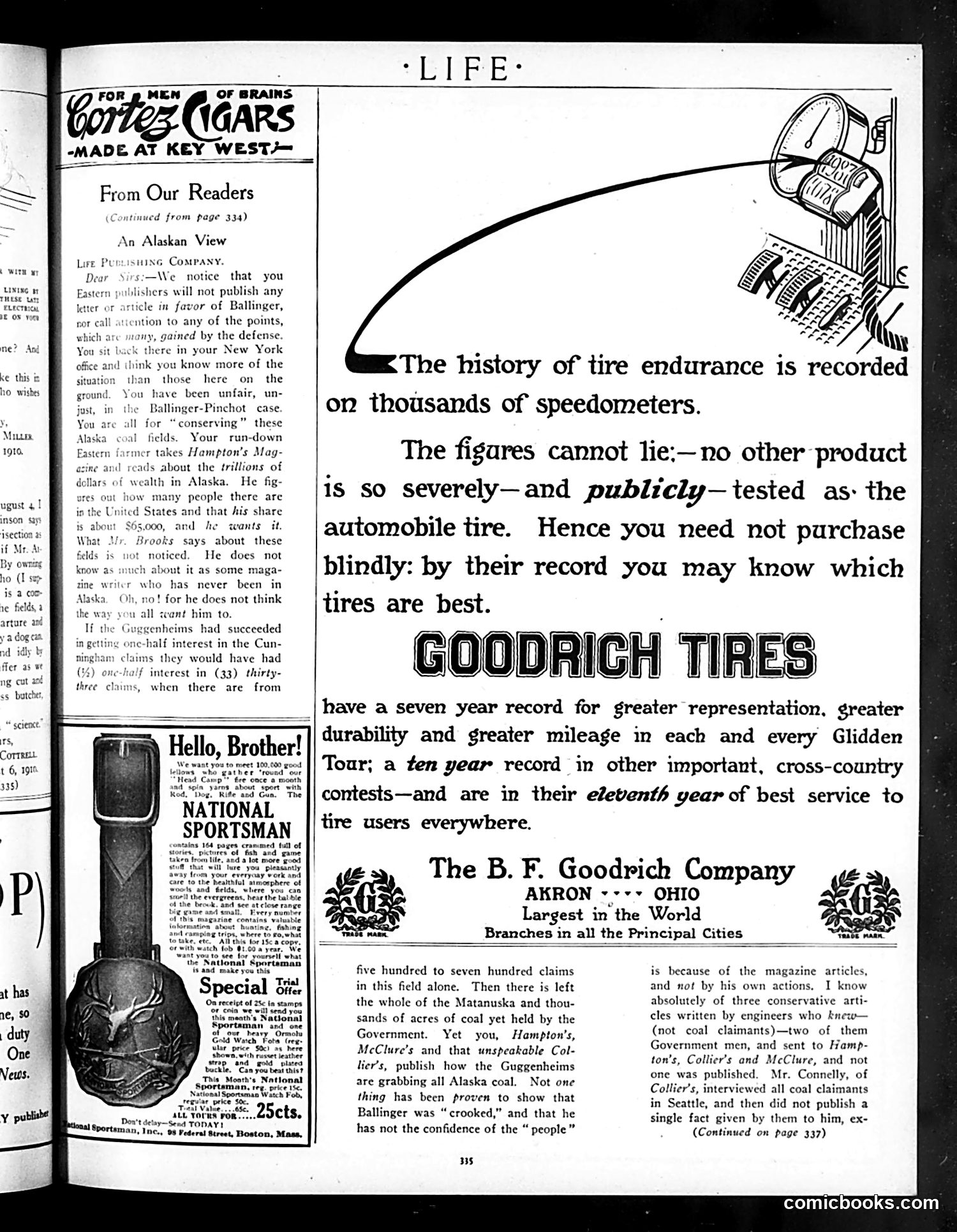
This page is primarily **advertising**, not satire. The dominant content is a Goodrich Tires advertisement claiming superiority based on public testing records—seven-year records in Gidden Tours, ten-year records in cross-country contests, and "eleventh year" service records. The left column contains a reader's letter addressing Eastern publishers' alleged unfair coverage of Alaska resources, and an advertisement for the "National Sportsman" magazine featuring a hunting knife. There is **no political cartoon** on this page. The tire advertisement uses a speedometer illustration as visual metaphor (tires' "history of endurance is recorded on thousands of speedometers"), but this is commercial art, not satire or commentary. The page reflects early-20th-century advertising strategy: establishing product credibility through claimed performance data and public validation.
This page is primarily **promotional text, not satire or political cartoon**. It announces that LIFE magazine's "mental circulation" has reached 15 million—a concept the editor explains as the imaginary readership of mentally circulated copies (people who read borrowed or passed-along copies beyond paid subscriptions). The text is a tongue-in-cheek pitch to advertisers, claiming that LIFE reaches readers beyond its physical circulation count. It includes playful jabs at advertising sincerity and a humorous reference to "Gee. Ime. Mit." from LIFE's Thought Bureau, suggesting editors monitor ad honesty. The page mixes self-promotion with satirical commentary on advertising practices and magazine circulation claims—typical early 20th-century magazine marketing rhetoric dressed in humor.
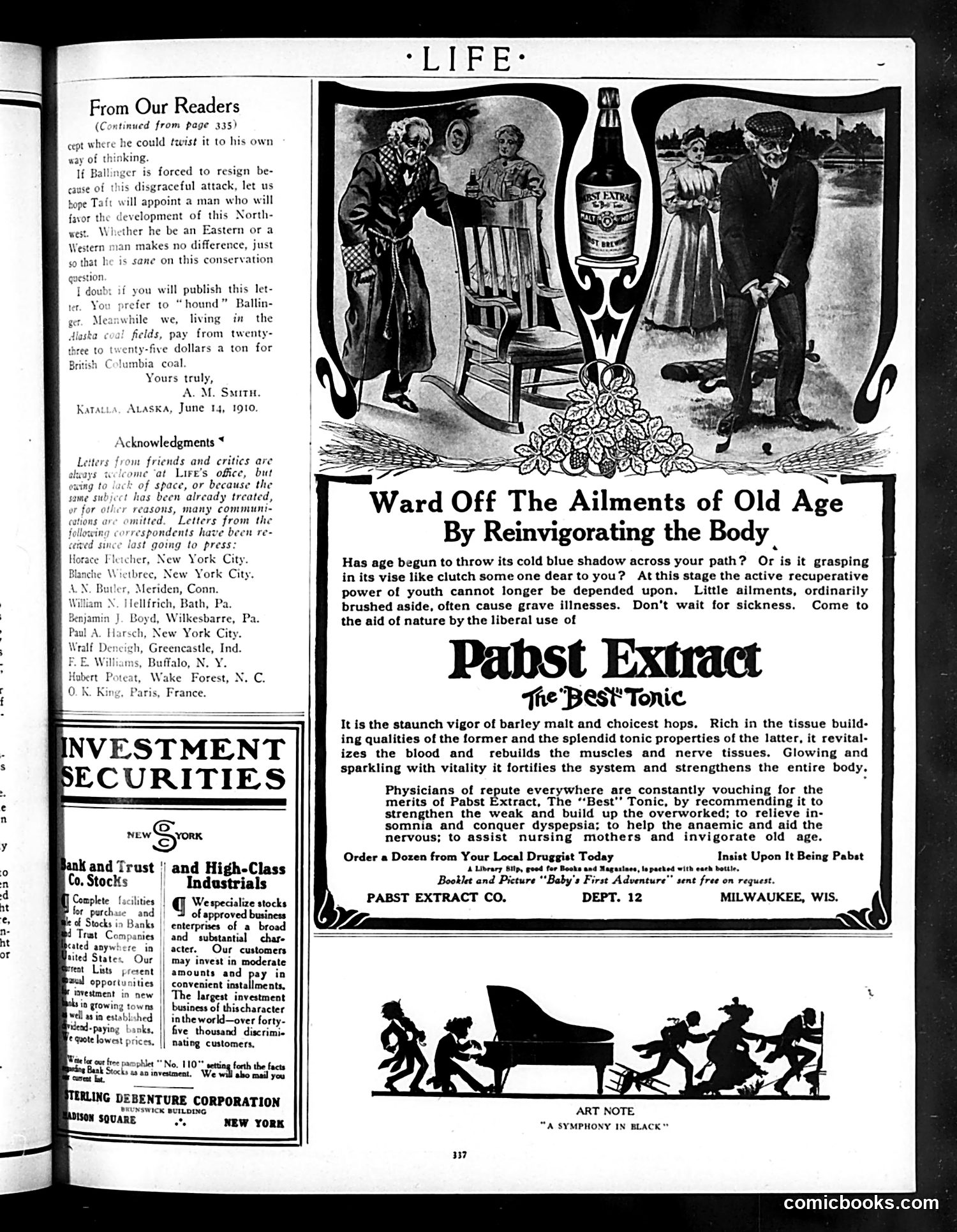
This page is primarily **advertising and letters to editors**, not political satire. The main content is a full-page advertisement for **Pabst Extract**, a barley malt tonic marketed as a health supplement for aging. The ad claims it "reinvigorates the body" and combats ailments of old age, targeting elderly readers concerned with vitality and strength. The image shows what appears to be a funeral scene—elderly mourners and a casket—suggesting the product prevents death or decline. The left side contains reader letters and investment securities advertisements, typical of Life magazine's mixed commercial content. The bottom features an art note titled "A Symphony in Black," showing silhouetted figures at a piano, unrelated to the main advertisement. This reflects early 20th-century medical advertising practices where tonics made broad health claims without regulation.
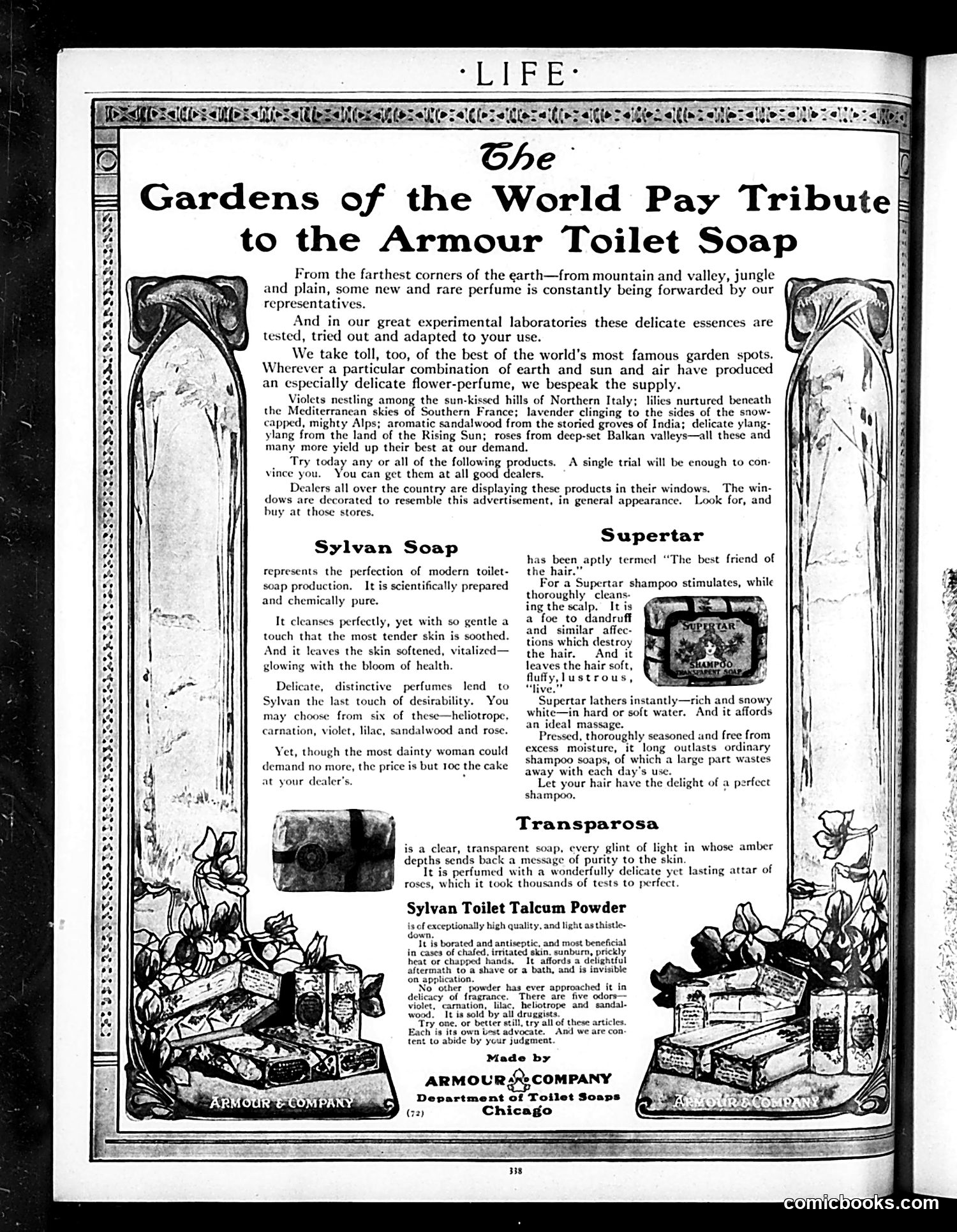
This is **not a political cartoon or satire page**—it is a straightforward advertisement for Armour & Company's toilet soap and cosmetics products, published in *Life* magazine. The page promotes four products: - **Sylvan Soap** (perfumed toilet soap in various scents) - **Supertar** (a medicinal shampoo for dandruff) - **Transparosa** (transparent soap) - **Sylvan Toilet Talcum Powder** The decorative illustrations show flowers and garden imagery, supporting the advertisement's marketing angle that these products contain perfumes sourced from "gardens of the world." The ornamental borders and botanical drawings are purely aesthetic, not satirical. This represents typical early 20th-century product advertising in *Life* magazine.
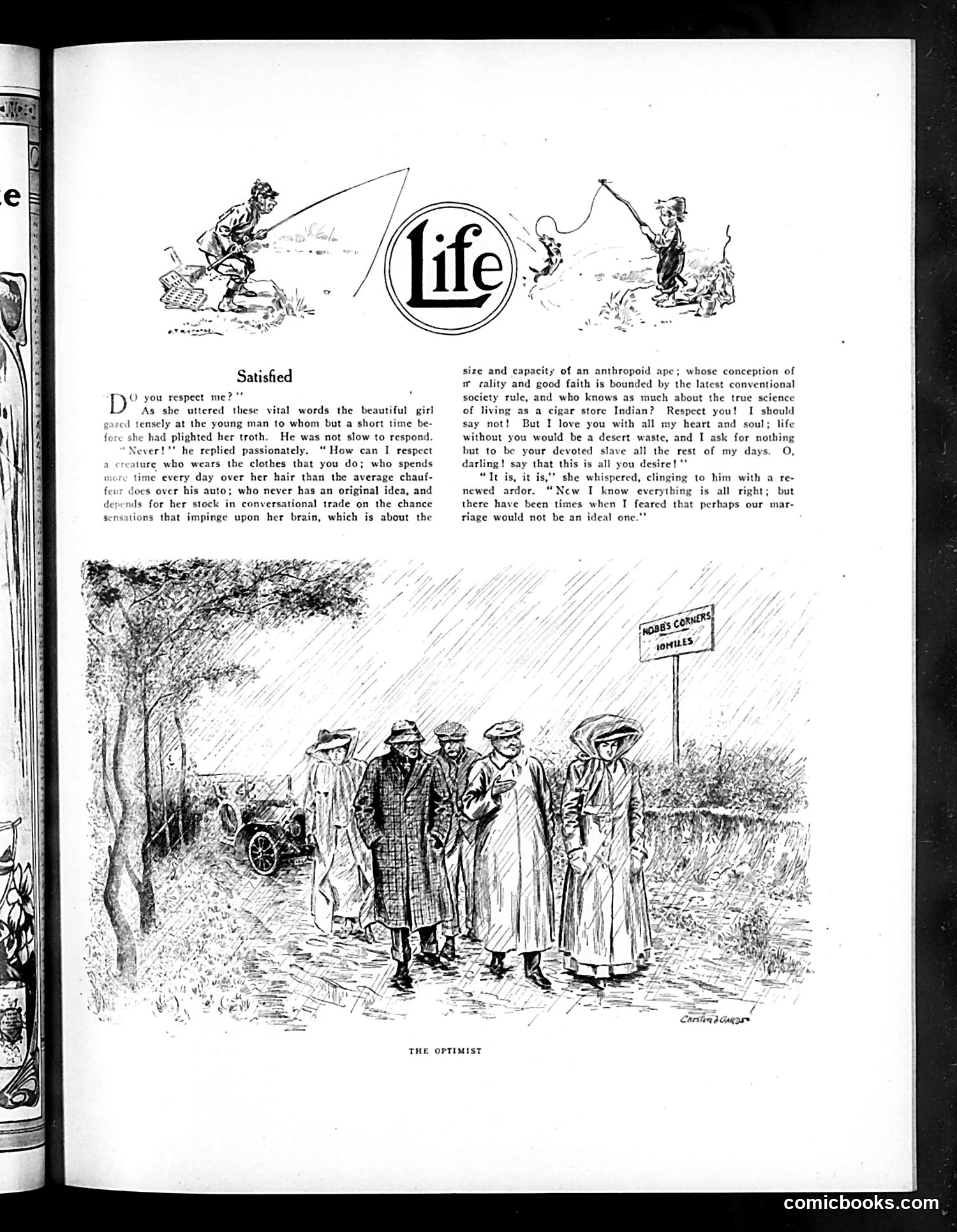
This page contains a romantic story titled "Satisfied" (top) and a cartoon titled "The Optimist" (bottom). The story depicts a young woman rejecting a suitor's proposal, claiming she cannot respect a man who lacks ambition and wears cheap clothes. She insists on marrying someone with higher social standing and financial success. "The Optimist" cartoon below satirizes this materialistic attitude. It shows a group of women standing in the rain beside a broken-down automobile, apparently stranded. Despite their predicament, their optimistic expressions suggest they remain hopeful—likely about finding wealthy husbands regardless of circumstances. The "Hobbs Corners" road sign and rural setting emphasize the contrast between their modest situation and their elevated expectations, mocking the era's preoccupation with marrying for money and status.
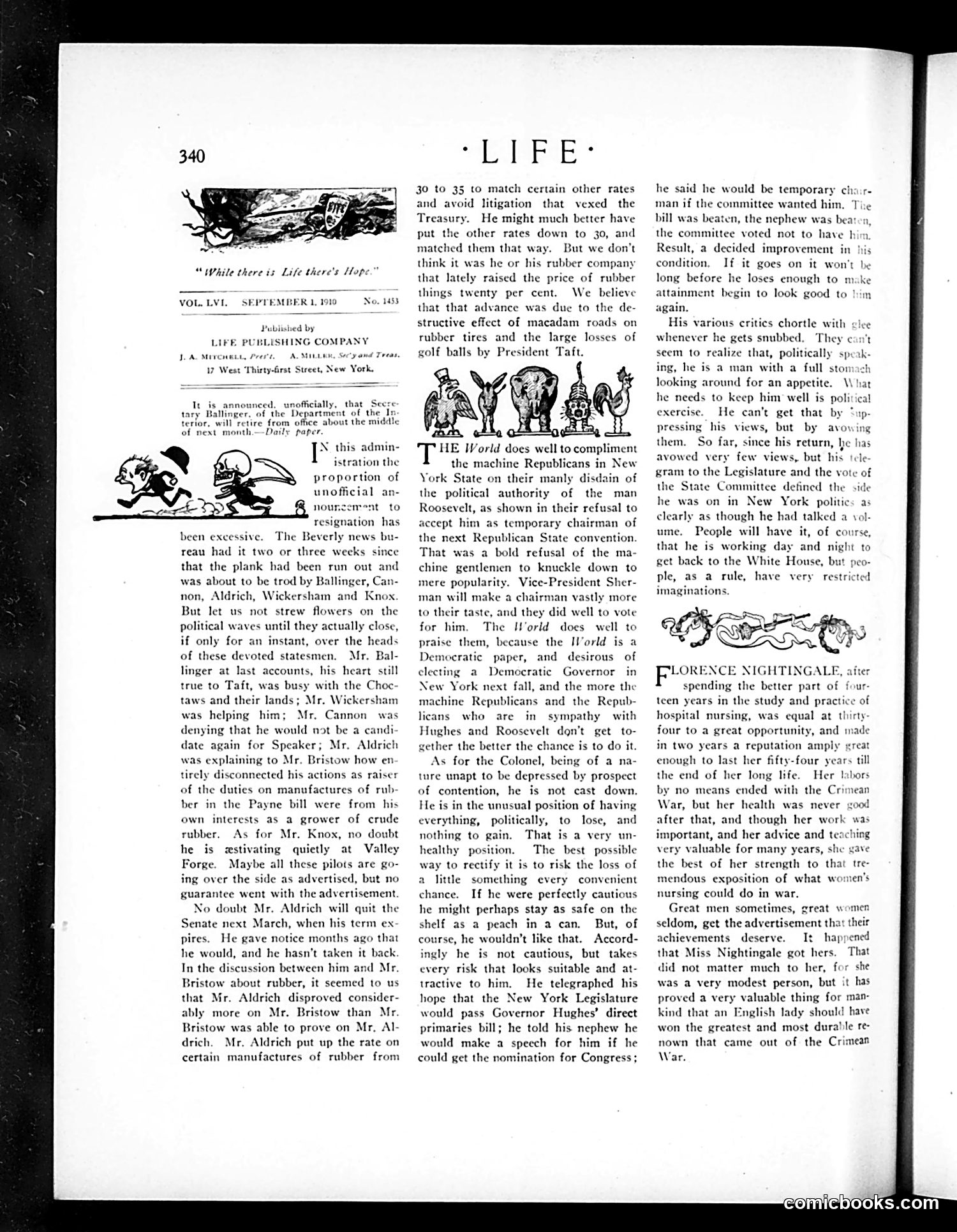
The page critiques Republican Party leadership's treatment of Theodore Roosevelt. The text discusses Roosevelt's exclusion as temporary chairman of the next Republican State convention—a deliberate snub by New York machine Republicans (Aldrich, Wickersham, Knox). The *Life* editors praise Roosevelt's political resilience despite this rejection, noting he maintains his principles without bitterness. They contrast this favorably with the "machine Republicans," portraying Roosevelt as principled while party leadership appears petty and faction-driven. The piece also includes a separate article praising Florence Nightingale's nursing legacy. Overall, the page presents Roosevelt sympathetically as a wronged elder statesman while satirizing the Republican establishment's political maneuvering against him.
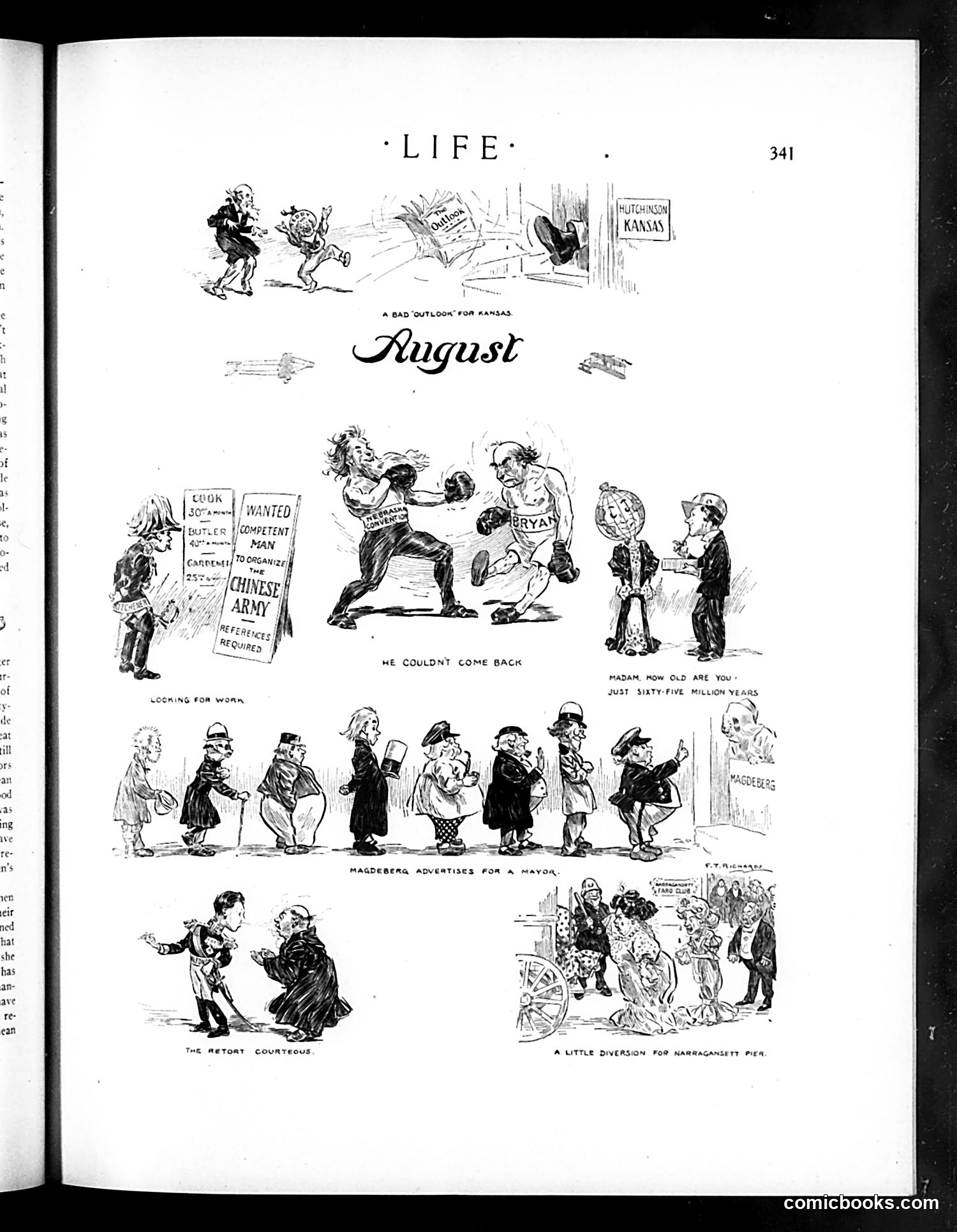
This page presents satirical commentary on August 1908 American politics and social issues: **"A Bad Outlook for Kansas"** depicts political turmoil, likely referencing Kansas's contentious state politics. **"He Couldn't Come Back"** shows Bryan (labeled) apparently defeated, referencing William Jennings Bryan's failed presidential campaigns. **"Looking for Work"** satirizes unemployment and job-seeking desperation during economic hardship. **"Madebergs Advertises for a Mayor"** mocks incompetent or corrupt municipal leadership. **"The Retort Courteous"** appears to show a social interaction or quarrel. **"A Little Diversion for Narragansett Pier"** references the Rhode Island resort town, likely mocking wealthy leisure culture. The cartoons employ exaggerated caricature and humor to critique political failures, economic conditions, and social pretension of the 1908 era.
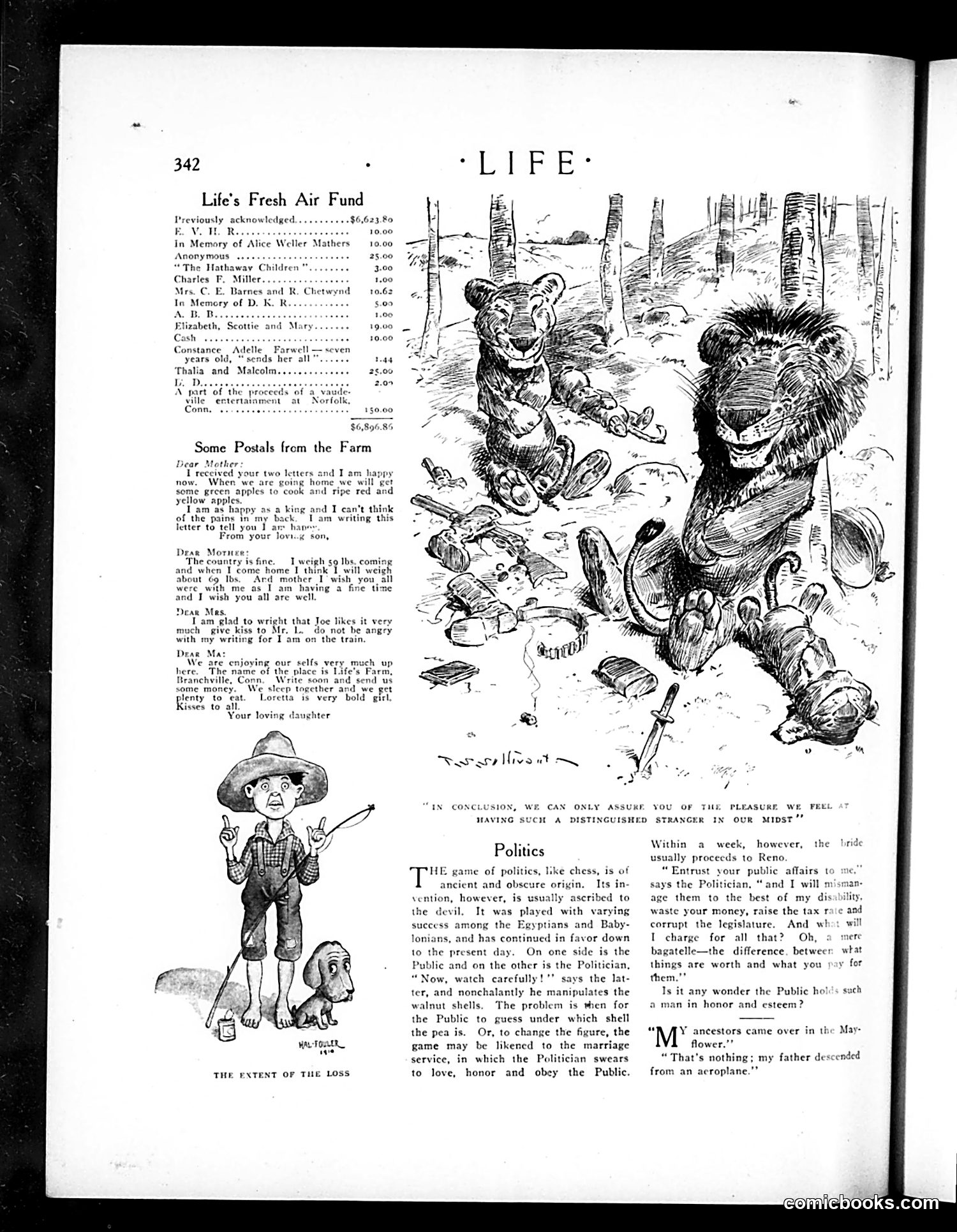
This page satirizes political corruption through an extended metaphor. The main cartoon illustrates politics as a shell game—the Politician manipulates walnut shells while the Public tries to guess which conceals the "pea," representing truth or fair dealing. The accompanying text expands this critique: the Politician swears to "love, honor and obey the Public" (like marriage vows), then immediately abandons these promises. The Politician boasts of raising taxes, corrupting the legislature, and charging exorbitant fees—all while pretending these are mere "bagatelles" (trifles). The final exchange mocks class pretension: one figure claims aristocratic ancestry ("ancestors came over in the Mayflower"), while another trumps this with absurdist humor ("my father descended from an aeroplane"), deflating pretentious status-claiming. The satire exposes how politicians deceive the public through sleight-of-hand deception while enriching themselves, and how citizens foolishly grant them respect despite obvious corruption.
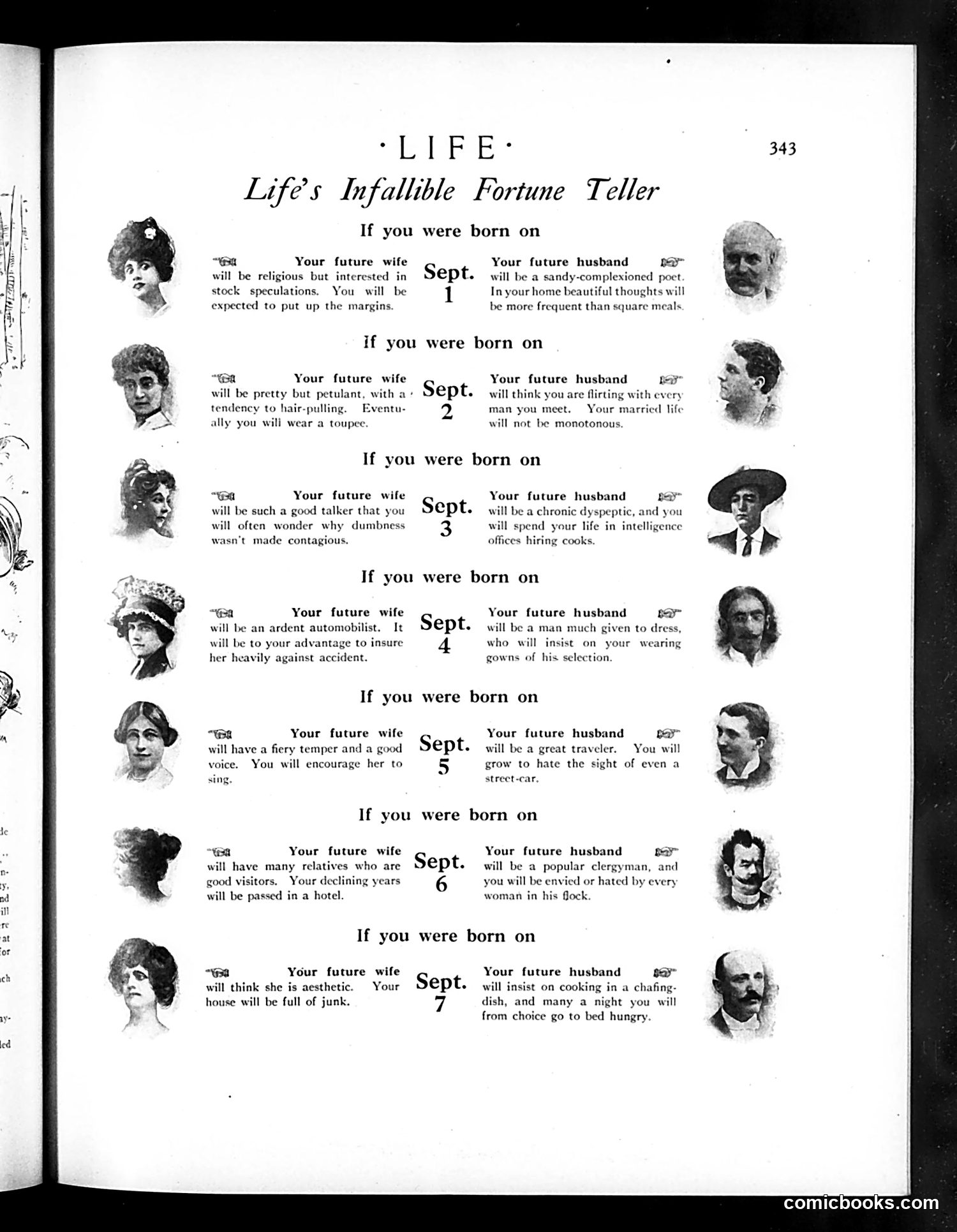
This is a satirical "fortune teller" feature mocking both astrology and early-20th-century gender stereotypes. For each September birth date (1-7), it offers humorous predictions about the reader's future spouse, with accompanying portraits. The satire targets: **Gender roles**: Women are defined by appearance, domestic skills, or temperament (petulant, talkative, aesthetic). Men are characterized by profession or habits (clergyman, dyspeptic, dressy). **Class anxiety**: References to stock speculation, servants ("hiring cooks"), chafing-dish cooking, and hotel living reflect concerns about maintaining middle-class status. **Marriage pessimism**: Nearly all predictions suggest incompatibility or frustration—jealous husbands, wives with annoying habits, couples constantly at odds. The joke assumes readers recognize these as exaggerated but relatable marital stereotypes of the era. It's gentle mockery of both matrimony and the pseudoscience of fortune-telling itself.
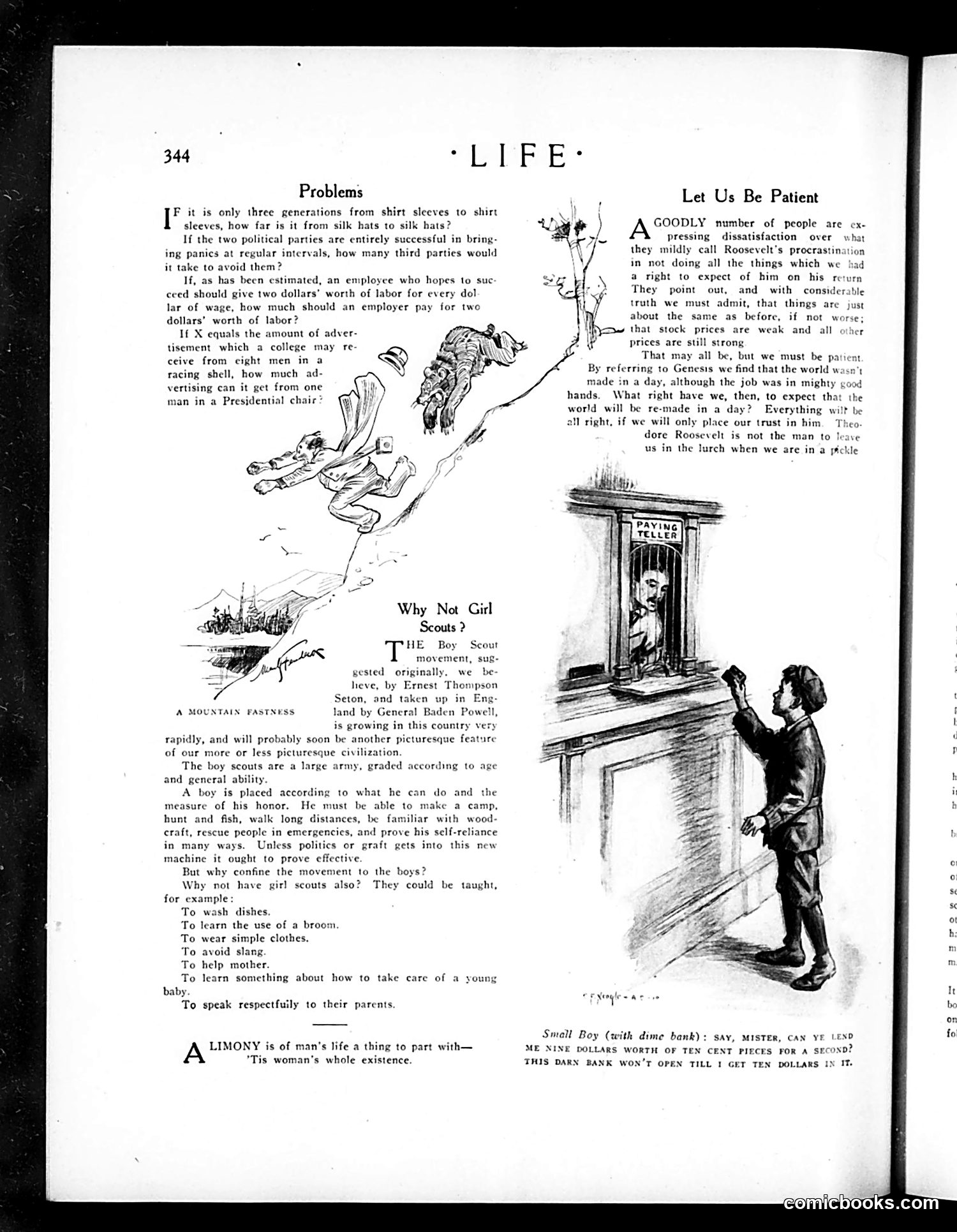
This page contains three satirical pieces targeting early 20th-century American social issues. **"Problems"** presents rhetorical questions mocking political and economic contradictions—particularly critiquing labor exploitation and the cyclical nature of economic panics caused by "two political parties." **"Why Not Girl Scouts?"** sarcastically proposes Girl Scouts as a counterpart to the Boy Scout movement (then recently established in America by Ernest Thompson Seton and Baden-Powell). The satire is sharply misogynistic by modern standards: it "jokes" that girls should be trained only in domestic servitude (washing dishes, housekeeping) rather than the outdoor skills and self-reliance taught to boys. This reflects period attitudes dismissing female capability. **"Let Us Be Patient"** defends Theodore Roosevelt against criticism that his reforms haven't yet transformed society, urging patience by comparing the world's creation to Roosevelt's reformist agenda. It's apologetic propaganda for the Progressive president. The illustration labeled "A Mountain Fastness" appears to accompany the cartoon about a boy at a savings bank, playing on themes of financial precarity during the era's economic instability.
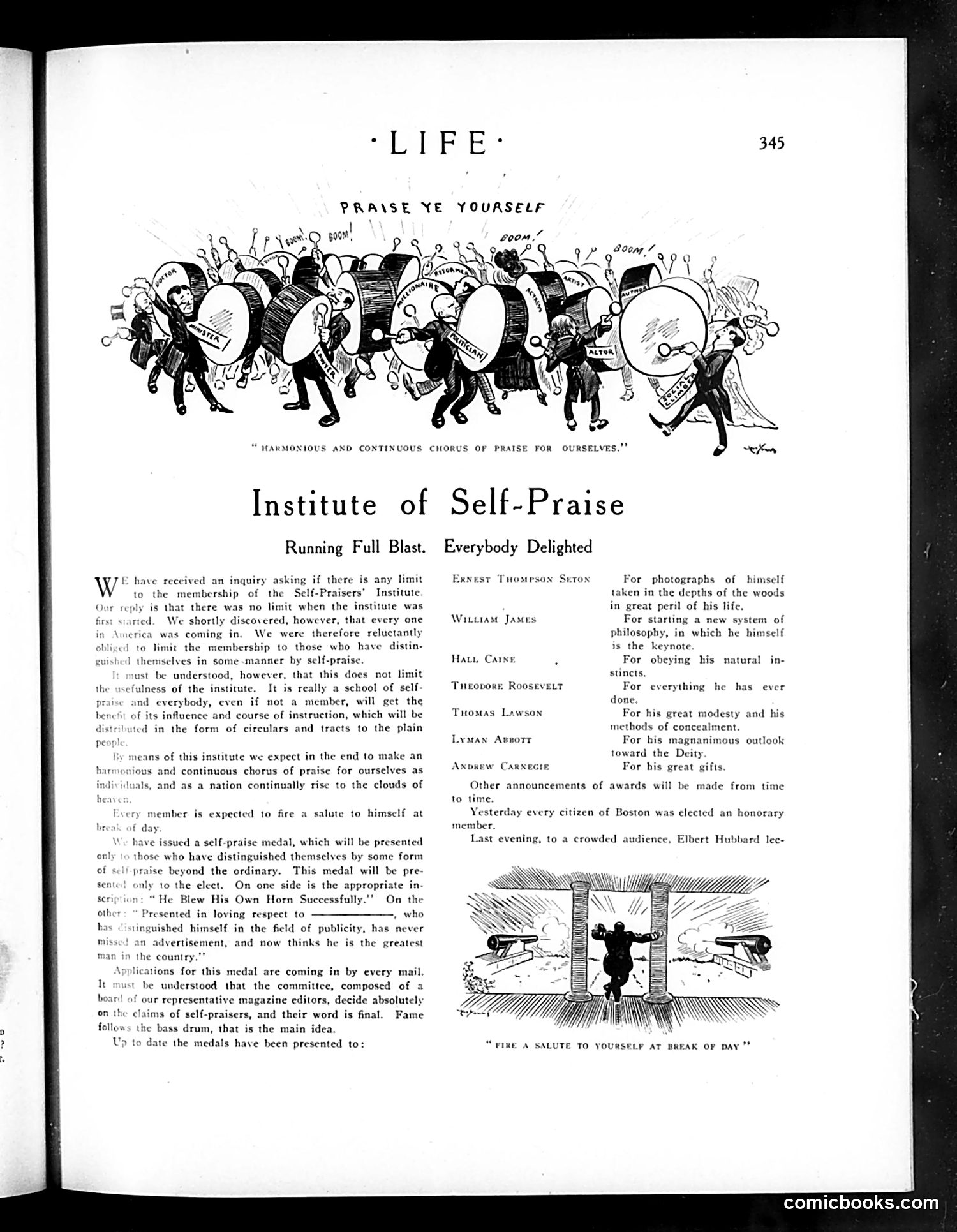
This Life magazine satire mocks American celebrity culture and ego. The "Institute of Self-Praise" is a fictional organization awarding medals to famous figures for excessive self-promotion and vanity. Named recipients include Theodore Roosevelt, Andrew Carnegie, William James, and Ernest Thompson Seton—prominent early 1900s figures. The satire credits them with absurd achievements: Roosevelt for "obeying his natural instincts," Carnegie for "great modesty" (ironic, given his wealth), Seton for photographing himself "in great peril." The top illustration shows figures firing drums and horns—literally praising themselves. The bottom cartoon depicts a man saluting himself at dawn. The joke is that American society had become so obsessed with self-promotion and personal publicity that even respected intellectuals and industrialists deserved mockery for their vanity. The satirical "medal" inscription—"He Blew His Own Horn Successfully"—captures the core complaint: prominent men were essentially just advertising themselves.
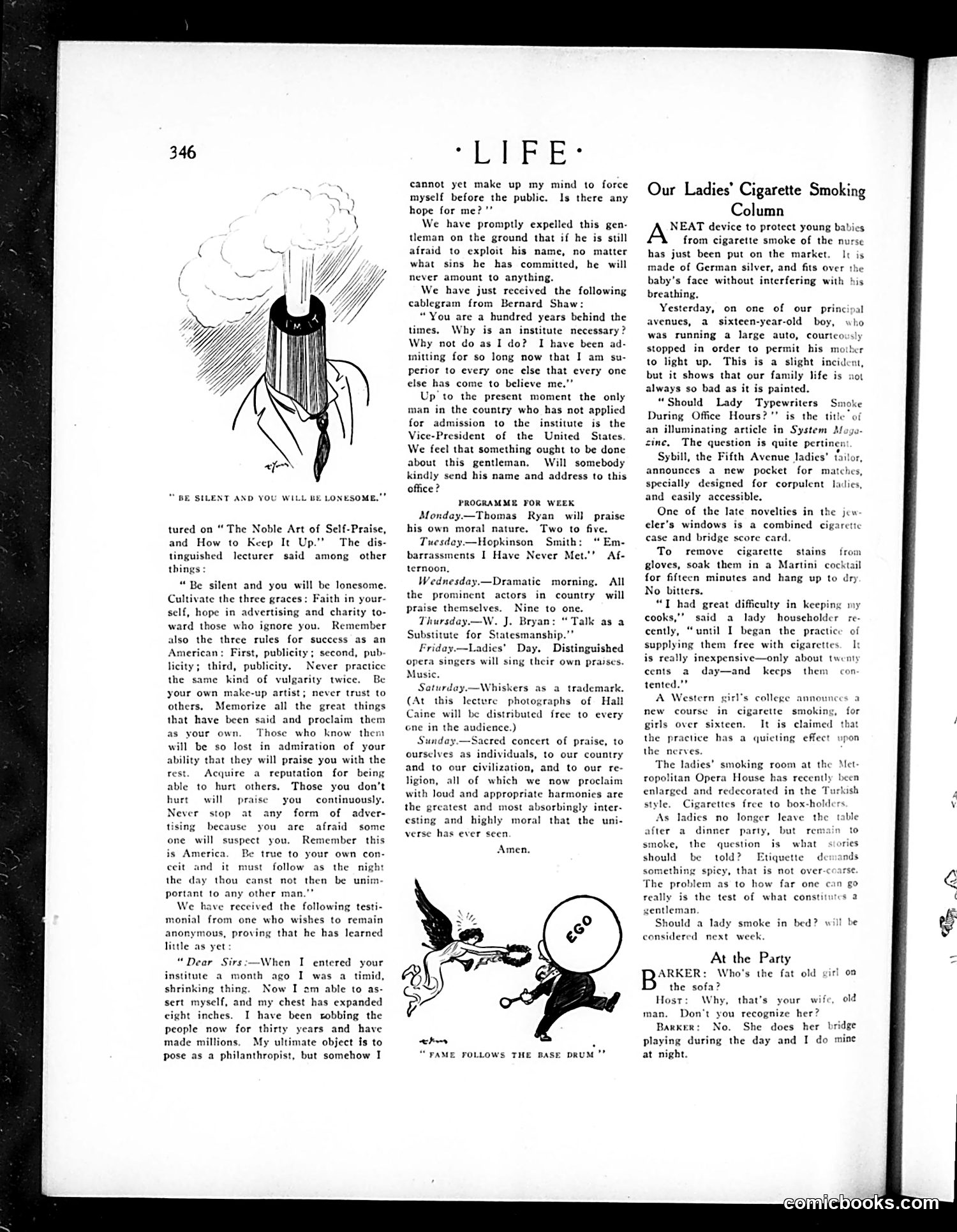
**Main Content: Self-Praise Institute Satire** This page satirizes American culture's obsession with self-promotion and publicity. The central article mocks an imaginary institute teaching "self-praise," positioning shameless self-advertising as the key to American success. The satire identifies "publicity" as America's primary value—repeated three times as the "three rules for success." The cartoon (top left) depicts a pompous figure, captioned "BE SILENT AND YOU WILL BE LONESOME"—mocking Americans' compulsive need for attention. **Notable References:** - **Bernard Shaw** (cablegram): Famous playwright cited as having perfected self-promotion - **Vice-President of the United States**: Humorously noted as the only American who hasn't applied to the institute—implying even politicians aren't shameless enough - Weekly programming includes Thomas Ryan, Hopkinson Smith, W.J. Bryan, and opera singers—all real public figures being satirized **Secondary Content: "Ladies' Cigarette Smoking Column"** Brief items about women smoking, including a device to protect babies from cigarette smoke and etiquette questions about ladies smoking in various settings. The page targets Gilded Age American excess and vanity.
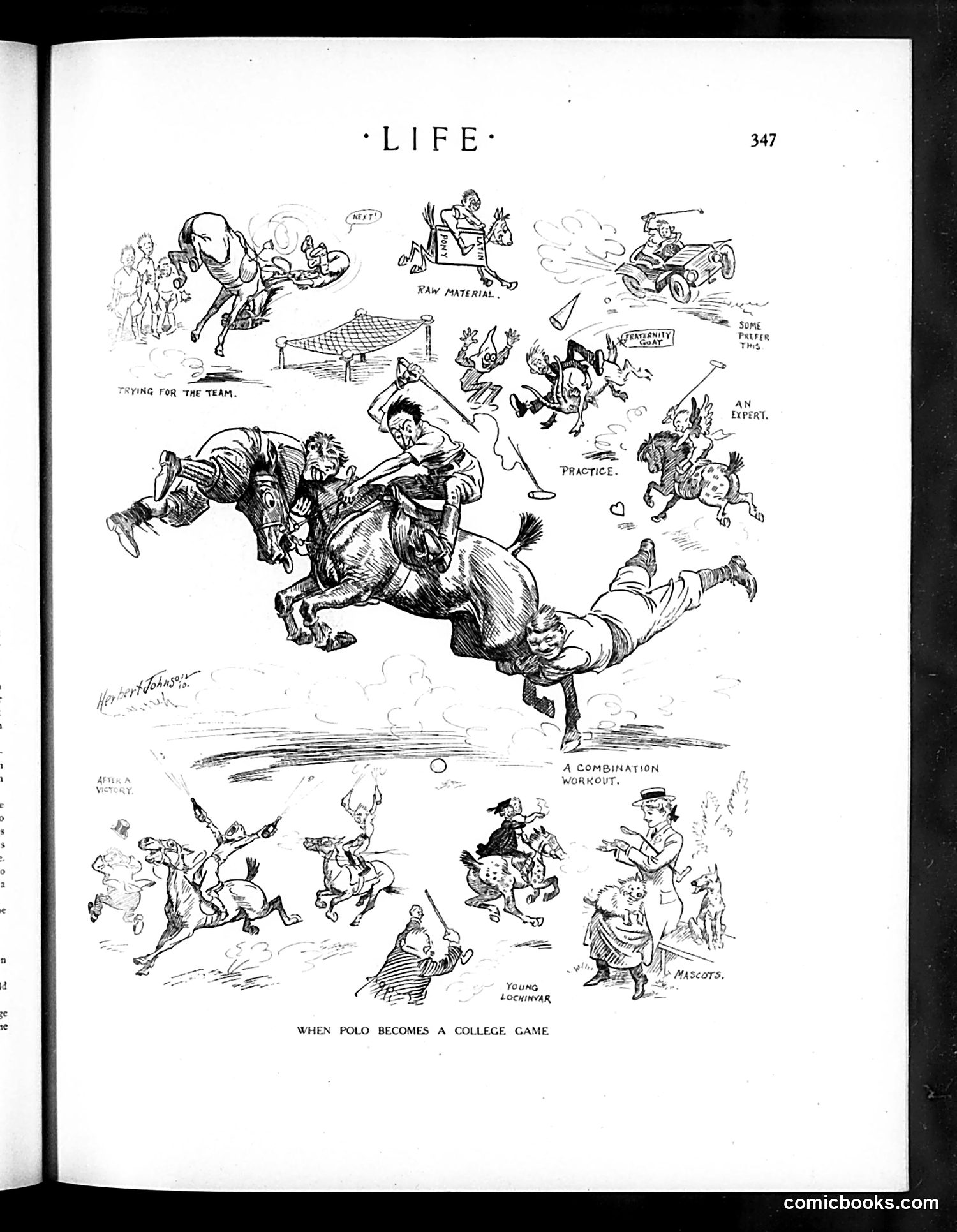
This satirical cartoon mocks the chaos that would ensue if the elite sport of polo—traditionally played by wealthy horsemen—became a college game with student participation. The central image shows a horse wildly bucking its riders in all directions, depicting the disorder. Surrounding vignettes illustrate absurd amateur attempts: "Trying for the Team," "Raw Material," "Practice," "An Expert," and "A Combination Workout" all show untrained students comically failing at polo. The bottom panel references "Young Lochinvar" and "Mascots," suggesting college traditions would replace polo's refined etiquette. The satire contrasts polo's exclusivity with the chaos of democratizing it through college athletics—implying college students lack the skill, discipline, and resources for such a sophisticated sport. The joke targets both collegiate enthusiasm and polo's upper-class pretensions.
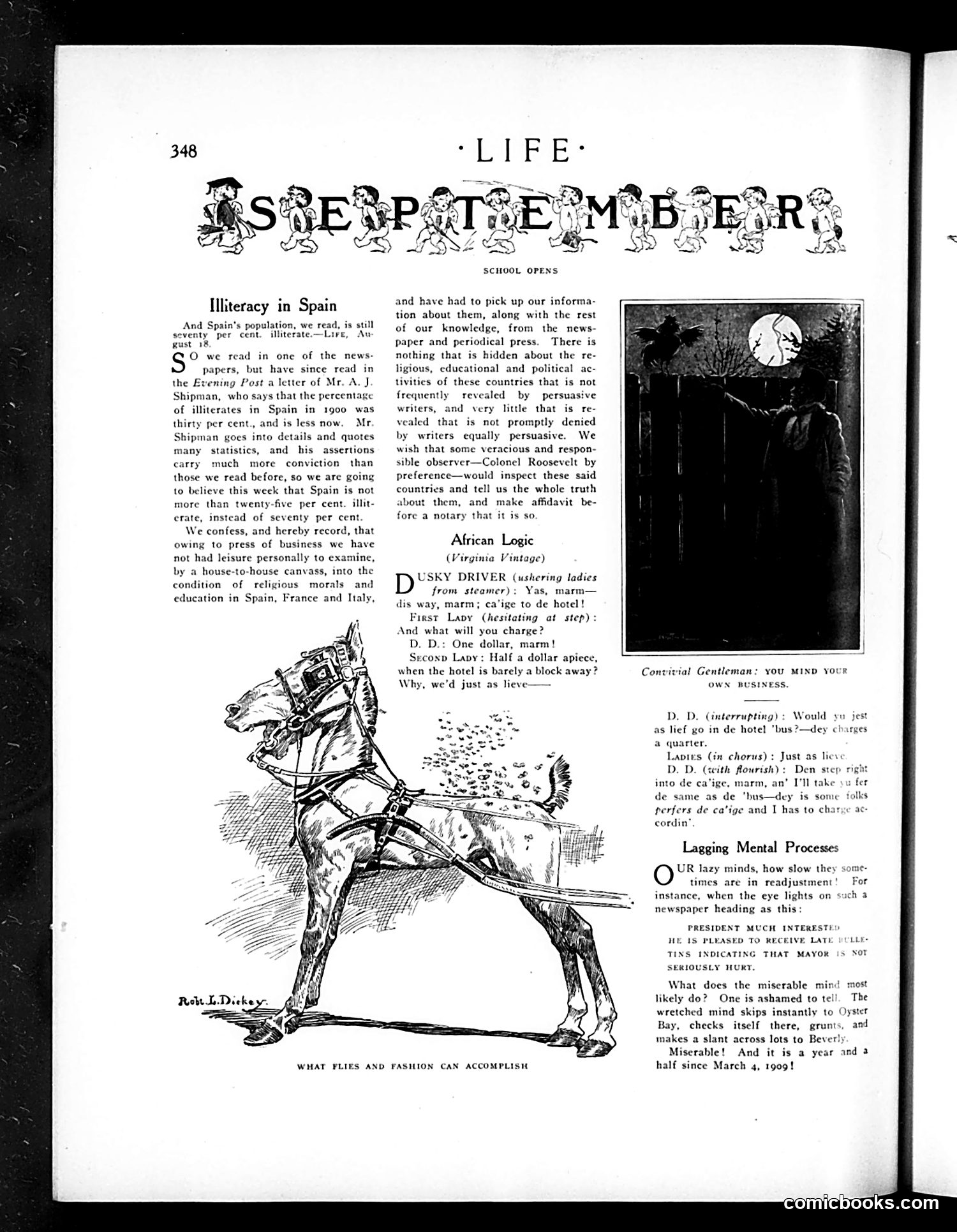
This page contains three satirical pieces: **"Illiteracy in Spain"** mocks journalistic unreliability. Life admits it prints unverified claims about foreign countries (Spain's illiteracy rate), then contradicts itself when a reader provides statistics. The piece satirizes how newspapers casually publish conflicting "facts" without personal verification—humorously suggesting even President Theodore Roosevelt couldn't be trusted to tell the truth about such matters. **"African Logic"** is a racist dialect comedy sketch depicting a Black carriage driver using exaggerated speech ("Yas, marm," "ca'ige"). The "joke" plays on supposed Black illogic: the driver charges the same fare ($1) whether customers take his carriage or the cheaper hotel bus, since both involve transport. The humor relies entirely on ethnic caricature. **"Lagging Mental Processes"** satirizes how readers' minds work slowly—when seeing a newspaper headline about the Mayor being "seriously hurt," readers' thoughts instinctively jump to Oyster Bay (Teddy Roosevelt's home) before correcting course to Beverly Hills, revealing how current events get mentally filtered through recent scandals.
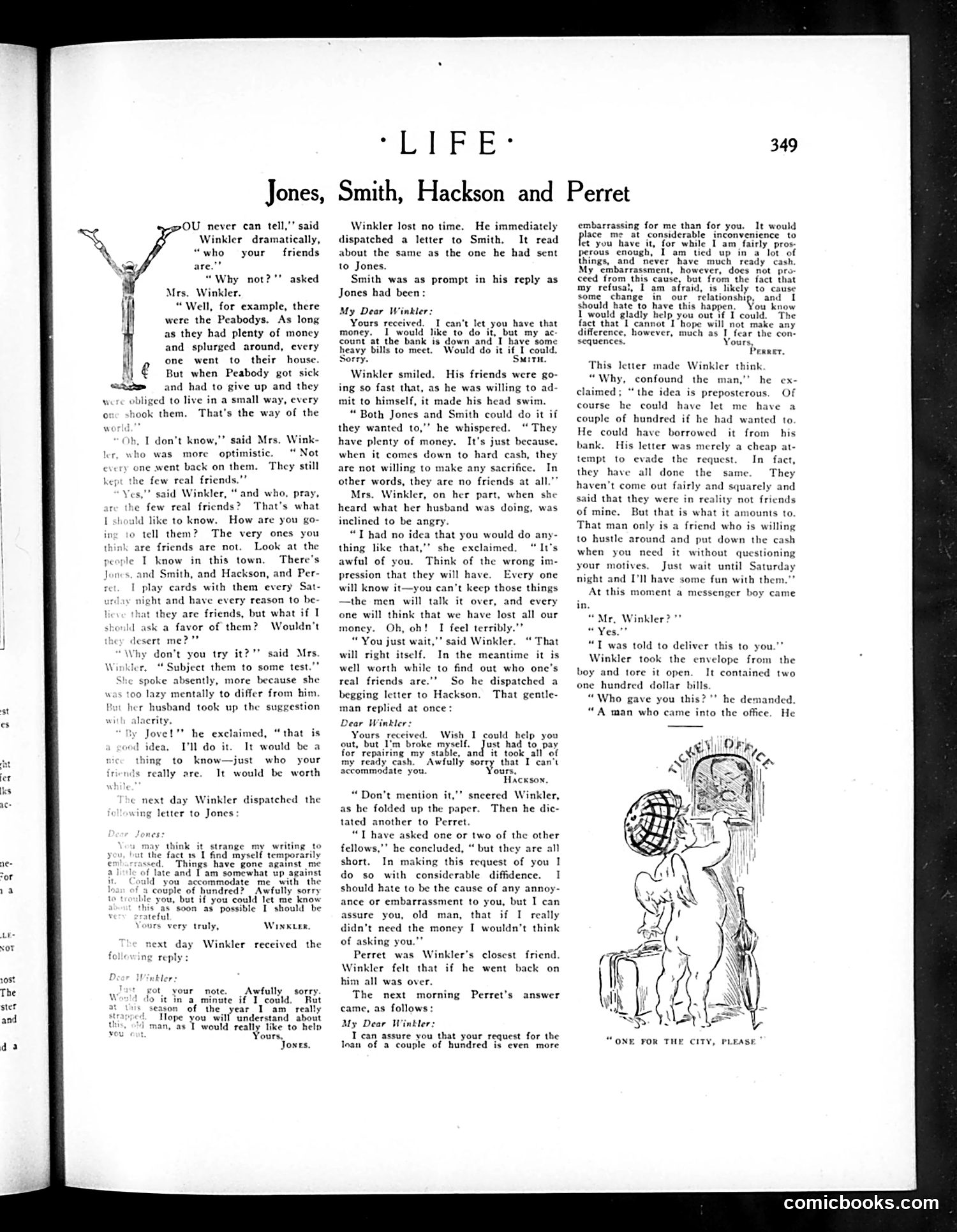
This page presents a serialized story titled "Jones, Smith, Hackson and Perret" about a man named Winkler who tests his friendships. After his wife suggests he verify who his real friends are, Winkler writes letters to four acquaintances requesting loans of a couple hundred dollars, claiming financial hardship. The satire targets the superficiality of social friendships in early 20th-century America. Each friend makes excuses (bank accounts down, seasonal expenses, stable repairs) rather than help—revealing that their camaraderie is conditional on prosperity. Winkler's conclusion is cynical: these men he plays cards with "every Saturday night" are no true friends because they won't sacrifice for him. The accompanying illustration shows a figure at a "Turkey Office," likely advertising or unrelated to the main narrative. The story's point is timeless social commentary: fair-weather friendships evaporate when money is involved.
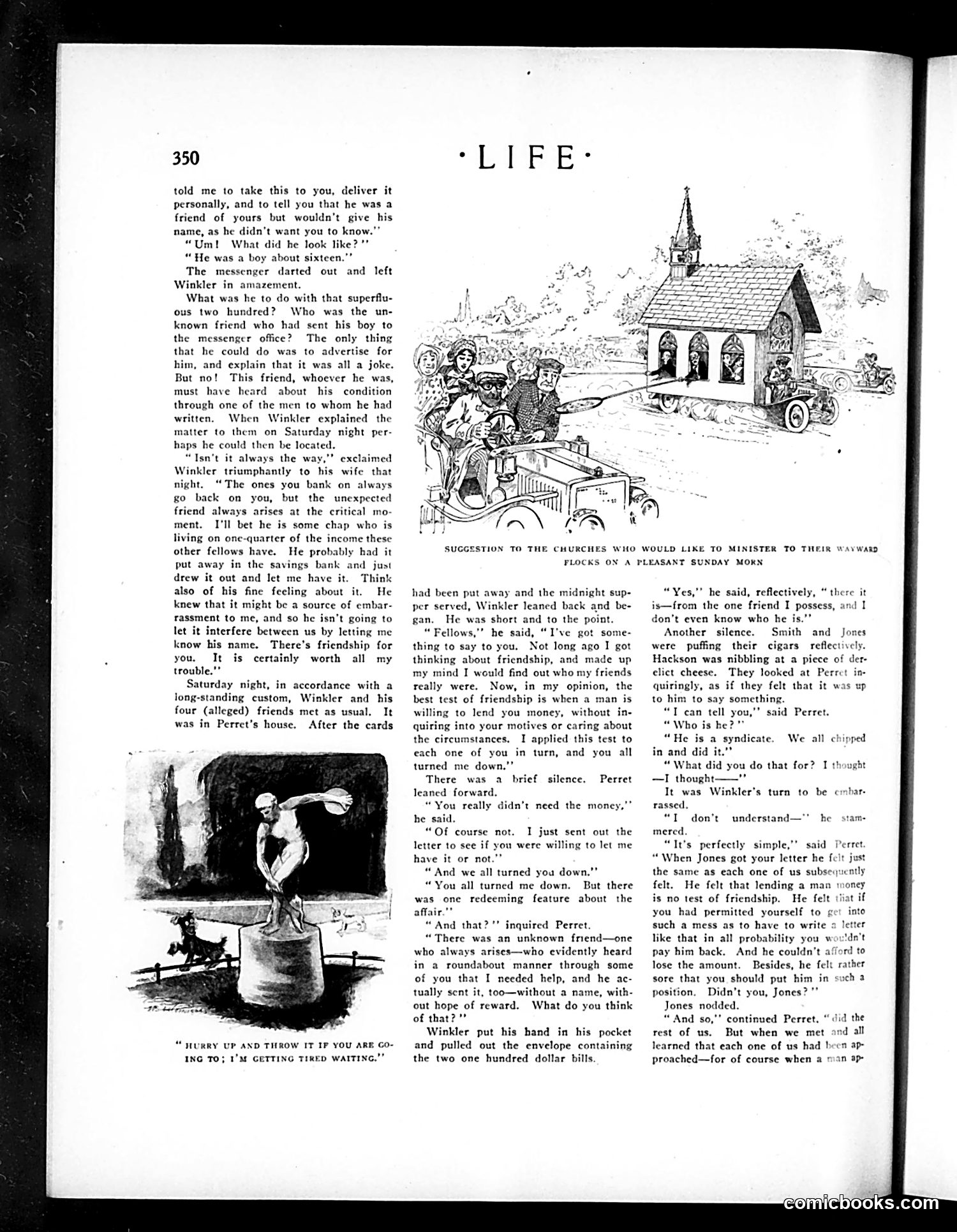
This page presents a satirical story about **friendship and money**. The protagonist Winkler conducts a "test" by asking four friends for a loan to determine who truly values him. All four refuse. However, an anonymous benefactor sends $200, which Winkler attributes to a mysterious true friend. At the climactic dinner scene, Winkler reveals this gift to shame his friends—only to discover the joke is on him: **all four friends conspired together** to send the money anonymously after learning of his needs. They orchestrated it as a group "syndicate" rather than as individuals. The satire targets **false pride and misguided friendship metrics**—Winkler's cynical test backfires when he learns genuine friendship doesn't require individual heroics or secret benefactors. His friends' collective gesture proves more meaningful than he anticipated. The illustration at top shows a church scene, likely commenting on morality and community values in relation to the story's themes.
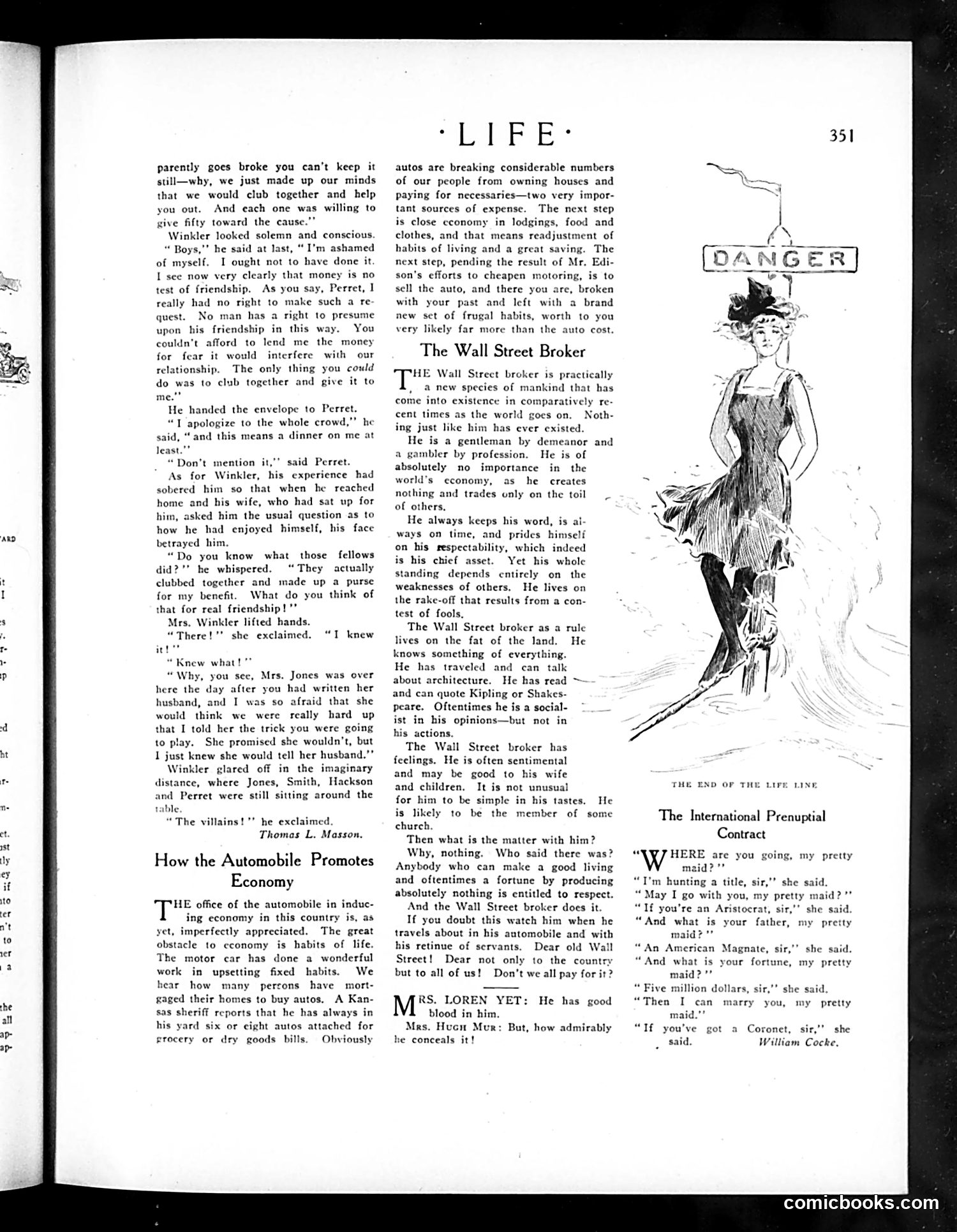
This page contains two satirical pieces typical of early 20th-century American humor: **"How the Automobile Promotes Economy"** is deadpan satire. The author argues that automobiles, by forcing people to mortgage homes and go into debt buying cars, actually *promote economy* by breaking their old spending habits on housing and food. The joke is the absurd logic: financial ruin becomes "economic improvement." This mocks both the automobile industry's aggressive marketing and Americans' gullible embrace of consumer debt. **"The Wall Street Broker"** offers a caustic portrait of a new professional type. The satirist describes brokers as gentlemen by appearance but gamblers by nature—creating nothing of value, living parasitically off others' financial foolishness, and depending entirely on market manipulation and client weakness. Their respectability is mere window-dressing for essentially predatory behavior. Both pieces critique early 20th-century consumer culture and financial systems as fundamentally deceptive and economically destructive, disguised under respectability and progress.
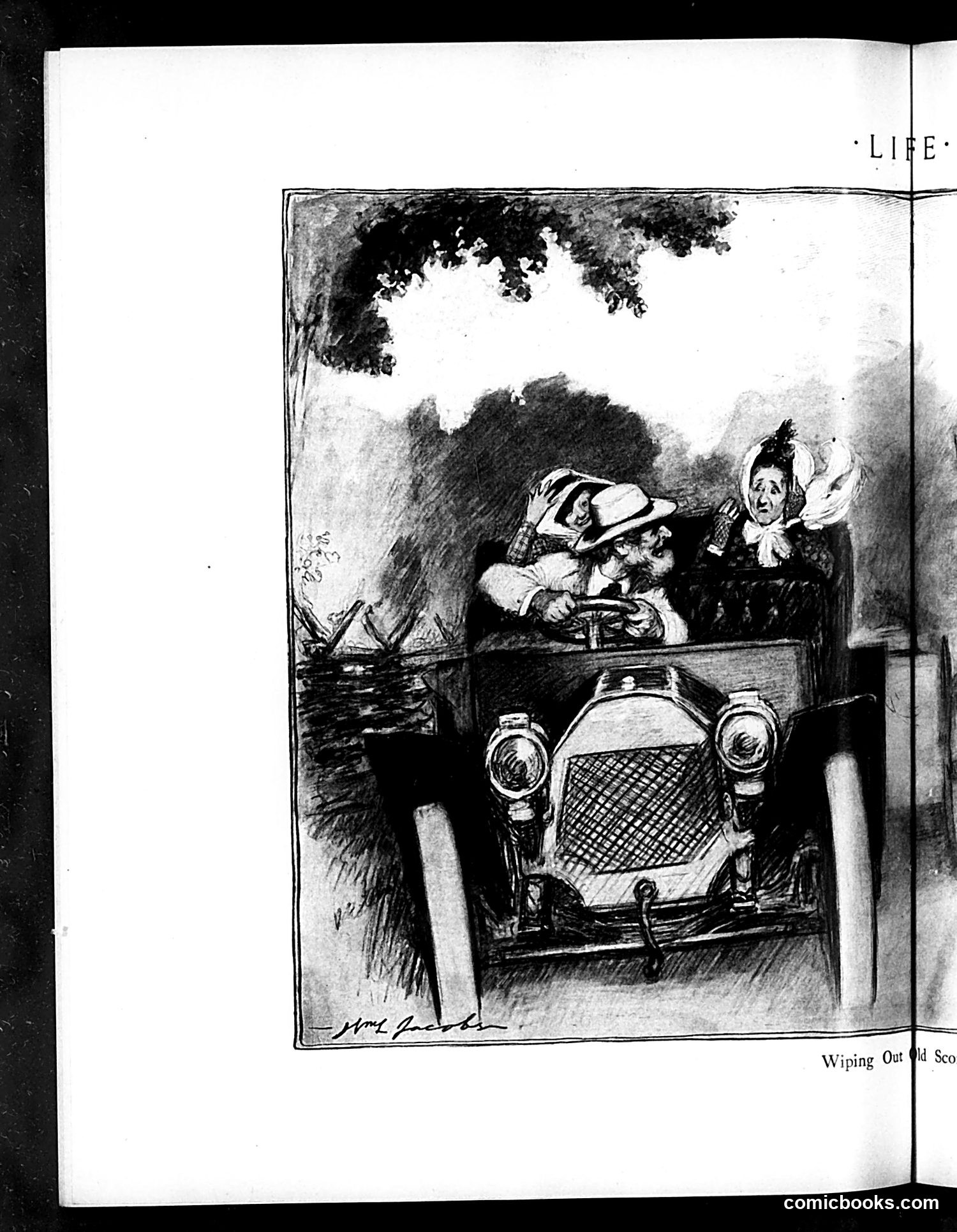
This cartoon depicts two figures in an early automobile, apparently engaged in a high-speed chase or reckless driving scene. The title "Wiping Out Old Scores" suggests a humorous commentary on settling debts or grievances—likely a visual pun where literally "wiping out" (through dangerous driving) replaces the figurative meaning of resolving conflicts. The exaggerated expressions and wild hair of the passengers convey chaos and danger. The detailed rendering of the automobile's mechanical features and the dramatic landscape suggest this is satirizing dangerous or irresponsible behavior, possibly critiquing contemporary attitudes toward new automotive technology or reckless social behavior. The exact figures remain unclear without additional context, though the cartoon appears from Life's early satirical period.
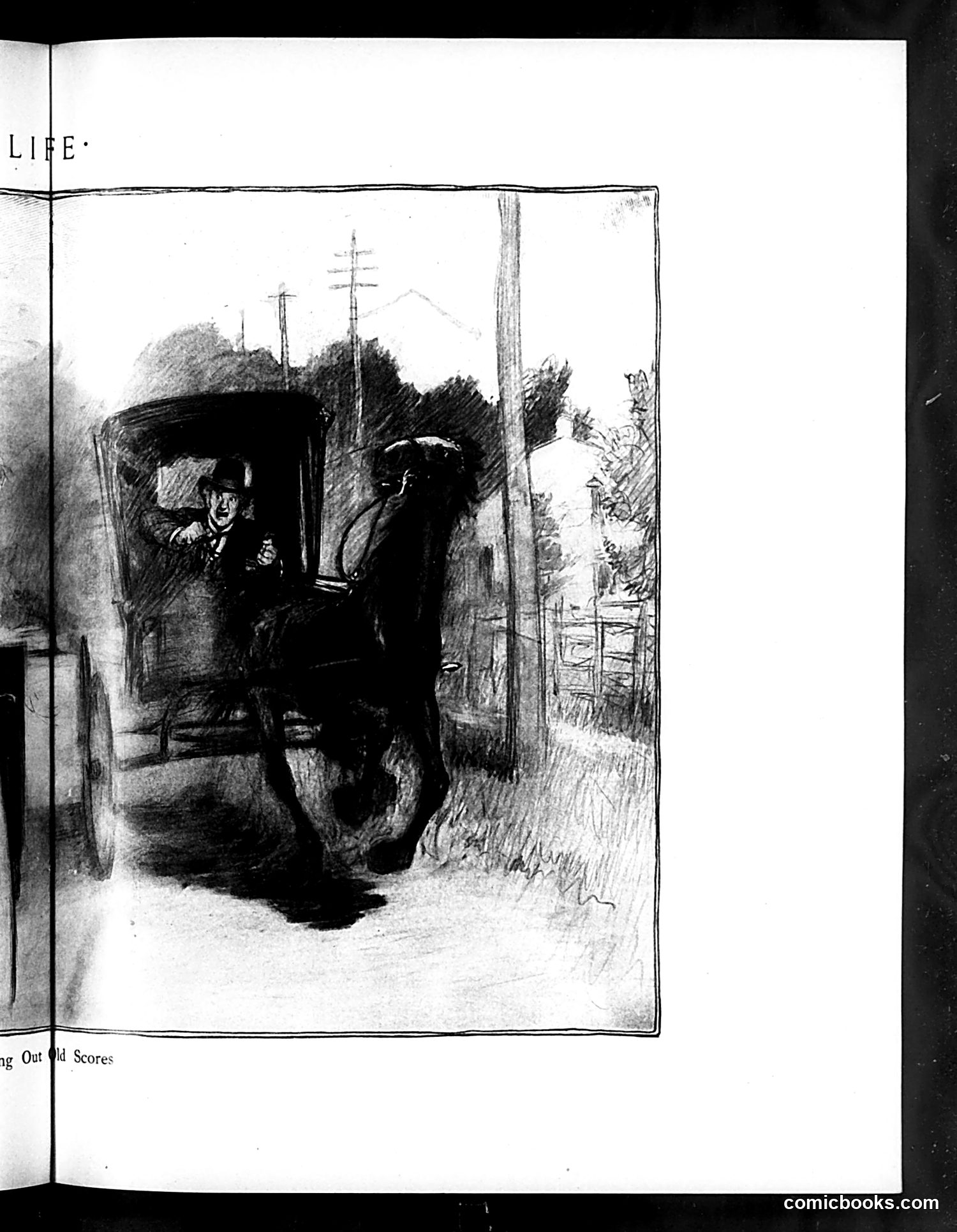
This appears to be a page from *Life* magazine featuring a sketch-style illustration. The image shows a figure looking out from what appears to be a vehicle or enclosed space, with another silhouetted figure visible outside. Power lines and rural landscape elements are visible in the background. The OCR text provides only a source attribution ("comicbooks.com") and partial text fragments ("ng Out ld Scores"), which are insufficient to determine the cartoon's specific political or social commentary. Without legible caption text or clear identifying details in the illustration itself, I cannot reliably identify the figures depicted or explain the intended satirical message to a modern reader. The style and composition suggest early-to-mid 20th century work, but the exact subject remains unclear from the available information.
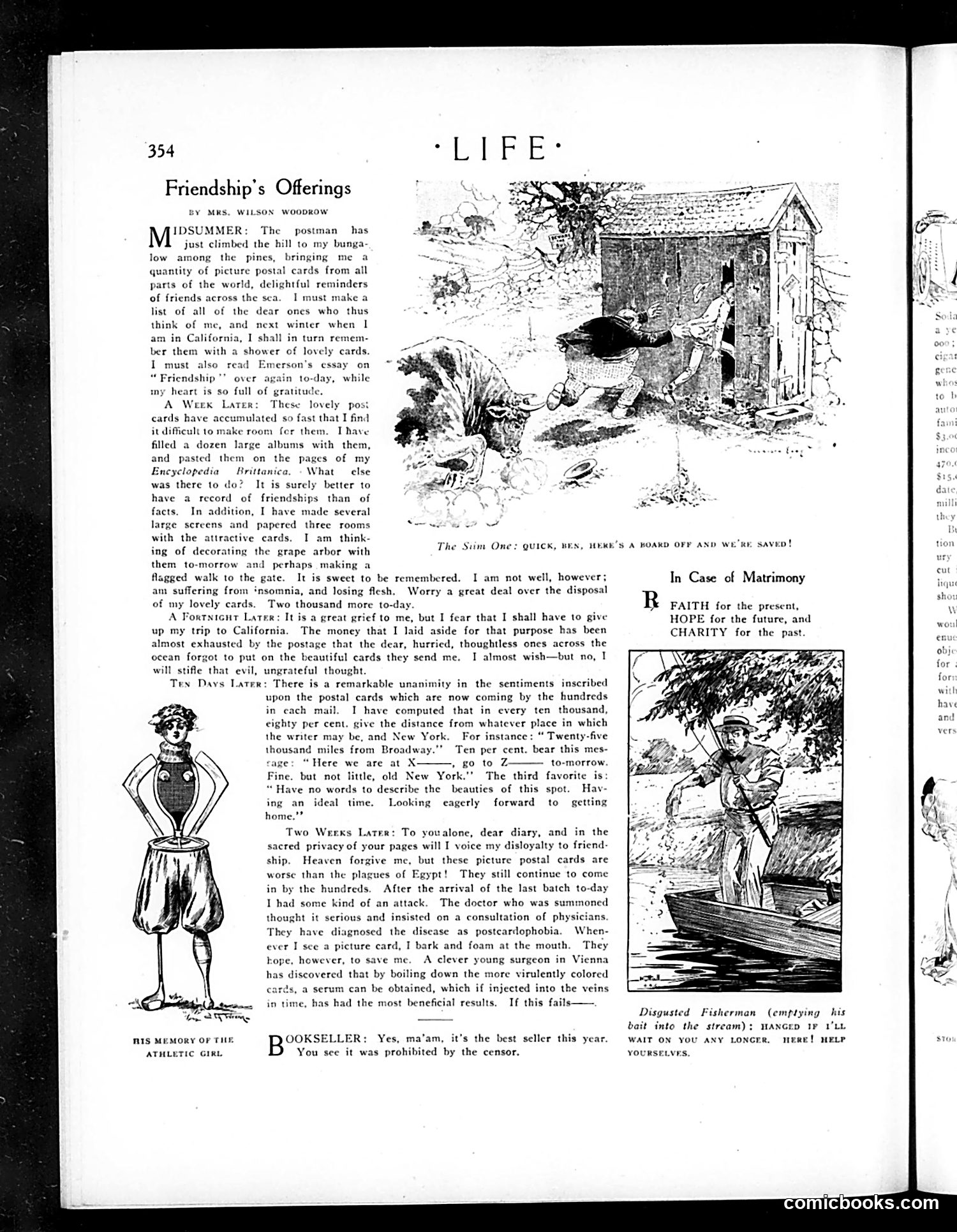
This humor piece mocks the early 1900s craze of sending picture postcards. The author (bylined "Mrs. Wilson Woodrow") describes receiving postcards from friends abroad, then becoming obsessed with collecting, organizing, and decorating her home with them. What begins as gratitude spirals into chaos: thousands arrive, she fills albums and wallpapers rooms, postal costs drain her vacation fund, and she develops "postcardophobia"—a fictional disease requiring medical intervention. The satire targets Victorian sentimentality and the compulsive, status-conscious collecting habits of the era. The repetitive banal messages ("Have no words to describe...") mock the thoughtlessness behind this "thoughtful" gesture. The secondary cartoon of the "Disgusted Fisherman" suggests even nature's creatures reject human communication trinkets. The byline appears to reference President Woodrow Wilson's wife, adding satirical social commentary.
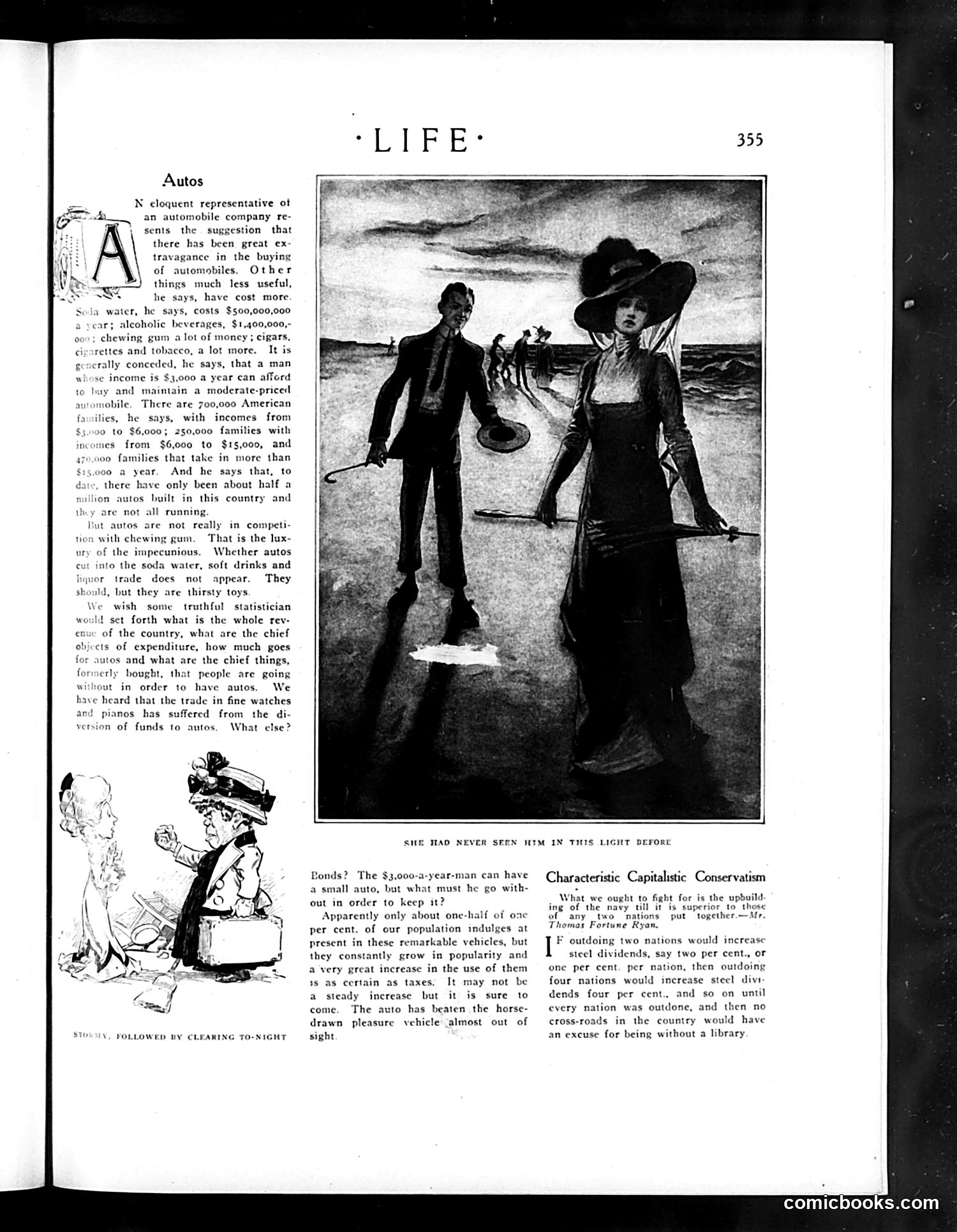
This page satirizes automobile industry defensiveness and capitalist logic. The main article mocks an auto company representative who justifies extravagant auto-buying by claiming other luxuries (soda water, alcohol, chewing gum) cost far more. The implicit critique: this is weak reasoning—the auto industry is deflecting legitimate concern about wasteful consumption by pointing to other wasteful spending. The photograph captioned "She had never seen him in this light before" appears to show a couple in an automobile, likely illustrating the romantic/social appeal driving auto purchases. The lower section, "Characteristic Capitalistic Conservatism," ridicules industrialist Thomas Fortune Ryan's logic about naval expansion: if building two extra warships increases steel profits 2%, then building four would increase profits 4%, and so on infinitely. The final line sarcastically suggests this absurd maximalist thinking would eventually justify every rural crossroads having a library—exposing the circularity and self-serving nature of pure profit-driven reasoning.
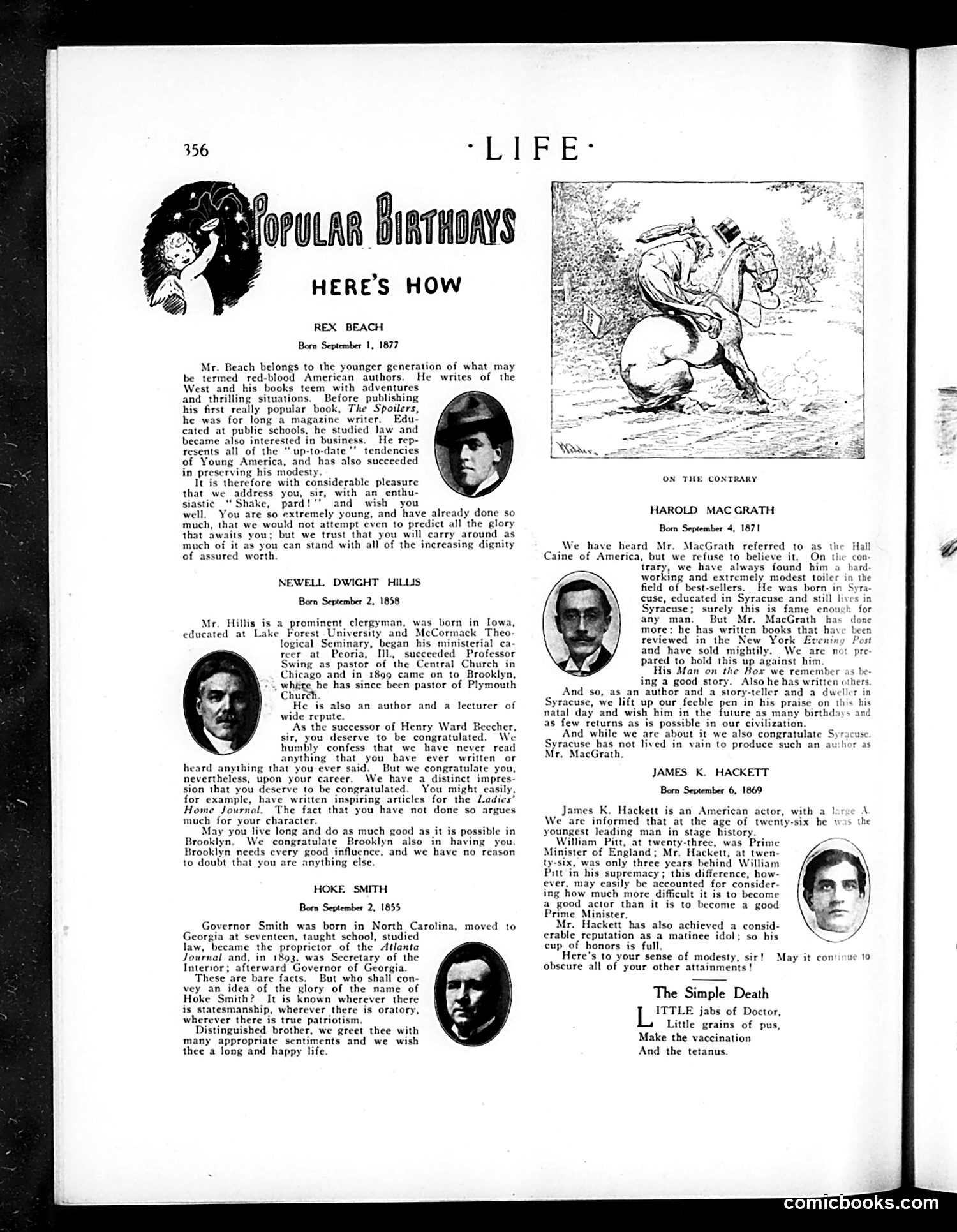
This page celebrates birthdays of four prominent Americans with **mock congratulations** that are actually **backhanded insults disguised as praise**. The satire works through exaggerated, patronizing language: - **Rex Beach** (author): Called "extremely young" despite real accomplishments, praised for maintaining modesty as if that's surprising. - **Newell Dwight Hillis** (clergyman): The editors admit they've *never read or heard* anything he wrote/said, yet congratulate him anyway. They praise him for *not* writing for *Ladies' Home Journal*—damning by inversion. - **Hoke Smith** (politician): Gets flowery praise about his "glory" and "statesmanship" that reads as empty rhetoric. - **Harold MacGrath** (author): Explicitly titled "On the Contrary," sarcastically refusing to compare him to Hall Caine while ironically praising his modesty and commercial success. The humor relies on readers recognizing the gap between fulsome flattery and actual substance—a signature Life magazine technique mocking American pretension and self-congratulation.
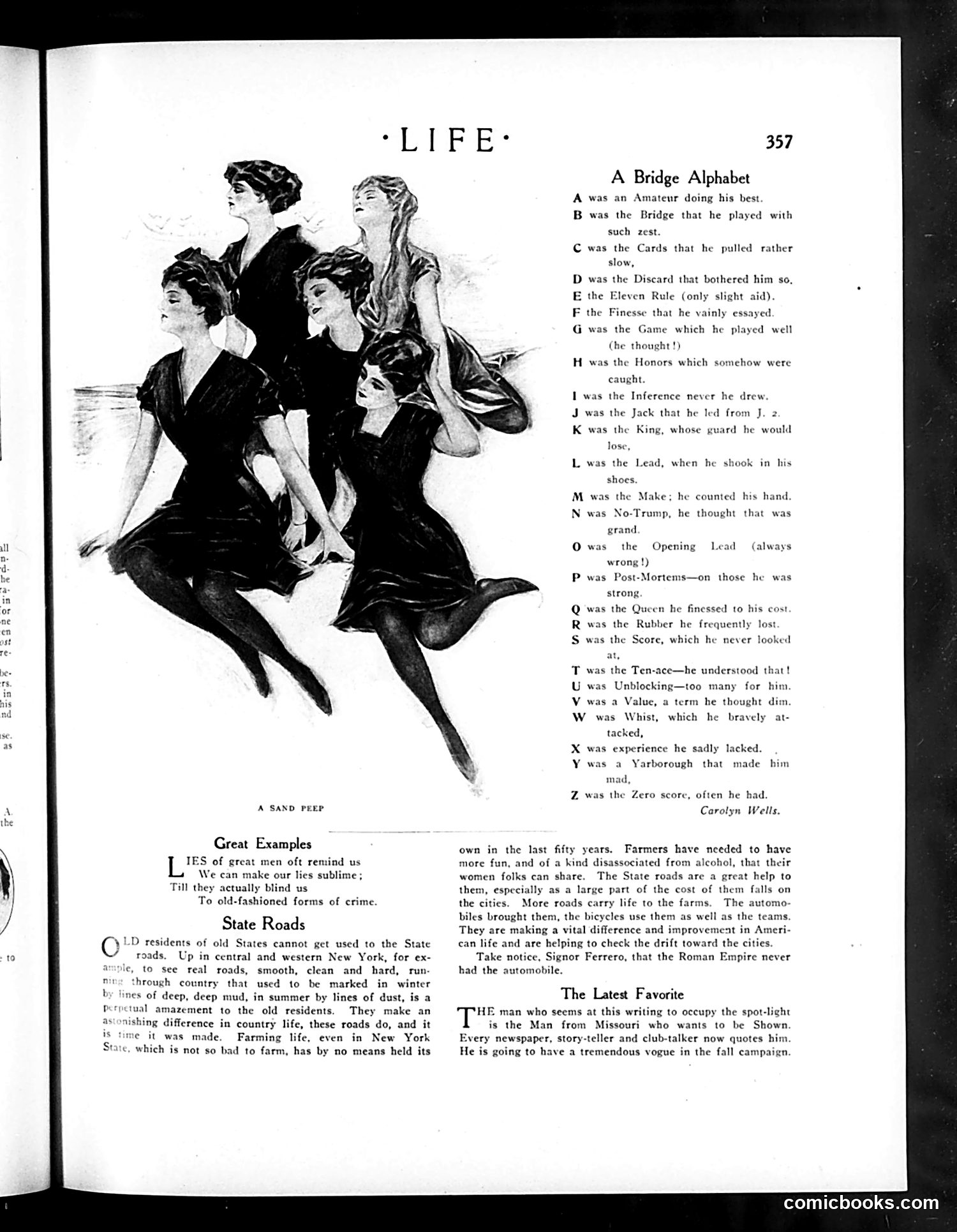
This page contains three distinct pieces of satirical content from *Life* magazine: **"A Bridge Alphabet"** (main feature): A humorous alphabetical poem by Carolyn Wells mocking an amateur bridge player. Each letter represents a bridge term paired with the player's mistake or weakness—he makes poor leads (J), loses the King's guard (K), miscounts his hand (M), and lacks experience (X). The joke targets bridge enthusiasts' pretensions; bridge was a fashionable card game among the upper classes, and the poem gently ridicules incompetent players. **"A Sand Peep"** (small cartoon): The sketch and accompanying poem mock politicians and public figures who construct grandiose rhetoric ("make our lies sublime") to obscure old corruption dressed in new language. **Other articles** discuss state roads improving rural life and farming, and mention "the Man from Missouri who wants to be Shown"—likely referencing a political figure seeking to build a national reputation. The overall tone is characteristic of *Life*'s gentle, urbane satire targeting middle and upper-class social pretensions and political behavior.
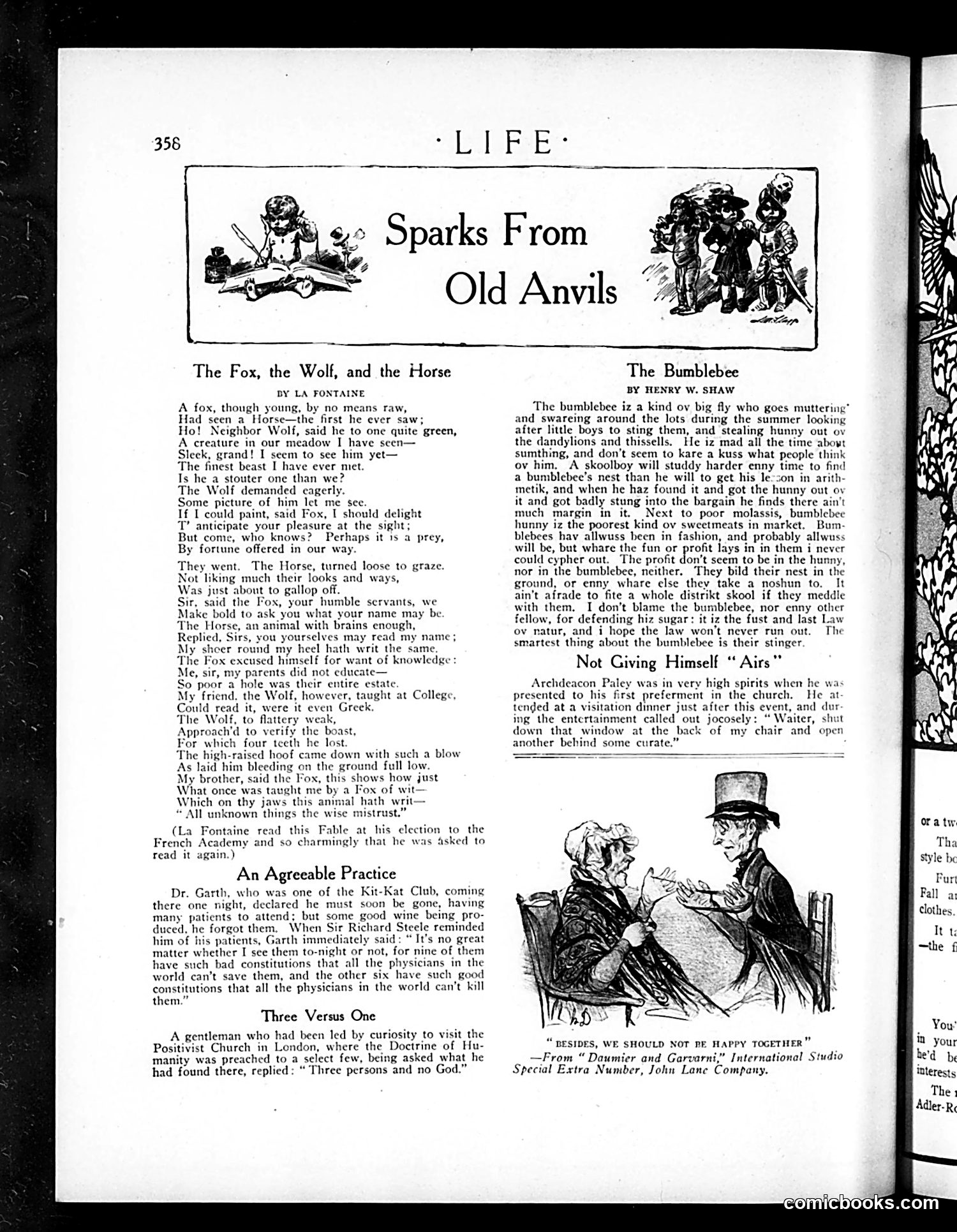
This page contains several short satirical pieces rather than political cartoons: **"The Fox, the Wolf, and the Horse"** — La Fontaine's classic fable, republished here, teaches that the wise distrust unknown things. The wolf's attempt to read writing on the horse's leg results in him being kicked and losing teeth—a consequence for his presumption. **"An Agreeable Practice"** — A brief anecdote mocking Dr. Garth, a physician who prioritizes socializing over attending patients, claiming half his patients will die regardless of care and half will survive regardless—a jab at medical arrogance. **"Three Versus One"** — A joke about the Positivist Church in London, which preached "the Doctrine of Humanity." A visitor sardonically reports finding "three persons and no God"—mocking the church's atheistic philosophy. **"The Bumblebee"** by Henry W. Shaw — Humorous dialect piece describing bumblebees as perpetually angry insects whose honey is worthless, defending their stings as natural law. The page demonstrates Life's mix of reprinted classic literature with contemporary social commentary and humor.
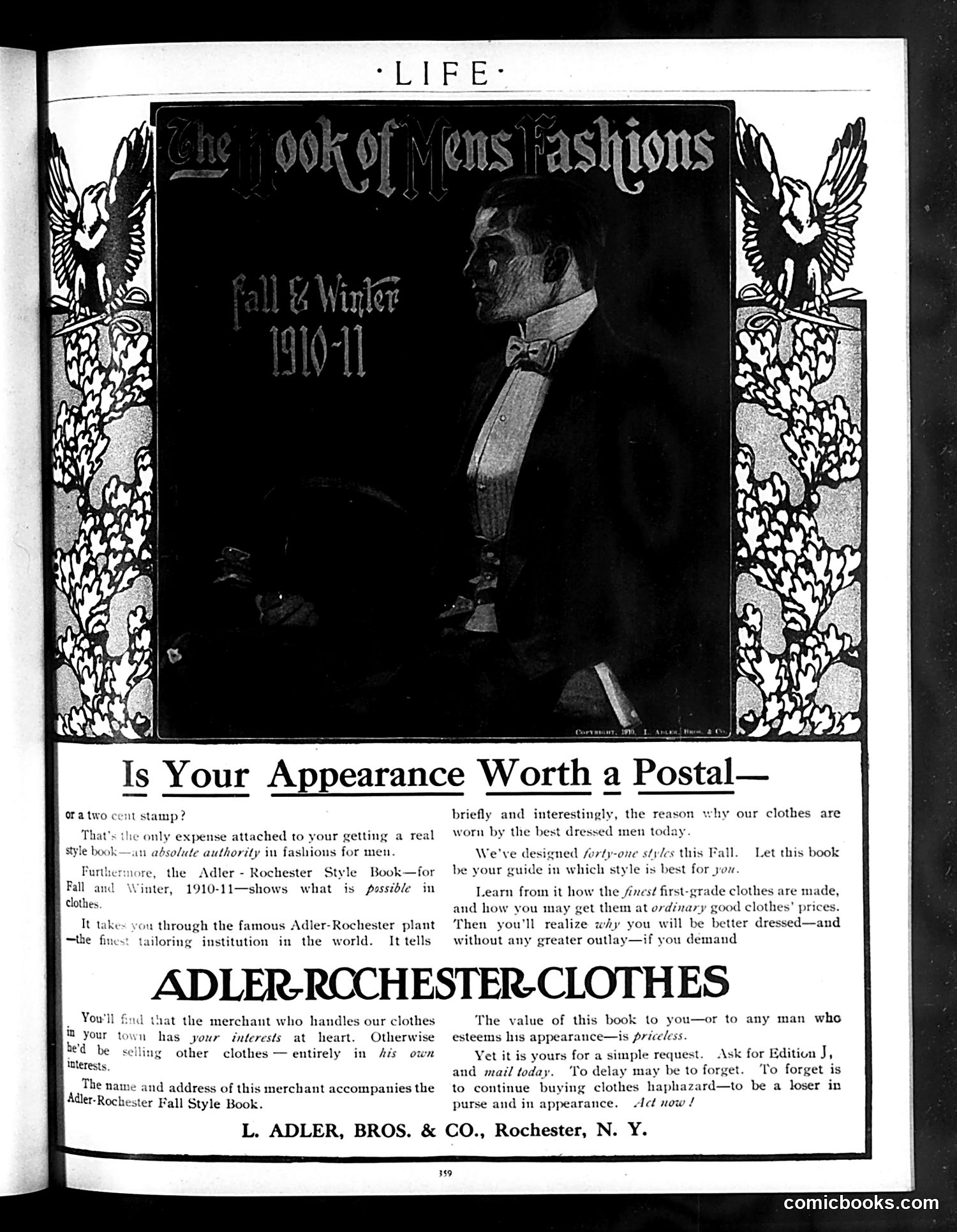
This page is **primarily advertising**, not satire or political commentary. It's an Adler-Rochester Clothes company ad from Life magazine's Fall & Winter 1910-11 issue. The illustration shows a well-dressed man in formal attire (suit, bow tie, pocket square), representing the aspirational "best dressed" gentleman of the era. The ornate art nouveau borders with eagles frame this idealized figure. **The pitch**: For just a two-cent stamp (the cost of postage), readers could request a free style guide ("Edition J") that would teach them how to dress fashionably and purchase quality clothes at reasonable prices. The ad employs early advertising psychology—claiming appearance determines success and suggesting that poor grooming equals financial failure ("be a loser in purse and in appearance"). This reflects early 1900s consumer culture targeting middle-class men worried about social mobility through proper dress. The factory tour reference emphasizes manufacturing legitimacy, a common advertising tactic of the industrial era.
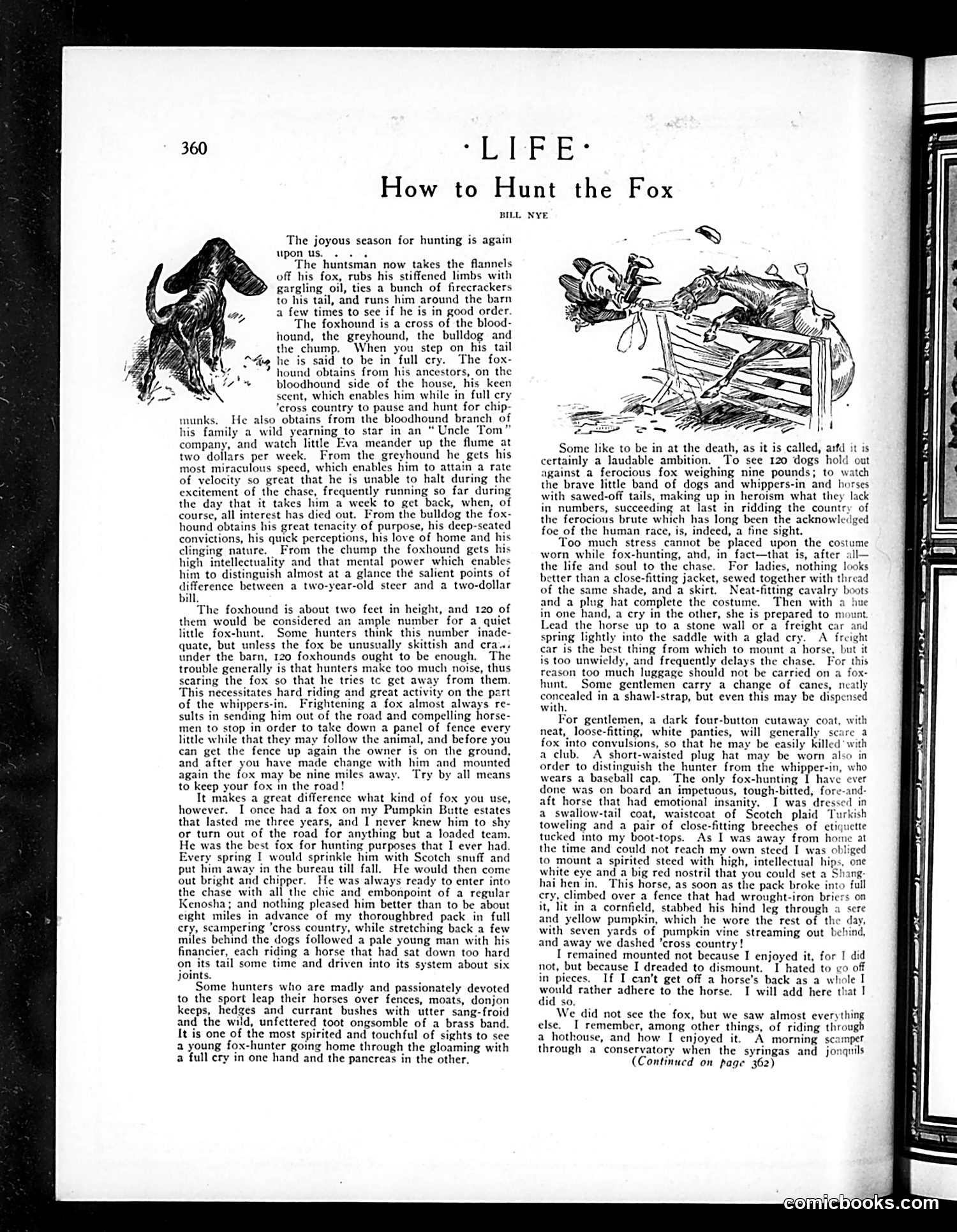
This is satirical humor masquerading as practical instruction. Bill Nye, a popular American humorist of the late 19th century, uses absurdist logic to mock fox hunting—a genteel sport associated with wealthy leisure classes. The satire works through exaggeration: hunters supposedly store foxes in bureaus with Scotch snuff, tie firecrackers to their tails, and breed hounds from "bloodhounds, greyhounds, bulldogs and chumps." Nye ridicules both the sport's inefficiency (120 dogs to chase one fox; riders constantly dismounting to rebuild fences) and hunters' pretensions to sophistication. The illustrations show genteel riders in formal hunting attire, contrasting with Nye's description of the chaotic reality—exhausted horses, lost foxes, frustrated riders. The overall message: fox hunting is an absurdly complicated, wasteful pursuit masquerading as an elegant pastime, engaging people's vanity more than their sense.
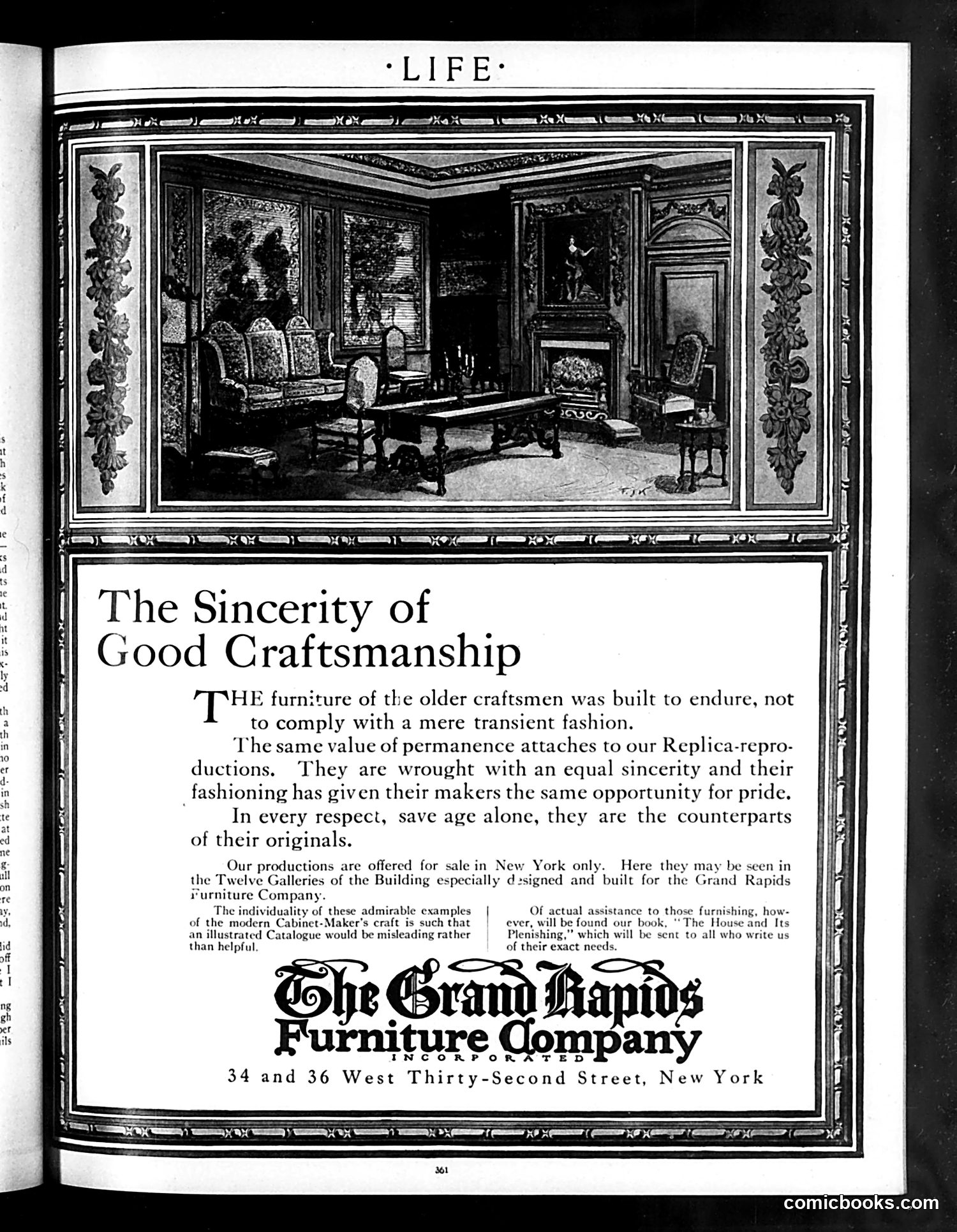
This is **not a cartoon or satire**, but a **furniture advertisement** from Life magazine. The Grand Rapids Furniture Company advertises "Replica-reproductions" of antique furniture. The ad argues that their modern reproductions possess the same craftsmanship and durability as original period pieces—claiming they are "counterparts of their originals" except for age. The ornate interior photograph at top illustrates the company's aesthetic: wealthy, refined furnishings in classical style. **The implicit message** appeals to early 20th-century consumers' desire for prestige: owning high-quality reproductions allows customers to possess the appearance and status of antique ownership without the expense. The company emphasizes "sincerity" and permanence to assure buyers they're purchasing quality, not cheap imitations. This reflects a period when industrial reproduction of historical styles was marketed as democratizing luxury rather than creating "fakes"—a tension unexamined in the ad itself.
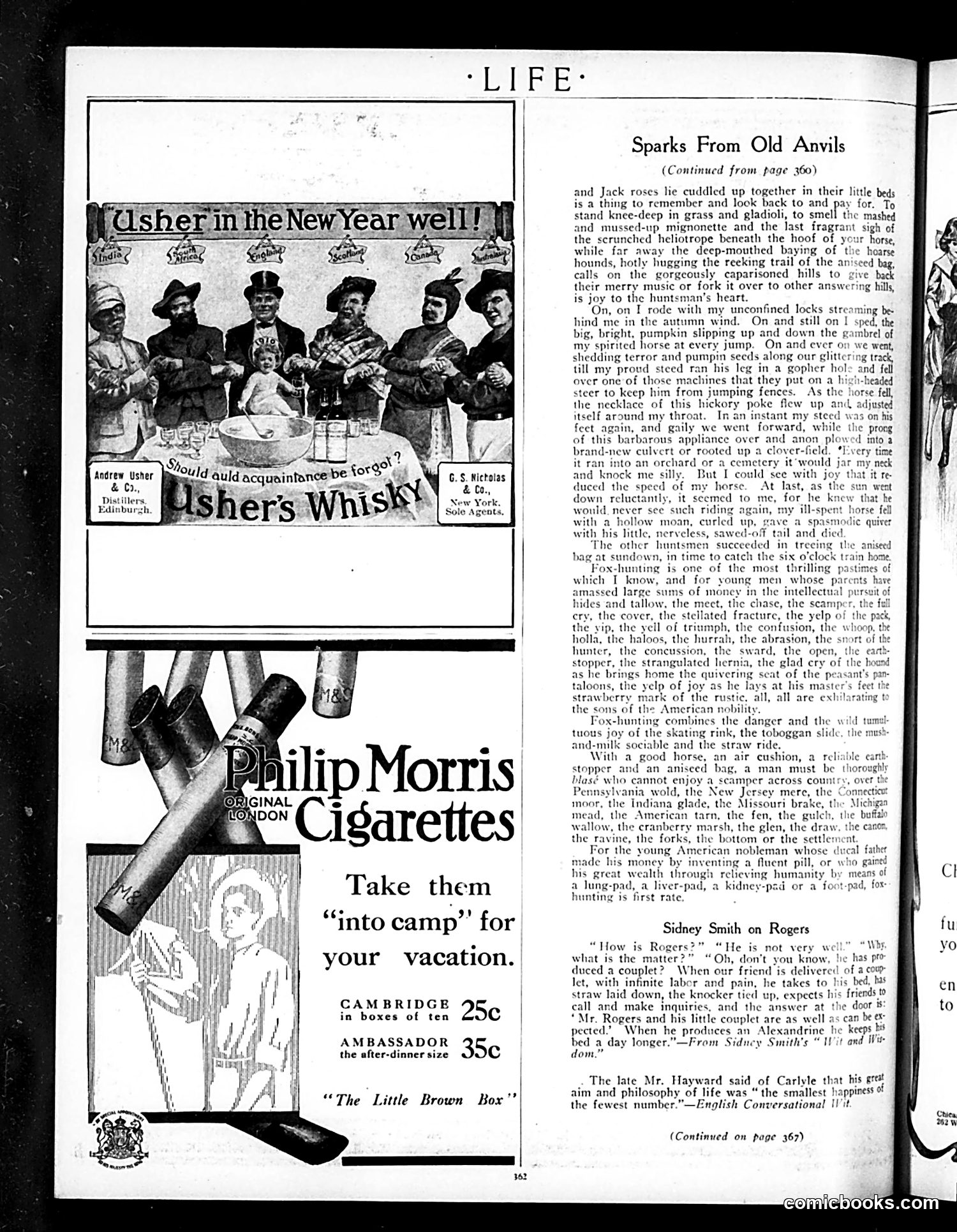
This page mixes entertainment with advertising typical of early 20th-century *Life* magazine. **The Cartoon (top left):** "Usher in the New Year well!" depicts five men in formal attire and top hats toasting with drinks. It's a straightforward New Year's advertisement for Usher's Whisky—a Scottish brand. The humor is mild wordplay ("Usher in" the new year by consuming their product). **The Main Content (right):** "Sparks From Old Anvils" is a humorous essay about fox-hunting, written in deliberately overwrought, comedic prose. The author mocks the activity by describing increasingly absurd accidents—his horse injuring itself, him being strangled by his necklace, plowing into orchards and cemeteries—while maintaining the breathless enthusiasm of an actual hunting enthusiast. It's satirizing the pretentious romanticization of aristocratic pastimes. **The Advertisements:** Philip Morris Cigarettes and a brief anecdote about the wit "Sidney Smith on Rogers" round out the page—typical period magazine filler. The overall effect: genteel satire mixed with commercialism.
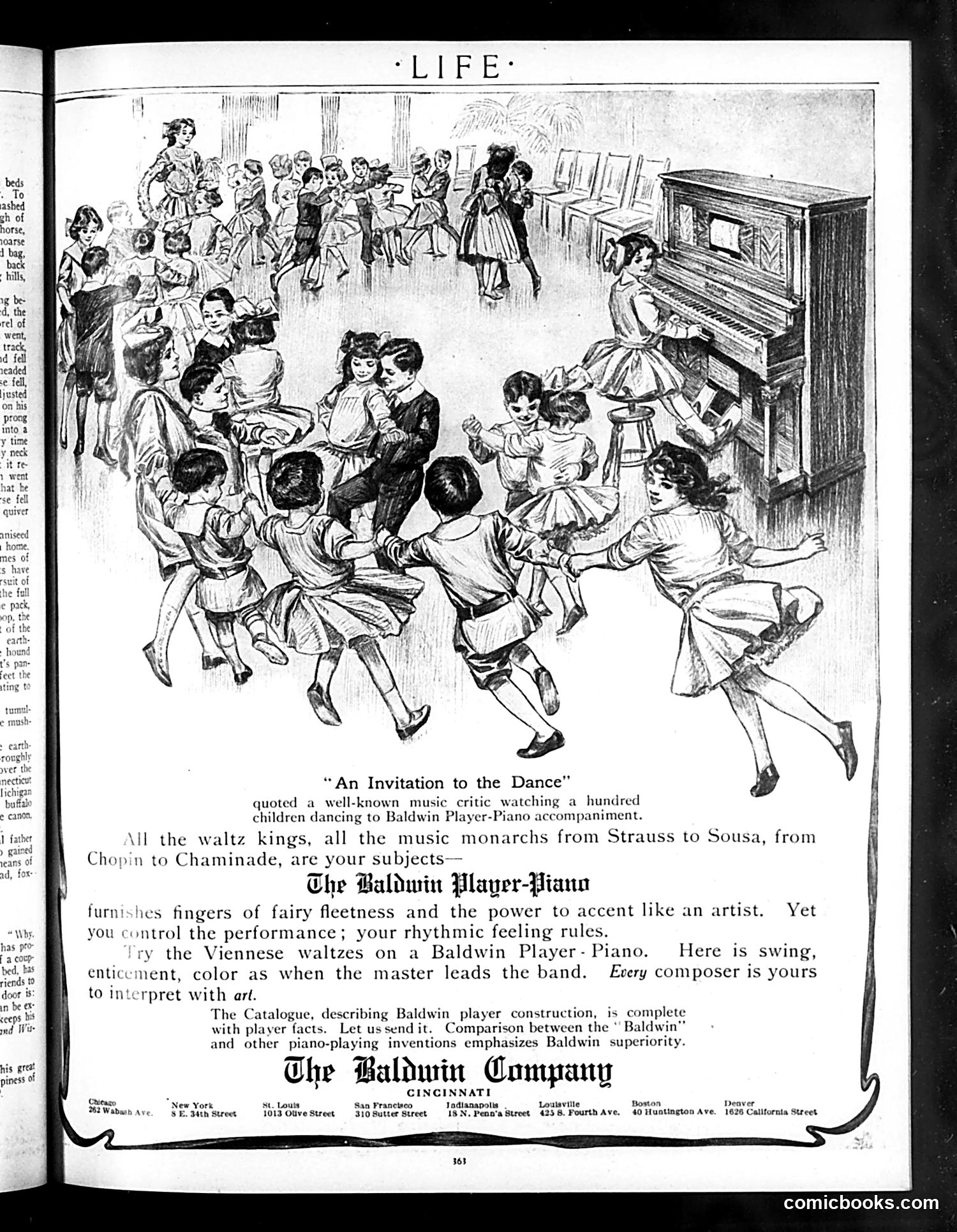
This is primarily a **Baldwin Player-Piano advertisement** disguised as editorial content in *Life* magazine. The illustration shows children dancing enthusiastically while one girl plays a Baldwin Player-Piano—a mechanical piano that could play pre-programmed music rolls, requiring minimal skill from the operator. The satire is subtle but present: the ad claims that owning a Baldwin gives you command over "all the waltz kings" (famous composers like Strauss, Sousa, Chopin), yet you merely "control the performance; your rhythmic feeling rules." This is contradictory—a player-piano *removes* artistic control, automating what skilled pianists spent years learning. The joke appears to be that amateur players delude themselves into thinking they're interpreting great composers when they're simply operating a machine. The "music critic" quotation framing it as "An Invitation to the Dance" adds mock-legitimacy to what is essentially a commercial pitch targeting consumers who wanted the *appearance* of musical sophistication without the actual skill required. This reflects early 20th-century anxieties about technology replacing craftsmanship and authentic artistry.
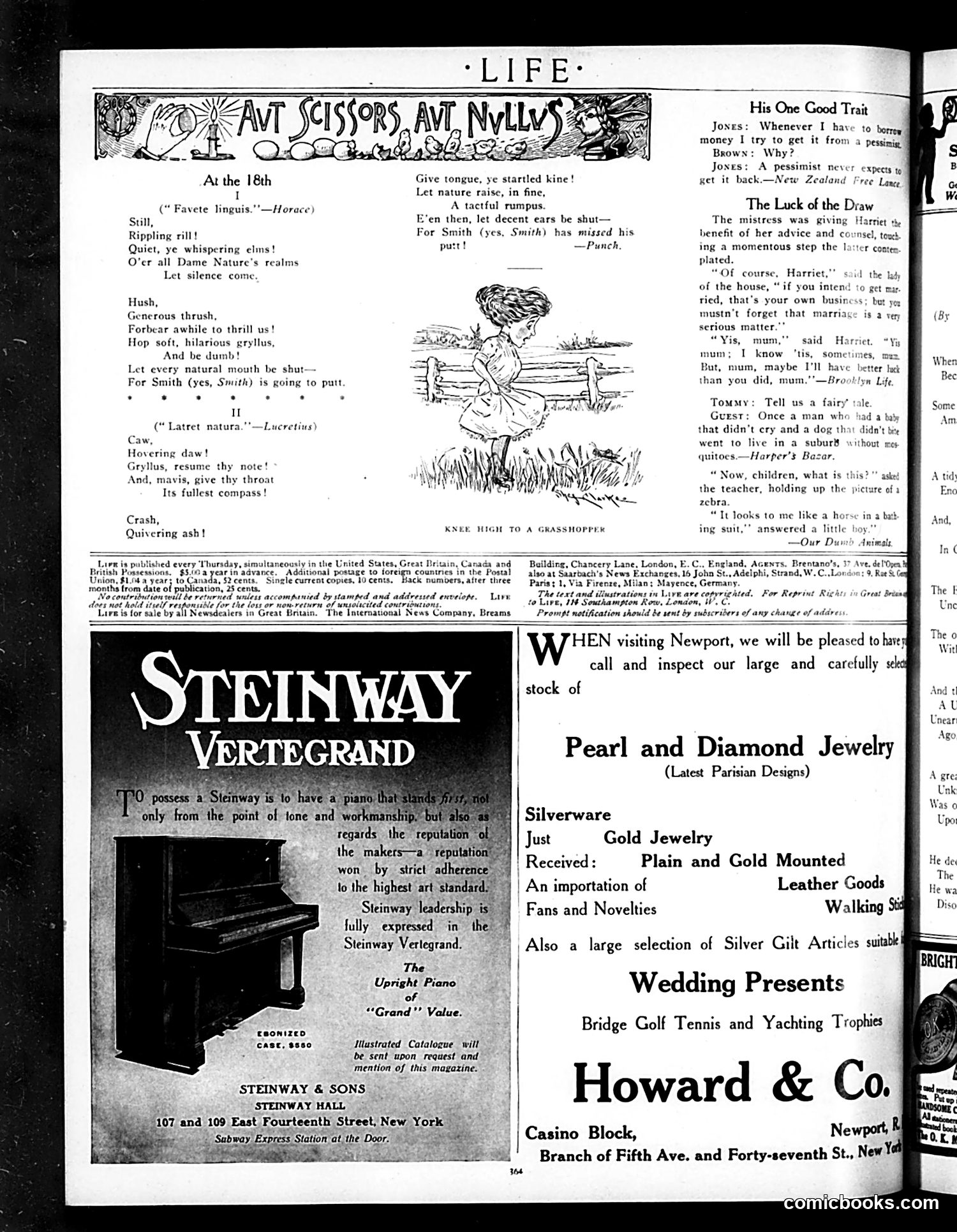
This page consists primarily of **humorous verse and advertisements** rather than political cartoons. The main content is a Latin-titled poem ("Either Scissors or Nothing") mocking a golfer named Smith who has just missed his putt. The poet humorously calls for all of nature—birds, insects, and rustling leaves—to fall silent in respectful commemoration of this golfing failure. It's genteel, satirical humor about the serious demeanor golf enthusiasts adopt over their game. The page includes several **short joke items** about pessimists, marriage advice, and a child mistaking a zebra for "a horse in a bathing suit"—light social satire typical of *Life* magazine's humor. The **advertisements** dominate the lower half, promoting Steinway pianos and Howard & Co. jewelry in Newport, targeting wealthy readers. There are **no political cartoons** or serious social commentary on this page—it's lifestyle humor and commercial advertising aimed at an affluent, educated audience.
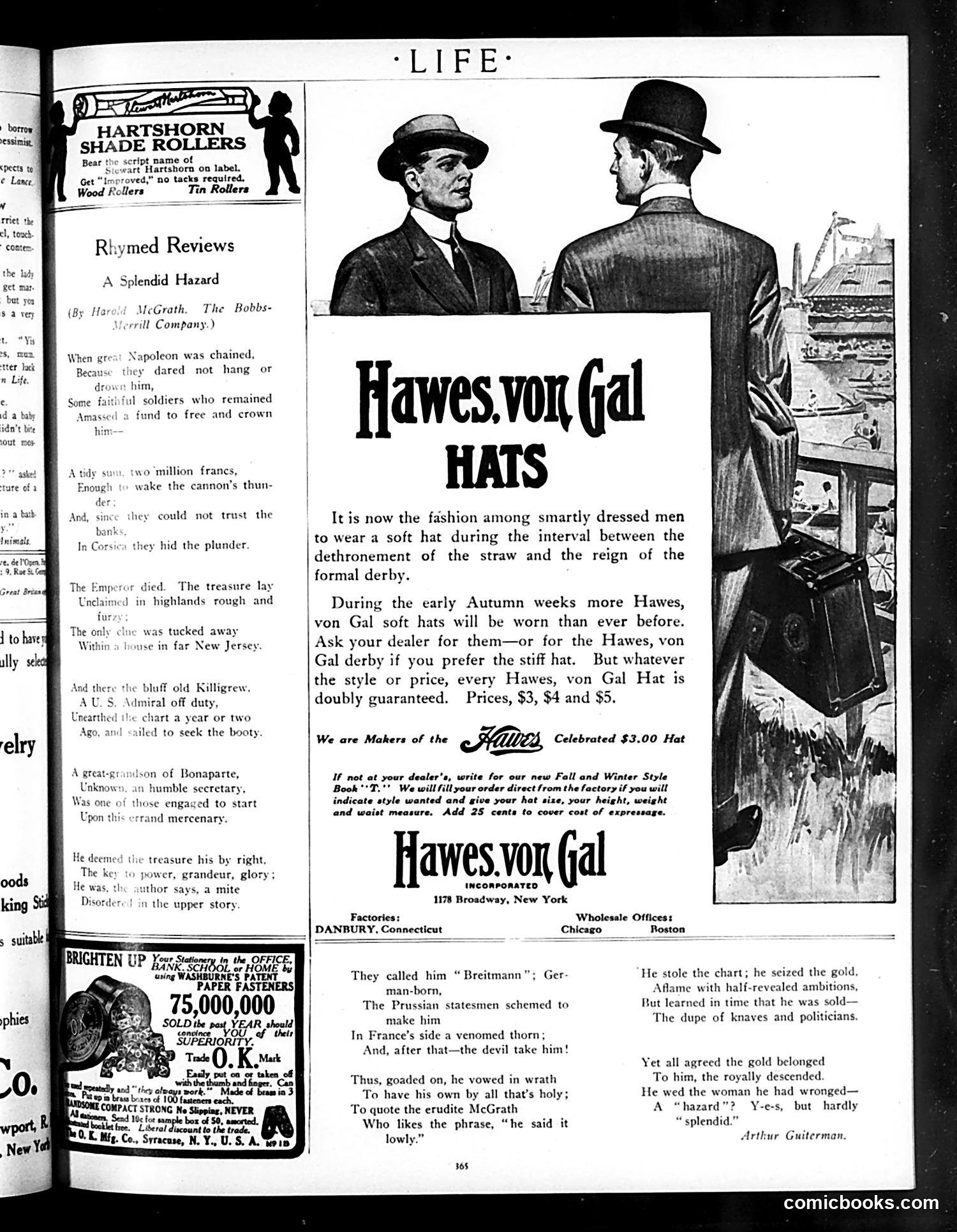
This page is primarily a **hat advertisement** for Hawes, von Gal hats, featuring two well-dressed men in bowlers discussing fashion. The ad copy explains that soft hats are becoming fashionable during autumn as a transition between straw hats and formal derbies, priced $3-$5. The left column contains **"Rhymed Reviews"**—a satirical poem by Harold McGrath titled "A Splendid Hazard." The narrative follows a scheme involving a Prussian plot: a German-born man ("Breitmann") is manipulated by Prussian statesmen to cause trouble in France by stealing treasure. He's ultimately duped by "knaves and politicians," marries a wronged woman, and the "hazard" proves anything but "splendid." The satire mocks political intrigue, corruption, and the gap between grand ambitions and sordid outcomes. The poem's ironic tone—particularly the final dismissal of the "hazard" as barely "splendid"—suggests cynicism about European power plays and personal redemption. The page also includes minor advertisements for office supplies.
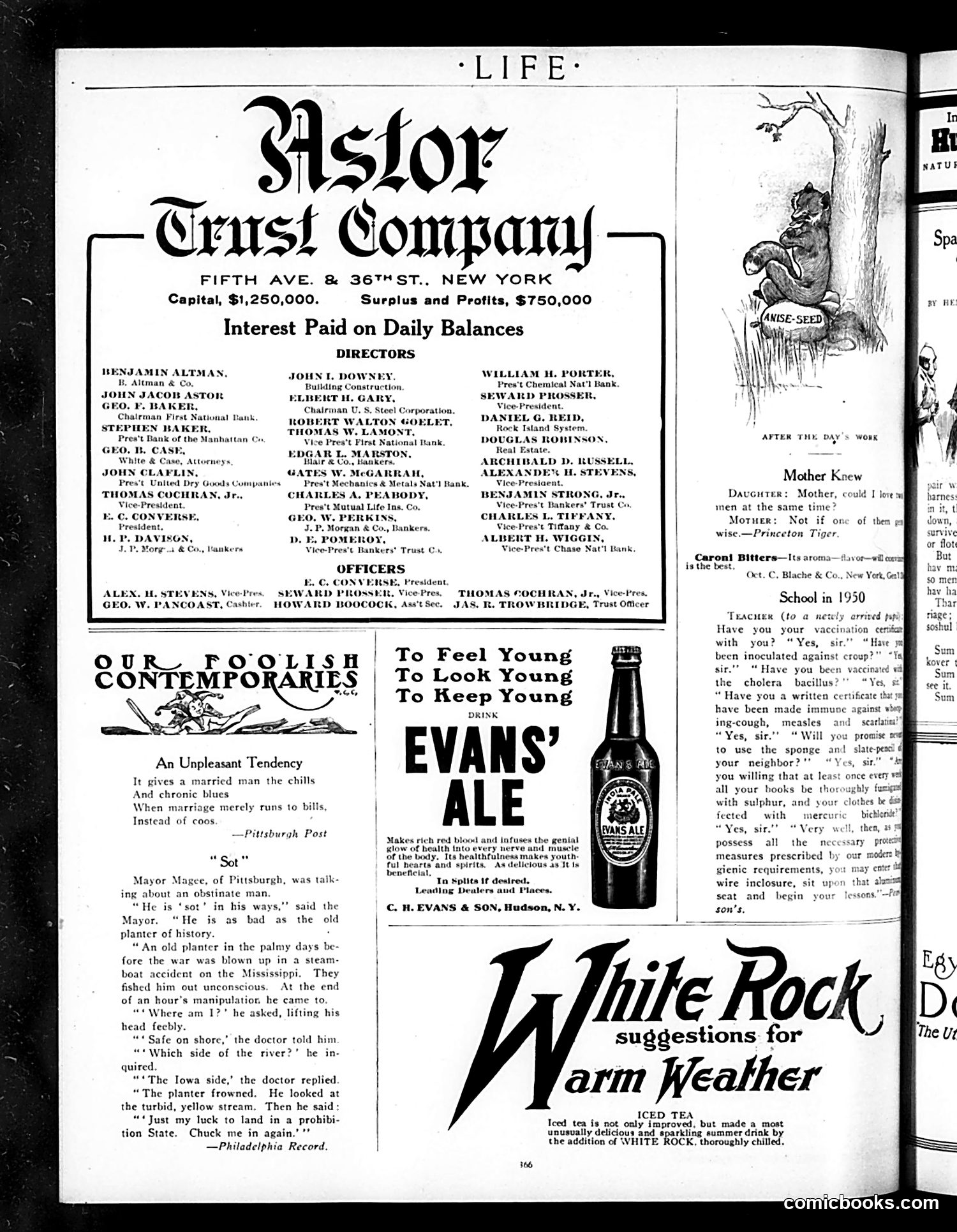
This page is primarily **advertisements and business notices** rather than political satire. The dominant feature is an Astor Trust Company bank advertisement listing directors and officers—prominent New York financiers from the early 20th century. The actual satirical content is minimal: **"Our Foolish Contemporaries"** presents a brief anecdote mocking an obstinate Pittsburgh politician (Mayor Magee) through a historical analogy about a stubborn antebellum planter who, after being rescued from a steamboat accident, demands to be thrown back because he landed on the Iowa (non-slavery) side of the Mississippi River. The joke criticizes rigid, unreasonable adherence to principle. **"School in 1950"** is a humorous dialogue imagining future vaccination requirements for schoolchildren—satirizing the expansion of medical preventive measures. The remaining content consists of **product advertisements** (Evans' Ale, White Rock iced tea, various tonics) and reprinted humor columns from other newspapers. The page reflects *Life*'s dual role as both satirical magazine and advertising vehicle for affluent readers.
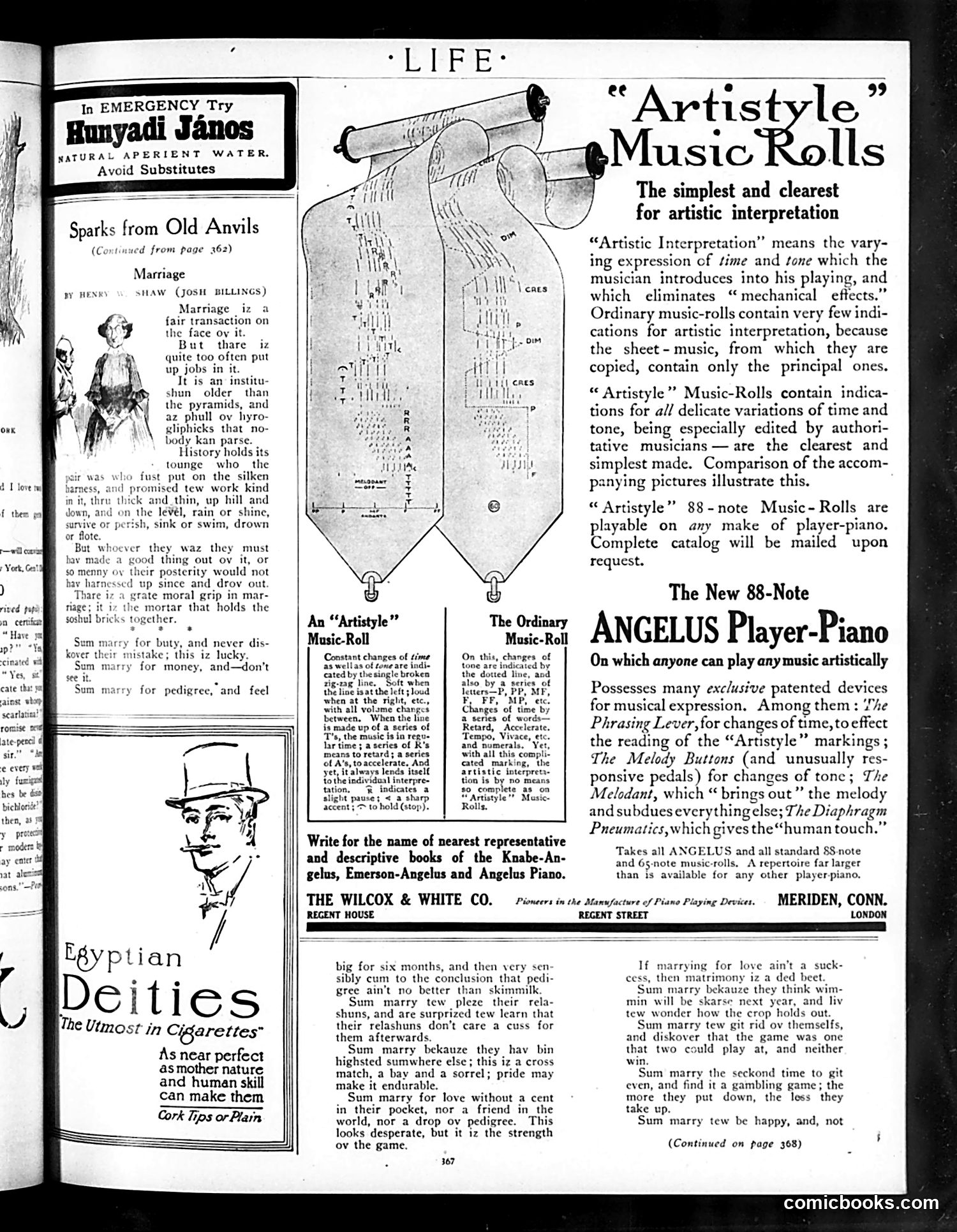
This page is primarily **advertising content** from an early 20th-century *Life* magazine, not political satire. The main feature is an advertisement for **"Artistyle" Music Rolls** and the **Angelus Player-Piano**—mechanical devices that played pre-recorded music on pianos, the era's equivalent to recorded music. The ads emphasize that unlike ordinary player-piano rolls, "Artistyle" rolls include musical notations for *artistic interpretation*—variations in tempo and tone that make mechanical playback sound more human and expressive. The left sidebar contains **"Sparks from Old Anvils,"** a humorous column by Josh Billings (pseudonym of Henry Wheeler Shaw), a 19th-century American humorist. The excerpt uses comic misspellings and dialect ("thare iz," "tew") to joke about marriage, presenting it as a practical rather than romantic institution—a safe, conventional subject for family-oriented *Life* magazine humor. Additional period advertisements appear: Hunyadi Janos water (a laxative) and Egyptian Deities cigars. The page reflects early-1900s consumer culture and gentle domestic humor.
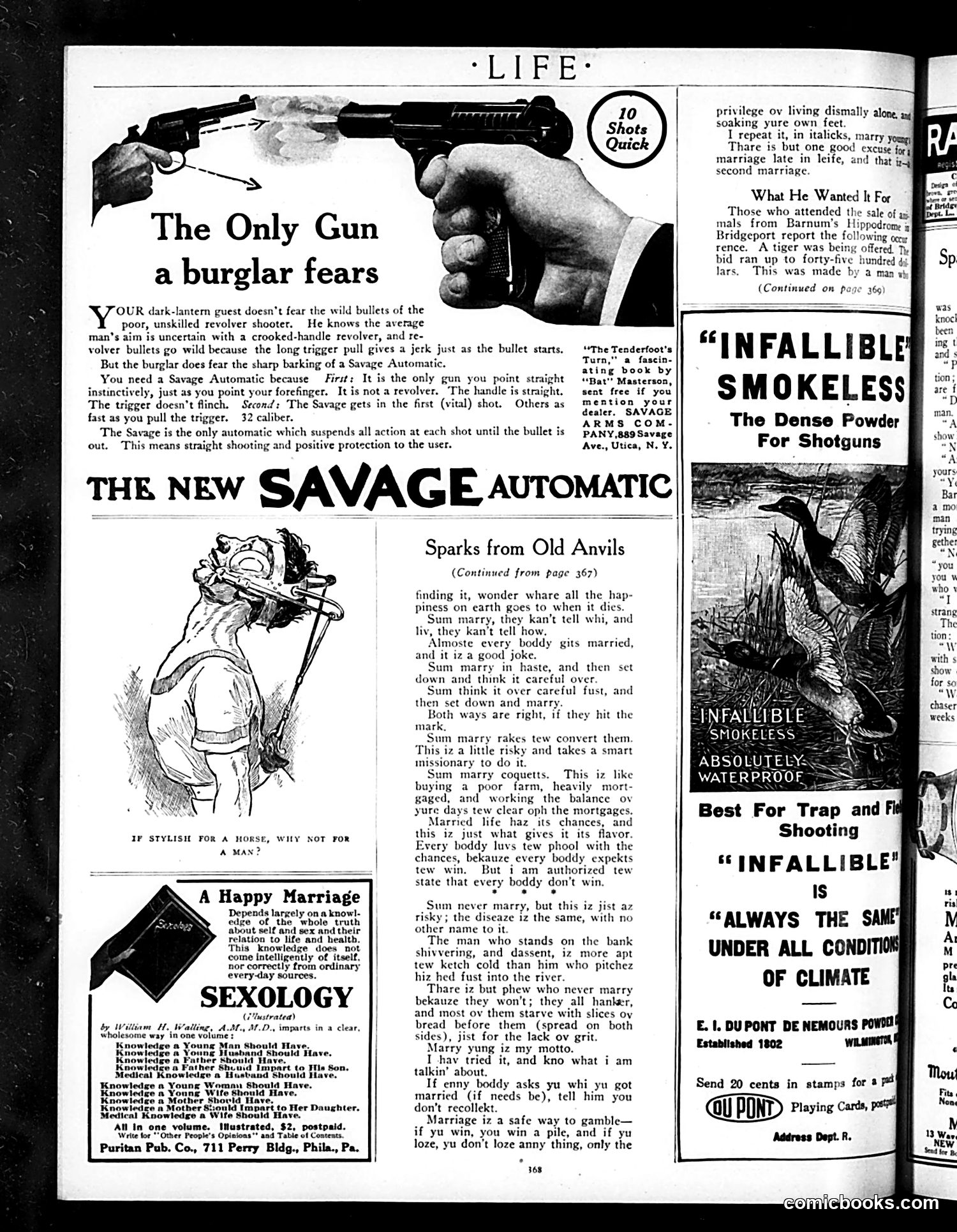
This Life magazine page combines firearms advertising with humorous social commentary and mail-order book ads—typical of early 20th-century magazines. **Main Advertisement:** The Savage Automatic pistol is marketed to homeowners as superior burglar protection. The pitch emphasizes its straight-shooting accuracy compared to unreliable revolvers, appealing to middle-class concerns about home security. **The Humor:** "Sparks from Old Anvils" is a satirical advice column using deliberately misspelled dialect ("phool," "bekauze," "iz") to mock folk wisdom about marriage. The piece presents marriage as equally risky whether you marry or avoid it—a cynical commentary on matrimony dressed in folksy humor. **Sidebar Ads:** A "Sexology" book promises practical knowledge for newlyweds, reflecting Victorian-era embarrassment about sex education; an "Infallible Smokeless" powder ad targets hunters. Together, the page reflects early-1900s anxieties: home security, marital uncertainty, and the promise of modern products and information to solve social problems.
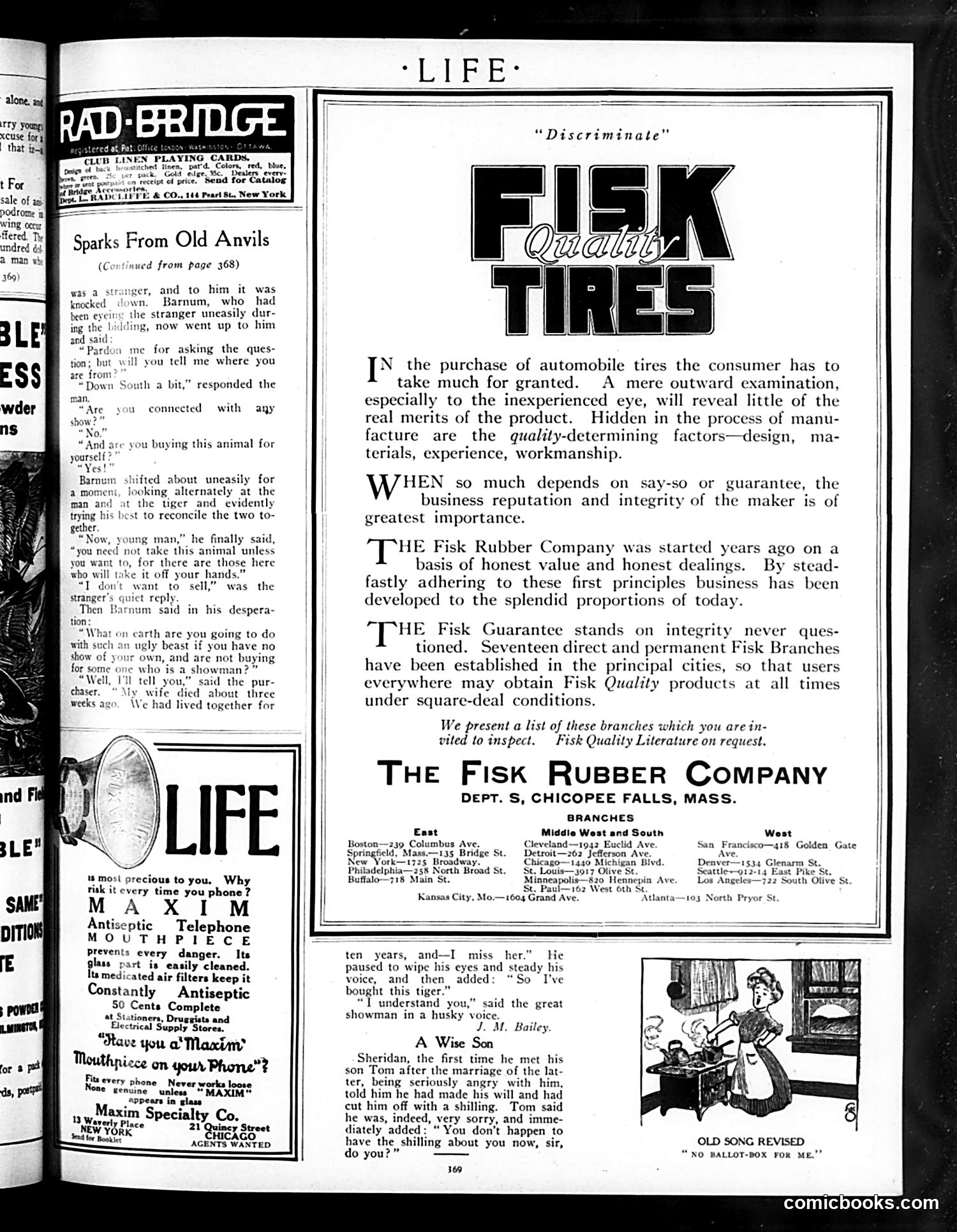
This page mixes advertising with two distinct narrative pieces: **"Sparks From Old Anvils"** (left): A sentimental anecdote about P.T. Barnum. A grieving widower purchases a tiger at auction; when Barnum questions why, the man reveals his late wife loved the animal. Barnum, moved by this explanation, facilitates the sale. The story illustrates Barnum's reputed softheartedness beneath his showman's exterior—a humanizing portrait of the famous circus promoter. **Fisk Rubber Company Advertisement** (center/right): A full-page advertisement emphasizing that tire quality depends on manufacturer integrity rather than visual inspection. Fisk positions itself as trustworthy through established branches nationwide. This reflects early 20th-century consumer anxiety about hidden product defects and reliance on brand reputation. **"A Wise Son"** (bottom): A brief anecdote about General Sheridan's son Tom, who responds cleverly when threatened with disinheritance—requesting the shilling immediately, displaying wit and humor rather than contrition. The page is primarily **advertising and nostalgic storytelling** rather than satirical content. The humor is gentle, sentimental rather than biting.
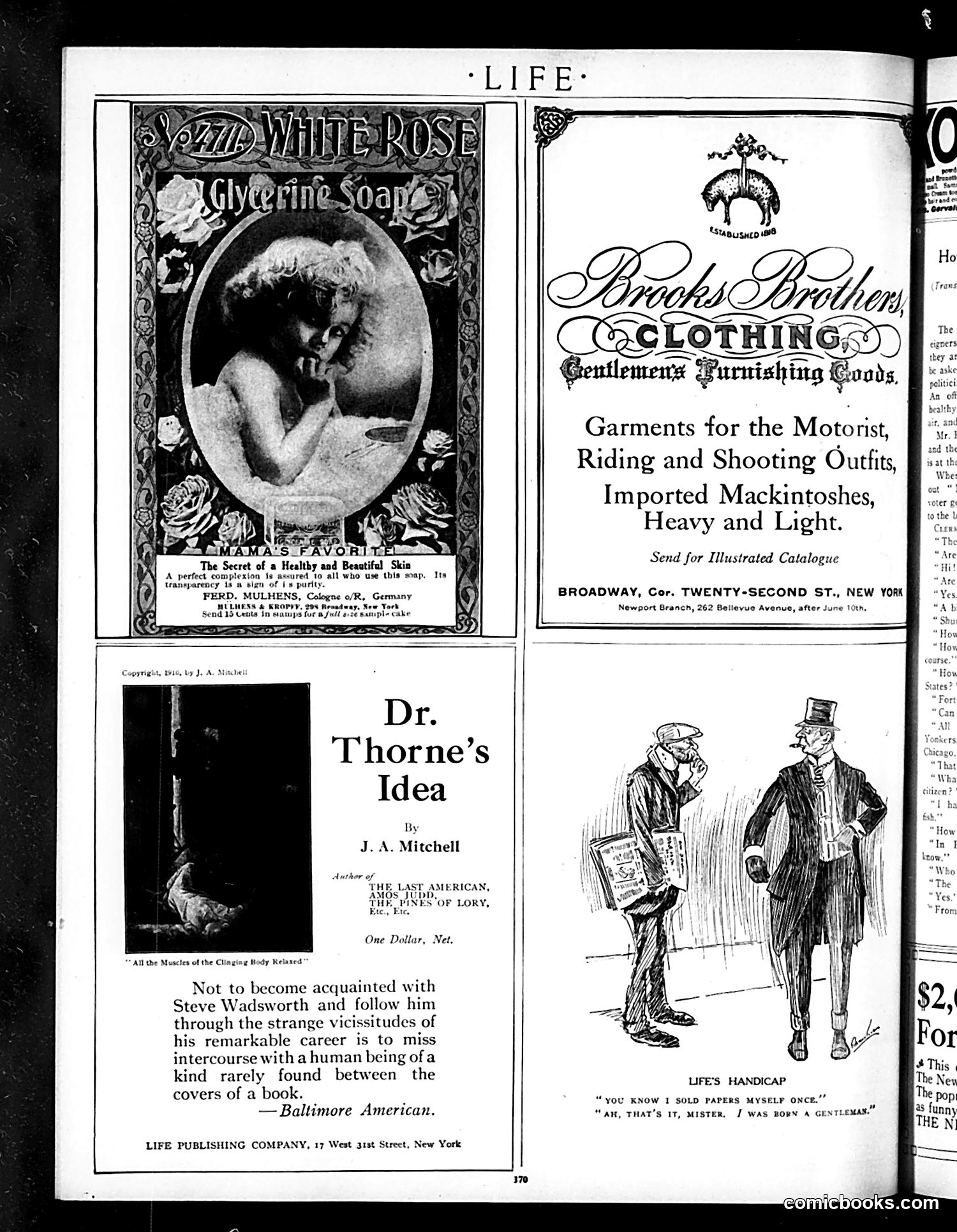
This cartoon satirizes class pretension and social mobility. Two men—one shabby and carrying papers (suggesting a newspaper vendor), the other well-dressed and top-hatted—have a brief exchange. The working-class man mentions he once sold papers himself, attempting camaraderie. The gentleman dismisses him, claiming he was "born a gentleman," implying innate superiority that transcends experience. The satire targets the wealthy man's snobbery: his claim to be "born" a gentleman contradicts the working man's actual labor and humble origins. The joke suggests that true character comes from work and experience, not birthright—a common Progressive-era critique of aristocratic pretension. The title "Life's Handicap" implies the working man faces obstacles the privileged ignore, despite their supposed shared humanity.
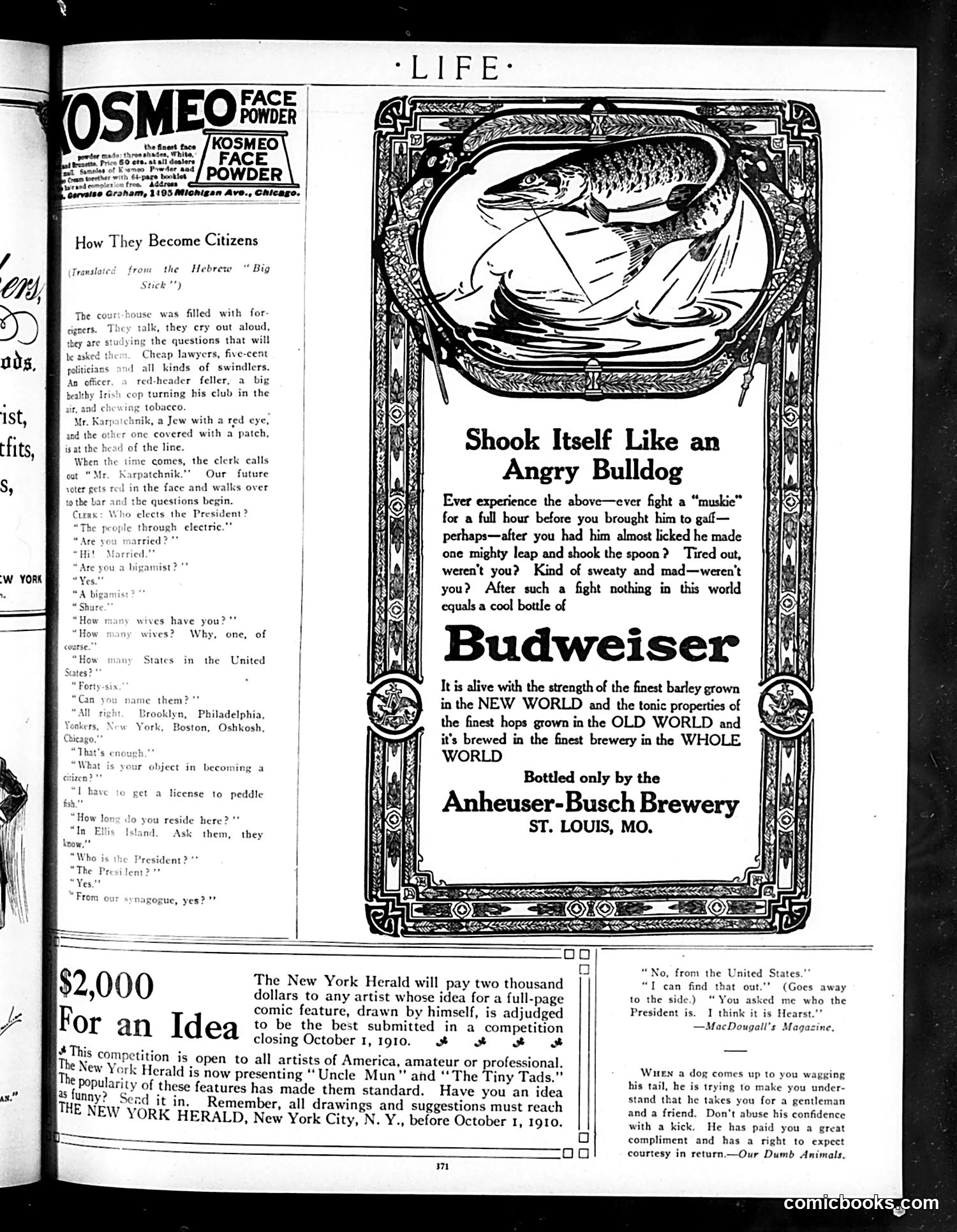
**"How They Become Citizens"** (left column) is satirical commentary on immigration and naturalization. It depicts Jewish immigrants being interrogated by a clerk using crude stereotypes and dialect ("Karpatshnik," "patchnik"). The questions—about the President, states, and civic knowledge—mock both the immigrants' unfamiliarity with American civics and the superficial, often-swindled naturalization process. The reference to the Hebrew "Big Stick" likely alludes to President Theodore Roosevelt's famous phrase, suggesting the coercive or aggressive nature of these proceedings. The piece critiques how immigrants were tested and exploited by "five-cent politicians" and corrupt lawyers during citizenship processing, while portraying the immigrants themselves through dehumanizing caricatures typical of early 20th-century American prejudice. **Right side:** This is primarily Budweiser beer advertising, unrelated to the satirical content.
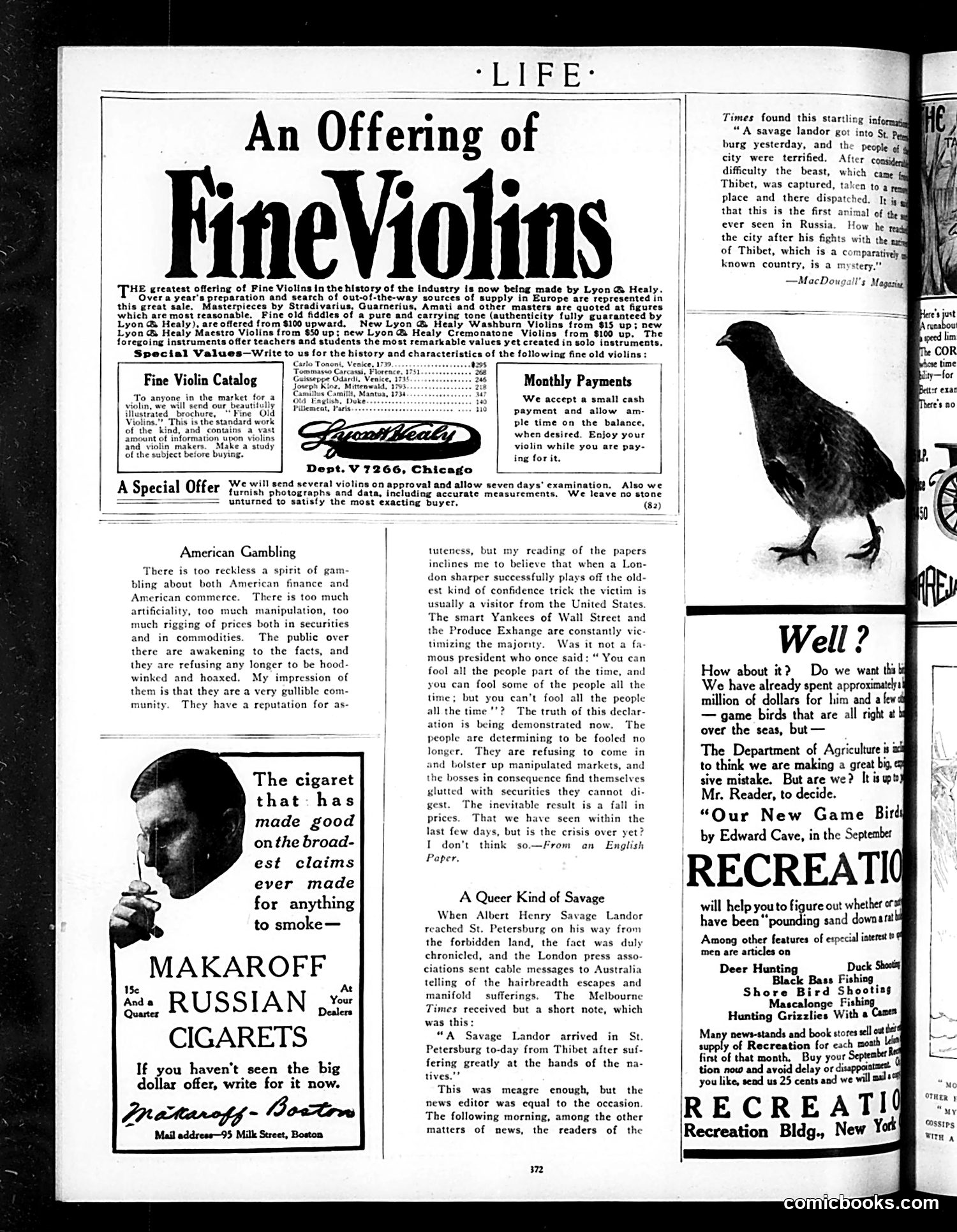
This is primarily an **advertising page** from Life magazine, not a political cartoon page. The dominant content is a large advertisement for Lyon & Healy's fine violins, offering masterpieces and payment plans. The page includes minor satirical content: **"American Gambling"** — A brief editorial criticizing reckless speculation in American finance and commerce. It quotes an English paper claiming Americans are gullible marks easily swindled by "London sharpers" (con artists) on Wall Street and the Produce Exchange. The piece argues the public is finally waking up to market manipulation. **"A Queer Kind of Savage"** — A short humorous piece about explorer Albert Henry Savage Landor's return from Tibet. The joke appears to be that despite harrowing adventures, Landor sent only a terse telegram to the Melbourne Times, leaving the editor to sensationalize minimal information. The Makaroff Cigarettes ad at bottom-left is also present. Overall, this is a typical Life magazine page blending advertising with light social commentary rather than hard political satire.
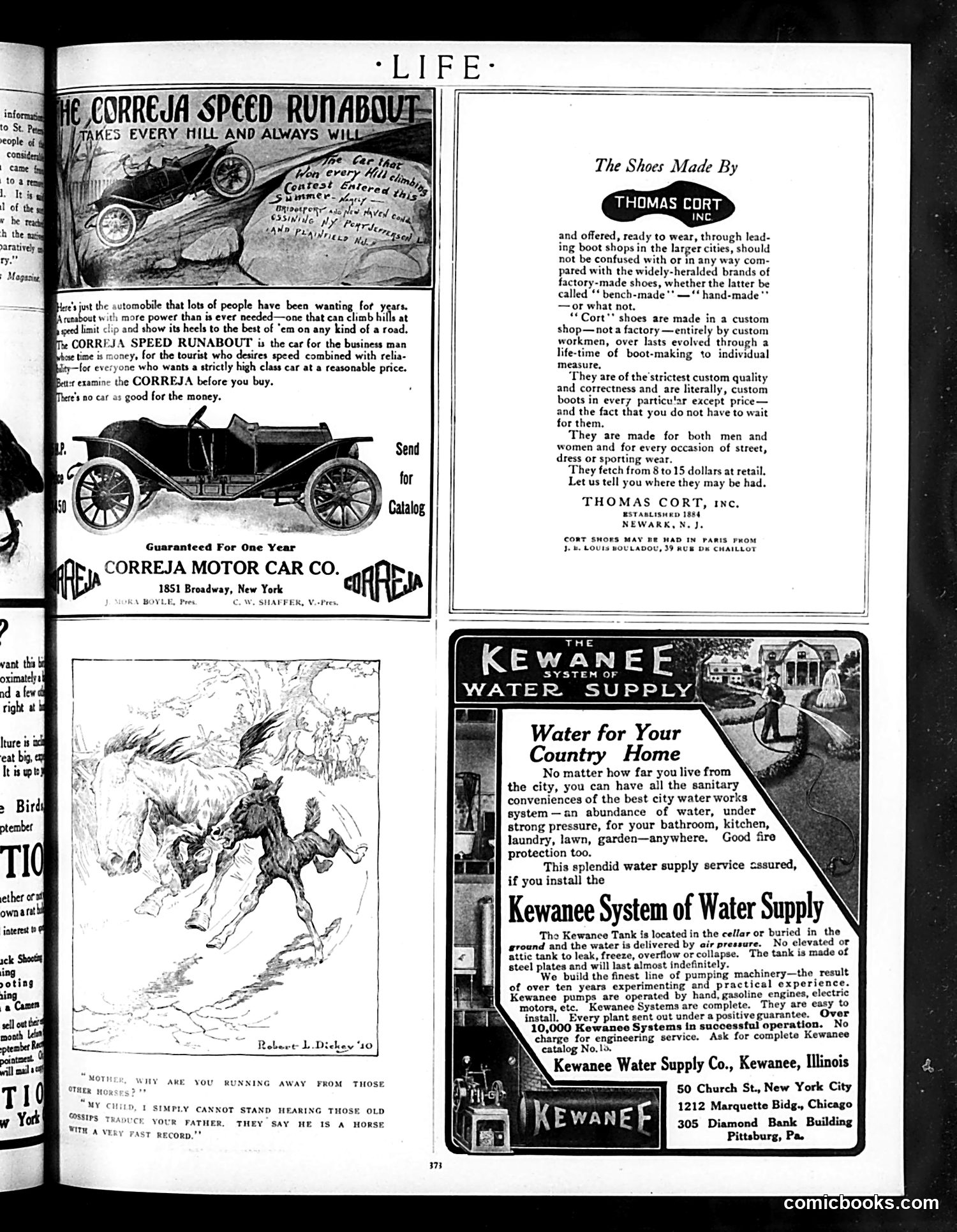
This page consists primarily of **advertisements** rather than editorial cartoons or satire. The upper left features a **Correja Motor Car ad**, emphasizing a reliable, powerful automobile for businessmen and tourists—practical messaging typical of early automotive marketing. The center-right contains a **Thomas Cort shoe advertisement**, distinguishing custom-made "Cort" shoes from factory-produced competitors, appealing to quality-conscious consumers. Below that is a small **cartoon illustration** (credited to Robert L. Dickey) showing children fleeing, with accompanying dialogue about someone being "a horse with a very fast record"—appearing to be humorous commentary on rumor-spreading or gossip, though the specific reference is unclear without fuller context. The bottom third shows a **Kewanee water supply system advertisement**, promoting indoor plumbing and pressurized water systems for rural homes—highlighting early 20th-century modernization appeals. The page is fundamentally a **commercial product showcase** rather than political or social satire.
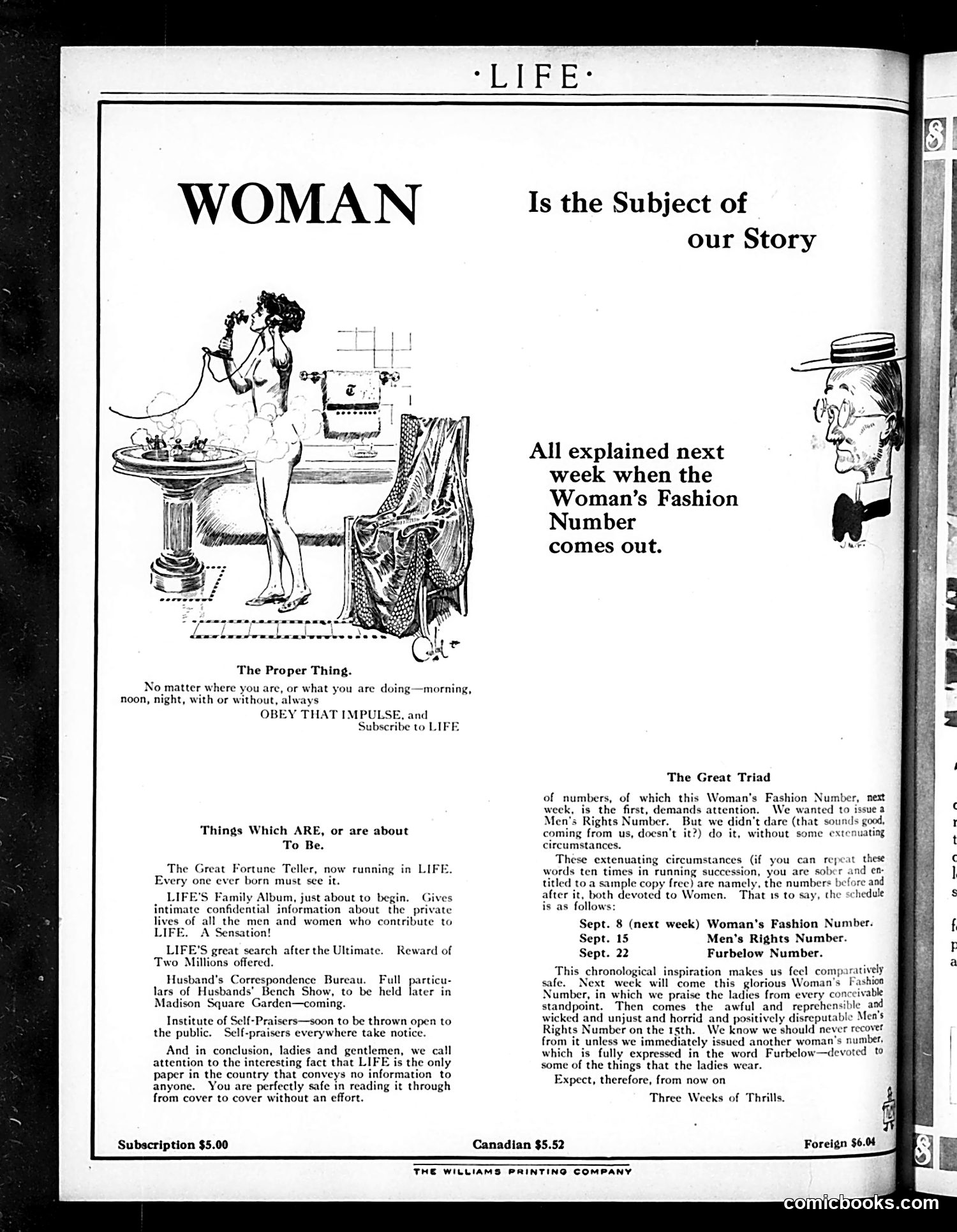
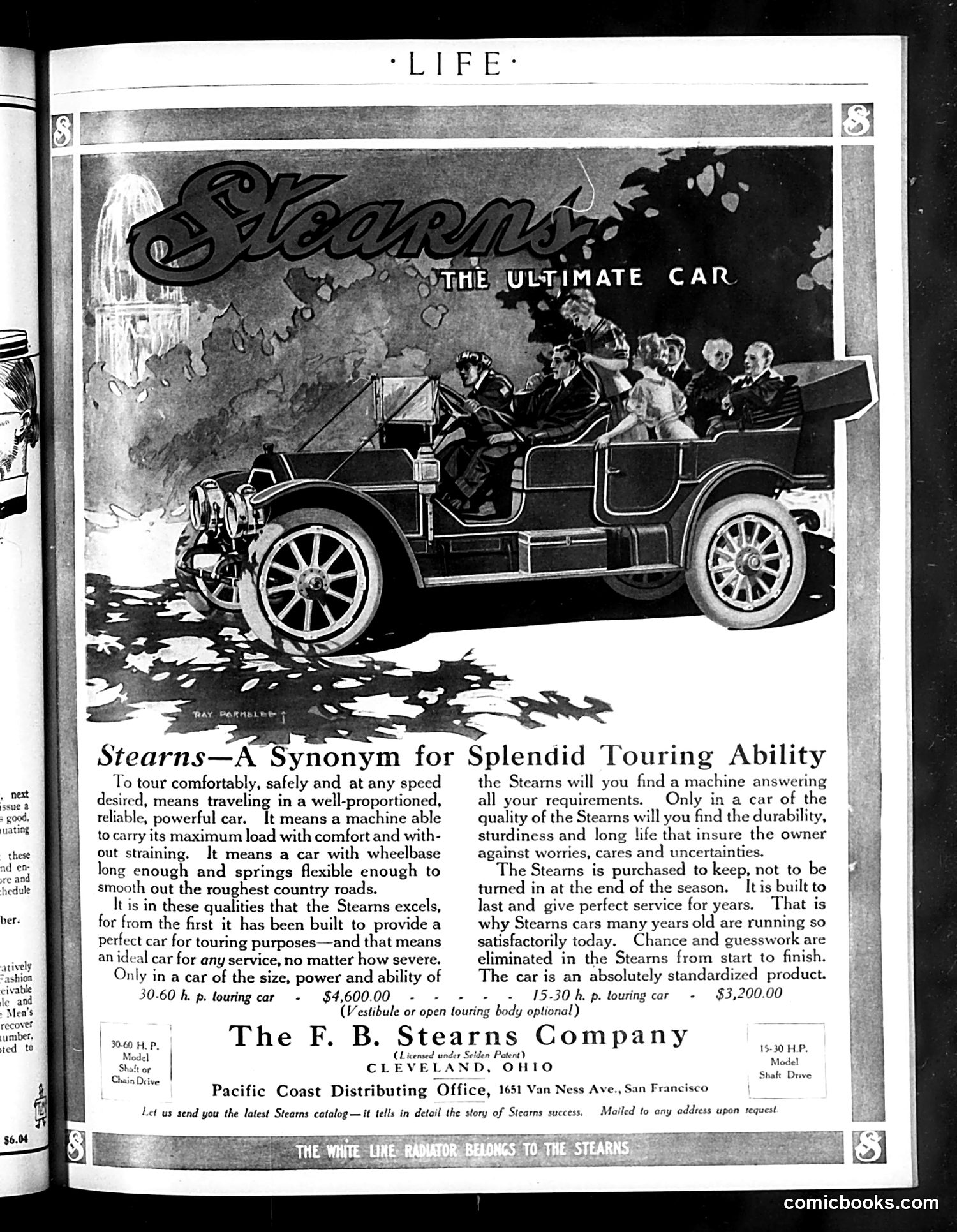
This is primarily **automobile advertising**, not political satire. The page features a Stearns car advertisement from The F.B. Stearns Company of Cleveland, Ohio. The illustration shows an early 1900s touring car carrying well-dressed passengers in period clothing, depicted passing by Niagara Falls—a famous tourist destination. This visual choice reinforces the ad's messaging: the Stearns is marketed as "the ultimate car" for comfortable, reliable touring. The text emphasizes durability, power (30-60 h.p.), and long-term value—that Stearns cars remain serviceable for years, not disposable. Pricing ranges from $3,200 to $4,600. There is **no political cartoon or satire present**. This is straightforward early automotive marketing, using a picturesque tourist scene to appeal to affluent buyers seeking a dependable vehicle for leisure travel during the era when automobile touring was becoming a status activity.
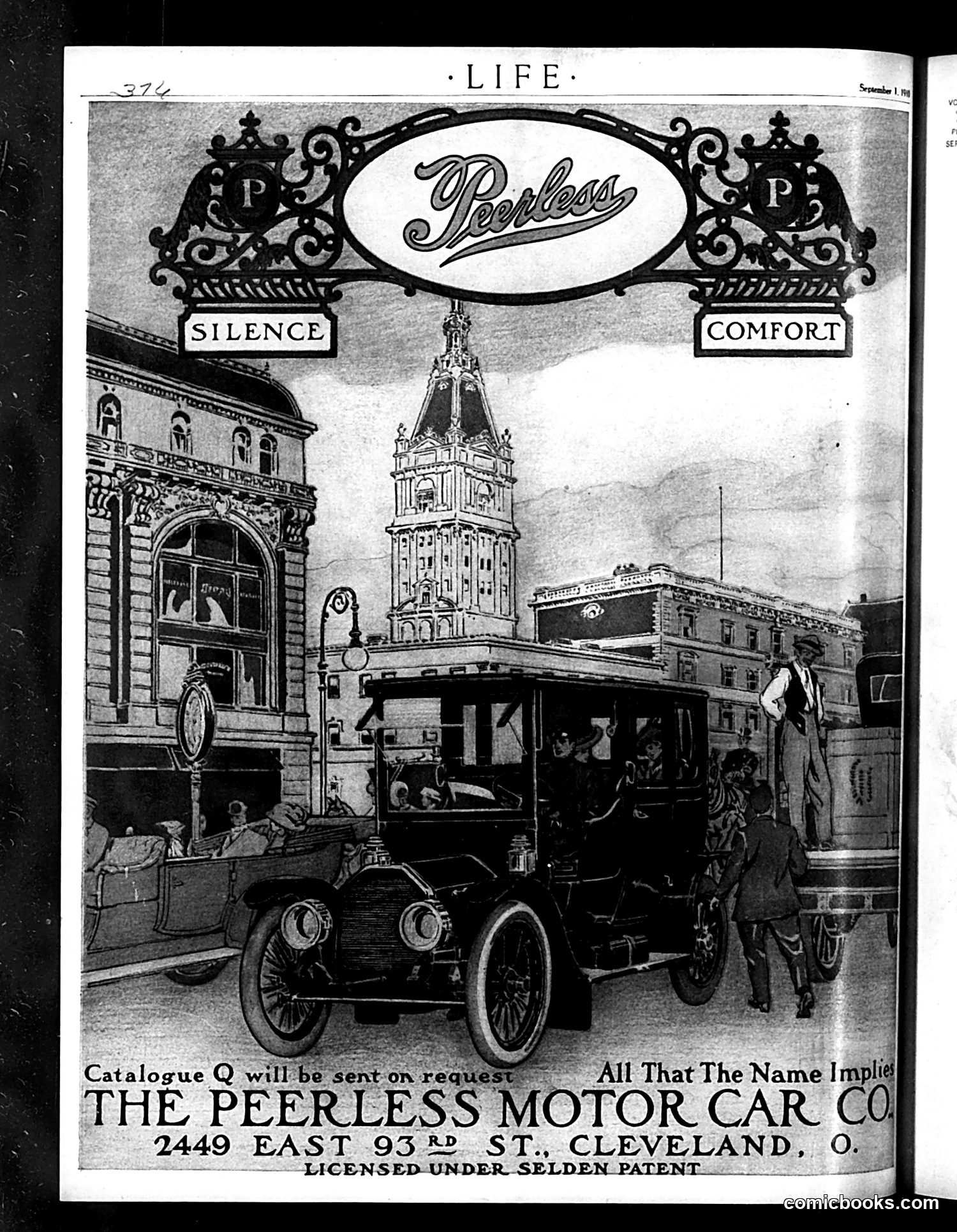
This is primarily a **Peerless Motor Car advertisement**, not political satire. The page shows an early automobile (likely 1910s-era) in an urban street scene with classical architecture. The ad emphasizes two brand qualities: "**Silence**" and "**Comfort**"—key selling points for early automobiles, which were notoriously loud and mechanically jarring. The tagline "**All That The Name Implies**" suggests the brand name itself conveys superiority. The reference to "**Selden Patent**" is significant: this was a controversial patent controlling automobile manufacturing that dominated the industry until 1911, creating legal monopolies. The ornate "P" emblems and classical architectural framing position Peerless as a luxury vehicle for affluent buyers. This is straightforward product advertising rather than social commentary.