
Life, 1910-09-01 · page 30 of 48
Life — September 1, 1910 — page 30: what you’re looking at
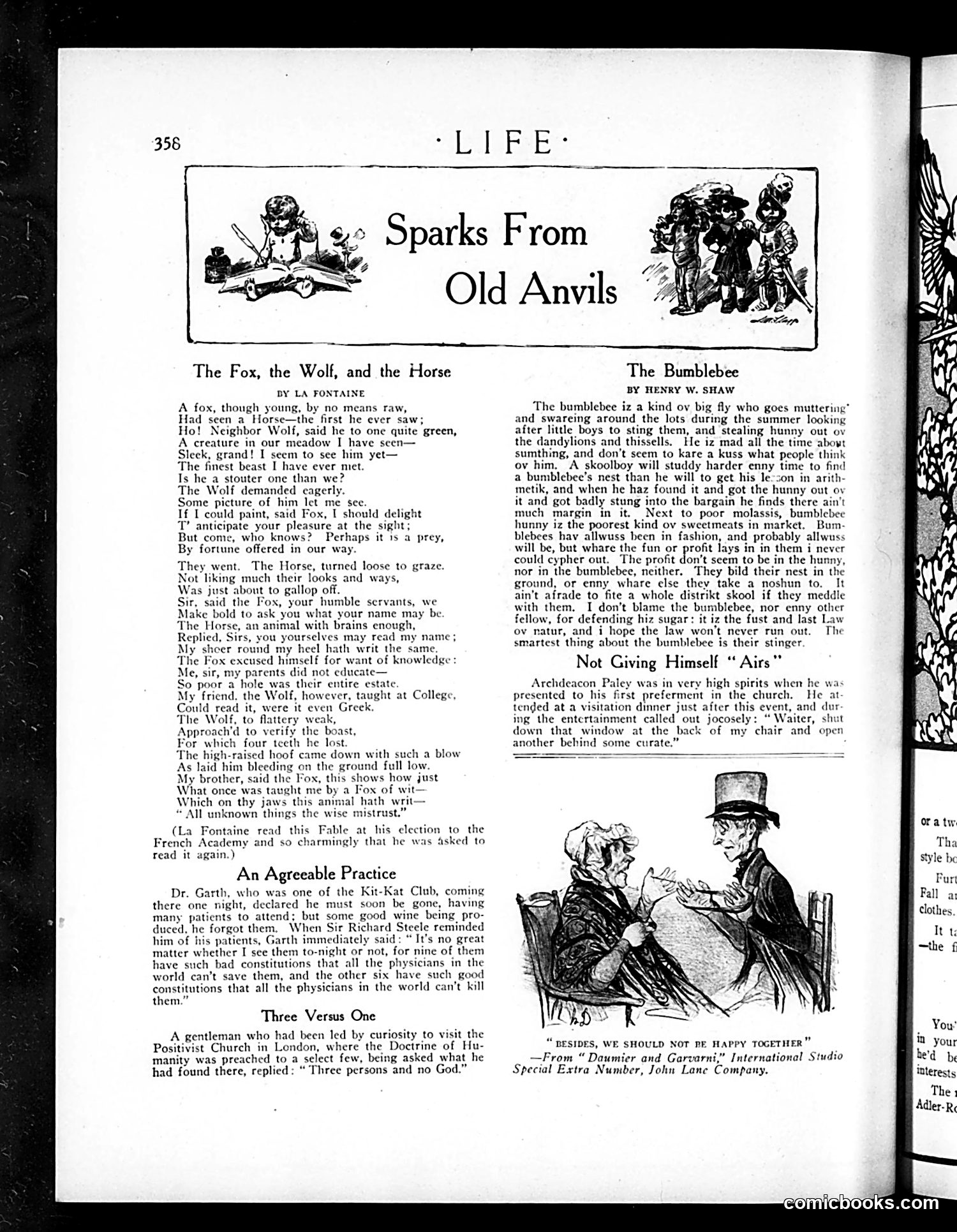
What you’re looking at
This page contains several short satirical pieces rather than political cartoons: **"The Fox, the Wolf, and the Horse"** — La Fontaine's classic fable, republished here, teaches that the wise distrust unknown things. The wolf's attempt to read writing on the horse's leg results in him being kicked and losing teeth—a consequence for his presumption. **"An Agreeable Practice"** — A brief anecdote mocking Dr. Garth, a physician who prioritizes socializing over attending patients, claiming half his patients will die regardless of care and half will survive regardless—a jab at medical arrogance. **"Three Versus One"** — A joke about the Positivist Church in London, which preached "the Doctrine of Humanity." A visitor sardonically reports finding "three persons and no God"—mocking the church's atheistic philosophy. **"The Bumblebee"** by Henry W. Shaw — Humorous dialect piece describing bumblebees as perpetually angry insects whose honey is worthless, defending their stings as natural law. The page demonstrates Life's mix of reprinted classic literature with contemporary social commentary and humor.
📄 Transcribed text from this page (OCR, searchable)
Machine-transcribed from the original scan — historical spelling and the odd misread are preserved.
AGERE: The Fox, the Wolf, and the Horse BY LA FONTAINE A fox, though young, by no means raw, Had seen a Horse—the first he ever saw; Ho! Neighbor Wolf, said he to one quite green, A creature in our meadow I have seen— Sleek, grand! I seem to see him yet— The finest beast I have ever met. Is he a stouter one than we? The Wolf demanded cagerly. Some picture of him Ict me see. If I could paint, said Fox, I should delight T’ anticipate your pleasure at the sight; But come, who knows? Perhaps it 1s a prey, By fortune offered in our way. They went. The Horse, turned loose to graze. Not liking much their looks and ways, Was just about to gallop off. Sir, said the Fox, your humble servants, we Make bold to ask you what your name may The Horse, an animal with brains enough, Replied, Sirs, you yourselves may read my name; My shcer round my heel hath writ the same. The Fox excused himself for want of know Me, sir, my parents did not educa! So poor a hole was their entire estate. My friend, the Wolf, however, taught at College, Could read it, were it even Gr The Wolf, to flattery wea Approach’d to verify the boast, For which four teeth he lost. The high-raised hoof came down with such a blow As laid him bleeding the ground full low. My brother, said the Fox, this shows how just What once was taught me by a Fox of wit— Which on thy jaws this animal hath writ— “ All unknown things the wise mistrust.” (La Fontaine read this Fable at his election to the French Academy and so charmingly that he was Asked to read it again.) An Agreeable Practice Dr. Garth, who was one of the Kat Club, coming there one night, declared he must soon be gone, having many patients to attend; but some good wine be pro- duced, he forgot them. When Sir Richard Steele reminded him of his patients, Garth immediately said: “ It’s no great matter whether I see them to-night or not, for nine of them have such bad constitutions that all the physicians in the world can’t save them, and the other six have such good constitutions that all the physicians in the world can’t kill them.” Three Versus One A gentleman who had been led by curiosity to visit the Positivist Church in London, where the Doctrine of Hu- manity was preached to a select few, being asked what he had found there, replied: “ Three persons and no God.” The Bumblebee BY HENRY W. SHAW The bumblebee iz a kind ov big fly who goes muttering’ and swareing around the lots during the summer looking after little boys to sting them, and stealing hunny out ov the dandylions and thissells. He iz mad all the time abovt sumthing, and don’t seem to kare a kuss what people think ov him. A skoolboy will studdy harder enny time to find a bumblebee’s nest than he will to get his le-son in arith- metik, and when he haz found it and got the hunny out ov it and got badly stung into the bargain he finds there ain't much margin in it. Next to poor molassis, bumblebee hunny iz the poorest kind ov sweetmeats in market. Bum- blebees hav allwuss been in fashion, and probably allwuss will be, but whare the fun or profit lays in in them i never could cypher out. The profit don’t seem to be in the hunny, nor in the bumblebee, neither. They bild their nest in the ground, or enny whare else they take a noshun to. It ain't afrade to fite a whole distrikt skool if they meddle with them. I don’t blame the bumblebee, nor enny other fellow, for defending hiz sugar: it iz the fust and last Law ov natur, d i hope the law won't never run out. The smartest thing about the bumblebee is their stinger, Not Giving Himself ‘ Airs” Archdeacon Paley was in very high spirits when he was presented to his first preferment in the church. He at tenged at a visitation dinner just after this event, and dur ing the entertainment called out jocosely: “ Waiter, shut down that window at the back of my chair and open another behind some curate.” “ BESIDES, WE SHOULD NOT RE HAPPY TOGETHER” —From “ Daumier and Garvarni,” International Studio Special Extra Number, John Lane Company. Clothes. Itt; wthe f _ You M your bed be interests The : Adler-R,