
Life, 1910-09-01 · page 21 of 48
Life — September 1, 1910 — page 21: what you’re looking at
What you’re looking at
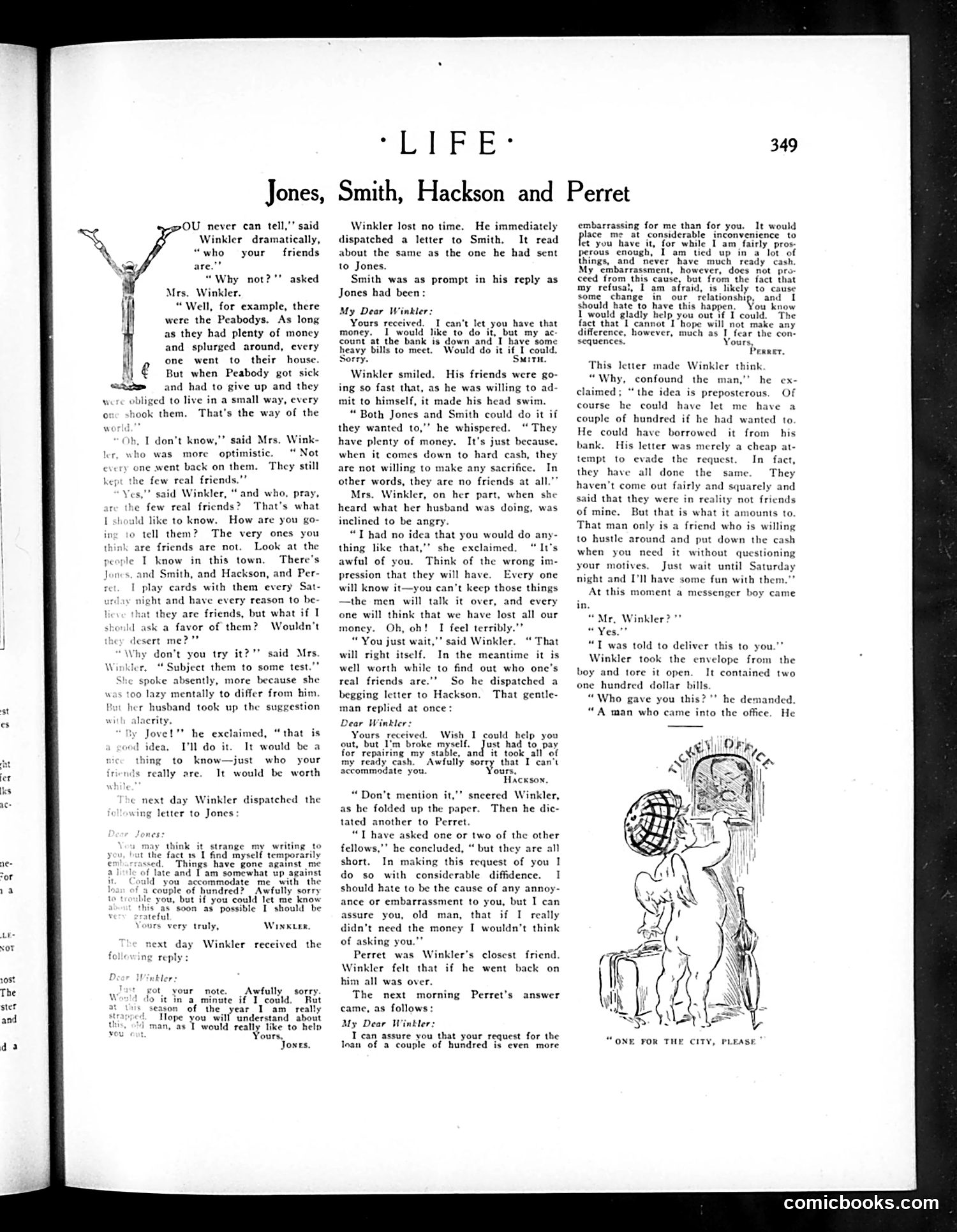
This page presents a serialized story titled "Jones, Smith, Hackson and Perret" about a man named Winkler who tests his friendships. After his wife suggests he verify who his real friends are, Winkler writes letters to four acquaintances requesting loans of a couple hundred dollars, claiming financial hardship. The satire targets the superficiality of social friendships in early 20th-century America. Each friend makes excuses (bank accounts down, seasonal expenses, stable repairs) rather than help—revealing that their camaraderie is conditional on prosperity. Winkler's conclusion is cynical: these men he plays cards with "every Saturday night" are no true friends because they won't sacrifice for him. The accompanying illustration shows a figure at a "Turkey Office," likely advertising or unrelated to the main narrative. The story's point is timeless social commentary: fair-weather friendships evaporate when money is involved.
📄 Transcribed text from this page (OCR, searchable)
Machine-transcribed from the original scan — historical spelling and the odd misread are preserved.
ne “or 1a “FE 349 Jones, Smith, Hackson and Perret OU never can tell,’’ said XS Winkler dramatically, \ your friends “Why not?" asked Mrs. Winkler. “Well, for example, there were the Peabodys. As long they had plenty of money i nd splurged around, every {) one went to their house. 1 € But when Peabody got sick Ade and had to give up and they wore obliged to live in a small way, every or hook them, That's the way of the Ob, I don't kno said Mrs. Wink- ler, who was more optimistic. Not every one went back on them. They still kept the few real friend: Yes," said Winkler, “and who, pray, re the few real friends? That's what I should like to know. How are you go- ing to tell them? The very ones you think are friends are not. Look at the people IT know in this town, There's Jones, and Smith, and Hackson, and Per- ct. I play cards with them every Sat- urday night and have every reason to be- hat they are friends, but what if I should ask a favor of them? Wouldn't cy desert me?"* Vhy don’t you try it?’? said Mrs. sler, “Subject them to some test." She spoke absently, more because she wos too lazy mentally to differ from him her husband took up the suggestion with alacrity, ty Jovel’? he exclaimed, “that is idea, I'll do it. It would be a ng to know—just who your friends really are. It would be worth © next day Winkler dispatched the ellowing letter to Jones: se 1 may think it strange my writing to you, Hut the fact as I find myself temporarily € ssed. Things have gone against me a { late and Tam somewhat up against mmodate me with the it, Could you a nan of a couple of hundred? Awfully sorry you, but if you could let me know sat soon as possible I should be tefu Yours very tru A Winxtee, next day Winkler received the following reply: D Winkler: ql) fet, your note. Awfully sorry. Ww to it in a minute if I could. Rut at vis season of the year I am. really : Hope you will understand about as T would really like to hel Winkler lost no time. He immediately dispatched a letter to Smith, It read about the same as the one he had sent to Jones. Smith was as prompt in his reply as Jones had been: My Dear Winkler: Yours received. I can't let you have that money. I would like to do it, but my ac: count at the bank is down and'I have some heavy bills to meet. Would do it if,1 could. Sorry. Serrit. Winkler smiled. His friends were go- ing so fast that, as he was willing to ad- mit to himself, it made his head swim “Both Jones and Smith could do it if they wanted to,” he whispered. “ They have plenty of money. It’s just because, when it comes down to hard cash, they are not willing to make any sacrifice, In other words, they are no friends at all.”’ Mrs. Winkler, on her part, when she heard what her husband was doing, was inclined to be angry. “Thad no idea that you would do any- thing like that,"? she exclaimed. “It's awful of you. Think of the wrong im- pression that they will have. Every one will know it—you can’t keep those things —the men will talk it over, and every one will think that we have lost all our money. Oh, oh! I feel terribly.”” “You just wait," said Winkler.“ That will right itself. In the meantime it is well worth while to find out who one’s real friends are.” So he dispatched a begging letter to Hackson. That gentle- man replied at once: Dear Winkler: Yours received. Wish I could help you ut, but I'm broke myself. | Just had to, pay for repairing my stable, and it took all of my ready cash. Awfully sorry that I can’t accommodate you. Yours, Hacxson, “ Don’t mention it,’’ sneered Winkler, as he folded up the paper. Then he dic- tated another to Perret “T have asked one or two of the other fellows,’’ he concluded, “ but they are all short. In making this request of you I do so with considerable diffidence. I should hate to be the cause of any annoy- ance or embarrassment to you, but I can assure you, old man, that if I really didn’t need the money I wouldn't think of asking you.”* Perret was Winkler’s closest friend. Winkler felt that if he went back on him all was over. The next morning Perret's answer came, as follows: My Dear Winkler: T can assure you that your request for the Ioan of a couple of hundred is even more embarrassing for me than for you, It would place me at considerable inconvenience to let you have it, for while I am fairly pros: perous enough, I am tied up in a lot of things, and never have much ready cash. My ‘embarrassment, however, does not pro- ceed from this cause, but from the fact that my refusa!, I am afraid, is likely to cause some change in our relationship, and should hate to have this happen. You know 1 would gladly help you out if I could. The fact that I cannot I hope will not make any difference, however, much as I fear the con- sequences. Yours, Denner. his letter made Winkler think “Why, confound the man,” he ex- claimed; “the idea course he could have let me have a couple of hundred if he had wanted to He could have borrowed it from his bank. His letter was merely a cheap at- tempt to evade the request. In fact, they have all done the same. haven't come out fairly and squarely said that they were in reality not friends of mine. But that is what it amounts to. That man only is a friend who is willing to hustle around and put down the cash when you need it without questioning your motives. Just wait until Saturday night and I'll have some fun with them. At this moment a messenger boy came in. “Mr, Winkler?” “Yes. “Twas told to deliver this to you.’” Winkler took the envelope from the nd tore it open. It contained two one hundred dollar bills. “Who gave you this?" he demanded. A man who came into the office. He preposterous, Of bo: “ONE POR THE CITY, PLEASE’ comicbooks.com