
Life, 1910-09-01 · page 22 of 48
Life — September 1, 1910 — page 22: what you’re looking at
What you’re looking at
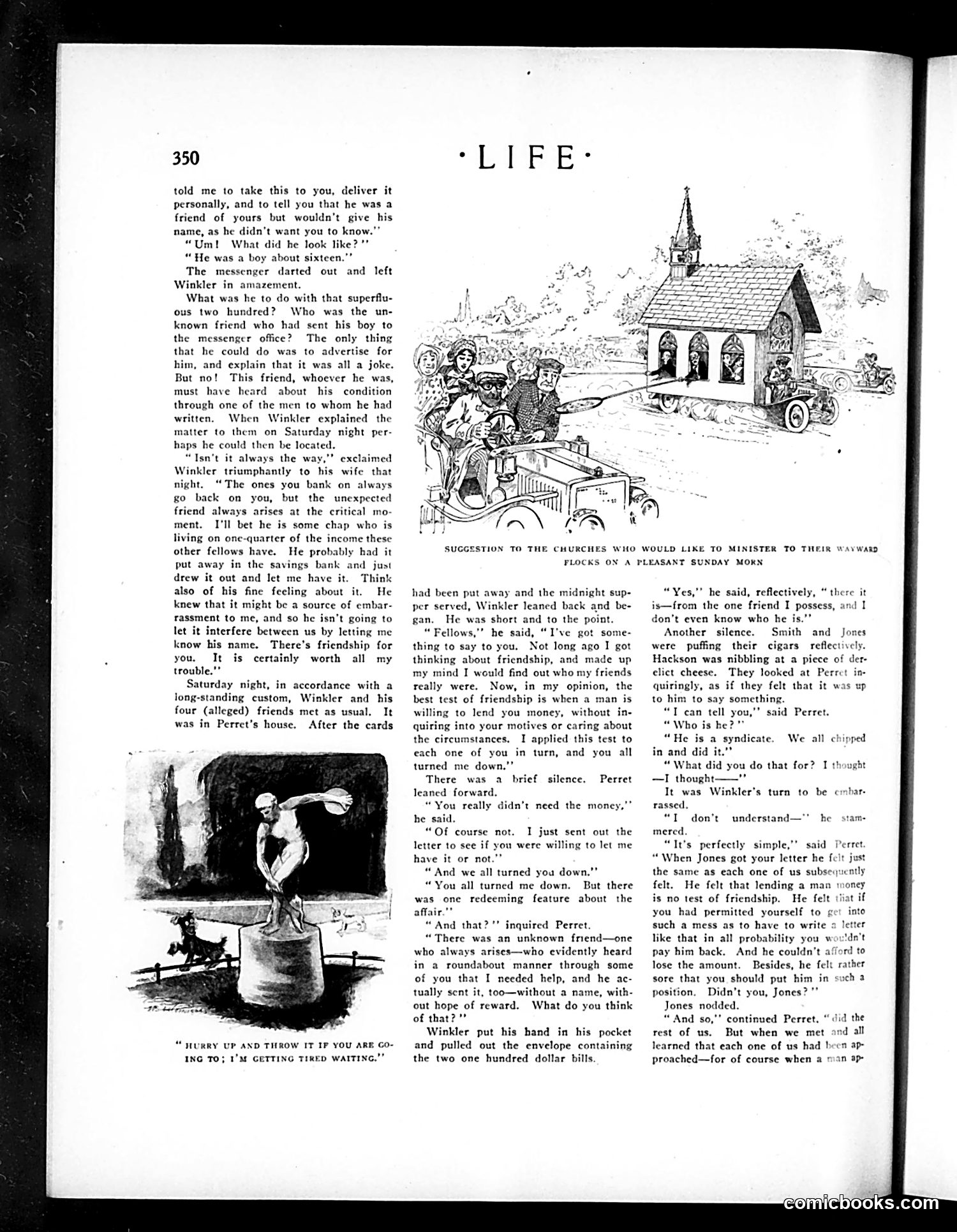
This page presents a satirical story about **friendship and money**. The protagonist Winkler conducts a "test" by asking four friends for a loan to determine who truly values him. All four refuse. However, an anonymous benefactor sends $200, which Winkler attributes to a mysterious true friend. At the climactic dinner scene, Winkler reveals this gift to shame his friends—only to discover the joke is on him: **all four friends conspired together** to send the money anonymously after learning of his needs. They orchestrated it as a group "syndicate" rather than as individuals. The satire targets **false pride and misguided friendship metrics**—Winkler's cynical test backfires when he learns genuine friendship doesn't require individual heroics or secret benefactors. His friends' collective gesture proves more meaningful than he anticipated. The illustration at top shows a church scene, likely commenting on morality and community values in relation to the story's themes.
📄 Transcribed text from this page (OCR, searchable)
Machine-transcribed from the original scan — historical spelling and the odd misread are preserved.
350 told me to take this to you, deliver it personally, and to tell you that he was a friend of yours but wouldn't give his name, as he didn't want you to know."” “Um! What did he look like? ’’ “ He was a boy about sixteen.’” The messenger darted out and left Winkler in amazement. What was he to do with that superflu- ous two hundred? Who was the un- known friend who had sent his boy to the messenger office? The only thing that he could do was to advertise for him, and explain that it was all a joke. But no! This friend, whoever he was, must have heard about his condition through one of the men to whom he had written. When Winkler explained the matter to them on Saturday night per- haps he could then be located. “Isn't it al s the w * exclaimed Winkler triumphantly to his wife that night. “The ones you bank on always go back on you, but the unexpected friend always arises at the critical mo- ment. I'll bet he is some chap who is living on one-quarter of the income these other fellows have. He probably had it put away in the savings bank and just drew it out and Iet me have it. Think also of his fine feeling about it. He knew that it might be a source of embar- rassment to me, and so he isn’t going to let it interfere between us by letting me know his name. There's friendship for you. It is certainly worth all my trouble."* Saturday night, in accordance with a long-standing custom, Winkler and his four (alleged) friends met as usual, It was in Perret’s house. After the cards “SLURRY UP AND THROW IT IF YOU ARE ING TO; I'M GETTING TIRED WAITIN! SUGGESTION TO THE CHURCHES WHO WOULD LIKE TO MINISTER TO THEIR WAYWARD FLOCKS ON A PLEASANT SUNDAY MOKN had been put away and the midnight sup- per served, Winkler leaned back and be- gan. He was short and to the point. “ Fellows,’ he said, “I've got some- thing to say to you. Not long ago I got thinking about friendship, and made up my mind I would find out who my friends really were. Now, in my opinion, the best test of friendship is when a man is willing to lend you money, without in- quiring into your motives or caring about the circumstances, I applied this test to each one of you in turn, and you all turned me down.” There was a brief silence. leaned forward. “You really didn’t need the moncy,'” he said. “Of course not. I just sent out the letter to see if you were willing to let me have it or not.’" “ And we all turned you down,"" “You all turned me down. But there was one redeeming feature about the affair."" “And that?" inquired Perret, “There was an unknown frend—one who always arises—who evidently heard in a roundabout manner through some of you that I needed help, and he ac- tually sent it, too—without a name, with- out hope of reward. What do you think of that? ’* Winkler put his hand in his pocket and pulled out the envelope containing the two one hundred dollar bills. Perret “Yer he said, reflectively, “ th is—from the one friend I possess, and don’t even know who he is.’”’ Another silence. Smith and were puffing their cigars reflectively. Hackson was nibbling at a piece of der- elict cheese. They looked at Perret in- quiringly, as if they felt that it was up to him to say something. “Tocan tell you,’’ said Perret. “Who is he?" “He is a syndicate. We in and did it.” “ What did you do that for? I tt —I thought. " It was Winkler’s turn to be rassed. “IT don’t mered, “It’s perfectly simple,” “When Jones got your letter he felt the same as each one of us subs ly felt. He felt that lending a man money is no test of friendship. He felt i you had permitted yourself to ¢ such a mess as to have to write 2 like that in all probability you woutdn't pay him back. And he couldn't rd to lose the amount. Besides, he felt rather sore that you should put him in such a position. Didn't you, Jones?” Jones nodded. “And so,’’ continued Perret. “ the rest of us. But when we met learned that each one of us had been ap- proached—for of course when a man ap- all chipped understand—"’ he said Perret.