
Life, 1910-09-01 · page 29 of 48
Life — September 1, 1910 — page 29: what you’re looking at
What you’re looking at
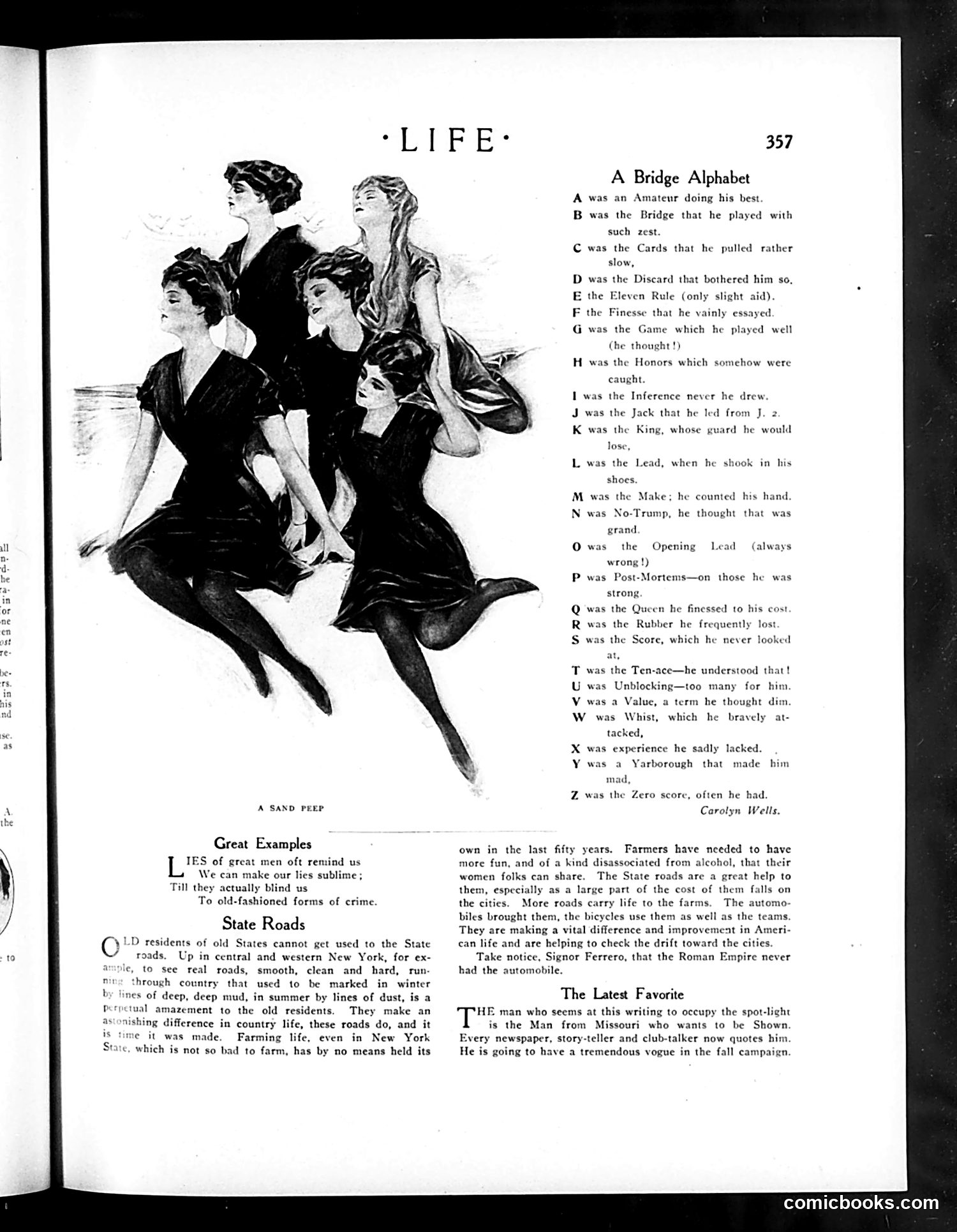
This page contains three distinct pieces of satirical content from *Life* magazine: **"A Bridge Alphabet"** (main feature): A humorous alphabetical poem by Carolyn Wells mocking an amateur bridge player. Each letter represents a bridge term paired with the player's mistake or weakness—he makes poor leads (J), loses the King's guard (K), miscounts his hand (M), and lacks experience (X). The joke targets bridge enthusiasts' pretensions; bridge was a fashionable card game among the upper classes, and the poem gently ridicules incompetent players. **"A Sand Peep"** (small cartoon): The sketch and accompanying poem mock politicians and public figures who construct grandiose rhetoric ("make our lies sublime") to obscure old corruption dressed in new language. **Other articles** discuss state roads improving rural life and farming, and mention "the Man from Missouri who wants to be Shown"—likely referencing a political figure seeking to build a national reputation. The overall tone is characteristic of *Life*'s gentle, urbane satire targeting middle and upper-class social pretensions and political behavior.
📄 Transcribed text from this page (OCR, searchable)
Machine-transcribed from the original scan — historical spelling and the odd misread are preserved.
A SAND PEEP Great Examples of great men oft remind us We can make our lies sublime ; Till they actually blind us ‘0 old-fashioned forms of crime. State Roads roads. Up in central and western New York, for ex- €, to see real roads, smooth, clean and hard, run- vs through country that used to be marked in winter lines of deep, deep mud, in summer by lines of dust, is a QC! D residents of old States cannot get used to the State / rpctual amazement to the old residents. They make an nishing difference in country life, these roads do, and it me it was made. Farming life, even in New York ©, which is not so bad to farm, has by no means held its 357 A Bridge Alphabet A was a B was the Bridge that he played with such zest. Amateur doing his best C was the Cards that he pulled rather slow, D was the Discard that bothered him so, E the Eleven Rule (only slight aid). F the Finesse that he vainly essayed G was the Game which he played well (he thought !) H was the Honors which somehow were caught. 1 was the Inference never he drew J was the Jack that he led from J. 2 K was the King, whose guard he would lose, L was the Lead, when he shook in his shoes. M was the Make; he counted his hand N was rump, he thought that was grand was the Opening Lead (always wrong !) was Post-Mortems—on those he was strong was the Queen he finessed to his cost was the Rubber he frequently lost S was the Score, which he never looked at, T was the Ten-ace—he understood t U was Unblocking—too many for him V was a Value, a term he thought dim. W was Whist, which he bravely at- tacked, X was experience he sadly lacked. Y was a Yarborough that made him mad, Z was the Zero score, often he had. Carolyn Wells. own in the last fifty years. Farmers have needed to have more fun, and of a kind disassociated from alcohol, that their women folks can share. The State roads are a great help to them, especially as a large part of the cost of them falls on the cities. More roads carry life to the farms. The automo- biles brought them, the bicycles use them as well as the teams They are making a vital difference and improvement in Ameri- can life and are helping to check the drift toward the cities. Take notice, Signor Ferrero, that the Roman Empire never had the automobile. The Latest Favorite HE man who seems at this writing to occupy the spot-light is the Man from Missouri who wants to be Shown. Every newspaper, story-teller and club-talker now quotes him. He is going to have a tremendous vogue in the fall campaign. comicbooks.com