
Life, 1910-09-01 · page 12 of 48
Life — September 1, 1910 — page 12: what you’re looking at
What you’re looking at
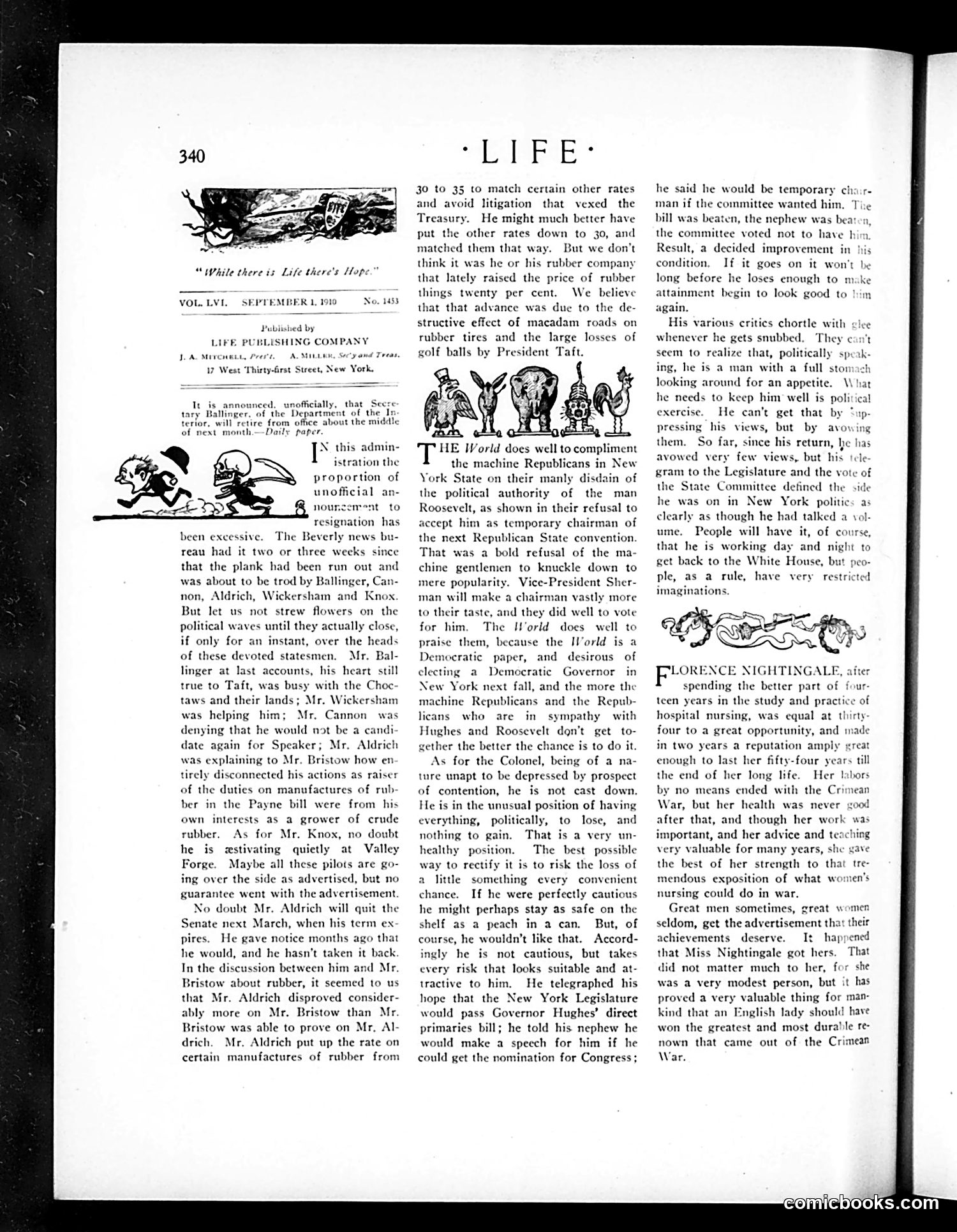
The page critiques Republican Party leadership's treatment of Theodore Roosevelt. The text discusses Roosevelt's exclusion as temporary chairman of the next Republican State convention—a deliberate snub by New York machine Republicans (Aldrich, Wickersham, Knox). The *Life* editors praise Roosevelt's political resilience despite this rejection, noting he maintains his principles without bitterness. They contrast this favorably with the "machine Republicans," portraying Roosevelt as principled while party leadership appears petty and faction-driven. The piece also includes a separate article praising Florence Nightingale's nursing legacy. Overall, the page presents Roosevelt sympathetically as a wronged elder statesman while satirizing the Republican establishment's political maneuvering against him.
📄 Transcribed text from this page (OCR, searchable)
Machine-transcribed from the original scan — historical spelling and the odd misread are preserved.
“While there is Life there's Hope” SEPTEMBER 1, 1910 Published by LIFE PUBLISHING COMPANY Pret A MiLK VOL. LVI. LAM It is announced, unofficially, that Se tary Ballinger. of the Department of the 1 terior, will retire from office about the middle of next month.—Daily paper, N this admin- istration the proportion of unofficial an- nounsement to resignation has been excessive. The Beverly news bu- reau had it two or three weeks since that the plank had been run out and was about to be trod by Ballinger, non, Aldrich, Wickersham and Knox But let us not strew flowers on the political waves until they actually close, if only for an instant, over the heads of these devoted statesmen. Mr. Bal- linger at last accounts, his heart still ue to Taft, was busy with the Choc- taws and their lands; Mr. Wickersham was helping him; Mr. Cannon wa denying that he would not be a candi date again for Speaker; Mr. Aldrich was explaining to Mr. Bristow how en tirely disconnected his actions as raiser of the duties on manufactures of rub- ber in the Payne bill were from his own interests as a grower of crude rubber. As for Mr. Knox, no doubt he is zstivating quietly at Valley Forge. Maybe all these pilots are go- ing over the side as advertised, but no guarantee went with the advertisement No doubt Mr. Aldrich will quit the Senate next March, when his term ex- pires. He gave notice months ago that he would, and he hasn't taken it back. In the discussion between him and Mr. Bristow about rubber, it seemed to us that Mr. Aldrich disproved consider- ably more on Mr. Bristow than Mr. Bristow was able to prove on Mr, Al- drich. Mr. Aldrich put up the rate on certain manufactures of rubber from “I IAESE * 30 to 35 to match certain other rates and avoid litigation that vexed the Treasury. He might much better have put the other rates down to 30, and matched them that way, But we don’t think it was he or his rubber company that lately raised the price of rubber things twenty per cent. We believe that that advance was due to the de- structive effect of macadam roads on rubber tires and the large losses of golf balls by President Taft. HE MWorld does well to compliment the machine Republicans in New York State on their manly disdain of the political authority of the man Roosevelt shown in their refusal to accept him as temporary chairman of the next Republican State convention. That was a bold refusal of the ma- chine gentlemen to knuckle down to mere popularity. Vice-President Sher- man will make a chairman vastly more to their taste, and they did well to vote for him, The World does well to praise them, because the H orld is a Democratic paper, and desirous of electing a Democratic Governor in New York next fall, and the more the machine Republicans and the Repub- licans who are in sympathy with Hughes and Roosevelt don’t get to- gether the better the chance is to do it. As for the Colonel, being of a na- ture unapt to be depressed by prospect of contention, he is not cast down. He is in the unusual position of having everything, politically, to lose, and nothing to gain. That is a very un- healthy position. The best possible way to rectify it is to risk the loss of a little something every convenient chance. If he were perfectly cautious he might perhaps stay as safe on the shelf as a peach in a can. But, of course, he wouldn’t like that. Accord- ingly he is not cautious, but takes every risk that looks suitable and at- tractive to him. He telegraphed his hope that the New York Legislature would pass Governor Hughes’ direct primaries bill; he told his nephew he would make a speech for him if he could get the nomination for Congress; he said he would be temporary chair- man if the committee wanted him. 7 bill was beaten, the nephew was bea: the committee voted not to have him. Result, a decided improvement in condition, If it goes on it won't | long before he loses enough to make attainment begin to look good to him again. His various critics chortle with clee whenever he gets snubbed. They can't seem to realize that, politically sp ing, he is a man with a full stomach looking around for an appetite, \\hat he needs to keep him well is political exercise. He can’t get that by ‘up: pressing his views, but by avowing them. So far, since his return, he has avowed very few views, but his tcle. gram to the Legislature and the vote of the State Committee defined the side he was on in New York politics as clearly as though he had talked a vol. ume. People will have it, of cc that he is working day and night to get back to the White House, but peo- ple, as a rule, have very imaginations. PS a LORENCE NIGHTINGALE spending the better part of fou teen years in the study and practice of hospital nursing, was equal at thirty- four to a great opportunity, and inade in two years a reputation amply great enough to last her fifty-four years till the end of her long life. Her labors by no means ended with the Crimean War, but her health was never good after that, and though her work was important, and her advice and teaching very valuable for many years, she gave the best of her strength to that tre- mendous exposition of what women’s nursing could do in war. Great men sometimes, great women seldom, get the advertisement that their achievements deserve. It happened that Miss Nightingale got hers. That did not matter much to her, for she was a very modest person, but it has proved a very valuable thing for man- kind that an English lady should have won the greatest and most durable re- nown that came out of the Crimean War. restricter