
Life, 1910-09-01 · page 23 of 48
Life — September 1, 1910 — page 23: what you’re looking at
What you’re looking at
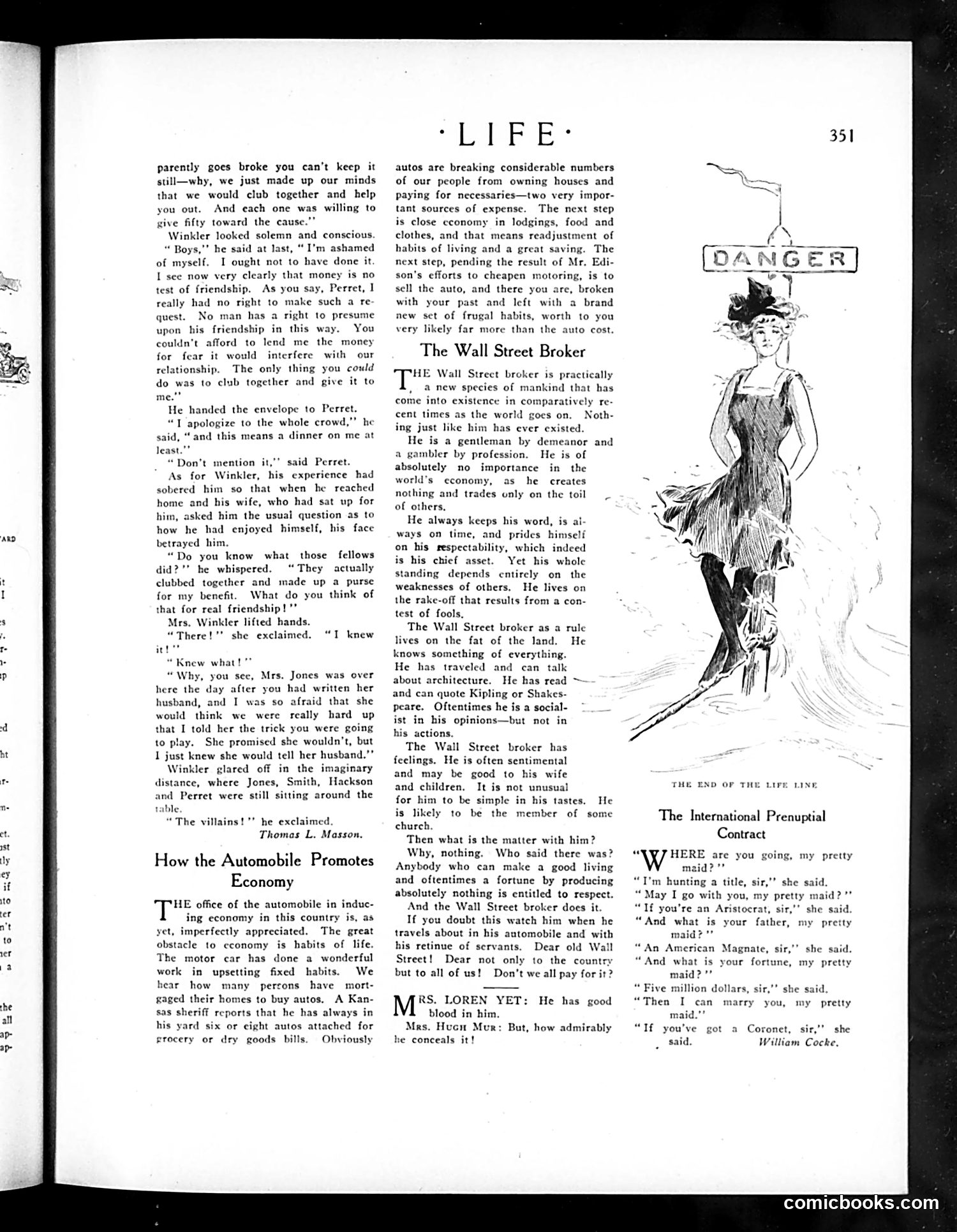
This page contains two satirical pieces typical of early 20th-century American humor: **"How the Automobile Promotes Economy"** is deadpan satire. The author argues that automobiles, by forcing people to mortgage homes and go into debt buying cars, actually *promote economy* by breaking their old spending habits on housing and food. The joke is the absurd logic: financial ruin becomes "economic improvement." This mocks both the automobile industry's aggressive marketing and Americans' gullible embrace of consumer debt. **"The Wall Street Broker"** offers a caustic portrait of a new professional type. The satirist describes brokers as gentlemen by appearance but gamblers by nature—creating nothing of value, living parasitically off others' financial foolishness, and depending entirely on market manipulation and client weakness. Their respectability is mere window-dressing for essentially predatory behavior. Both pieces critique early 20th-century consumer culture and financial systems as fundamentally deceptive and economically destructive, disguised under respectability and progress.
📄 Transcribed text from this page (OCR, searchable)
Machine-transcribed from the original scan — historical spelling and the odd misread are preserved.
parently goes broke you can’t keep it still—why, we just made up our minds that we would club together and help you out. And each one was willing to give fifty toward the cause."” Winkler looked solemn and conscious. “ Boys,’’ he said at last, “I'm ashamed of myself. I ought not to have done it. I see now very clearly that money is no test of friendship. As you say, Perret, 1 really had no right to make such a re quest. No man has a right to presume upon his friendship in this way. You couldn't afford to lend me the money for fear it would terfere relationship. The only thing you could do was to club together and give it to me.” He handed the envelope to Perret “T apologize to the whole crowd,” he said, “and this means a dinner on me a with our least “Don't mention it,” said Perret. As for Winkler, his experience had sobered him so that when he reached home and his wife, who had sat up for him, asked him the usual question as to how he had enjoyed himself, his face betrayed him. “Do you know what those fellows did?’ he whispered. “They actually clubbed together and made up a purse for my benefit. What do you think of that for real friendship !"" Mrs, Winkler lifted hands. “There!” she exclaimed. “I knew “Knew what!’ “Why, you see, Mrs. Jones was over here the day after you had written her husband, and I was so afraid that she would think we were really hard up that I told her the trick you were going to play. She promised she wouldn't, but 1 just knew she would tell her husband.’ Winkler glared off in the imaginary distance, where Jones, Smith, Hackson 1 Perret were still sitting around the able. “The villains! ’’ he exclaimed. Thomas L. Masson. How the Automobile Promotes Economy HE office of the automobile in induc- ing economy in this country is, as yet, imperfectly appreciated. The great obstacle to cconomy is habits of life. The motor car has done a wonderful work in upsetting fixed habits. We hear how many perons have mort- gaged their homes to buy autos. A Kan- sas sheriff reports that he has always in his yard six or eight autos attached for frocery or dry goods bills. Obviously “EPP E* autos are breaking considerable numbers of our people from owning houses and paying for necessaries—two very impor- tant sources of expense. The next step is close economy in lodgings, food and clothes, and that means readjustment of habits of living and a great saving. The next step, pending the result of Mr. Edi- son's efforts to cheapen motoring, is to sell the auto, and there you are, broken with your past and left with a brand new set of frugal habits, worth to you very likely far more than the auto cost. The Wall Street Broker HE Wall Street broker is practically a new species of mankind that has come into existence in comparatively re- cent times as the world goes on. Noth- ing just like him has ever existed. He is a gentleman by demeanor and a gambler by profession. He is of absolutely no importance in the world’s economy, as he creates nothing and trades only on the toil of others, He always keeps his word, is al- ways on time, and prides himseli on his respectability, which indeed is his chief asset. Yet his whole standing depends entirely on the weaknesses of others, He lives on the rake-off that results from a con- test of fools, The Wall Street broker as a rule lives on the fat of the land. He knows something of everything. He has traveled and can talk about architecture. He has read and can quote Kipling or Shakes- peare. Oftentimes he is a social- ist in his opinions—but not in his actions. The Wall Street broker has feelings. He is often sentimental and may be good to his wife and children, It is not unusual for him to be simple in his tastes. He is likely to be the member of some church. Then what is the matter with him? Why, nothing. Who said there was? Anybody who can make a good living and oftentimes a fortune by producing absolutely nothing is entitled to respect. And the Wall Street broker does it. If you doubt this watch him when he travels about in his automobile and with his retinue of servants, Dear old Wall Street! Dear not only to the countr) but to all of us! Don't we all pay for it? RS. LOREN YET blood in him, Mrs. Hucn Mu: fe conceals it! He has good : But, how admirably é [(DANGE TME END OF THE LIFE LINE The International Prenuptial Contract “ HERE are you going, my maid? “T'm bunting a title, sir," she said. “May I go with you, my pretty maid?” “If you're an Aristocrat, sir,” “And what is your father, my pr ™. : a American Magnate, sir,’" she said. nd what is your fortune, my pretty maid?”? “ Five million dollars, sir,”” “Then I can pretty she sai she said. marry pretty you, my maid.’ “If you've got a said. Coronet, sir,’’ she William Cocke, comicbooks.com