
Life, 1910-09-01 · page 16 of 48
Life — September 1, 1910 — page 16: what you’re looking at
What you’re looking at
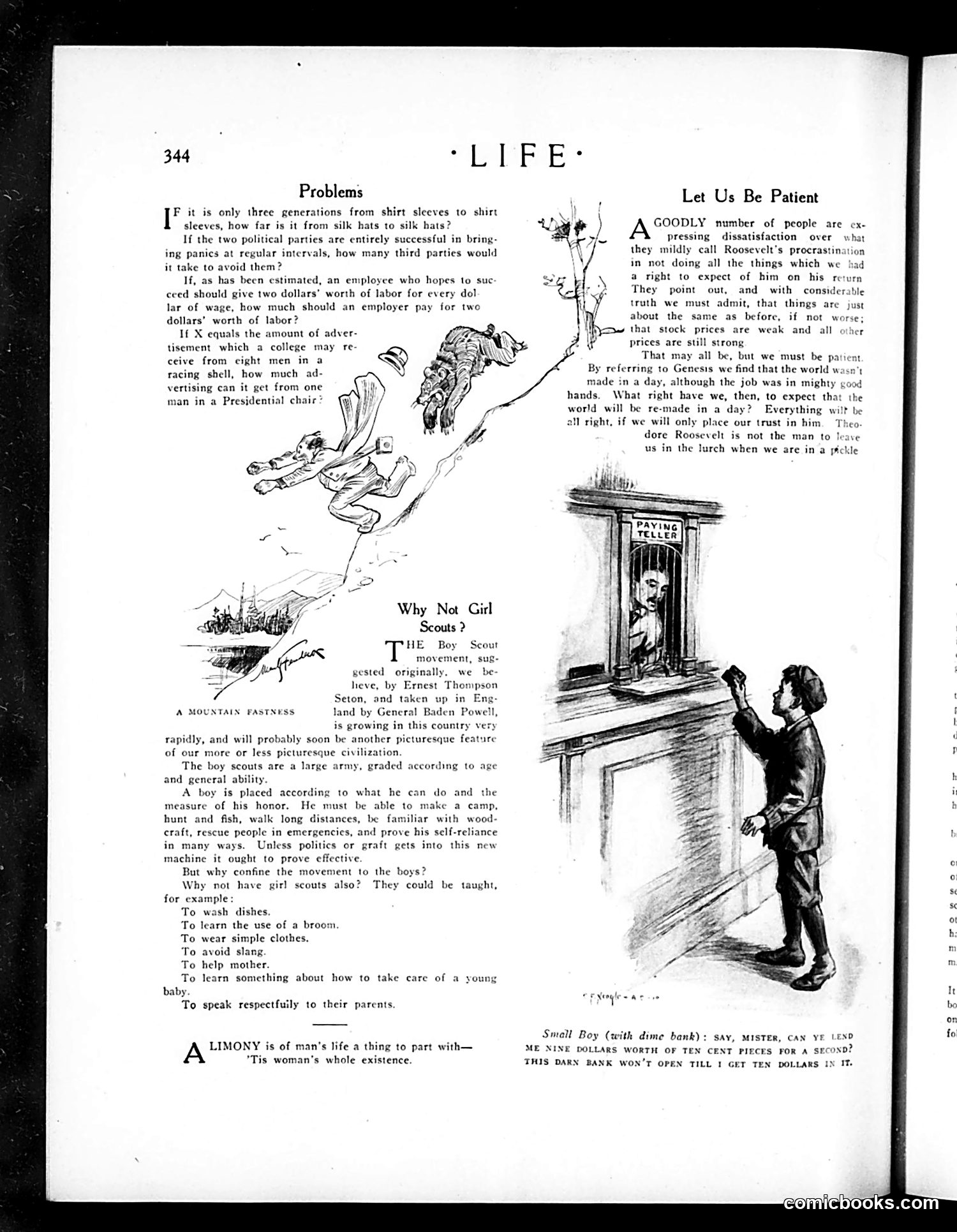
This page contains three satirical pieces targeting early 20th-century American social issues. **"Problems"** presents rhetorical questions mocking political and economic contradictions—particularly critiquing labor exploitation and the cyclical nature of economic panics caused by "two political parties." **"Why Not Girl Scouts?"** sarcastically proposes Girl Scouts as a counterpart to the Boy Scout movement (then recently established in America by Ernest Thompson Seton and Baden-Powell). The satire is sharply misogynistic by modern standards: it "jokes" that girls should be trained only in domestic servitude (washing dishes, housekeeping) rather than the outdoor skills and self-reliance taught to boys. This reflects period attitudes dismissing female capability. **"Let Us Be Patient"** defends Theodore Roosevelt against criticism that his reforms haven't yet transformed society, urging patience by comparing the world's creation to Roosevelt's reformist agenda. It's apologetic propaganda for the Progressive president. The illustration labeled "A Mountain Fastness" appears to accompany the cartoon about a boy at a savings bank, playing on themes of financial precarity during the era's economic instability.
📄 Transcribed text from this page (OCR, searchable)
Machine-transcribed from the original scan — historical spelling and the odd misread are preserved.
344 “LIFE: Problems F it is only three generations from shirt sleeves to shirt sleeves, how far is it from silk hats to silk hats? If the two political parties are entirely successful in bring- ing panics at regular intervals, how many third parties would it take to avoid them? If, as has been estimated, an employee who hopes to suc ceed should give two dollars’ worth of labor for every dol lar of wage, how much should an employer pay for two dollars’ worth of labor? If X equals the amount of adver- tisement which a college may re- ceive from cight men in a racing shell, how much ad- vertising can it get from one man in a Presidential cha’ Why Not Girl Scouts > HE Boy Scout movement, sug- gested originally, we be heve, by Ernest Thompson Seton, and taken up in Eng. land by General Baden Powell, is growing in this country very rapidly, and will probably soon be another picturesque feature of our more or less picturesque civilization. The boy scouts are a large army, graded according to age and general ability. A boy is placed according to what he can do and the measure of his honor. He must be able to make a camp, hunt and fish, walk long distances, be familiar with wood- craft, rescue people in emergencies, and prove his self-reliance in many ways. Unless politics or graft gets into this new machine it ought to prove effective But why confine the movement to the boys? Why not have girl scouts also? They could be taught, for example: To wash dishes. To learn the use of a broom. To wear simple clothes. To avoid slang To help mother. To learn something about how to take care of a young baby To speak respectfuily to their parents A MOUNTAIN FASTNESS A LIMONY is of man's life a thing to part with— 'Tis woman's whole existence. Let Us Be Patient GOODLY number of people are ex- pressing dissatisfaction over what they mildly call Roosevelt's procrastination in not doing all the things which we had a right to expect of him on his re: They point out, and with considerable truth we must admit, that things are just about the same as before, if not worse; that stock prices are weak and all other prices are still strong That may all be, but we must be patie: By referring to Genesis we find that the world ws made in a day, although the job was in mighty goo hands. What right have we, then, to expect that th world will be re-made in a day? Everything wilt | all right, if we will only place our trust in him. Theo dore Roosevelt is not the man to | in the lurch when we are in a ME NINE DOLLARS WORTH OF TEN CENT PIECES FOR A SEC THIS DARN BANK WON’T OPEN TILL 1 Gi