
A complete issue · 40 pages · 1910
Life — June 23, 1910
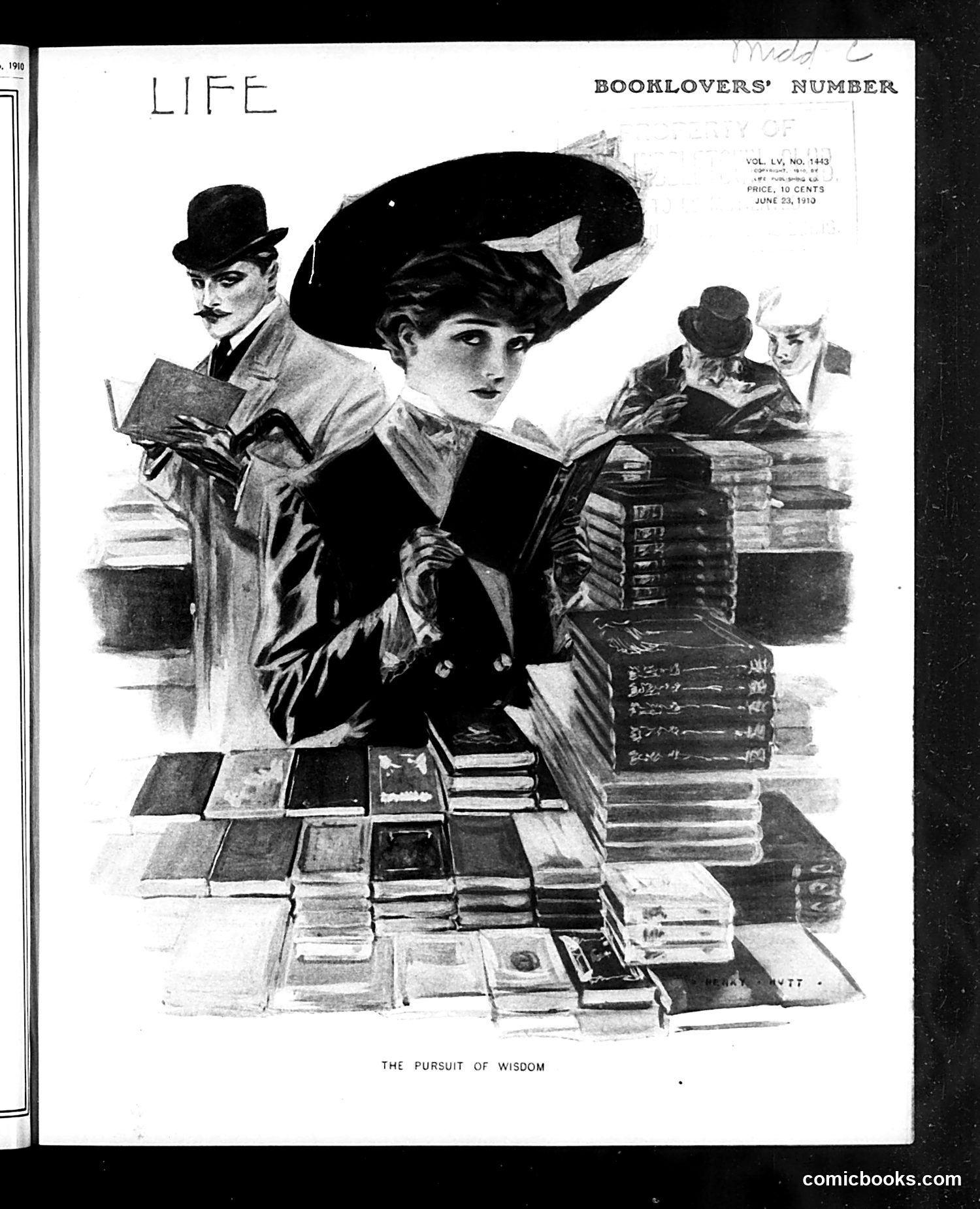
This cover illustration satirizes the intellectual aspirations of the era's educated classes. The central figure—a fashionably dressed woman wearing an enormous, impractical hat—carries a single book while surrounded by towering stacks of volumes. Male figures in the background also clutch books. The satire targets the pretense of "self-improvement" culture: the woman's elaborate appearance and the sheer volume of unread books suggest people were more concerned with the *appearance* of being cultured and educated than with actual learning. The unwieldy hat symbolizes impractical vanity overshadowing genuine intellectual pursuit. This reflects early 20th-century debates about whether mass-market publishing and education genuinely improved minds or merely created an illusion of sophistication among the leisure classes.
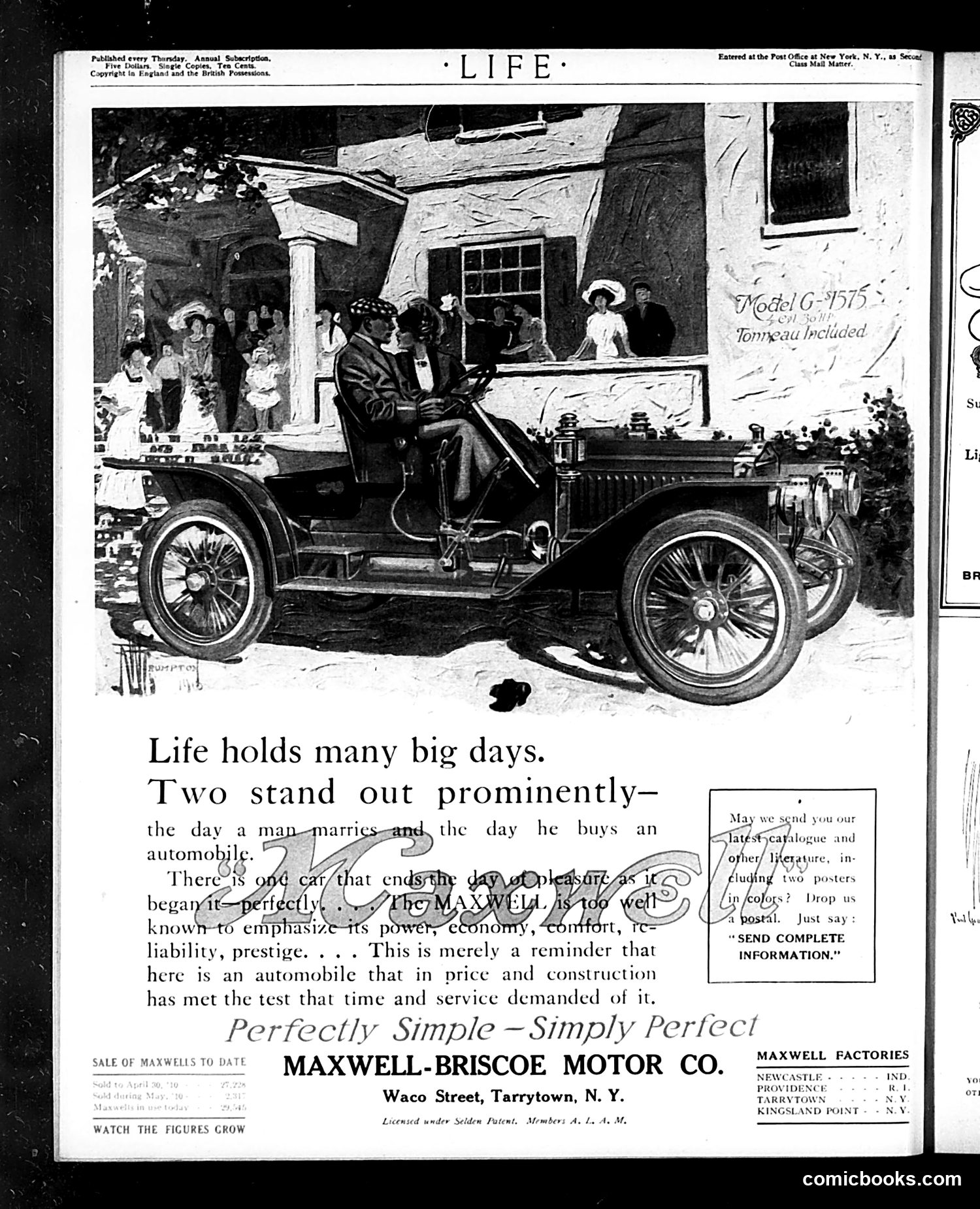
This page is primarily a **Maxwell-Briscoe automobile advertisement**, not political satire. The headline "Life holds many big days" positions car purchase alongside marriage as a major life milestone. The illustration shows a well-dressed man in an early automobile outside what appears to be a social venue, emphasizing the car's role in social status and leisure. The ad copy stresses the Maxwell's "power, economy, comfort, reliability, prestige," appealing to aspirational buyers. The tagline "Perfectly Simple—Simply Perfect" emphasizes accessibility to middle-class consumers. The reference to "WATCH THE FIGURES GROW" and sales data suggests this ran during a period of growing automobile adoption (likely early 1900s-1910s). This reflects America's transition to car culture rather than containing political messaging or caricature.
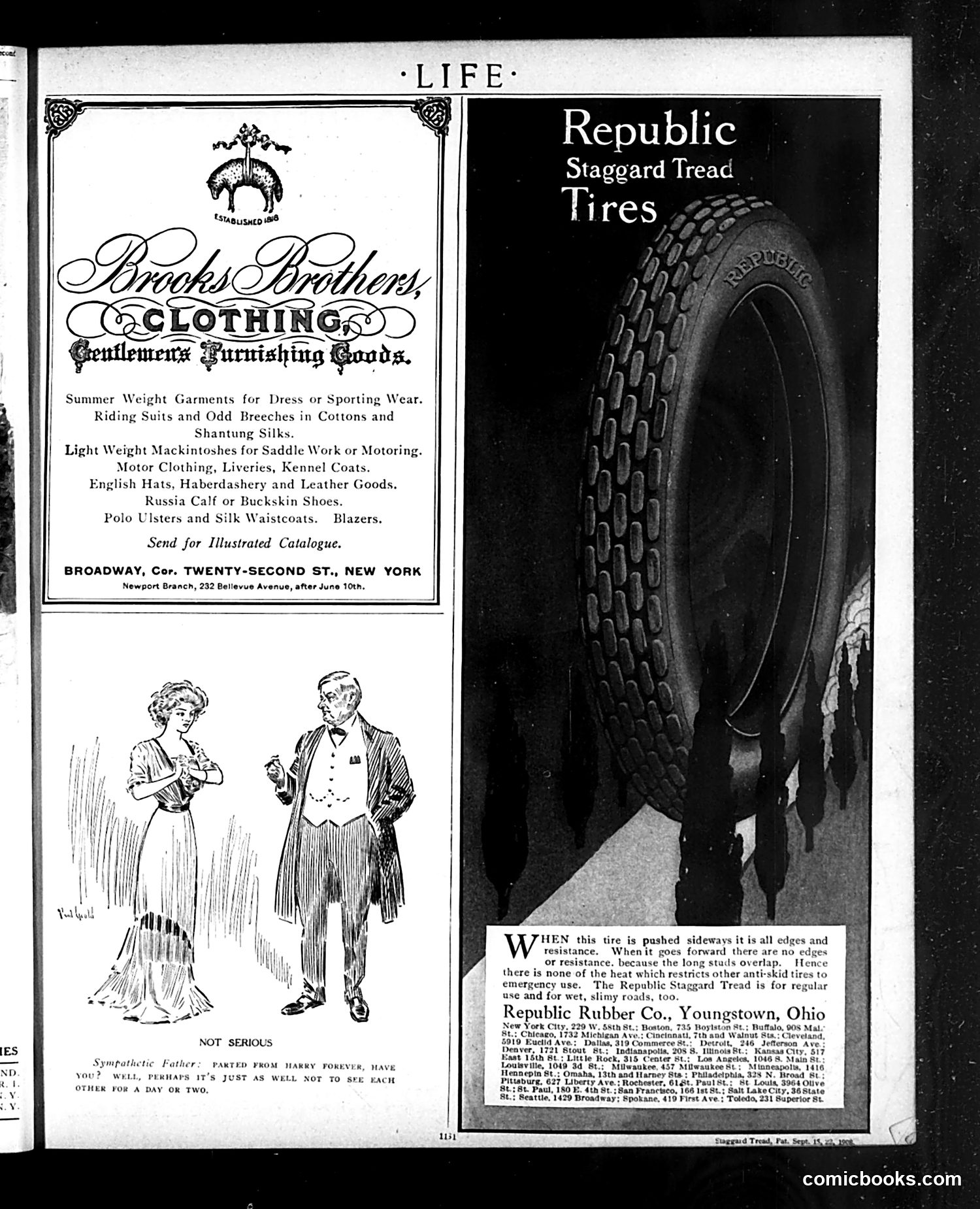
This page contains two unrelated advertisements rather than political satire. The left side advertises Brooks Brothers clothing for gentlemen, featuring a sketch titled "NOT SERIOUS" showing a couple in formal wear. The caption references "a Prophetic Father: PARTED FROM HARRY FOREVER, HAVE YOU? WELL, PERHAPS IT'S JUST AS WELL NOT TO SEE EACH OTHER FOR A DAY OR TWO." This appears to be light domestic humor about a couple's quarrel, not political commentary. The right side advertises Republic Staggard Tread Tires from Youngstown, Ohio. It includes a technical explanation of the tire's design features and lists numerous sales offices across America. Neither content contains political satire or social commentary—this is simply a commercial magazine page from the early 20th century.
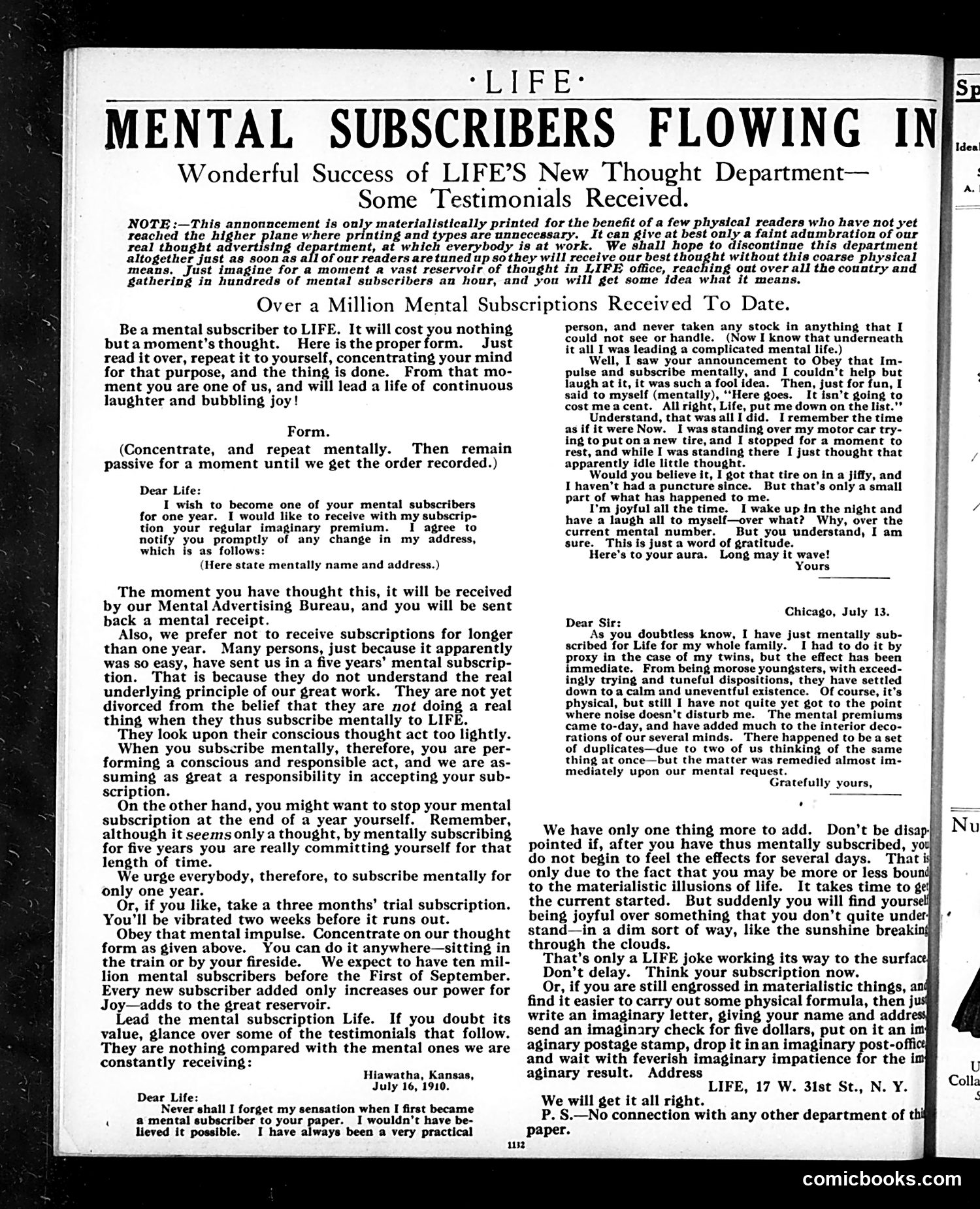
This page is primarily **advertising copy, not a cartoon or satirical content**. It promotes Life magazine's "Mental Subscribers" program—a gimmick where readers could mentally "subscribe" to the publication through concentrated thought rather than paying money. The piece is satirical about the concept itself: it mocks the impracticality by presenting testimonial letters from readers claiming the mental subscription actually worked, producing absurd results (one subscriber reports their car troubles vanished after "mental thoughts"). The satire targets both **credulous readers** willing to believe in magical thinking and **materialist illusions**—poking fun at metaphysical or pseudo-scientific claims popular in that era. The humor lies in earnestly presenting impossible results as genuine testimonials to an obviously fake subscription method.
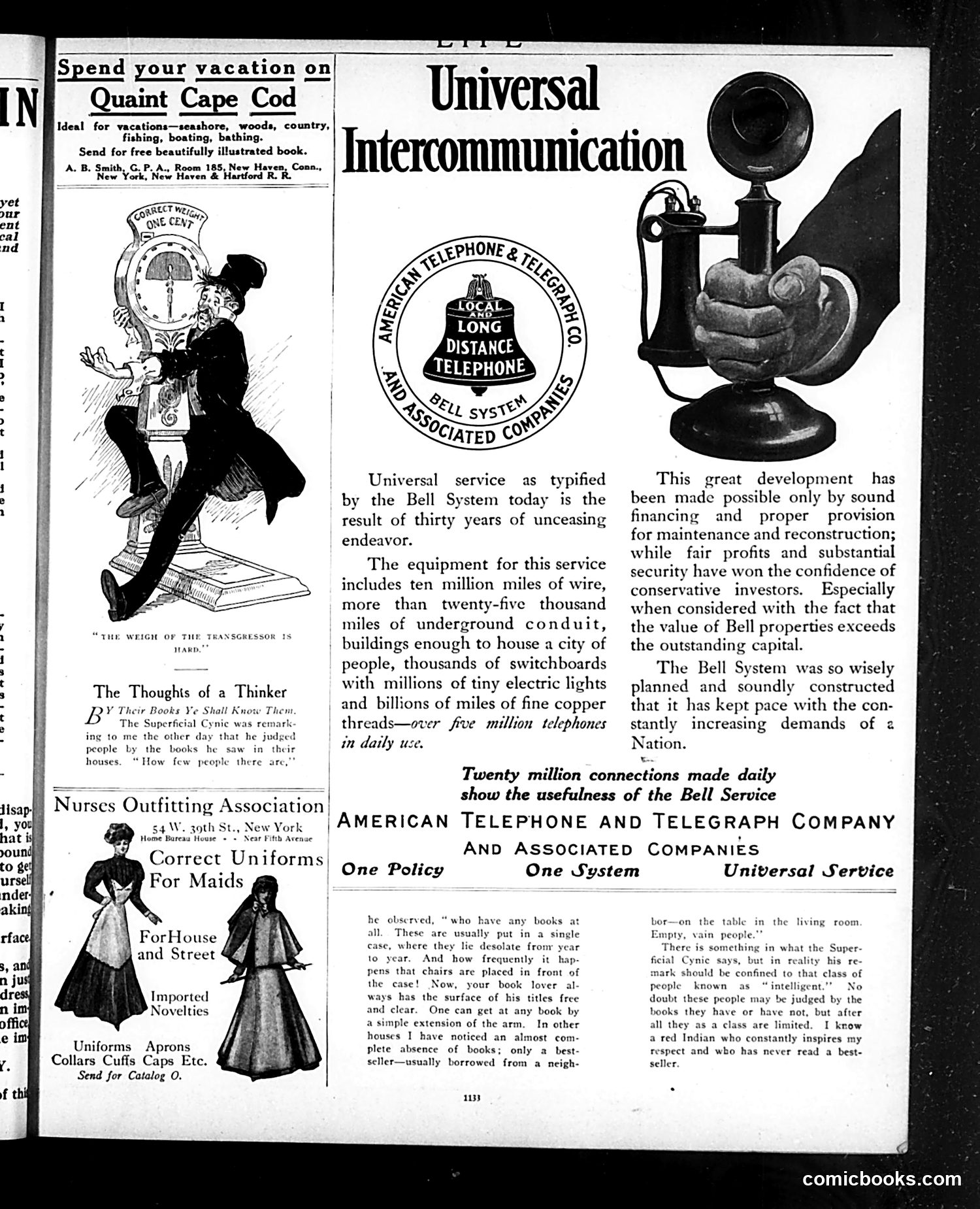
This page is primarily **advertising** rather than satirical content. The left side contains ads for Quaint Cape Cod vacations and a Nurses Outfitting Association offering uniforms and imported novelties. The dominant feature is a large **Bell System telephone advertisement** celebrating "Universal Intercommunication." The ad emphasizes the technical infrastructure supporting telephone service—ten million miles of wire, underground conduits, and switching equipment serving five million daily connections. The accompanying text presents this as a triumph of American capitalism: the Bell System's careful planning, sound financing, and investor confidence have enabled it to meet growing national demand. The single illustration shows a hand holding an old-style telephone handset. This represents corporate promotional content typical of the era, celebrating technological achievement and business success.
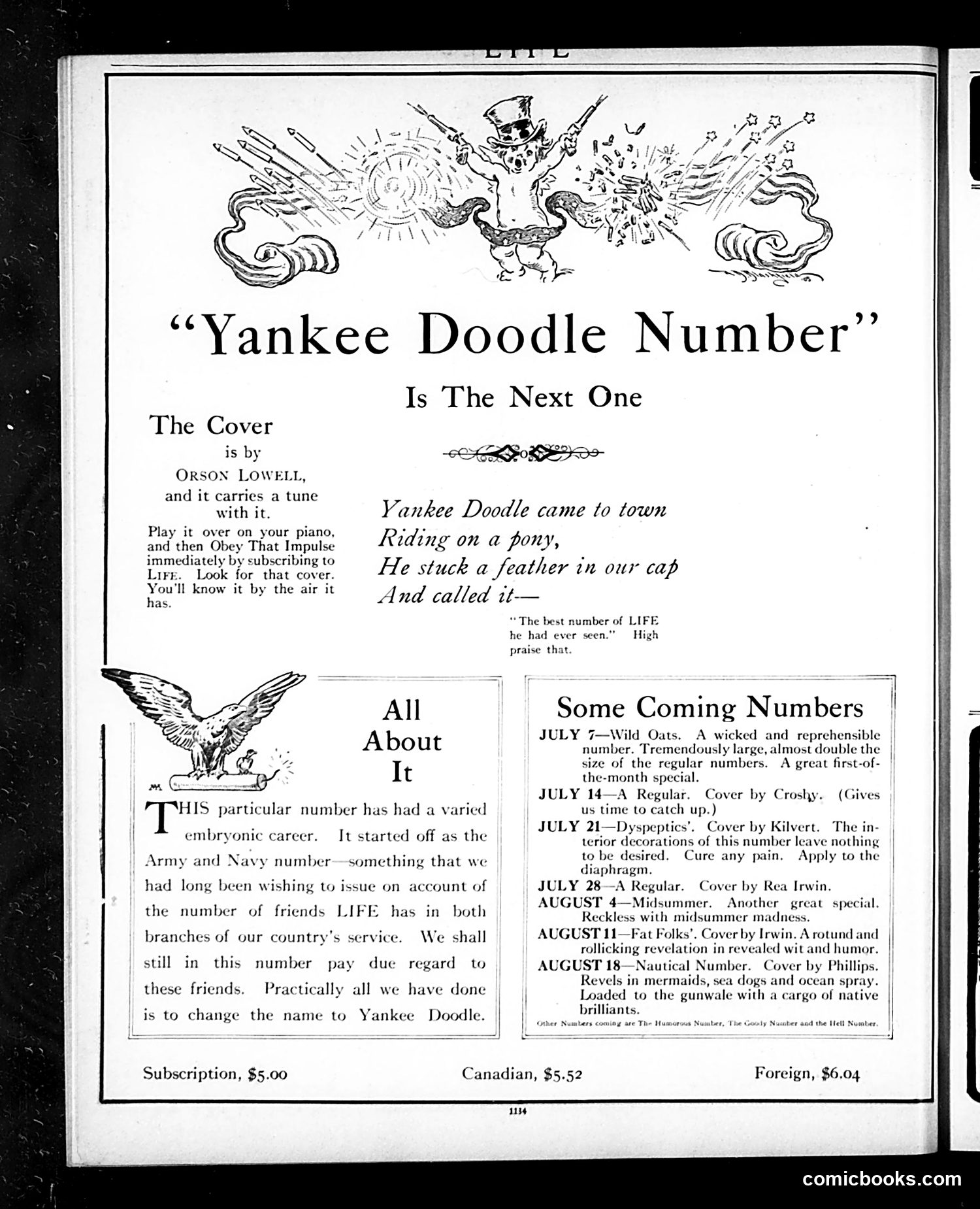
This page announces a special issue of *Life* magazine featuring "Yankee Doodle Number," with cover art by Orson Lowell. The content celebrates the famous Revolutionary War song "Yankee Doodle" by reprinting its opening verse. The satire appears mild by modern standards. The text explains the issue originally started as an Army and Navy publication but was renamed to "Yankee Doodle" to honor the magazine's friends in military service. The accompanying illustrations show patriotic imagery—an eagle and a cartoonish figure in a top hat with weapons and fireworks—typical of American patriotic humor. The page is primarily promotional, advertising upcoming special issues ("Some Coming Numbers") covering various themes. This appears to be wartime-era content, though the specific conflict is unclear from the page alone.
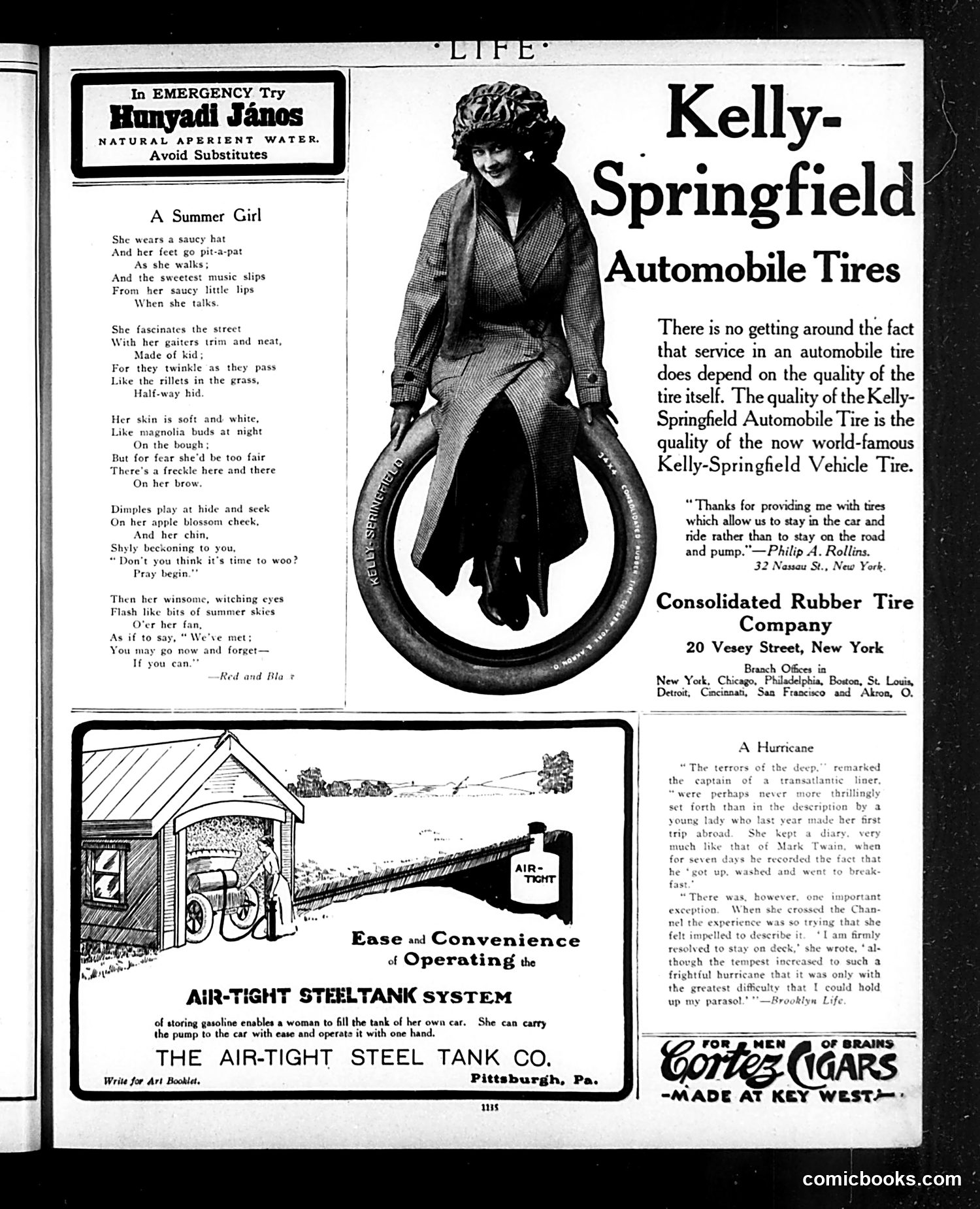
This page is primarily **advertising**, not satire or political commentary. It contains four distinct ads: 1. **Hunyadi János water** (top left) - a natural aperient water product 2. **Kelly-Springfield Automobile Tires** (center/right) - featuring a woman posing with a large tire, emphasizing product quality with a customer testimonial 3. **Air-Tight Steel Tank System** (bottom left) - showing a woman able to fill her own car's gasoline tank independently, marketed as convenient and modern 4. **Gorges Cigars** (bottom right) The page also includes poetry titled "A Summer Girl" (left side) describing fashionable women's appearance and behavior. The ads reflect **1920s consumer culture** and notably emphasize **women's independence and modernity** — women driving, managing vehicles autonomously, and participating in automotive culture.
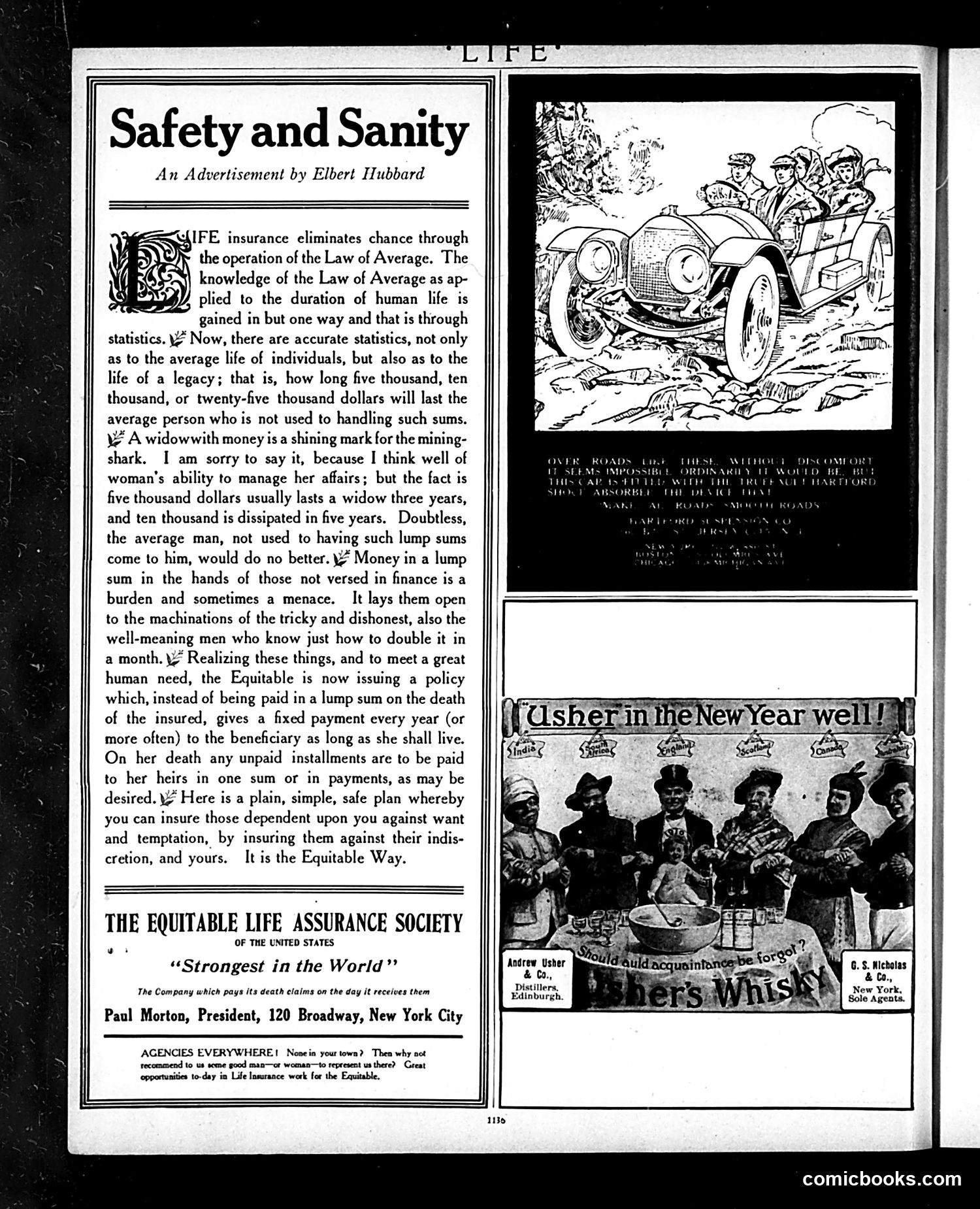
This page contains **two separate advertisements** rather than political satire. The left side is an Equitable Life Assurance Society advertisement by Elbert Hubbard. It argues that life insurance protects dependents from financial mismanagement, using statistics about how quickly large sums of money disappear. The ad promotes Equitable's fixed-payment policy as safer than lump-sum payouts. The right side advertises **Usher's Whisky** with a New Year's themed image showing six men in formal attire and hats toasting with drinks. The caption reads "Usher in the New Year well!" — a pun on the product name. Both are straightforward commercial advertisements typical of early 20th-century magazines, not satirical commentary. The Usher's ad's drinking imagery would be notable today as pre-Prohibition liquor advertising.
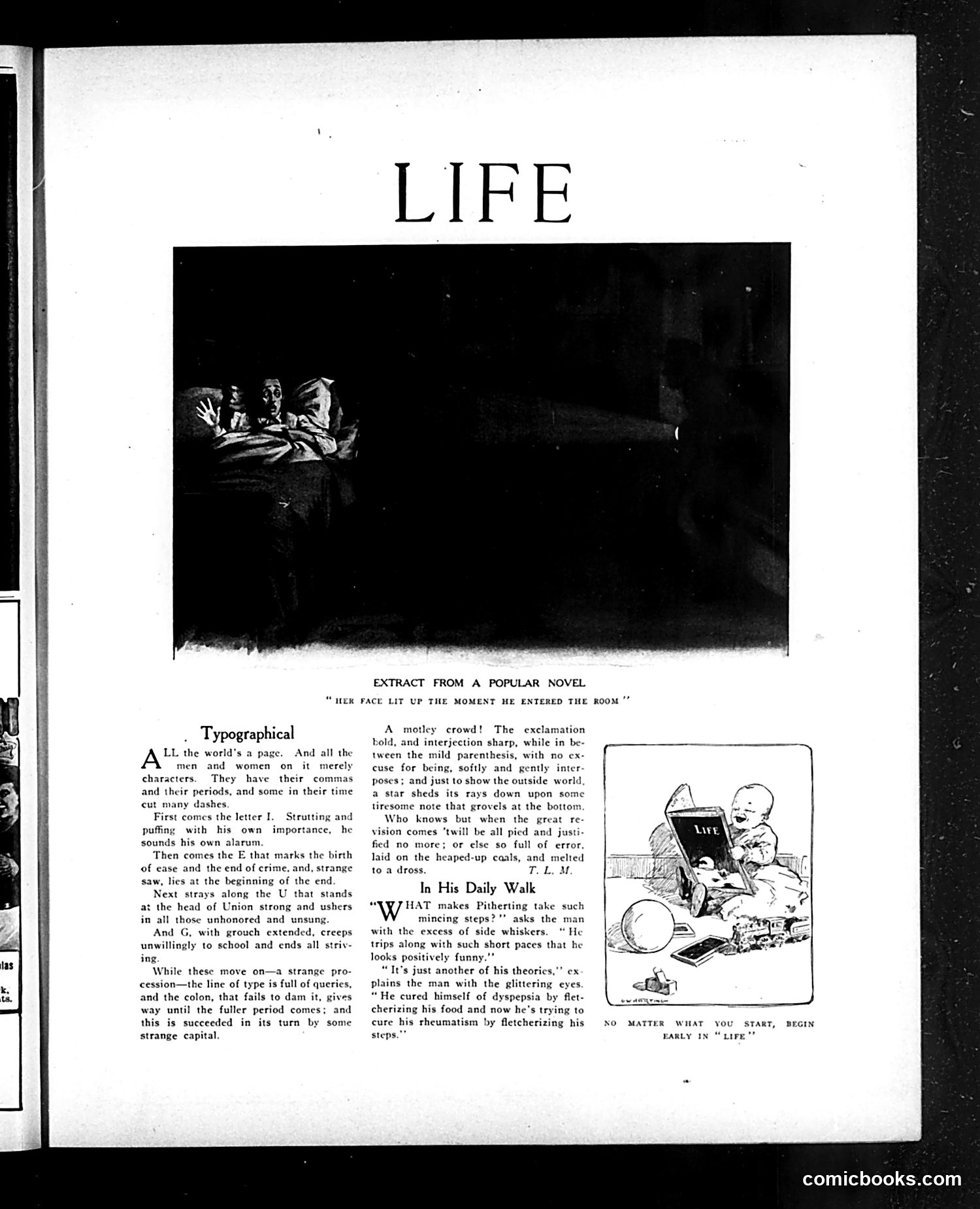
This page contains literary and typographical commentary rather than political satire. The main content includes: 1. **"Extract from a Popular Novel"** - A dark photograph captioned "Her face lit up the moment he entered the room," which appears to be humorous irony given the pitch-black image. 2. **"Typographical"** - A commentary on typography in literature, discussing how letters like "I" and "E" function in text, with wordplay about dashes and periods. 3. **"In His Daily Walk"** - A small cartoon showing a baby with Life magazine, captioned "No matter what you start, begin early in 'Life,'" which is an advertisement for the magazine itself using the magazine's name as a pun. The page blends literary criticism with self-promotional advertising typical of early Life magazine's sophisticated, intellectual humor.
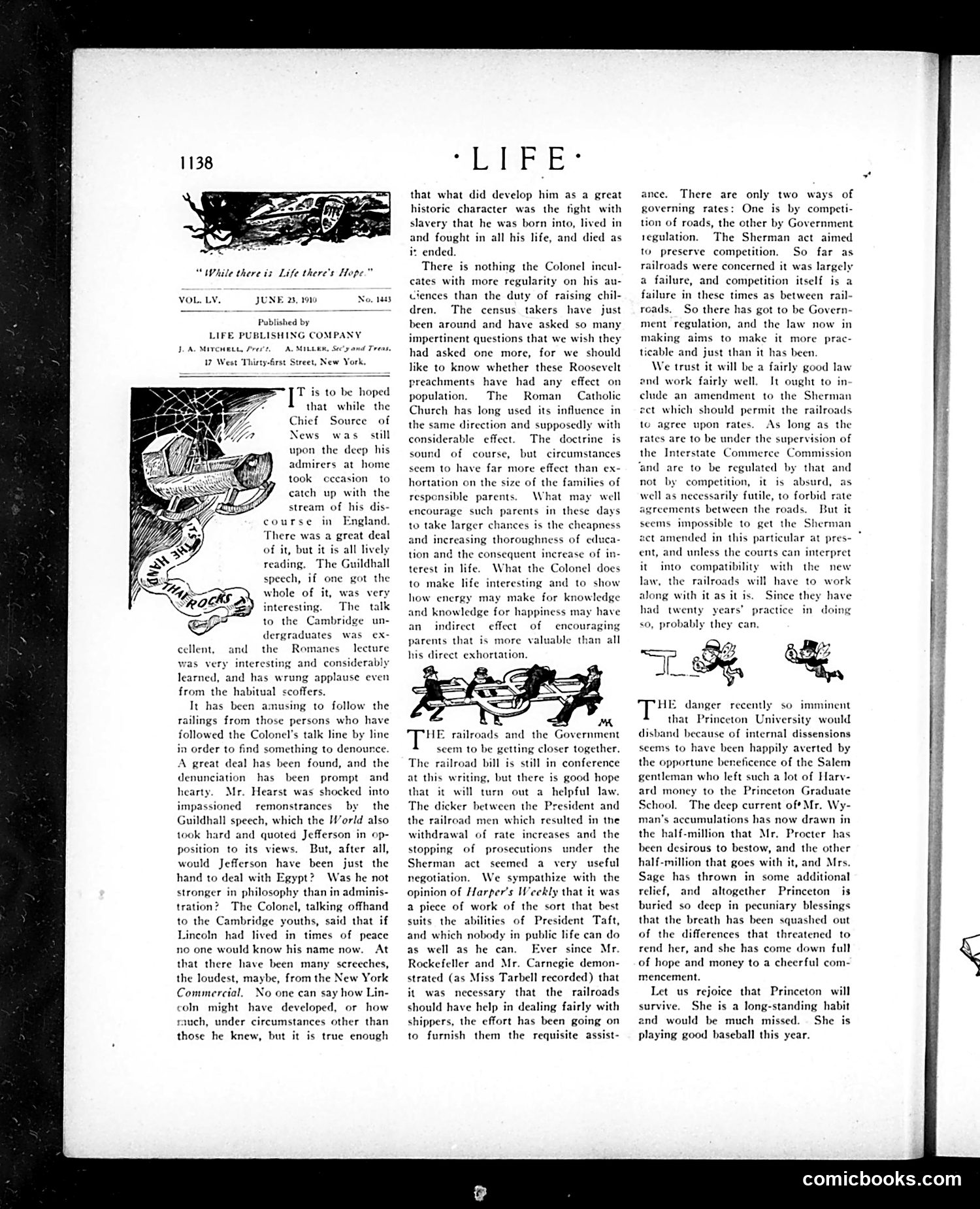
This page contains editorial commentary on contemporary issues rather than political cartoons. The main illustration—labeled "Life there's Hope"—depicts a figure in stocks or shackles, likely representing constraint or oppression. The text discusses railroad regulation, government control versus competition, and Roosevelt administration policies. It references debates over the Sherman Act's application to railroads and mentions Princeton University's recent internal troubles. The cartoon's specific meaning is unclear without additional context, but the shackled figure likely represents either: railroads constrained by government regulation, or citizens restricted by monopolistic railroad practices. The accompanying editorial suggests ambivalence about whether government regulation or competition better serves the public interest—a central Progressive Era debate.
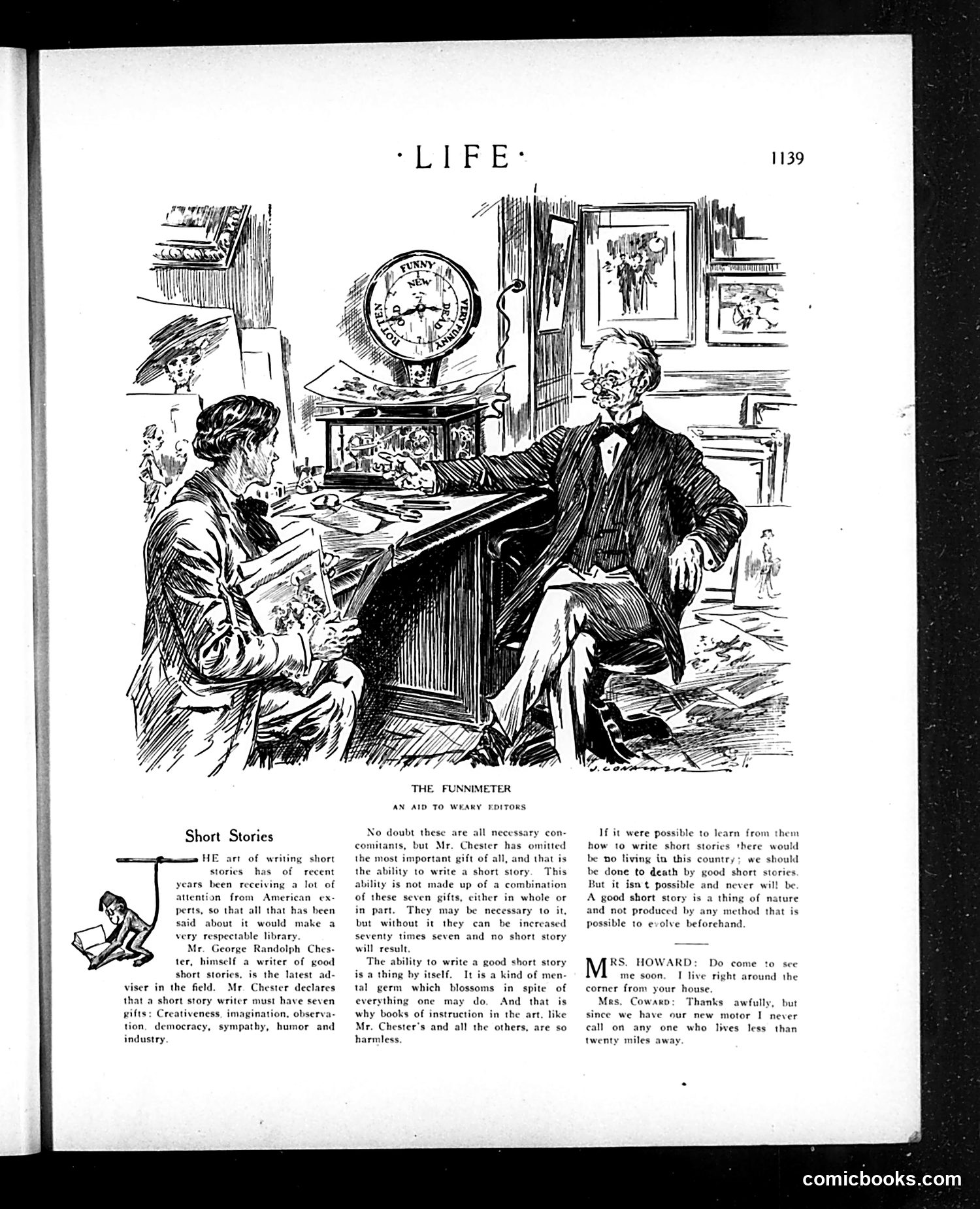
This cartoon satirizes the challenge editors face in evaluating humor submissions. The illustration shows two men at a desk with an ornate clock labeled "FUNNY" above it—a mock measuring device for determining whether writing is funny. The accompanying text discusses Mr. Chester's advice on short-story writing, emphasizing that good humor requires specific talents: "creativeness imagination, observation democracy, sympathy, humor and industry." The joke targets the subjective nature of editorial work: there's no objective "meter" for measuring humor, yet editors must constantly judge submissions. The cartoon humorously visualizes this impossible task—suggesting editors desperately need such a device because determining what's actually funny is inherently difficult and inconsistent.
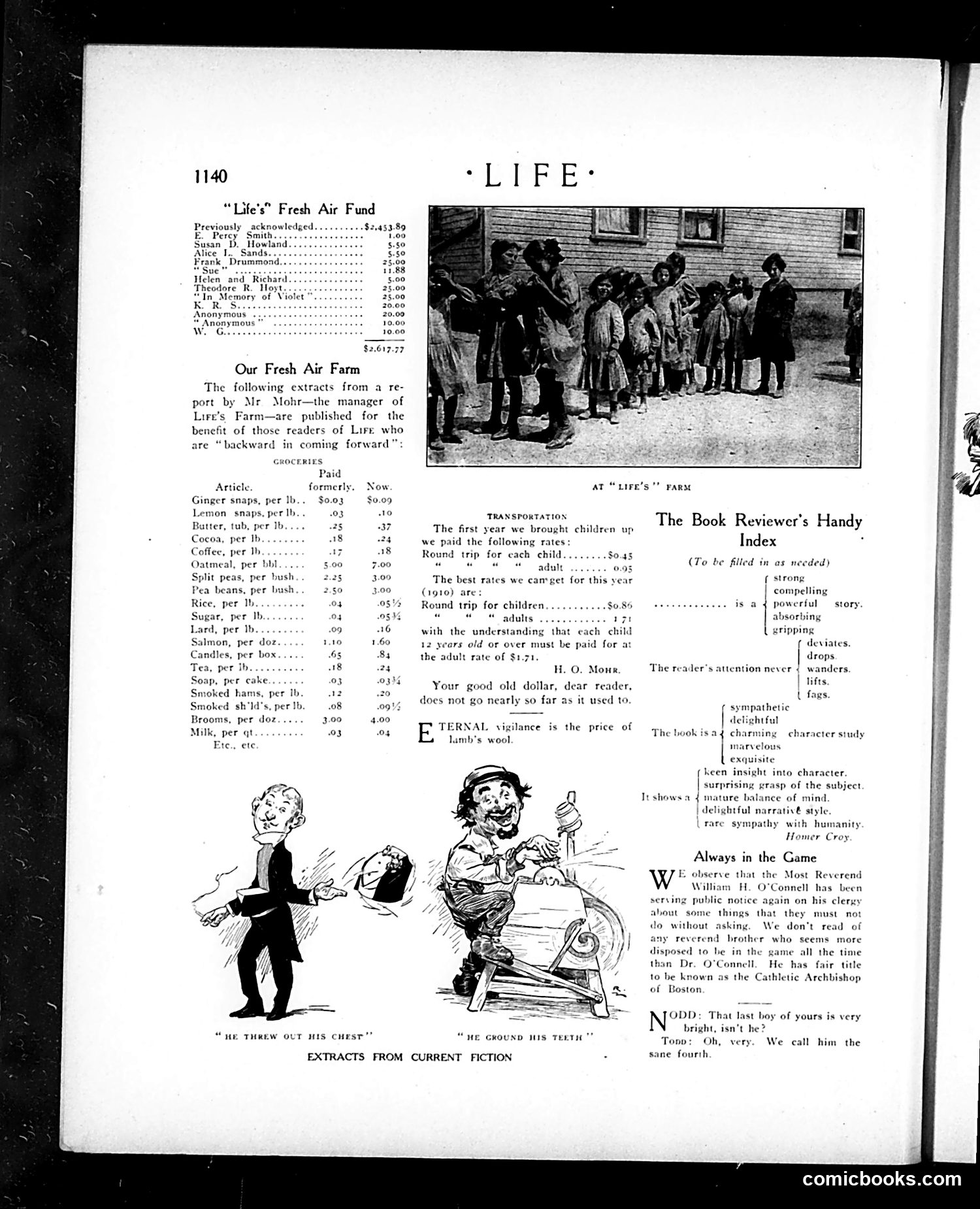
This page contains two cartoon "extracts from current fiction" at the bottom, both depicting exaggerated physical comedy: **Left cartoon** ("He threw out his chest"): Shows a thin man puffing out his chest while a rotund man looks on, illustrating the literal interpretation of an idiom about displaying pride or confidence. **Right cartoon** ("He ground his teeth"): Depicts a man literally grinding his teeth on a grinding wheel, again taking a common expression (grinding one's teeth in anger) literally for comedic effect. These are **visual puns**—wordplay jokes that illustrate idiomatic expressions through absurd literal interpretation. This type of humor was common in early-20th-century satirical magazines, relying on the audience's familiarity with everyday phrases to find humor in their impossible physical manifestations. The jokes require no specific political or social context beyond understanding English idioms.
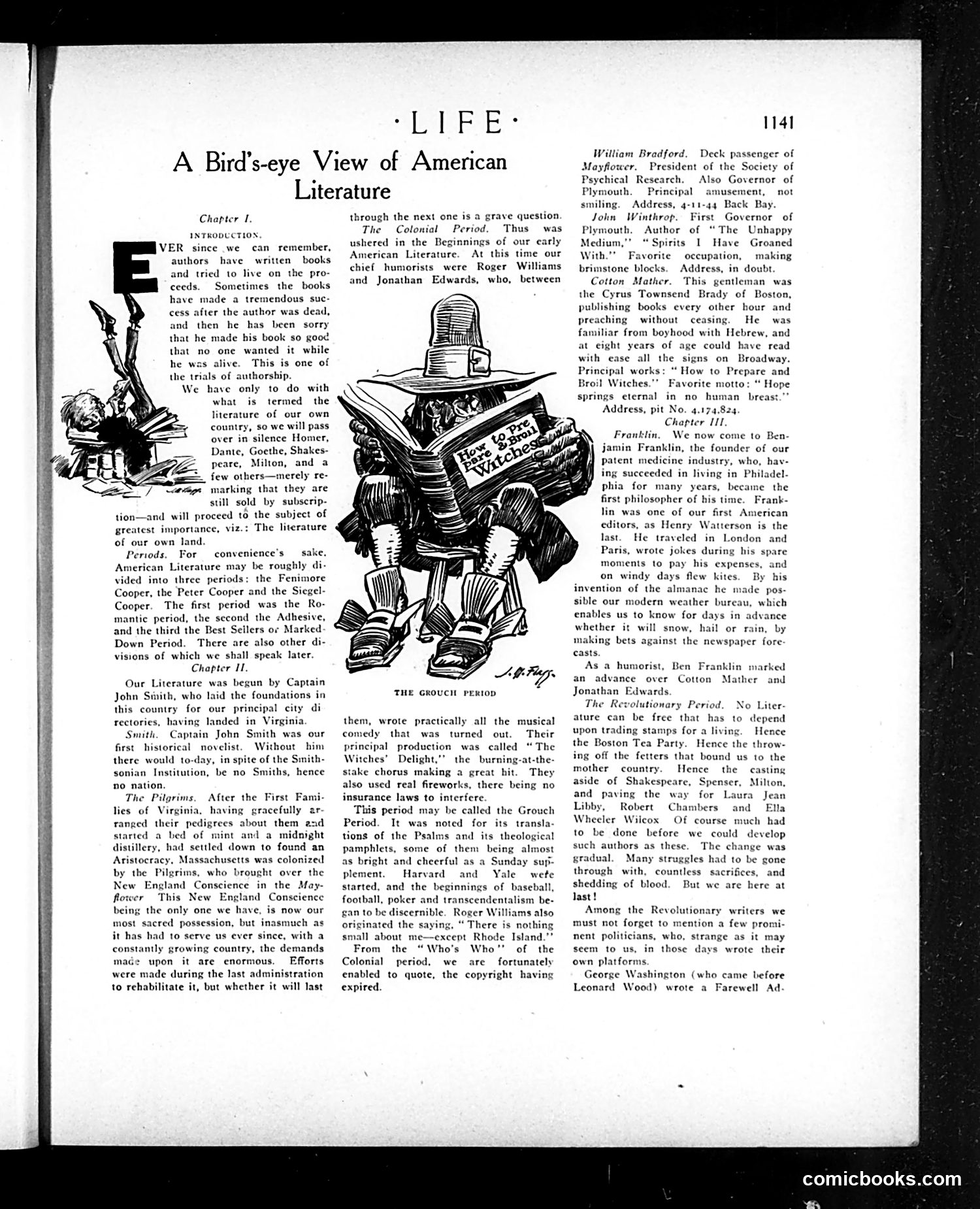
This page introduces a series surveying American literary history from colonial times onward. The central illustration depicts a figure (likely representing American literature itself) as a colonial-era Puritan or Pilgrim, reading a book while sitting atop a stack of volumes labeled with authors' names. The satire appears to mock how American literature is studied—presented as a stern, old-fashioned enterprise rooted in Puritanical traditions. The figure's formal colonial dress and serious demeanor suggest the text will critique how American literary history has been taught as a solemn, moralistic enterprise dominated by early Puritan writers. The upcoming chapters will examine periods from the Colonial through Revolutionary eras, tracing how American letters developed from religious and didactic origins.
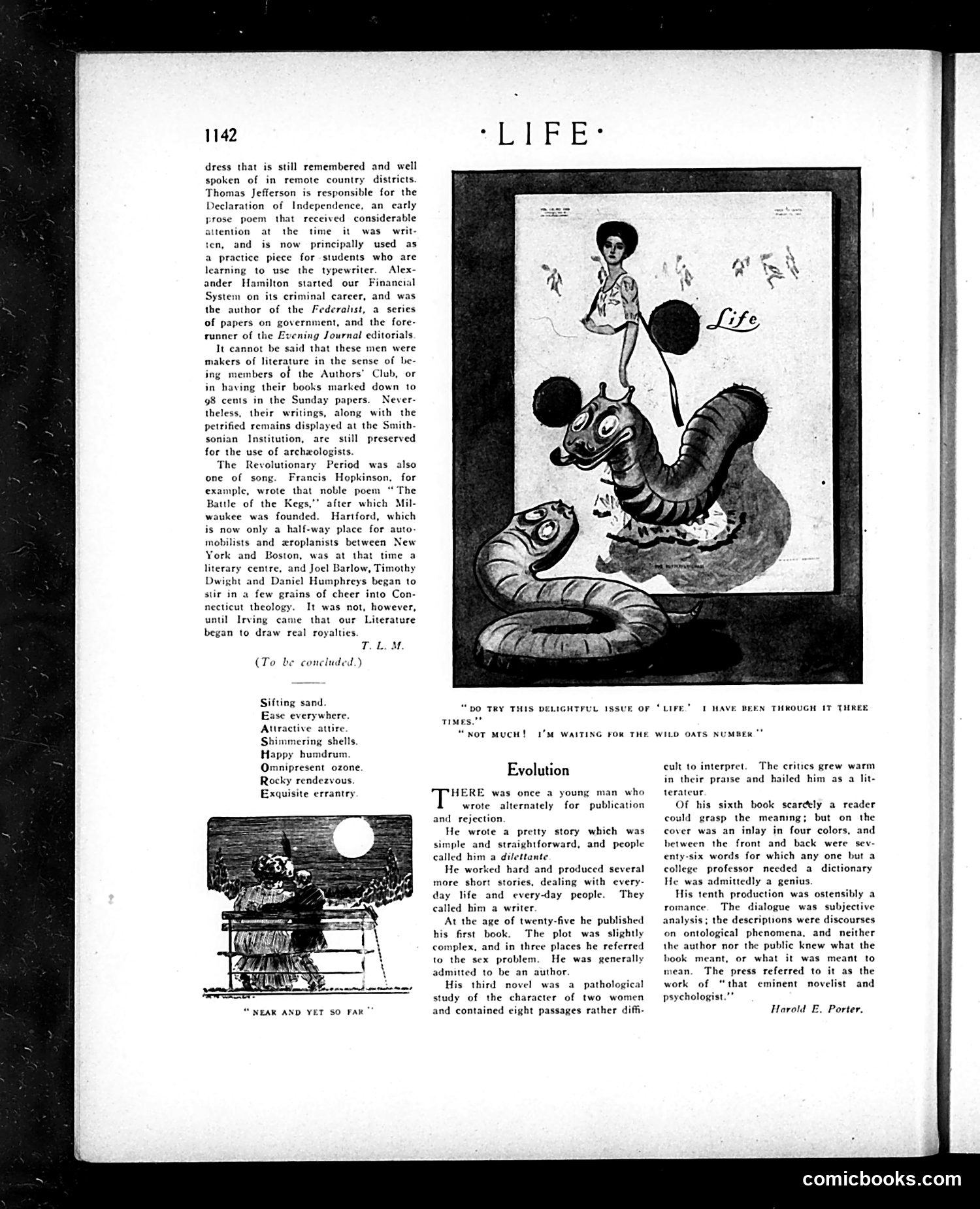
This page satirizes the evolution of literary pretension in America. The top section humorously debunks Revolutionary-era figures—Thomas Jefferson's Declaration is now just a typing practice exercise; Alexander Hamilton's *Federalist* papers are precursors to newspaper editorials. The main article "Evolution" (by Harold E. Porter) mocks how writers gain credibility through obscurity rather than talent. A young writer begins as a "dilettante" writing simple stories, becomes an "author" after adding vague sexual references to his third novel, and finally achieves "genius" status when his work becomes incomprehensible—filled with "ontological phenomena" that neither author nor readers understand. The satire's point: critics and the literary establishment reward complexity and obscurity over clarity and genuine storytelling. The fancier and more meaningless the prose becomes, the more prestigious the writer appears. It's a sharp critique of literary snobbery and the disconnect between critical acclaim and actual readability.
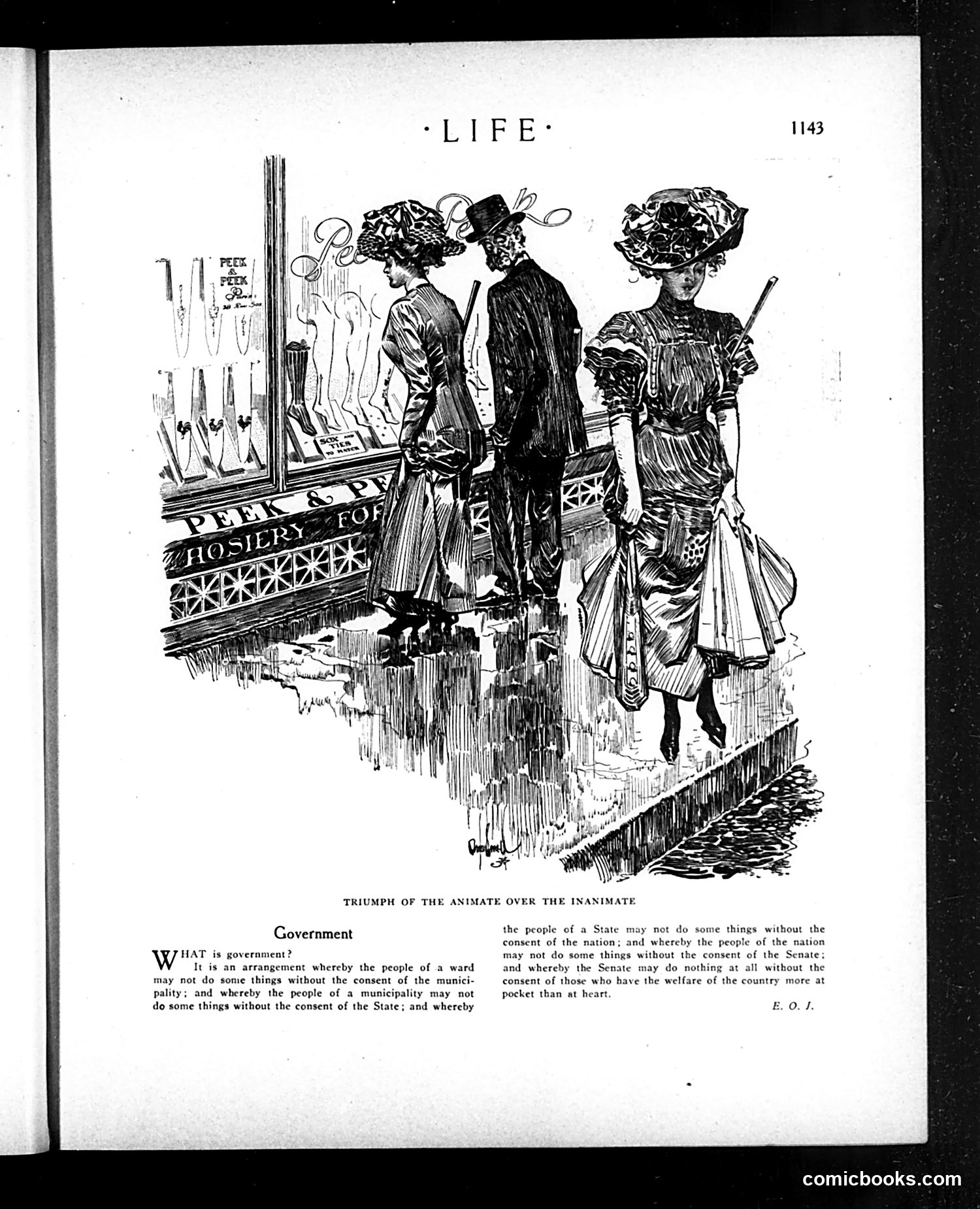
This satirical piece critiques bureaucratic government structure through a shopping scene. Three well-dressed women stand before a "Hosiery" store counter displaying stockings—the "inanimate" objects of the title. The accompanying definition of government is a cynical cascade: each level of authority (ward, municipality, state, nation, Senate) requires consent from higher powers, until finally the Senate answers to those with financial interests ("the welfare of the country more at pocket than at heart")—suggesting corruption and prioritization of money over public good. The cartoon's title suggests these animated, intelligent women triumph over mere merchandise, yet the satirical text implies that actual government power flows downward through layers of bureaucratic obstruction, ultimately controlled by wealthy special interests rather than serving the people. The piece mocks both governmental inefficiency and plutocratic influence.
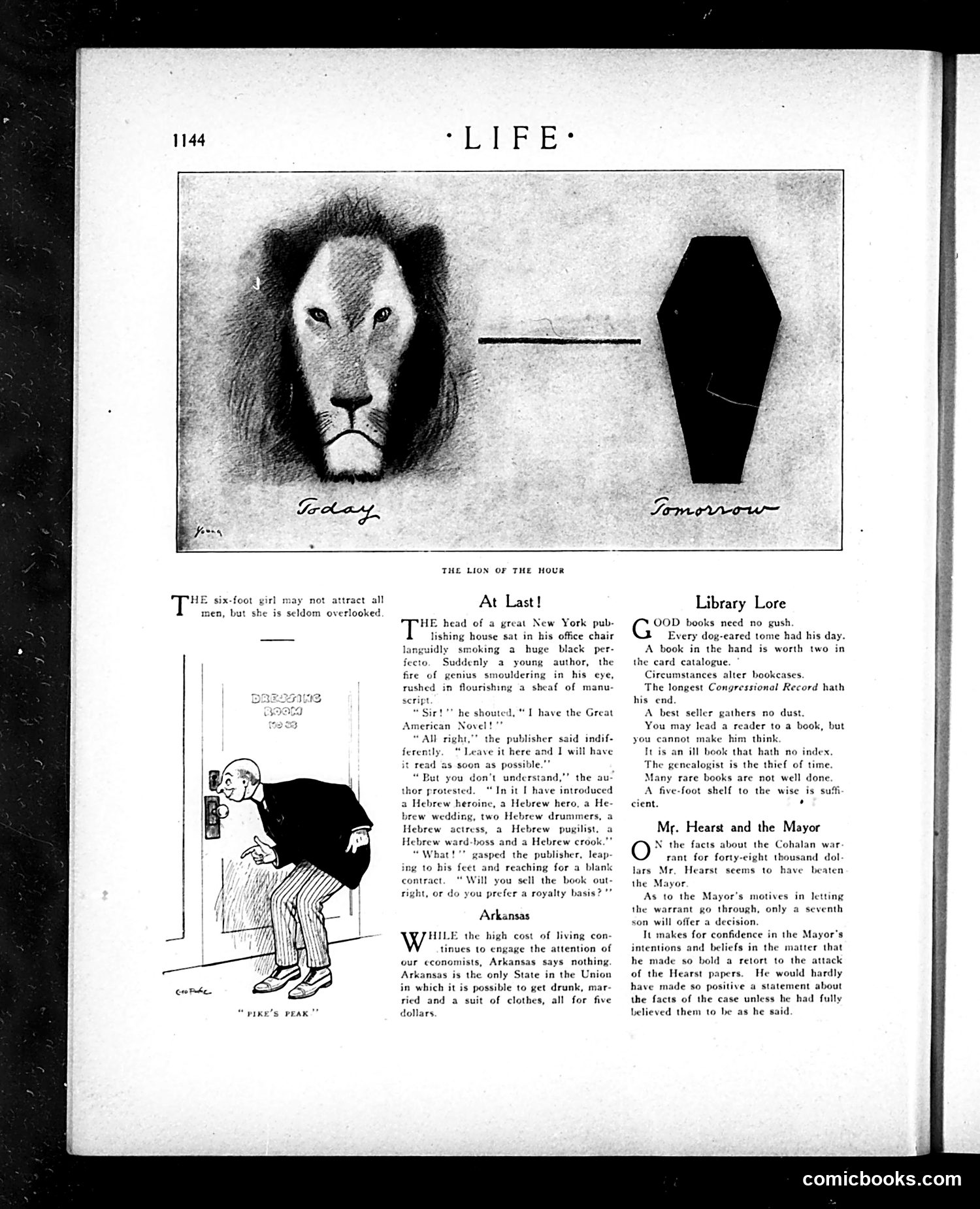
This page satirizes early 20th-century American publishing and politics through three distinct pieces: **Top cartoon:** "Today/Tomorrow" contrasts a lion's head (representing a living publisher or literary figure) with a coffin, darkly joking about celebrity's fleeting nature. **"At Last!" story:** Mocks publishers' sudden interest in "ethnic" literature. A young author pitches a novel featuring Hebrew characters (heroine, hero, drummer, actress, word-boss, crook). The indifferent publisher becomes eager only when hearing the Jewish content—satirizing how publishers chase marketable trends rather than literary merit. **"Pike's Peak" cartoon:** A nervous man at a door, likely referencing either a tall woman or someone facing an awkward social situation. **"Arkansas" item:** Jokes that Arkansas is so economically depressed one can get drunk, married, and suited for five dollars total. **"Mr. Hearst and the Mayor":** References William Randolph Hearst's conflict with New York's Mayor over a supposed warrant, suggesting Hearst "beat" the Mayor in this dispute. The page exemplifies *Life*'s satirical approach to publishing, economics, and local politics.
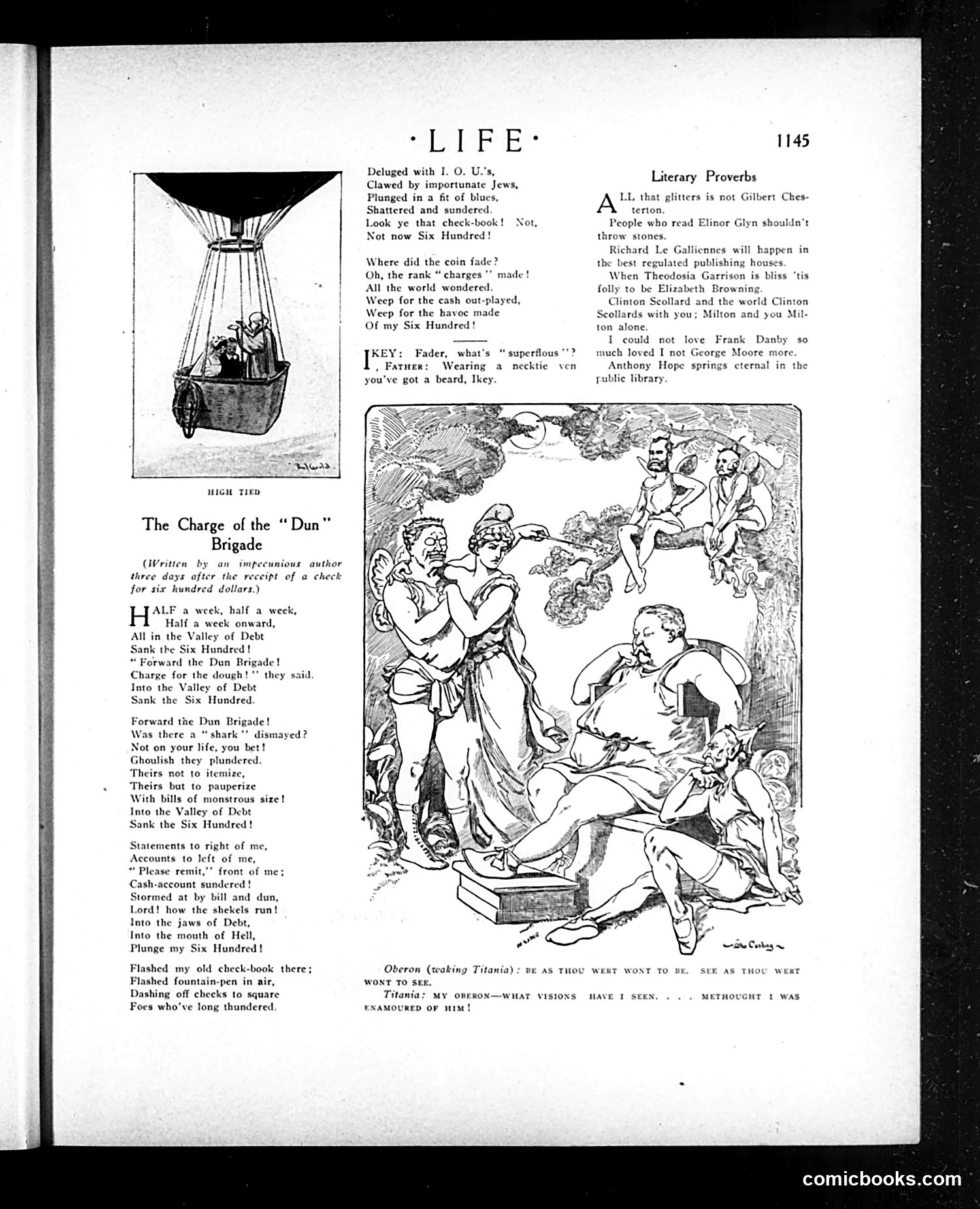
This satirical poem parodies Tennyson's "The Charge of the Light Brigade," substituting military cavalry with debt collectors ("duns"). The joke targets an impecunious author who received a $600 check but quickly faced bills and creditors pursuing payment. The satire operates on multiple levels: the author's six-hundred-dollar windfall is immediately consumed by outstanding debts and aggressive creditors ("sharks," "importunate Jews"). The mock-heroic language transforms mundane financial struggle into epic battle, with creditors as relentless adversaries overwhelming the hapless writer. The reference to "importunate Jews" reflects unfortunately common anti-Semitic stereotypes of the era regarding moneylenders and debt collection. The poem's humor relies on readers recognizing both literary parody and the universal middle-class anxiety of living paycheck-to-paycheck, where sudden income provides only temporary relief before obligations resurface.
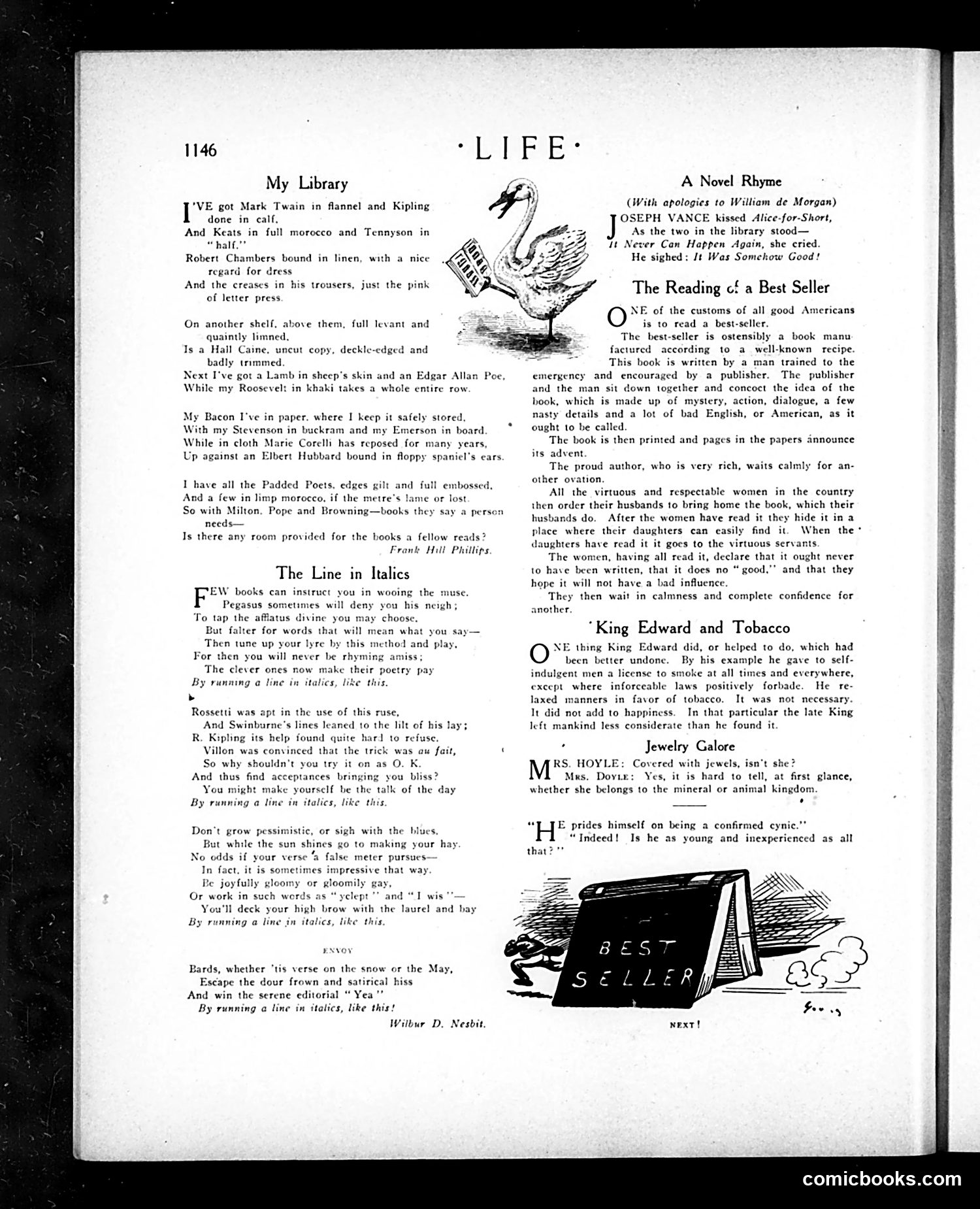
This page satirizes American literary pretension and publishing culture. The left column mocks collectors who obsessively bind books by famous authors (Mark Twain, Kipling, Keats, Tennyson) in expensive materials—valuing the *physical appearance* of literature over actual reading. The joke: these books sit displayed but unread, their bindings chosen for aesthetic matching rather than content. "The Line in Italics" ridicules poets who use *italicized text* as a lazy shortcut to seem profound—suggesting writers can hide weak verse through formatting tricks, a practice apparently common enough to warrant satire. "The Reading of a Best Seller" mocks both the publishing industry and consumers. It describes best-sellers as cynically manufactured products: publishers and authors collaborate on a formula of "mystery, action, dialogue, a few nasty details and bad English." Women buy them for respectability while hiding them from daughters, then publicly condemn the books—a hypocritical performance of morality. The cartoon of the "Best Seller" book emphasizes its commercial success over literary merit. The overall theme: American society values books as status symbols rather than for genuine engagement.
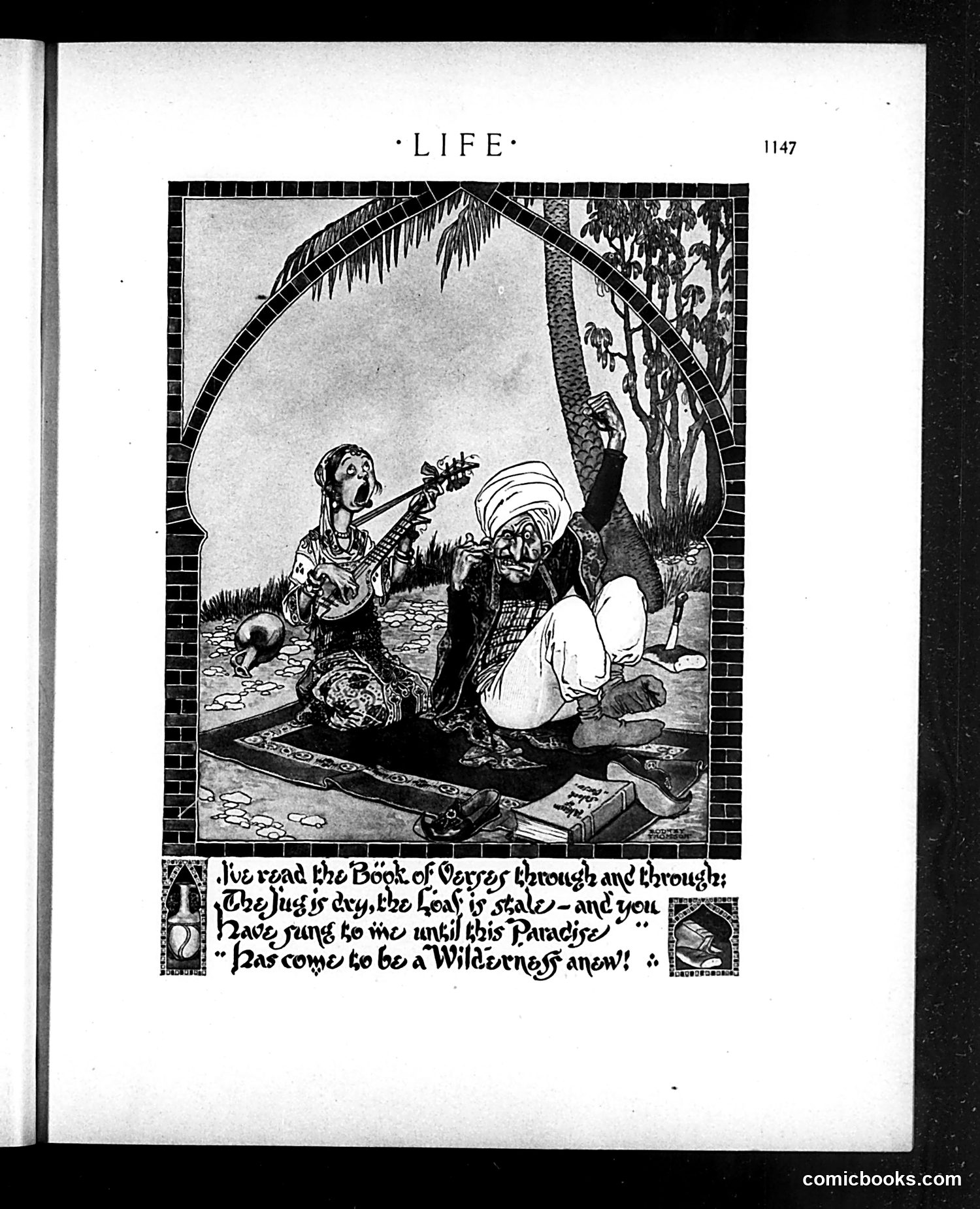
This appears to be a satirical illustration showing figures in an exotic/colonial setting beneath palm trees. One figure plays a stringed instrument while others listen. The caption references "the Book of Verses" and a "Paradise" that "has come to be a Wilderness anew." The satire likely critiques romanticized notions of colonial or exotic locales—suggesting that while such places are imagined as paradises through literature and poetry, the reality is wilderness and hardship. The figures' poses and the instrumental performance suggest a contrast between artistic fantasy and harsh reality. Without clearer OCR or additional context, the specific literary or political reference remains uncertain, though it appears to mock both orientalist fantasies and perhaps disillusionment with colonial ventures.
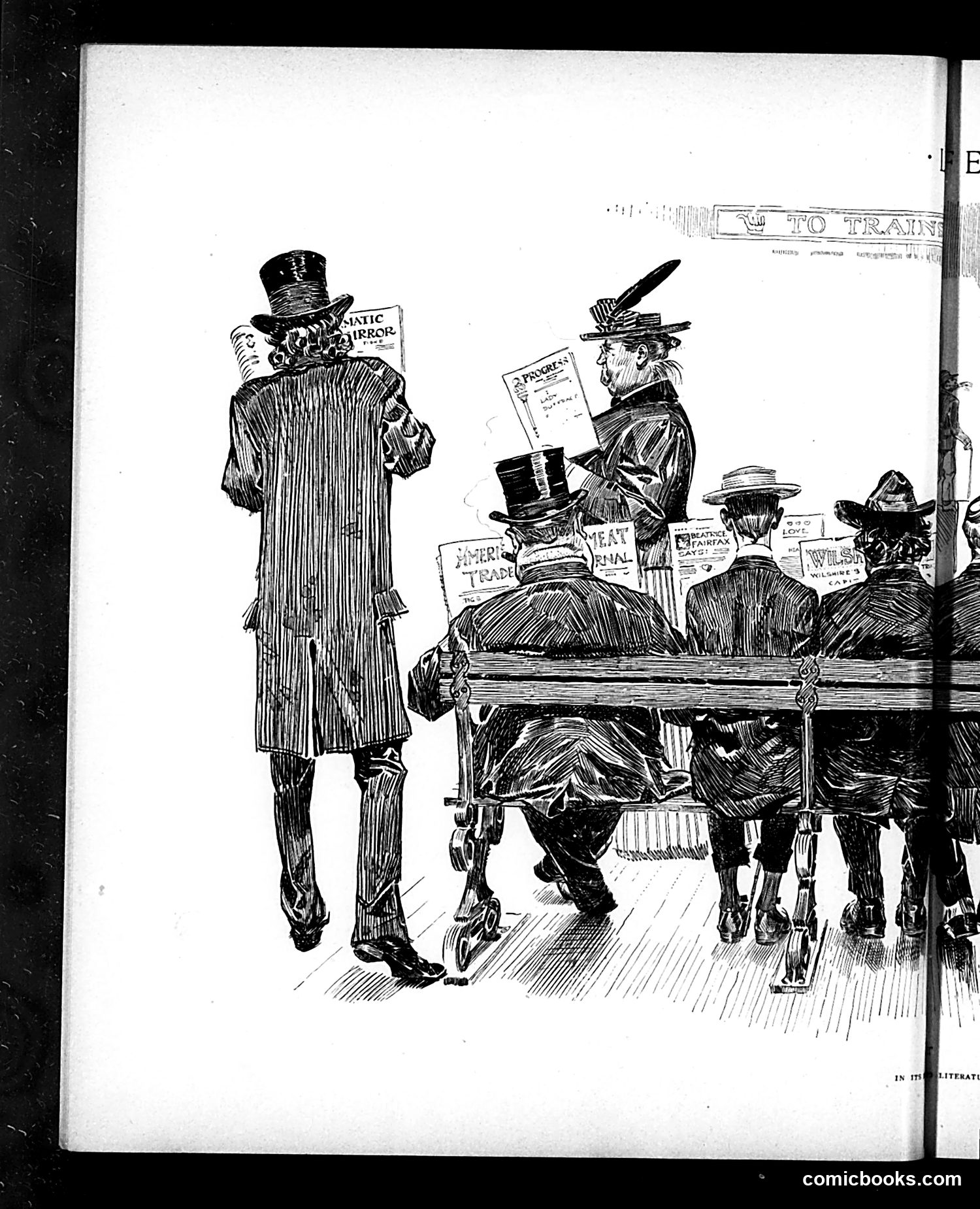
This appears to be a satirical illustration from *Life* magazine showing a scene at what looks like an auction or trading floor. A tall, thin figure in a long coat and top hat stands to the left, observing a group of seated men in hats who are holding up papers labeled with various company or product names (visible text includes references to trades and markets). The cartoon likely satirizes financial speculation, stock trading, or commercial dealings of the era. The standing figure appears to be a prosperous businessman or speculator observing the market activity below. The style and composition suggest social commentary on business practices, though without clearer text identification of specific companies or historical context, the precise target of satire remains unclear.
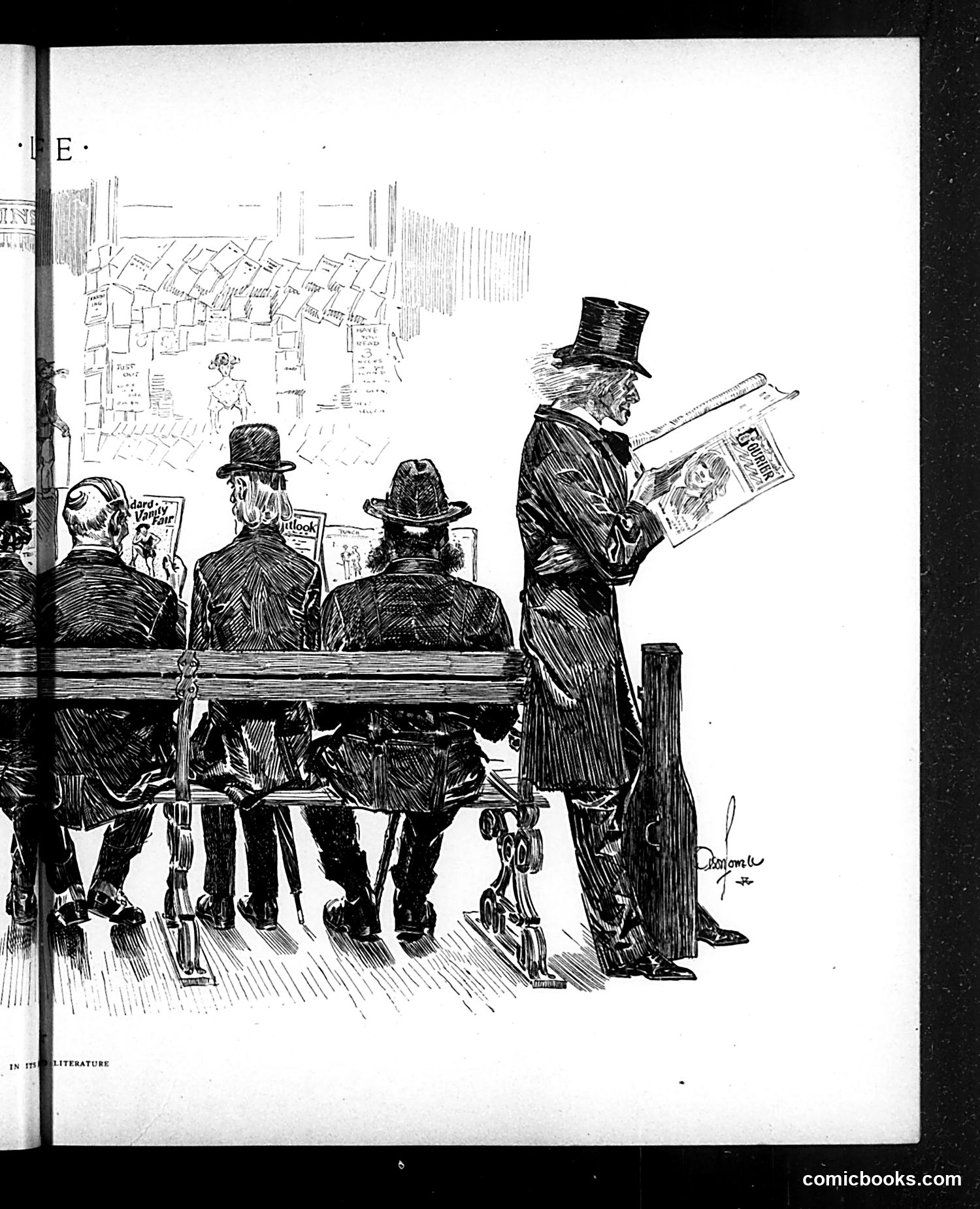
This is a satirical illustration from *Life* magazine depicting a scene of literary criticism or editorial review. Four men in formal Victorian-era dress examine what appears to be manuscript pages or proofs at a table. The standing figure on the right, wearing a top hat, holds up a publication or proof sheet for inspection. The cartoon likely satirizes the pretentious nature of literary gatekeepers—editors, critics, or publishers—who judged submitted work. The men's formal attire and serious expressions mock the self-importance of those controlling access to publication. The scattered papers and architectural sketch visible in the background suggest this depicts a publishing house or editorial office. The satire targets the snobbish, exclusive attitudes of the literary establishment toward aspiring writers seeking publication.
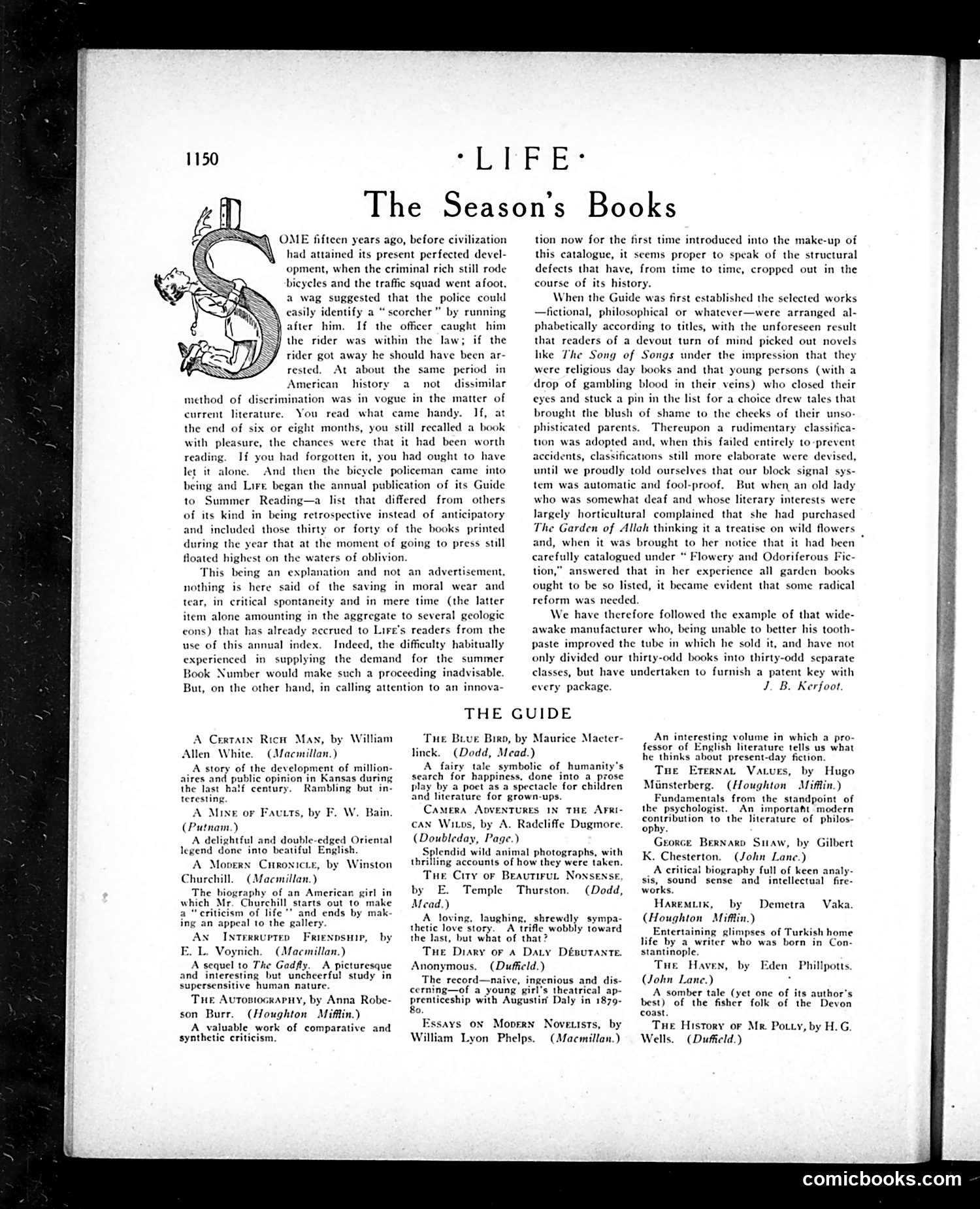
This is primarily a **title page and editorial introduction** to Life's annual summer reading guide, with minimal cartoon content visible. The small illustration at top left appears to be a decorative **bicycle-era vignette**, referencing the opening anecdote about identifying "scorchers" (reckless cyclists) fifteen years prior. The page's satire targets **literary classification systems**. Life explains their book guide evolved from simple alphabetical listing to elaborate categorization after amusing mishaps—notably an elderly, deaf woman purchasing *The Garden of Allah* (an erotic novel) believing it was horticultural nonfiction based on its filing under "Flowery...Fiction." The joke critiques both **imperfect cataloging systems** and the absurdity of matching readers' actual needs with organizational logic. It's light social humor about library science and reading habits rather than political satire. The tone is self-congratulatory about Life's improved "patent key" system for organizing their book recommendations.
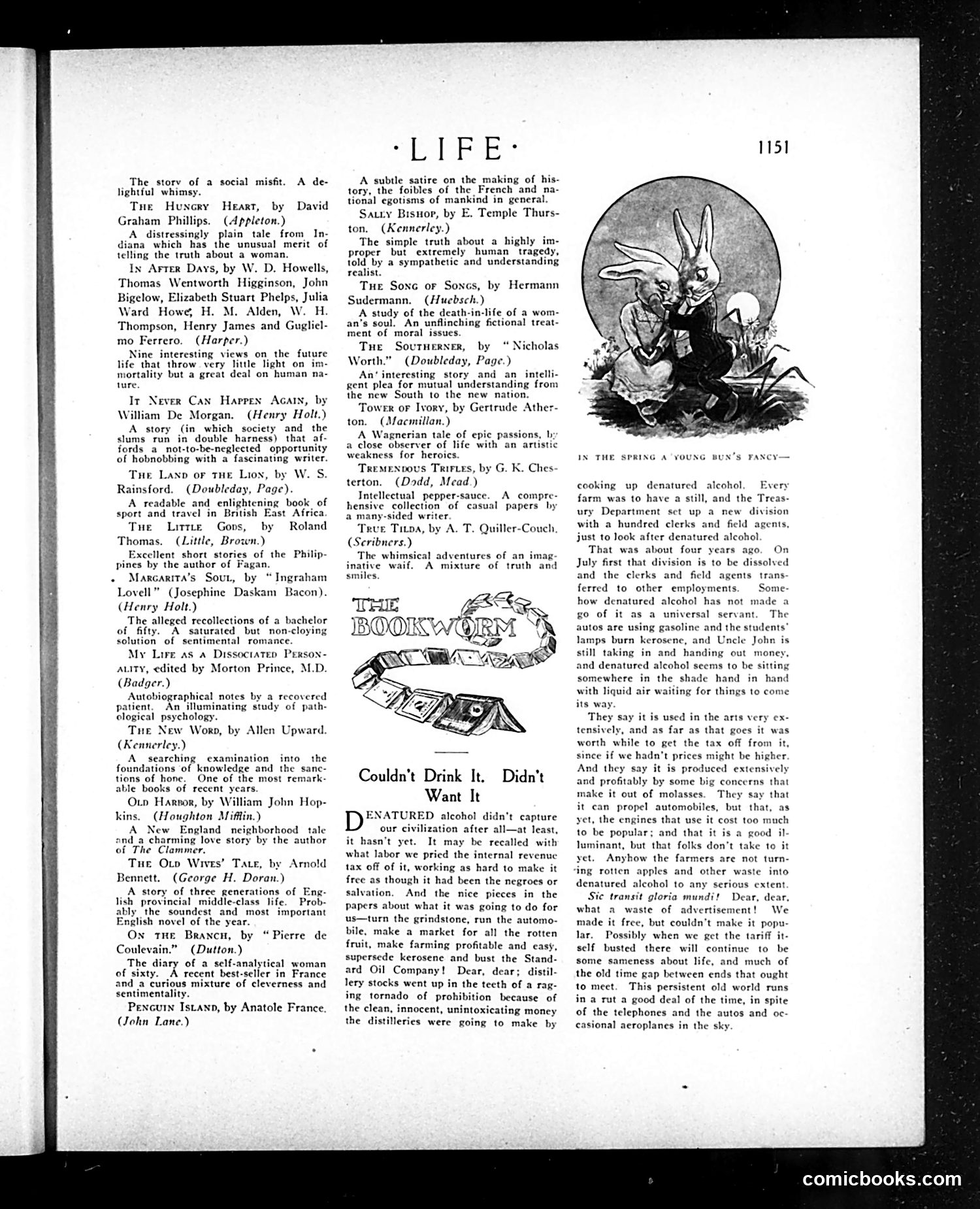
This page is a book review section with an accompanying satirical article about Prohibition-era denatured alcohol. The cartoon illustrates the article's central joke: the government attempted to tax alcohol heavily, so distilleries were allowed to produce "denatured" (poisoned) alcohol for industrial use, assuming people wouldn't drink it. The satire targets both government incompetence and American ingenuity. Despite being toxic, farmers and others found ways to use denatured alcohol anyway—straining it through various materials to remove poison, or using it in automobiles and lamps. The piece mocks this cat-and-mouse game: authorities tried to eliminate alcohol consumption through taxation and poison, yet Americans persisted in finding workarounds. The title's phrase—"couldn't drink it, didn't want it"—is ironic; people clearly *did* want it and *could* drink it, circumventing official restrictions. This reflects pre-Prohibition anxieties about alcohol policy's futility.
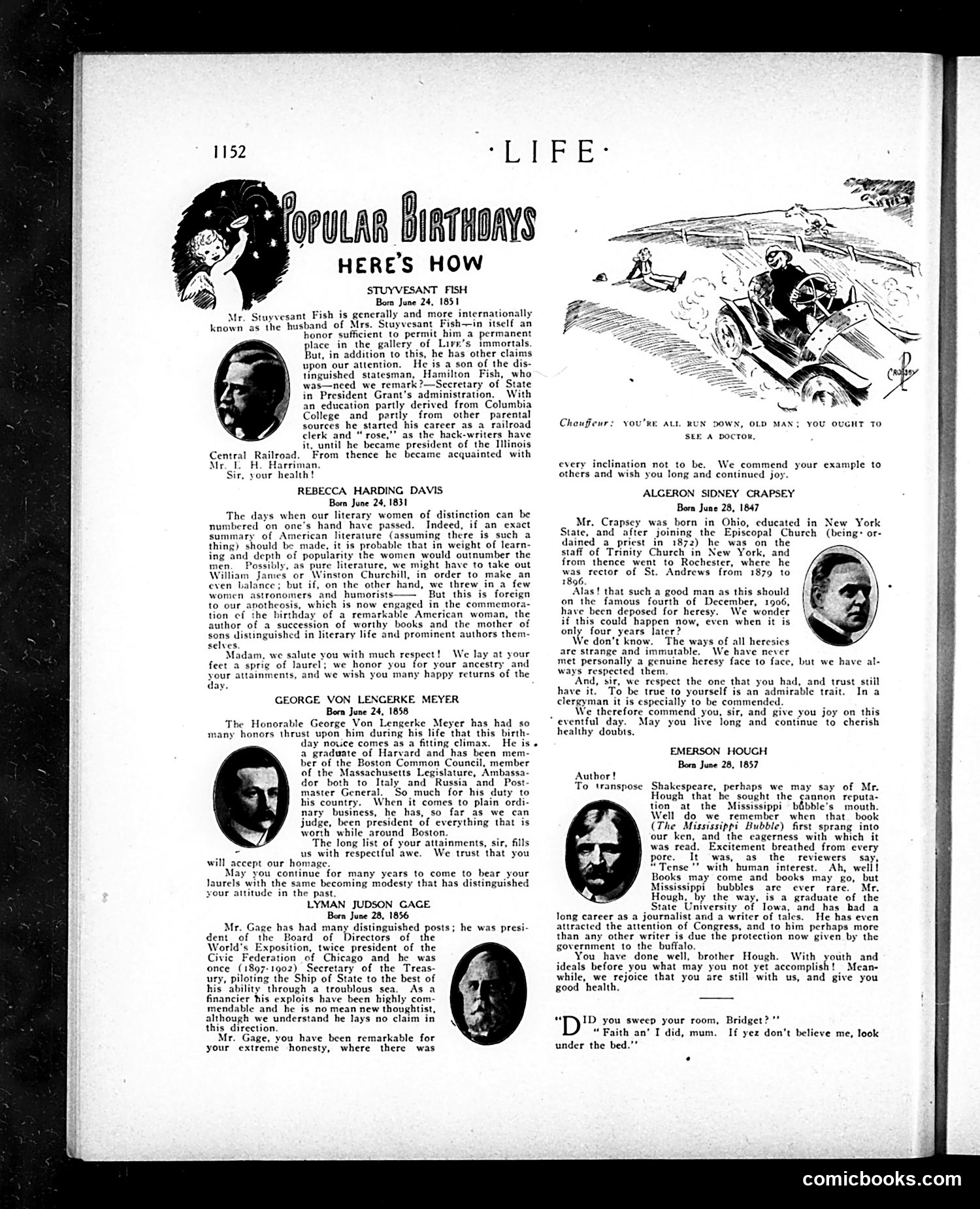
This page celebrates the birthdays of prominent American figures from June 1851-1858. The satirical "tributes" in Life's characteristic style offer backhanded praise to wealthy and politically connected men: **Stuyvesant Fish** (railroad executive) is mocked as primarily known as "the husband of Mrs. Stuyvesant Fish"—his wife apparently being more notable than him. **Rebecca Harding Davis** receives genuine respect as a distinguished American author and mother of literary sons. **George Von Lengerke Meyer** (Harvard graduate, diplomat, Postmaster General) is humorously praised for holding "president of everything...worth while around Boston." **Lyman Judson Gage** (Treasury Secretary during economic crisis) is ironically commended for "extreme honesty"—suggesting skepticism about financial leadership. The cartoon above shows an old man being advised to see a doctor, likely commentary on aging elites.
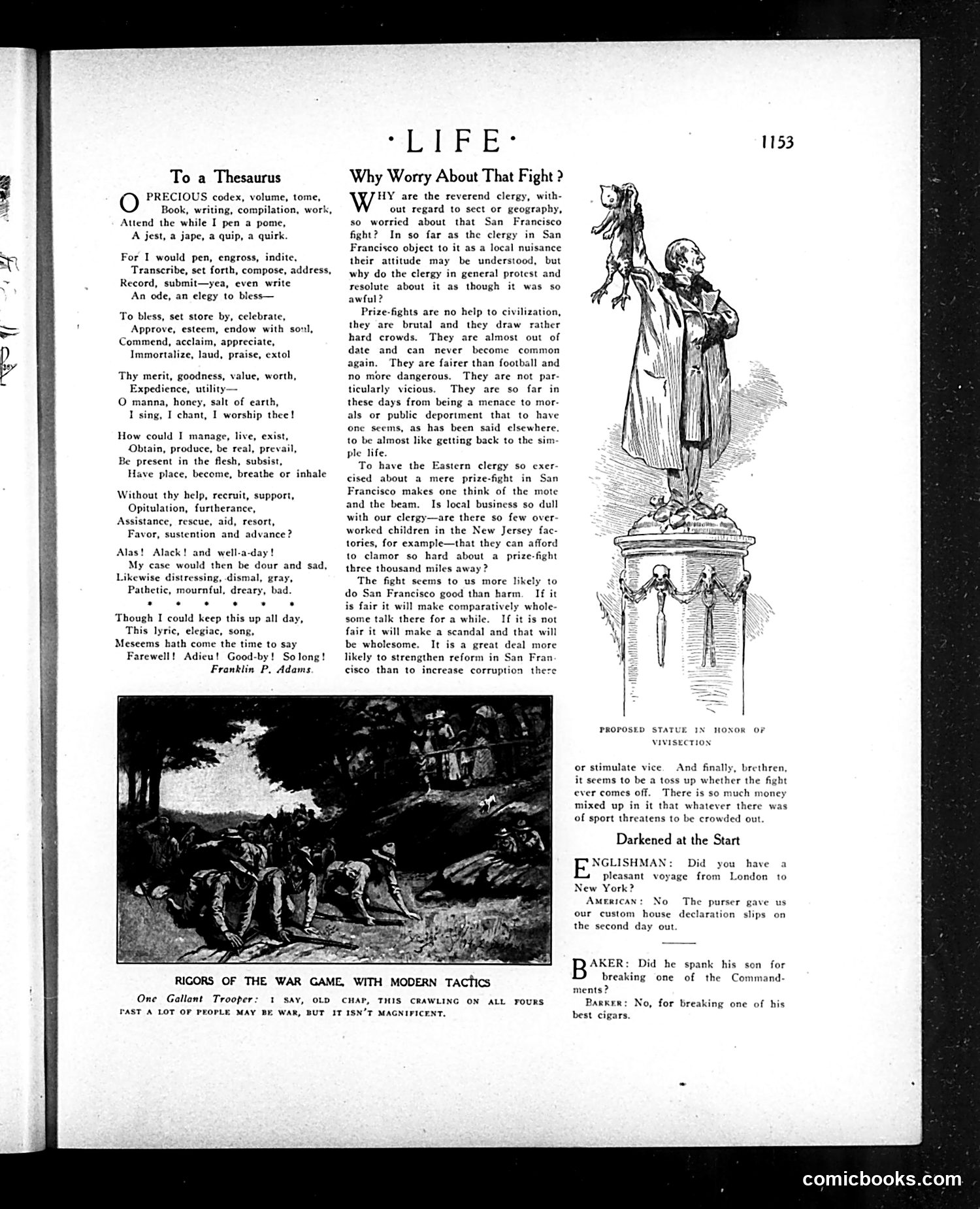
This page contains three distinct pieces of satirical content: **"To a Thesaurus"** (left column): A humorous poem by Franklin P. Adams mocking thesaurus overuse—demonstrating how one can express a simple idea through endless synonyms. It's satire on verbose, pretentious writing. **"Why Worry About That Fight?"** (center): Commentary on clergy protests against a San Francisco prize-fight. The author argues Eastern clergy are hypocritically concerned about a distant boxing match while ignoring local social problems (child labor in New Jersey factories). The piece sarcastically defends boxing as relatively harmless compared to football, suggesting reform-minded clergy should focus on genuine moral issues. **War cartoon and brief exchanges** (right): A soldier's complaint about modern "crawling on all fours" tactics shows war's unglamorous reality. The subsequent dialogues mock British-American cultural differences regarding custom declarations and parenting discipline. The page targets clerical hypocrisy, verbose writing styles, and the contrast between genteel expectations and practical reality—typical *Life* satirical concerns of its era.
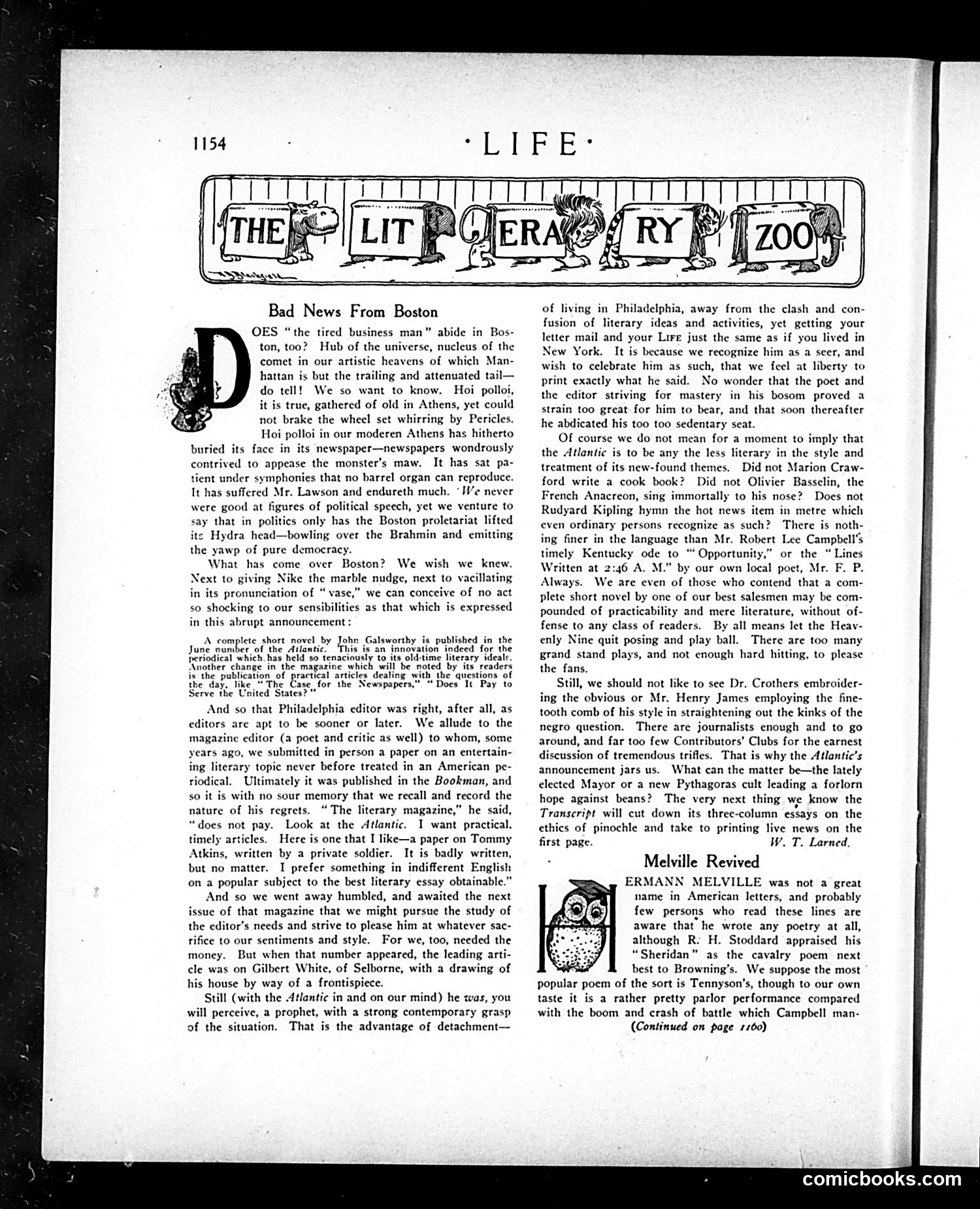
This is a satirical essay attacking *The Atlantic* magazine for abandoning literary standards. The writer mocks Boston's cultural pretensions—calling it "Hub of the universe"—while noting its recent shift toward practical, timely articles over pure literature. The core complaint: an editor once rejected the author's literary essay, demanding instead practical pieces like "Tommy Atkins, written by a private soldier" (badly written but useful). Yet when the author checked that same issue, the lead article was on Gilbert White—pure literature with illustrations. The editor's hypocrisy is exposed. Now *The Atlantic* is publishing John Galsworthy and adding practical articles on newspapers and public service. The author sarcastically questions whether famous writers like Marion Crawford (who wrote cookbooks) justify this descent into utility over artistry. The satire targets American magazine editors' mercenary compromises: they reject genuine literature for profit, then publish it anyway, revealing their real motive is money, not principle.
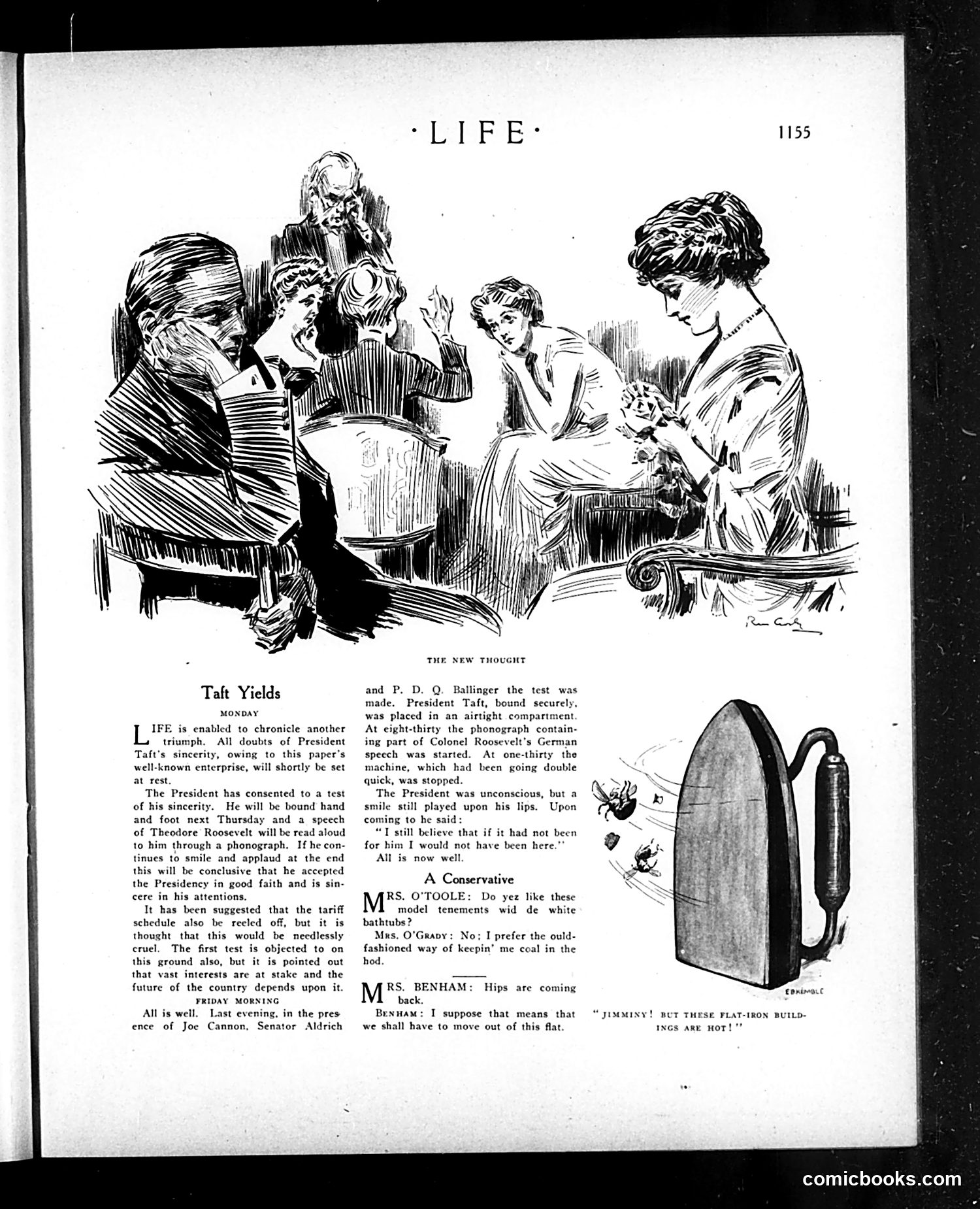
The main illustration depicts "The New Thought"—a social scene showing well-dressed figures in conversation. The accompanying article "Taft Yields" discusses President Taft's sincerity regarding a tariff schedule test. The text mentions Taft will be bound in an airtight compartment during a phonograph recording of Theodore Roosevelt's German speech. Below are two comic dialogues: "A Conservative" mocks Mrs. O'Toole's and Mrs. Benham's debate about fashion—specifically hips coming back into style, with Mrs. Benham joking they'll need to vacate their flat. The right illustration shows a woman in a corset, captioned "Jimmins! But these flat-iron buildings are hot!"—satirizing women's restrictive fashion (corsets) and modern architecture's lack of ventilation.
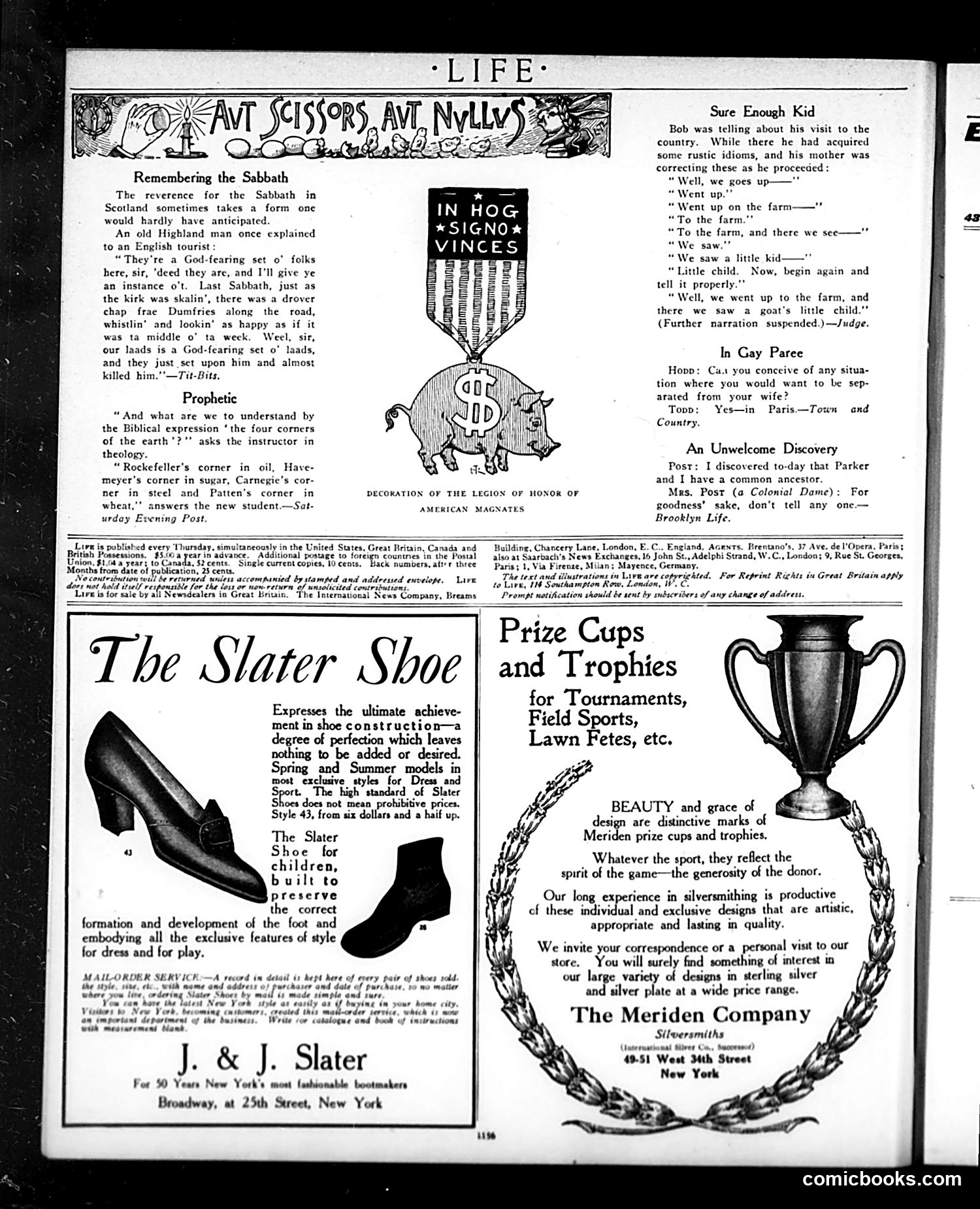
This page contains **humorous short stories and advertisements** rather than political cartoons. The content includes three jokes satirizing American society: 1. **"Remembering the Sabbath"** mocks Scottish religious hypocrisy—locals violently attack a cheerful stranger on Sunday, claiming it's "God-fearing" behavior. 2. **"Sure Enough Kid"** ridicules a mother correcting her son's grammar after his farm visit, showing class-conscious education anxiety. 3. **"Prophetic"** takes aim at **wealthy American industrialists** (Rockefeller, Carnegie, Patten) by having a theology student reinterpret the biblical "four corners of the earth" as these magnates' business monopolies—satire of their economic dominance and the era's concern about concentrated wealth. The accompanying **pig illustration labeled "IN HOG SIGNO VINCES"** (a Latin pun on "In hoc signo vinces") appears to mock these same magnates, treating them as pig-like money-grubbers. The page otherwise contains period advertisements for shoes and trophies, typical of the magazine format.
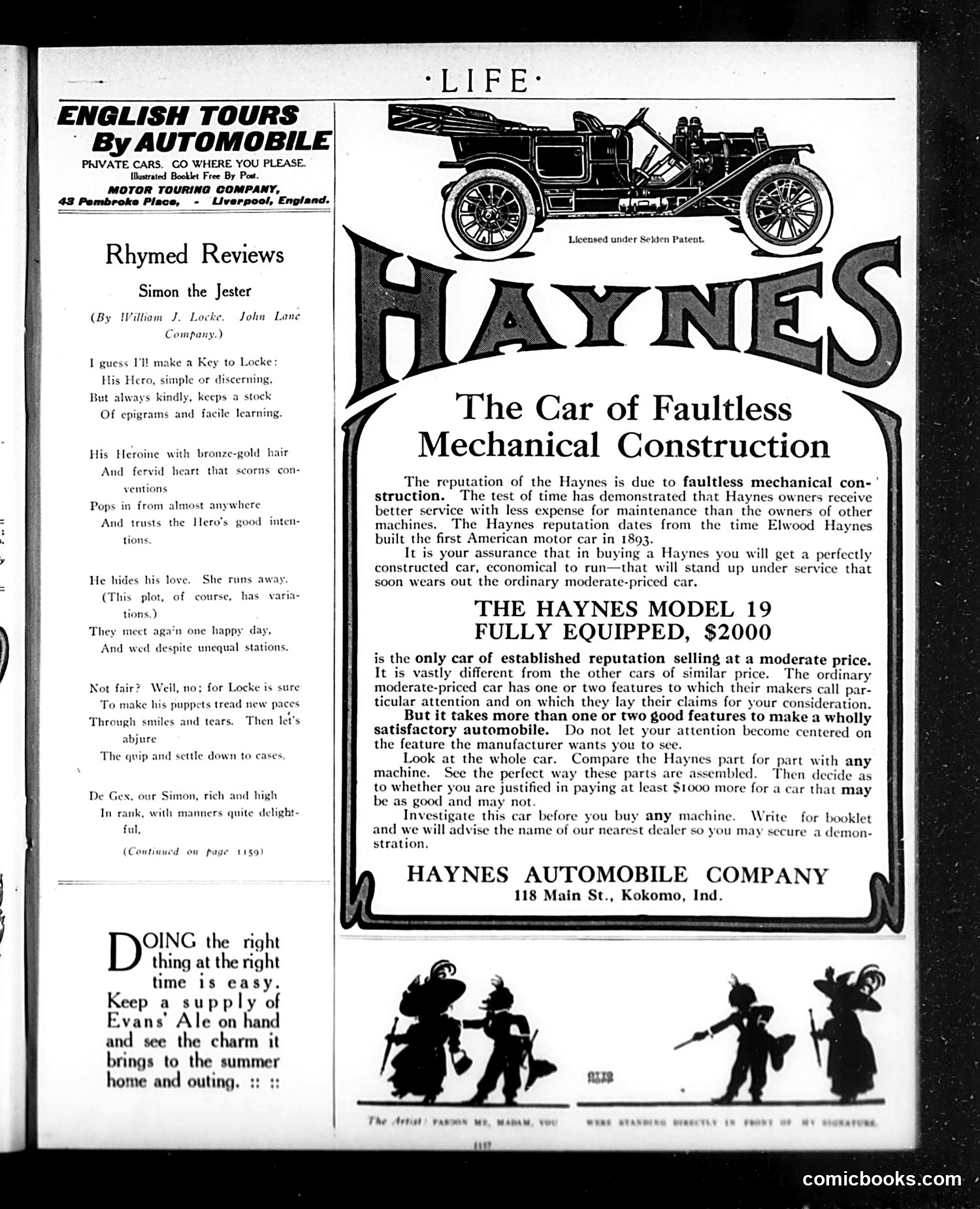
This page is primarily **advertising**, not satire or political commentary. The dominant content is a Haynes automobile advertisement claiming the Model 19 offers superior "faultless mechanical construction" at $2000—positioning it as better-built than competing cars at similar prices. The ad references Elwood Haynes building "the first American motor car in 1893," establishing brand heritage. The left side contains a "Rhymed Review" of William J. Locke's novel *Simon the Jester*, summarizing its conventional plot: a noble hero with a lower-class heroine who overcome social barriers to marry. The reviewer uses light verse to gently mock Locke's formulaic romance writing style. Below is an advertisement for Evans' Ale, suggesting it enhances summer entertaining. There's no political satire here—this is a typical Life magazine page mixing book reviews with commercial advertisements, standard for the publication's era.
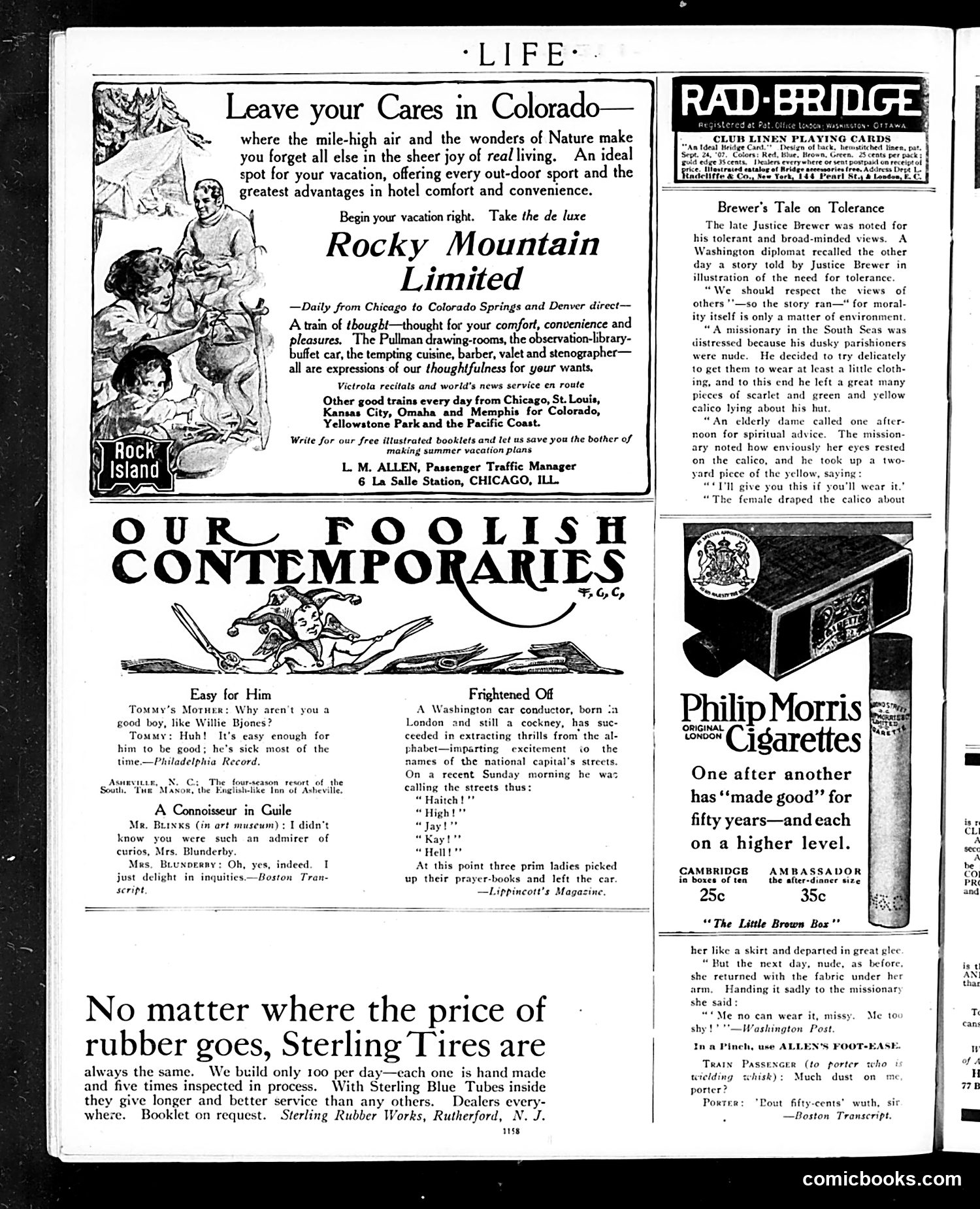
This page is primarily **advertising and humor pieces**, not political satire. The content includes: **Main Advertisement:** The "Rocky Mountain Limited" train advertisement promotes Colorado vacations, emphasizing luxury amenities (observation cars, dining, stenographer service). **"Our Foolish Contemporaries" Section:** Three brief humorous anecdotes about everyday life: - A mother's frustration that a sick boy behaves better than her healthy son - A London conductor extracting entertainment by pronouncing street names as profanities - A museum patron feigning cultural knowledge to seem refined **"Brewer's Tale on Tolerance":** A longer moral anecdote attributed to (likely) Justice David Josiah Brewer about a missionary attempting to clothe nude Pacific Islander parishioners. The humor derives from the punchline: the woman cannot wear the cloth because she lacks the garment to keep it up—a joke reflecting period attitudes toward non-Western peoples. **Philip Morris Cigarette Advertisement** and other product ads fill remaining space. This represents typical **early-20th-century Life content**: lighthearted social commentary, travel promotion, and consumer advertising rather than pointed political critique.
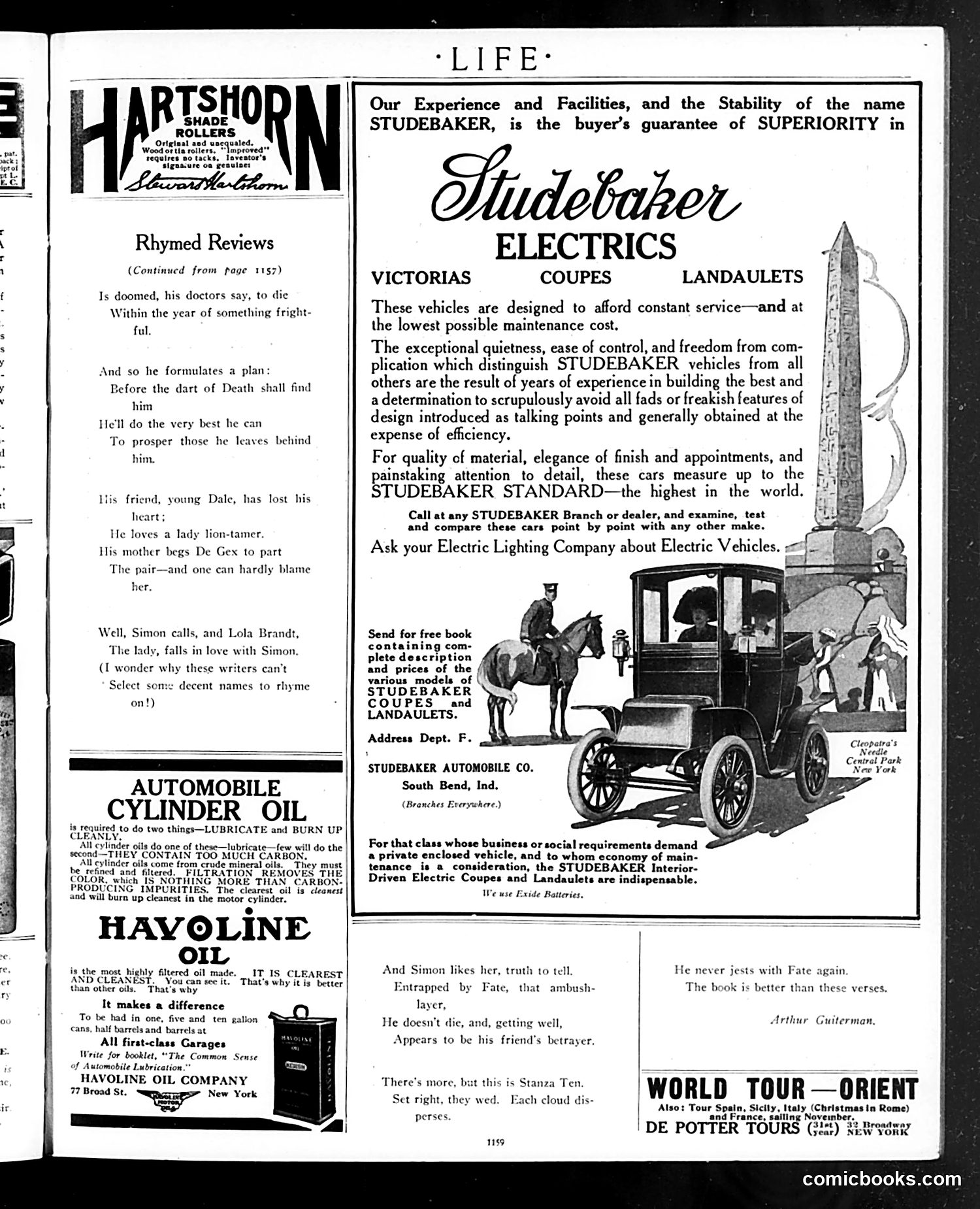
This page is primarily **advertising**, with a small literary feature. The "Rhymed Reviews" section (top left) is a humorous poem synopsis of what appears to be a serialized story or play. It concerns a dying man named De Gex who arranges his affairs before death. His friend Dale loves a lion-tamer named Lola Brandt; De Gex's mother opposes the match. When Simon enters, Lola falls for him instead—creating a love triangle resolved by stanza ten when Simon and Lola marry. The satirical jab is the author's aside mocking writers' poor rhyme choices (complaining about "Brandt/can't" and "Simon/rhyme on"). The bulk of the page features three large advertisements: **Hartshorn Shade Rollers**, **Havoline Oil** (emphasizing clarity and purity for automobile engines), and **Studebaker Electric Vehicles**—touting their quietness, quality, and reliability for wealthy buyers whose "business or social requirements demand a private enclosed vehicle." The advertising reflects 1910s consumer culture: automobiles, electric vehicles, and industrial lubrication products aimed at affluent readers.
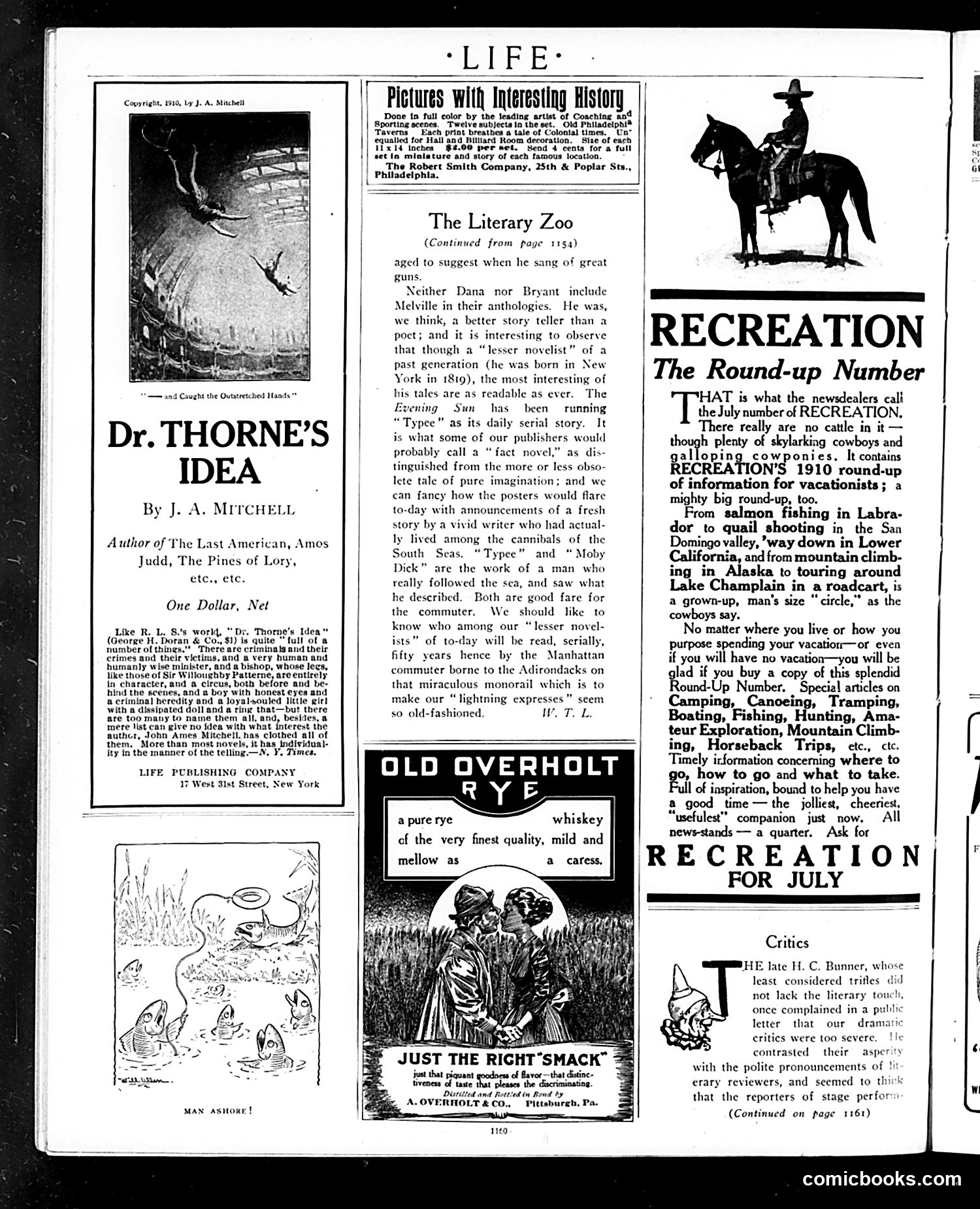
This page contains **no political cartoons**—it's primarily book reviews and advertisements from an early 1900s issue of Life magazine. The main content includes: **"Dr. Thorne's Idea"** — a book review by J.A. Mitchell praising a novel by John Ames Mitchell about criminals, ministers, and a circus, noting its literary merit and individual storytelling style. **"The Literary Zoo"** — a literary essay discussing Herman Melville's overlooked status. The writer argues Melville was a better storyteller than poet, and notes that *Typee* and *Moby Dick*—written by a man who actually lived among South Sea peoples—remain readable decades later. The piece wonders which contemporary "lesser novelists" will still be read fifty years hence. **Advertisements** include Old Overholt Rye whiskey and the July issue of *Recreation* magazine, promoting outdoor activities like fishing, hunting, and camping. The page reflects early 20th-century literary culture and leisure pursuits rather than political satire.
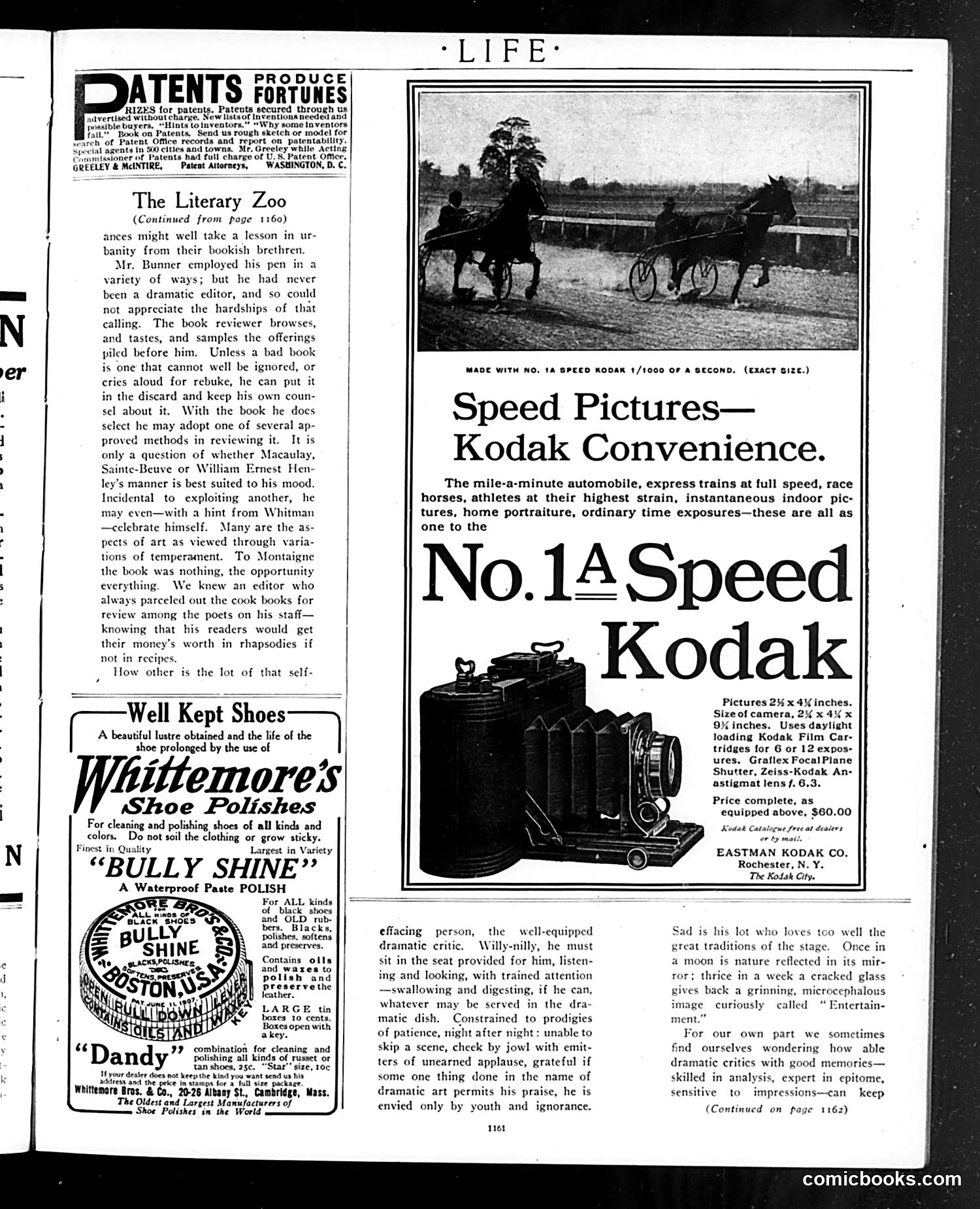
This page is primarily **advertising**, not political satire. It contains: 1. **Patent office advertisement** (top left) — a service notice 2. **"The Literary Zoo"** (continued article) — a humorous essay about book reviewers and dramatic critics, discussing how literary professionals like editor Henry Bunner approached their work differently 3. **Shoe polish ads** (left sidebar) — Whittemore's "Bully Shine" brand 4. **Kodak camera advertisement** (center/right) — promoting the "No. 1A Speed Kodak" camera, emphasizing its ability to capture fast-moving subjects (automobiles, trains, horses, athletes) The Kodak ad is notable for showcasing **early 20th-century photography technology** — the ability to photograph motion at high speed (1/1000 second) was remarkable for the era. The literary section contains no political cartoon or satire; it's straightforward editorial commentary on publishing professionals' different working styles.
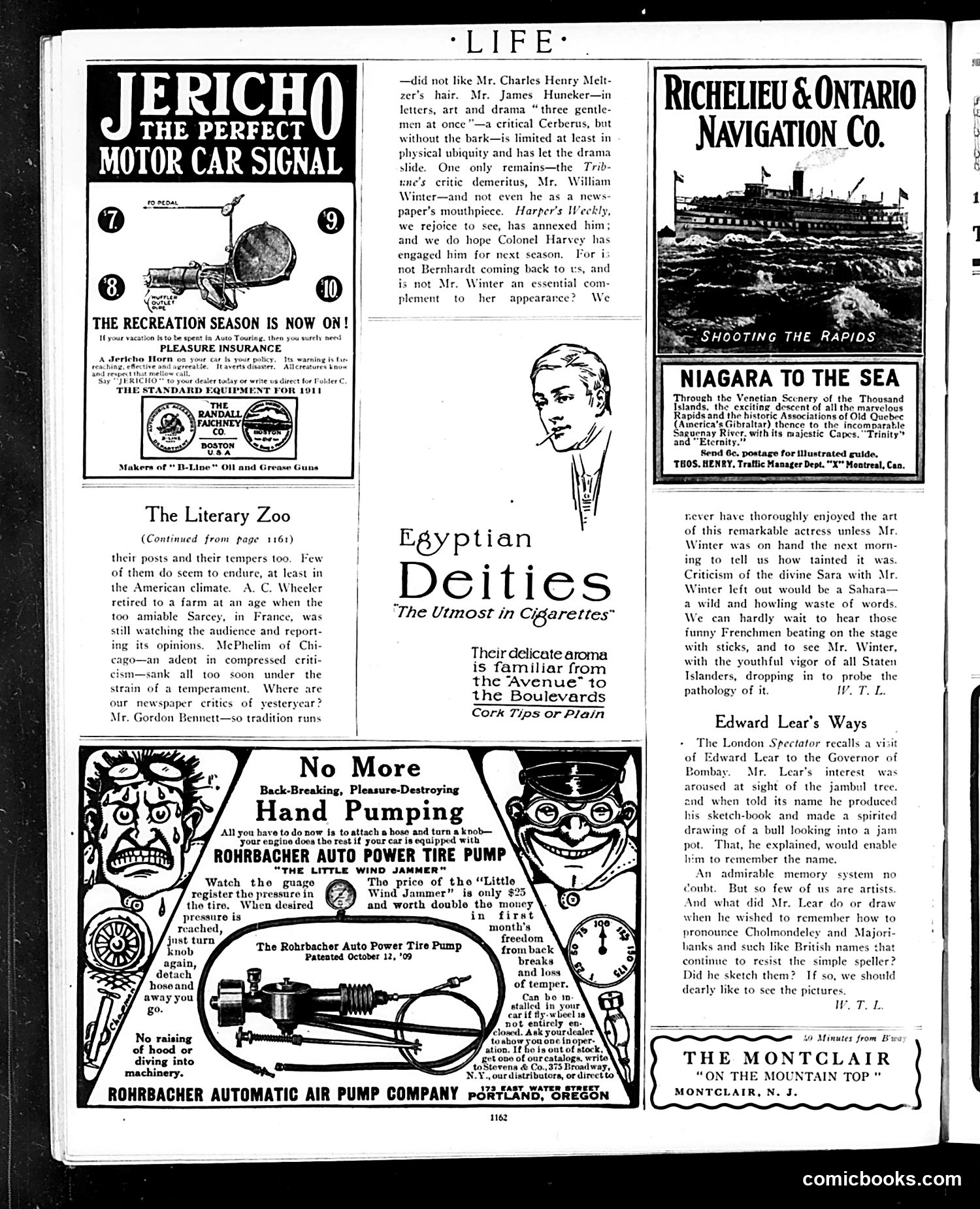
This page primarily contains **advertisements and literary commentary** rather than political cartoons. The main satirical content discusses **theater critics**, particularly **William Winter** (a prominent drama critic). The author humorously argues that Winter is essential to appreciating actress Sarah Bernhardt's performances—not for his insight, but because his overwrought criticism becomes part of the theatrical experience itself. The piece suggests Winter has become a fixture of theater-going, comparing a Bernhardt performance without his subsequent review to "a Sahara—a wild and howling waste of words." The advertisements include the **Rohrbacher Auto Power Tire Pump** (an early automotive accessory), **Egyptian Deities cigarettes**, and **Richelieu & Ontario Navigation** tourist cruises. A secondary piece discusses **Edward Lear's** (the artist/author) memory techniques, recounting how he drew absurd visual associations to remember names. The satire targets **mid-career journalism and theater criticism** rather than politics, mocking how critics become celebrities whose pronouncements matter more than the actual art.
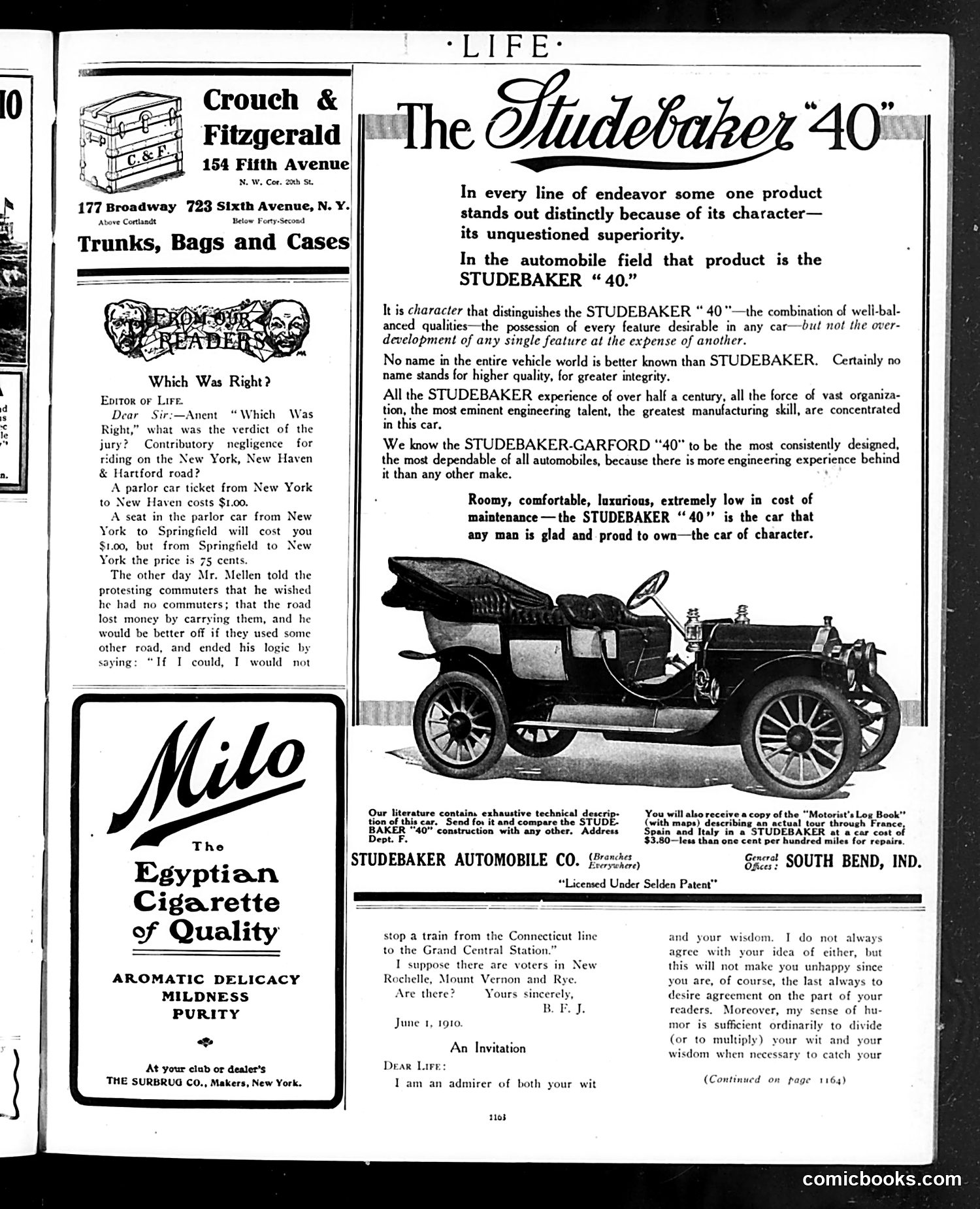
This page features reader letters to *Life* magazine, including a pointed critique of railroad executive Charles Mellen's dismissal of commuters. The writer references a recent *Life* cartoon called "Which Was Right?" (not visible here) that apparently depicted a rail safety or fare dispute. The letter sarcastically highlights Mellen's documented statement that he wishes he had "no commuters" and would prefer they use other routes—yet charges them inconsistent fares ($1.00 from New York to New Haven, but only 75¢ returning). The satire's point: Mellen's logic is absurd. He publicly resents the passengers his railroad depends on, admits the company loses money on them, yet extracts what profit he can through rate manipulation. The writer notes these commuters are voters in suburban towns (New Rochelle, Mount Vernon, Rye), suggesting political consequences for such arrogant monopoly behavior. This reflects Progressive Era frustration with railroad companies' unchecked power and contempt for the public.
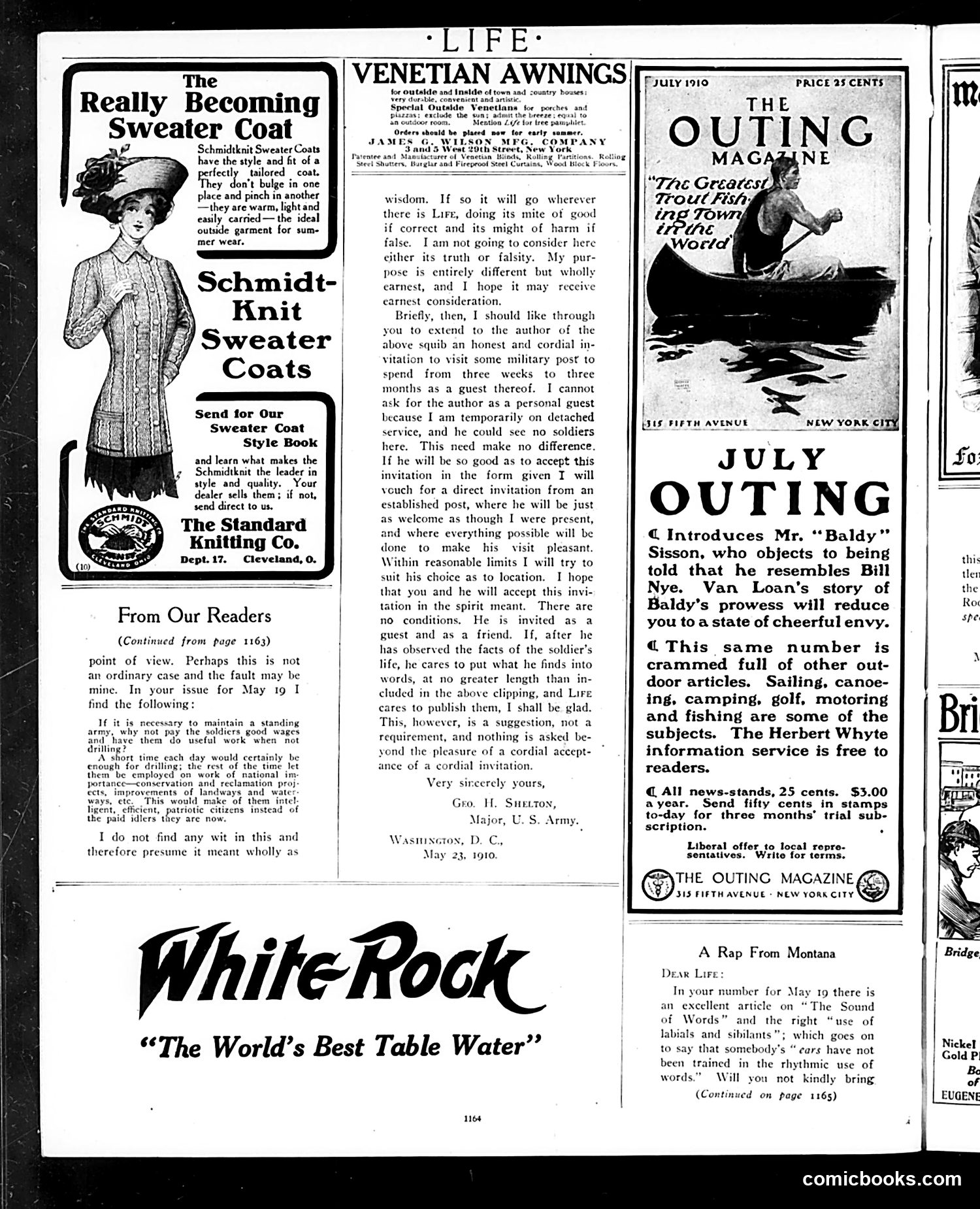
This page is primarily **advertisements and editorial content**, not political satire. The left side features a **Schmidt-Knit Sweater Coat advertisement** showing a fashionable woman's garment—a practical "sweater coat" marketed as stylish yet functional for summer wear. Below that is a **reader's letter section** ("From Our Readers"). A U.S. Army Major responds to a previous satirical piece in Life criticizing soldiers' wages and work assignments. The Major cordially invites the anonymous author to visit a military post to observe soldiers' actual lives firsthand—a good-natured challenge to the critic to base his satire on direct experience rather than assumption. The right page advertises **The Outing Magazine** (July 1910), promoting a humorous story about a character named "Baldy" Sisson, who allegedly resembles humorist Bill Nye, plus articles on outdoor activities (sailing, camping, golf, fishing). The bottom features a **White Rock water advertisement**. The page reflects early 20th-century periodical content: practical fashion, reader engagement, and light humor—not hard-hitting political commentary.
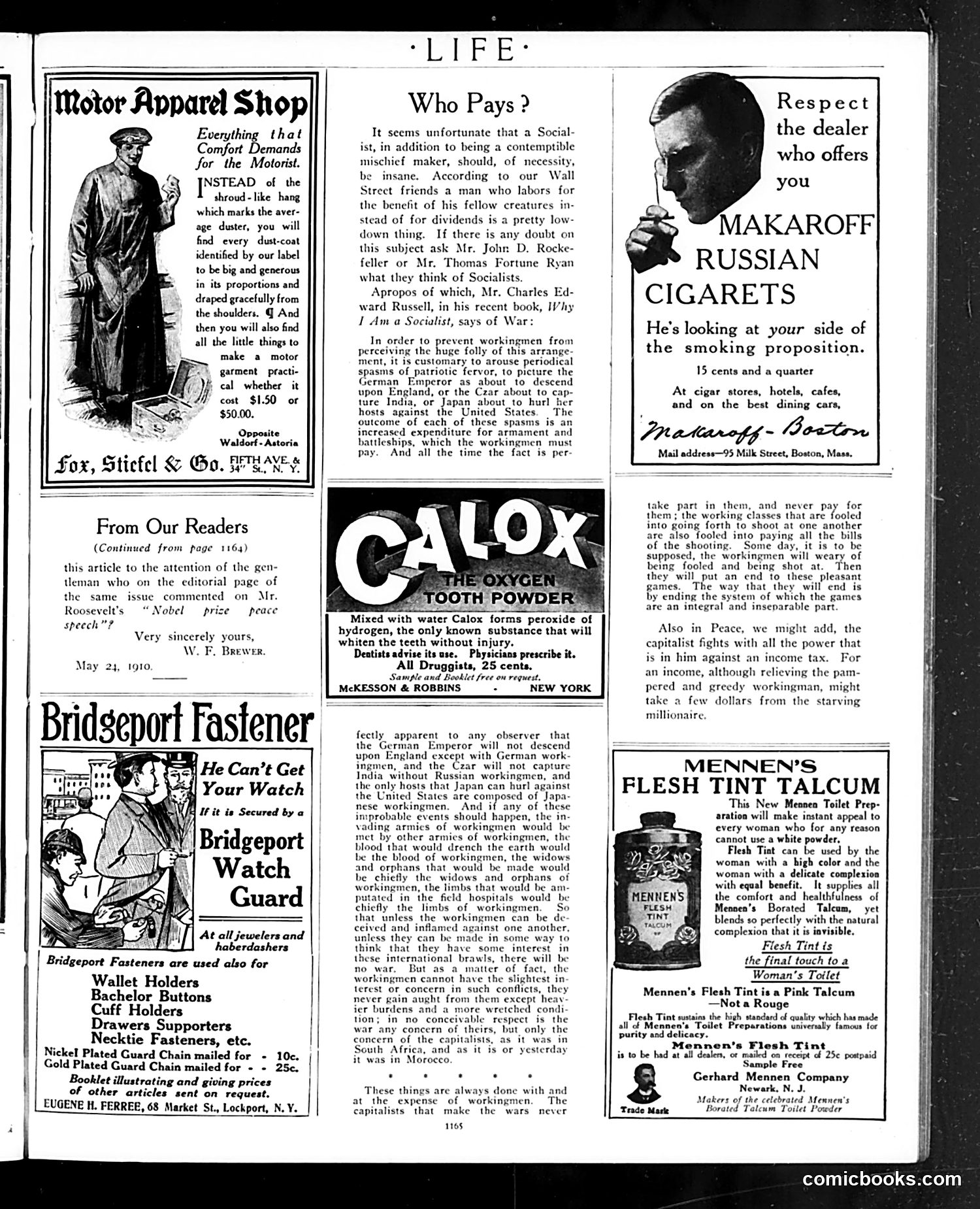
This page mixes commercial advertisements with political commentary typical of Life's satirical format. The main editorial content, titled "Who Pays?", critiques both Socialism and capitalism's war profiteering by quoting Charles Edward Russell's socialist tract *Why I Am a Socialist*. The piece argues that capitalists manufacture patriotic fervor and foreign threats (German Emperor, Russian Czar, Japan) to justify military spending that working-class soldiers must ultimately finance and die for. Russell's point: wars benefit only capitalists, while workers pay in blood and taxes regardless of which nation's "army of workingmen" they comprise. The surrounding ads—motor apparel, fasteners, tooth powder, talcum—are generic commercial fare. The editorial takes an anti-capitalist, pro-working-class position characteristic of Life's muckraking era, directly attacking how wealthy industrialists like Rockefeller and Ryan manipulate workers into supporting their financial interests through nationalism.
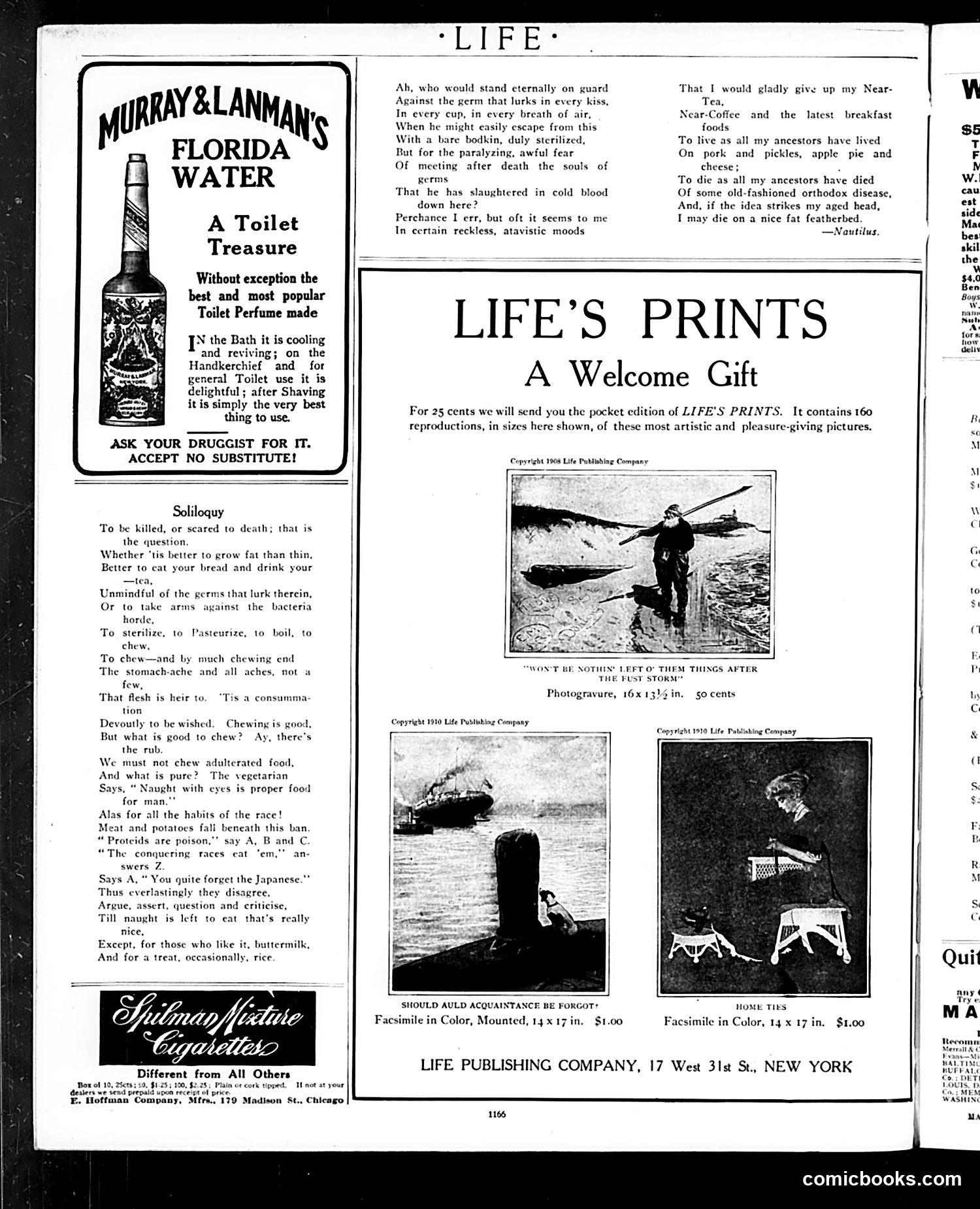
This page satirizes early 20th-century anxieties about **germ theory and food safety**. The main content consists of two related pieces: **"Soliloquy"** parodies Hamlet's existential monologue, replacing life-or-death questions with obsessive concerns about germs in food and drink. The satire targets the era's emerging "health consciousness"—people paralyzed by conflicting dietary advice (vegetarians vs. meat-eaters, sterilization advocates vs. traditionalists). The joke: modern hygiene obsession leaves nothing safe to eat except buttermilk and rice. **The poem above** similarly mocks germophobia, imagining someone preferring their ancestors' simpler diet and "old-fashioned orthodox disease" to constant sterilization anxiety. The **advertisements** (Florida Water perfume, cigarettes) represent period marketing that exploited these health fears. This reflects genuine early-1900s anxieties following Pasteur's discoveries about bacteria, but *Life* magazine ridicules the neurotic excess this knowledge produced—a common satirical theme of the era.
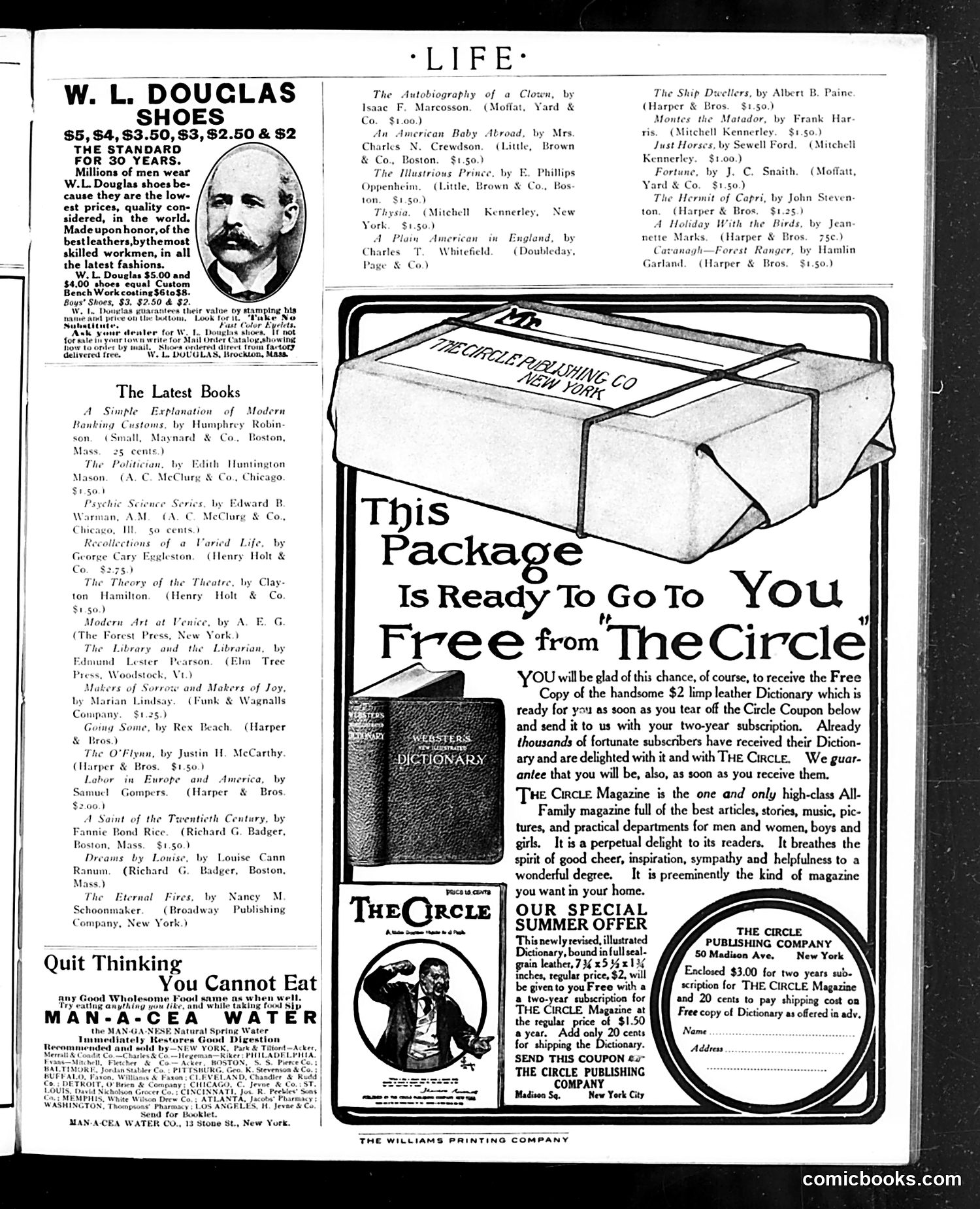
This page is primarily **advertising and book listings**, not political satire. The main content includes: **Left side:** W.L. Douglas shoe advertisement featuring a portrait of the company founder, promoting affordable shoes ("$5, $4, $3.50, $3, $2.50 & $2") as "the standard for 30 years." Below is a book review section and a Man-A-Cea Water advertisement about digestion. **Right side:** A large advertisement for *The Circle* magazine offering a free leather-bound dictionary with subscription. The illustrated package and dictionary are promotional imagery, not satirical commentary. **Bottom:** Man-A-Cea Water company advertisement. This appears to be a typical early 20th-century Life magazine page combining editorial content with commercial advertising. There is no discernible political cartoon or social satire present—it's a straightforward catalog of period publications and consumer products.
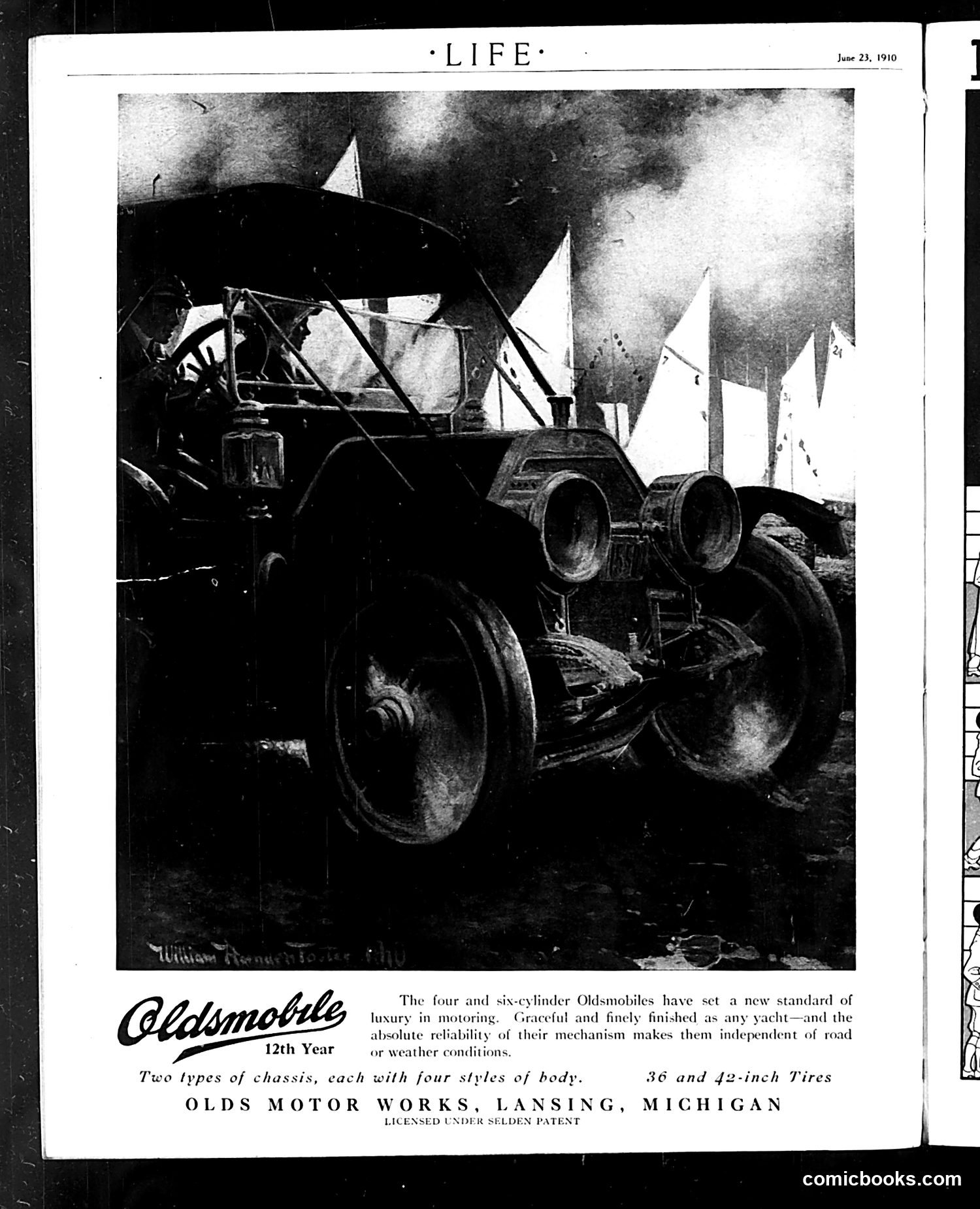
This is primarily **an automobile advertisement**, not political satire. The page features a photograph of an Oldsmobile automobile displayed alongside racing cars and white flags, seemingly at a motorsports event or exhibition. The ad promotes Oldsmobile's "12th Year" of production, emphasizing luxury, reliability, and mechanical independence from weather conditions. The copy references "four and six-cylinder" models with multiple body styles and tire options (36 and 42-inch). A notable detail is the mention of being "LICENSED UNDER SELDEN PATENT"—referring to the Selden Motor Vehicle Patent, a significant early automotive patent that controlled engine licensing. For modern readers: this represents early 1900s automobile marketing emphasizing durability and prestige to wealthy consumers. The Selden Patent reference reflects intense patent litigation that dominated the era's automotive industry. The racing context suggests Oldsmobile was competing through performance demonstration—a marketing strategy common in this period.