
Life, 1910-06-23 · page 10 of 40
Life — June 23, 1910 — page 10: what you’re looking at
What you’re looking at
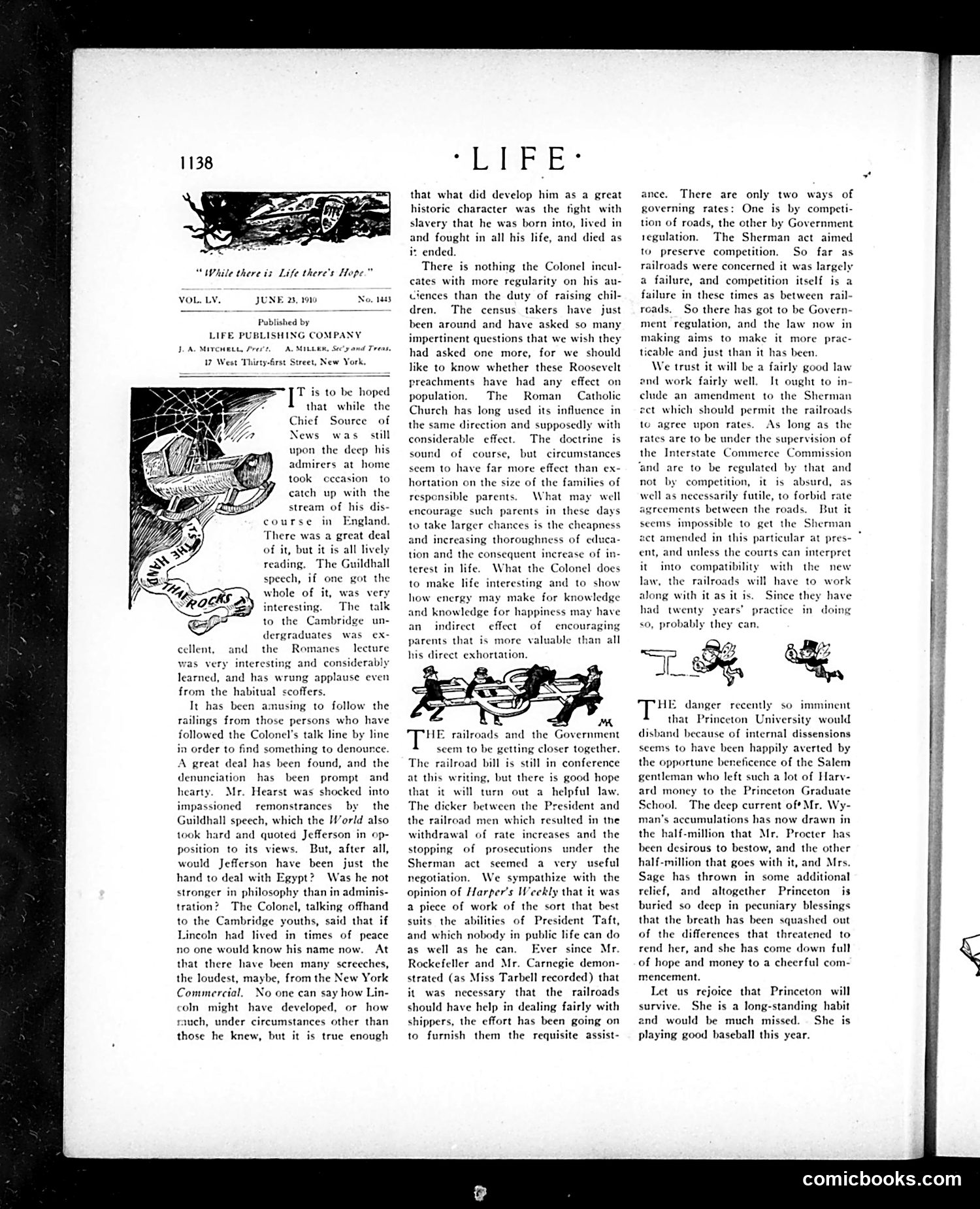
This page contains editorial commentary on contemporary issues rather than political cartoons. The main illustration—labeled "Life there's Hope"—depicts a figure in stocks or shackles, likely representing constraint or oppression. The text discusses railroad regulation, government control versus competition, and Roosevelt administration policies. It references debates over the Sherman Act's application to railroads and mentions Princeton University's recent internal troubles. The cartoon's specific meaning is unclear without additional context, but the shackled figure likely represents either: railroads constrained by government regulation, or citizens restricted by monopolistic railroad practices. The accompanying editorial suggests ambivalence about whether government regulation or competition better serves the public interest—a central Progressive Era debate.
📄 Transcribed text from this page (OCR, searchable)
Machine-transcribed from the original scan — historical spelling and the odd misread are preserved.
“While there iz Life there's Hope.” JUNE 23, 1910 VOL. LY. No, 1435 Published by LIFE PUBLISHING COMPANY JA. MavowEne, Pres, 17 West Thirty-Grst Street, New York. AL MILLER, See'y and Treas. T is to be hoped that while the chief Source of News sul upon the deep his admirers at home took cccasion to catch up with the stream of his dis- course in England. There was a great deal of it, but it is all lively reading. The Guildhall speech, if one got the whole of it, was very interestin} The talk to the Cambridge un- dergraduates and the Romanes was very interesting and consideral learned, and wrung applause even from the habitual scoffers. It has been amusing to follow the railings from those persons who have followed the Colonel's talk line by line in order to find something to denounce. A great deal has been found, and the denunciation has been prompt and hearty. Mr. Hearst was shocked into impassioned remonstrances by the Guildhall speech, which the World also took hard and quoted Jefferson in op- position to its views. But, after all, would Jefferson have been just the hand to deal with Egypt? Was he not stronger in philosophy than in adminis- tration? The Colonel, talking offhand to the Cambridge youths, said that if Lincoln had lived in times of peace no one would know his name now. At that there have been many sereeches, the loudest, maybe, from the New York Commercial. No one can say how Lin- coln might have developed, or how auch, under circumstances other than those he knew, but it is true enough was was ¢N cellent, lecture “EIREE* that what did develop him as a great historic character was the fight with slavery that he was born into, lived in and fought in all his life, and died as it ended. There is nothing the Colonel incul- cates with more regularity on his au- ciences than the duty of raising chil- dren. The census takers have just been around and have asked so many impertinent questions that we wish they had asked one more, for we should like to know whether these Roosevelt preachments have had any effect on population. The Roman Catholic Church has long used its influence in the same direction and supposedly with considerable effect. The doctrine is sound of course, but circumstances seem to have far more effect than ex- hortation on the size of the families of responsible parents, What may well encourage such parents in these days to take larger chances is the cheapness and increasing thoroughness of edu tion and the consequent increase of in- terest in life. What the Colonel does to make life interesting and to show how energy may make for knowledge and knowledge for happiness may have an indirect effect’ of encouraging parents that is more valuable than all his direct exhortation. HE railroads and the Government seem to be getting closer together, The railroad bill is still in conference at this writing, but there is good hope that it will turn out a helpful law. The dicker between the President and the railroad men which resulted in tne withdrawal of rate increases and the stopping of prosecutions under the Sherman act seemed a very useful negotiation. We sympathize with the opinion of Harper's Weekly that it was a piece of work of the sort that best suits the abilities of President Taft, and which nobody in public life can do as well as he can. Ever since Mr. Rockefeller and Mr. Carnegie demon- strated (as Miss Tarbell recorded) that it was necessary that the railroads should have help in dealing fairly with shippers, the effort has been going on to furnish them the requisite assist- ance. There are only two ways of governing rates: One is by competi- tion of roads, the other by Government regulation. The Sherman act aimed to preserve competition. So far as railroads were concerned it was largely a failure, and competition itself is a failure in these times as between rail- roads. So there has got to be Govern- ment regulation, and the law now in ing aims to make it more prac- ticable and just than it has been. We trust it will be a fairly good law nd work fairly well. It ought to in elude an amendment to the Sherman ect which should permit the railroads to agree upon rates. As long as the rates are to be under the supervision of the Interstate Commerce Commission ‘and are to be regulated by that and not by competition, it is absurd, as well as necessarily futile, to forbid rate agreements between the roads. But it seems impossible to get the Sherman act amended in this particular at pres- ent, and unless the courts can interpret it into compatibility with the new law, the railroads will have to work along with it as it is. Since they have had twenty sing so, probably they can. = HE danger recently so imminent that Princeton University would disband because of internal dissensions seems to have been happily averted by the opportune beneficence of the Salem gentleman who left such a lot of Harv- ard money to the Princeton Graduate School. The deep current of Mr. W. man’s accumulations has now drawn in the half-million that Mr. Procter has been desirous to bestow, and the other half-million that goes with it, and Mrs. Sage has thrown in some additional relief, and altogether Princeton is buried so deep in pecuniary blessings that the breath has been squashed out of the differences that threatened to rend her, and she has come down full of hope and money to a cheerful com- mencement. Let us rejoice that Princeton will She is a long-standing habit She is years’ practice in ¢ survive and would be much missed. playing good baseball this year. comicbooks.com