
Life, 1910-06-23 · page 22 of 40
Life — June 23, 1910 — page 22: what you’re looking at
What you’re looking at
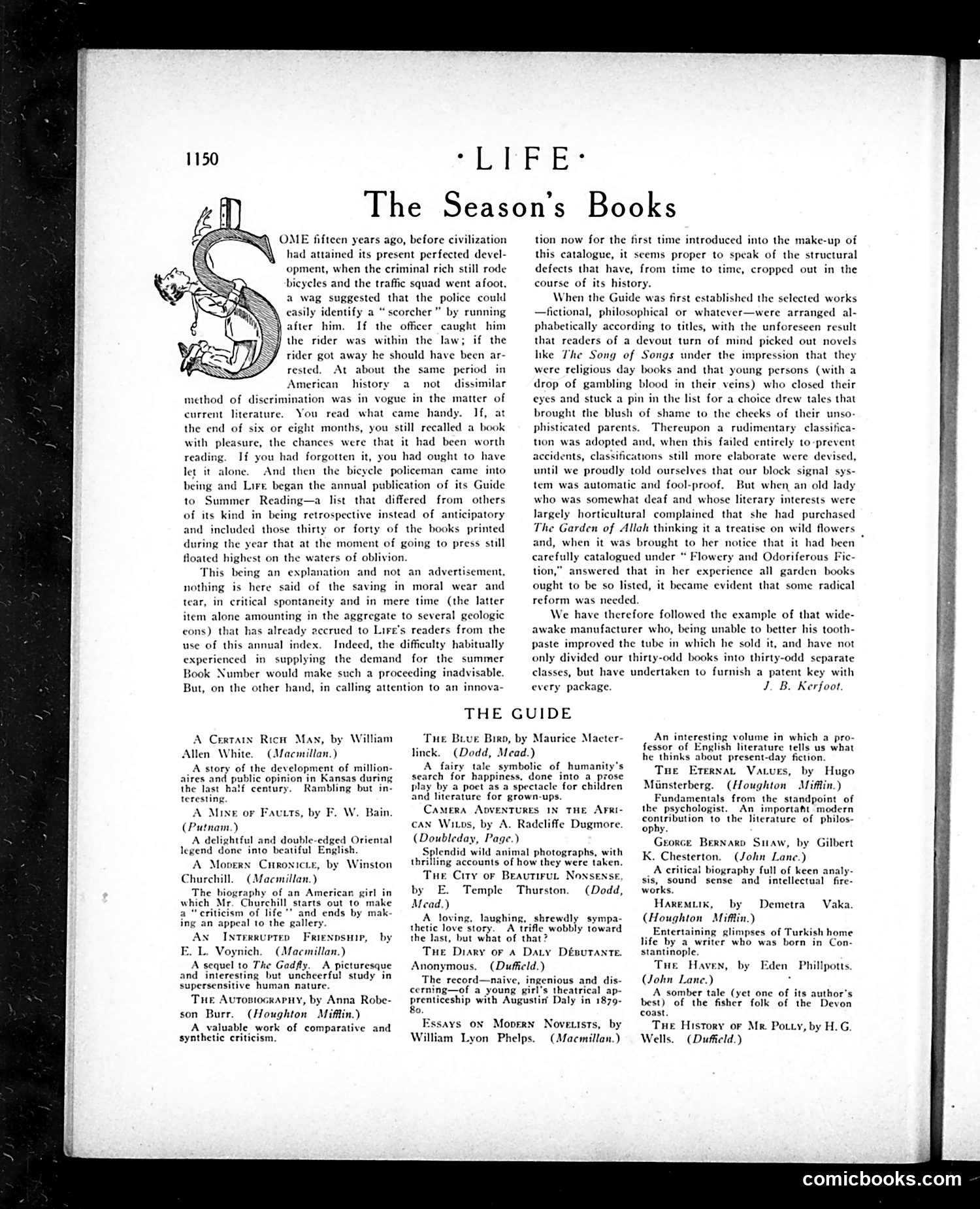
This is primarily a **title page and editorial introduction** to Life's annual summer reading guide, with minimal cartoon content visible. The small illustration at top left appears to be a decorative **bicycle-era vignette**, referencing the opening anecdote about identifying "scorchers" (reckless cyclists) fifteen years prior. The page's satire targets **literary classification systems**. Life explains their book guide evolved from simple alphabetical listing to elaborate categorization after amusing mishaps—notably an elderly, deaf woman purchasing *The Garden of Allah* (an erotic novel) believing it was horticultural nonfiction based on its filing under "Flowery...Fiction." The joke critiques both **imperfect cataloging systems** and the absurdity of matching readers' actual needs with organizational logic. It's light social humor about library science and reading habits rather than political satire. The tone is self-congratulatory about Life's improved "patent key" system for organizing their book recommendations.
📄 Transcribed text from this page (OCR, searchable)
Machine-transcribed from the original scan — historical spelling and the odd misread are preserved.
re FESE* The Season’s Books OME fifteen years ago, before civilization had attained its present perfected devel- opment, when the criminal rich still rode bicycles and the traffic squad went afoot. a wag suggested that the police could \ casily identify a“ scorcher” by running after him. If the officer caught him the rider was within the law; if the rider got away he should have been ar- rested. At about the same period in American history a not dissimilar method of discrimination was in vogue in the matter of current literature. You read what came handy. If, at the end of six or eight months, you still recalled a book with pleasure, the chances were that it had been worth reading. If you had forgotten it, you had ought to have let it alone. And then the bicycle policeman came into being and Lire began the annual publication of its Guide to Summer Reading—a list that differed from others of its kind in being retrospective instead of anticipatory and included those thirty or forty of the books printed during the year that at the moment of going to press still floated highest on the waters of oblivion. This being an explanation and not an advertisement, nothing is here said of the saving in moral wear and tear, in critical spontaneity and in mere time (the latter item alone amounting in the aggregate to several geologic cons) that has already accrued to Lire’s readers from the use of this annual index. Indeed, the difficulty habitually experienced in supplying the demand for the summer Book Number would make such a proceeding inadvisable. tion now for the first time introduced into the make-up of this catalogue, it seems proper to speak of the structural defects that have, from time to time, cropped out in the course of its history. When the Guide was first established the selected works. —fictional, philosophical or whatever—were arranged al- phabetically according to titles, with the unforeseen result that readers of a devout turn of mind picked out novels hike The Song of Songs under the impression that they were religious day books and that young persons (with drop of gambling blood in their veins) who closed their eyes and stuck a pin in the list for a choice drew tales that brought the blush of shame to the cheeks of their unso- phisticated parents. Thereupon a rudimentary. classitica- tion was adopted and, when this failed entirely to-prevent accidents, classifications still more elaborate were devised, until we proudly told ourselves that our block signal sys- tem was automatic and fool-proof. But when an old lady who was somewhat deaf and whose literary interests were largely horticultural complained that she had purchased The Garden of Allah thinking it a treatise on wild flowers and, when it was brought to her notice that it had been carefully catalogued under “ Flowery and Odoriferous Fic- tion,” answered that in her experience all garden books ought to be so listed, it became evident that some radical reform was needed. We have therefore followed the example of that wide- awake manufacturer who, being unable to better his tooth- paste improved the tube in which he sold it, and have not only divided our thirty-odd books into thirty-odd separate classes, but have undertaken to furnish a patent key with But, on the other hand, in calling attention to an innova- A Certaix Ric’ Max, by William Allen White. (Macmillan.) A story of the development of million- aires and public opinion in Kansas during the last half century. Rambling but in- teresting A Mine or Fautts, by F. W. Bain. (Putnam.) A delightful and double-edged Oriental legend done into beatiful English. A Movers Cnroxicie, by Winston Churchill. (Macmillan. The biography of an American girl in which Mr. Churchill starts out to make a “criticism of life” and ends by mak ing an appeal to the gallery AN Intereuptep Friennsip, by L. Voynich. (Macmillan.) A sequel to The Gadfly. A picturesque and interesting but unchcerful study in supersensitive human nature. Tue Avtostocrarny, by Anna Robe- son Burr. (Houghton Mifflin.) A valuable work of comparative and synthetic criticism. every package. THE GUIDE He Buve Biro, by Maurice Macter- linck. (Dodd, Mead.) A fairy tale symbolic of humanity's search for happiness, done into a prose play by a poet as a spectacle for children and literature for grown-ups. Camera AvvenTuRES IN THE AFRi- cay Witos, by A. Radcliffe Dugmore. (Doubleday, Page.) Splend d wild animal photographs, with thrilling accounts of how they were taken. Tue City or Beautirut Nonsense. by E. Temple Thurston. (Dodd, Mead.) A loving, laughing, shrewdly sympa- thetic love story. A trifle wobbly toward the last, but what of that? Tue Diary of A Daty Députante. Anonymous. (Duffcld.) The record—naive, ingenious and di cerning—of a young girl's theatrical ap- prenticeship with Augustin’ Daly in 1879- Bo. Essays ox Movern Novetists, by William Lyon Phelps. (Macmillan) J. B. Kerfoot. An interesting volume in which a pro- fessor of English literature tells us what he thinks about present-day fiction Tue Erternat Vatu by Hugo Minsterberg. (Houghton Miffin.) Fundamentals from the standpoint of the psychologist. An importaft. modern contribution to the literature of philos- ophy. Grorce Bernaro Suaw, by Gilbert K. Chesterton. (John Lane.) A critical biography full of keen analy- sis, sound sense and intellectual fire- works, Haremiik, by Demetra Vaka. (Houghton Miffin.) Entertaining glimpses of Turkish home life by a writer who was born in Con stantinople. Tue Haven, by Eden Phillpotts. (John Lane.) = A somber tale (yet one of its author's best) of the fisher folk of the Devon coast, Tue History or Mr. Potty, by H.G. Wells. (Duffield.) ST AO Ane comicbooks.com