
Life, 1910-06-23 · page 14 of 40
Life — June 23, 1910 — page 14: what you’re looking at
What you’re looking at
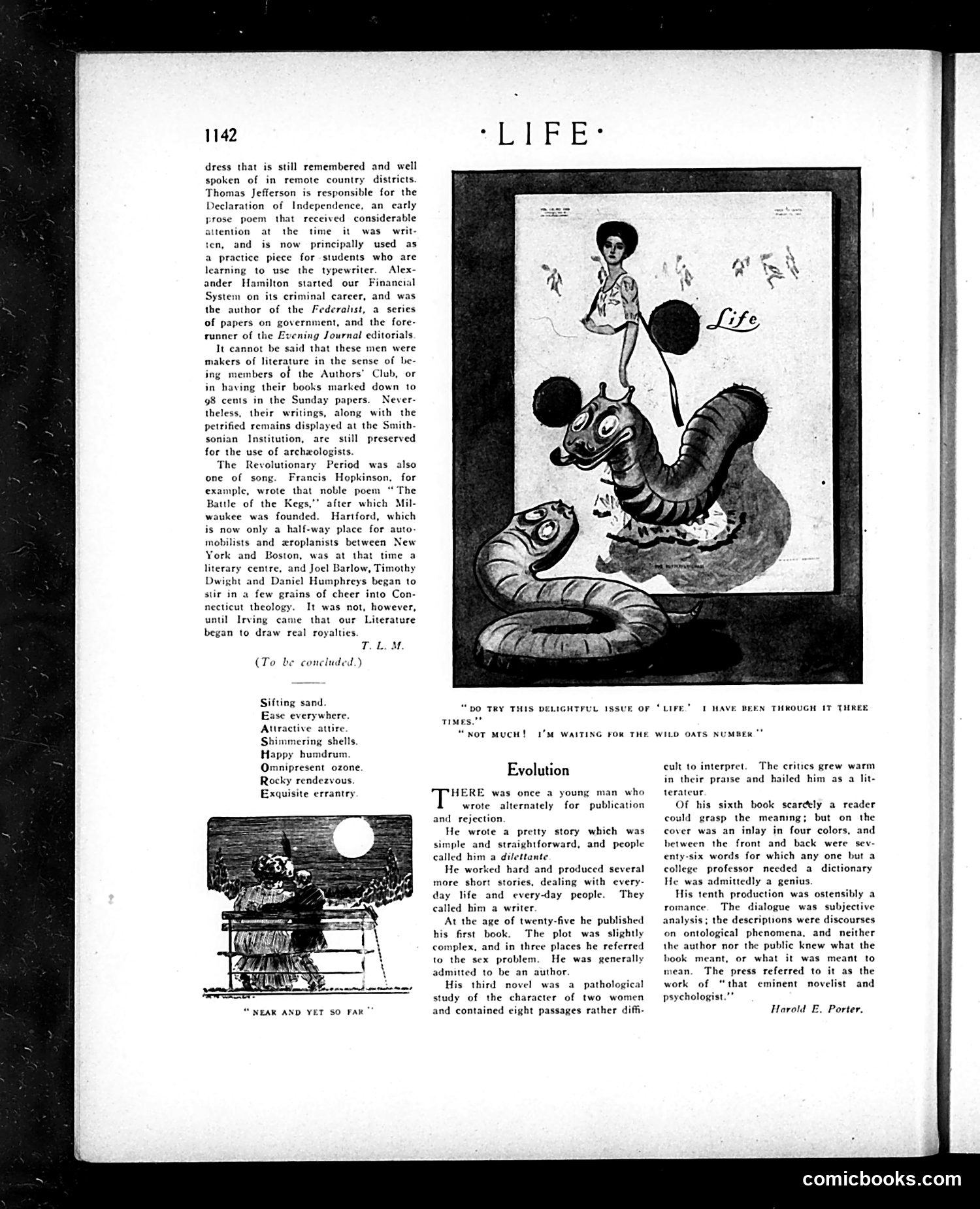
This page satirizes the evolution of literary pretension in America. The top section humorously debunks Revolutionary-era figures—Thomas Jefferson's Declaration is now just a typing practice exercise; Alexander Hamilton's *Federalist* papers are precursors to newspaper editorials. The main article "Evolution" (by Harold E. Porter) mocks how writers gain credibility through obscurity rather than talent. A young writer begins as a "dilettante" writing simple stories, becomes an "author" after adding vague sexual references to his third novel, and finally achieves "genius" status when his work becomes incomprehensible—filled with "ontological phenomena" that neither author nor readers understand. The satire's point: critics and the literary establishment reward complexity and obscurity over clarity and genuine storytelling. The fancier and more meaningless the prose becomes, the more prestigious the writer appears. It's a sharp critique of literary snobbery and the disconnect between critical acclaim and actual readability.
📄 Transcribed text from this page (OCR, searchable)
Machine-transcribed from the original scan — historical spelling and the odd misread are preserved.
1142 dress that is still remembered and well spoken of in remote country districts. Thomas Jefferson is responsible for the Declaration of Independence, an early that received considerable attention at the time it was wri ten, and is now principally used as a practice piece for students who are learning to use the typewriter. Alex- ander Hamilton started our Financial System on its criminal career, and was the author of the Federalist, a series of papers on government, and the fore- runner of the Evening Journal editorials It cannot be said that these men were makers of literature in the sense of be- ing members of the Authors’ Club, or in having their books marked down to g8 cents in the Sunday papers. Never- theless, their writings, along with the prose poem petrified remains displayed at the Smith- preserved sonian Institution, still for the use of archzologists. The Revolutionary Period was also one of song. Francis Hopkinson, for example, wrote that noble poem “The Battle of the Kegs,"’ after which Mil- waukee was founded. Hartford, which is now only a half-way place for auto- mobilists and zroplanists between New York and Boston, was at that time a literary centre, and Joel Barlow, Timothy Dwight and Daniel Humphreys began to stir in a few grains of cheer into Con- necticut theology. It was not, however, until Irving came that our Literature began to draw real royalties T. LM. (To be concluded.) are Sifting sand Ease everywhere. Attractive attire Shimmering shells. Happy humdrum. Omnipresent ozone. Rocky rendezvous. Exquisite errantry “ NEAK AND YET SO FAK" “bo TRY THIS DEI times." NOT MUCH IGHTPUL ISSUE OF I'M WAITING POR THE Evolution HERE was once a young man who wrote alternately for publication and rejection He wrote a pretty story which was simple and straightforward, and people called him a dilettante He worked hard and produced several more short stories, dealing with every- day life and every-day people. They called him a writer At the age of twenty-five he published his first book. The plot was slightly complex, and in three places he referred to the sex problem. He was generally admitted to be an author. His third novel was a pathological study of the character of two women and contained eight passages rather diffi- ‘LIFE’ 1 MAVE BEEN THROUGH IT THREE WILD OATS NUMBER” cult to interpret. The critics grew warm in their prarse and hailed him as a lit- terateur Of his sixth book scarcely a reader could grasp the meaning; but on the cover was an inlay in four colors, and between the front and back were sev- enty-six words for which any one but a college professor needed a dictionary He was admittedly a genius. His tenth production was ostensibly a romance. The dialogue was subjective analysis; the descriptions were discourses ‘on ontological phenomena, and neither the author nor the public knew what the book meant, or what it was meant to The press referred to it as the work of “that eminent novelist and psychologist.” mean Harold E. Porter. comicbooks.com