
Life, 1910-06-23 · page 13 of 40
Life — June 23, 1910 — page 13: what you’re looking at
What you’re looking at
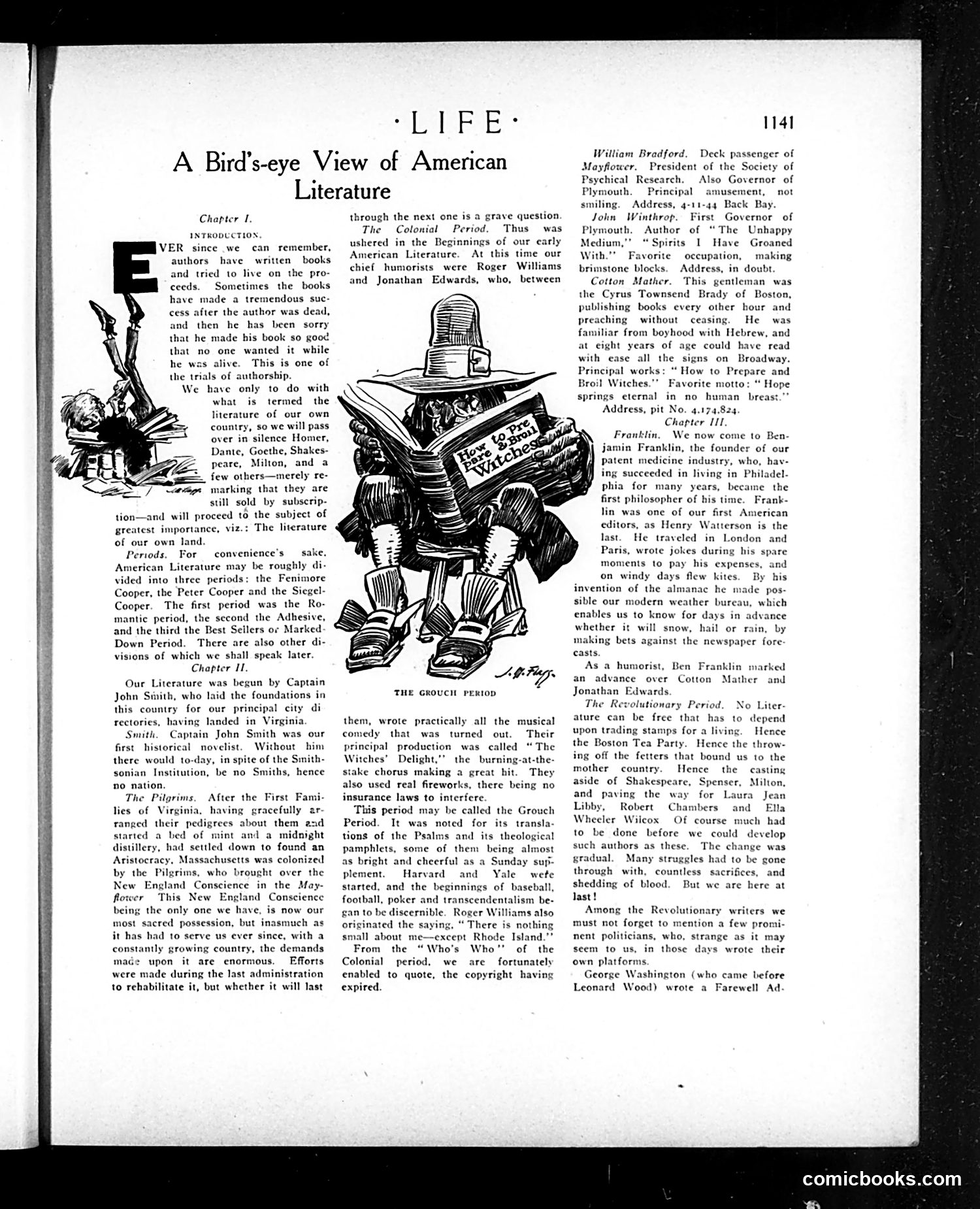
This page introduces a series surveying American literary history from colonial times onward. The central illustration depicts a figure (likely representing American literature itself) as a colonial-era Puritan or Pilgrim, reading a book while sitting atop a stack of volumes labeled with authors' names. The satire appears to mock how American literature is studied—presented as a stern, old-fashioned enterprise rooted in Puritanical traditions. The figure's formal colonial dress and serious demeanor suggest the text will critique how American literary history has been taught as a solemn, moralistic enterprise dominated by early Puritan writers. The upcoming chapters will examine periods from the Colonial through Revolutionary eras, tracing how American letters developed from religious and didactic origins.
📄 Transcribed text from this page (OCR, searchable)
Machine-transcribed from the original scan — historical spelling and the odd misread are preserved.
subacute Ae, 7 ‘ 4 ALEIERSE* A Bird’s-eye View of American Literature Chapter 1. INTRODUCTION VER since we can remember, authors have written books and tried to live on the pro- ceeds. Sometimes the books have made a tremendous suc- cess after the author was dead, and then he has been sorry that he made his book so gooe that no one wanted it while he was alive. This is one of the trials of authorship. We have only to do with what is termed the literature of our own country, so we will pass over in silence Homer, Dante, Goethe, Shakes- peare, Milton, and a few others—merely re- marking that they are still sold by subserip- tion—and will proceed to the subject of greatest importance, viz.: The literature of our own land. Periods. For conveniences sake. American Literature may be roughly di- vided into three periods: the Fenimore Cooper, the Peter Cooper and the Sicgel- Cooper. The first period was the Ro- mantic period, the second the Adhesive, and the third the Best Seilers or Marked Down Period. There are also other di- visions of which we shall speak later. Chapter II. Our Literature was begun by Captain John Sinith, who laid the foundations in this country for our principal city di rectories, having landed in Virginia Smith. Captain John Smith was our first. historical novelist. Without him there would to-day, in spite of the Smith- sonian Institution, be no Smiths, hence no nation. The Pilgrims, After the First Fami- lies of Virginia, having gracefully ar. ranged their pedigrees about them and started a bed of mint and a midnight distillery, had settled down to found an Aristocracy, Massachusetts was colonized by the Pilgrims, who brought over the New England Conscience in the May- flower This New England Conscience being the only one we have, is now our most sacred possession, but inasmuch as it has had to serve us ever since, with a constantly growing country, the demands made upon it are enormous. Efforts were made during the last administration to rehabilitate it, but whether it will last through the next one is a grave question The Colonial Period. Thus was ushered in the Beginnings of our early American Literature. At this time our chief humorists were Roger Williams nd Jonathan Edwards, who, between Md] patent medicine industry, who, hav- og. THE GROUCH PERIOD them, wrote practically all the musical comedy that was turned out. Their principal production was called “The Witches’ Delight,” the burning-at-the- stake chorus making a great hit. They also used real fireworks, there being no insurance laws to interfere. This period may be called the Grouch Period. It was noted for its transla- tions of the Psalms and its theological pamphlets, some of them being almost as bright and cheerful as a Sunday sup- plement. Harvard and Yale wete started, and the beginnings of baseball, football, poker and transcendentalism be- gan to be discernible. Roger Williams also originated the There is nothing small about m xcept Rhode Island."* From the “Who's Who’ of the Colonial period, we are fortunately enabled to quote, the copyright having expired. 141 William Bradford. Deck passenger of Mayflower. President of the Society of Psychical Research. Also Governor of Plymouth. Principal amusement, not smiling. Address, 4-11-44 Back Bay. John Winthrop. Fir Governor of Plymouth. Author of “The Unhappy Medium,” “Spirits I Have Groaned With.”” ‘avorite occupation, making brimstone blocks. Addre: in doubt Cotton Mather. This gentleman was the Cyrus Townsend Brady of Boston, publishing books every other bour and preaching without ceasing. He was familiar from boyhood with Hebrew, and at eight years of age could have read with case all the signs on Broadway. Principal works: “ How to Prepare and Broil Witches.” Favorite motto: “ Hope springs eternal in no human. breast.”” Address, pit No. 4.174.824. Chapter IL Franklin. We now come to Ben- jamin Franklin, the founder of our Ya) ing succeeded in living in Philadel- phia for many years, became the first philosopher of his time. Frank- lin was one of our first American editors, as Henry Watterson is the last. He traveled in London and Paris, wrote jokes during his spare moments to pay his expenses, and on windy days flew kites. By his invention of the almanac he made pos- sible our modern weather bureau, which enables us to know for days in advance whether it will snow, hail or rain, by making bets against the newspaper fore casts As a humorist, Ben Franklin marked an advance over Cotton Mather and Jonathan Edwards The Revolutionary Period. ature can be free that has to depend upon trading stamps for a living. Hence the Boston Tea Party. Hence the throw- ing off the fetters that bound us to the mother country. Hence the casting aside of Shakespeare, Spenser, Milton, and paving the way for Laura Jean Libby, Robert Chambers and Ella Wheeler Wiicox Of course much had to be done before we could develop such authors as these. The change was gradual. Many struggles had to be gone through with, countless. sacrifices, and shedding of blood. But we are here at las Among the Revolutionary writers we must not forget to mention a few promi- nent politicians, who, strange as it may seem to us, in those days wrote their own platforms. George Washington (who came before Leonard Wood) wrote a Farewell Ad- No Liter- comicbooks.com