
Life, 1910-06-23 · page 23 of 40
Life — June 23, 1910 — page 23: what you’re looking at
What you’re looking at
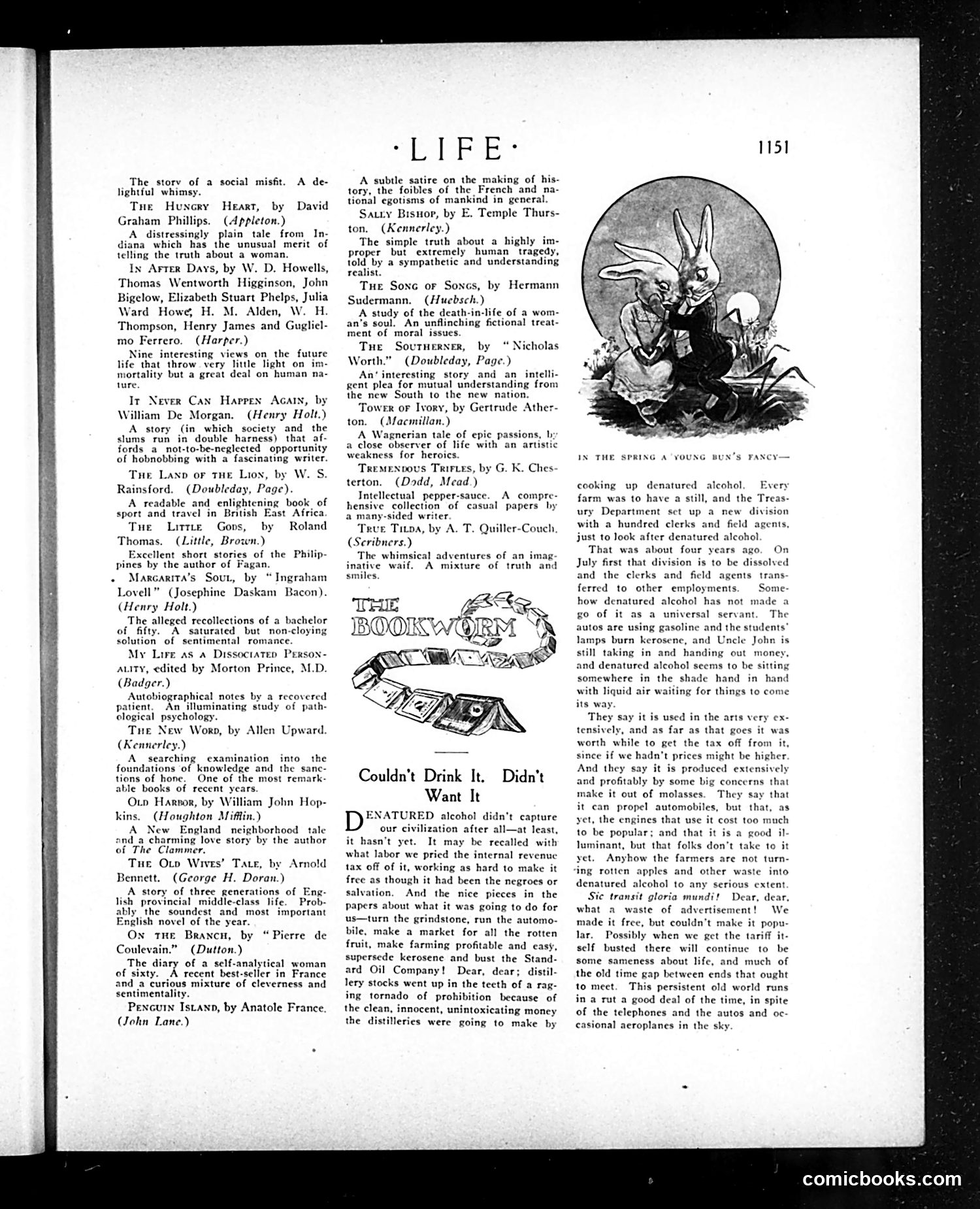
This page is a book review section with an accompanying satirical article about Prohibition-era denatured alcohol. The cartoon illustrates the article's central joke: the government attempted to tax alcohol heavily, so distilleries were allowed to produce "denatured" (poisoned) alcohol for industrial use, assuming people wouldn't drink it. The satire targets both government incompetence and American ingenuity. Despite being toxic, farmers and others found ways to use denatured alcohol anyway—straining it through various materials to remove poison, or using it in automobiles and lamps. The piece mocks this cat-and-mouse game: authorities tried to eliminate alcohol consumption through taxation and poison, yet Americans persisted in finding workarounds. The title's phrase—"couldn't drink it, didn't want it"—is ironic; people clearly *did* want it and *could* drink it, circumventing official restrictions. This reflects pre-Prohibition anxieties about alcohol policy's futility.
📄 Transcribed text from this page (OCR, searchable)
Machine-transcribed from the original scan — historical spelling and the odd misread are preserved.
The storv of a social misfit. A de- lightful whims: Tne Huncry Graham Phillips. (A ppleton.) A distressingly plain tale from In- diana which has the unusual merit of telling the truth about a woman. In Arter Days, by W. D. Howells, Thomas Wentworth Higginson, John Bigelow, Elizabeth Stuart Phelps, Julia Ward Howe, H. M. Alden, W. H. Thompson, Henry James and Gugliel- mo Ferrero. (Harper.) Nine interesting views on the future life that throw very little light on mortality but a great deal on human na ture. It Never Can Happen Acatn, by William De Morgan. (Henry Holt.) A story (in which society and the slums run in double harness) that af- fords a not-to-be-neglected opportunity of hobnobbing with a fascinating writer. Tue Laxp or THE Liox, by W. S. Rainsford. (Doubleday, Page). A readable and enlightening book of sport and travel in British East Africa Tue Litre Gons, by Roland Thomas. (Little, Brown.) Excellent short stories of the Philip- pines by the author of Marcarita’s Sout, by “Ingraham Lovell” (Josephine Daskam Bacon). (Henry Holt.) The alleged recollections of a bachelor of fifty. A saturated but non-cloying solution of sentimental romance. My Lire a Dissoctaten Person- auity, edited by Morton Prince, M.D. (Badger.) Autobiographical notes by a recovered patient. An illuminating study of path- ological psychology. Tne New Wor, by (Kennerley.) A searching examination into the foundations of knowledge and the sanc- tions of hone. One of the most remark- able books of recent years. Otp Harpor, by William John Hop- kins. (Houghton Miffin.) A New England neighborhood tale and_a charming love story by the author of The Clammer. Tue Ovo Wives’ Tate, by Bennett. (George H. Doran.) A story of three generations of Eng- lish provincial middle-class life. Prob- ably the soundest and most important English novel of the year. On tHe Brancu, by Coulevain.” (Dutton.) The diary of a self-analytical woman of sixty. recent best-seller in France and a curious mixture of cleverness and sentimentality. Pencutn Istanp, by Anatole France. (John Lane.) Heart, by David Allen Upward. Arnold “Pierre de EEE A subtle satire on the making of his- tory, the foibles of the French and na- tional egotisms of mankind in general. Satty Bisuor, by E. Temple Thurs- ton, (Kennerley.) The simple truth about a highly im- proper but extremely human traged: told by a sympathetic and understanding realist. Tue Sone oF Soncs, by Sudermann. (Huebsch.) A study of the death-in-life of a wom- an’s soul. An unflinching fictional treat- ment of moral issues. Tue Sovtnerner, by “ Nicholas Worth.” (Doubleday, Page.) An‘ interesting story and an intelli- gent plea for mutual understanding from the new South to the new nation. Tower oF Ivory, by Gertrude Ather- ton. (Macmillan.) A Wagnerian tale of epic passions, by a close observer of life with an artistic weakness for heroics. Tremenvous Trirtes, by G. K. Ches terton, (Dodd, Mead.) Intellectual pepper. hensive collection of a many-sided writer. Trve Tita, by (Seribners.) The whimsical adventures of an imag- inative waif. A mixture of truth and smiles. THE BOOK oat Hermann A compre- 1 papers. by T. Quiller-Couch Couldn't Drink It. Want It NATURED alcohol didn't capture our civilization after all—at least, it hasn't yet. It may be recalled with what labor we pried the internal revenue tax off of it, working as hard to make it free as though it had been the negroes or salvation. And the nice pieces in the papers about what it was going to do for us—turn the grindstone, run the automo- bile, make a market for all the rotten fruit, make farming profitable and easy, supersede kerosene and bust the Stand- ard Oil Company! Dear, dear; distil- lery stocks went up in the teeth of a rag- ing tornado of prohibition because of the clean, innocent, unintoxicating money the distilleries were going to make by Didn't IN THE SPRING A/YOUNG BUN’S FANCY— cooking up denatured alcohol. Every farm was to have a still, and the Treas- ury Department set up a new division with a hundred clerks and field agents, just to look after denatured alcohol That was about four years ago. On July first that division is to be dissolved and the clerks and field agents trans- ferred to other employments. Some- how denatured alcohol has not made a go of it as a universal servant. The autos are using gasoline and the students" lamps burn kerosene, and Uncle John is still taking in and handing out and denatured alcohol seems to be sitting somewhere in the shade hand in hand with liquid air waiting for things to come money, They say it is used in the arts very ex- tensively, and as far as that goes it was worth while to get the tax off from it, since if we hadn't prices might be higher And they say it is produced extensively and profitably by some big concerns that make it out of molasses. They say that it can propel automobiles, but that, yet, the engines that use it cost too much to be popular; and that it is a good il- luminant, but that folks don’t take to i yet. Anyhow the farmers are not turn- ‘ing rotten apples and other waste into denatured alcohol to any serious extent Sic transit gloria mundi! Dear, dear, what a waste of advertisement! We made it free, but couldn't make it popu- lar. Possibly when we get the tariff it- self busted there will continue to be some sameness about life, and much of the old time gap between ends that ought to meet. This persistent old world runs in a rut a good deal of the time, in spite of the telephones and the autos and oc- casional aeroplanes in the sky comicbooks.com