
Life, 1910-06-23 · page 26 of 40
Life — June 23, 1910 — page 26: what you’re looking at
What you’re looking at
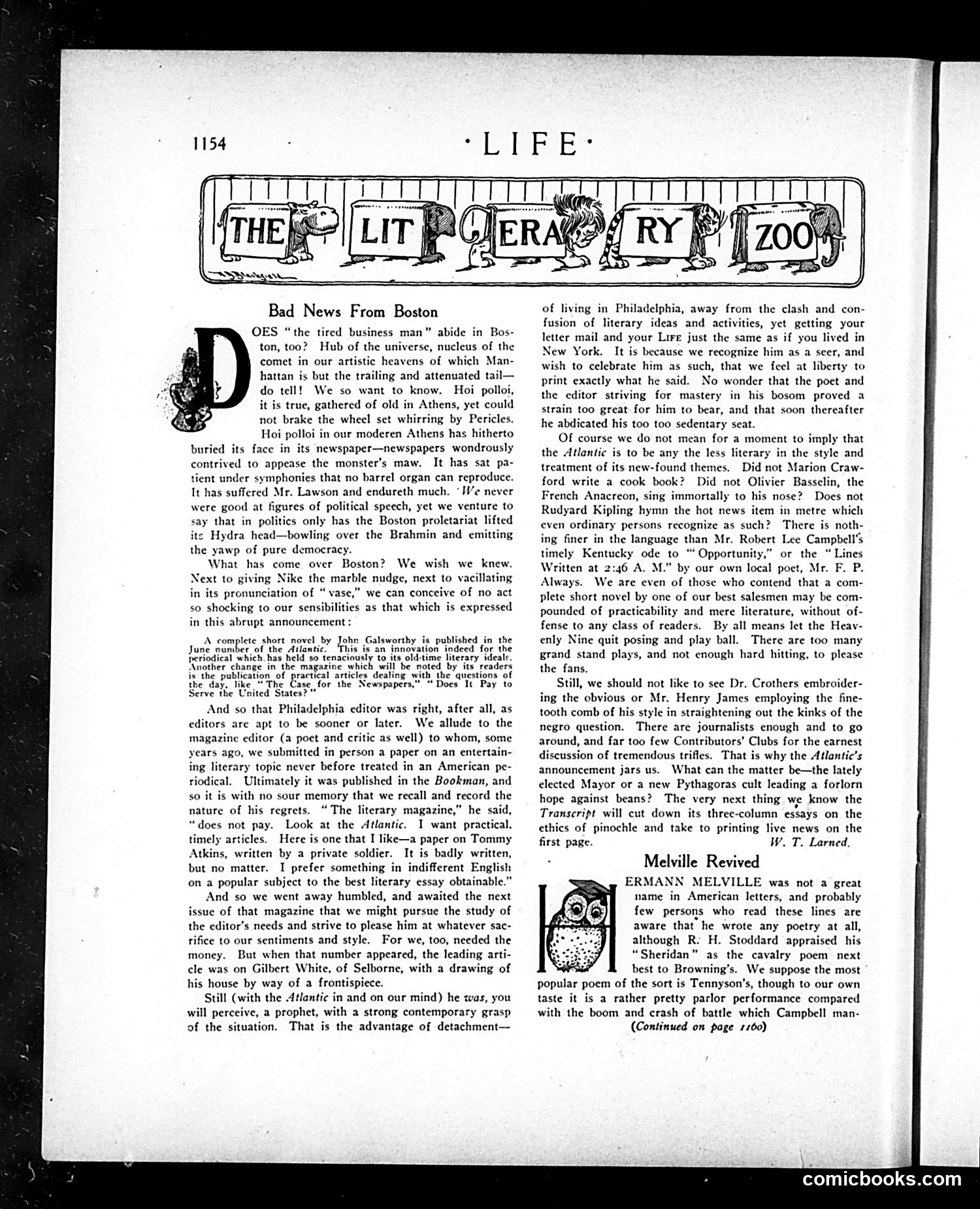
This is a satirical essay attacking *The Atlantic* magazine for abandoning literary standards. The writer mocks Boston's cultural pretensions—calling it "Hub of the universe"—while noting its recent shift toward practical, timely articles over pure literature. The core complaint: an editor once rejected the author's literary essay, demanding instead practical pieces like "Tommy Atkins, written by a private soldier" (badly written but useful). Yet when the author checked that same issue, the lead article was on Gilbert White—pure literature with illustrations. The editor's hypocrisy is exposed. Now *The Atlantic* is publishing John Galsworthy and adding practical articles on newspapers and public service. The author sarcastically questions whether famous writers like Marion Crawford (who wrote cookbooks) justify this descent into utility over artistry. The satire targets American magazine editors' mercenary compromises: they reject genuine literature for profit, then publish it anyway, revealing their real motive is money, not principle.
📄 Transcribed text from this page (OCR, searchable)
Machine-transcribed from the original scan — historical spelling and the odd misread are preserved.
Bad News From Boston OES “the tired business man” abide in Bos- ton, too? Hub of the universe, nucleus of the comet in our artistic heavens of which Man- hattan is but the trailing and attenuated tail— do tell! We so want to know. Hoi polloi, it is true, gathered of old in Athens, yet could not brake the wheel set whirring by Pericles. Hoi polloi in our moderen Athens has hitherto buried its face in its newspaper—newspapers wondrously contrived to appease the monster’s maw, It has sat pa- tient under symphonies that no barrel organ can reproduce. It has suffered Mr. Lawson and endureth much. ‘We never were good at figures of political speech, yet we venture to say that in politics only has the Boston proletariat lifted its Hydra head—bowling over the Brahmin and emitting the yawp of pure democracy. What has come over Boston? We wish we knew. Next to giving Nike the marble nudge, next to vacillating we can conceive of no act so shocking to our sensibilities as that which is expressed in this abrupt announcement: A complete short novel by John Galsworthy is published jin the June number of the Atlantic. ‘This is an innovation indeed for the periodical which, has held so tenaciously to its old-time literary ideals. ‘Another change in the magazine which will be noted by its readers ig the publication of practical articles dealing the questions of the day, like “The Case, for the Newspapers,” “Does It Pay to Serve the United States?” And so that Philadelphia editor was right, after all, as editors are apt to be sooner or later. We allude to the magazine editor (a poet and critic as well) to whom, some years ago, we submitted in person a paper on an entertain- ing literary topic never before treated in an American pe- riodical. Ultimately it was published in the Bookman, and so it is with no sour memory that we recall and record the nature of his regrets. “The literary magazine,” he said, “does not pay. Look at the Atlantic. I want practical. timely articles. Here is one that I like—a paper on Tommy Atkins, written by a private soldier. It is badly written, but no matter. I prefer something in indifferent English on a popular subject to the best literary essay obtainable.” And so we went away humbled, and awaited the next issue of that magazine that we might pursue the study of the editor's needs and strive to please him at whatever sac- rifice to our sentiments and style. For we, too, needed the money. But when that number appeared, the leading arti- cle was on Gilbert White, of Selborne, with a drawing of his house by way of a frontispiece. Still (with the Atlantic in and on our mind) he was, you will perceive, a prophet, with a strong contemporary grasp of the situation. That is the advantage of detachment— of living in Philadelphia, away from the clash and con- fusion of literary ideas and activities, yet getting your letter mail and your Lire just the same as if you lived in New York. It is because we recognize him as a seer, and wish to celebrate him as such, that we feel at liberty to print exactly what he said. No wonder that the poet and the editor striving for mastery in his bosom proved a strain too great for him to bear, and that soon thereafter he abdicated his too too sedentary seat. Of course we do not mean for a moment to imply that the Atlantic is to be any the less literary in the style and treatment of its new-found themes. Did not Marion Craw- ford write a cook book? Did not Olivier Basselin, the French Anacreon, sing immortally to his nose? Does not Rudyard Kipling hymn the hot news item in metre which even ordinary persons recognize as such? There is noth- ing finer in the language than Mr. Robert Lee Campbell's timely Kentucky ode to “‘ Opportunity,” or the “ Lines Written at 2:46 A. M.” by our own local poet, Mr. F. P. Always. We are even of those who contend that a com- plete short novel by one of our best salesmen may be com- pounded of practicability and mere literature, without of- fense to any class of readers. By all means let the Heav- enly Nine quit posing and play ball. There are too many grand stand plays, and not enough hard hitting, to please the fans. Still, we should not like to see Dr. Crothers embroider- ing the obvious or Mr. Henry James employing the fine- tooth comb of his style in straightening out the kinks of the negro question. There are journalists enough and to go around, and far too few Contributors’ Clubs for the earnest discussion of tremendous trifles. That is why the Atlantic’s announcement jars us. What can the matter be—the lately elected Mayor or a new Pythagoras cult leading a forlorn hope against beans? The very next thing we know the Transcript will cut down its three-column essays on the ethics of pinochle and take to printing live news on the first page. W. T. Larned, Melville Revived ERMANN MELVILLE was not a great name in American letters, and probably few persons who read these lines are aware that he wrote any poetry at all, although R: H. Stoddard appraised his “Sheridan” as the cavalry poem next . best to Browning's. We suppose the most popular poem of the sort is Tennyson's, though to our own taste it is a rather pretty parlor performance compared with the boom and crash of battle which Campbell man- (Continued on page 1160) comicbooks.com