
A complete issue · 36 pages · 1910
Life — March 17, 1910
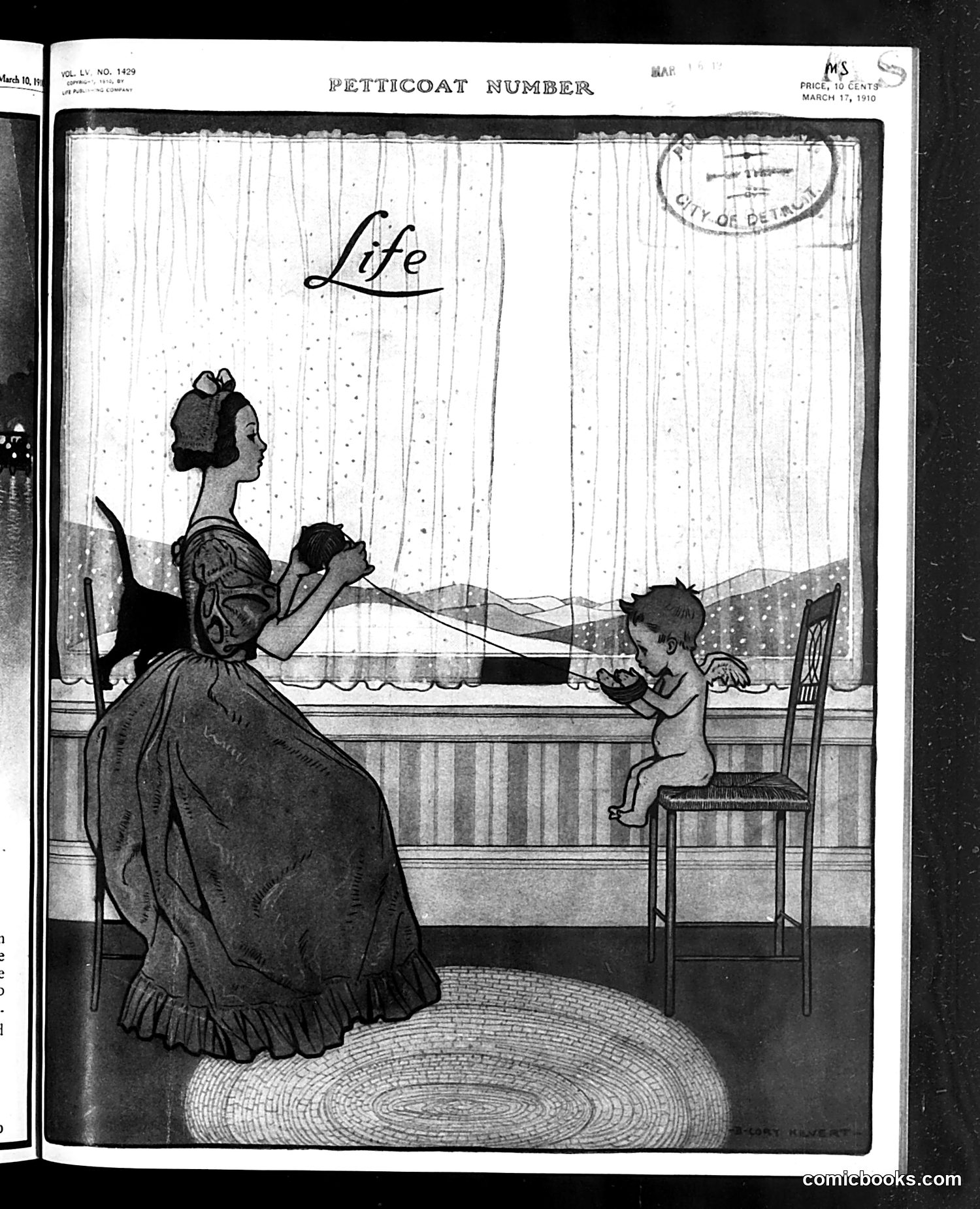
This appears to be a cover illustration from *Life* magazine (Vol. LV, No. 1429, dated March 15, 1910, priced 10 cents). The image depicts a woman in Edwardian dress playing with a cherub or cupid figure by a window overlooking a landscape. The title "Life" and the domestic scene suggest this is satirizing contemporary attitudes toward motherhood, childhood, or domestic leisure. The cherub's presence may reference classical artistic traditions or invoke themes of innocence and motherhood—subjects *Life* frequently used for both sentimental and satirical commentary. Without additional OCR text from the page's body, the specific satirical point remains unclear, though the composition suggests commentary on upper-class domestic life or idealized femininity of the Edwardian era.
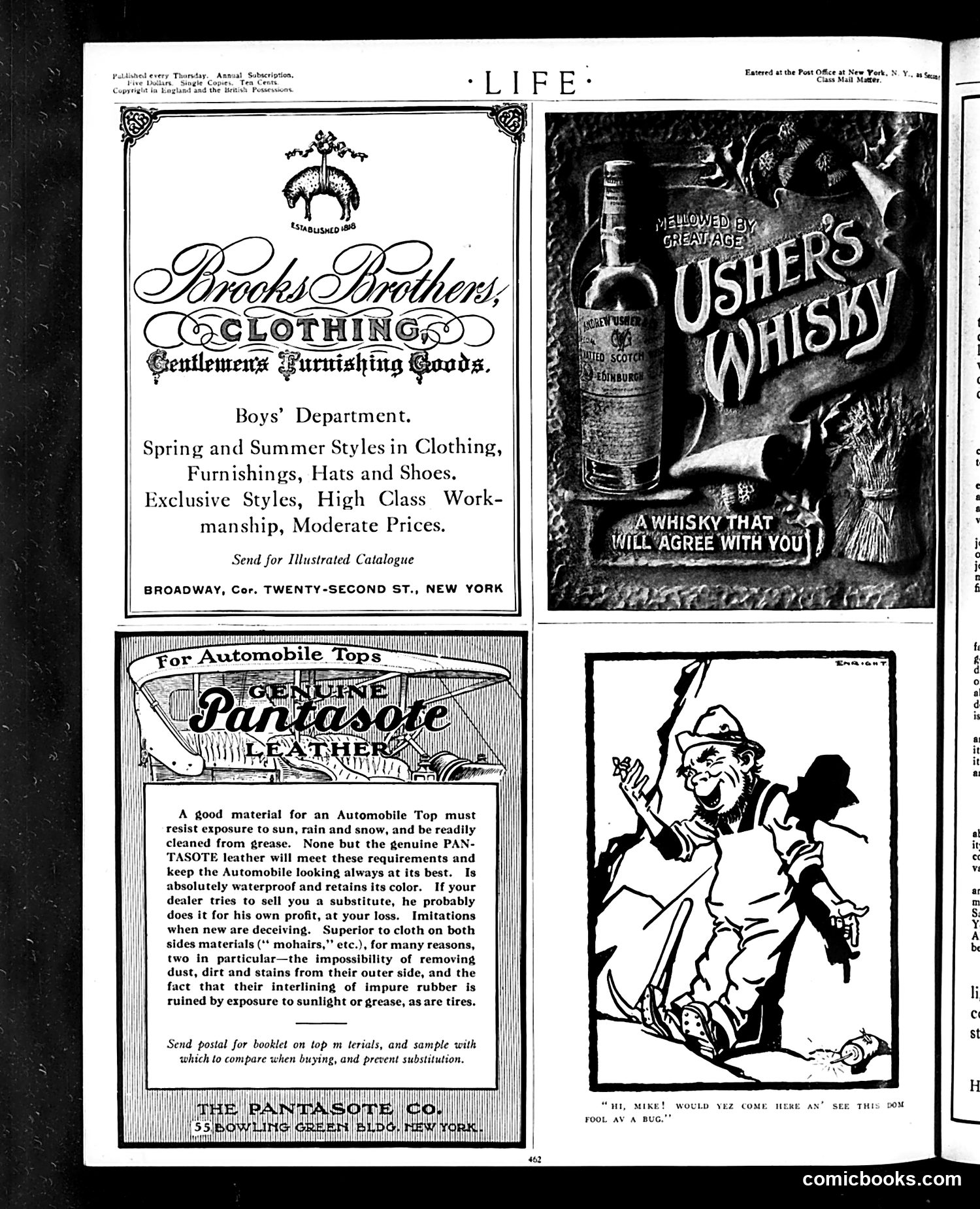
This page consists primarily of **advertisements** rather than editorial cartoons. The main content includes: 1. **Brooks Brothers** clothing ad for boys' department 2. **Usher's Whisky** advertisement ("A Whisky That Will Agree with You") 3. **Pantasote Company** ad for automobile top leather material 4. A **cartoon illustration** showing a comedic figure (appears to be an Irishman based on stereotypical depiction) saying "Hi, Mike! Would yez come here an' see this dom fool at a bug." The cartoon appears to use period ethnic stereotyping common to early 20th-century American humor. The joke seems to involve someone calling attention to a fool ("dom fool") and a bug, though the exact satirical point is unclear without additional context.
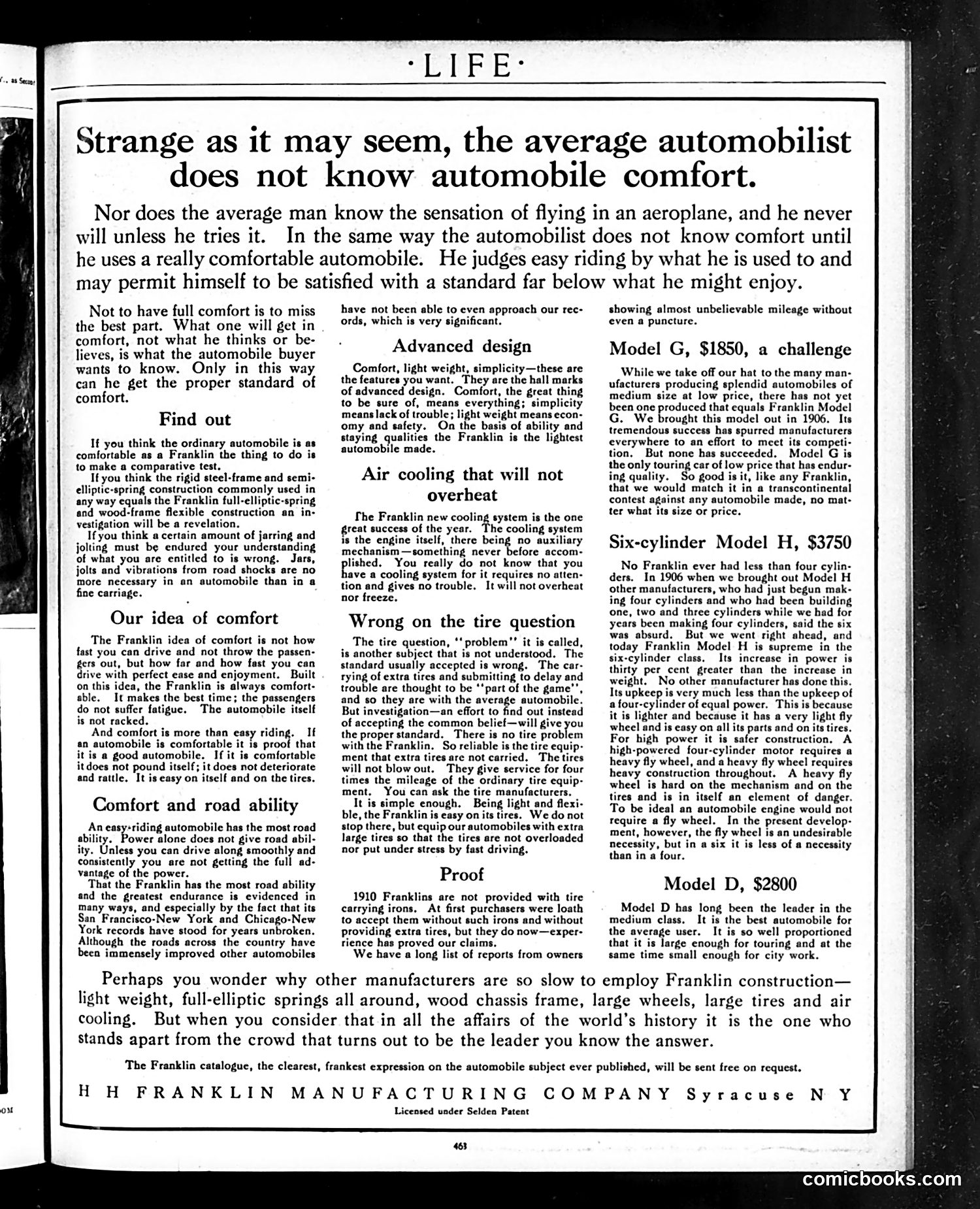
This page is primarily **Franklin automobile advertising**, not satire or political commentary. It's a straightforward promotional piece from the H.H. Franklin Manufacturing Company of Syracuse, New York. The ad argues that average car owners don't truly understand automobile comfort until experiencing a Franklin. It compares this to how someone hasn't truly experienced flight until trying an airplane. The copy emphasizes Franklin's distinctive features: light weight, advanced air-cooling system (rather than water cooling), and reliable tire construction. Three specific models are highlighted with prices: Model G ($1,850), Model H ($3,750), and Model D ($2,800). This represents early 20th-century automotive marketing—educational, feature-focused, and designed to persuade middle-class readers that Franklin's engineering philosophy offered superior comfort and reliability compared to competitors.
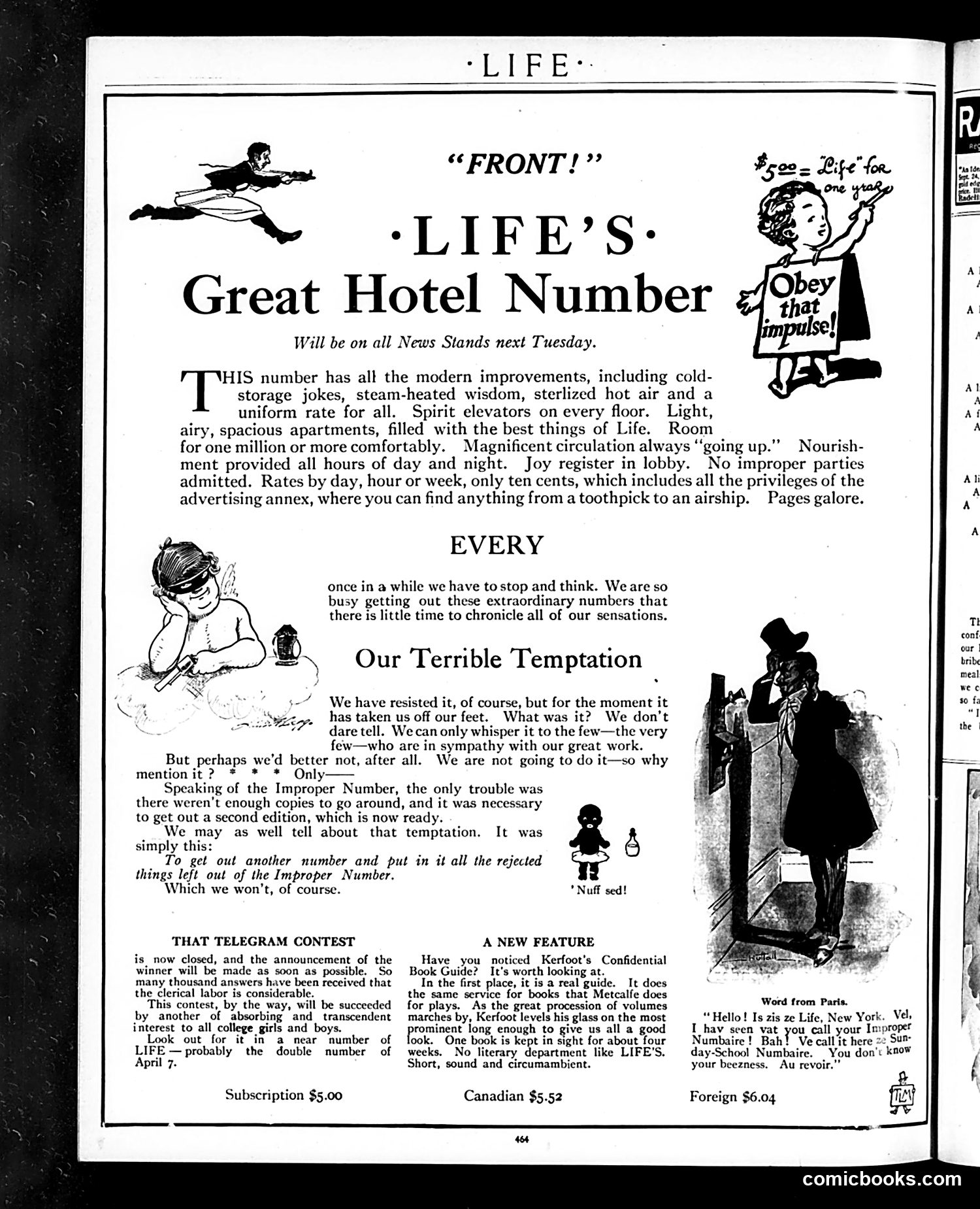
This page announces Life's "Great Hotel Number," an upcoming special issue to be released next Tuesday. The content is primarily **promotional advertising** rather than political satire. The illustrations depict humorous scenarios: a man diving/flying horizontally (suggesting energetic chaos), a cherub-like figure, and a figure in formal dress. These appear to be whimsical decorative elements rather than specific caricatures of identifiable public figures. The text playfully describes the hotel issue's contents as including jokes about "cold-storage," "steam-heated wisdom," and "sterilized hot air"—puns suggesting satirical hotel humor rather than commentary on current events or politics. The page also mentions a closed telegram contest and references Kerfoot's Confidential Book Guide as "A NEW FEATURE." Overall, this is a **commercial announcement** dressed in Life's characteristic humorous style, not political-historical commentary.
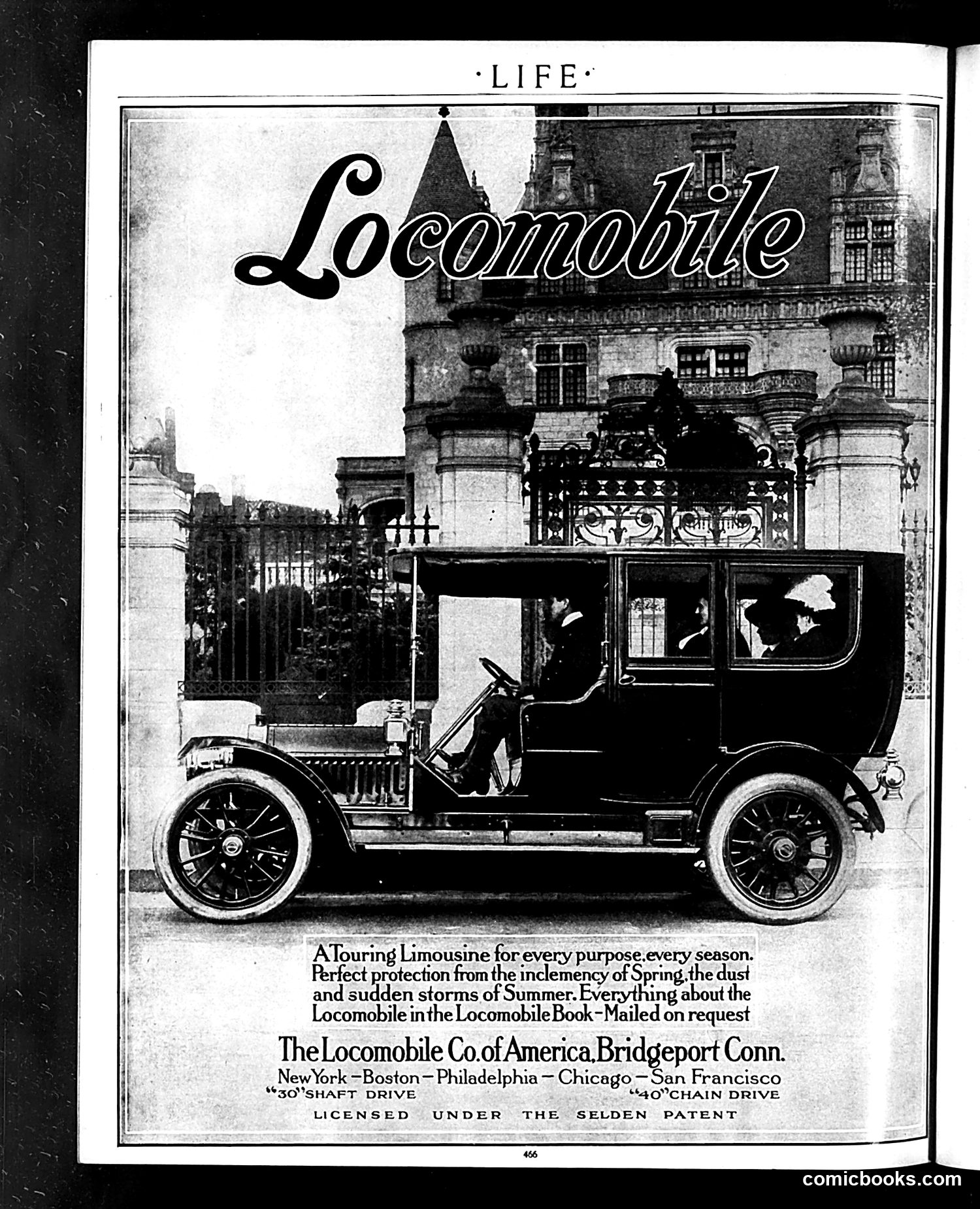
This page is **not a political cartoon or satire—it's a straightforward advertisement** for the Locomobile automobile, published in *Life* magazine. The ad showcases a touring limousine positioned in front of an elegant mansion, emphasizing luxury and wealth. The text promises "perfect protection from the inclemency of Summer, the dust and sudden storms," marketing the vehicle as practical for affluent consumers across all seasons. The Locomobile Company of America, based in Bridgeport, Connecticut, operated multiple sales offices nationwide. The advertisement highlights two drive-shaft options ("30 shaft drive" and "40 chain drive") and notes the car was "licensed under the Selden patent"—a significant detail referring to early automotive patent litigation. This represents typical early-20th-century automotive advertising targeting wealthy audiences.
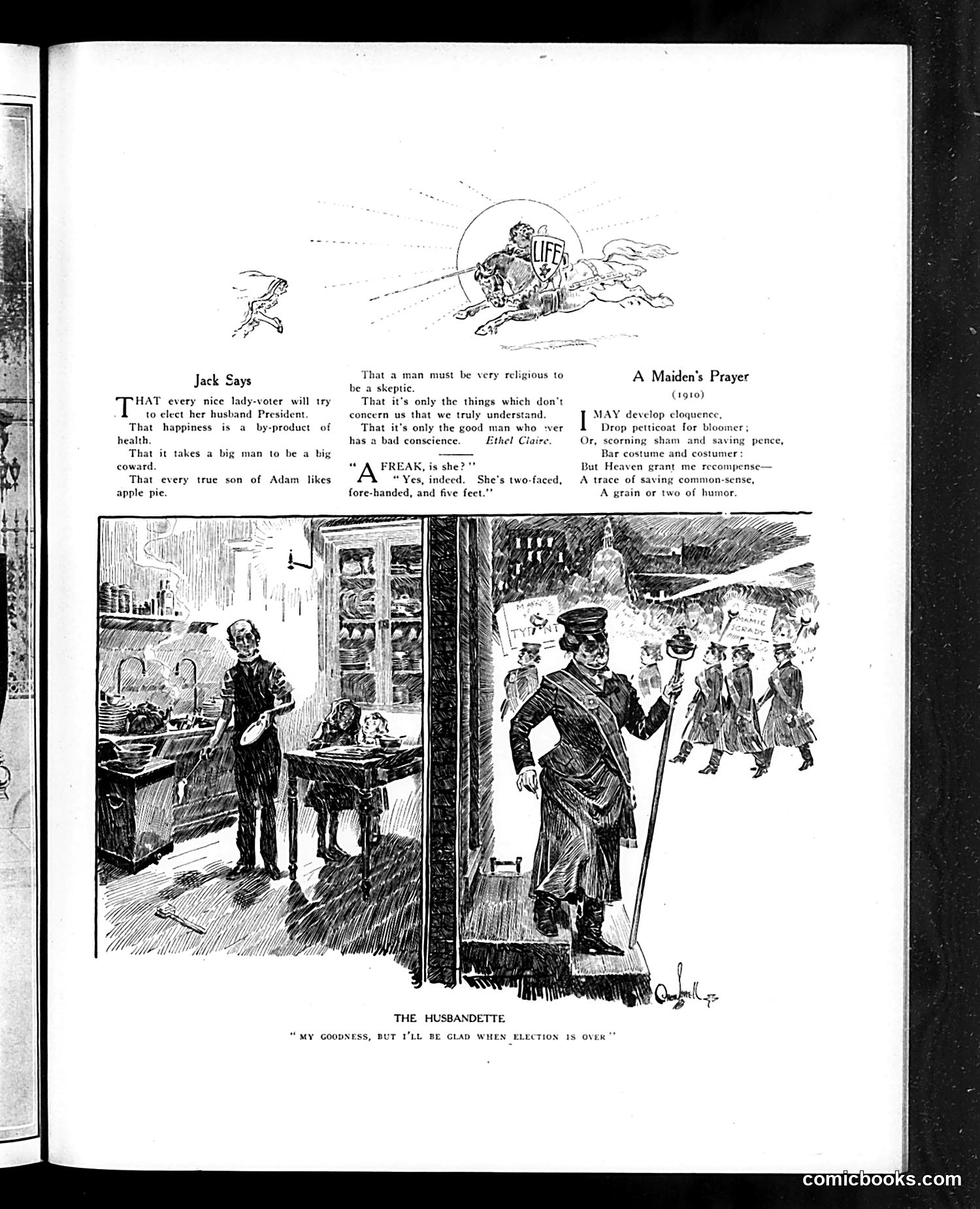
This cartoon satirizes a woman's anxieties about her husband's political involvement during an election season. The illustration shows a military or political figure leaving home while his wife waves goodbye, saying "My goodness, but I'll be glad when election is over." The joke targets wives of politically active men who must endure their husbands' intense campaign schedules and related domestic disruptions. The woman appears exhausted by the electoral process—not from voting rights concerns, but from the practical inconvenience of her husband's absence during campaigning. The surrounding text ("Jack Says") offers misogynistic commentary about women voters and gender roles, typical of this era's satirical magazine humor. The cartoon mocks both political campaigns and domestic life through the "husbandette's" perspective.
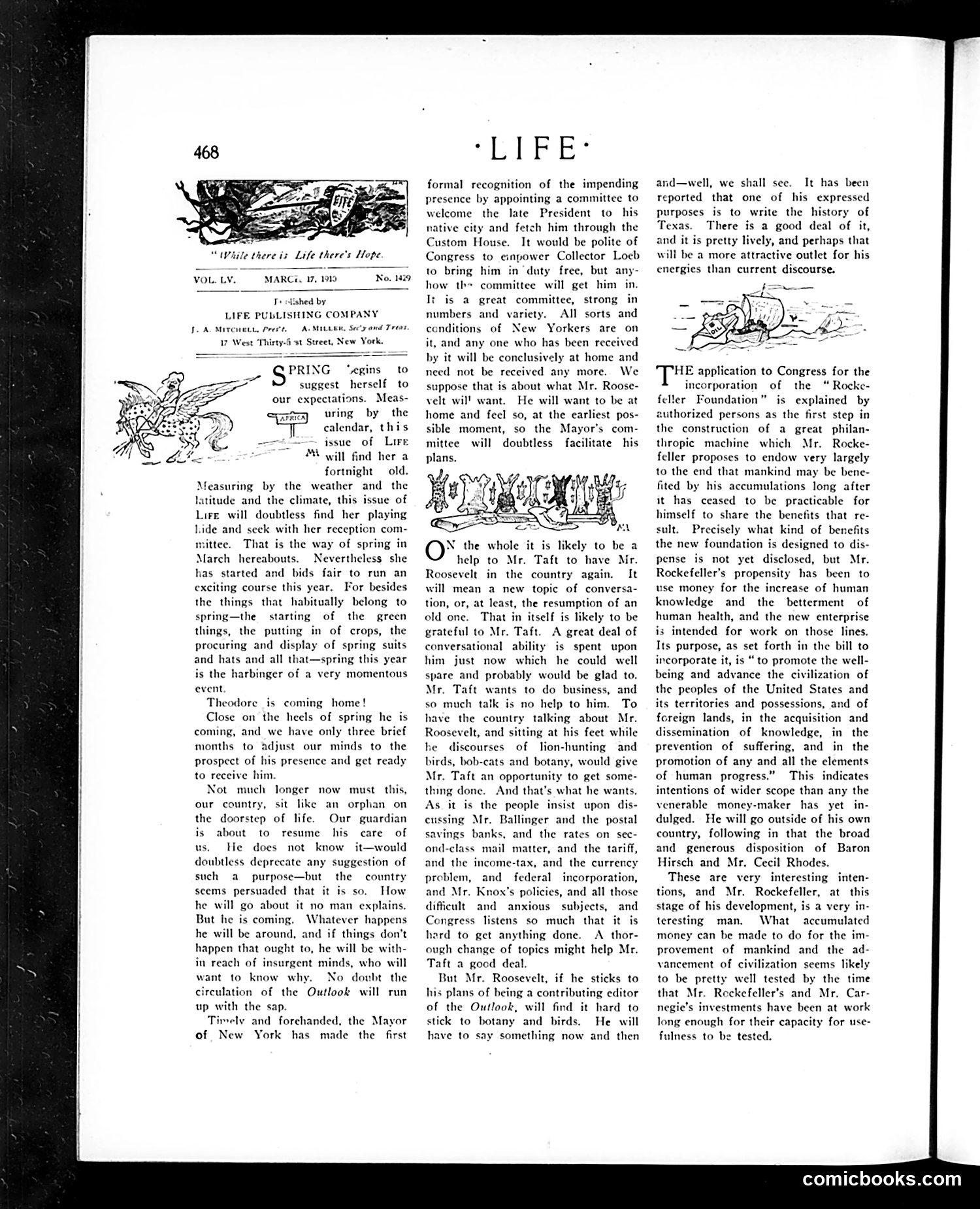
This page contains editorial commentary about President Theodore Roosevelt's impending return to America. The text discusses Roosevelt's anticipated reception, mentioning plans for a committee to welcome him through New York's Custom House. The commentary is satirical about the political excitement surrounding Roosevelt's homecoming and the various interests hoping to engage him—including discussion of business matters, postal reform, tariffs, and federal incorporation issues. The writer expresses skepticism about whether Roosevelt will have time for substantive contributions or merely provide conversation about hunting and nature. The accompanying illustrations appear to be decorative rather than direct political cartoons, featuring whimsical spring-themed imagery. The satire targets both Roosevelt's celebrity status and the public's unrealistic expectations for his involvement in governance.
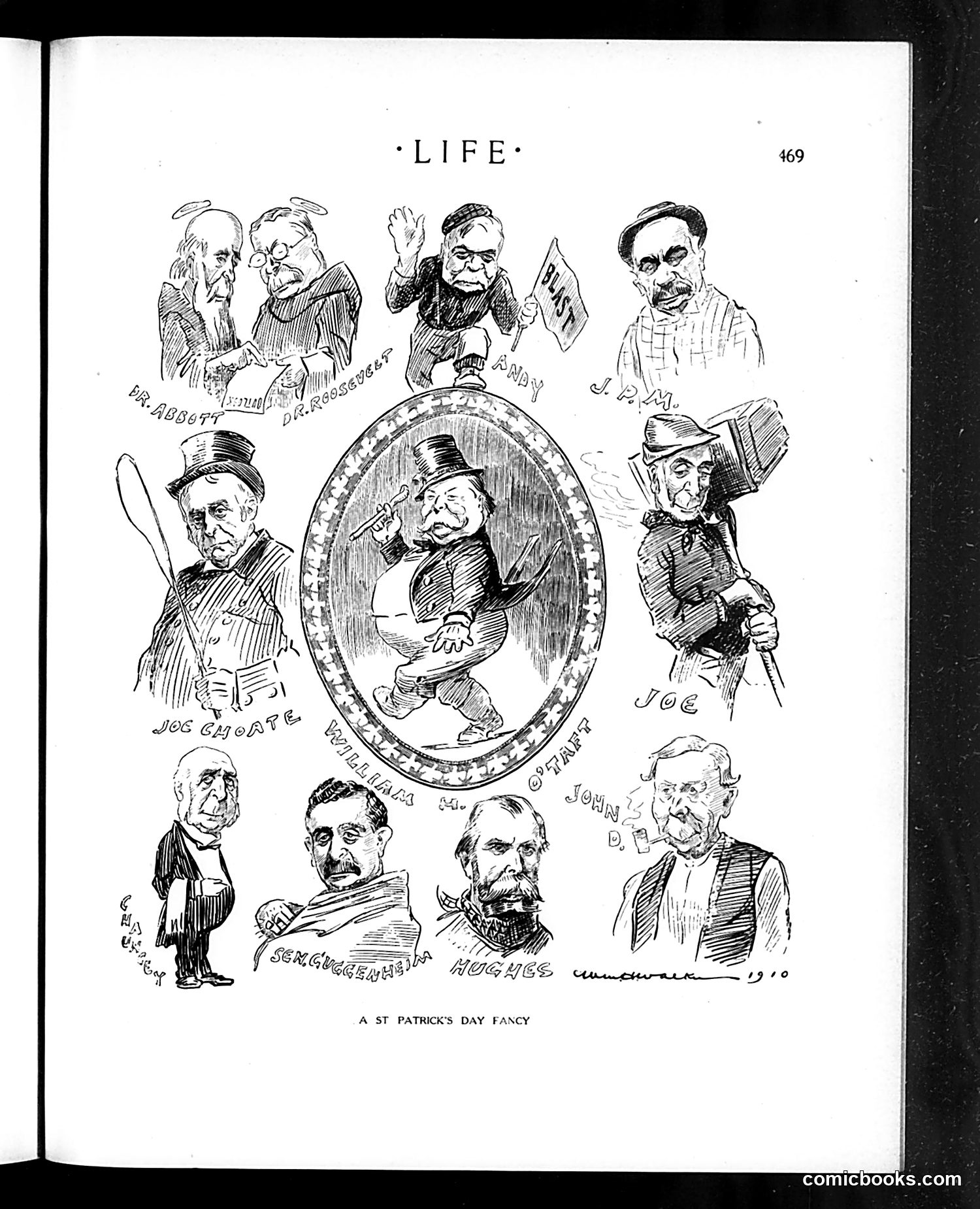
This is a satirical cartoon from *Life* magazine (dated 1910 based on the signature) depicting Irish-American political figures arranged around a central caricature labeled "William O'Taff" in a decorative oval frame. The surrounding figures are labeled with names including Dr. Abbott, Div. Roosevelt, J.P.M., Joe Choate, Joe, John, and references to Sengeorgeanta and Hughes. The style suggests these are prominent Irish-American politicians or public figures of the era being mocked for their ethnic identity and political connections. The "St Patrick's Day Fancy" framing indicates this is holiday-themed satire, likely satirizing Irish-American political influence or stereotypes during the Progressive Era. Without clearer identification of all figures, the specific political critique remains partially unclear to modern readers.
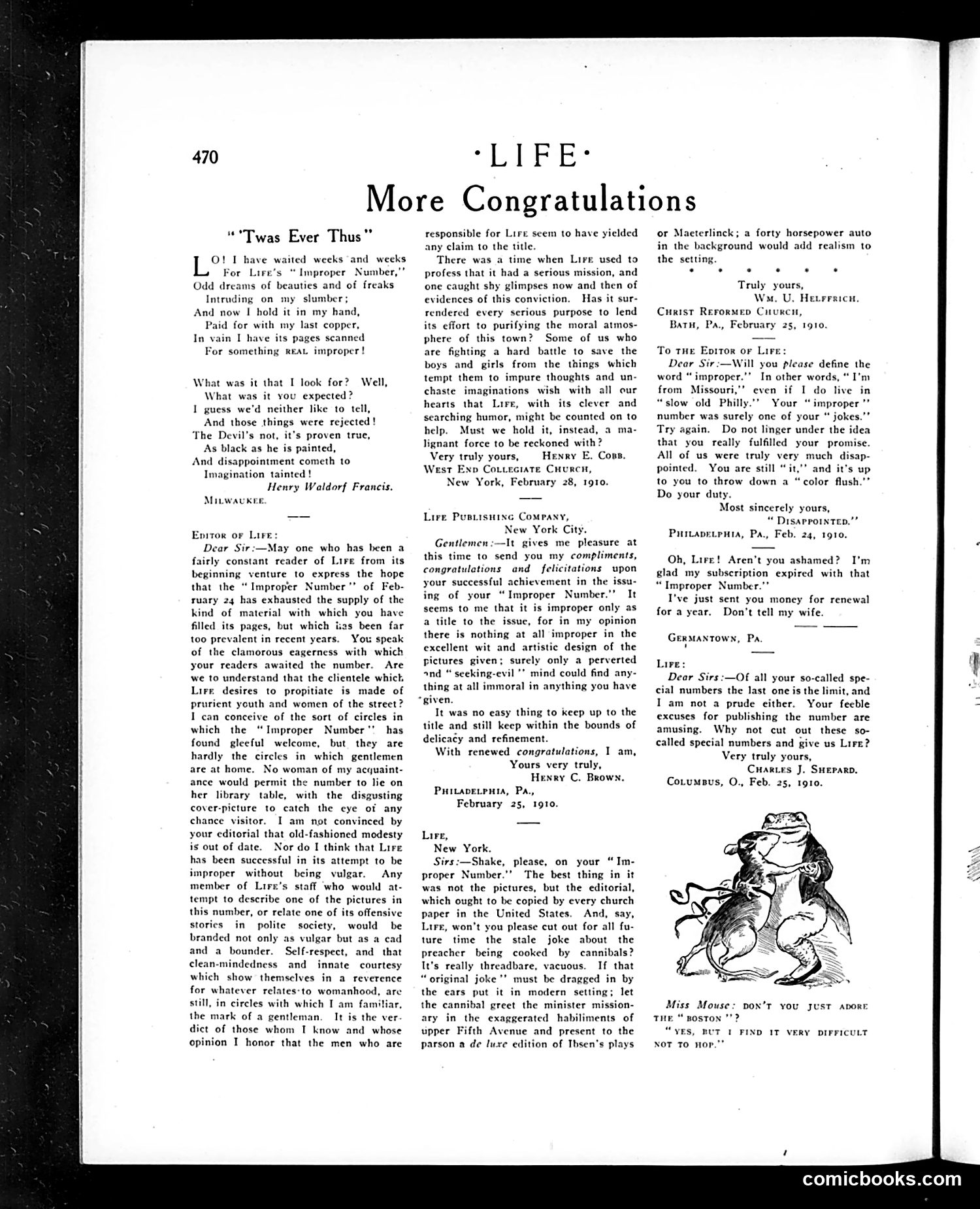
This page comprises reader letters responding to Life's recent "Improper Number" issue. The letters discuss Life magazine's editorial content and design, particularly praising the magazine's wit and artistic quality while debating its appropriateness. **The cartoon** (bottom right) depicts Miss Mouse, apparently a recurring character, in a Boston setting. The caption reads: "Don't you just adore the 'Boston'?" with Miss Mouse replying "Yes, but I find it very difficult not to hop." This appears to be a visual pun playing on "Boston" (likely a dance or social context of the era) and the character's mouse nature—she finds it difficult "not to hop," a characteristic mouse behavior. The humor relies on the incongruity between genteel social activities and animal instinct.
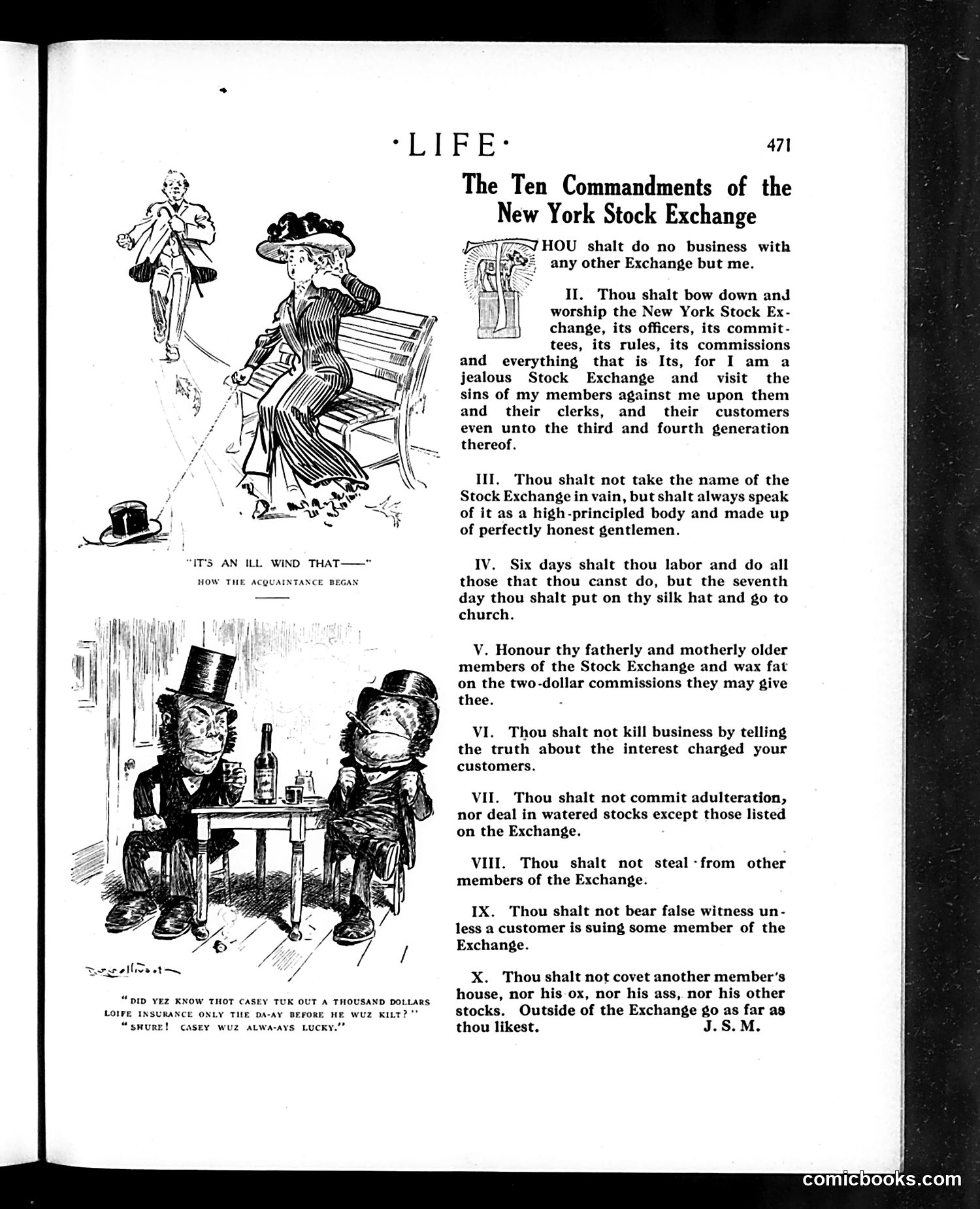
This is a satirical piece mocking the New York Stock Exchange and its members. The commandments parody the Biblical Ten Commandments, suggesting that stock brokers operate by their own corrupt moral code rather than actual ethics. The top illustration shows a woman (likely Lady Liberty or Justice) blown backward by wind—suggesting the Exchange's instability. The bottom cartoon depicts two wealthy men at a table with alcohol and money, with text implying casual fraud: one claims insurance covered his losses before being "killed." The satire's point: Stock Exchange members prioritize profit, commissions, and self-interest over honesty, fair dealing, and genuine principles. They "worship" the Exchange itself rather than maintaining ethical standards. This reflects Progressive-era criticism of Wall Street corruption and speculation.
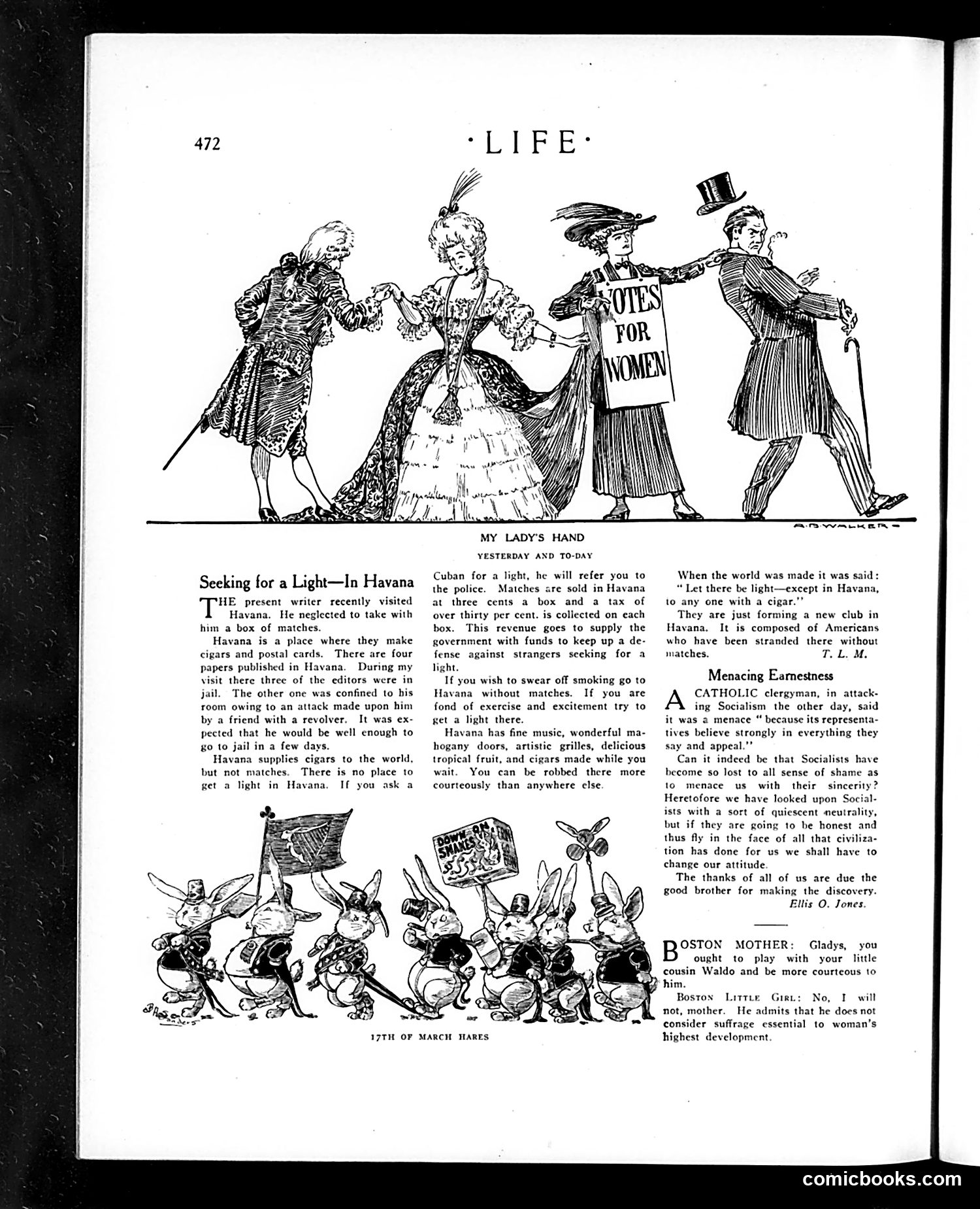
The top illustration satirizes women's suffrage through a drawing of a well-dressed woman being pulled in opposite directions by four male figures. One man holds a "Votes for Women" sign, while others attempt to restrain her with a top hat, cane, and formal attire—representing competing social forces and male perspectives on women's rights. The cartoon mocks the suffrage movement by depicting the woman as a passive object of male manipulation rather than an active agent for her own rights. The accompanying text about Havana cigars and light-seeking provides ironic juxtaposition to this serious political imagery. The bottom illustration shows March hares, likely referencing Lewis Carroll's "Alice in Wonderland," though its satirical meaning here is unclear without additional context.
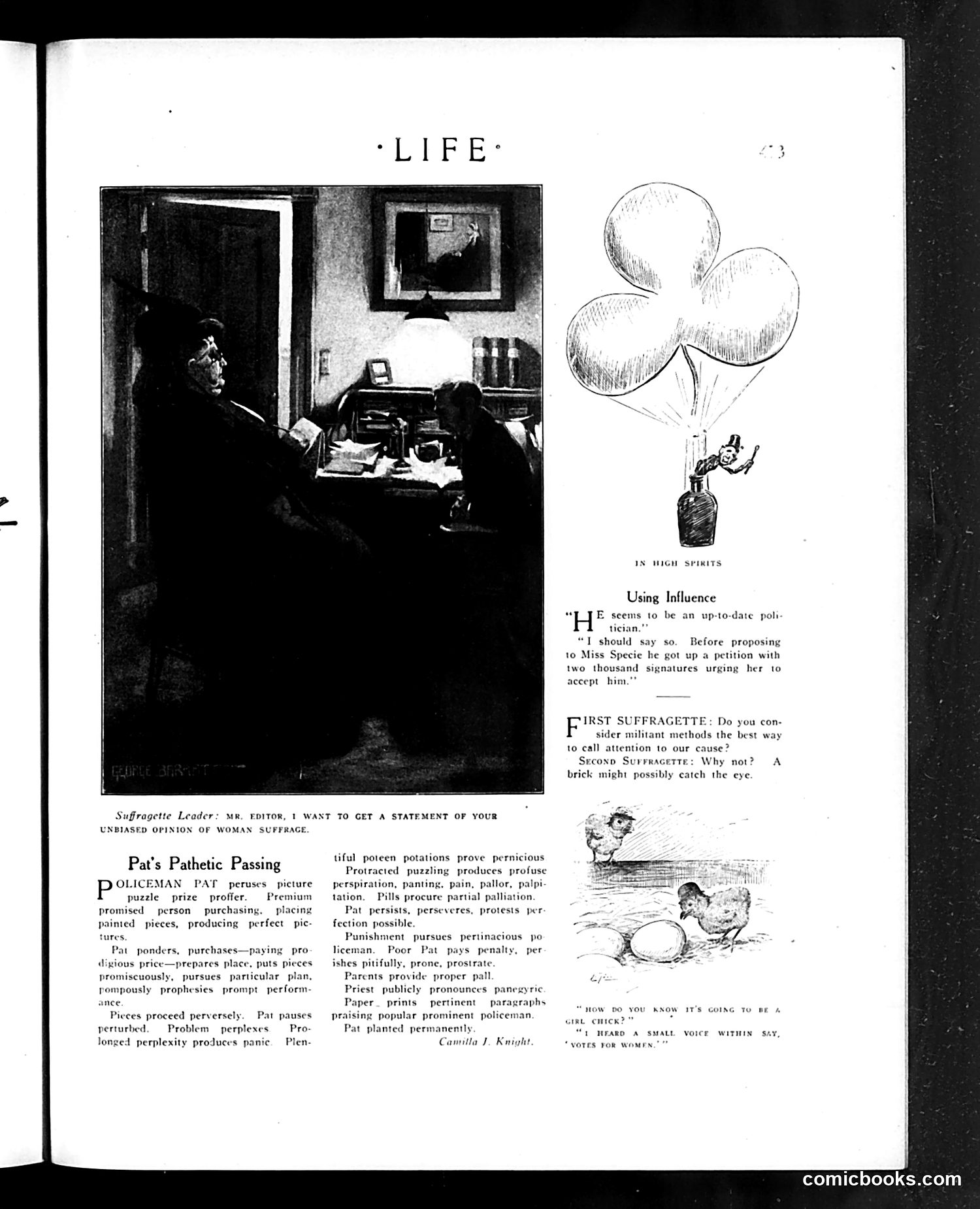
This page from *Life* magazine contains satirical commentary on early 20th-century social issues. The left photograph shows a "Suffragette Leader" meeting with an editor, captioned requesting "an unbiased version of woman suffrage." The right section includes cartoon sketches and text mocking suffragette activism. One cartoon labeled "In High Spirits" depicts a figure in a hot air balloon, likely satirizing suffragettes as unrealistic or frivolous. The text "Pat's Pathetic Passing" appears to mock someone's political efforts through exaggerated language about "perplexing" and "panic." A dialogue between "First Suffragette" and "Second Suffragette" discusses militant tactics for drawing attention to their cause—the satire suggesting such methods are counterproductive or absurd. The overall tone is dismissive of women's suffrage activism, characterizing it as emotional, ineffective, and worthy of ridicule rather than serious consideration.
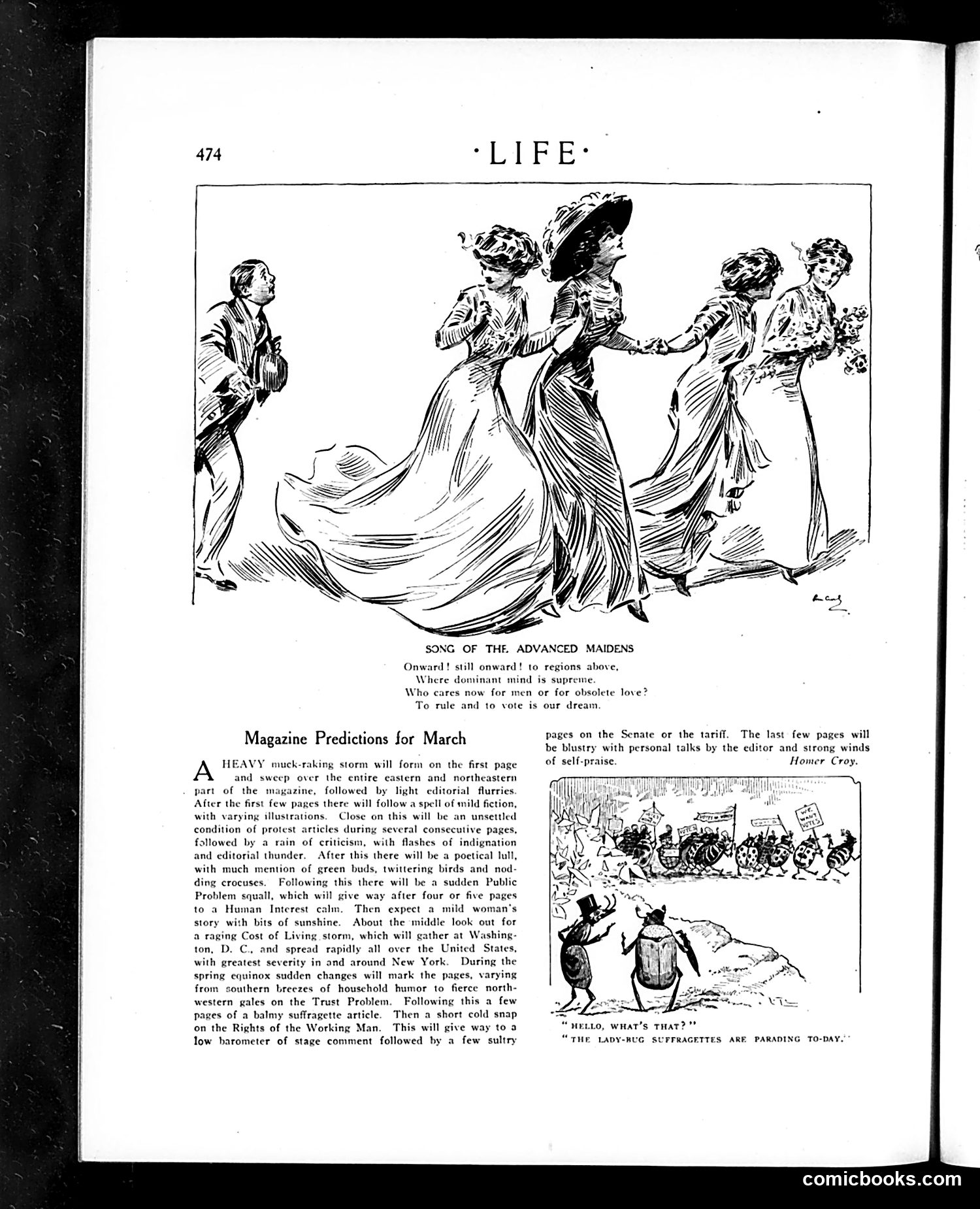
This page satirizes the women's suffrage movement circa 1910s America. **Top cartoon:** "Song of the Advanced Maidens" mocks female suffragettes as rejecting traditional romance and domesticity, pursuing instead political power ("To rule and to vote is our dream"). The elegantly dressed women are depicted as abandoning men and "obsolete love" for ambition—a common anti-suffrage caricature portraying feminism as unnatural. **Bottom cartoon:** The caption "The Lady-Bug Suffragettes Are Parading To-Day" makes a pun, conflating actual suffrage marches with insects. This trivializes women's political activism as frivolous or absurd. **"Magazine Predictions" text:** Uses weather metaphors to forecast *Life* magazine's March content, casually including "a balmy suffragette article" alongside unrelated topics, suggesting suffrage coverage as predictable monthly filler rather than serious political commentary. The overall tone is dismissive—positioning women's voting rights as amusing social folly rather than legitimate political demand.
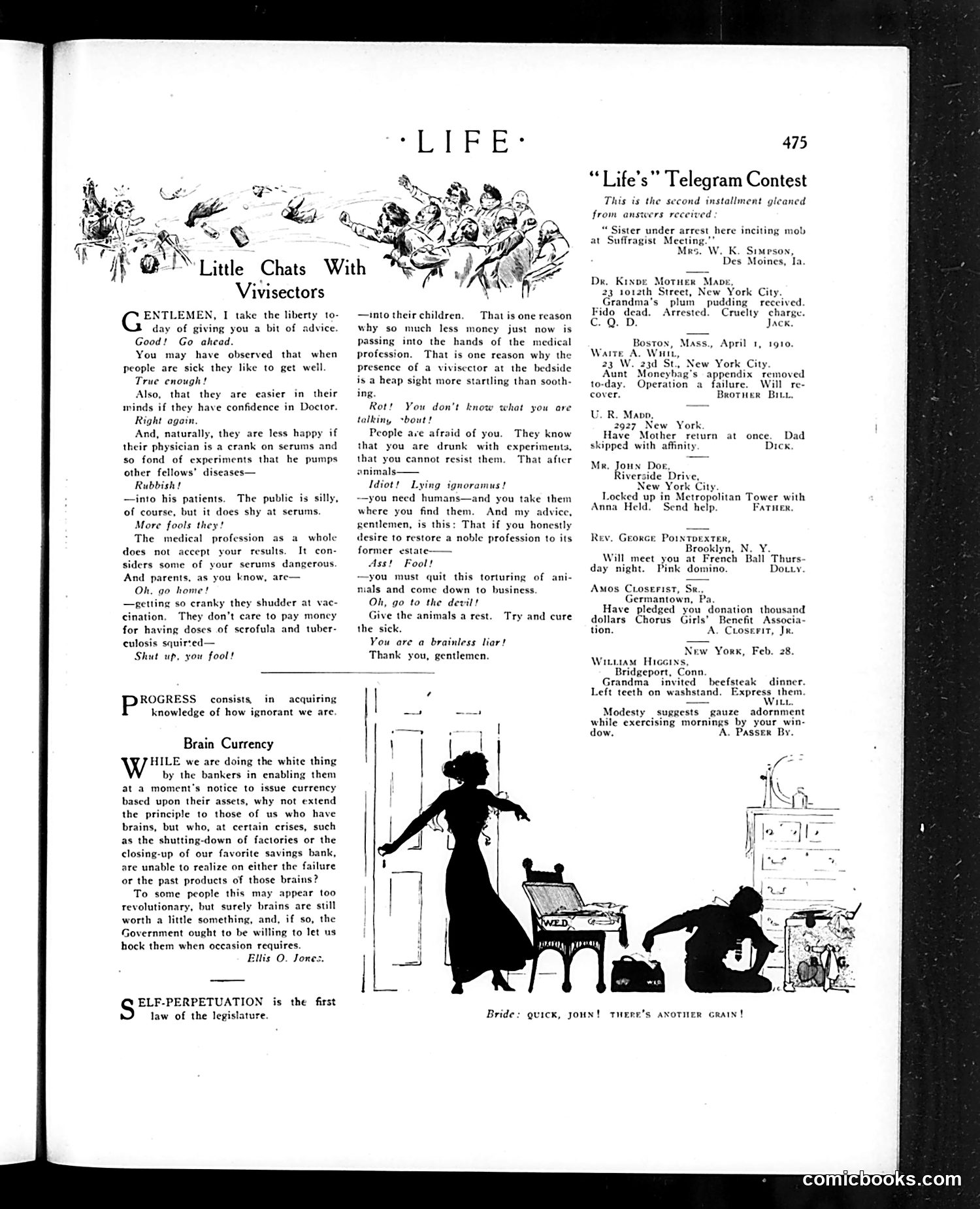
This page contains two satirical pieces attacking medical vivisectionists (animal experimenters): **"Little Chats with Vivisectors"** (main piece): A dialogue where a speaker advocates ending animal experimentation. He argues vivisectors have become obsessed with experiments, conduct dangerous and untested procedures, and that public distrust—particularly parents refusing vaccinations—damages the medical profession's reputation. The vivisectors respond with outrage and dismissal ("Shut up, you fool!"), illustrating their defensive, arrogant stance. The satire suggests vivisectionists prioritize their experimental obsessions over patient welfare and professional credibility. **"Brain Currency"** (brief column): A sarcastic proposal that if bankers can issue currency based on assets, why not doctors issue it based on their intellectual "brain" assets—a jab at both banking practices and medical pretensions. **"Life's Telegram Contest"**: Humorous fake telegrams parodying sensational news items (arrests, deaths, affairs), offering contemporary satire unrelated to vivisection. The page reflects early-20th-century anti-vivisection sentiment and medical skepticism popular in American culture.
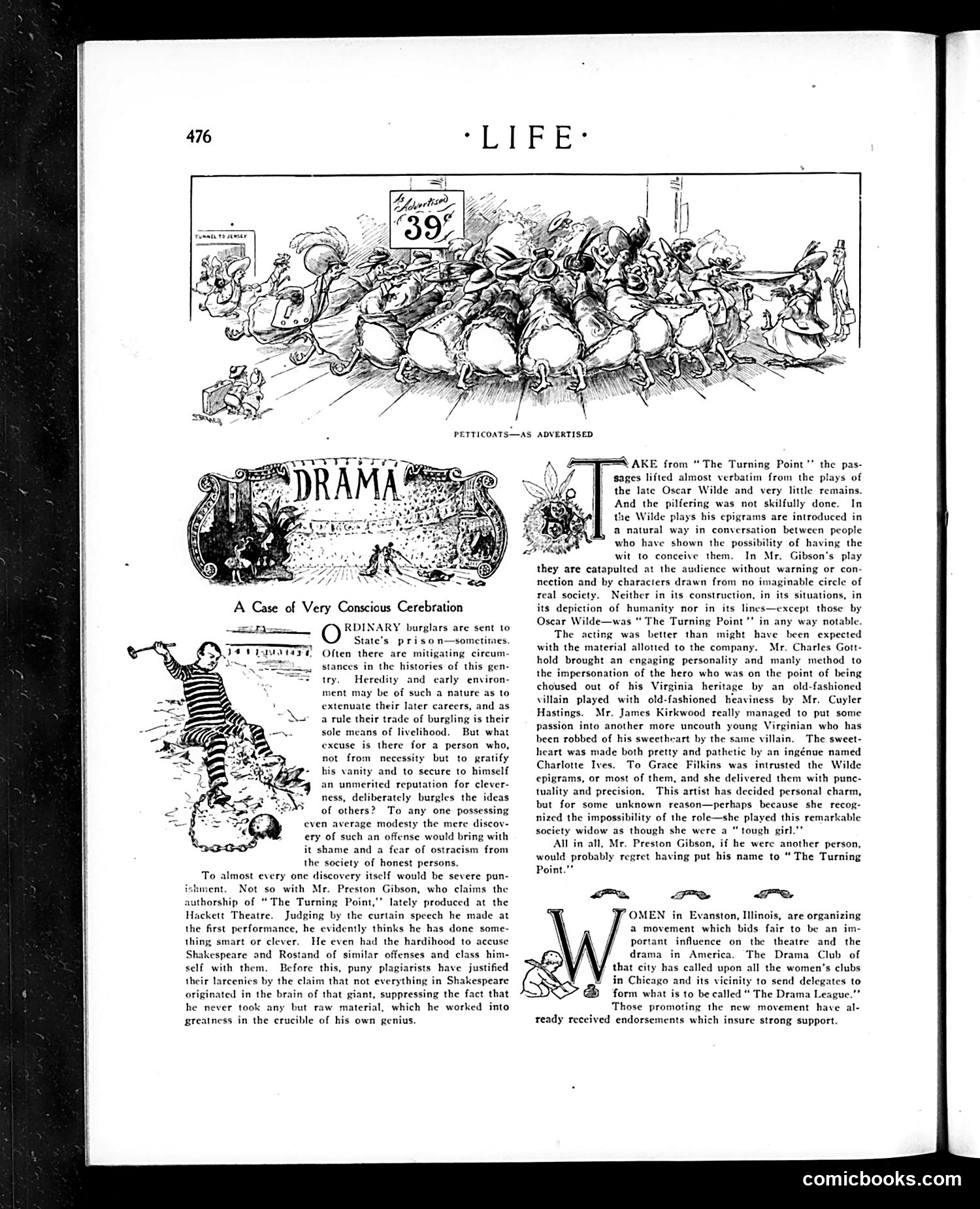
This page contains two drama-related pieces: **Top Cartoon**: "Petticoats—As Advertised" depicts a chaotic scene of numerous figures in petticoats (women's undergarments) being paraded or displayed, with a price tag of 39¢ visible. This appears to be satirizing theatrical productions that rely on spectacle and female clothing/bodies rather than substantive content. **Main Article**: A scathing theater review attacking playwright Preston Gibson for plagiarizing Oscar Wilde's work in his play "The Turning Point" (produced at the Hackett Theatre). The critic argues Gibson shamelessly stole Wilde's epigrams and dialogue, then absurdly compared himself to Shakespeare and Rostand. The review condemns Gibson for lacking the creative genius to transform "raw material" into something original, unlike Shakespeare. Cast members received praise, but the play itself is deemed worthless without Wilde's borrowed lines. **Bottom Item**: News about women in Evanston, Illinois organizing "The Drama League"—a movement to promote theatrical influence and drama in America, gathering endorsements from women's clubs.
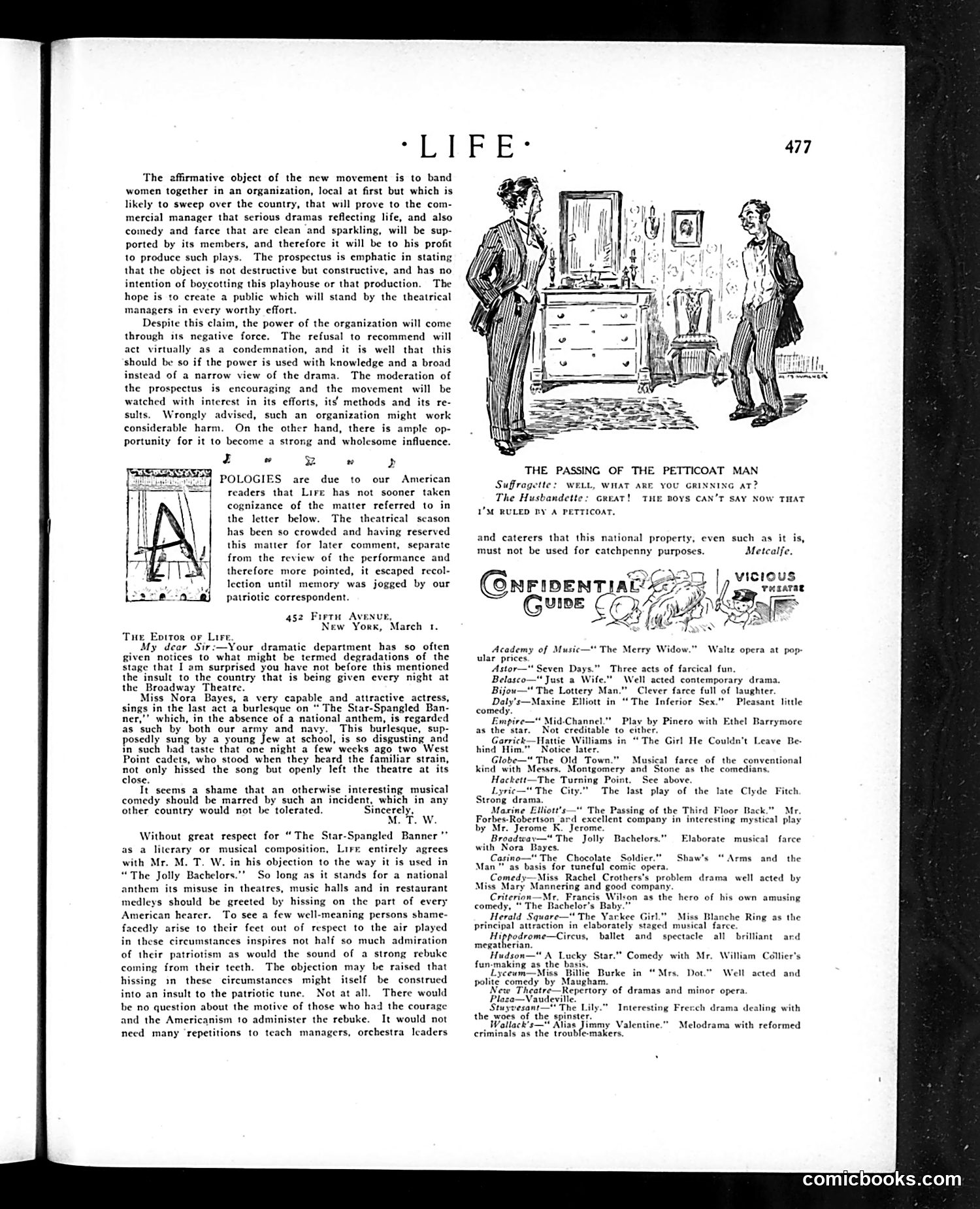
This cartoon depicts a domestic scene where a woman stands assertively near a dresser while a man looks on awkwardly. The caption reads: "Well, what are you grinning at?" / "Great! The boys can't say now that I'm ruled by a petticoat." **The satire:** This jokes about changing gender dynamics and women's growing independence in the early 20th century. The phrase "ruled by a petticoat" was a period insult suggesting a man was dominated by women. The cartoon suggests that as women gain autonomy and assertiveness (she appears to be claiming household authority), men can no longer use this taunt—though the man's grin implies some ambivalence about this shift. The surrounding editorial content discusses a women's organization promoting serious theater, reinforcing the page's theme of female empowerment and influence in public life, making the cartoon's commentary on changing domestic power structures timely and relevant to contemporary readers.
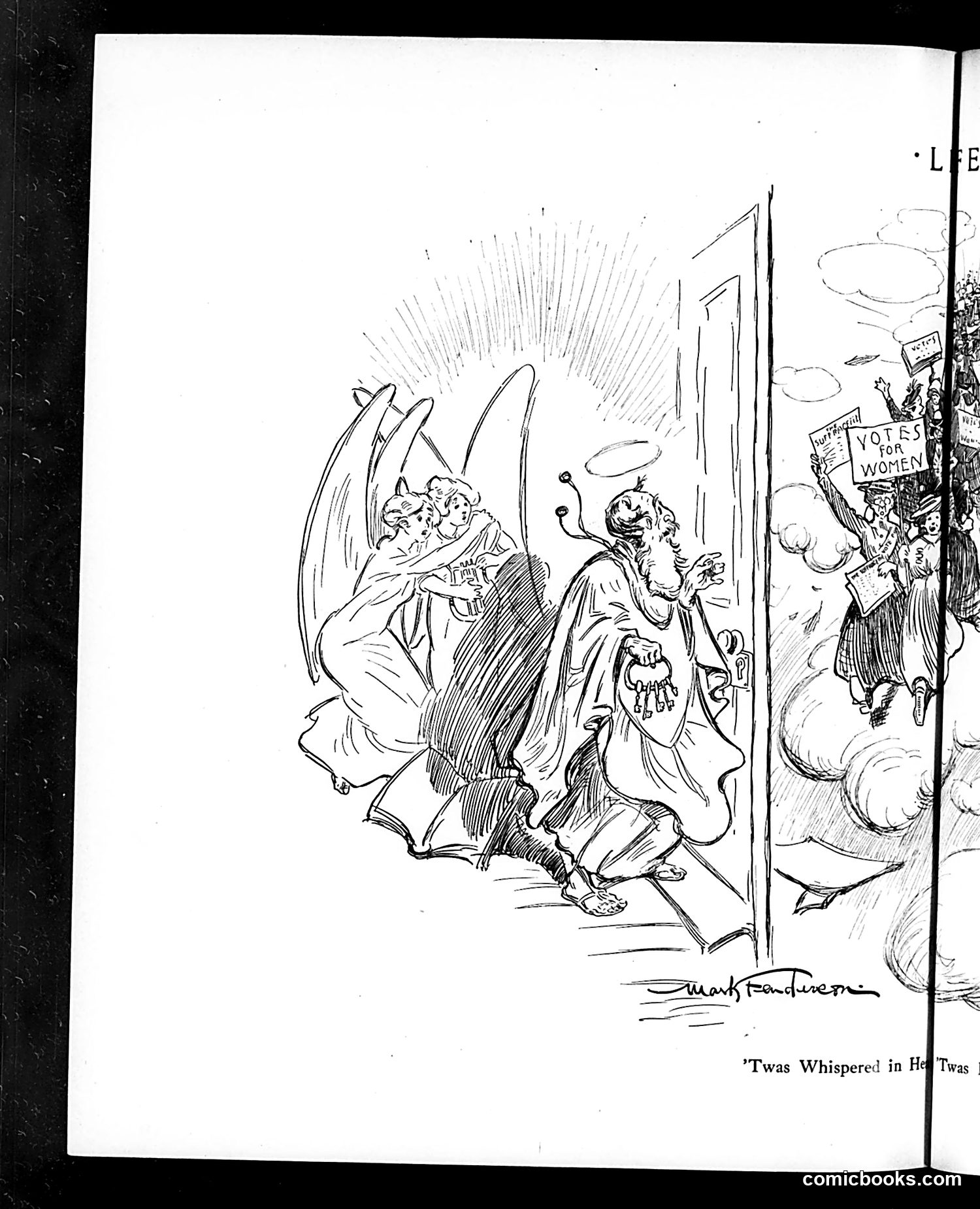
This is a political cartoon by Mark Bandiera (signature visible) depicting what appears to be angels or heavenly figures at a gate—likely representing the Gates of Heaven or a similar celestial entrance. The figures on the left appear surprised or scandalized by something being whispered to them from the right side. On the right, there's a reference to "VOTES FOR WOMEN," suggesting this cartoon satirizes the women's suffrage movement. The joke appears to mock the idea that women's voting rights would be shocking or scandalous news even in heaven—treating suffrage as something so radical or controversial that it would cause consternation among celestial beings. The caption "'Twas Whispered in Heaven" (text partially obscured) completes the joke, though the full context is cut off.
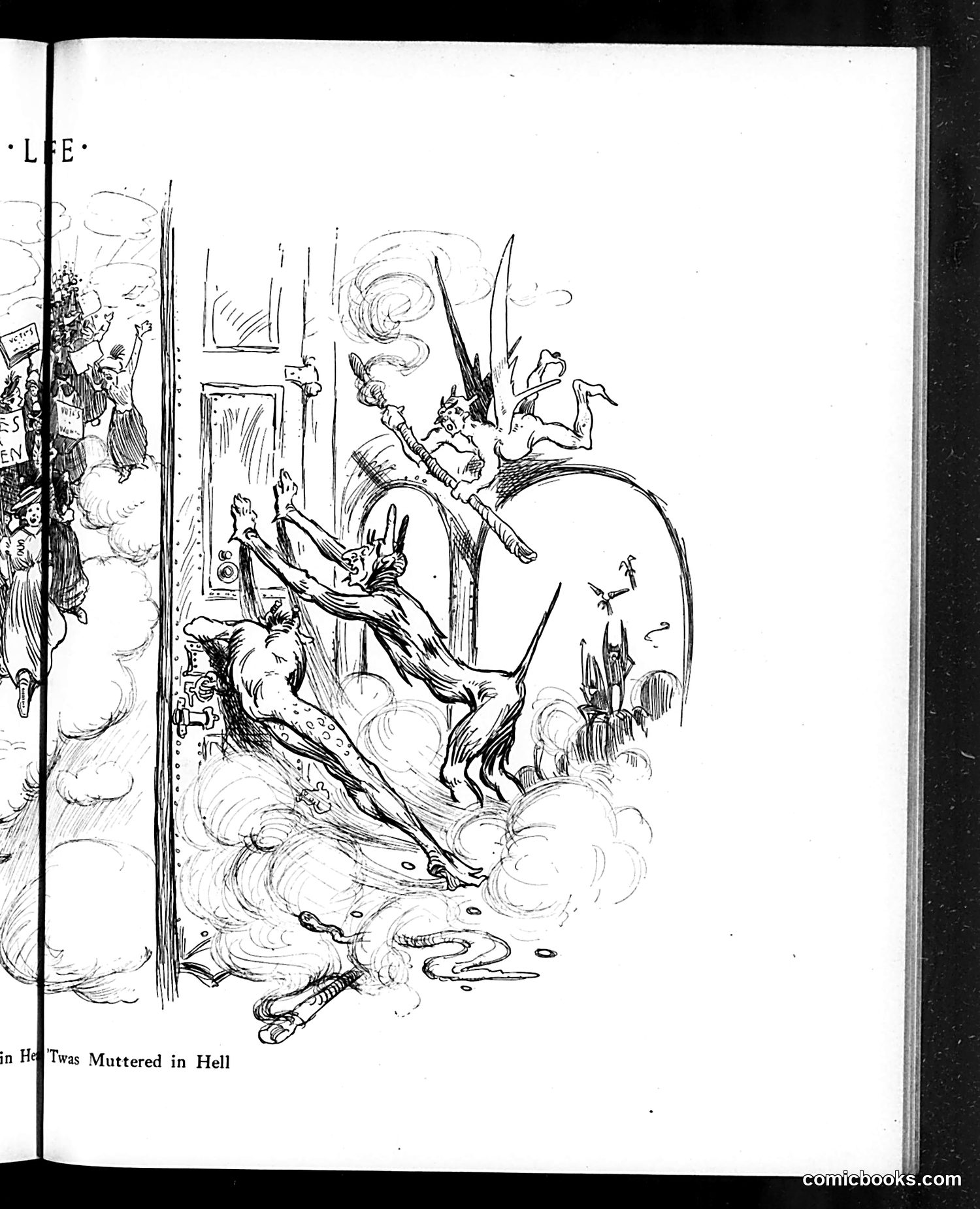
The OCR text is illegible, but the image itself shows a satirical illustration titled "'Twas Muttered in Hell" (visible at bottom). The cartoon depicts a demonic or devilish figure with horns, surrounded by clouds of smoke, appearing to be in an infernal setting. The figure seems agitated or dramatic. On the left side, there appear to be additional smaller figures, possibly representing politicians or public figures of the era. Without legible text or a visible date, I cannot definitively identify which specific political figures or events are being satirized. The "Hell" setting suggests this is social or political commentary mocking someone's actions or reputation as morally corrupt or damnable—common satirical tropes in *Life* magazine during its heyday. The style suggests early-to-mid 20th century, but more context is needed for precise identification.
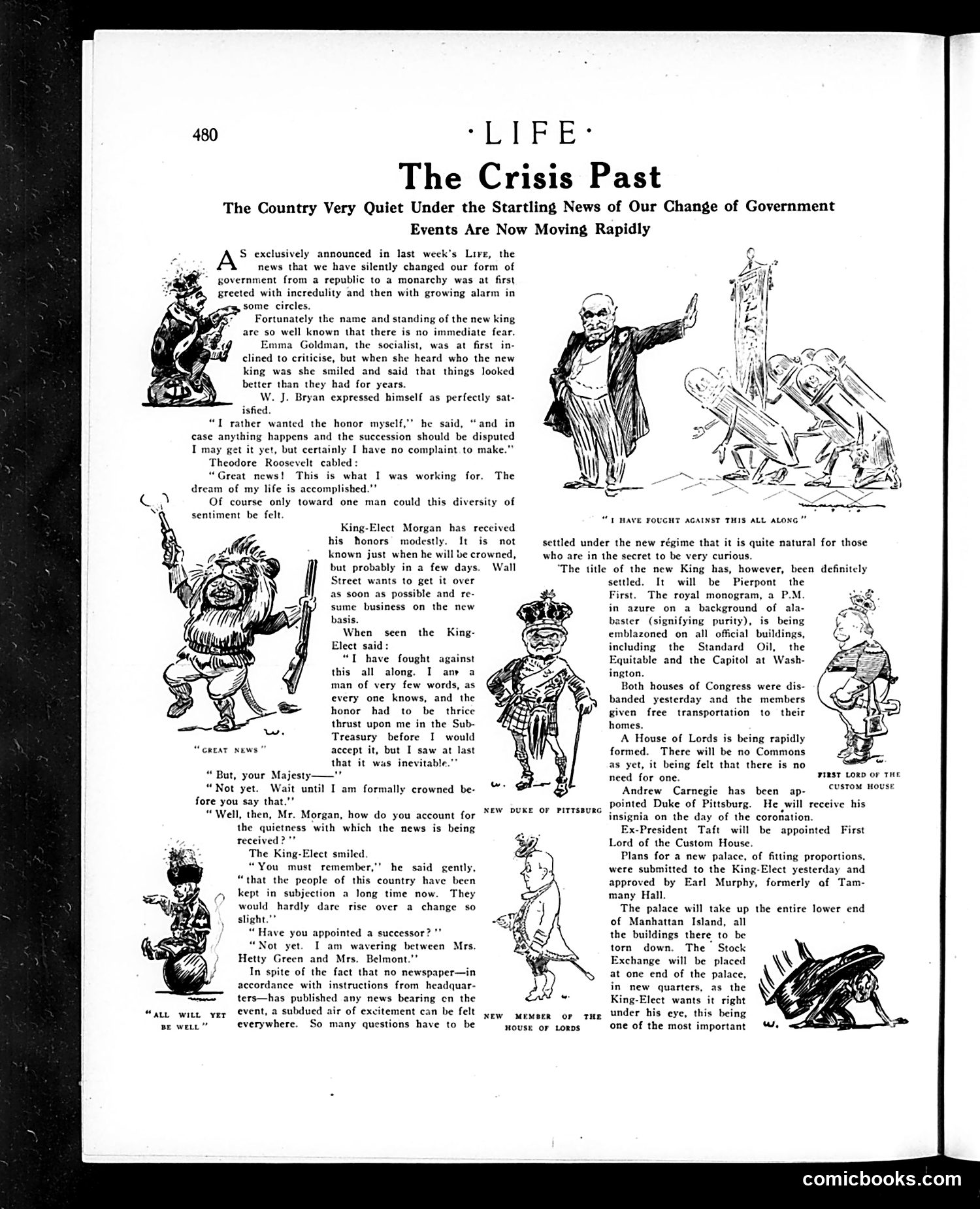
This satirical piece mocks the idea that J.P. Morgan has become king of America, replacing the republic with a monarchy. The cartoons depict various politicians' exaggerated reactions. **Key figures identified:** - **J.P. Morgan** ("King-Elect Morgan"): The powerful banker portrayed as the new monarch - **Emma Goldman**: Socialist who approves of the change - **W.J. Bryan**: Presidential candidate satisfied with Morgan as king - **Theodore Roosevelt**: Enthusiastically supports it - **Andrew Carnegie**: Appointed "Duke of Pittsburgh" **The satire's point:** Life mocks how concentrated wealth and corporate power under figures like Morgan had become so dominant that America functioned as a plutocracy rather than democracy. The joke is that formalizing Morgan as "king" merely acknowledges the existing reality—the ultra-wealthy already controlled government. The absurd details (dissolving Congress, appointing nobility, replacing the Stock Exchange) exaggerate this critique of corporate oligarchy and the erosion of democratic institutions.
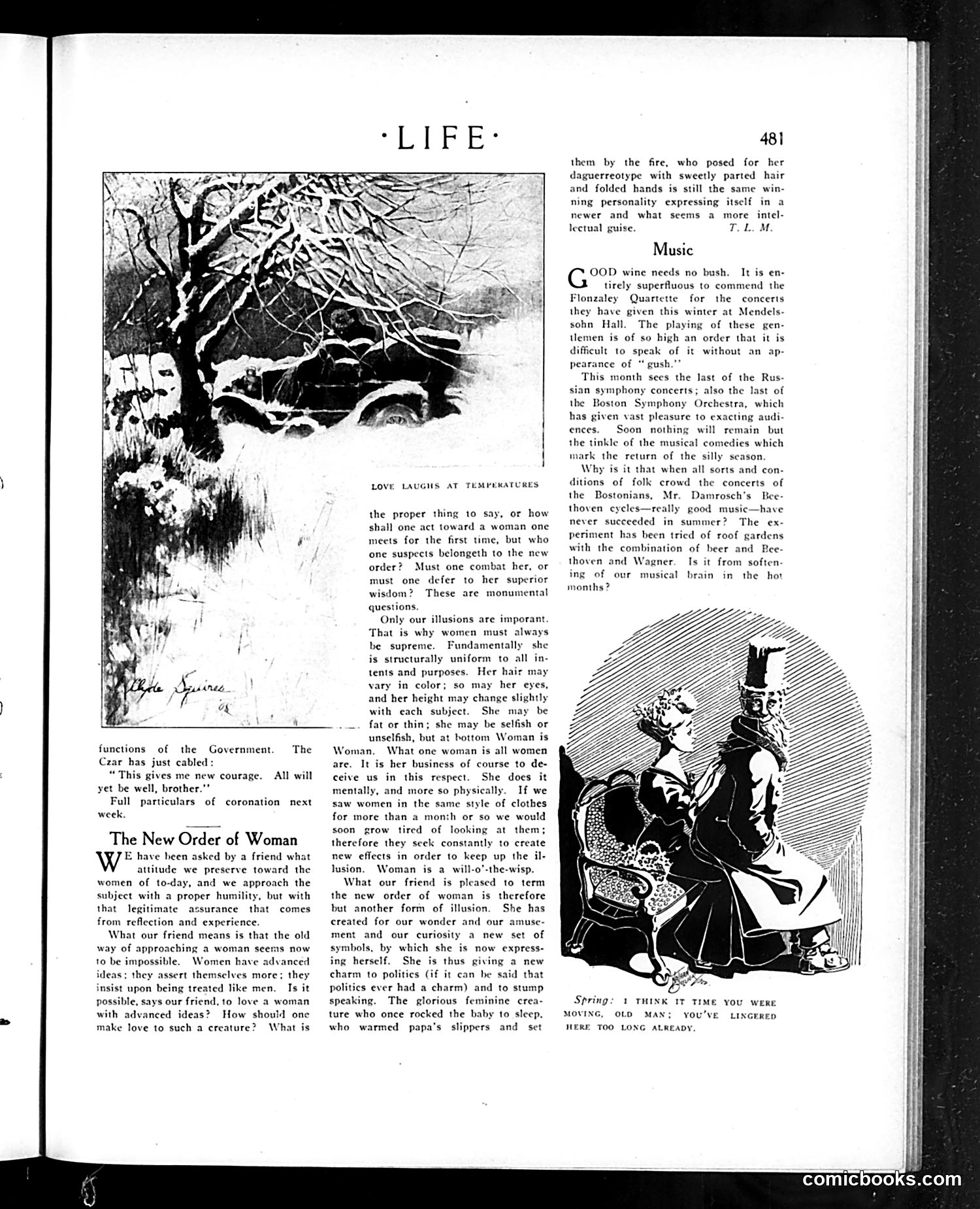
This page contains two distinct pieces of social satire: **"The New Order of Woman"** essay argues that despite women's advancing claims to equality and "modern" ideas, they remain fundamentally unchanged. The author contends women are inherently manipulative—using fashion and appearance to create illusions that captivate men. The satire dismisses women's demands for equal treatment as merely a new costume for the same unchanging female nature. This reflects early 20th-century anxiety about women's suffrage and workplace advancement. **The cartoon "Love Laughs at Temperatures"** depicts an elderly man and woman (likely representing Winter/Old Man Winter and Spring) in an intimate embrace despite harsh weather. The caption below—"I think it time you were moving, old man; you've lingered here too long already"—is a double entendre: Spring literally tells Winter to leave, but it's flirtatious banter between romantic figures. Both pieces use humor to comment on gender relations and social change, though with notably different tones—one cynical about women's progress, the other whimsical about romance transcending seasons.
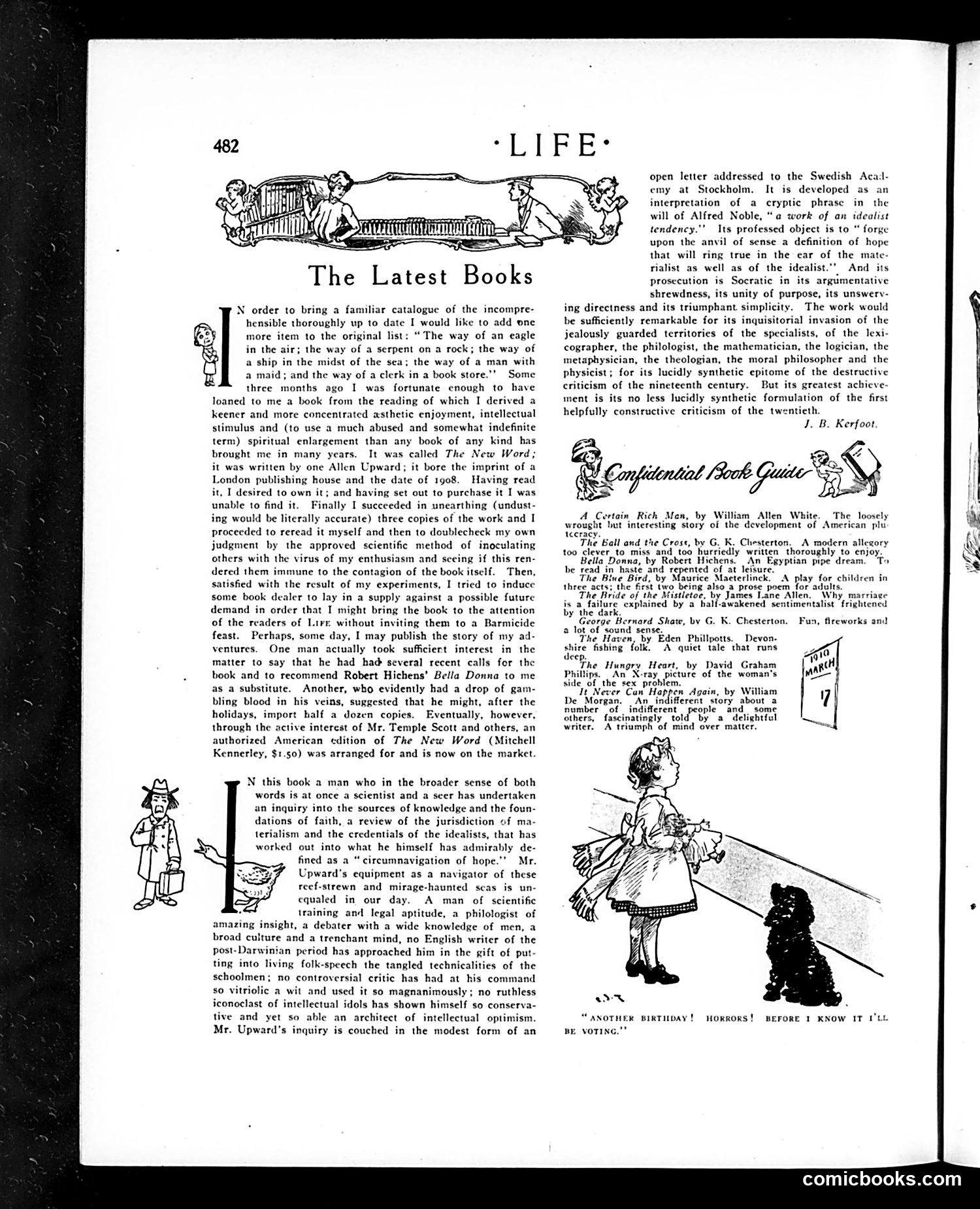
This page is primarily a book review section titled "The Latest Books," not a political cartoon page. The reviewer discusses *The New Word* by Allen Upward (1908), an philosophical inquiry framed as an open letter to the Swedish Academy addressing Alfred Nobel's bequest for works of "idealist tendency." The small illustration at bottom right depicts a child's birthday scene with the caption "Another birthday! Horrors! Before I know it I'll be voting"—a light social joke about time passing quickly and the burden of adult responsibilities. The "Confidential Book Guide" sidebar recommends other contemporary titles, including works by William Allen White and G.K. Chesterton. There is no significant political satire or caricature. This is straightforward literary criticism from the early 20th century, reflecting intellectual concerns about reconciling materialism with idealism—a major philosophical debate of the post-Darwinian era.
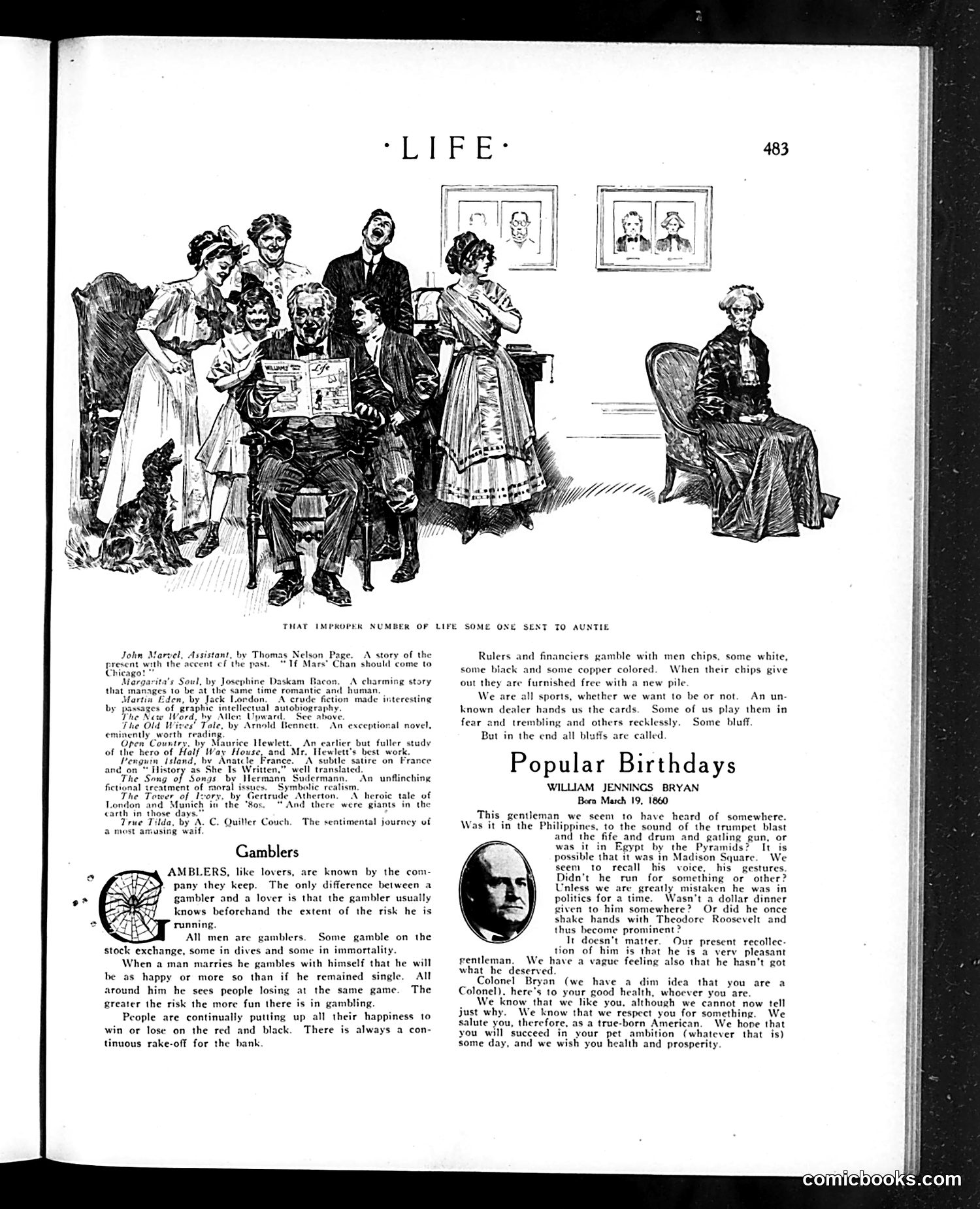
This page from *Life* magazine features satirical commentary on early 1900s American society. The main illustration depicts a group gathered around a man reading *Life* itself—a self-referential joke about the magazine's cultural prominence and readership. Below, two sections target different subjects: **"Gamblers"** uses extended metaphor comparing financial speculation (stock exchange) to literal gambling, suggesting wealthy Americans recklessly risk fortunes like casino players. The commentary implies both are morally equivalent. **"Popular Birthdays"** mocks **William Jennings Bryan** (1860-1925), the three-time presidential candidate and populist politician. The satire feigns forgetfulness about his fame—asking if he was involved in the Philippines (referencing the Spanish-American War he opposed), Egypt, or presidential campaigns—then backhanded-compliments him as "pleasant" while suggesting he "hasn't got what he deserved" (likely lost elections). The tone is affectionate mockery of a prominent political figure.
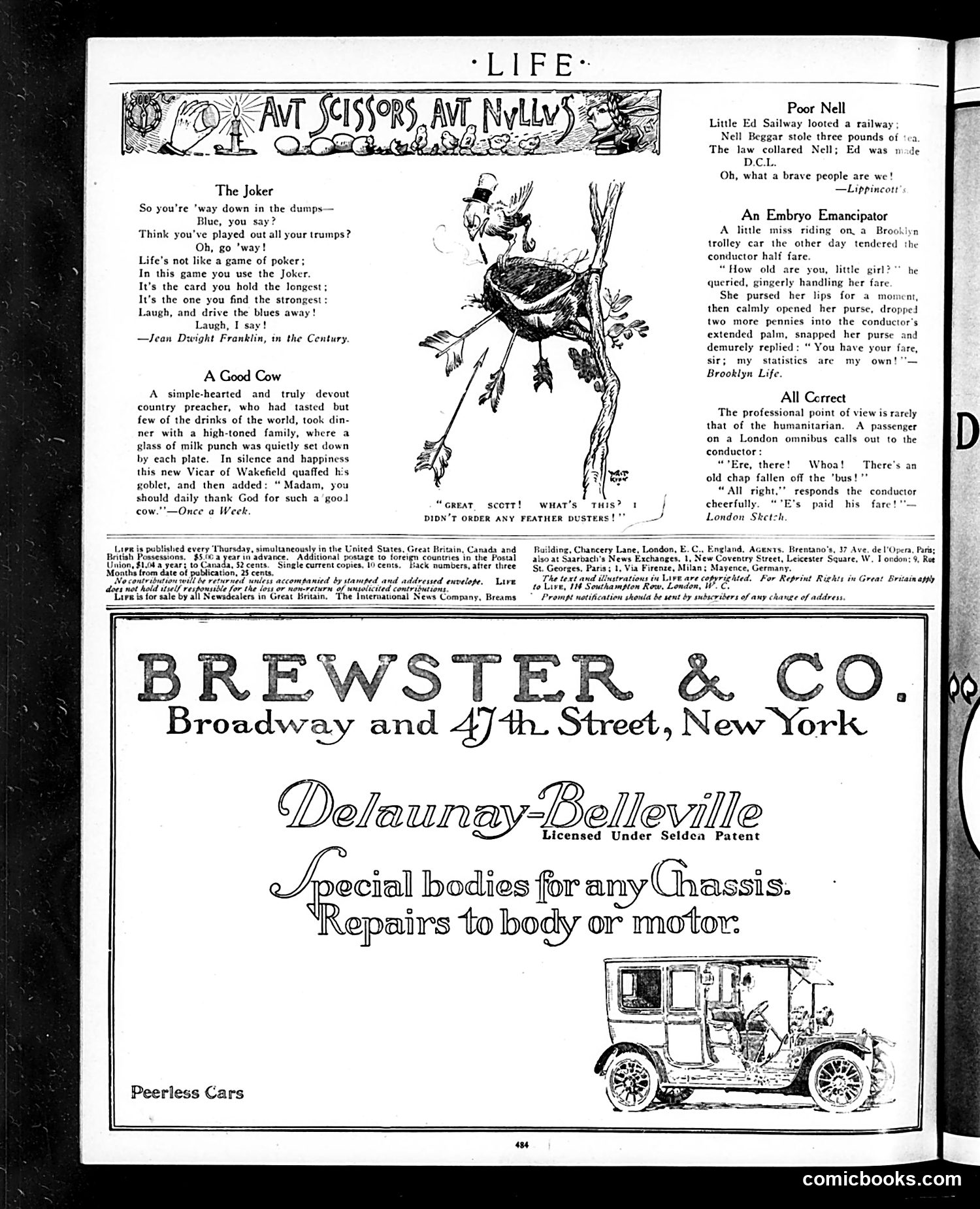
This page combines satirical poetry with advertising. The main content consists of four brief humorous verses: **"The Joker"** advises readers facing depression to use humor as their trump card—a metaphor treating life like poker, where laughter defeats despair. **"A Good Cow"** recounts an anecdote about a naive country clergyman who, served milk punch, naively thanks his hostess for her "good cow," missing the alcoholic beverage's sophistication—satire of rural innocence. **"Poor Nell"** contrasts harsh justice: a beggar woman is jailed for stealing three pounds, while a railway executive loots railways and receives a D.C.L. (honorary doctorate). The irony highlights class-based legal disparities. **"An Embryo Emancipator"** describes a young girl asserting independence by paying full trolley fare and insisting her "statistics are my own"—early feminist satire mocking a child's precocious assertion of personal autonomy. The page is primarily advertising space for Brewster & Co. automobiles and Delaunay-Belleville cars.
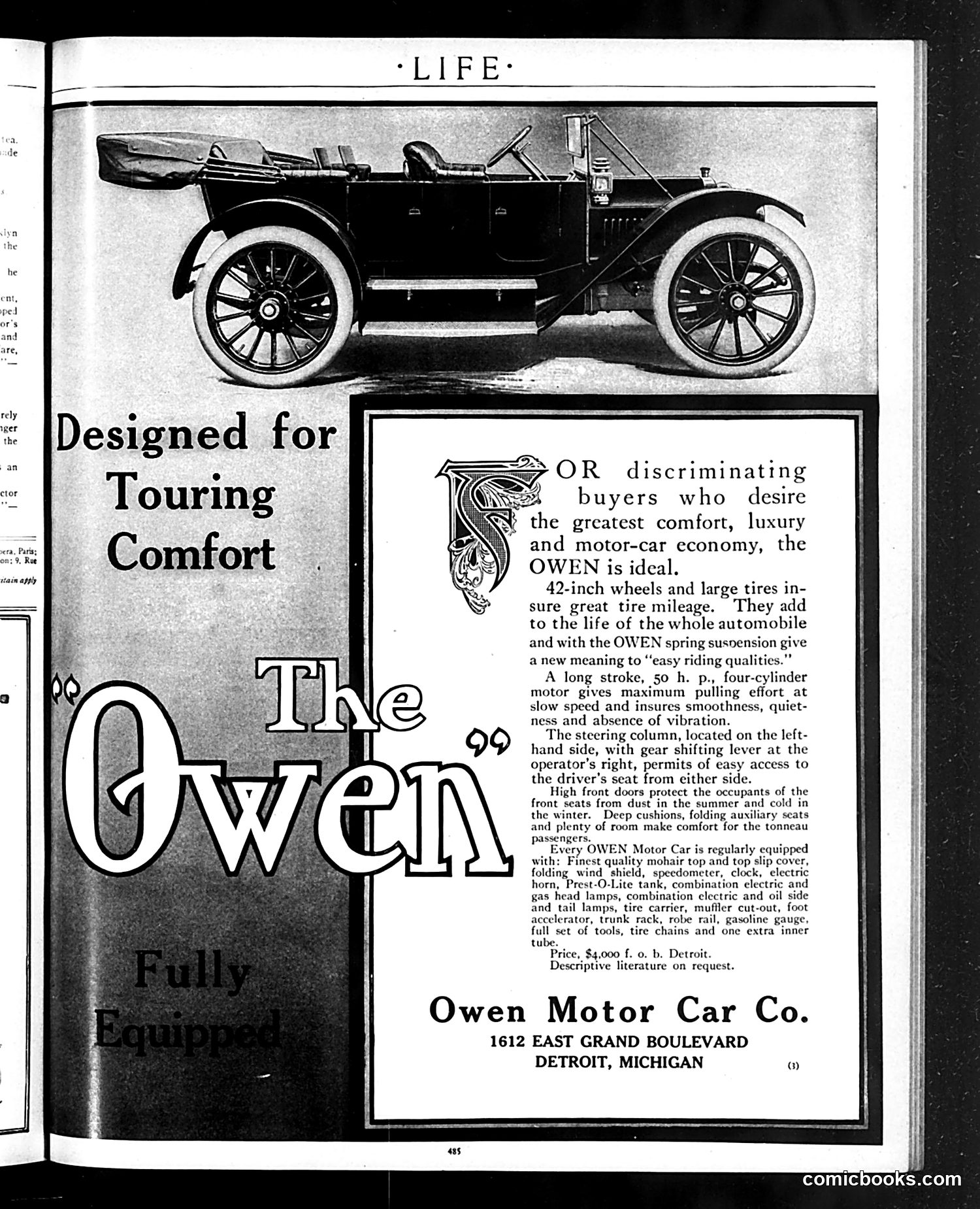
This is **not a cartoon or satire**—it's a straightforward automobile advertisement from Life magazine's pages. The page advertises the Owen Motor Car, a touring automobile manufactured in Detroit. The ad emphasizes practical features appealing to early 20th-century drivers: 42-inch wheels, tire durability, a smooth-riding suspension, a four-cylinder engine, and comfort amenities like cushioned seats and high doors for dust protection. At $4,000 (substantial money at the time), the Owen targets "discriminating buyers" seeking luxury combined with economy. The detailed feature list—electric lighting, mohair top, speedometer, tools included—reflects the technological novelty of automobiles in this era. The ornamental initial letter "O" and layout are typical period design. There is no satire or political commentary present; this is simply period advertising emphasizing engineering quality and comfort features that would have seemed innovative to contemporary readers.
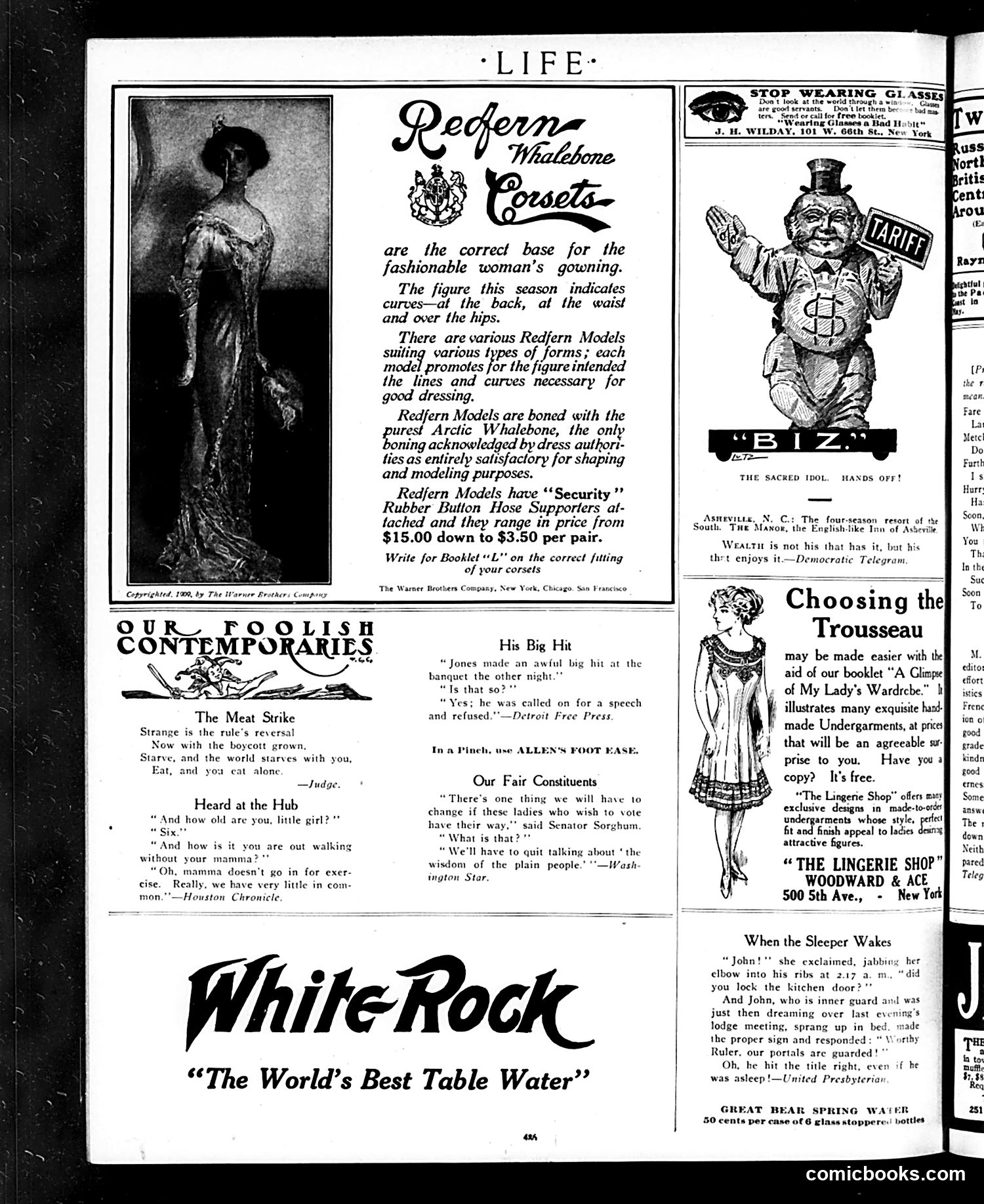
This page mixes advertisements with satirical humor pieces reflecting early 20th-century concerns: **"Our Foolish Contemporaries"** section contains three brief satirical commentaries: 1. **"The Meat Strike"** jokes about a boycott's paradoxical logic—starving yourself to protest harms everyone equally. 2. **"Heard at the Hub"** mocks a young girl's casual dismissal of exercise with her mother, suggesting class detachment from physical activity. 3. **"His Big Hit"** satirizes a man gaining social approval by *refusing* to give a requested speech—inverting expected behavior. **"Our Fair Constituents"** targets women's suffrage advocates. Senator Sorghum quips that if women gain voting rights, politicians must stop praising "the wisdom of the plain people"—implying women voters will be less easily manipulated by such platitudes. The remaining content is **product advertising** for corsets, undergarments, foot powder, and table water—typical period commerce. The page's satire reflects anxieties about labor strikes, gender roles, and women's political participation circa 1910s America.
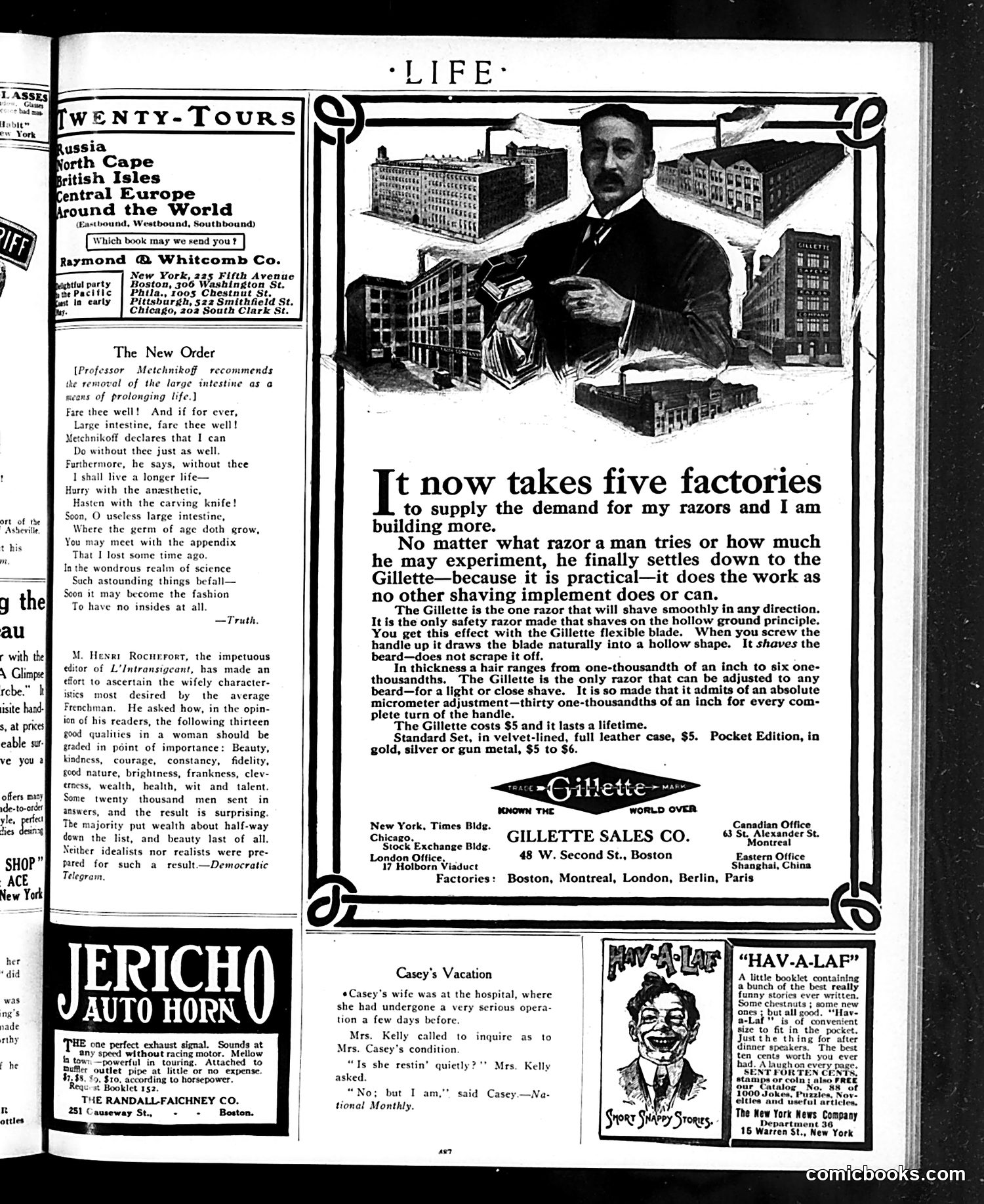
This page is primarily **advertising**, not political satire. The dominant content is a large Gillette razor advertisement featuring a mustachioed man surrounded by factory buildings, claiming five factories now supply demand for his razors. The only satirical content is a brief poem titled "The New Order" (left column), which mocks Professor Metchnikoff's scientific theory recommending removal of the large intestine to extend life. The poem humorously imagines people cheerfully submitting to surgery, envisioning a future where "to have no insides at all" becomes fashionable. This reflects early-20th-century skepticism toward extreme medical interventions. Secondary items include a French poll about desirable wifely qualities (noting Frenchmen ranked wealth over beauty), a "Hav-a-Laf" humor booklet advertisement, and a Jericho auto horn ad—all typical period advertising and filler content for Life magazine.
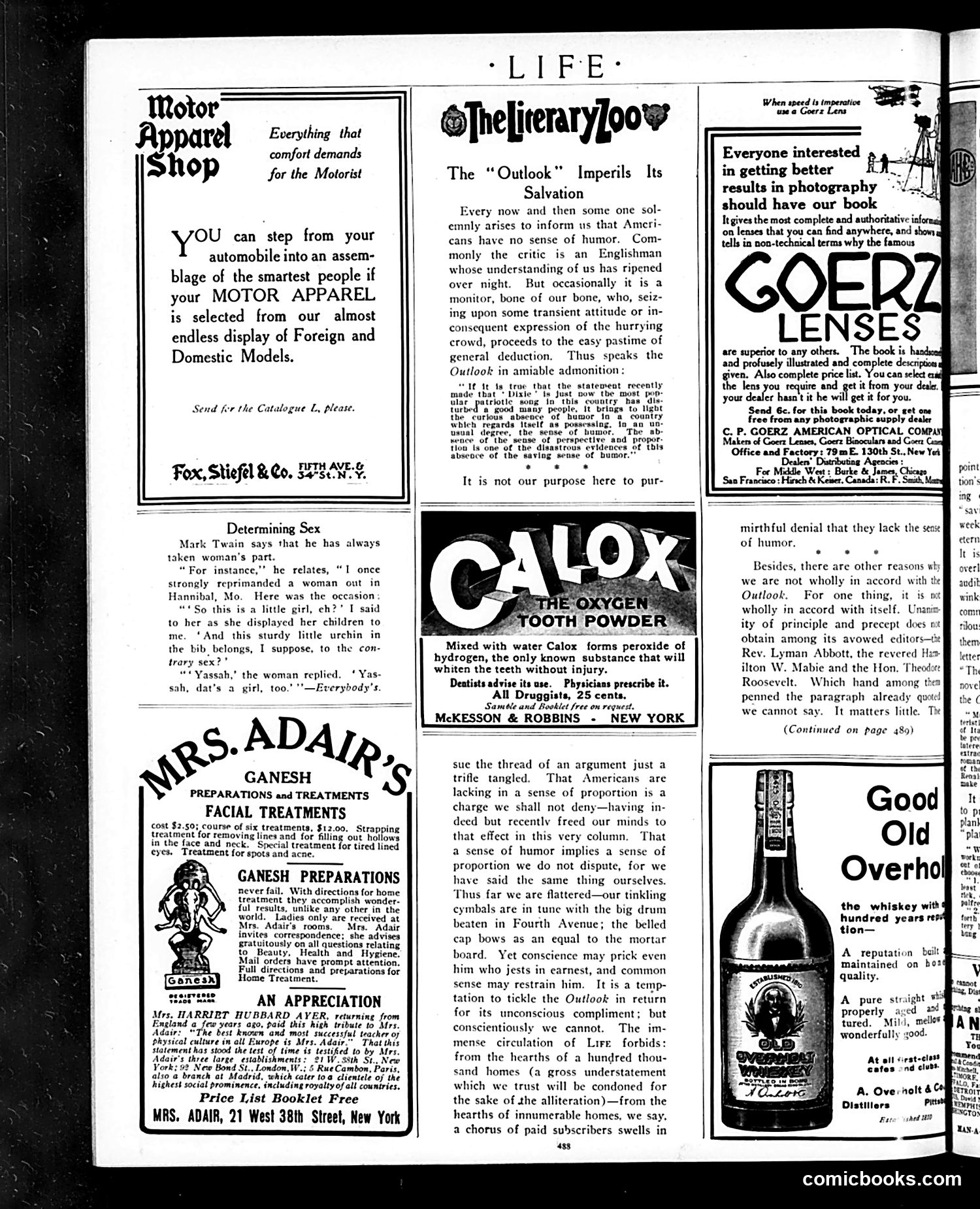
This page is primarily **advertisements and satirical commentary** rather than political cartoons. The main satirical piece is "The Literary Zoo," which critiques *The Outlook* magazine's claim that Americans lack humor. Life defends American humor by arguing that identifying a "sense of proportion" requires humor itself—a self-referential joke about cultural criticism. The piece suggests that *The Outlook*'s serious tone about American character is itself humorless and overwrought. The anecdote by Mark Twain about "Determining Sex" is a mild gender joke: a woman sarcastically refers to her sturdy child in a dress as a girl, playing on assumptions about appearance versus actual sex. The remaining content consists of period advertisements for motor apparel, facial treatments (Mrs. Adair's beauty preparations), optical lenses (Goerz), tooth powder (Calox), and whiskey (Good Old Overholts). These ads reflect early 20th-century consumer culture and beauty standards. **Context for modern readers:** This represents how Life magazine blended advertising revenue with cultural commentary and humor.
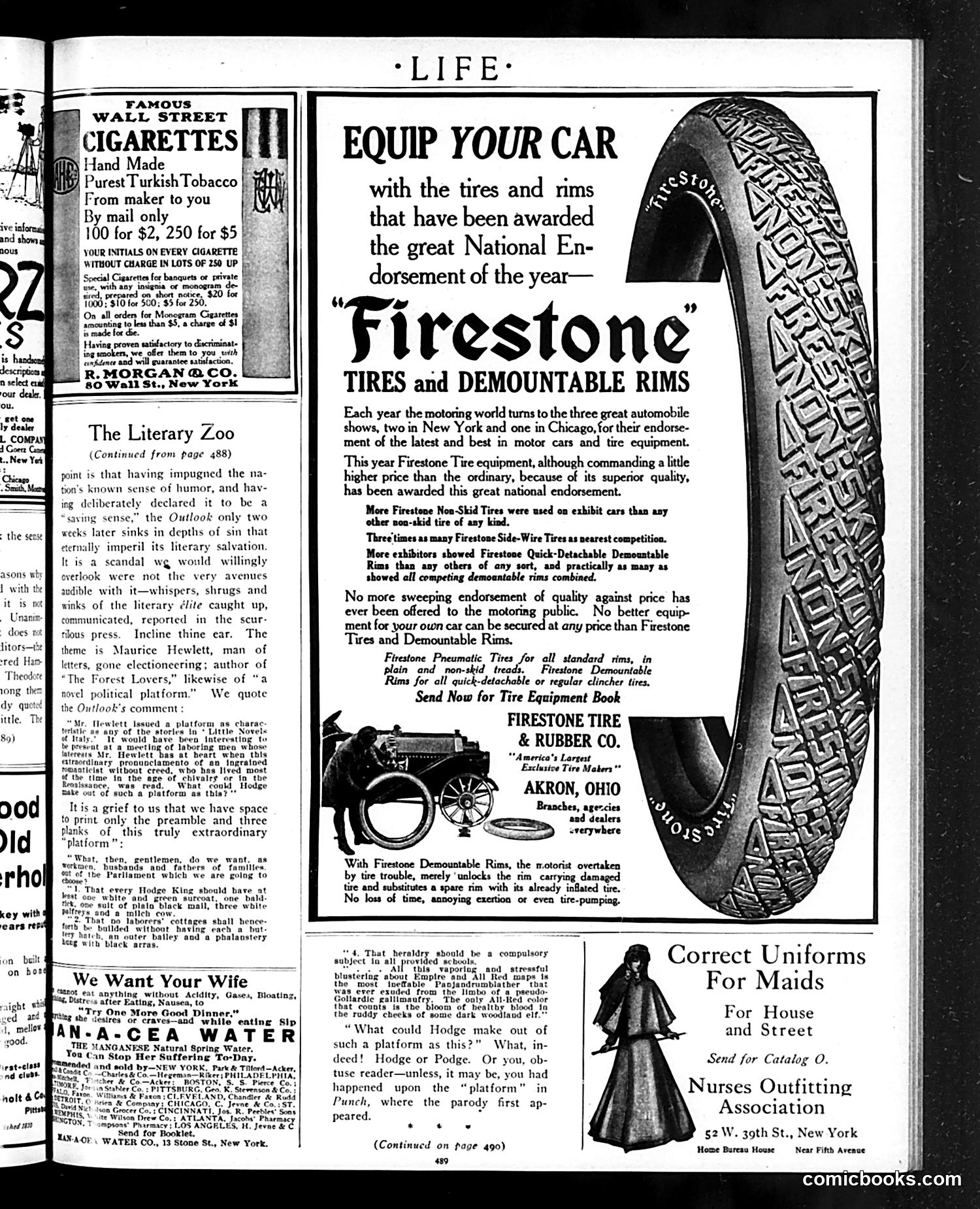
This page is primarily **advertising, not political satire**. The dominant content is a full-page Firestone Tire advertisement featuring a large tire image and promotional text claiming Firestone tires received "the great National Endorsement of the year" based on prevalence at automobile shows. The left column contains "The Literary Zoo," a satirical essay mocking author Maurice Hewlett's entry into politics. The piece ridicules his published political platform as absurdly ornate and impractical—filled with whimsical medieval-style demands about laborers' cottages and heraldry education. The satire suggests Hewlett's literary sensibilities made him ridiculous as a political candidate. Lower sections include advertisements for Wall Street cigarettes and "Correct Uniforms For Maids." **No political cartoon appears on this page.** The satire is textual rather than visual, targeting a specific (though now-obscure) British literary figure's political pretensions.
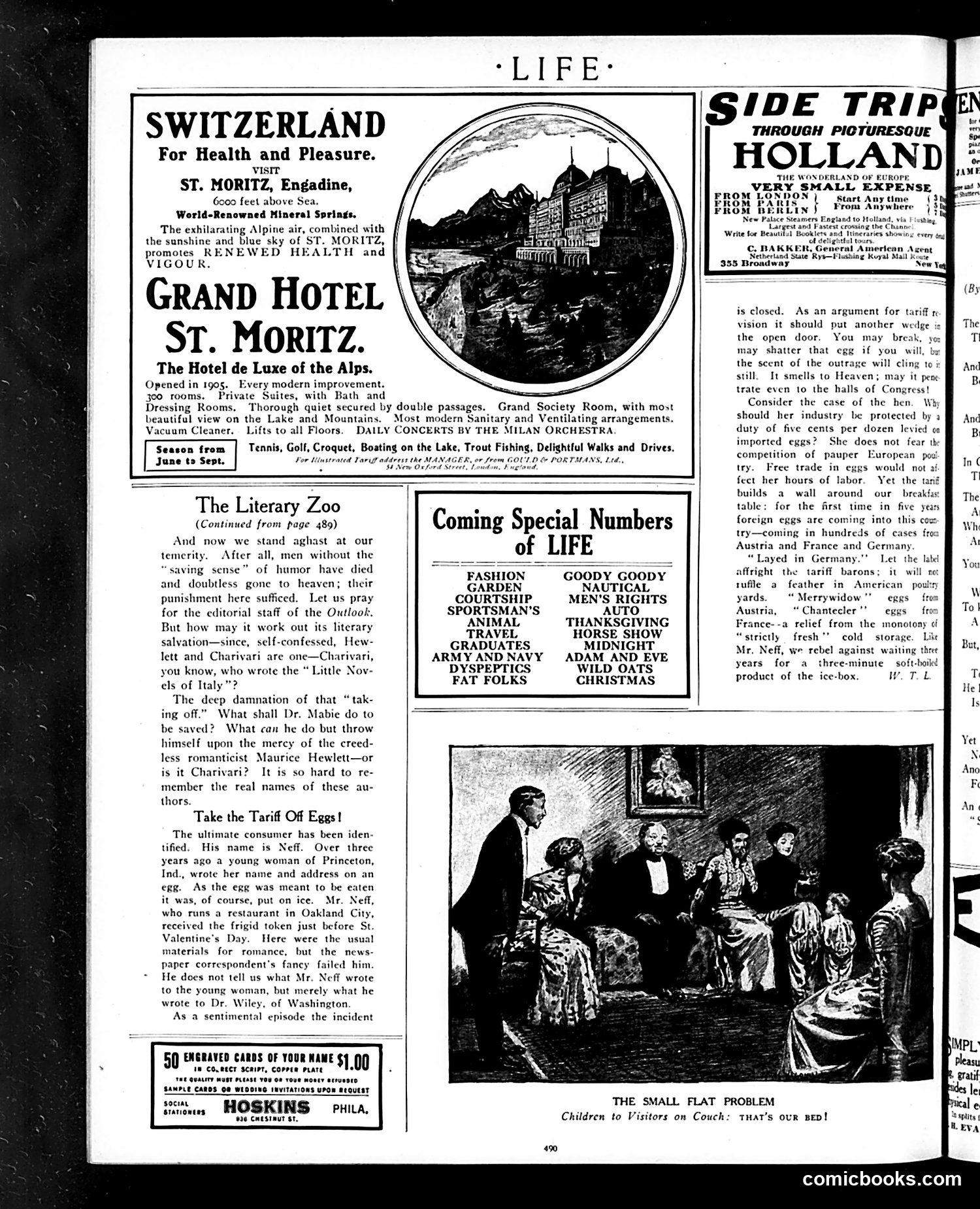
This page is primarily **advertisements and literary content**, not political cartoons. The main visual element is a small illustration titled "THE SMALL FLAT PROBLEM: Children to Visitors on Couch—That's Our Bed!" depicting crowded urban living conditions—a social commentary on housing shortages affecting middle-class families in cramped apartments. The text includes a satirical section "Take the Tariff Off Eggs!" mocking American protectionist trade policy. It describes how imported eggs (from Germany, Austria, France) are entering the U.S. market cheaply, arguing this demonstrates tariff protection is ineffective. The piece uses a real anecdote about an egg with a woman's name traced across state lines as a humorous framing device to discuss serious economic policy debates of the era. The page reflects early 20th-century concerns about trade, housing, and consumer goods.
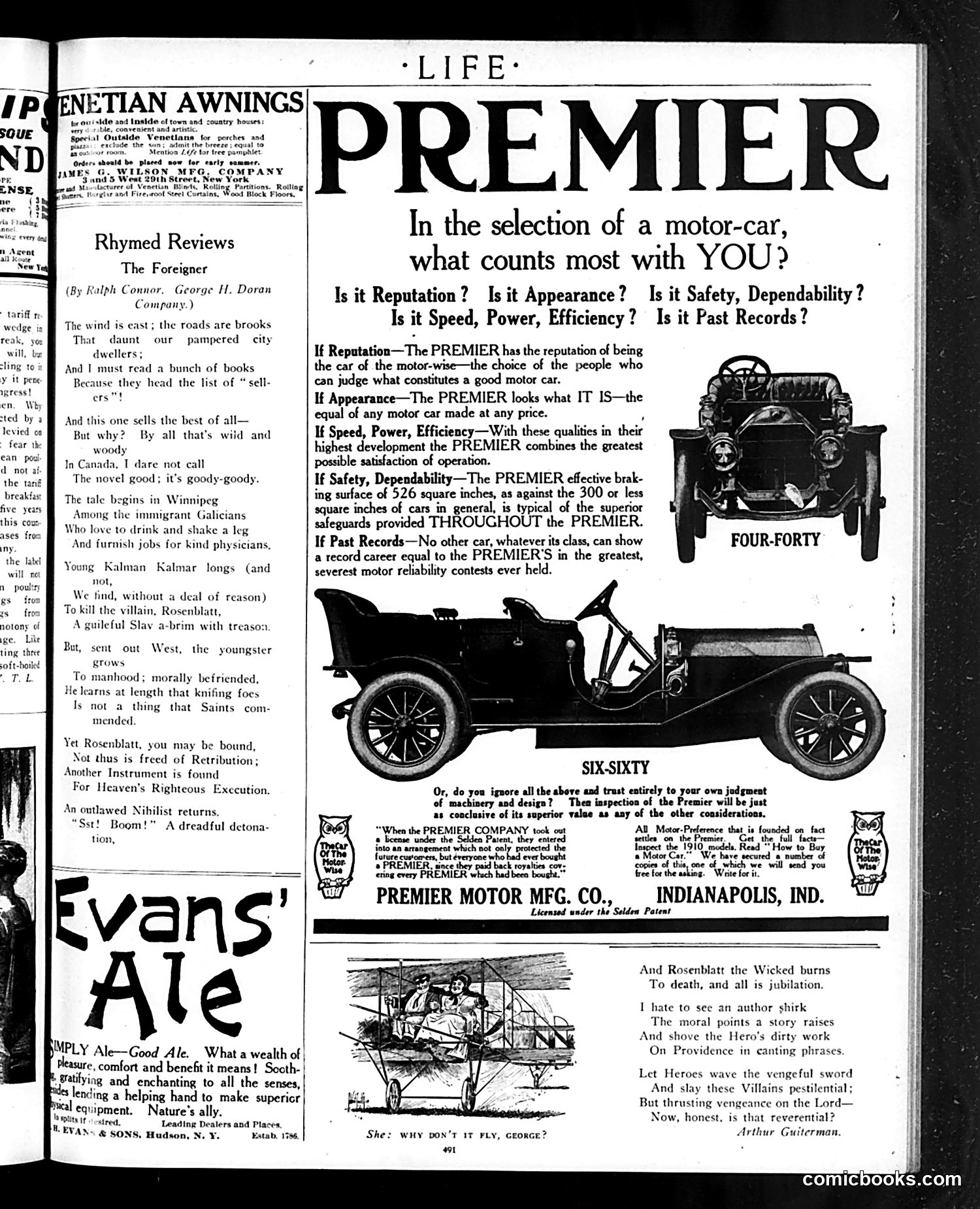
This page comprises three distinct elements: **Left Column - "Rhymed Reviews"**: A book review by Arthur Guiterman critiquing Ralph Connor's novel *The Foreigner*. Guiterman satirizes the plot—a morality tale about an immigrant named Kalman who learns not to murder—by mocking its "goody-goody" religiosity. His final stanza attacks the author's narrative dodge: having Providence (God) execute vengeance rather than having the hero do it himself, which Guiterman finds hypocritical and cowardly moralizing. **Center/Right - Premier Motor Company Advertisement**: A full-page car advertisement using rhetorical questions to tout the Premier automobile's superior reputation, appearance, speed, safety, and reliability record. The ad targets consumers who value substance over superficial choice. **Bottom - Cartoon**: A simple illustration captioned "She: WHY DON'T IT FLY, GEORGE?" showing an early airplane, likely mocking the novelty and impracticality of aviation in this era. **Context**: This represents Life's dual role as satirical commentary (book review, humor) and high-end advertising vehicle for affluent readers.
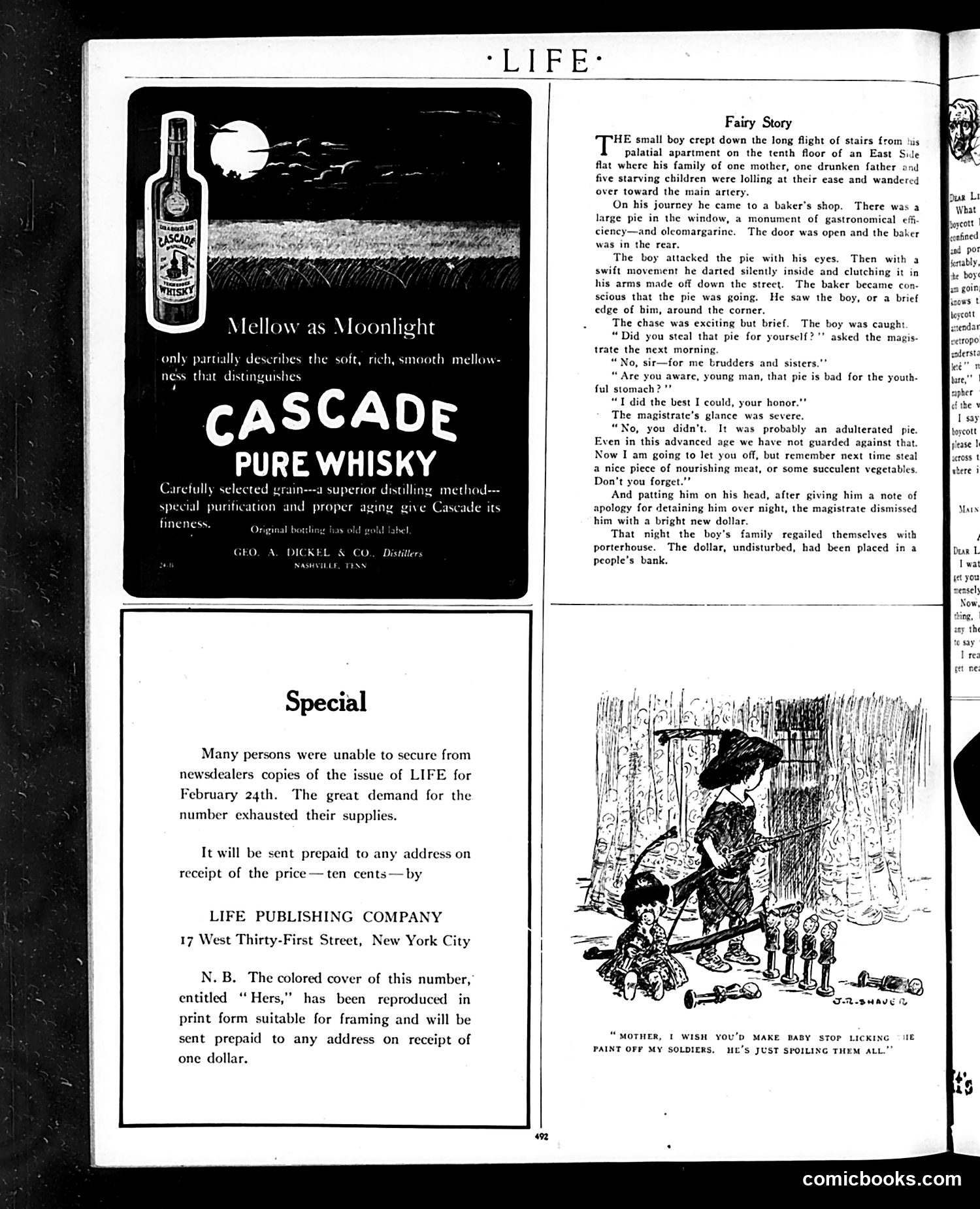
This page combines advertising with satirical fiction. The **Cascade Whisky ad** uses romanticized imagery of moonlit countryside to market liquor—typical early-20th-century advertising. The main content is a satirical fairy tale mocking naive judicial sentimentality toward poverty. A starving boy steals a pie to feed his family; when caught, the magistrate absurdly lectures him about *adulterated* pie being unhealthy, then releases him with a dollar and a note "apologizing" for detaining him overnight. The satire targets: - **Patronizing, out-of-touch authority**: The magistrate misses the point entirely—the boy needs food, not dietary advice - **Institutional hypocrisy**: The court "apologizes" while ignoring actual deprivation - **Class blindness**: The magistrate suggests stealing meat instead, as if theft-selection matters to the hungry The title "Fairy Story" signals this is mockery of unrealistic, feel-good narratives about poverty and justice. The illustration shows the boy and officer among tenement poor, grounding the satire in real urban poverty of the era.
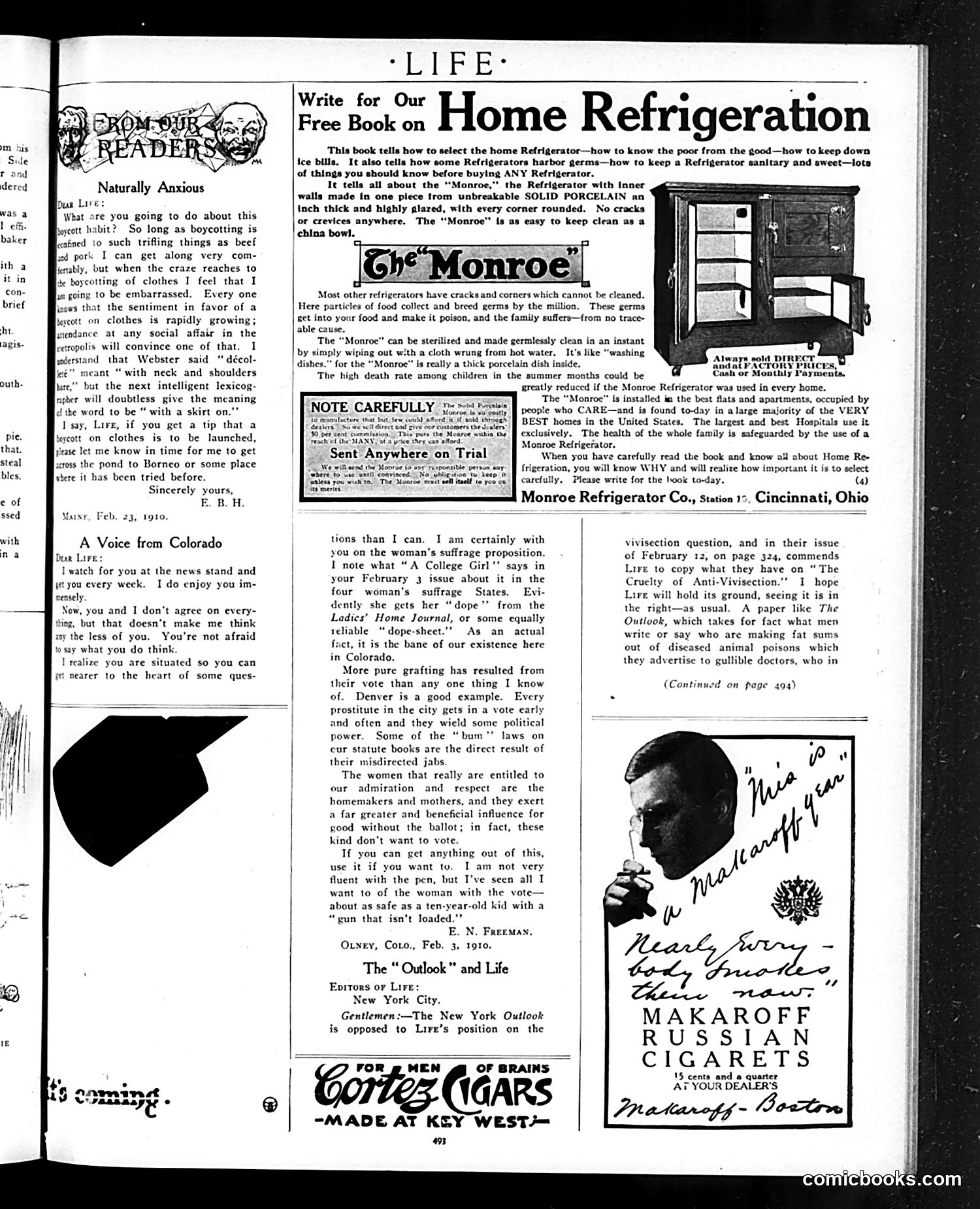
This page combines editorial correspondence with advertising. The left side features reader letters debating social issues of the era: **"Naturally Anxious"** discusses a boycott of beef and pork, then expands to criticize proposed boycotts of clothes—the writer fears clothing boycotts will create social embarrassment, particularly regarding women appearing without "neck and shoulders" (suggesting concerns about immodest dress). **"A Voice from Colorado"** supports women's suffrage, praising *Life* for advocating it while disagreeing on other matters. The writer argues women's rights movements deserve "admiration and respect." **"The 'Outlook' and Life"** references a competing magazine's position on women's suffrage. The dominant advertisement promotes the **Monroe Refrigerator**, emphasizing its one-piece porcelain interior (no cracks for bacteria), cleanliness, and use in "BEST homes" and hospitals—linking domestic hygiene to modern technology and class status.
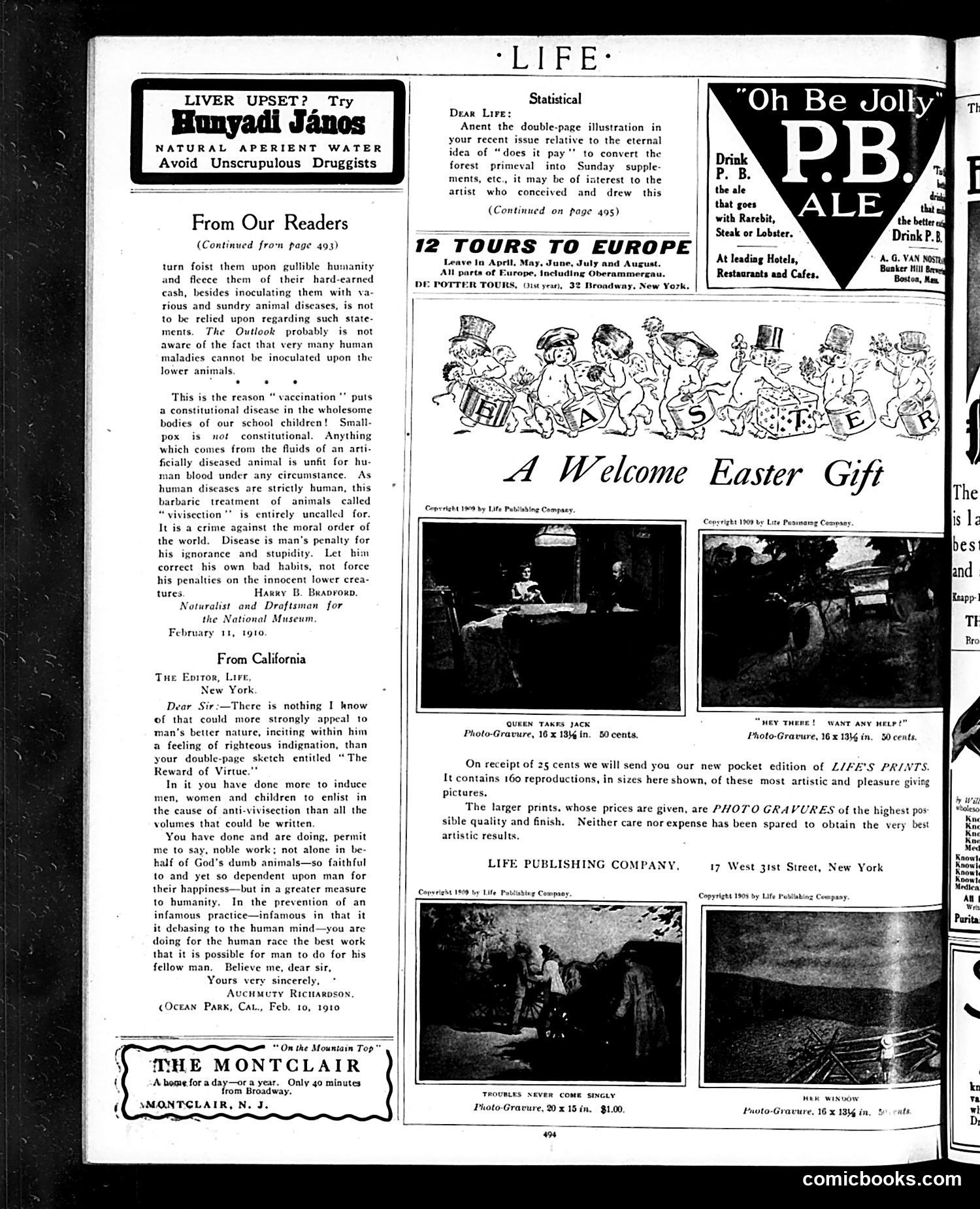
This page combines reader letters and advertisements typical of Life magazine's format. The letters debate contemporary social issues: **Main Content:** Two readers defend **anti-vivisection** (animal experimentation), arguing it's both cruel and scientifically unsound. One writer contends that vaccinating children with diseased animal matter is dangerous and immoral. The other praises Life's editorial cartoon "The Reward of Virtue" for championing animal protection as a moral issue affecting human dignity. **Historical Context:** Early 20th-century anti-vivisection was a significant reform movement among educated Americans concerned with animal cruelty and medical ethics. These letters reflect genuine contemporary debate about vaccination safety and animal testing—concerns that, while scientifically misguided by modern standards, represented serious moral positions at the time. **Advertisements:** The page also features travel tours, hotel promotions, ale, and photo-gravure prints—standard commercial content showing Life's dual nature as satirical commentary and consumer magazine. The overall tone suggests Life engaged substantive reader debate alongside entertainment and advertising.
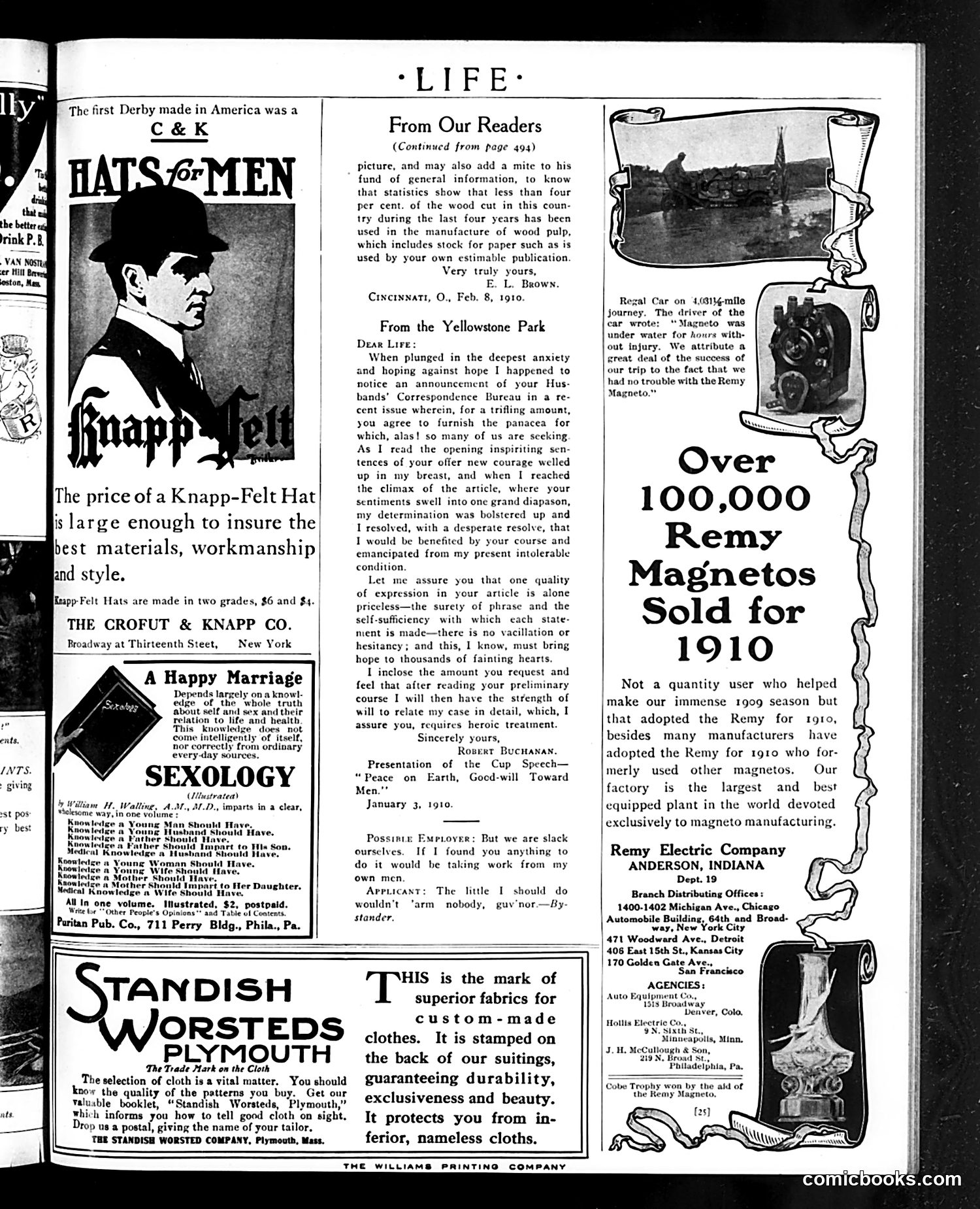
This page is primarily **advertising and reader correspondence**, not political satire. The "From Our Readers" section contains three letters: one about wood pulp statistics, one from a man responding to a "Husbands' Correspondence Bureau" advertisement (apparently a marital advice service), and a brief dialogue about employment. The advertisements include: - **Knapp-Felt Hats** (with a man's profile in formal wear) - **Sexology** book (addressing marriage/sexual education) - **Standish Worsted** fabric - **Remy Magnetos** (automobile ignition systems, claiming 100,000 sold in 1910) There is **no political cartoon visible** on this page. The content reflects early-1900s consumer culture and social concerns—marital advice, clothing quality, and emerging automotive technology. The tone is earnest advertising rather than satirical commentary.
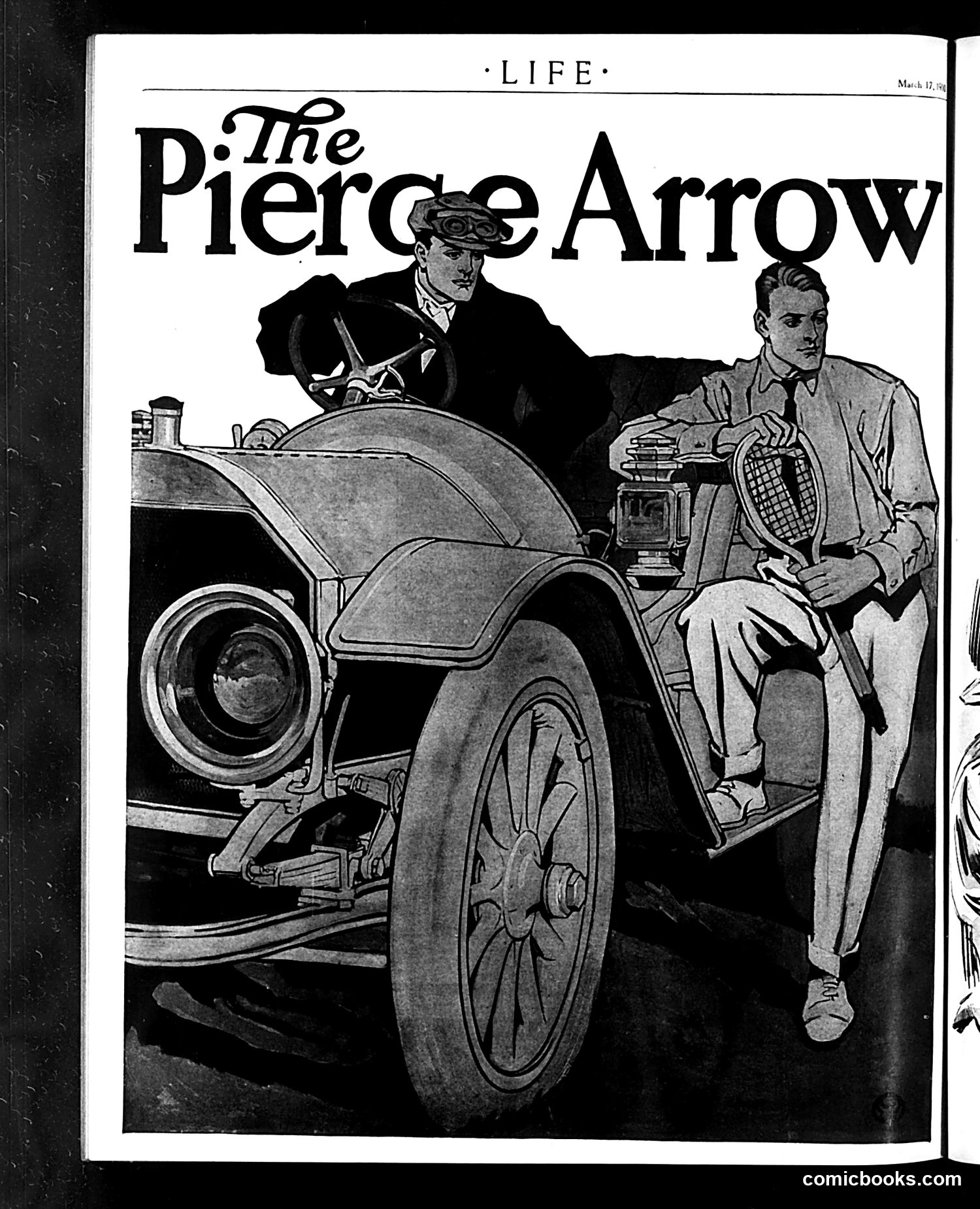
This is a **car advertisement**, not political satire. "The Pierce Arrow" was a luxury automobile brand popular in the early 20th century. The image shows two well-dressed men with a Pierce Arrow vehicle—one man in a coat and hat leaning toward the car's engine, another in lighter clothing holding what appears to be sporting equipment (possibly a tennis racket). The advertisement appeals to affluent, active men by associating the Pierce Arrow with leisure, sophistication, and mechanical reliability. The styling and composition suggest this appeared in *Life* magazine's early era when such publications featured both satirical content and upscale advertising targeting educated, wealthy readers.