
Life, 1910-03-17 · page 8 of 36
Life — March 17, 1910 — page 8: what you’re looking at
What you’re looking at
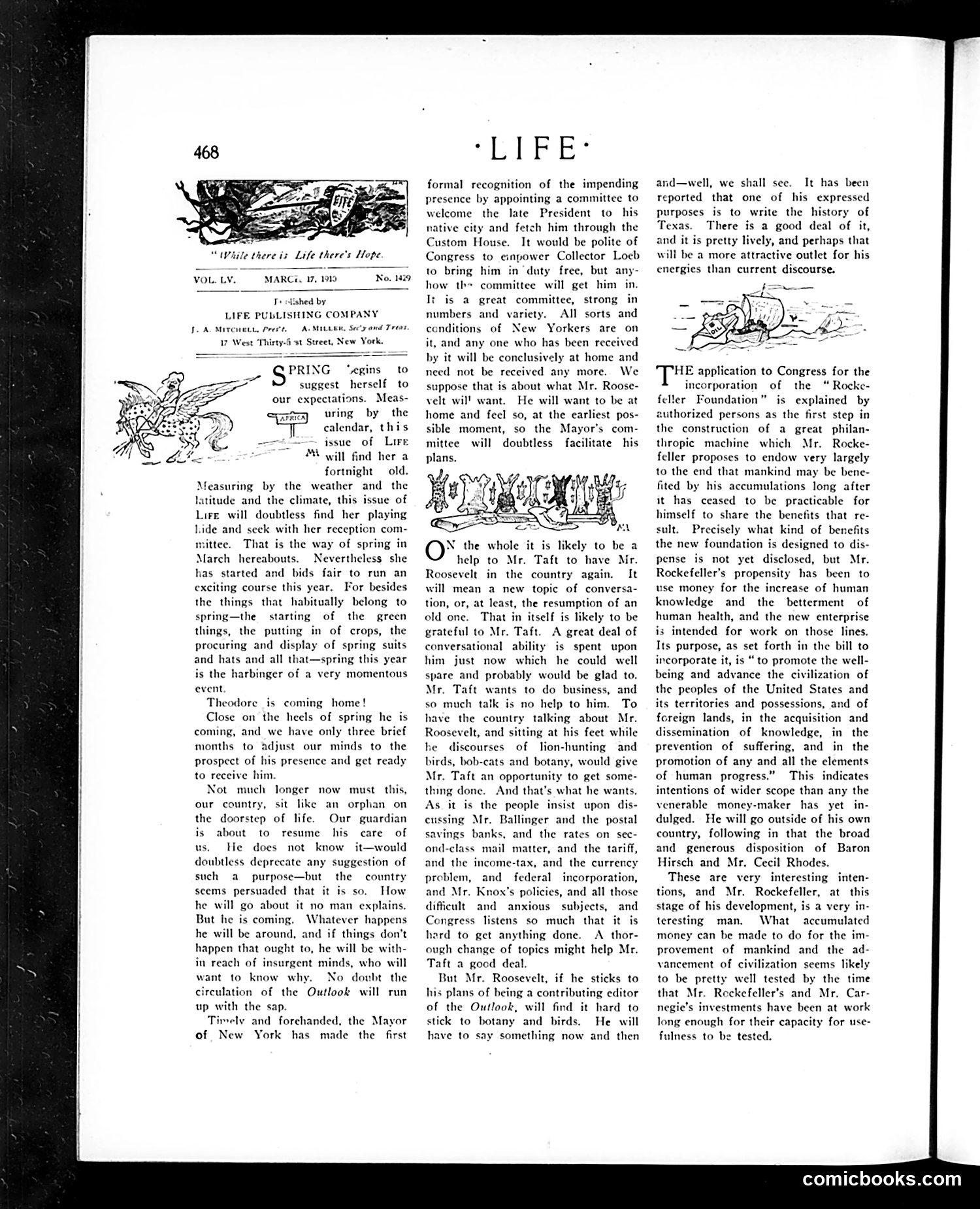
This page contains editorial commentary about President Theodore Roosevelt's impending return to America. The text discusses Roosevelt's anticipated reception, mentioning plans for a committee to welcome him through New York's Custom House. The commentary is satirical about the political excitement surrounding Roosevelt's homecoming and the various interests hoping to engage him—including discussion of business matters, postal reform, tariffs, and federal incorporation issues. The writer expresses skepticism about whether Roosevelt will have time for substantive contributions or merely provide conversation about hunting and nature. The accompanying illustrations appear to be decorative rather than direct political cartoons, featuring whimsical spring-themed imagery. The satire targets both Roosevelt's celebrity status and the public's unrealistic expectations for his involvement in governance.
📄 Transcribed text from this page (OCR, searchable)
Machine-transcribed from the original scan — historical spelling and the odd misread are preserved.
VOL. LY MARCI. 17, 1919 T+ slished by LIFE PUBLISHING COMPANY J. A. Mircueet, Pr ACMILLEN, Sec'y and Treas 17 West Thirty: at Street, New York. PRING ‘gins to suggest herself to our expectations. Meas- =) uring by the calendar, this : issue of Lire AN will find her a fortnight old. Measuring by the weather and the latitude and the climate, this issue of Lire will doubtless find her playing lide and seck with her reception com- m3 . That is the way of spring in March hereabouts. Nevertheless she has started and bids fair to run an exciting course this year. For besides the things that habitually belong to spring—the starting of the green things, the putting in of crops, the procuring and display of spring suits and hats and all that—spring this year is the harbinger of a very momentous event Theodore is coming home! Close on the heels of spring he is coming, and we have only three brief months to adjust our minds to the prospect of his presence and get ready to receive him. Not much longer now must this, our country, sit like an orphan on the doorstep of life. Our guardian is about to resume his care of us. He not know it—would doubtless depreeate any suggestion of stich a purpose—but the country seems persuaded that it is so. How he will go about it no man explains. But he is coming. Whatever happens he will be around, and if things don’t happen that ought to, he will be with- in reach of insurgent minds, who will want to know why. No doubt the circulation of the Outlook will run up with the sap. Timely and forehanded, the Mayor of New York has made the first does ‘LIF RB formal recognition of the impending presence by appointing a committee to welcome the late President to his native city and fetch him through the Custom House. It would be polite of Congress to einpower Collector Loeb to bring him in ‘duty free, but any- how the committee will get him in, t is a great committee, strong in numbers and variety. All sorts and conditions of New Yorkers are on it, and any one who has been received by it will be conclusively at home and need not be received any more. We suppose that is about what Mr. Roose: velt wil! want. He will want to be at home and feel so, at the earliest pos- sible moment, so the Mayor's com- mittee will doubtless facilitate his N the whole it is likely to be a help to Mr. Taft to have Mr. Roosevelt in the country again. It will mean a new topic of conversa- tion, or, at least, the resumption of an old one. That in itself is likely to be grateful to Mr. Taft. A great deal of conversational ability is spent upon him just now which he could well spare and probably would be glad to. Mr. Taft wants to do business, and so much talk is no help to him. To have the country talking about Mr. Roosevelt, and sitting at his feet while he discourses of lion-hunting and birds, bob-cats and botany, would give Mr. Taft an opportunity to get some- thing done. And that's what he wants. As it is the people insist upon dis- cussing Mr. Ballinger and the postal savings banks, and the rates on see- ond-class mail matter, and the tariff, and the income-tax, and the curren problem, and federal incorporation, and Mr. Knox's policies, and all those difficult’ and anxious subjects, and Congress listens so much that it is hard to get anything done. A thor- ough change of topics might help Mr. Taft a good deal. But Mr. Roosevelt, if he sticks to his plans of being a contributing editor of the Outlook, will find it hard to stick to botany and birds. He will have to say something now and then and—well, we shall see. It has been reported that one of his expressed purposes is to write the history of Te: There is a good deal of it, and it is pretty lively, and perhaps that will be a more attractive outlet for his energies than current discourse. ——— THE application to Congress for the incorporation of the “ Rocke- feller Foundation” is explained by authorized persons as the first step in the construction of a great philan- thropic machine which Mr. Rocke- feller proposes to endow very largely to the end that mankind may be bene- fited by his accumulations long after it has ceased to be practicable for himself to share the benefits that re- sult. Precisely what kind of benefits the new foundation is designed to dis- pense is not yet disclosed, but Mr. Rockefeller’s propensity has been to use money for the increase of human knowledge and the betterment of human health, and the new enterprise is intended for work on those lines, Its purpose, as set forth in the bill to incorporate it, is “ to promote the well- being and advance the civilization of the peoples of the United States and its territories and possessions, and of foreign lands, in the acquisition and dissemination of knowledge, in the prevention of suffering, and in the promotion of any and all the elements of human progress.” This indicates intentions of wider scope than any the venerable money-maker has yet in- dulged. He will go outside of his own country, following in that the broad and generous disposition of Baron Hirsch and Mr. Cecil Rhodes. These are very interesting inten- tions, and Mr. Rockefeller, at this stage of his development, is a very in- teresting man. What accumulated money can be made to do for the im- provement of mankind and the ad- vancement of civilization seems likely to be pretty well tested by the time that Mr. Reckefeller’s and Mr. Car- negie’s investments have been at work long enough for their capacity for use- fulness to be tested. comicbooks.com