
Life, 1910-03-17 · page 16 of 36
Life — March 17, 1910 — page 16: what you’re looking at
What you’re looking at
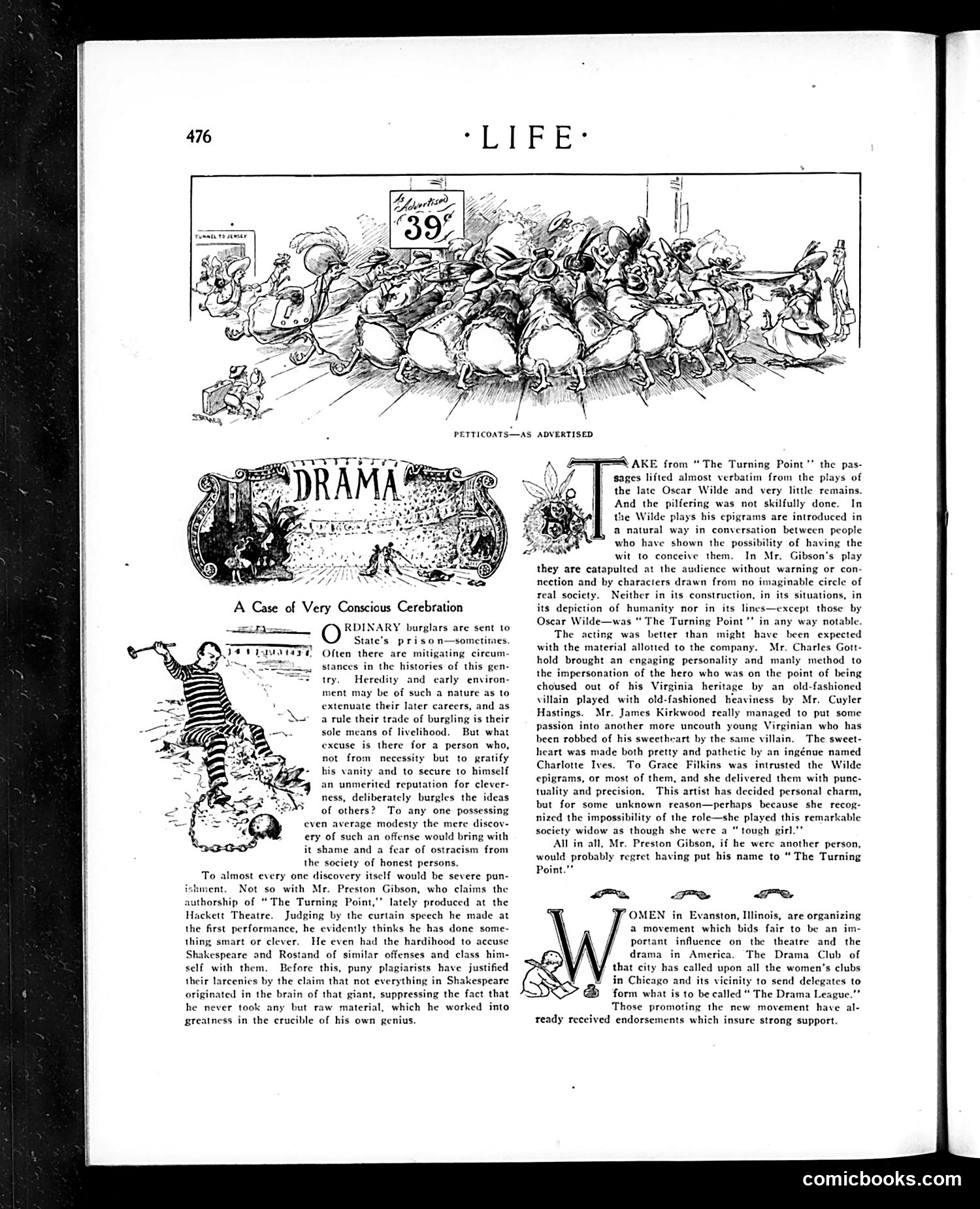
This page contains two drama-related pieces: **Top Cartoon**: "Petticoats—As Advertised" depicts a chaotic scene of numerous figures in petticoats (women's undergarments) being paraded or displayed, with a price tag of 39¢ visible. This appears to be satirizing theatrical productions that rely on spectacle and female clothing/bodies rather than substantive content. **Main Article**: A scathing theater review attacking playwright Preston Gibson for plagiarizing Oscar Wilde's work in his play "The Turning Point" (produced at the Hackett Theatre). The critic argues Gibson shamelessly stole Wilde's epigrams and dialogue, then absurdly compared himself to Shakespeare and Rostand. The review condemns Gibson for lacking the creative genius to transform "raw material" into something original, unlike Shakespeare. Cast members received praise, but the play itself is deemed worthless without Wilde's borrowed lines. **Bottom Item**: News about women in Evanston, Illinois organizing "The Drama League"—a movement to promote theatrical influence and drama in America, gathering endorsements from women's clubs.
📄 Transcribed text from this page (OCR, searchable)
Machine-transcribed from the original scan — historical spelling and the odd misread are preserved.
PETTICOATS— ARY burglars are sent to ate’s prison—sometines. Often there are mitigating circum- stances in the histories of this gen- try. Heredity and carly environ- ment may be of such a nature as to extenuate their later careers, and as a rule their trade of burgling is their sole means of livelihood. But what excuse is there for a person who, not from necessity but to gratify his vanity and to secure to himself an unmerited reputation for clever- ness, deliberately burgles the ideas of others? To any one possessing even average modesty the mere discov- ery of such an offense would bring with it shame and a fear of ostracism from the society of honest persons. To almost every one discovery itself would be severe pun- ishment. Not so with Mr. Preston Gibson, who claims the uthorship of “The Turning Point,"’ lately produced at the Hackett Theatre. Judging by the curtain spcech he made at the first performance, he evidently thinks he has done some- thing smart or clever. He even had the hardihood to accuse Shakespeare and Rostand of similar offenses and class self with them. Before this, puny plagiarists have justified their larcenies by the claim that not everything in Shakespeare nated in the brain of that giant, suppressing the fact that he never took any but raw material, which he worked into greatness in the crucible of his own genius. * the pas- sages lifted almost verbatim from the plays of the late Oscar Wilde and very little remains. And the pilfering was not skilfully done. In the Wilde plays his epigrams are introduced in a natural way in conversation between people who have shown the possibility of having the wit to conceive them. In Mr. Gibson’s play they are catapulted at the audience without warning or con- nection and by characters drawn from no imaginable circle of real society. Neither in its construction, in its situations, in its depiction of humanity nor in its lines—except those by Oscar Wilde—was “ The Turning Point? in any way notable. The acting was better than might have been expected with the material allotted to the company. Mr. Charles Gott- hold brought an engaging personality and manly method to the impersonation of the hero who was on the point of being choused out of his Virginia heritage by an old-fashioned villain played with old-fashioned heaviness by Mr. Cuyler Hastings. Mr. James Kirkwood really managed to put some passion into another more uncouth young Virginian who has been robbed of his sweetheart by the same villain. The sweet- heart was made both pretty and pathetic by an ingénue named Charlotte Ives. To Grace Filkins was intrusted the Wilde epigrams, or most of them, and she delivered them with punc- tuality and precision. This artist has decided personal charm, but for some unknown reason—perhaps because she recog- nized the impossibility of the role—she played this remarkable society widow as though she were a “tough girl.’” All in all, Mr. Preston Gibson, if he were another person, would probably regret having put his name to “The Turning Point.” Pe OMEN in Evanston, Ilino are organizing a movement which bids fair to be an im- portant influence on the theatre and the drama in America. The Drama Club of that city has called upon all the women’s clubs in Chicago and its vicinity to send delegates to form what is to be called “ The Drama League. Those promoting the new movement have al- ready received endorsements which insure strong support. comicbooks.com