
Life, 1910-03-17 · page 17 of 36
Life — March 17, 1910 — page 17: what you’re looking at
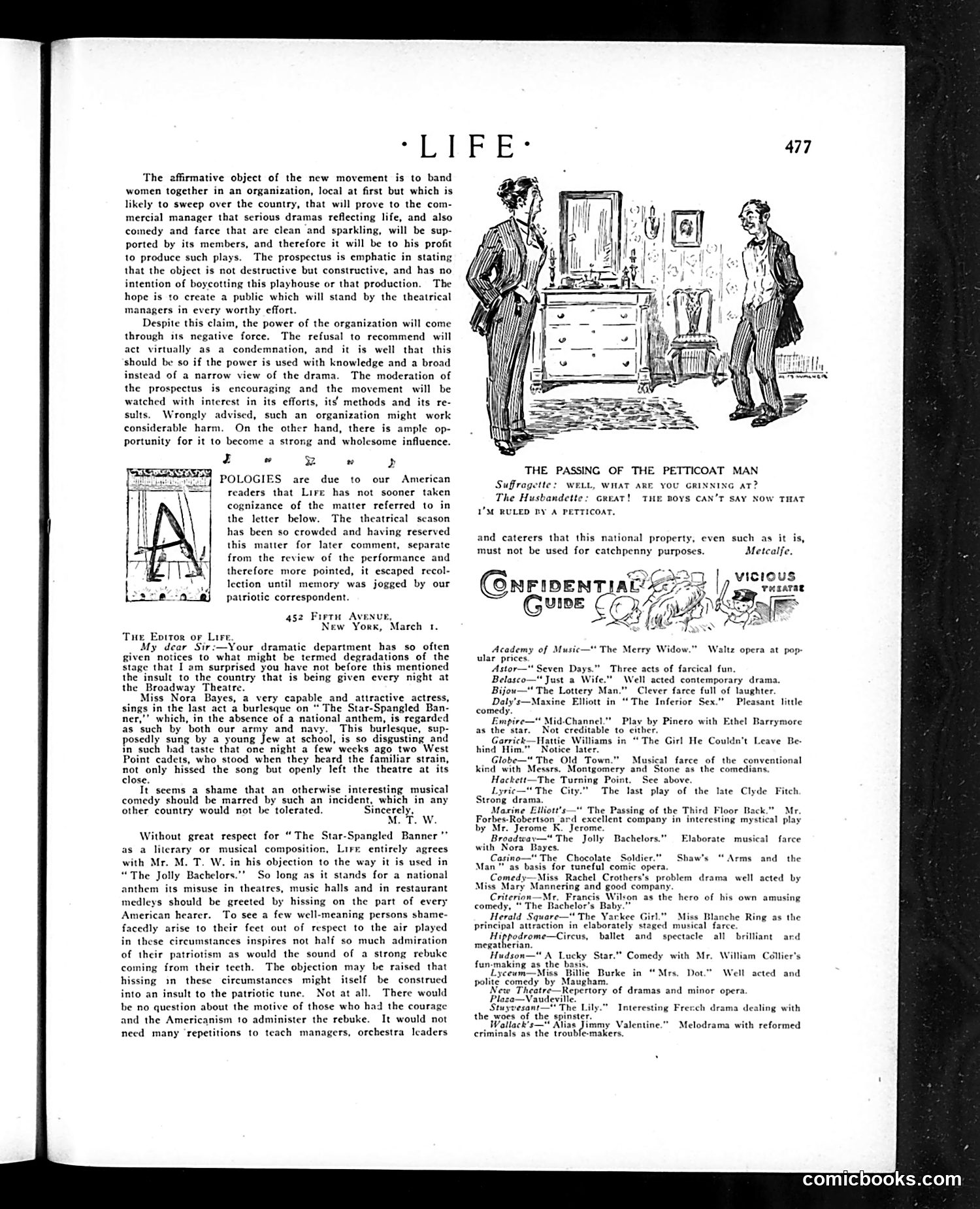
What you’re looking at
This cartoon depicts a domestic scene where a woman stands assertively near a dresser while a man looks on awkwardly. The caption reads: "Well, what are you grinning at?" / "Great! The boys can't say now that I'm ruled by a petticoat." **The satire:** This jokes about changing gender dynamics and women's growing independence in the early 20th century. The phrase "ruled by a petticoat" was a period insult suggesting a man was dominated by women. The cartoon suggests that as women gain autonomy and assertiveness (she appears to be claiming household authority), men can no longer use this taunt—though the man's grin implies some ambivalence about this shift. The surrounding editorial content discusses a women's organization promoting serious theater, reinforcing the page's theme of female empowerment and influence in public life, making the cartoon's commentary on changing domestic power structures timely and relevant to contemporary readers.
📄 Transcribed text from this page (OCR, searchable)
Machine-transcribed from the original scan — historical spelling and the odd misread are preserved.
“LIFE: The affirmative object of the new movement is to band women together in an organization, local at first but which is likely to sweep over the country, that will prove to the com- mercial manager that serious dramas reflecting life, and also comedy and farce that are clean and sparkling, will be sup- ported by its members, and therefore it will be to his profit to produce such plays. The prospectus is emphatic in stating that the object is not destructive but constructive, and has no intention of boycotting this playhouse or that production. The hope is to create a public which will stand by the theatrical managers in every worthy effort. Despite this claim, the power of the organization will come through its negative force. The refusal to recommend will act virtually as a condemnation, and it is well that this should be so if the power is used with knowledge and a broad instead of a narrow view of the drama. The moderation of the prospectus is encouraging and the movement will be watched with interest in its efforts, its methods and its re- Wrongly advised, such an organization might work considerable harm. On the other hand, there is ample op- portunity for it to become a strong and wholesome influence. BZ ow » are due to our American readers that Lire has not sooner taken cognizance of the matter referred to in the letter below. The theatrical season has been so crowded and having reserved this matter for later comment, separate from the review of the performance and therefore more pointed, it escaped recol- lection until memory was jogged by our patriotic correspondent. 452 Fiera Ave ew Yor ur, March 1. Tue Epttor or Li My dear Sir:—Your dramatic department has so often given notices to what might be termed degradations of the stage that I am surprised you have not before this mentioned the insult to the country that is being given every night at the Broadway Theatre. Miss Nora Bayes, a very capable and attractive actress, sings in the last act a burlesque on “ The Star-Spangled Ban- ner,’ which, in the absence of a national_anthem, is regarded as such by ‘both our army and navy, This burlesque, sup- posedly sung by a young Jew at school, is so disgusting and in such had taste that one night a few’ weeks ago two West Point cadets, who stood when they heard the familiar strain, not only hissed the song but openly left the theatre at its close. It scems a shame that an otherwise interesting musical comedy should be marred by such an incident, which in any other country would not be tolerated. Sincerely. MT. W. Without great respect for “The Star-Spangled Banner" as a literary or musical composition, Lire entirely agrees with Mr. M. T. W. in his objection to the way it is used in “The Jolly Bachelors.”” So long as it stands for a national anthem its misuse in theatres, music halls and in restaurant medleys should be greeted by hissing on the part of every American hearer. To see a few well-meaning persons shame- facedly arise to their feet out of respect to the air played in these circumstances inspires not half so much admiration of their patriotism as would the sound of a strong rebuke coming from their teeth. The objection may be raised that hissing in these circumstances might itself be construed into an insult to the patriotic tune. Not at all. There would be no question about the motive of those who had the courage and the Americanism to administer the rebuke. It would not need many ‘repetitions to tcach managers, orchestra leaders THE PASSING OF THE PETTICOAT MAN Suffragette: WeLt., WHAT ARE YOU GRINNING AT? The Husbandette: Great! THE BOYS CAN’T SAY NOW THAT i'M RULED BY A PETTICOAT. and caterers that this national property, even such as it is, must not be used for catchpenny purposes. Metcalfe. CONFIDENT Ane bight | Gute Sh be WX Academy of Music—" The Merry Widow. ular prices Astor—“ Seven Days.” Three acts of farcical fun. Belasco—* Just a Wife." Well acted contemporary drama, Bijou—" The Lottery Man.” Clever farce full of laughter. Daly's—Maxine Elliott in “The Inferior Sex." Pleasant little comedy. mpire—" Mid-Channel.""_ Play by Pinero with Ethel Barrymore as the star. Not creditable to either. Garrick—Hattie Williams in “The Girl He Couldn't Leave Be- hind Him.” Notice later. Globe—" The Old Town.” Waltz opera at pop- Musical farce of the conventional kind with Messrs. Montgomery and Stone as the comedians, Hackett—The Turning Point. See above, .. Lyric—" The City.” The last play of the late Clyde Fitch Strong drama, Marine Elliott's—" The Passing of the Third Floor Back.” Mr Forbes-Robertson_ard excellent company in interesting mystical play by Mr. Jerome K. Jerome. Broadwav—" The Jolly h Nora Bayes. Casino—" The Chocolate Soldier. Man” as basis for tuneful comic opera. _Comedy—Miss Rachel Crothers’s problem drama well acted by Miss Mary Mannering and good company. Criterion—Mr, Francis Wilson as the hero of his own amusing “The Bachelor's Baby.” _ Herald Square—" The Yarkee Girl.” Miss Blanche Ring as the principal attraction in elaborately staged musical farce Hippodrome—Circus, ballet and spectacle all brilliant megatherian. Hudson—" A Lucky Star." Comedy with Mr, William Collier's fun-making as the basis. Lyceum—Miss Billie Burke in Mrs. polite comedy by Maugham. . New Theatre—Repertory of dramas and minor opera Plaza—Vaudeville. Stuyvesant—" The Lily.” the woes of the spinster. : Weltack's—* Aliag Jimmy Valentine.” criminals as the troubfe-makers, Bachelors.” Elaborate musical farce Shaw's “Arms and the ard Dot.” Well acted and Interesting Fresch drama dealing with Melodrama with reformed comicbooks.com